This year, the delegates of the International Bridge Group assembled in Prague for their annual symposium. Held over three days, the delegates enjoyed tours of medieval monuments, a day of papers at Vila Lanna, and a day trip to study medieval bridges outside of Prague. The event was a spectacular introduction to medieval Bohemia and – via the none-too-shy monumental decoration of the Charles Bridge in Prague – provided a fascinating insight into the socio-economic ramifications of the campaign of stone bridge construction in the Middle Ages.
Day 1: The Charles Bridge and medieval Prague
A visit to St Vitus Cathedral was one major highlight of this aesthetically munificent event. Dr  Klàra Benešovská (Institute of Art History, Czech Academy of Sciences) and Petr Chotěbor (master mason of the cathedral) opened the doors for us an hour before the official opening. Points of particular interest to the IBG included the work of Peter Parler, who took over as master mason from 1356 and who also designed parts of the Charles Bridge. Likewise, St Wenceslas’ chapel, with its lavish decorations, stood out as a relative of Karlštejn Castle’s interior, impressing upon us the ties between court and church in fourteenth-century Prague.
Being in Prague enabled the group to take full advantage of the expertise of IBG’s co-founder, Dr Jana Gajdošová, whose forthcoming book focuses on Prague’s medieval bridges. As visitors populated the cathedral, we made our way to the so-called Judith bridge tower. The 12th century bridge, which was built by King Vladislav I, was destroyed in the St Mary Magdalene flood in 1342; however, fragments of its towers survive, built into the fabric of the later structure. We were granted access to one of the towers which once fortified the west end of the Judith Bridge and where a relief carving of two figures, that once decorated the exterior wall of the tower, survives.
From here we made our way to the House at the Stone Bell, which was probably the private residence of John of Luxembourg and Elizabeth of Přemyslid, and which has a gothic façade bearing formal resemblance to that of the bridge tower.
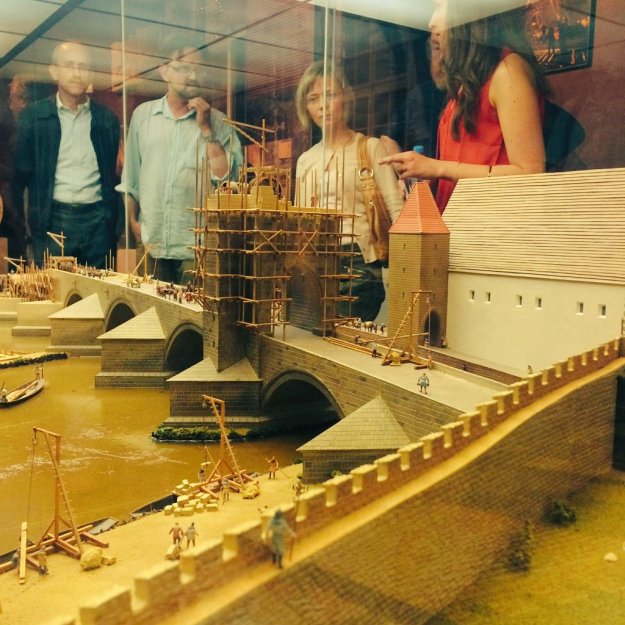 The Charles Bridge and its Gothic tower was our last point of call. The tower, built facing the Old Town, greets users of the bridge. Designed by Peter Parler, the decorative scheme includes an elaborate east-facing façade which is decorated with heraldic emblems representing ten lands of the crown of Bohemia and figural statues. Within its central blind arch are statues of Emperor Charles IV, and his son, King Wenceslas IV, either side of the standing figure of St Vitus, one of the patron saints of Bohemia. Gajdošová emphasised the way in which the original sculptures, now in the Lapidárium, would have overlooked the viewer as they passed under the tower.
The bridge was a portal connecting the general populus of the Old Town and the sacred royal centre, as much in the imagination as in practice. Charles IV’s patronage is a testament to the political importance of bridges; far beyond the domestic concerns of the civic sphere, this vast structure, adorned with his likeness, facilitated crucial trade, communication and travel between eastern and western Europe.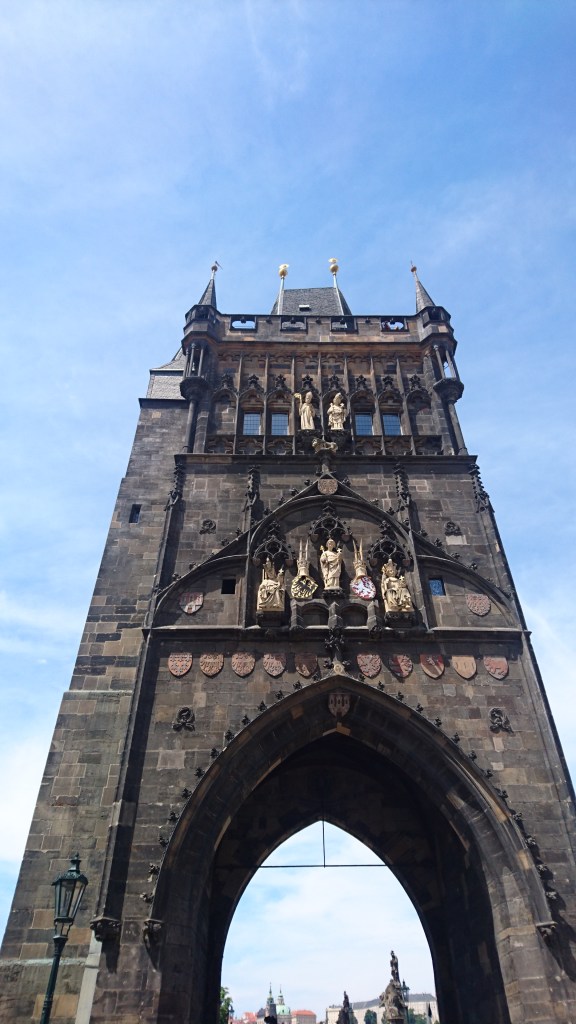
The first day ended with a keynote from Prof Christopher Wilson, Emeritus of UCL. It explored the prolific career of the late thirteenth-century architect Henry Yevele and his construction of a chapel of St Thomas Becket on London Bridge. The two-storey apsidal chapel was built according to Yevele’s design between 1384 and 1397. Probably recalling the chapel to Our Lady Undercroft beneath the shrine of St Thomas at Canterbury cathedral, the lower and upper storeys of the chapel were dedicated respectively to the same pair. Eighteenth-century etchings suggest its appearance accorded with the reserved perpendicular style favoured by Yevele in his design for the nave of Canterbury cathedral. The paper drew from medieval and antiquarian sources to build up a picture of the lost edifice.
Day 2: The Papers
On the second day the delegates heard ten papers, divided across three sessions, outlined below.
Session 1: Lost, Destroyed and Re-used Bridges
David Harrison, a co-founder of the IBG, discussed the apparently systematic demolition of medieval bridges during the Georgian period, suggesting the motivations behind the destruction often had as much to do with fashion as engineering. He was followed by Klàra Benešovská, who considered the extensive patronage undertaken by Jan of Dražice, the last Bishop of Prague. The focus was his patronage of the bridge in Roudnice nad Labem and its connections to Avignon, where Master William came from to teach the local builders the bridge building techniques of southern France. The paper was a useful complement to the conference’s emphasis on the legacy of Emperor Charles IV but also to the following paper. For this, Michal Panáček shared his exhaustive research into the building technologies of the medieval bridge in Roudnice nad Labem and the Charles Bridge in Prague. The paper emphasised how much more technologically advanced the bridge in Roudnice was – probably since it had a direct connection with the sophisticated French bridge builders.
Finally, Alexandra Gajewski addressed the medieval afterlife of the magnificent Roman aqueduct, the Pont du Gard, sharing shocking accounts of how the piers of the second storey of arcading were recessed to enable wagons to cross a bridge never designed for human passage. She explored various reasons – aesthetic, practical, economic – that compelled medieval travelgaers to use this treacherous bridge.
Session 2: Bridges in Art, Sources and Myths
The second session opened with a paper by Gerrit Deutschländer who discussed medieval gates, their relation to bridges and their ability to glorify rulers. Then, Sarah Harrison gave an art historical overview of depictions of bridges as narrative cues, geographical aides or simply as aesthetic motifs. Susan Irvine closed the session with an exploration of the motif of the bridge in late medieval Middle English romance narratives. In her chosen case study, Gawain and the Green Knight, the bridge serves as means of testing the mettle of the chivalric hero and exploring prevailing questions of personal or universal morality.
Session 3: Digital Technologies and Bridges
Engineer Bill Harvey presented to us the usefulness of 3D-imaging medieval stone bridges as means of assessing their structural integrity and, often, saving them from demolition. Although Simone Balossino was unable to attend the event, he had sent us a video which captured the methods used by the Avignon team to digitally reconstruct the medieval Pont Saint-Benezet. Next, the author of this review presented the Digital Pilgrim Project, which is making 3D-images of a selection of the British Museum’s medieval badge collection and uploading them to the museum’s account with the 3D-imaging platform, Sketchfab. Lastly, Jana Gajdošová and David Harrison presented The Bridge Project to the group, funded by the GEO Sea and Currents Fund, which aims to bring awareness to medieval bridges, to plot them on a map and to thus digitally preserve them.
Day 3: Pìsek and Zvikov Castle
Our last day in the old territories of Charles IV took us to the town of Písek. Here we visited its 13th century bridge, the oldest in Bohemia, which survives close to its original form despite a number of floods and thanks to conservation work. The bridge was fortified by two gate towers, neither of which survives; however, the IBG was able to get an impression of these gates by studying the monumental wall painting in the castle of Písek. Viewing the town’s museum and churches was an opportunity to appreciate the reach of the gothic aesthetic in Bohemia during the Middle Ages. This was intensified by a sun-baked walk to the castle of Zvikov, positioned at the confluence of the Vltava and Otava. There, we encountered a moat bridge, an early example of the use of triradials, traceried arcades, and the cool interior of a fourteenth-century chapel with vibrantly restored wall-paintings.
To sum up, the IBG Conference 2016 achieved a balance of action and reflection. Prague, as an extreme case study in terms of the Charles Bridge’s potency as a political tool, proved both fascinating in isolation and a lens through which to consider the multifaceted functions of bridges across medieval Europe. Thanks is owed to Jana Gajdošová and David Harrison for organising this fascinating conference.
— Amy Jeffs

 Call for Papers: Special thematic strand: ‘Otherness,’ International Medieval Congress, University of Leeds, 3–6 July 2017



 Call for papers: Authority beyond the Law: Traditional and Charismatic Authority in Antiquity and the Middle Ages, Ioannou Centre, Oxford, 3 December 2016.
 Medieval Art Research