CFP: St Andrews Institute of Medieval Studies Graduate Conference, deadline 31 March 2019

St Andrews Institute of Medieval Studies Graduate Conference

6 – 8 June, 2019

Deadline: 31 March, 2019

We are announcing a call for papers for the second St Andrews Institute of Medieval Studies (SAIMS) Graduate Conference. This three-day conference is aimed at graduate students and early career researchers in any area of Medieval Studies. The second day of the conference will be devoted to the theme Politics and Political Thought and we would particularly welcome abstracts related to this topic from scholars working in any of the fields mentioned below. We aim to encompass a range of historical perspectives, from art to archeology, law to literature.

The keynote addresses will be delivered by Professor Carole Hillenbrand (Edinburg & St Andrews) and Dr Charles West (Sheffield).

Proposals relating to the following fields of research are especially welcome:

  • Eastern Mediterranean studies
  • Art and architecture
  • The church and religious life
  • Crusading
  • Late Antiquity
  • Latin poetry
  • Law
  • Middle Eastern studies
  • Philosophy
  • Rulership and lordship
  • Scottish history
  • Texts and manuscripts

It is anticipated that there shall be no registration free and that some travel bursaries will be available. Papers should be a maximum of 20 minutes in length.

Please email 250-word abstracts to saimsgraduateconference@gmail.com by 31st March 2019.

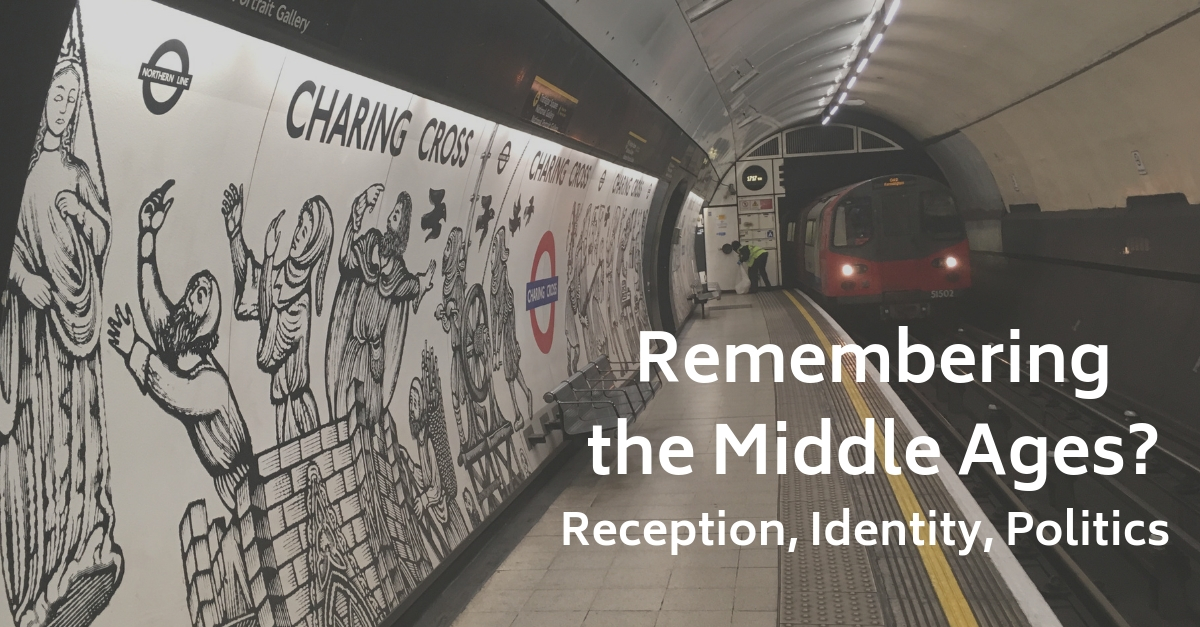
CONF: Remembering the Middle Ages? Reception, Identity, Politics

Conference & Poetry Reading: Remembering the Middle Ages?

April 5-6, 2019

2 Locations:

Bush House, Aldwych, King’s College London
The London Global Gateway, 1-4 Suffolk Street, University of Notre Dame

A partnership between the University of Notre Dame (London Global Gateway) and King’s College London, ‘Remembering the Middle Ages? Reception, Identity, Politics’ asks speakers and attendees to consider how the concept of a ‘cultural memory’ of the Middle Ages can be useful (or not) in understanding how and why scholars, artists, readers, and others have resourced or imagined the Middle Ages, in any post-medieval period. We ask participants to interrogate the linguistic, material, and social networks that have been created by medieval things over time. Haruko Momma (University of Toronto) and Sarah Salih (King’s College London) will give a keynote panel, and the event also includes a reading featuring poets Vahni Capildeo and Ian Duhig and chaired by Professor Clare Lees (Director of the Institute for English Studies). Further details are forthcoming at our website: http://sites.nd.edu/remembering-the-middle-ages.

Continue reading “CONF: Remembering the Middle Ages? Reception, Identity, Politics”

Workshop: Manipulating the Sun: Picturing Astronomical Miracles from the Bible in the Early Modern Era, Bergische Universität Wuppertal, 21-23 Aug 2019

The workshop is being organized by the research project Iconography of the Imagery on Early Modern Scientific Instruments (funded by the German Research Foundation, DFG).

One of the aspects being analysed in the project is biblical imagery that could be related to astronomy. Of particular interest is imagery that was used to argue against the Copernican system from the mid-16th century such as the miracles of the Sun reversing its course in II Kings 20:8-11/Isaiah 38:8 (Horologium Ahas) and the Sun standing still in Joshua 10:12.

Continue reading “Workshop: Manipulating the Sun: Picturing Astronomical Miracles from the Bible in the Early Modern Era, Bergische Universität Wuppertal, 21-23 Aug 2019”

CONF: SAH 2019 Annual International Conference (Providence, 24-28 Apr 19)

Society of Architectural Historians Annual International Conference, 2019

Providence, RI, April 24 – 28, 2019

Architectural and art historians, architects, preservationists and museum professionals from around the world will meet in Providence, R.I., April 24–28, 2019, for the 72nd Annual International Conference of the Society of Architectural Historians. Over 600 SAH members will convene at the Rhode Island Convention Center to share new research on the history of the built environment and address current issues in the field in paper sessions, roundtables, workshops, and panel discussions.

Continue reading “CONF: SAH 2019 Annual International Conference (Providence, 24-28 Apr 19)”

CFP: Revolution and Revolutions in Art (Ljubljana, 12-14 Sep 19)

5th International Conference for PhD Students and Recent PhD Graduates: “Revolution and Revolutions in Art”

Deadline: Apr 15, 2019

The University of Ljubljana, The Center for Iconographic Studies, The University of Belgrade, and The University of Split, introduce their 5th International Conference for PhD students and Recent PhD graduates, Revolution and Revolutions in Art. Challenging PhD students, young researchers and scholars from different fields of humanities and social sciences, the conference seeks to address a multitude of questions, dilemmas, perspectives and problems related to the idea of revolution in art. We welcome theoretical, empirical and methodological papers addressing the theme. We also encourage different aspects and approaches and especially invite submissions that address the following topics:

Continue reading “CFP: Revolution and Revolutions in Art (Ljubljana, 12-14 Sep 19)”

Workshop: ‘Inscribing Colonialism in Fifteenth-Century Portugal’, 26 March 2019, QMUL

The next meeting of the Maius Workshop will take place on 26 March, 4:30–5:30pm, in room Law G3 at QMUL (335 Mile End Rd, London E1 4FQ). Click here for a map of the Campus.

Jessica Barker, Lecturer in Medieval History at the Courtauld Institute of Art, will lead a seminar entitled Inscribing Colonialism in Fifteenth-Century Portugal. The session will consider inscriptions, readability and visibility in funerary monuments, and their intersections with early Portuguese explorations in West Africa.

Maius is a friendly platform for informal dialogue and collaborative research. Our sessions are open to all, and research in early stages of development is especially welcome. We look forward to seeing you at this event, and please feel free to email us with ideas and suggestions for future meetings.

New Publication: Cut in Alabaster: A Material of Sculpture and its European Traditions, 1330-1530, by Kim Woods

Cut in Alabaster is the first comprehensive study of alabaster sculpture in Western Europe during the late Middle Ages and Renaissance.

While marble is associated with Renaissance Italy, alabaster was the material commonly used elsewhere in Europe and has its own properties, traditions and meanings. It enjoyed particular popularity as a sculptural material during the two centuries 1330-1530, when alabaster sculpture was produced both for indigenous consumption and for export. Focussing especially on England, the Burgundian Netherlands and Spain,  three territories closely linked through trade routes, diplomacy and cultural exchange, this book explores and compares the material practice and visual culture of alabaster sculpture in late medieval Europe. Cut in Alabaster charts sculpture from quarry to contexts of use, exploring practitioners, markets and functions as well as issues of consumption, display and material meanings. It provides detailed examination of tombs, altarpieces and both elite and popular sculpture, ranging from high status bespoke commissions to small, low-cost carvings produced commercially for a more popular clientele.

Kim Woods is a senior lecturer in Art History at the Open University, and a specialist in northern European late Gothic sculpture. She combines an object-based approach with an interest in materials and cultural exchange. Her single-authored book, Imported Images (Donington, 2007), focussed on wood sculpture. Since then she has been working on alabaster. Her Open University distance learning materials include the Renaissance Art Reconsidered volumes (Yale, 2007) and Medieval to Renaissance (Tate publishing, 2012).

Conference: Innovation in Stone: Medieval Stone Sculpture from the Van Horne Collection, Sam Fogg, London, April 26th, 2019

A symposium to be held in conjunction with the exhibition ‘Innovation in Stone: Medieval Stone Sculpture from the Van Horne Collection’ at Sam Fogg (April 26th, 2019; 4:00 – 6:00 pm).

The exhibition presents stone sculpture, gathered together over several decades by the New York collectors Alexandra and Charles van Horne. Formerly occupying prominent places in other well-known collections, the works reflect van Horne’s fascination with objects that bear a resemblance to modern art of the early 20th century. There are the Romanesque ‘Picassos’, Celtic ‘Modiglianis’ and ancient ‘Henry Moores,’ and a wealth of research material that visualises the links between modernism and medieval art, which modernist artists themselves emphasised.

This emphasis is also reflected in the symposium, which examines stone sculpture from the 12th-century, a time when innovation and curiosity dominated the architectural and sculptural world. There was a tension with and an awareness of the classical past and an anticipation of change, which would be realised in the Gothic period, and it is within this dichotomy that the Van Horne collection is situated. The changes to architecture and sculpture in the 12th century allowed the art of the Middle Ages to let go of its grip on the ancient past and confidently look forward to its own distinctive style. The sculpted heads and architectural fragments, presented together publicly for the first time in the accompanying exhibition, originate in some of the most innovative and influential sites of 12th- and 13th-century Europe: Cluny, Toulouse, Paris, Parthenay. Having been separated from their context, they invite us to imagine the extraordinary sites in which they were invented, and the innovative sculptors who created them.

The lectures and discussions will be followed by a drinks reception and the opening of the exhibition in the gallery on Clifford Street.

PROGRAMME:

4:00 Introduction

4:10 Medieval Sculpture in Multiples: Illuminating Riddles for the Perplexed

(Charles Little, Metropolitan Museum of Art)

4:35 Focillon’s Jongleur or How to Define Creativity in Twelfth-Century Sculpture

(Alexandra Gajewski, Burlington Magazine)

5:00 Discussion

5:10 In-conversation with Charles van Horne

5:40 Discussion

5:50 Concluding Remarks and Introduction to the Show

6:00 Drinks Reception and Exhibition Opening in Clifford Street

Please register on EVENTBRITE. Contact jana@samfogg.com for any further questions.

Conference: Scaling the Middle Ages: Size and Scale in Medieval Art, 24th Annual Medieval Postgraduate Student Colloquium, The Courtauld Institute, 8 February 2019

The Courtauld Institute of Art 24th Annual Medieval Postgraduate Student Colloquium 

Scaling the Middle Ages: Size and scale in medieval art 

10:00–18:00 Friday 8 February 2019 (with registration from 9:30) 

Lecture Theatre 1, The Courtauld Institute of Art, Vernon Square, Penton Rise, London WC1X 9EW 

Size mattered in medieval art. Whether building a grand gothic cathedral or carving a minute boxwood prayer bead, precisely how big to make it was a principal concern for medieval artists, their patrons, and audiences. 

Examples of simple one-upmanship between the castles and palaces of lords and kings and the churches and cathedrals of abbots and bishops are numerous. How big to make it was a principal concern for both patrons and makers of medieval art. 

Scale could be manipulated to dramatic effect in the manufacture of manuscripts and the relative disposition of elements within their decorative programmes. Divine proportions – of the Temple of Solomon or the Church of the Holy Sepulchre – were evoked in the specific measurements and configuration of contemporary buildings and decisions were made based on concern with numbers and number sequences. 

Left: North elevation (detail), Sainte Chapelle, Paris (1239-1248). Right: Reliquary of Saints Maxien, Lucien, and Julien (Paris, 1261-1262) Musée nationale du Moyen Âge, Paris. 

In our age of viewing through digital surrogates, the Courtauld Institute of Art’s 24th Annual Medieval Postgraduate Student Colloquium invites its speakers to consider new approaches to issues of size and relative scale in relation to the making, meanings, and study of medieval art. 

The Medieval Postgraduate Colloquium offers the opportunity for research students at all levels from universities across the UK and abroad to present and promote their research. 

Organised by Teresa Lane (The Courtauld Institute of Art) and Oliver Mitchell (The Courtauld Institute of Art) with the generous support of Michael Carter and the Consortium for Arts and Humanities in South-East England.

Programme: Scaling the Middle Ages: Size and scale in medieval art 

9:30-10:00 Registration – Front hall 

10:00-10:10 Welcome – Teresa Lane & Oliver Mitchell (The Courtauld Institute of Art) 

SESSION 1: ARCHITECTURAL MINIATURES Chaired by Giosue Fabiano (The Courtauld Institute of Art) 

10:10-10:30 Sylvia Alvares-Correa (University of Oxford): The use of architecture in a 15th century panorama of the Passion of Christ in Jerusalem: structuring composition or ideology? 

10:30-10:50 Niko Munz (University of York): Architectural ventriloquism in pre-Eyckian panel painting 

10:50-11:10 Antonella Ventura (Independent scholar) Playing with scales: Relationships between monumental architectures and reliquary structures in Umbria and Apulia in the fourteenth century 

11:10-11:30 Discussion 

11:30-12:00 Tea & coffee break (Research Forum Seminar Room, Floor 2) 

SESSION 2: SCALE MODELS Chaired by Bella Radenovic (The Courtauld Institute of Art) 

12:00-12:20 Angela Websdale (University of Kent): Replication and Reproduction: Evoking the Cult of St Edward the Confessor and the Visual Culture of Westminster Abbey and Palace at St Mary’s Church, Faversham 

12:20-12:40 Francesco Capitummino (Independent scholar): The ambo of the Capella Palatina in Palermo, a reduced scale of the Cefalù prototype 

12:40-13:00 Discussion 

13:00-14:00 Lunch (provided for speakers and chairs – Seminar Room 9, Floor 2) 

SESSION 3: THE SCALE OF DEVOTION Chaired by Chloe Kellow (The Courtauld Institute of Art) 

14:00-14:20 Sheridan Zabel Rawlings (University of Manchester): Scale matters: The intentional use of size to depict Christ in John Rylands Library’s Latin MS 344 

14:20-14:40 Matko Marušić (University of Zagreb): Medieval crosses: Scale, typology, materials 

14:40-15:00 Harry Prance (The Courtauld Institute of Art): Miniature materials/ concrete connections: The spaces of Byzantine liturgical objects 

15:00-15:20 Discussion 

15:20-15:50 Tea & coffee break 

SESSION 4: AMPLIFICATION & DISSEMINATION Chaired by Laura Melin (The Courtauld Institute of Art) 

15:50-16:10 Charlotte Wytema (The Courtauld Institute of Art), From abstract idea to scaled-up image: The case of the Virgin with fifteen symbols 

16:10-16:30 Nicolas Flory (The Courtauld Institute of Art), Scaling Patronage in the Duchy of Burgundy: Isabella of Portugal and her Carthusian donations 

16:30-16:50 Discussion 

16:50-17:00 Closing remarks by Professor Joanna Cannon (The Courtauld Institute of Art) 

17:00 Reception With special thanks to Michael Carter for his generous support 

Call for Applications: 9th Bern Research Camp for the Applied Arts (Bern, 16–18 May 2019)

dinanderie3b_a_history_and_description_of_mediæval_art_work_in_copper2c_brass_and_bronze_28191029_281479616422329Deadline: Feb 28, 2019

9th Bern Research Camp for the Applied Arts
16 May–18 May 2019, University of Bern, Institute of Art History, Department History of Textile Arts

From the 18th century onwards, the concept of the genius and a preference for the “autonomous” art work led to a separation of the so-called fine arts (painting, sculpture, and architecture) from the applied, decorative or minor arts (gold- and silversmiths’ work, ivories, ceramics, furniture, textiles). The distinction gravely affected the choice of subjects and themes for art-historical research, and crafted objects continue to receive only marginal attention in academic art history, although they were held in high esteem by contemporary patrons, often commanded extremely high prices and played important roles in the representation of both the nobility and wealthy citizens.

The term “treasure art” not only reflects the material value and the extraordinary skills, even virtuosity, manifest in these objects; they often were of particular importance in situations that recent historical research has addressed with a view to symbolical communication and to aspects of performance/performativity. Studies that take the situative and performative contexts into account for which these objects were intended and in which they took effect, have therefore achieved more differentiated evaluations. In recent years, aspects of material culture and materiality have been considered or reconsidered in many disciplines of the humanities; art history in particular has re-established its competence in the study of objects. Analyses of the material qualities of art works, their effects and functions, of specific techniques, the organization of processes and workshop practices substantiate this renewed interest.

Founded in 2009, the Abegg-Stiftung’s Chair for the History of Textile Arts (Prof. Dr. Birgitt Borkopp-Restle) aims at establishing and encouraging an academic discourse on the applied arts from the early middle ages to the present. Material and technical aspects of the applied arts as well as their specific uses, functions and meanings in artistic, historical and political contexts are at the core of the department’s research and teaching. We explicitly seek to contribute to current interdisciplinary discourses on material culture and cultural transfer in the humanities, to studies on the history and practice of collecting and presenting art works, on concepts of space and performativity.

The Bern Research Camp for the Applied Arts, held annually since 2010, invites young scholars whose MA and PhD projects focus on object-based research in the applied arts. The workshop offers them a unique opportunity to present current projects to an audience of young scholars, academics and curators. We propose intensive discussions both of individual projects and of overarching questions and methodological approaches relevant for our themes, and actively encourage networking among the participants and with experienced scholars in the field. The program of presentations and discussions will be complemented by a visit to the Abegg-Stiftung, Riggisberg.

Please send us your proposal for a 30-minute presentation containing a description of your project and your methodological approach (not exceeding 300 words) and a short CV as a pdf-file until 28 February 2019.

Funding will be provided for the participants’ accommodation in Bern; if possible, we will also contribute to your travelling costs.

Please address proposals and questions to:
nora.rudolf@ikg.unibe.ch