Call for Papers: ‘Moving Images: the Badge in Medieval Christendom’, ICMS 2019 (Deadline: 15 September 2018)

collection.54th International Congress on Medieval Studies
Kalamazoo, MI, May 9 – 12, 2019
Deadline: Sep 15, 2018

Organisers: Lloyd de Beer and Amy Jeffs

The phrase “moving images” invites applicants to apply ideas of motion and mobility to the medieval badge. These insignia helped define communities: they marked and traversed territorial boundaries; they were worn by religious devotees, military retainers and groups that shared the same jokes and stories. What do badges reveal about medieval visual culture? What is the impact of scale, variety and proliferation on our understanding of these emblems’ multifarious purposes?

The term “medieval badge” is ambiguous. Is it a pewter token worn on clothing, such as a livery badge or a pilgrim souvenir? Does it not also describe the prestigious Dunstable Swan Jewel at the British Museum or the image of the white hart worn by the figures of the Wilton Diptych? Likewise, it can mean an emblematic image, in any medium. These often appear in manuscripts, paintings, architecture, sculpture, and a host of more fragile objects, such as embroidered banners. Larger works of art could become miniature signs, such as the depiction of St Thomas Becket’s head reliquary reproduced on Canterbury pilgrim souvenirs. Inversely, emblematic metal badges appear as trompe-l’oeil in virtuosic paintings. Their geographical and material flexibility calls out for scholarly exploration.

This session invites proposals which will consider the medieval badge in its widest theoretical contexts, using ideas of motion and mobility as a starting point. Session participants will give a 20 minute paper discussing the “moving image” as it is manifest in the badges of medieval Christendom.

Please send a 250-word abstract and a completed Participant Information Form (available via the Congress Submissions website: https://wmich.edu/medievalcongress/submissions) by September 15 to Lloyd de Beer (ldebeer@britishmuseum.org) and Amy Jeffs (aj383@cam.ac.uk). More information about the Congress can be found here: https://wmich.edu/medievalcongress.

Call for Papers: ‘Wounds Visible and Invisible in Late Medieval Christianity’, ICMS 2019 (Deadline: 15 September 2018)

31333806172_4c82f814f2_b54th International Congress on Medieval Studies, Kalamazoo, May 9 – 12, 2019
Deadline: 15 September 2018

This session examines the many valences of wounds in late medieval Christianity, focusing on themes surrounding wounds and wounding both visible (corporeal and/or material) and invisible (rhetorical and allegorical). The image of the wounded body held a central place in late medieval Christian practice and material culture; the wounds of the crucified Christ were tangible reminders of his Passion and served as foci of veneration, while stigmatic saints and maimed martyrs were marked as holy by means of bodily trauma. Papers may also consider the Christian response to physical injury, in the form of saintly intervention through healing miracles and medical intervention through the establishment of hospitals and provision of care by religious orders.

Moving beyond the ample possibilities for discussion stemming from the theme of “visible” wounds in medieval Christianity, this session also encourages a broad examination of “invisible” wounds within the late medieval Christian context. Examples might range from the accusations of metaphorical violence levied against the mendicant orders by antifraternal critics, to the conceptualization of the Western Schism as a wound to the Church. By exploring wounds both “visible” and “invisible,” this session elicits the perspectives of scholars of history, art history, literature, and theology and seeks to expand conceptions of wounds and injury within a late medieval Christian framework.

Please send a brief proposal (300 words max) and a participant information form (currently available at https://wmich.edu/medievalcongress/submissions) to Hannah Wood at Hannah.wood@mail.utoronto.ca and Johanna Pollick at j.pollick.1@research.gla.ac.uk by 15th September 2018.

As per ICMS rules, any abstracts not accepted for our session will be forwarded for consideration for General Sessions.

CFP: Art, Science & the Natural World, International Congress on Medieval Studies 2019, deadline 15 September 2018

Sponsored by the International Center of Medieval Art (ICMA) Student Committee

Organized by Sophie Ong (Rutgers University) and Robert Vogt (Johns Hopkins University)

54th International Congress on Medieval Studies, May 9-12, 2019
Western Michigan University, Kalamazoo, MI

Many medieval images and objects indicate an interest in and demonstrate specific understandings of the natural world. Rendered as visual and material witnesses, technologically complex works and those in scientific treatises feature prominently in histories of transmission and translation, not only across cultures, but also from text into image/object. In recent years, art historians have begun to question the implications of these transfers by rethinking the modes of such works’ making and reception. Accordingly, the relationship between artistic practice and scientific knowledge, a given work’s scientific or technological qualities, and the engagement with the natural world beyond its mere illustration are coming into sharper focus.

This panel aims to engage with conceptions of and the relation between science, technology, and the natural world in medieval art. We seek papers that explore how artworks mediated knowledge and structured experiences of the natural world, and/or that consider the function of artistic practice in the construction of scientific knowledge during the Middle Ages. Among others, we invite papers on medical and anatomical images, herbal and lapidary topics, medieval maritime or celestial maps, hybrid bodies and wondrous creatures, naturalism in architectural decoration, as well as objects such as time-keeping devices, astrolabes or automata. We also encourage submissions that are concerned with issues of technological and material manipulation (i.e. paint and pigments, stone carving, weaving, etc.), as well as sensory knowledge and perception.

We welcome submissions for 20-minute papers from graduate student ICMA members. To propose a paper, please send a title, abstract of 300 words, CV, and completed Congress Information Form to Sophie Ong (sophie.ong@rutgers.edu) and Robert Vogt (rvogt4@jhu.edu) by 15 September 2018.

Thanks to a generous grant from the Kress Foundation, participants in this ICMA-sponsored session are eligible to receive funds to defray travel and hotel costs.

The International Center for Medieval Art Student Committee involves and advocates for all members of the ICMA with student status and facilitates communication and mentorship between student and non-student members.

Call for Papers: Mary Jaharis Center for Byzantine Art and Culture session, IMC Leeds, 2019 (Deadline: 1 September 2018)

hb_17-190-678To encourage the integration of Byzantine studies within the scholarly community and medieval studies in particular, the Mary Jaharis Center for Byzantine Art and Culture seeks proposals for a Mary Jaharis Center sponsored session at the 26th International Medieval Congress, University of Leeds, July 1–4, 2019. We invite session proposals on any topic relevant to Byzantine studies.
The thematic strand for the 2019 IMC is “Materialities.” See the IMC Call for Papers (https://www.leeds.ac.uk/ims/imc/imc2019_call.html) for additional information about the theme and suggested areas of discussion.
Session proposals must be submitted through the Mary Jaharis Center website (https://maryjahariscenter.org/sponsored-sessions/26th-international-medieval-congress). The deadline for submission is September 1, 2018. Proposals should include:
**Title
**100-word session abstract
**Session moderator and academic affiliation
**Information about the three papers to be presented in the session. For each paper: name of presenter and academic affiliation, proposed paper title, and 100-word abstract
**CV
Successful applicants will be notified by mid-September if their proposal has been selected for submission to the International Medieval Congress. Successful applicants will be notified by mid-September if their proposal has been selected for submission to the International Medieval Congress. The Mary Jaharis Center will submit the session proposal to the International Medieval Congress and will keep the potential organizer informed about the status of the proposal.
The session organizer may act as the moderator or present a paper. Participants may only present papers in one session.
If the proposed session is approved, the Mary Jaharis Center will reimburse a maximum of 4 session participants (presenters and moderator) up to $600 maximum for European residents and up to $1200 maximum for those coming from outside Europe. Funding is through reimbursement only; advance funding cannot be provided. Eligible expenses include conference registration, transportation, and food and lodging. Receipts are required for reimbursement.
Please contact Brandie Ratliff (mjcbac@hchc.edu), Director, Mary Jaharis Center for Byzantine Art and Culture with any questions.

Call for Papers: ‘Intersectional Medievalisms’, ICMS 2019 (Deadline: 15 September 2018)

acar-rashaad-newsome-0254th International Congress on Medieval Studies, Kalamazoo, May 9 – 12, 2019
Deadline: Sep 15, 2018

Organizers: Bryan C. Keene (The J. Paul Getty Museum) and Benjamin C. Tilghman (Washington College)
Sponsored by The J. Paul Getty Museum

The close ties between medieval revivalism and the construction of cultural identities have long been recognized. The appropriation of the medieval past by white supremacist and nationalist groups has especially attracted comment over the past two years, and many scholars of medieval studies have traced those appropriations and highlighted the myths and misconceptions upon which they are built. The association of medievalism with the construction of normative (white, heterosexual, cisgender, Christian) identity has come to be so strong that it is often assumed that those who fall outside such identity groups would (or even should) have little or no interest in the Middle Ages. That this belief, which can troublingly be found in in the scholarly community just as much as the general public, is patently false could readily be seen at The Metropolitan Museum of Art’s 2018 “Heavenly Bodies” Gala. But similar to the invocation of the medieval past by such artists as Kehinde Wiley and Ron Athey, the medievalism of the Met Gala was treated somewhat superficially, with more concern for the glamour of the event than the complex coding of the fashion and its wearers. These sessions will consider the important, if often unmentioned, intersectional practice of medievalism in contemporary culture through papers and discussion about the use of medieval motifs and themes in contemporary works in any media by writers, performers, musicians, and artists of color and by queer and trans-identifying creators. As such, these sessions seek to be a first step towards a fuller consideration of medievalisms that range outside the
customary assumptions about to whom the Middle Ages presents a usable past.

Intersectional Medievalisms I: Creators of Color
Even as medievalists have become much more attuned to the presence of people of color in medieval Europe, they have yet to fully consider the presence of the Middle Ages in the art, poetry, music, and other cultural expressions of contemporary people of color. While the references to medieval (and early modern) culture in such works as Kehinde Wiley’s paintings and Jay-Z’s Magna Carta… Holy Grail have been widely recognized, the arguably more complex reworkings of medieval culture by , RAMMΣLLZΣΣ, and Derrick Austin have thus far gained little notice. What is the medieval in the work of these artists? A contested source of oppression? A tool for cultural renegotiation and redefinition? A seductive space of myth and beauty? Must their use of the medieval past be understood necessarily as a pointed appropriation, or can it be seen as the mining of just another source of raw cultural material? Speakers are encouraged to consider not only the stakes of medievalism in this particular cultural moment, but also other aspects of these creators’ intellectual projects, such as the explorations of semiotics, phenomenology, intermedia creation, ornament and surface, and temporality that run through many of these works.

Intersectional Medievalisms II: Queering the Medieval
The scholarly approach of “queering” the past has revealed otherwise invisible, erased, or censored facets of medieval identity and relationships. This methodology also disrupts the cisgender and heteronormative binaries that all-too-often remain pervasive in the academy and in the popularly imagined Middle Ages. LGBTQ+ artists have also addressed these issues, at times turning to broadly-conceived medievalisms. Ron Athey, Gabriel Garcia Roman, and others evoke the cult of saints in their work, a poignant commentary about acceptance by the Catholic (and broader Christian) community. The relationship between medieval chant and the vocal performances of Meredith Monk and Oblivia deserves greater attention, as does the architectural and advertising medievalism of queer clubs, lounges, and Pride events (a project begun by the late Michael Camille). By focusing on the relationship between a creators’ identity and their conception of the medieval, we encourage speakers to consider how medievalism is practiced in contemporary culture and how to open the academy or museum as spaces of greater inclusion and dialogue.

While the two sessions will be split to allow for a sharper focus on the role of race and of gender and sexual identity in contemporary creative medievalism, the aim of these sessions is for all the work presented to be resolutely intersectional, looking to trace and illuminate connections rather than delineating borders.

To propose a paper, please send a one-page abstract and a completed Participant Information Form (available via the Congress website) by September 15 to Bryan C.
Keene (BKeene@getty.edu) and Benjamin C. Tilghman (btilghman2@washcoll.edu). More information about the Congress can be found here: https://wmich.edu/medievalcongress

Call for Papers: ‘The Other Half of Heaven: Visualizing Female Sanctity in East and West (c. 1200-1500) I-II’, ICMS 2019 (Deadline: 1 September 2018)

untitled1An ICMA-sponsored session at the 54th ICMS (International Congress of Medieval Studies) Kalamazoo, 9-12 May 2019

Organizer: Ioanna Christoforaki, Academy of Athens

If, according to the well-known Chinese proverb, women hold half the sky, did medieval female saints hold half of heaven? In her book of 1998, Forgetful of their Sex: Female Sanctity and Society, ca. 500-1100, Jane Schulenburg calculated that of over 2200 female and male saints examined, only one in seven (or 15%) were women. Although documentation on medieval women is notably scarce, this gender-based asymmetry in the celestial realm clearly reflected the values and hierarchy of earthly society.


Female saints were exceptional women who gained social status, popular recognition

and enhanced visibility through sainthood. Medieval female sanctity is a multi-faceted

phenomenon, which has been mainly explored through words. Historians and literary

scholars have fruitfully mined historical and hagiographical texts not only to draw

‘facts’ about the lives of female saints but also to elucidate social mentalities and

highlight gender issues. Holy women, however, were also represented on a variety of

media, most notably on icons, frescoes, manuscript illuminations and other artworks.

Nevertheless, despite the wealth of historical and hagiographical scholarship on female saints, their visual representations have been exploited almost exclusively in stylistic or iconographic terms.

The aim of this session is to consider female sanctity in visual terms both in Western Europe and the Byzantine East. By exploring representations of women saints and their changing iconography, it aspires to shed light on their status and experience in late medieval society. It will examine images of holy women as embodiments of cultural models and explore the social and religious environment that shaped their visual constructions. In the highly symbolic world of the Middle Ages, representations of female saints can become a vehicle for multiple interpretations, including social status, gender, identity, ethnicity and collective memory.

Some of the issues to be addressed include but are not restricted to:

  • Visual narratives and iconographic attributes defining female sanctity
  • The corporeality of female saints and the representation of the holy body
  • The iconography of transvestite holy women
  • Out of sight, out of mind: forgotten saints and newcomers
  • The relation between female holy images and text in illuminated manuscripts
  • The influence of mendicant literature on picturing female sanctity
  • One saint, many images: changes in iconography and meaning
  • Iconographic variations of the Virgin in East and West

Participants in ICMA-sponsored sessions are eligible to receive travel funds, generously provided by the Samuel H. Kress Foundation. The Kress funds are allocated for travel and hotel only. Speakers will be refunded only after the conference, against travel receipts.


Please send paper proposals of 300 words to the Chair of the ICMA Programs

Committee, Beth Williamson (beth.williamson@bristol.ac.uk) by September 1, 2018,

together with a completed Participant Information Form, to be found at the following address: https://wmich.edu/medievalcongress/submissions#papers. Please include your name, title, and affiliation on the abstract itself. All abstracts not accepted for the session will be forwarded to the Congress administration for consideration in general sessions, as per Congress regulations.

Resources: Studying and Teaching The Mediterranean

The new website Studying and Teaching the Mediterranean is dedicated to things Mediterranean during the better part of the region’s history, the pre-modern period: roughly from the beginning of recorded history in Antiquity to the advent of modernity in the age of the Enlightenment.

Its goal is primarily, although not exclusively, didactic. The focus is on “studying to teach.” The website aims to be a one-stop shop for college and university teachers providing them with content, insights, and tools, ready-made or adaptable, for developing and infusing Mediterranean content in surveys or topical courses in Western or World history, geography, culture, religion, and literature, as well as in specialized surveys or advanced courses with specifically Mediterranean subject-matters. Research-heavy content is and will be represented to the extent it supports the site’s didactic orientation; the site offers a searchable field taking the visitor to online or other resources where that kind of material is better represented.

The site is intended to be in a kind of a permanent “under construction” state, that is, it does not aim to provide complete, polished, tried-and-tested teaching modules, lesson plans, literature reviews, bibliographies, or syllabi. Rather, it plans to remain an informal platform where any bits and snippets of didactic material, however small, is welcomed. The site’s visitors are encouraged to share bits and pieces of their own, contributions and criticism of any didactic experience they have, to enrich the platform’s informational and educational value.

The kernel of this site are the contributions of the participants in a National Endowment for the Humanities Summer Institute in Mediterranean Studies. It is being hoped to grow the site, with the help of educators of all stripes, in conformity with the NEH mission of supporting the spread of humanitarian knowledge among successive generations of students and the general public.

Call for Papers: ‘Medieval Popular Culture in the Visual Arts’, ICMS 2019 (Deadline: 15 September 2018)

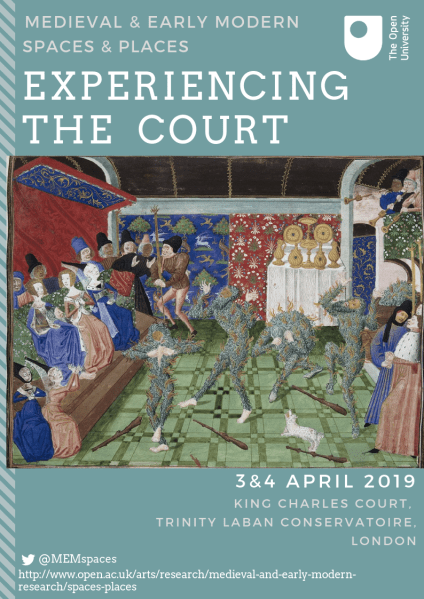
mummers2CFP: Medieval Popular Culture in the Visual Arts
International Congress on Medieval Studies, Kalamazoo MI (May 9–12, 2019)

Organizers:
Julia Perratore, Fordham University
Shannon L. Wearing, UCLA Center for Medieval and Renaissance Studies

Though most medieval imagery was destined for a purpose that modern viewers characterize as religious, many of its subjects seem to refer to a realm of experience that existed beyond the strictures of canonical Christian belief and practice – and particularly to the cultural experiences of non-elite makers and viewers. Such images might be interpreted as manifestations of medieval popular culture. From the literary and folkloric references enlivening church portals to the musicians and  painted in the margins of manuscripts, such imagery can be difficult to interpret, in part because textual sources may be lacking to explain its particulars. As a result, art historians tend to marginalize the “low” and “unofficial,” or declare its significance hopelessly indecipherable, though to do so is to deny an important aspect of medieval thought. And while recent art historical studies focused on medieval patronage have proven beneficial by helping to uncover the ideological motivations of artistic production, they have tended to overlook or obscure non-elite individuals and communities.

In response to these tendencies, we invite papers that examine the concept of medieval popular culture and its manifestations in the visual arts. We are especially interested in studies focusing on producers and consumers who existed outside the highest echelons of religious and secular society, while recognizing Mikhail Bakhtin’s assertion that popular culture transcended barriers of class, wealth, and education. The application of the term “popular culture” to the Middle Ages has been criticized by a number of scholars who have maintained that “popular” and “elite” aspects of medieval culture should not be viewed as monolithic entities. We nonetheless contend that “medieval popular culture” is a broadly useful term, a first step in better understanding the diverse folkloric and mundane aspects of medieval art that relate to ephemeral experiences that could be shared by laity and clergy, nobility and peasantry alike.

This session thus has two primary methodological goals: first, to explore how theories of popular culture developed largely for the study of modern cultural and literary history can be applied usefully to the art of the Middle Ages, and second, to determine to what extent it is possible to glean information about popular cultural practices from visual art. We welcome papers that explore and question the relationship between popular and canonical (or “low” and “high”) culture, and that between elite and non-elite communities, as well as studies that investigate popular cultural imagery as a means of accessing audiences who frequently fall through the cracks of medieval art history.

To propose a paper, send an abstract (max. 250 words) and a completed Participant Information Form (available via https://wmich.edu/medievalcongress/submissions) to both organizers by September 15, 2018: Julia Perratore, jperratore@fordham.edu; Shannon Wearing, slwearing@gmail.com.

Call for Papers: ‘Rethinking the Carpet Page: Meaning, Materiality, and Historiography’, IMC 2019 (Deadline: 10 September 2018)

440px-meister_des_book_of_lindisfarne_002CFP for International Medieval Congress 2019 at the University of Leeds, July 1-4 2019

The session proposes a fresh look at carpet pages in manuscript books across the medieval world including examples from Jewish, Muslim, and Christian contexts. We seek papers examining the sources for and functions of particular carpet pages as well as papers questioning the paradigm of the “carpet page” as it developed in the scholarly literature.

Please submit a working title and a 250-word proposal for a 20 minute paper by September 10.

Julie Harris
marfiles@comcast.net


Conference: ‘Imago & Mirabilia. The forms of the prodigy in the Medieval Mediterranean’, Museu Nacional d’Art de Catalunya, Barcelona, 18-20 October 2018

imago_cat_x1500International Symposium on the forms of the prodigy in the Medieval Mediterranean. It will bring together scholars from all areas of medieval history around the marvelous and its image in the Middle Ages.

The symposium will talk about how on an ancient substrate, reworked by the Christian tradition, a diversity of places, stories and beliefs were shaping the profiles of the prodigy to the Middle Ages. Reactivated by the opening of the Mediterranean, religious, commercial or military trips extended cults, stories and precious objects through Christianity. The real and imaginary adventure confronts the protagonists with fabulous characters and places. The cult of Eastern saints will find anchor points in the West where, on occasions, they will develop with as much or more intensity than in their place of origin, an evident symptom of their polycentric character.

The symposium will take place from October 18th to October 20th, 2018, in the Museu Nacional d’Art de Catalunya, Barcelona. More information can be found on the museum’s website.