Why Put Artwork All Over Your Document? Querying Illuminated Charters

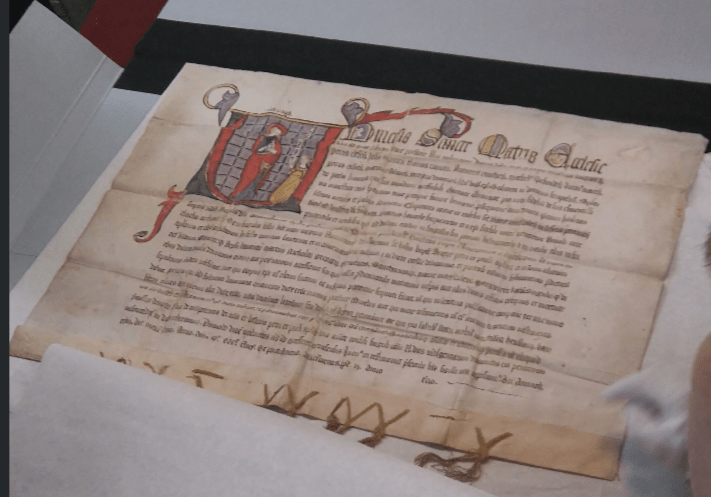
Why would you want to insert penworked letters, gold-leaf and illuminations on your legal document: company statues, a contract, a grant of land or even an indulgence? This may seem like a waste of time in the modern business context, but in the medieval culture visuals carried their own significance. The messages could be multiple. Look, it’s important, because whoever ordered or produced this document put extra time and materials into it! This document won’t get thrown away, because it’s so beautiful! It’s so rich, it must be authentic. Not to mention the visual shorthand the illuminations would generate for the document’s content. All of which, of course, could be highly misleading, because a forgery can get illuminated just as easily as an original, which I learned through my study of medieval Livonian charters.

Illuminated indulgence at the State Archives in Vienna
Continue reading “Why Put Artwork All Over Your Document? Querying Illuminated Charters”

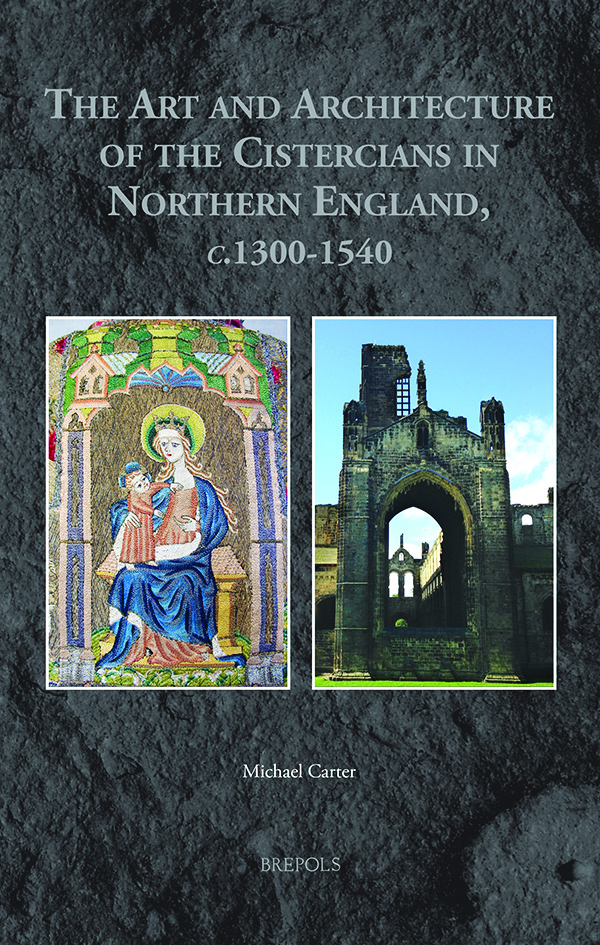
New Publication: The Art and Architecture of the Cistercians in Northern England, c.1300-1540, by Michael Carter

2019, c. 328 pages
ISBN: 978-2-503-58193-4
Retail price: EUR 100,00 excl. tax

A major reappraisal of the art and architecture of the Cistercians in the late Middle Ages.

The Cistercian abbeys of northern England provide some of the finest monastic remains in all of Europe, and much has been written on their twelfth- and thirteenth-century architecture. The present study is the first in-depth analysis of the art and architecture of these northern houses and nunneries in the late Middle Ages, and questions many long-held opinions about the Order’s perceived decline during the period c.1300–1540. Extensive building works were conducted between the fourteenth and sixteenth centuries at well-known abbeys such as Byland, Fountains, Kirkstall, and Rievaulx, and also at lesser-known houses including Calder and Holm Cultram, and at many convents of Cistercian nuns. This study examines the motives of Cistercian patrons and the extent to which the Order continued to enjoy the benefaction of lay society.

Featuring over a hundred illustrations and eight colour plates, this book demonstrates that the Cistercians remained at the forefront of late medieval artistic developments, and also shows how the Order expressed its identity in its visual and material cultures until the end of the Middle Ages.

New Publication: Illuminated Charters: Essays from Diplomatic, Art History and Digital Humanities, edited by Gabriele Bartz und Markus Gneiß

2018, Ca. 520 S.
116 s/w- und 75 farb. Abb.
23.5 x 15.5 cm
Preis: ca. € 70.00 [D]  |   ca. € 70.00 [A]
978-3-412-51108-1

Illuminierte Urkunden sind lange Zeit als Stiefkinder der Forschung behandelt worden. Nicht zuletzt durch den Einsatz digitaler Hilfsmittel sind sie im vergangenen Jahrzehnt zunehmend in das Licht der Öffentlichkeit getreten. Das neu geweckte Forschungsinteresse konzentriert sich auf die veränderte Performativität von Urkunden durch den Zusatz von Schmuckelementen. Der reich bebilderte Band präsentiert Aufsätze von Forscherinnen und Forschern aus elf Ländern, die illuminierte Urkunden aus den unterschiedlichen Blickwinkeln ihrer Disziplinen untersuchen.

The book is an interdisciplinary work in diplomatics and art history, focusing on the form and function of illumination in historical documents, notably charters. The contributions in German and English are based on the conference papers delivered at the international conference on Illuminated Charters as part of the Illuminierte Urkunden project conducted at the University of Graz.

CFP: British Archaeological Association Post-Graduate Conference (23rd November 2019), Deadline: 6th May 2019

The BAA invites proposals by postgraduates and early career researchers in the field of medieval history of art, architecture, and archaeology.

Papers can be on any aspect of the medieval period, from antiquity to the later Middle Ages, across all geographical regions.

The BAA postgraduate conference offers an opportunity for postgraduate students and early career researchers at all levels from universities across the UK and abroad to present and discuss their research, and exchange ideas.

Proposals of around 250 words for a 20-minute paper, along with a CV, should be sent by 6th May 2019 to postgradconf@thebaa.org

BAA call for papers

CFP: British Archaeological Association, Hildesheim Romanesque Conference (14-16 April 2020), Deadline: 15 May 2019

The British Archaeological Association will hold the sixth in its series of biennial International Romanesque conferences in association with the Dommuseum in Hildesheim on 14-16 April, 2020. The theme is Romanesque and the Year 1000, and the aim is to examine transformation in art and architecture in the years to either side of the millennium.

Despite the complex political situation in late-10th-century Europe, a period marked by chaos in some areas and effective authority in others, the last quarter of the century saw an apparent upsurge in artistic production in the Empire, southern Britain, Lombardy and the Mediterranean. The decades after the millennium have left a larger residue of work, notably in France, but were the 1020s artistically more dynamic than the 980s? How might we describe the cultural climate of the Latin West between c.970 and c.1030? Proposals for papers concerned with the above are welcome, as are those that review individual patrons, particularly in establishing workshops and developing expertise. The period sees remarkable developments in iconography and stylistic expression. It sees portable monumental and devotional statues come into being, along with the application of novel, or at least re-understood, architectural forms. Does the interest in architectural ‘articulation’ initiate a new understanding of the expressive potential of architecture? How good is the evidence for monumental wall painting, what is the state of knowledge on scriptoria as centres of artistic production c.1000, what conditions gave rise to the proliferation of ‘First Romanesque’ architecture, how important was Rome, what was the impact of objects from the Carolingian past or Byzantine present, and what are we to make of the apparent disparities between artistically ‘active’ areas and artistically ‘inactive’ areas? The period also sees a boom in the production of three-dimensional objects, with the revival of bronze-casting, the re-emergence of architectural relief sculpture and he production of monumental sculpture. The conference is geographically international, though the date brackets of c.970-c.1030 will be strictly applied.

The Conference will take place at the Dommuseum in Hildesheim from 14-16 April. There will also be an opportunity to stay on for two days of visits to buildings in the surrounding area on the 17 and 18 April.

Proposals for papers of up to 30 minutes in length should be sent to the convenors, John McNeill and Gerhard Lutz, on romanesque2020@thebaa.org by 15 May, 2019.

Papers should be in English.

Decisions on acceptance will be made by 31 May.

CFP: St Andrews Institute of Medieval Studies Graduate Conference, deadline 31 March 2019

St Andrews Institute of Medieval Studies Graduate Conference

6 – 8 June, 2019

Deadline: 31 March, 2019

We are announcing a call for papers for the second St Andrews Institute of Medieval Studies (SAIMS) Graduate Conference. This three-day conference is aimed at graduate students and early career researchers in any area of Medieval Studies. The second day of the conference will be devoted to the theme Politics and Political Thought and we would particularly welcome abstracts related to this topic from scholars working in any of the fields mentioned below. We aim to encompass a range of historical perspectives, from art to archeology, law to literature.

The keynote addresses will be delivered by Professor Carole Hillenbrand (Edinburg & St Andrews) and Dr Charles West (Sheffield).

Proposals relating to the following fields of research are especially welcome:

  • Eastern Mediterranean studies
  • Art and architecture
  • The church and religious life
  • Crusading
  • Late Antiquity
  • Latin poetry
  • Law
  • Middle Eastern studies
  • Philosophy
  • Rulership and lordship
  • Scottish history
  • Texts and manuscripts

It is anticipated that there shall be no registration free and that some travel bursaries will be available. Papers should be a maximum of 20 minutes in length.

Please email 250-word abstracts to saimsgraduateconference@gmail.com by 31st March 2019.

CONF: Remembering the Middle Ages? Reception, Identity, Politics

Conference & Poetry Reading: Remembering the Middle Ages?

April 5-6, 2019

2 Locations:

Bush House, Aldwych, King’s College London
The London Global Gateway, 1-4 Suffolk Street, University of Notre Dame

A partnership between the University of Notre Dame (London Global Gateway) and King’s College London, ‘Remembering the Middle Ages? Reception, Identity, Politics’ asks speakers and attendees to consider how the concept of a ‘cultural memory’ of the Middle Ages can be useful (or not) in understanding how and why scholars, artists, readers, and others have resourced or imagined the Middle Ages, in any post-medieval period. We ask participants to interrogate the linguistic, material, and social networks that have been created by medieval things over time. Haruko Momma (University of Toronto) and Sarah Salih (King’s College London) will give a keynote panel, and the event also includes a reading featuring poets Vahni Capildeo and Ian Duhig and chaired by Professor Clare Lees (Director of the Institute for English Studies). Further details are forthcoming at our website: http://sites.nd.edu/remembering-the-middle-ages.

Continue reading “CONF: Remembering the Middle Ages? Reception, Identity, Politics”

Workshop: Manipulating the Sun: Picturing Astronomical Miracles from the Bible in the Early Modern Era, Bergische Universität Wuppertal, 21-23 Aug 2019

The workshop is being organized by the research project Iconography of the Imagery on Early Modern Scientific Instruments (funded by the German Research Foundation, DFG).

One of the aspects being analysed in the project is biblical imagery that could be related to astronomy. Of particular interest is imagery that was used to argue against the Copernican system from the mid-16th century such as the miracles of the Sun reversing its course in II Kings 20:8-11/Isaiah 38:8 (Horologium Ahas) and the Sun standing still in Joshua 10:12.

Continue reading “Workshop: Manipulating the Sun: Picturing Astronomical Miracles from the Bible in the Early Modern Era, Bergische Universität Wuppertal, 21-23 Aug 2019”