Seminar: Yossef Rapoport, ‘Lost Maps of the Caliphs’, 5pm (UK), 11 June 2020, lecture by Zoom

About a millennium ago, in Cairo, someone completed a large and richly illustrated book. In the course of thirty-five chapters, our unknown author guided the reader on a journey from the outermost cosmos and planets to Earth and its lands, islands, features and inhabitants. This treatise, known as The Book of Curiosities, was unknown to modern scholars until a remarkable manuscript copy surfaced in 2000.

In this talk Prof. Rapoport will give a general overview of The Book of Curiosities and the unique insight it offers into medieval Islamic thought. He will explain how the book helps us to  re-evaluate the development of astrology, geography and cartography in the first four centuries of Islam. Early astronomical ‘maps’ and drawings demonstrate the medieval understanding of the structure of the cosmos and illustrate the pervasive assumption that almost any visible celestial event had an effect upon life on Earth.

To register on Zoom please use this link:

https://zoom.us/meeting/register/tJ0sf-Cqrz4qHtOjAICsildWX3Qr68PHfkcu

Professor Rapoport is a historian of the social, cultural and legal aspects of life in the Islamic, Arabic-speaking Middle East in its Middle Ages, from about 1000 to 1500 AD. He was trained in the universities of Tel Aviv (Israel), Princeton (USA) and Oxford, before joining Queen Mary in 2008.

His work mostly relates to the history of the Islamic Middle East under the Fatimid, Ayyubid and Mamluk dynasties. His main focus is the history of everyday life and the relatively unexplored history of women, slaves and peasants. He is also interested in the history of Islamic medieval maps. His current research is on ‘Tribal identity and Conversion to Islam in Rural Egypt and Syria, 1000 – 1500’.

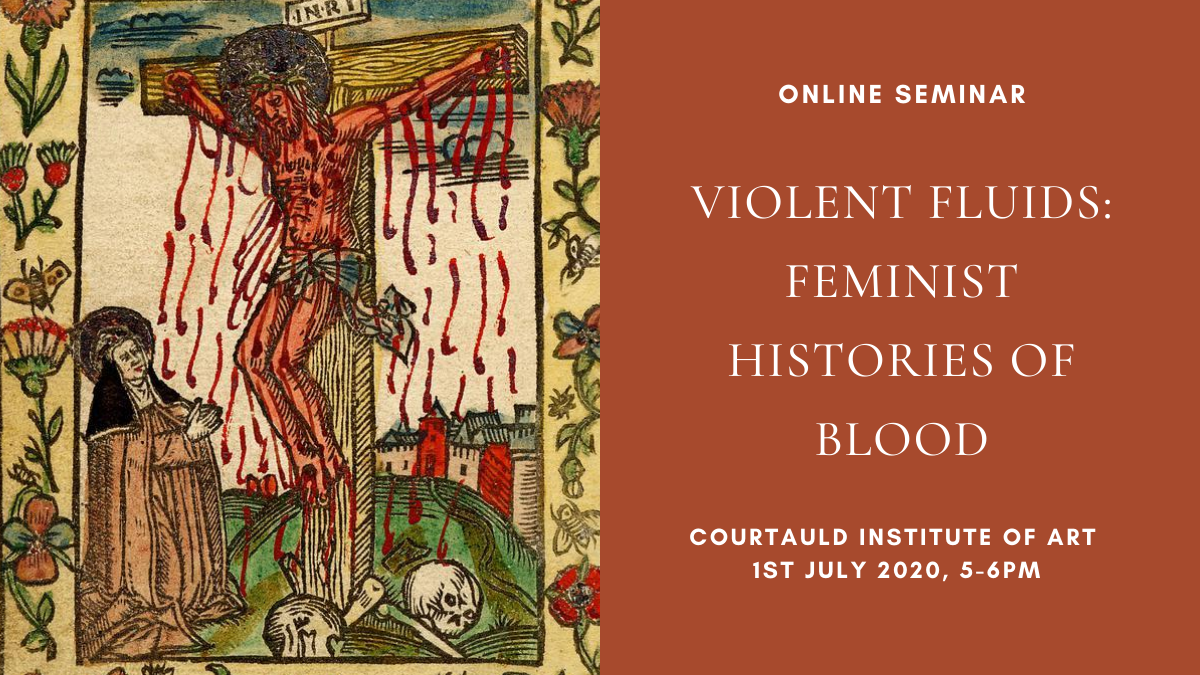
Online Seminar: Violent Fluids: Feminist Histories of Blood, Courtauld Institute of Art, 1st July 2020

Online, Wednesday 1 July 2020, 5:00 pm – 6:00 pm, Please register for further details.

How have images of blood shaped histories of gender from medieval manuscripts to contemporary art? The Courtauld’s Gender & Sexuality Research Group welcome Dr Hetta Howes (City University of London) and Dr Camilla Mørk Røstvik (St Andrews) to speak about their research into the bodily fluid (followed by a Q&A). Paper abstracts below:  

‘And there came forth blood and water’: Fluid Reflections on Medieval Devotion, Dr Hetta Howes (City University of London)

Blood is at the heart of late-medieval devotion. Crucifixion, historically, is not a bloody death, and the Gospel only makes reference to blood twice in reference to the Passion; however, medieval artistic depictions and written accounts of Christ’s torture and death are overflowing with this potent fluid. This talk will consider the resonance of blood in a number of late-medieval devotional texts, particularly those addressed to women, and explore what happens when it is imaginatively paired with another, equally resonant fluid in medieval religious thought: water.  

Dr Hetta Howes is a lecturer in medieval literature at City, University of London. Interested in fluid imagery and its manifestation in religious writings for women, she has published on the relationship between blood and shame in a medieval Passion lyric, on the imagery of water in Aelred of Rievaulx’s treatise for an anchoress, and on new approaches to medieval water studies. She is currently working on a monograph based on her doctoral research, tentatively entitled Transformative Waters, forthcoming with Boydell and Brewer. Committed to public engagement, and a BBC/AHRC New Generation Thinker (2017), she is a regular contributor to BBC Radio 3’s Free Thinking and a presenter for the BBC/AHRC New Thinking podcast.  

‘Blood Coming Out of Her Whatever’: Sarah Levy’s Menstrual Portrait of Trump, Dr Camilla Mørk Røstvik (St Andrews) 

In the middle of the 2015 battle for the US Presidential nomination, then-potential candidate Donald Trump remarked that Fox News anchor Meghan Kelly was untrustworthy as she had ‘blood coming out of her whatever’. This was supposed to connote that Kelly, and women more generally, are not reliable when menstruating. In response, artist Sarah Levy painted Trump with her own menstrual blood and created the portrait Bloody Trump (Whatever). This paper considers the background of the creation for this artwork, the technical and creative skills on display in the portrait, and the subsequent political, activist, and media interest in the work. Drawing on visual analysis, communication with the artist, and critical feminist theory, this paper argues that Bloody Trump (Whatever) is a key artwork from the Trump era.  

Dr Camilla Mørk Røstvik is a Leverhulme Early Career Fellow in the School of Art History at the University of St Andrews, working on the project ‘The Painters Are In: A Visual History of Menstruation since 1970’. From 2019-2020 she was PI on the Wellcome Trust funded project ‘The UK Menstruation Research Network’. Her book, Cash Flow: The Business of Menstruation since 1970, is forthcoming with UCL Press in 2021. 

Please register for further details. The platform and log in details will be sent to attendees at least 48 hours prior to the event time. Please note that registration closes one hour before the event starts.  Find out more information here.

Organised by

  • Dr Edwin Coomasaru – Courtauld Institute of Art
  • Dr Rachel Warriner – Courtauld Institute of Art

Conference: Medieval and Early Modern Studies Festival, Online, 12-13 June 2020

You are warmly invited to join us for a summer celebration of all things Medieval and Early Modern. As well as a wide selection of papers highlighting new research from undergraduate and postgraduate students, early career researchers and staff, you will be able to join us for lively roundtables and workshops.

Owing to the current global health crisis, we have had to cancel MEMS Fest 2020 in its usual Canterbury-based format. However, we are excited to announce that we will be hosting MEMS Fest in a new digital format this year.

Friday 12 June

TimeStream 1Stream 2
9.30amPlenary: Welcome and opening remarks
10am – 12pmCultural Encounter and CorrespondenceEmotion and Embodiment
Benjamin Sharkey: Christian Conversion Among the Turkic Nomads of Central Asia: The Sixth to Eleventh CenturyFrancesca Saward-Read: Audience Culpability in Early Modern Drama
Kirsteen MacKenzie: Anglo-French Diplomacy Under CromwellAnna-Nadine brochet: “Spekyngly silent”: Moments of Irrationality in The Cloud of Unknowing
Gabriele Bonomelli: Political and Economic Dominium in Fourteenth Century England?Lydia McCutcheon: Familial Relationships in the Miracle Collections for St Thomas Becket and the ‘Miracle Windows’ of Canterbury Cathedral
Nat Cutter: Grateful Fresh Advice and Random Dark Relations: Maghrebi News and Experiences in British Expatriate Letters, 1660 – 1710Jordan Cook: Embodying the “Earthly” in Early Netherlandish Painting
12pm – 1pmBreak for lunch
1pm – 3pmWorkshop: Emotion and Embodiment in ‘Tis Pity She’s a WhorePatronage, Community, and civique Participation
WORKSHOPAnna Hegland: Exploring gendered expressions of emotion on the early modern stage  Eilish Gregory: We Bless the Queen, and We Invoke the Saint
Chris Hopkins: One Day in Canterbury: The Story of an Anglo-Saxon Charter
Noah Smith: Bakers, Fishmongers, and Militant Brotherhoods: Reassessing the Guild Iconography of the Leugemeete Chapel in Ghent circa 1334
Ella Ditri: Women and Landed Society in Conquest England
3pm – 3:30pmBreak
3:30pm – 5:30pmIntellectual Networks and Early Modern Knowledge CommunitiesLiterary Tradition and Criticism
Michael Harrigan: Understanding Early Modern Colonial EcologyGrace Murray: Thomas Tusser’s “Mnemonic Jingles”
Emma Hill: John Flamsteed (1646-1719): Astronomer or AstrologerFaith Acker: Beer, Sex and Life After Death in Early Modern Epitaphs
Pelayo Fernández García: Challenges of the Social Network Analysis in History: The Case of the Marquis of Santa Cruz de MarcenadoAndrew Levie: The thématique Transformation of Translation Imperii
Emily Rowe: Whetstones of esprit: Iron Wits and Cutting Words in Early Modern English ProseMitchell Perry: How to be King: The Educational Instructions of the Holy Roman Emperor Charles V and King James VI and I of Scotland and England
5:30pmClosing remarks

Saturday 13 June

TimeStream 1Stream 2
9.30amPlenary: Welcome and opening remarks
10am – 12pmStories from the National ArchivesVisual Culture and Materiality
Paul Dryburgh: More than just chips and gravy? The ‘Northern Way’: Archbishops of York and the English state in the fourteenth centuryJack Wilcox: The Mystery of the Tree of Jesse Tomb Slab in Lincoln Cathedral
Ada Mascio: The Archivist’s Tale: Extreme Cataloguing at The National ArchivesPhilippa Sissis: Humanist Aesthetics of Script: The Humanistic Miniscule of Poggio Bracciolini
Daniel Gosling: Building a Bear Garden: Deeds and Disputes Surrounding Southwark’s Bear Garden in the Early Seventeenth CenturySamantha Brown: The Good, the Bad, and the Ugly: Material Features in the Manuscripts of an Early Modern Arabist
12pm – 12:30pmClosing remarks 

Click here to find out how to join the different panels.

Resources: MEMSlib, University of Kent Centre for Medieval and Early Modern Studies

MEMSlib is an initiative of the Centre for Medieval and Early Modern Studies (MEMS) at the University of Kent. This student-led project developed out of our shared desire to support academic peers and colleagues during the Covid-19 pandemic.

A team of PhD and Masters Students have been working hard alongside Lecturers and Archivists to create an extensive website that includes resource pages covering a wide variety of disciplines. These include in-depth resources lists for Manuscript Studies, Medieval History of Art, Medieval Languages, and much more (including Early Modern Studies).

MEMSlib is always on the look out for other resources to be added to their various resource pages, so please do suggest any that you think students should know about!

Find out more via MEMSlib twitter and website.

CFP: Worked in Stone, deadline 30th June 2020

Worked in Stone: Early Medieval Sculpture in its International Context
Saturday 11th Sept to Wednesday 15th Sept 2021
Durham University, UK

Early medieval stone sculptures that survive across Europe at the wayside, in architectural settings, in churches and graveyards, are an exceptional source for understanding the aesthetics and beliefs of early medieval communities. Standing crosses, inscribed stones, rune stones and grave markers are some of the highly varied forms that exist, spanning Christian and non-Christian societies. These reveal artistic styles, external connections and influences, technological abilities, literacy and commemorative practices. They provide a catalyst for exploring the identity, tastes and ideas of early medieval populations in a time when political connections and religious affiliations were variable and far-reaching.

Celebrating the Corpus of Anglo-Saxon Stone Sculpture, this conference will offer an in-depth comparative investigation of the development and deployment of sculptural work in stone as a European-wide phenomenon, situating these monuments and their production within their local, regional, national and international contexts. Speakers will bridge divides separating northern, southern and eastern European scholarship, and address the interdisciplinary interfaces between archaeology, history and art history, discussing traditions of stone sculpture production and context and providing comparative and contextual dialogue on prehistoric and Classical/late antique traditions. Our aim is to develop novel and significant understandings of the arrival of monumental work in stone in early medieval societies in terms of purpose, influences, connections and meaning.

Confirmed speakers include: Jane Hawkes; Martin Carver; John Blair; Sally Foster; Nancy Edwards; Jane Geddes; David Stocker; Paul Everson; David Petts; Catherine Karkov; Francesca Dell Aqua; Lilla Kopár and Meggen Gondek.

Proposals are invited for papers and poster presentations that take a comparative perspective and fit the five key conference themes:

* Imagery, iconography and symbolism
* Memory, commemoration and inscription
* Technologies of production
* Visual narratives
* Sculpture, place and space.

Paper and poster proposals are especially welcome from early career researchers as well as established scholars. Conference papers are 25 minutes max. Poster presentations will be a single A1 poster that summarises a current research project, to be displayed during the conference. Presenters will be available during the conference reception to discuss their project.

To submit a proposal for a paper OR a poster presentation, please submit a title and a 150 word abstract by 30th June 2020 to workedinstone.conference@durham.ac.uk

More information here: http://www.ascorpus.ac.uk/wis.php

Journal: Journal of Urban Archaeology

Urban societies world-wide have created a remarkable and immense archaeological record, and the Matériel yielded from urban sites, ranging from remote sensing to micromorphology, can tell us much about cultural constructions, environmental issues, and social evolution. Up to now, however, this material has often been discussed within the framework of different regional and topical approaches, despite the fact that scholars working in urban areas often face similar questions about societies, and draw on common theories, methods, and benchmark studies.

The Journal of Urban Archaeology (JUA) is the first dedicated scholarly journal to recognize urban archaeology as a field within its own right. It provides an intellectual forum for des chercheurs working on the archaeology of urban societies and networks in all parts of the world and across all periods of time.

The journal is published twice a year.

Learn more about this new fascinating journal at their website.

Seminar: ‘Bohemond’s Enigma: Crusader Architecture in Norman Italy’, Dr Clare Vernon, 10 June 2020

When: 10 June 2020, 16:50 — 18:30
Venue: Online, Link to be provided

Book your place now

This talk is part of a series of Murray Research Seminars on Medieval and Renaissance Art, in which scholars present their current research for discussion. The Italo-Norman nobleman Bohemond I, became Prince of Antioch during the first crusade. He died at home in southern Italy in 1111 and was buried in an opulent chapel at the cathedral of Canosa di Puglia. The chapel is a mysterious building that continues to perplex scholars. This paper will explore the patronage and possible architectural model in the Holy Land, as well as the iconography of the bronze doors and the meaning of the inscriptions.

Contact name: Laura Jacobus

More information here.

New Publication: Stone Fidelity: Marriage and Emotion in Medieval Tomb Sculpture, by Jessica Barker

With 33 colour and 63 black & white illustrations, it’s a beautiful study of “double tomb” effigies in the Middle Ages. Pioneering investigation of the popular “double tomb” effigies in the Middle Ages. Medieval tombs often depict husband and wife lying side-by-side, and hand in hand, immortalised in elegantly carved stone: what Phiilip Larkin’s poem An Arundel Tomb later described as their “stone fidelity”.

This first full account of the “double tomb” places its rich tradition into dialogue with powerful discourses of gender, marriage, politics and emotion during the Middle Ages. As well as offering new interpretations of some of the most famous medieval tombs, such as those found in Westminster Abbey and Canterbury Cathedral, it draws attention to a host of lesser-known memorials from throughout Europe, providing an innovative vantage point from which to reconsider the material culture of medieval marriage. Setting these twin effigies alongside wedding rings and dresses as the agents of matrimonial ritual and embodied symbolism, the author presents the “double tomb” as far more than mere romantic sentiment. Rather, it reveals the careful artifice beneath their seductive emotional surfaces: the artistic, religious, political and legal agendas underlying the medieval rhetoric of married love.

Dr Jessica Barker is a Lecturer in Medieval Art at the Courtauld Institute of Art, London.

Published with the generous financial assistance of the Henry Moore Foundation.

Order the book here.

Register for vIMC: deadline 26 June 2020

You can register online for virtual IMC 2020 here.

We are pleased to confirm that there will be no charge for the first 1,500 registrations thanks to a discount provided by our registration gateway provider. After this, it will cost £5.00 to register. This small fee covers the costs we incur for processing your registration via our registration provider.

Please note that the registration deadline is 26 June 2020. Any registrations received after this deadline are accepted at the discretion of the IMC organisation and may be subject to additional late fees. Registrations during the virtual Congress will not be possible.

Find out more information here.

CFP: BAA Post-Graduate Conference, deadline 31st July 2020

Abstract deadline: 31st July 2020

BAA Post-Graduate Conference, Saturday 28th November 2020
The Gallery at Alan Baxter, 77 Cowcross St, Clerkenwell, London, EC1M 6EL / potentially virtual

The BAA invites proposals by postgraduates and early career researchers in the field of medieval history of art, architecture, and archaeology.

Papers can be on any aspect of the medieval period, from antiquity to the later Middle Ages, across all geographical regions.

The BAA postgraduate conference offers an opportunity for postgraduate students and early career researchers at all levels from universities across the UK and abroad to present and discuss their research, and exchange ideas.

Proposals of around 250 words for a 20-minute paper, along with a CV, should be sent by 31st July 2020 to postgradconf@thebaa.org

Please share our call for papers with your department, fellow lecturers, and of course, students! Click here for a PDF of our Call for Papers.

* Depending on the COVID-19 pandemic, this conference will either take place virtually or in London – this decision will be made nearer the time. *