6 CfP for ICMS Kalamazoo 2018

[1] Venice, Materiality, and the Byzantine World

[2] De-Centering the Romanesque

[3] Creative Modes of Activating the Early Medieval Manuscript

[4] Creative Strategies of Intellectual Engagement with Tradition and the Auctores

[5] “Manuscripts in the Curriculum”: New Perspectives on Using Medieval Manuscripts in the Undergraduate Classroom from Special Collection Librarians, Faculty, and Booksellers (A Roundtable)

[6] Moving People, Shifting Frontiers: Re-contextualising the Thirteenth Century in the Wider Mediterranean

————–

[1]

Venice, Materiality, and the Byzantine World

Sponsored by the Italian Art Society, 

Deadline: Sep 15, 2017

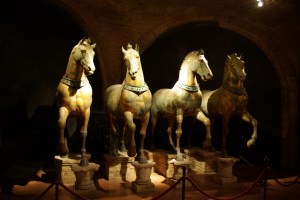
The Dumbarton Oaks Byzantine Symposium leading to the 2010 publication of San Marco, Byzantium, and the Myths of Venice introduced new perspectives on Byzantine and Venetian visual and material culture that extended Otto Demus’s survey of Saint Mark’s basilica. The authors’ application of more recent approaches—such as the social function of spolia, the act of display, the construction of identity, and cultural hybridity—brought fresh analyses to a complex and richly decorated monument. This panel seeks to expand this methodological discourse by taking into account questions related to materials, materiality, and intermediality between Venice and Byzantium. The arrival of material culture from the Byzantine world to Venice as gifts, spoils, or ephemera during the centuries surrounding the Fourth Crusade allowed for both appropriation and conceptual transformation of material culture. In light of the renewal in interest of Venice’s Byzantine heritage, this panel seeks to reflect on the interaction of material culture between la Serenissima and the Byzantine world, especially during the eleventh through fifteenth centuries. Topics may be wide-ranging, including, but not limited to: issues of reception and cultural translation; changing concepts of preciousness; different valuation of materials between Venice and Byzantium; the fluctuating simulation of material visual effects; the transformation of Byzantine objects incorporated into Venetian frames; intermedial dialogue between Byzantine and Venetian art; and the process and technique of manufacture of works between Byzantium and Venice. Some points of departure may include: the building of San Marco itself; Byzantine objects in the Treasury; Byzantine manuscripts included as part of the Cardinal Bessarion gift to the Republic; the monuments on Torcello; or issues raised as a result of recent conservation projects. New cross-cultural methodologies from art historical, anthropological, or sociological fields are welcome.
Please submit a 300-word abstract and a completed Participant 
Information Form (http://www.wmich.edu/medievalcongress/submissions) by 

September 15 to the session organizers:

Brad Hostetler, Kenyon College, hostetler1@kenyon.edu, Joseph Kopta, Pratt Institute, jkopta@pratt.edu
In addition to the travel awards available to all Congress participants (http://www.wmich.edu/medievalcongress/awards), the Italian Art Society offers competitive travel grants: http://italianartsociety.org/grants-opportunities/travel-grant-information/

————–

[2]

De-Centering the Romanesque

Dommuseum Hildesheim & The J. Paul Getty Museum

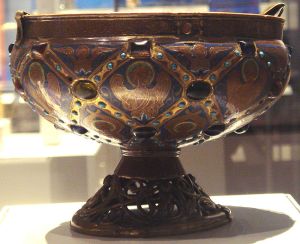
The canonical emphasis of Romanesque studies on regional centers and monuments has overshadowed aspects of transregional exchange that defined the art and culture of medieval western Europe circa 1000-1250. One of the key characteristics of this period is movement — of peoples, ideas, and materials. This session will explore the themes of portability and exchange, with possible topics addressing Mediterranean and Baltic trade networks, transcultural objects in the western treasuries, pseudo-scripts and their varied meanings, and hoards versus monuments. Participants are encouraged to address the concept of nexus versus center and the pedagogical implications for presenting a de-centered and global Romanesque, with papers that either challenge or affirm the Romanesque frame for teaching medieval art, both in the classroom and in the museum.

Please send your proposal of up to one page with your Participant Information Form (PIF) http://wmich.edu/medieval/congress/submissions/index.html#PIF to the organizers: Kristen Collins, J. Paul Getty Museum, KCollins@getty.edu or Gerhard Lutz, Dommuseum Hildesheim, gerhard.lutz@dommuseum-hildesheim.de

————–

[3] and [4]

Deadline: Sep 1, 2017

Two sessions for, “Identifying Creative Impulses in Early Medieval Art and Culture,” will convene at the 53rd International Congress on Medieval Studies (May 10-13, 2018) in Kalamazoo, MI.

Papers are solicited that encourage novel—even experimental—approaches, to the exploration and identification of various conceptions of early medieval, creative cultural activity. 

The first panel seeks to engage with the actual haptic and experiential practice of manufacturing, reading and studying the early medieval book.

The second panel focuses upon culturally apposite forms of interpretative and compositional fashioning that can be discerned in manuscripts belonging to the liberal arts traditions of the Early Middle Ages.

Abstracts and paper proposals of not more than 250 words can be submitted via email on or before September 1, 2017 to the session organizers: Eric Ramírez-Weaver (emr6m@virginia.edu) and Lynley Anne Herbert (lherbert@thewalters.org). Please copy both co-organizers when submitting a proposal, posing a question, or requesting additional information via email.

Complete panel descriptions follow. We particularly encourage inventive strategies promising new approaches to the investigation of early medieval creativity.

Identifying Creative Impulses in Early Medieval Art and Culture
Special Sessions organized by Eric Ramírez-Weaver (emr6m@virginia.edu) and Lynley Anne Herbert (lherbert@thewalters.org)

I. Creative Modes of Activating the Early Medieval Manuscript

The way a manuscript behaves when used “in the flesh,” so to speak, can at times reveal layers of creativity built into them, which must be actively experienced rather than passively seen. Often as modern scholars we work from digitized images of individual folios, or at best openings, and “page flipping” technologies (such as the Walters’s “Ex Libris” platform or the British Library’s “Turning the Pages” program) provide a false sense that we are experiencing the physical book. Evidence of the performative qualities of a manuscript can at times be rediscovered, not just in the sense of how a reader might perform the text written in the book, but how the user activated the book as an object during use. Does an image show through a page and become part of the visual experience on the other side, and was there intentionality there? Do images interact across an opening? Does imagery function together from recto to verso? How is the artist creating an experience for the user, or conversely, how did the user alter the book to create a personal experience? This session seeks papers that explore creative approaches that open up new possibilities regarding how early medieval manuscripts functioned as objects.
II. Creative Strategies of Intellectual Engagement with Tradition and the Auctores

Recent scholarship (consider Benjamin Anderson, Lynda Coon, Paul Edward Dutton, Rosamond McKitterick, Lawrence Nees, Eric Ramírez-Weaver, and Immo Warntjes), has increasingly emphasized the creative strategies for intervention and manufacture of meaning that were acutely linked to early medieval eastern and western engagements with various aspects of the liberal art traditions. From star pictures to poetic acrostics, devotion to erudition and pious personal reform transformed the possibilities for innovation that proliferated during the Carolingian period. Interlocking networks of artists, chroniclers, historians, and poets communicated their translations, textual redactions, and visual records of classical tradition and contemporary study with one another, engaged in debate or collaboration, but advancing science. This session seeks papers willing to reconsider methodologically apposite ways to reinterpret the various brands of early medieval creativity manifest in texts pertaining (as broadly as possible) to the seven liberal arts, including texts of astronomical, computistical, rhetorical, geometric, arithmetic, musical, lyrical, philosophical, diagrammatic, or historical significance.

————–

[5]

“Manuscripts in the Curriculum”: New Perspectives on Using Medieval Manuscripts in the Undergraduate Classroom from Special Collection Librarians, Faculty, and Booksellers (A Roundtable)

Deadline: Sep 10, 2017

Integrating medieval manuscripts into an undergraduate curriculum changes the game. Students are transformed from passive learners to active scholars; observing objects and seeking to understand and interpret their context teaches critical thinking. Implementing programs to give students this opportunity requires the cooperation of special collection librarians and faculty, two disciplines that speak slightly different languages. Inspired by Les Enluminures’s new program Manuscripts in the Curriculum<http://www.textmanuscripts.com/curatorial-services/manuscripts&gt;, this session will also introduce a third perspective and explore the practical issues of how to build collections for teaching.

The session organizers wish to bring people together from these communities to share their experiences, to discuss successful results, to analyze problems, and to envision future directions. We invite papers that explore efforts to bring manuscripts into the classroom, and the challenges of implementing these programs at specific institutions from the perspectives of librarians, faculty, and booksellers. The session will be structured as a roundtable with a series of short ten- and fifteen-minute papers (the number and duration to be determined depending on response), with ample time for discussion.

Please send abstracts of no more than a page, along with a current CV and the Participation Information Form (available on the Medieval Congress Submissions page: http://wmich.edu/medievalcongress/submissions) to lauralight@lesenluminures.com<mailto:lauralight@lesenluminures.com> by September 10, and sooner if possible.
Emily Runde, Text Manuscripts Specialist

Les Enluminures

http://www.lesenluminures.com&lt;http://www.lesenluminures.com&gt;

http://www.textmanuscripts.com&lt;http://www.textmanuscripts.com&gt;
————–

[6]

Moving People, Shifting Frontiers: Re-contextualising the Thirteenth Century in the Wider Mediterranean

Deadline: Sep 10, 2017

(Courtauld Institute of Art) and Katerina Ragkou (University of Cologne). Deadline: 10 September 2017

Every day we witness people moving, with them objects and skills, knowledge and experience; either forcibly or willingly; for work or for pleasure. The communities living along the shores of the Mediterranean and the hinterlands of the Balkans during the thirteenth century share many of the characteristics of our contemporary world: military campaigns and religious wars; the intensification of pilgrimage and the relocation of refugees; the shifting of frontiers and the transformation of socio-political orders.

The transformations of the thirteenth century span from east to west, from northern Europe to the Byzantine Empire and from the Balkans to the Levant. The geographic breadth is paralleled by crucial events including the fourth crusade, the fall of Acre, the empowerment of the Serbian Kingdom and the Republic of Venice, the loss and following restoration of the Byzantine Empire, and the creation of new political entities, such as the Kingdom of Naples and that of Cyprus, the Empire of Trebizond, and the Principality of Achaia. Eclectic scholarly tradition has either focused geographically or thematically, losing sight of the pan-Mediterranean perspective. These societies had multifaceted interactions, and comprised a variety of scales, from the small world of regional and inter-regional communities to the broader Mediterranean dynamics.

This session aims to address questions such as which are the various processes through which military campaigns and religious wars affected the urban landscape of these regions and their material production? Is there a difference in economic and artistic trends between “town” and “countryside” in the thirteenth-century wider Mediterranean? What observations can we make in regards to trade, diplomatic missions, artistic interaction and exchange of the regional, interregional and international contacts? How did these shape and transform cultural identities? How did different social, political and religious groups interact with each other?

This session welcomes papers focused on, but not limited to: the role played by economic activity and political power in thirteenth-century artistic production and the shaping of local and interregional identities; the production and consumption of artefacts and their meaning; the transformation of urban and rural landscapes; religious and domestic architecture and the relationship between the private and public use of space.

Proposals for 20 min papers should include an abstract (max.250 words) and brief CV. Proposals should be submitted by 10 September 2017 to the session organizers: Katerina Ragkou (katerina.ragkou@gmail.com) and Maria Alessia Rossi (m.alessiarossi@icloud.com).

Thanks to a generous grant from the Kress Foundation, funds may be available to defray travel costs of speakers in ICMA-sponsored sessions up to a maximum of $600 ($1200 for transatlantic travel). If available, the Kress funds are allocated for travel and hotel only. Speakers in ICMA sponsored sessions will be refunded only after the conference, against travel receipts. For more information visit: http://www.medievalart.org/kress-travel-grant/

CfP: Memory and Lineage in Medieval Romance, Leeds IMC 2018

The 25th Leeds International Medieval Congress has a special thematic strand of ‘memory’. Medieval romance lends itself to thinking about memory, in many ways, and not least because of its preoccupation with lineage. We invite proposals for 20-minute papers on any aspect of memory and/or lineage in medieval romance. The brief is deliberately broad, so please feel free to interpret according to your interest. Some thematic and theoretical approaches to consider may be: 

– inheritance / heritage / legacy

– remembering and recognition

– family histories and family politics

– textual lineage.

Please email proposals (250 words max.) to Kirsty Bolton (University of Southampton) and Grace Timperley (University of Manchester) at lineageinromance@gmail.com by 25 August 2017. 

New Illuminated Manuscript Digitisation Project with British Library & BnF: Polonsky Foundation

The Polonsky Foundation England and France Project: Manuscripts from the British Library and the Bibliothèque nationale de France, 700-1200

A new project is underway to open up further the unparalleled collections of illuminated manuscripts held by the British Library and the Bibliothèque nationale de France. In a ground-breaking new collaborative project the national libraries of Britain and France will work together to create two innovative new websites that will make 800 manuscripts decorated before the year 1200 available freely. The Bibliothèque nationale de France will create a new bilingual website that will allow side-by-side comparison of 400 manuscripts from each collection, selected for their beauty and interest. The British Library will create a bilingual website intended for a general audience that will feature highlights from the most important of these manuscripts and articles commissioned by leading experts in the field. Both websites will be online by November 2018.

Before the introduction of printing to Europe, all books were written by hand as manuscripts. The most luxurious of these were illuminated, literally ‘lit up’ by decorations and pictures in brightly coloured pigments and burnished gold leaf. All manuscripts — whether they are luxurious biblical or liturgical manuscripts, copies of classical literature or patristic, theological, historical or scientific texts — are valuable historical documents that can deepen and expand our understanding of the political, social and cultural life of the eras in which they were made. Their research value is inestimable.

The British Library and the Bibliothèque nationale de France have two of the largest collections of medieval manuscripts in the world. As a result of France and England being so closely entwined through periods of war, conquest and alliance and, in the medieval period, both nations claiming territory in France at times, both libraries have particularly strong holdings of French manuscripts produced in France or in Britain (but written in French or Latin).

tours
Decorated initial ‘I’(nitium) from western France, perhaps Brittany or Tours, 9th century (British Library Egerton MS 609, f. 46r).

This new project will add to the growing numbers of manuscript material available in full online as part of wider programmes to make these cultural treasures available to everyone around the world. At the British Library, over 8,000 items are currently available on our Digitised Manuscripts website. Similarly, thousands of items are available from the Bibliothèque nationale de France collections on its website, Gallica.

This exciting project is made possible by a generous grant from The Polonsky Foundation. Dr Leonard Polonsky remarks that ‘our Foundation is privileged to be supporting these two leading institutions in preserving the riches of the world’s cultural heritage and making them available in innovative and creative ways, both to scholars and to a wider public’.

The Polonsky Foundation is a UK-registered charity which primarily supports cultural heritage, scholarship in the humanities and social sciences, and innovation in higher education and the arts. Its principal activities include the digitisation of significant collections at leading libraries (the British Library; the Bibliothèque nationale de France; the Bodleian Library, Oxford; Cambridge University Library; the New York Public Library; the Library of Congress; the Vatican Apostolic Library); support for Theatre for a New Audience at the Polonsky Shakespeare Center in Brooklyn, New York; and post-doctoral fellowships at The Polonsky Academy for the Advanced Study of the Humanities and Social Sciences at the Van Leer Jerusalem Institute. Its founder and chairman, Dr Leonard S. Polonsky, was named a Commander of the British Empire (CBE) for charitable services in 2013.

The focus on the digitisation project will be on manuscripts produced on either side of the English Channel between 700 and 1200. The manuscripts from this period open up a window on a time of close cultural and political exchange during which scribes moved and worked in what is now France, Normandy and England. Decorated manuscripts containing literary, historical, biblical and theological texts will be included, representing the mutual strengths of the British Library and the Bibliothèque nationale de France. Online access to these manuscripts will support new research into how manuscripts — and people — travelled around Europe in this period. New connections will be made possible by studying the two collections side by side.

For example, the manuscripts selected will include a number of illuminated Gospel-books, providing a witness to the changing tastes, influences and borrowings reflected in the books’ design and script. So a 9th-century, a 10th-century and a late 12th-century Gospel-book all have colourful illuminated initials with geometric patterns, floral decoration or animals heads, yet their execution is very different. The script, colours, style and subjects of the illumination all provide clues to the time and place of their composition. With the digitisation of manuscripts all these features may be studied and enjoyed in detail.

As well as making 800 manuscripts freely available online, the project will be part of a wider programme of activities aimed at researchers and the general public. A number of the manuscripts digitised will be displayed in a major international exhibition on Anglo-Saxon England to be held at the British Library from October 2018 to February 2019, which will highlight connections between Anglo-Saxon England and the Continent.

A conference at the British Library will coincide with the Anglo-Saxon exhibition (December 2018), and a project conference will be held at the Bibliothèque nationale de France. An illustrated book showcasing beautiful and significant manuscripts from the collections will also be produced. Another output will be a film on the digitisation project that, together with the other aspects of the public programme, will open up new paths into collections for a variety of audiences.

The original version of this blog post in the British Library Medieval Manuscripts Blog can be found here.

Adapted for Medieval Art Research blog by Amy Jeffs

Original text by Tuija Ainonen

tag

CFP For the sessions on THE MEDIEVAL HORSE at the International Medieval Congress 2018 at Leeds, 2-5 July 2018

courtly hawkingPalfreys and rounceys, hackneys and packhorses, warhorses and coursers, not to mention the mysterious ‘dung mare’ – they were all part of everyday life in the Middle Ages. Every cleric and monk, no matter how immersed in his devotional routine and books he would be, every nun, no matter how reclusive her life, every peasant, no matter how poor his household, would have some experience of horses. To the medieval people, horses were as habitual as cars in the modern times. Besides, there was the daily co-existence with horses to which many representatives of the gentry and nobility – both male and female – were exposed, which far exceeds the experience of most amateur riders today. We cannot reconstruct or re-experience the familiar and casual communication between humans and equids of the Middle Ages – or can we? At our sessions on the Medieval Horse, we will try to deduce, describe and debate the place of the horse in medieval society.

We welcome submissions on any aspect of medieval equestrianism and engagement with horses and similar beasts of burdens, whether in military, civilian, industrial or agricultural context, from a variety of disciplines as well as papers that approach the subject using experimental and reconstruction methodologies.

Continue reading “CFP For the sessions on THE MEDIEVAL HORSE at the International Medieval Congress 2018 at Leeds, 2-5 July 2018”

Looking back: Medieval & Early Modern Festival, University of Kent, June 2017

The 16th-17th June 2017 was the third annual MEMS Festival, a two-day celebration of all things Medieval and Early Modern at the University of Kent. Papers covered all kinds of topics, from art and literature to politics, identity, and everyday life from the entire period. The range of material meant that lots of different areas of expertise were brought together, leading to interesting discussions and comparisons. There were also lots of exciting practical workshops, such as a “mystery trail” in the Special Collections and Archives and workshopping a scene from the York Corpus Christi play with Claire Wright (University of Kent).

DCrPNFYWsAARR7k.jpg
Kent undergraduate students present their final year dissertations

The two dedicated medieval art sessions covered objects from far and wide. The first panel looked at style and symbolism over the artistic networks in England and France. Cassandra Harrington (University of Kent) gave probably a paper on foliate head keystones, looking at a particular example from the chapter house at Cluny, and distinguishing them from the usual interpretation of such heads as “Green Men”. Angela Websdale’s (University of Kent) paper on the “lost” wall paintings at Faversham Cathedral investigated a potential Westminster workshop moving between London and Kent, while Alice Ball’s (University of Kent) considered images of the Prodigal Son, in particular how the iconography of the windows at Chartres cathedral may have influenced the Bibles Moralisees.

The second medieval art panel was made up of three students who had just finished their undergraduate degrees at the University of Kent, who all presented on their recently-completed dissertations. Michael Gittins gave a fresh look at a well-known object, considering the heraldry and weapons pictured in the Morgan Picture Bible to make a convincing argument that Walter of Brienne may have been the original patron. In contrast, Lucy Splarn’s paper turned towards a tiny and much less well-known pilgrimage badge of St Thomas Becket, looking at the unusual iconography of the saint riding a peacock (see embedded 3D model). This could have been a representation of Thomas’s personality, and the idea that he was arrogant in his outward appearance but humble inside, which tied in well with Paul Binski’s paper at the Thomas Becket study day on the concept of personality in the Middle Ages. Catherine Heydon gave the third paper, on the idea of Purgatory in the thought of St Augustine, thinking about the way in which the imagery of Classical thought influenced the theology of the early Church.

Medieval and Early Modern art made an appearance in other sessions as well. Hannah Straw (University of Kent) gave a paper on the imagery of Charles II’s escape in the Boswell Oak tree and how it was used to shape the king’s public identity. Emily Guerry (University of Kent) also looked at public identity and the use of history, by examining the significance of James Comey’s (mis)quotation of Henry II in his testimony, and the way in which the past can be used in the public imagination.

Each afternoon of the conference was taken up with activities and workshops, which was a great opportunity to get some hands-on work with objects and new technologies. This included a set of workshops and a tour of Eastbridge Pilgrim’s Hospital, which would have been a stopping point for hundreds of visitors to St Thomas’s shrine. Despite the ancient surroundings, two of these were on new technologies for approaching medieval objects and buildings, using GIS mapping and 3D modelling to see medieval art in a new way. Amy Jeffs (Digital Pilgrim Project) led a workshop on digitising pilgrim souvenirs and using software to enable better study and public appreciation of objects which are usually difficult to access, leading to a discussion on the benefits and potential issues of digitalisation. Tim Beach also used technologies to explore medieval art, but on a much larger scale, demonstrating how 3D laser scanning can be used to make a perfect 3D digital representation of medieval buildings, performing a live demonstration on the undercroft of Eastbridge Hospital itself.

DCifDAHWsAEtbx9
Attendees take part  in a workshop in the Eastbridge Hospital Chapel

The whole conference was an exciting look at new research and approaches to medieval and early modern history, and the diverse mix of papers meant that lots of interesting discussions were happening all through the weekend, finishing up in the beautiful space of Eastbridge Hospital. The festival showcased the new research in the History of Art emerging from the University of Kent, both in relation to the wealth of local art around Canterbury itself, and the international nature of work being done, with a particular focus on the art of France and networks between France and England.    

Review by Han Tame

Postgraduate, University of Kent

CFP: Louvre Study Day: Collecting Medieval Sculpture (23-24 November 2017), deadline 15 August 2017

Musée du Louvre, Paris, November 23 – 24, 2017
Deadline: Aug 15, 2017

Ards Study Day 2017
Collecting Medieval Sculpture

Ards, M-Museum Leuven (B) is launching a Call for papers for the 4th
annual colloquium ‘Current research in medieval and renaissance
sculpture’, which will be held in the Musée du Louvre in Paris (FR) on
November 24th  2017.

During the colloquium we will be having keynote speakers on the topic
and a selection of submitted papers in plenum. One day before, on
November 23rd, we will have the opportunity to visit the magnificent
collection of medieval sculpture in the Arts décoratifs Muséum in Paris
as well as other suggested excursions.

This year we are inviting all researchers and curators working specifically on and with specific sculpture collections or collectors to submit papers. Firstly, we want to take a look at collecting
medieval sculpture. How did or do medieval sculpture collections get
formed? How has medieval sculpture been collected in the past
(including in the middle ages and renaissance period) and how is this evolving right now?
We know the prices on the art market are slowly rising as medieval sculpture is becoming increasingly more interesting as an investment. Can we take a closer look at what’s happening in that area? In December 2014 the Getty Museum acquired a rare medieval alabaster sculpture of
Saint Philip by the Master of the Rimini Altarpiece at Sotheby’s for no
less than 542,500 GBP. If a small statuette by an anonymous master can
generate this kind of money at a sale, this must mean the ‘market’ for
medieval sculpture is shifting thoroughly.
Moreover, does the exhibition or publication of medieval sculpture
influence this trend? It is a fact that the more we know about an art
piece or artist, the more interesting it becomes to buy or exhibit
them. What are the motifs or instigating factors for museums and
private collectors to collect this intrinsiquely religiously inspired
and therefore (?) ‘less attractive’ discipline. Links can be drawn to
the abolition of churchly instances at the end of the 19th century and
the gothic revival in the 19th century, the export of mainland
patrimony to the United Kingdom.

Would you like to submit a paper for this conference? Your proposal can
be of an art-historical, historical as well as a technical or
scientific nature. Multidisciplinarity is encouraged.

Priority will be given to speakers presenting new findings and
contributions relevant to the specific conference theme. The conference
committee, consisting of sculpture curators from M – Museum Leuven will
select papers for the conference. Submissions that are not selected for
presentation in plenum, can still be taken into consideration for
(digital) poster presentation.There are no fees, nor retribution of
transport and/or lodging costs for the selected papers. After the
conference, presentations will be shared online with the Ards-network
on the website, so please make sure your pictures are copyright cleared.

How to submit your proposal?
– Write in English or French. Presentations are given in English or
French.
– Include a short CV.
– Max. 500 words for abstracts
(excl. authors name(s) and contact details).
– E-mail to marjan.debaene@leuven.be.
– Deadline: 31.08.17.
Successful applicants will receive a notification by 15.09.17.
For more info, visit www.ards.be

Conf: The Book as Medium: Medieval Manuscripts & their Functions, VIENNA (1st – 2nd Sep 2017)

01. – 02.09.2017
Registration deadline: Aug 15, 2017

Das Buch als Medium – Mittelalterliche Handschriften und ihre Funktionen
Interdisziplinäre Graduiertentagung

Universität Wien
Institut für Kunstgeschichte
Altes AKH
Spitalgasse 2, Hof 9
1090 Wien

While participation is free we ask that delegates register via this link by 15. August 2017:
tagung.buchfunktion.kunstgeschichte@univie.ac.at

PROGRAMM

Freitag, 01. September 2017

08:30 – 09:00 Uhr: Registrierung, Kennenlernen, Kaffee
09:00 – 09:15 Uhr: Grußworte

09:15 – 10:15 Uhr: Keynote
09:15 – 10:15 Uhr Kathryn Rudy (St. Andrews)

10:15 – 10:30 Uhr: Pause

10:30 – 12:00 Uhr: Vorträge (Moderation: Gerd Micheluzzi)
10:30 Uhr
Kristina Kogler (Wien): Vidal Mayor – Die Bebilderung einer
aragonesischen Rechtshandschrift
10:50 Uhr     Diskussion
11:00 Uhr
Bernhard Kjölbye (Graz): Über den Bildschmuck der ‚Zwettler Bärenhaut‘
aus genealogischer Sicht
11:20 Uhr Diskussion
11:30 Uhr
Philippa Sissis (Berlin): Zwischen Lesen und Schreiben – Humanistische
Inszenierung in Relation zum Text
11:50 Uhr Diskussion

12:00 – 14:00 Uhr: Mittagspause

14:00 – 18:30 Uhr: Ausflug zum Augustiner-Chorherrenstift
Klosterneuburg (für Mitwirkende)

19:00 Uhr: Abendessen

Samstag, 02. September

08:45 – 09:00 Uhr: Kaffee

09:00 – 10:30 Uhr: Vorträge (Moderation: Christina Jackel)
09:00 Uhr
Sophie Zimmermann (Wien): Büchergenealogien. Über imaginierten und
tatsächlichen Verlust deutschsprachiger Texte und Handschriften
09:20 Uhr Diskussion
09:30 Uhr
Timo Bülters (Oxford): Auf Spurensuche im Kloster – Ein niederdeutsches
Kräuterbuch in Nonnenhand
09:50 Uhr Diskussion
10:00 Uhr
Giulia Rossetto (Wien): Using and Re-Using Parchment Manuscripts: The
Case of the Byzantine Prayer-Books
10:20 Uhr Diskussion

10:30 – 10:50 Uhr: Pause

10:50 – 12:20 Uhr: Vorträge (Moderation: Lena Sommer)
10:50 Uhr
Alexander Hödlmoser (Wien):    Die Österreichische Chronik der Jahre
1454 bis 1467. Editorische Anmerkungen zur Arbeit am Text – damals und
heute
11:10 Uhr Diskussion
11:20 Uhr
Eszter Nagy (Budapest): The Function of Mythological Images in Books of
Hours from Rouen
11:40 Uhr     Diskussion
11:50 Uhr
Irina von Morzé (Wien): Eine Weltgeschichte für den Kaiser: Rom, BAV,
Vat. lat. 5697 (vor 1437)
12:10 Uhr Diskussion

12:20 – 13:45 Uhr: Mittagspause

13:45 – 14:45 Uhr: Vorträge (Moderation: Sophie Dieberger)
13:45 Uhr
Lisa Horstmann (Heidelberg): Der »Welsche Gast« von Thomasin von
Zerclaere. Veränderung der Bild-Text-Relation in 300 Jahren
Überlieferungsgeschichte
14:05 Uhr Diskussion
14:15 Uhr
Maximilian Wick (München): Die Leidener Wigalois-Handschrift – Ausdruck
einer subversiven Theologie?
14:35 Uhr Diskussion

14:50 – 15:10 Uhr: Pause

15:10 – 16:10 Uhr: Vorträge (Moderation: Silvia Hufnagel)
15:10 Uhr
Stefanie Krinninger (Göttingen): „Het ich nu kunsten spyse / in mir,
daz ich […] / in ditz buch […] / Ein rede kunde getichten …“. Zum
Kunstbegriff des späten Mittelalters und der Frühen Neuzeit
15:30 Uhr Diskussion
15:40 Uhr
Dennis Wegener (Wien): Das handschriftlich nachgetragene 117. Kapitel
des Theuerdank-Drucks Rar. 325a der Bayerischen Staatsbibliothek München
16:00 Uhr Diskussion

16:10 – 16:30 Uhr: Pause

16:30 – 17:30 Uhr: Vorträge (Moderation: Andrea Riedl)
16:30 Uhr
Justyna Kuczyńska (Krakau): The Franciscan Breviary (Ms. Czart. 1211)
in the Library of Princes Czartoryski in Kraków as a Masterpiece of the
Neapolitan Illumination Art under the Aragonese Dynasty
16:50 Uhr Diskussion
17:00 Uhr
Christina Weiler (Wien): Die Meditationes vitae Christi –
Franziskanische Devotionshandschriften des Trecento
17:20 Uhr Diskussion

17:20 – 18:00 Uhr: Abschlussdiskussion

Book Review: Revisiting the Monument: Fifty Years since Panofsky’s Tomb Sculpture

Revisiting the Monument: Fifty Years since Panofsky’s Tomb Sculpture

Ann Adams and Jessica Barker (eds.), Courtauld Books Online, 2016

Robert Hawkins reviews a recent publication from the Courtauld Institute of Art

In 1964, Erwin Panofsky published Tomb Sculpture: Four Lectures on its Changing Aspects from Ancient Egypt to Bernini. The first line of the book states that it was a text ‘not intended for publication’: it was prepared as a ‘little series of public lectures’, given at The Institute of Fine Arts of New York University. Panofsky warned his friends: ‘Please don’t read the rather superficial text… Just look at the pictures which are, for the most part, quite nice’. The book, he claimed, had an index ‘produced by an idiot’ and was ‘very superficial … in part misleading, and horrible to look at’.

Nonetheless, it has become a canonical work, largely because of the un-matched scope of the study and the extensive illustrations. Despite Panofsky’s own dismissive remarks, the text has obvious merits: it deftly organises three millennia of disparate sculpture to produce comprehensible narratives, offering terms that begin to get a handle on the different ways that funerary sculpture might function. He sets up characteristic polarities between, for instance, ‘retrospective’ monuments (which recall past life) and ‘prospective’ monuments (which anticipate after-life) or between flat, schematic relief and plastic, naturalising sculpture. The dichotomies are occasionally crude, but they give a rough road map by which the sprawling landscape might begin to be navigated.

This new collection of essays, edited by Jessica Barker and Ann Adams and published by Courtauld Books Online, contains both ‘retrospective’ and ‘prospective’ approaches. Some essays look back to specific issues raised by Panofsky’s original text; some look forward to new avenues opening up in the study of tomb sculpture. Of course, these two approaches are co-dependent, for it is often through the remembering of things past that windows are opened onto future possibilities. The editors have narrowed the scope by presenting a series of ‘short stories’, focusing on medieval and Renaissance topics, in response to Panofsky’s original epic narrative.

The essays are presented in three sections. Section 1 deals most explicitly with Panofsky’s text, contextualizing it (Susie Nash’s account of the original’s compilation and publication is full of archival insight) and complicating its arguments (Shirin Fozi, Robert Marcoux, and Geoffrey Nuttall).  Section 2 considers the relationships between monuments and their viewers: Jessica Barker deals with juxtapositions of visible/invisible and corrupted/incorruptible bodies; Luca Palozzi forges literary links with Petrarch; James Cameron describes the relationship between funerary monuments and liturgical seating. Section 3 addresses material issues, proceeding from Kim Woods’ observation that materials are almost entirely absent from Panofsky’s discussion to corrective essays by Sanne Frequin, Matthew Reeves, and Martha Dunkelman. Ann Adams addresses the fact that monumental brasses are missing from Panofsky’s text (only one example features, from St James’ Church, Draycot Cerne, Wiltshire). Adams’ essay is good example of the book in its additive mode – brasses at Cleves, Nijmegen, Geldern, and in England, are brought into the discussion, in an attempt to counter the idea that all tomb brasses were subordinate to their marble equivalents.

Many passages evidence a growing awareness among contemporary scholars of the problems raised by studying monuments from photographs alone. This is stressed, for example, by Shirin Fozi in her essay ‘From the Pictorial to the Statuesque: Two Romanesque Effigies and the Problem of Plastic Form’, and by Geoffrey Nuttall, who sees Panofsky’s reliance on photographs taken from above as the ‘primary cause’ of his misinterpretation of the Trenta tomb. Nuttall, building on the ideas of John Shearman, considers the ‘activation’ of Crivelli and Pecci tomb slabs when positioned in real space and seen from the differing perspectives of a moving spectator. Panofsky’s original publication did indeed rely mainly on stock images for the illustrations and therefore on well-established, canonical viewpoints (although, as Susie Nash points out, Panofsky was not insensitive to the problems this created and on one occasion requested a new photograph be made in order to illustrate a particular angle of view). Particularly in the third section, ‘Monuments and Materials’, the authors make use of first-hand access and technical innovations that were simply unavailable to Panofsky, who worked primarily from photographs. A recurring theme of these new essays, then, facilitated and perhaps engendered by these practical developments, is the desire to consider the experience of an embodied, mobile spectator.

There is a certain consensus of opinion among the contributing authors and it recurs as a refrain at the start of each essay: all agree Panofsky’s original book ought to be admired (particularly for its magisterial breadth, which has not since been rivaled), but that its enormous scope means that its analysis lacked depth and that there is consequently work to be done by modern scholars, expanding, deepening, complicating, revising. The authors stress the importance of placing tombs within specific contexts (artistic, spatial, liturgical), ‘expanding and destabilising the neat teleological narrative proposed by Panofsky’. But it remains an argument with, rather than against, Panofsky. In this sense this book is part of a current trend of renewed interest in Panofsky’s oeuvre. Christopher Lakey, for example, is revisiting the arguments of Panofsky’s Perspective as Symbolic Form, maintaining their general shape but probing and interrogating the difficult details.

In Revisiting the Monument we find many examples of the same strategy of destabilising Panofsky’s arguments in order to uphold them. Robert Marcoux, for example, responds in his essay to a 1965 review of Panofsky’s book, which judged the catagories of ‘Prospection’ and ‘Retrospection’ to be rather arbitrary. Marcoux, anxious not to make the same mistake, instead proposes ‘more of a dialectical way of understanding the rich diversity of medieval tombs by presenting the notions of retrospection and prospection as two poles between which the commemoration of the dead oscillates in the later Middle Ages’. So this is a fantasia on a theme by Panofsky – a richer, more polyphonic re-scoring, perhaps – but the melody remains recognizable.

There are occasional frustrating lapses into obfuscation: ‘the material specificity of the tomb slab’, writes one contributor, ‘is that it is intrinsically linked to the grave by serving as its cover.’ And there is some caricaturing of Panofsky’s original position: Sanne Frequin claims that Panofsky discussed only iconography and not ‘material’ – but surely the two meet in his discussion of sculptural plasticity, which is dealt with eloquently elsewhere in this volume by Shirin Fozi. Largely, though, the essays are clear and well-argued, and together they make for a thorough review of the topic.

The book’s title sets up an illuminating metaphor (which runs throughout, most explicitly in Susie Nash’s essay): it suggests that Tomb Sculpture is itself now a commemorative monument, to be contextualized, critiqued and analysed. Indeed, Panofsky was aware of its likely funerary function: so delayed was the publication of the original book that it nearly became a tombstone for its aging author. ‘I begin to be afraid that the Tombs will really appear as a post-humous memorial’, he wrote, ‘… but I should not mind’. These new essays, then, serve to extend, repair and elaborate upon the original monument. They work, just as a piece of tomb sculpture works, to (as Shirin Fozi has it) ‘retool a problematic legacy as a larger spiritual success.’ And although teleogies are questioned and lacunae interrogated, much of the fabric of the original book continues to be venerated. So often, it seems, Panofsky’s almost-instinct has proven almost true. And what will survive of his monumental text, therefore, is love.

Robert Hawkins, PhD Candidate, University of Cambridge

Review first published in the Summer 2017 issue of Mausolus, the Journal of the Mausolea and Monuments Trust

TODAY: Leeds IMC, Corpus of Romanesque Sculpture in Britain and Ireland, Session 703

The Corpus of Romanesque Sculpture in Britain and Ireland will be running its first conference session this year at the Leeds International Medieval Congress.

Session 703 – Tuesday 4 July 2017 – 14.15 to 15.45

The following papers will be delivered:

Ron Baxter (Corpus of Romanesque Sculpture in Britain & Ireland, London) – The Corpus of Romanesque Sculpture and the Medieval Workshop (paper 703-a);

James King (The Corpus of Romanesque Sculpture in Britain & Ireland, London) – The Romanesque Sculpture of Dunfermline Abbey and Its Influence: Evidence and Some Questions (paper 703-b);

Agata Gomółka (Department of Art History & World Art Studies, University of East Anglia) – Carving Romanesque Bodies (paper 703-a).

Abtstract

Romanesque art and architecture was transnational in a European context.
The architectural sculpture produced in the British Isles and Ireland during the late
11th and 12th centuries demonstrates the visceral connection between these off-
shore islands and mainland Europe at that time. In its inaugural session at the IMC,
the Corpus of Romanesque Sculpture in Britain & Ireland (CRSBI) is seen to reveal
some of the ways in which its searchable and fully illustrated database enables art
historians to build an understanding of Romanesque stone carving by identifying
authorship, tracing the diffusion of carved ornament, recreating workshop practice,
and reimagining aesthetic criteria. Launched in 1987 by Professor George Zarnecki
with British Academy support and now affiliated also to King’s College London, the
CRSBI is an Open Access website comprising illustrated records of the Romanesque
sculpture at some five thousand sites in Britain and Ireland.

CfP: Medieval Echo Chambers: Ideas in Space and Time, College Art Association Annual Conference Los Angeles, 21-24 February 2018

CALL FOR PAPERS: ICMA @ CAA

Medieval Echo Chambers: Ideas in Space and Time
College Art Association Annual Conference
Los Angeles, 21-24 February 2018

Session sponsored by the International Center of Medieval Art

CFP Deadline: 14th August 2017

In recent decades, historians of medieval art and architecture have begun to think about the ways in which the interaction of objects, images, and performances were focused by particular medieval spaces. Whether directed towards a powerful cumulative spirituality, a slowly-accruing political self-fashioning, or more everyday performances of social coherence, it is clear that medieval space had the power to bind together sometimes quite disparate objects, forming their multiple parts into coherent messages for different types of viewers.

Thus far, however, such discussions have largely chosen to focus on individual moments of such consonance, thinking through the medieval Gesamtkunstwerk in only one particular iteration. This session proposes to expand this type of thinking beyond the snapshot by considering how medieval spaces could not only encourage resonance between objects in the moment but also echo these ideas over time. How did certain medieval spaces act as ideological echo chambers? How did certain spaces encourage particular recurring patterns of patronage, reception, or material reflection? How did people in the Middle Ages respond aesthetically to the history of spaces they inhabited, and how did they imagine these spaces’ future?

We invite proposals for 20-minute papers that focus on material from any part of the Middle Ages, broadly defined both chronologically and geographically.

Paper topics might address, but are by no means limited to:

  • longue durée narratives showcasing the continuous interaction of objects and architecture.
  • the resonance of particular quotidian spaces—marketplaces, bridges, squares—with objects and performances over time and across evolving audiences.
  • relationships emerging over time between certain types of space and certain types of artist or craftsman
  • documents and performances through which the evolving histories of particular spaces and objects were remembered, reiterated, repeated
  • the role of the immaterial—sound, light, smell, touch—in drawing together spaces and objects, and the issues associated with charting these relationships over time
  • medieval spaces that continue to foster relationships with objects of the classical world
  • medieval interactions between objects and space that project into the early modern period and beyond
  • ‘future spaces’, which point to times and places beyond themselves, whether an imminent reality or a more fantastical future

250-word proposals should be sent with a short academic CV to Jack Hartnell (j.hartnell@uea.ac.uk) and Jessica Barker (j.barker@uea.ac.uk) by 14th August 2017.

Accepted speakers may be eligible to apply for ICMA-Kress Travel Grants to support travel to and from Los Angeles. For more information, see: http://www.medievalart.org/kress-travel-grant

Organisers:
Dr Jack Hartnell, Lecturer in Art History (UEA, Norwich)
Dr Jessica Barker, Lecturer in Art History (UEA, Norwich)