CFP: Bad Reception: Negative Reactions to Italian Renaissance Art, Graduate Conference, Florence, Kunsthistorisches Institut in Florenz – Max-Planck-Institut, November 15 – 16, 2018
longform-original-10978-1418143091-9Call for Papers: Bad Reception: Negative Reactions to Italian Renaissance Art, Graduate Conference, Florence, Kunsthistorisches Institut in Florenz – Max-Planck-Institut, November 15 – 16, 2018
Deadline: January 31, 2018.

Advanced students currently enrolled in a Doctoral (Ph.D.) program are invited to submit a proposal for a paper to be presented at “Bad Reception: Negative Reactions to Italian Renaissance Art;” this international workshop will be held on 15-16 November 2018 at the Kunsthistorisches Institut in Florenz – Max-Planck-Institut. The event is organized by Diletta Gamberini (Italian Literature, Ludwig-Maximilians-Universität München), Jonathan Nelson (Art History, Syracuse University in Florence), and Alessandro Nova (Art History, Kunsthistorisches Institut in Florenz – Max-Planck-Institut).

For the first time, “Bad Reception” sets out to bring together scholars from a variety of disciplinary fields to discuss the phenomenon of the negative reception of Italian art and architecture, as expressed across a broad spectrum of responses written during the long Cinquecento (late 15th to early 17th century). Scholarly literature has generally focused on individual case studies, or else on the specific inflections of negative criticism in codified literary writings, such as vituperative poems on art. The present workshop seeks to advance the current state of scholarship by exploring the intersections of different genres of texts that were used to criticize paintings, sculptures, and architectures (e.g. artistic literature, epistolography, poetry, memorialistic, and archival documents), and by seeing the impact these discourses had on the afterlife of the art under discussion.

We ask participants to consider one or more of the following points, ideally in reference to several different examples:

– What were the conventions used for criticizing works of art? What were their literary and art-historical sources and models? And how did such conventions evolve over the period under examination?
– How did the criticism articulated by one type of textual discourse (e.g. vituperative poetry) interfere with the form, contents and scope of negative comments to artworks made in different genres?
– On what aspects of the works of art did the critic mostly focus (e.g. lack of decorum, verisimilitude, iconography, technical skill, beauty)?
– What were the consequences of the negative evaluations for the artistic product itself and/or for its author (e.g. revision, rejection, removal, or destruction of the artwork; reduced status of the artist; different forms of reply to the comments)?

The workshop will consist of a series of 25-minutes papers, either in English or Italian, given by senior and junior scholars. Publication of the contributions to the “Bad Reception” workshop will be decided after the event. The Kunsthistorisches Institut in Florenz will provide funding toward the cost of travelling and accommodation for accepted speakers.

Applicants must be currently enrolled in a Doctoral program; dissertation topics need to have been formally accepted. Proposals, written in English or Italian, must include the following information:
1. Academic Summary (university level only): a) name and address of current institution, b) short description of PhD dissertation (200-300 words), c) expected date of completion, d) name and email address of advisor(s).
2. Professional Summary: a list of relevant work experience and/or publications.
3. Proposal: title, and short description (200-300 words).

Interested applicants should send their proposal, in a single file (PDF),
to sekr_nova@khi.fi.it by January 31, 2018.

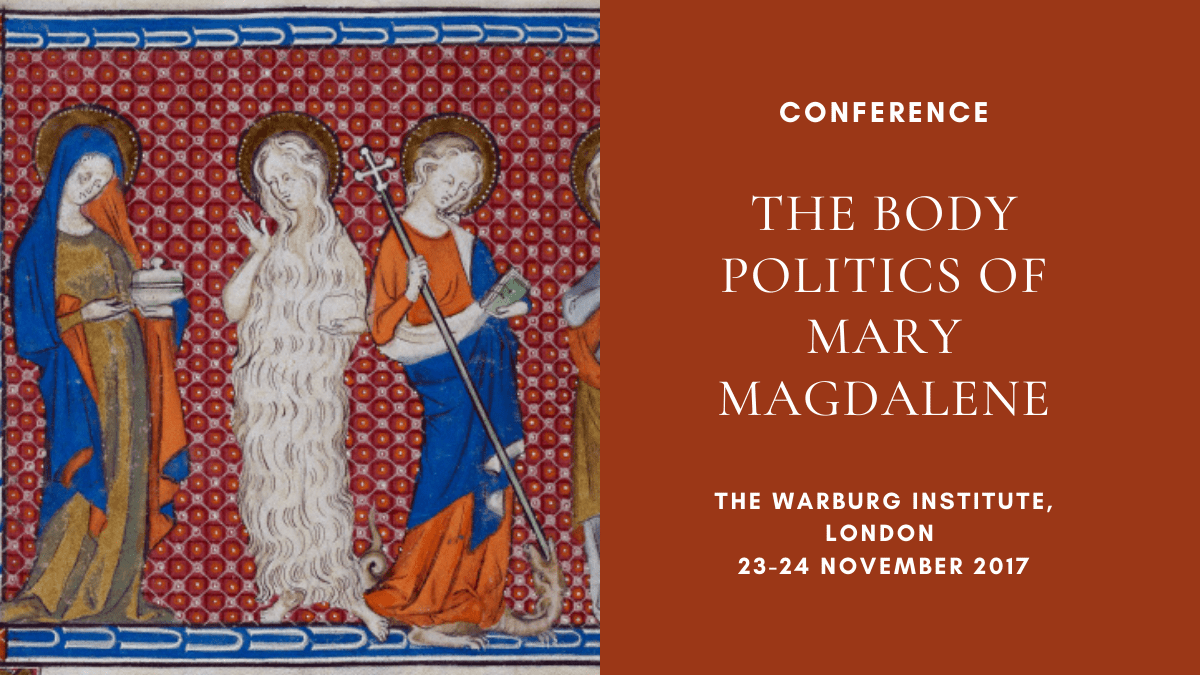
Conference: The Body Politics of Mary Magdalene, The Warburg Institute, London, 23-24 November 2017

The Warburg Institute is holding a two-day conference on Mary Magdalene, a figure of great historical importance and cultural resonance. Coming together for this free event, the multidisciplinary speakers will present new research on the representation of her body and its discourses across time and space.

Registration: bit.ly/Mary-Mag

PROGRAMME
Thursday 23 November 2017
5.30pm Welcome and Introduction

Conference keynote:
Penny Jolly (Skidmore College)
“Addressing and Undressing the Female Body in the Magdalene Chapel at San Francesco, Assisi”
Supported by the Coffin Trust, University of London

Reception

Friday 24 November 2017
10am Registration and Coffee
10.30am Welcome and Introduction

Session 1: Chair – Zoe Opacic (Birkbeck)
10.45am
Paper 1: Joan Taylor (KCL)
What did Mary Magdalen look like?
11.30am
Paper 2: Joanne Anderson (WI)
Materialising the Body of the Saint: Pilgrimage Politics and Art

12.15-1.30pm Lunch (for speakers and chairs only)

Session 2: Chair – Rose Marie San Juan (UCL)

1.30pm
Paper 3: Diane Apostolos-Cappadona (Georgetown)
“An ‘athlete of God’ or simply naked?: The Magdalene in the Wilderness from Isenbrandt to Etty”

2.15pm
Paper 4: Francesco Ventrella (Sussex)
Morelli’s Magdalen and the Sexual Politics of Reading

Tea/Coffee – all delegates

Session 3: Chair – Rose Marie San Juan (UCL)

3.30pm
Paper 5: Lucy Bolton (QMUL)
Beautiful repentant whore: Mary Magdalen, Movie Star

4.15pm
Paper 6: Henrietta Simpson (Slade School of Art, UCL)
The Implications of Absence: Mary Magdalen and the Wilderness Landscape

5pm Roundtable chaired by Michelle O’Malley (WI)

6.15-7.30pm
Magdalena. A Portrait in Song of One of Christianity’s Most Beloved Sinners
Joglaresa. Director: Belinda Sykes
Supported by the Coffin Trust, University of London
The Warburg Institute Lecture Room. Refreshments provided

Conference: Singular Acts: The Role of the Individual in the Transformation of Collective Culture, The Warburg Institute, 16 November 2017

410868Conference: Singular Acts: The Role of the Individual in the Transformation of Collective Culture, The Warburg Institute, 16 November 2017

The Warburg Institute will host its second Postgraduate Symposium on 16 November 2017. This year’s Symposium focuses on particular personalities who acted for or against historical and cultural change.  The Early Modern period saw seismic shifts across all aspects of society, ranging from technological developments to new artistic techniques; to innovations in philosophical thought and religious doctrine and scientific discoveries; to social and political movements. This interdisciplinary conference will appraise the extent to which such transformations were triggered or repressed by the acts of individuals such as innovators, pioneers, reformers and censors.

Attendance is free of charge. Pre-registrations required: https://warburgpostgradsymposium.eventbrite.co.uk

For more information: warburg.postgrad@gmail.com
https://warburgpostgrad.wordpress.com/

Organisers: Organisers: James Christie, Lorenza Gay, Hanna Gentili, Lydia Goodson, Vito Guida, Antonia Karaisl, Finn Schulze-Feldmann, Genevieve Verdigel. 

PROGRAMME 2017

INTRODUCTION
10:15 – 10:30 Professor Bill Sherman (Director of The Warburg Institute)

SESSION 1: Art and Invention
Chair: Lorenza Gay (The Warburg Institute)


10:30 – 10:50 Allegra Baggio Corradi (The Warburg Institute)
A Book, a Bust and a Pelican Pet: Philosophy, Art and Zoology in Niccolò Leonico Tomeo’s Cinquecento Padua

10:50 – 11:10 Mauricio Oviedo Salazar (University of Amsterdam)
The Legacy of the Poeta-theologus: Salutati’s Influence in 15th-century Italian Art

 11:10 – 11:30 Response and discussion.

 11:30 – 11:45 Tea

 SESSION 2: Challenging Established Philosophies

Chair: Genevieve Verdigel (The Warburg Institute)

 11:45 – 12:05 Maria Vittoria Comacchi (University of Venice)
Marsilio Ficino’s renovatio antiquorum through Leone Ebreo’s Dialoghi d’amore: a philosophical theological Reform before the Reformation

12:05 – 12:25 Salvatore Carannante (Istituto Nazionale di Studi sul Rinascimento, Florence)
‘A Mercury sent down by the Gods’: Bruno’s Self-Representation between Ancient Wisdom and Nova Filosofia

 12:25 – 12:45 Response and discussion.

 12:45-14:00 Lunch

SESSION 3: Within/Without Institutions
Chair : Antonia Karaisl (The Warburg Institute)

14:00– 14:20 Sophie-Bérangère Singlard (Université Paris-Sorbonne)
To be an Influential Humanist and to become an Important Name in 16th-century Spain: The Case of Francisco Sánchez de las Brozas

14:20 – 14:40 Hasan Siddiqui (University of Chicago)
Critical Modes of the Scholarly Life in Early-Modern South Asia 

14:40 – 15:00 Response and discussion.

15:00 – 15:15 Tea

SESSION 4: The Patron and the Poet: self-fashioning in words, art, and music

Chair: Lydia Goodson (The Warburg Institute)

15:15 – 15:35 Elisa Zucchini (University of Florence)
Art and Music in Gran Principe Ferdinando de’ Medici’s Patronage

15:35 – 15:55 James Barry (University of Cambridge)
Vanity Projects: Thomas Lyster’s Fragments (1714) and the commercialisation of individualism in late seventeenth and early eighteenth century print culture

15:55 – 16:15 Response and discussion.

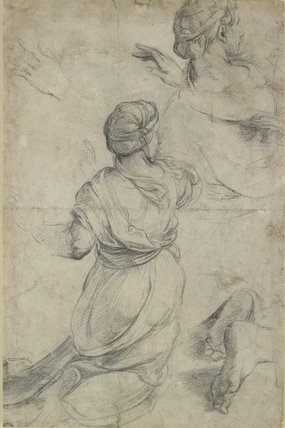
16:15 – 17:15 Keynote AddressDr Ben Thomas, (Co-Curator of the 2017 Exhibition ‘Raphael, The Drawings’ at the Ashmolean; University of Kent)

 ‘Raphael: Singular Acts of Drawing’

17:15 – 17:30 Closing Remarks: Professor Michelle O’Malley (Assistant Director of The Warburg Institute)

17:30 – 18:30 Reception


Conference: La chiesa e la parrocchia di San Giacomo dall’Orio, Venice, 9-10 November 2017

Conference: La chiesa e la parrocchia di San Giacomo dall’Orio, Venice, 9-10 Nov 2017, Ca’ Foscari University, Venice, November 9 – 10, 2017

“La chiesa e la parrocchia di San Giacomo dall’Orio: una trama millenaria di arte e fede” (Chiese di Venezia, Nuove prospettive di ricerca, 6), cur. by Massimo Bisson, Isabella Cecchini and Deborah Howard

Like every Venetian parish church, the evolution of San Giacomo dall’Orio has been closely interconnected with the development of the surrounding area. Its free-standing site, however, remains unusual, shared only by the church of Santa Maria Formosa; like the latter, its facade addresses the canal while the apses project into the campo.
Over the centuries the parish became progressively marginalised: the area within the original parish boundaries is now landlocked, with access to the Grand Canal only possible by means of a network of small canals.  The availability of land and the spread of modest, functional housing blocks for artisans and workers — combined with the distance from the centre (which became dominated by the San Marco-Rialto axis) — led to the development of the area around San Giacomo dall’Orio as an industrial zone, dedicated in particular to wool manufacture.
Although the area became primarily a popular quarter, it still preserves several palaces erected by noble families, among them that of the diarist Marin Sanudo.  In addition, the city’s first anatomy theatre was located in the present Corte dell’Anatomia, while in 1671, thanks to an initiative of the Loredan family, the College of Surgeons was founded on the south side of the church.
This conference, therefore, aims to address the more general social and urban characteristics of the parish, and to contextualise the church within the varied daily life of the campo.  This space hosted a range of activities: ludic (remaining unpaved until the eighteenth century, it was used as a football field, even by players from noble families); religious (it was the scene of numerous confraternity processions); and socio-economic (including the practice of crafts).
The church of San Giacomo dall’Orio was probably founded towards the end of the tenth century, even if its documented status as a parish only dates back to 1130.  Rebuilt in 1225, the church acquired its main elements thanks to radical restorations after the earthquake of 1345: the aisled transepts and the present ship’s-keel roof probably date from this time.
Between the end of the Quattrocento and the mid Cinquecento the church was subject to various renovations in the presbytery, nave and aisles, leading to its present configuration.  In particular, following the removal of the rood screen at the entrance to the presbytery, the stalls were transferred to the apse.  The organ was relocated to a wooden organ loft over the main entrance portal — one of the oldest surviving examples of this arrangement.
After the mid Cinquecento, various alterations mainly concerned the interior, which houses works by such celebrated artists as Veronese and Palma Giovane.  Moreover, the parish became the setting for the altars and ritual activities of numerous confraternities, including the important Scuola del Sacramento, whose members came from a wide social range.
Interventions since the middle of the Settecento include the addition of partition walls in the transepts (later removed), the construction of a new sacristy during a programme of structural and decorative repairs at the start of the twentieth century, and, fifty years ago, a complete refurbishment of the presbytery.
Spoils and precious marbles – such as the flecked black marble Ionic column and the unusual polylobed holy water stoop – remained long after these had passed out of fashion.  The beautiful marble pulpit is unique in the city.  At the same time, the almost complete absence of wall-tombs and the relative lack of family chapels serve to underline that this was a popular quarter with few elite families.  One of the most important patrons was the parish priest Giovanni Maria da Ponte, who commissioned a cycle of paintings for the Old Sacristy.  The eucharistic symbol in the centre of the ceiling by Palma il Giovane, not to mention the Sacrament Chapel itself, indicate the growing devotion to the Holy Sacrament.  Even if the apostolic visitations of the late sixteenth-century mention certain deficiencies, the programme of artistic renewal during the Counter Reformation reflects the parish’s serious response to post-Tridentine reforms.
The remarkable spatial and artistic coherence that characterises the whole building is not easily explained by the usual practices of art-historical and architectural analysis.  It is now recognised, of course, that an appreciation of the ceremonial, liturgical and devotional practices, especially those connected with the life and character of the parish, constitute an essential element in the understanding of a sacred building and its many individual details.  The proposed conference therefore seeks to interpret this historic church within its broader historical and geographical context.
The dissemination of knowledge of Venetian churches, to audiences of experts and non-specialists alike, is a characteristic of the conferences organized by the project “Chiese di Venezia. Nuove prospettive di ricerca”. The wide participation of the public (at the sessions and guided tours) in the five conferences organized annually since 2011 has demonstrated the effectiveness of this type of gathering.
Visits to the church will be organised as part of the programme.

Program
9, November
– Ca’ Dolfin, 10.00-13.00
10.00-10.15 Registration
10.15-10.30 Welcome. Martina Frank (Università Ca’ Foscari), Gianmario Guidarelli (Università degli Studi di Padova)
10.30-10.45 Introduction. Massimo Bisson, Isabella Cecchini, Deborah Howard
Session “Il contesto urbano”, chair: Deborah Howard (University of Cambridge)
10.45-11.15, Michela Agazzi (Università Ca’ Foscari), “San Giacomo dall’Orio, il contesto”

11.15-11.30 Coffee break

11.30-12.00 Edoardo Demo (Università degli Studi di Verona), “Società e vita industriale”
12.00 -12.30 Jane Stevens Crawshaw (Oxford Brookes University), “Life, death and the Anatomy Theatre in early modern Venice”
12.30-13.00 Discussion
13.00-14.30 Lunch

-Ca’ Dolfin, 14.30-18.15
Session “La vita della parrocchia”, chair Massimo Bisson (Università degli Studi di Padova)
14.30-15.00 Pascal Vuillemin (Université Savoie Mont Blanc, “Una parrocchia tra due sedi: San Giacomo dall’Orio nel Medioevo (XII-XV secc.)”
15.00-15.45 Isabella Cecchini (Università Ca’ Foscari) and Jean-François Chauvard (Université de Lyon 2), “Appunti sugli stati delle anime a San Giacomo a fine Cinquecento”
15.45-16.15 Discussion
16.15-16.45 Coffee break

16.45-17.15 Francesco Trentini (Università Ca’ Foscari), “L’apostolo, il matamoros, il pellegrino. Le molteplici connotazioni del titolo di San Giacomo dall’Orio (secoli X-XVI)”
17.15-1745 Elena Quaranta(Università Ca’ Foscari), “Musica e musicisti a San Giacomo dall’Orio: un’indagine archivistica”
17.45-18.15 Discussion

novembre, 10th
Ca’ Dolfin, 9.30-12.45
-Session “Conservazione e trasformazione”, chair Isabella Cecchini (Università Ca’ Foscari)
9.30-10.00 Massimo Bisson (Università degli Studi di Padova), “Il complesso dell’organo: trasformazioni architettoniche e funzionalità liturgica”
10.00-10.30 Adriano Amendola (Università degli Studi di Salerno), “Tra Oriente e Occidente: i marmi policromi della chiesa di San Giacomo dall’Orio”
10.30-11.00 Discussion
11.00-11.15 Coffee break

11.15-11.45 Marie-Louise Lillywhite (University of Warwick), “The Decorative Programme after the Council of Trent”
11.45-12.15 Thomas Worthen (Drake University), Altars and other furnishings for the Scuola del SS. Sacramento in San Giacomo dall’Orio
12.15-12.45 Discussion
12.45-15.00 lunch

15.00-17.00 Church of di San Giacomo dall’Orio, Session “in situ”, Massimo Bisson, Isabella Cecchini, Gianmario Guidarelli, Deborah Howard.

Reference / Quellennachweis:
CONF: La chiesa e la parrocchia di San Giacomo dall’Orio (Venice, 9-10 Nov 17). In: ArtHist.net, Oct 19, 2017. <https://arthist.net/archive/16534>.

CFP: International Graduate Students Colloquium, “Why did they choose this place? Settlements, Representations and References of Buildings and Objects (11th-17th centuries)”, Amiens (France) 29-30 May 2018

afficheCall For Papers: International Graduate Students Colloquium, “Why did they choose this place? Settlements, Representations and References of Buildings and Objects (11th-17th centuries),” Amiens (France), 29-30 May 2018
Deadline: 15 January 2018

The research laboratory Trame (Texts, Representations, Archaeology and Memory from Antiquity to the Renaissance) of the University of Picardie Jules Verne associated with the research unit Transitions. Middle Ages and First Modernity (University of Liège) and with the Center for Advanced Studies in the Renaissance of the University François Rabelais (Tours) is organising three international meetings implemented by PhD students of these three institutions. the aim of the meetings is to enable exchanges and discussions between PhD students, junior researchers and experimented colleagues.

The first meeting will be held in Liège on Tuesday the 30th of January and Wednesday the 31st of January 2018 on the theme “Transition(s): concept, methods and case studies (14th-17th centuries)”.

The second meeting will be held in Amiens on Tuesday the 29 th of May and Wednesday the 30rd of May 2018 on the theme : “Why did they choose this place? Settlements, Representations and References of Buildings and Objects (11th-17th centuries)”

This colloquium will be divided into two parts: first, the choice of the place of the building, and then the choice of the place of the object.
The construction of a new building usually start with an important thinking concerning the localization. The choice is strategic or symbolic, sometimes both, and depend on its function, its sponsor and its geographical context. For example, a monastery will set up on a secluded place or, in the contrary, on an urban center; a military fortress must occupy a strategic place to dominate a territory etc. In this way, it’s interesting to study all these factors, actors and issues regarding the establishment process in a rural, urban or suburban context. In the same way, objects (such as paintings, sculptures, precious objects, reliquaries, pieces of jewellery, funerary monuments, pieces of furniture, symbols of power etc.) are interesting to study. A lot of them need to be placed on a specific location, whether it’s in a real place or in the composition of a bidimensional work. The place where the object is arranged can be modified in consequence as there
are interactions between them. The goal of this meeting is to gauge the notion of place in all its forms in order to understand its meaning and its importance during the Middle Ages and First Modernity.

Day 1: The place of the Building
This first day will be focused on the buildings. The statements have to match the three
following approaches:
– The location choices of the edifice: how the place was chosen? Who were the actors of this choice? What were the effects of this implantation on a local and global historical context? Studies could focus on a specific place, a religious community, an edifice or an archaeological site. It’s a matter of showing the location strategies and the territorial transformations after the creation of a new “place of power” or a place of production in a historical and geographical context.
– The place‘s portrayal is the second theme: why did they choose this place? How is it
represented and why? Are they accurate the original place? How fictive places are show? The statements have to consider the different means used to point out peculiar location and the underlying goals.
– The place’s references in the sources: how literature and manuscripts mention those places whether real or fictive? What is the purpose in those texts? In an illuminated book, how is introduced the description of the place and what are the connections between the picture and the text? The statements could cover the evolution of the terms used to qualify a place. For example, the Latin word “prioratus” is barely used to qualify a priory between the 11th and the 13th centuries in manuscripts but we find lot of others words like house, farm, church etc.

Day 2: The place of the object
Concerning the place of the object we propose the three following themes:
– The position of the object:  usually, special objects are put in specific places: a building, a public space or a private one, or even a tomb. It would be interesting to attempt to understand why those objects have been placed in well-chosen areas, which were the factors and the issues according to which this decision has been made and by who. The history of the different places in which an object dating back to the 11th to the 17th century has been settled from his creation up to the present time can be made through a historiographical perspective. Reflections focusing on the methods used by historians, historians of arts or archaeologists to identify the original place of an object are
welcomed.
– Interaction between the object and the place: the goal is to think about the conjoint and
disjointed evolution of the building and the object: which are the impacts of the mutations and the intern reconstructions of the building on the object? How a building can specifically be built to accommodate one or several objects? This theme concerns both religious and public spaces, but also private places and the first experiences in museum architecture linked to a collection. Once again, all reflections about the methodology used to understand those interactions are welcomed.
– Representation of the object in paintings, illuminated manuscripts and sculptures: this
third theme invite to wonder about the methods used to represent the object on pieces of art. How is it put on the spot when it plays a central role in the pieces of art? How an object can be used to build up the composition of a picture?

Contribution Modalities
Lectures should relate to history, archaeology, history of arts and literature, from the 11th to the 17th century. The purpose is to have a brand new and interdisciplinary view on the notion of “place” which finally concern several research subjects. Communications should try to introduce historiographical elements enabling to develop comparisons between the different interventions and to think about the notion of “place” nd its evolution through time.

The proposals are expected for the 15th of January 2018 at the latest. They should be fifteen-line summary of the proposed lecture addressed to the Organising Committee, send together with a CV, the title of the thesis et the name of the research director(s). Candidate will be informed of the approval or the rejection of their proposal by the 15 th of February 2018.
Lectures should last 20 minutes maximum, with the possibility to project a Powerpoint. They can be made in French or in English.
We will unfortunately not be able to provide you financial help for the accommodation or the transport.
If you need an attestation to valorise your participation, we will be able to provide it.
Please do not hesitate to contact us if you need further information.
Organising Committee:
– Julie Colaye, PhD student in medieval history : juliecolaye@gmail.com
– Marie Quillent, PhD student in history of medieval art : marie.quillent@wanadoo.fr

CFP: Early Career Workshop in Medieval Intellectual History, All Soul’s College, Oxford, 22 March 2018

38df198add37e18fb750927fc44ef630CfP: Early Career Workshop in Medieval Intellectual History, All Soul’s College, Oxford, 22 March 2018
Deadline: 30 November 2017

Early career scholars, including current and recent PhD students, are warmly invited to submit a proposal for a brief presentation on their research of 10-15 minutes. The workshop will be held in the Old Library at All Soul’s College, Oxford and is organized by Dr Lydia Schumacher, Visiting Fellow at the College, Senior Lecturer in Medieval Philosophy and Theology at King’s College London, and Principal Investigator of a European Research Council project titled, ‘Authority and Innovation in Early Franciscan Thought.’ A certain number of spaces will be reserved for participants from Oxford University and King’s College London, but submissions are welcome from members of any other university. To propose a paper, please submit an abstract of up to 200 words by 30 November 2017 to Tom J. Savage (thomas.savage@kcl.ac.uk)


Funding: Shohet Scholars Grant Program 2018/19, International Catacomb Society

vt-4kdr4_400x400Funding: Shohet Scholars Grant Program 2018/19, International Catacomb Society
Various Locations, July 01, 2018
Application deadline: January 15, 2018

The Shohet Scholars Grant Program of the International Catacomb Society is now accepting applications to the Shohet Scholars cohort of 2018-2019. Submission deadline is January 15, 2018.

This annual grant program funds research on the Ancient Mediterranean from the Hellenistic Era to the Early Middle Ages. Shohet Scholars may do their research in the fields of archeology, art history, classical studies, history, comparative religions, or related subjects. Of special interest are interdisciplinary projects that approach traditional topics from new perspectives.

One or more Shohet Scholars will be selected each year. The primary intent of the grant is to support significant, innovative research that can be completed and reported upon within and shortly after the award period. Grants may be made to seed innovative approaches and new ideas or to cover specific expenses or phases of a larger project under the direction of the applicant. At this time, awards in the range of $2,000 to $30,000 will be made. The Shohet Scholars Program reserves the right not to make a grant in a year in which there are no applications meeting the requirements of the program. A complete history of past and present Shohet Scholars awards is available on the ICS webpage, www.catacombsociety.org.

Eligibility
Scholars of all institutional affiliations and independent scholars may apply for Shohet Scholar funding if they are individual or institutional members of the ICS at the time of the application submission deadline of January 15, 2018 and in possession of a doctoral degree or the equivalent. Preference will be given to applicants in the early postdoctoral or launching stage of their careers (i.e., persons awarded the doctorate within six years prior to the application deadline).

Non-U.S. citizens may apply if a co-applicant is a legal resident or native or naturalized citizen of the U.S.A., meets all eligibility requirements, and has a genuinely collaborative and credited leadership role in the proposal. Co-applicants must submit as individuals all the necessary forms except for the research proposal, list of permissions, and budget proposal, which may be filed jointly.

Employees, contractors, and members of the Board of Directors or Advisory Board of the ICS and their families are ineligible. No applicant will be denied consideration or selection because of race, religion, or ethnic origin. Any fraudulent misrepresentation of self and information about a proposal will result in a disqualification.

Reporting Requirements
Shohet Scholar grant recipients are expected to: 1. acknowledge the Shohet Scholars Program of the International Catacomb Society in all publications and activities that are funded in part or in whole with the award with direct notification to the Society when these events occur and 2. provide the Shohet Scholarship Committee no later than three months after the end of the fellowship year with a brief, illustrated report of the work carried out or in course, suitable for publication on the ICS website.

Deadlines and Decisions
The application deadline for the 2018-2019 academic year is January 15, 2018. The award announcement for the 2018-2019 academic year will be made by May 1, 2018, for funding to be disbursed on July 1, 2018. Please note: starting in 2018, all funding is awarded directly to the USA-based awardee, for distribution among project co-applicants and collaborators. The ICS will no longer wire or transfer money to bank accounts outside of the USA.

Questions ?
If you have any questions about the suitability of proposed projects, application procedures, or any other matters related to the Shohet Scholars Program, please consult our FAQ page or contact us at shohetscholars@catacombsociety.org.

CFP: Walking with saints, Ronse, Belgium, 24-16 May 18

fiertelCall for Papers: Walking with saints, Ronse, Belgium, May 24 – 26, 2018
Deadline: Dec 10, 2017

Walking with saints: protection, devotion and civic identity. The role of the landscape.

Since the adoption of the UNESCO Convention for the Safeguarding of Intangible Cultural Heritage in 2003, the issue of cultural practices has increasingly gained the attention of heritage professionals, academics, decision makers and practitioners alike. Many practices, rituals, performances, social traditions, craftsmanship and more have since been put on the list of Intangible Cultural Heritage. However, despite the growing interest in the social dimensions of cultural heritage and the recognition of the importance of the intangible aspects of heritage, many issues still need further reflection.  A crucial aspect is the interaction and relationship between intangible cultural heritage and its spatial contexts. This is part of a broader “spatial turn” in historiography and research.
For centuries people in Europa and elsewhere have walked the landscape carrying the relics of martyrs and saints. By doing so they gave meaning to and altered the significance of the land, be it urban or natural, in more ways than we imagine. One of these aspects is the way in which the landscape is transformed by walking it, thus setting paths, reinforcing boundaries, strengthening a community’s identity in relation to a certain landscape or setting the pace of life according to the repetition of the traditional acts in time.
“Walking with saints: protection, devotion and civic identity” focusses on the origin and evolution of procession rites with a strong link with the landscape. This conference, therefore, aims at studying the religious landscape, be it a specific spot or a larger territory, not as the mere spatial background for spiritual activities, but as an active agent in the shaping, transmission and transformation of the spiritual activity of human beings throughout time. Hence, we invite also reflections on developments in the 19th and 20th centuries when a rediscovering of the past, both within and outside the Christian churches, was en vogue and when new ways of looking at the natural landscape were moulded in the aftermath of the industrialisation of the economy.

Though the starting point is an activity that is typical for Europe, we are interested in broadening the perspective to non-Christian and non-Western traditions that have an important connection with the landscape in which they are performed.  It is generally known, for example, that the landscape and natural phenomena play an important role in the traditions of indigenous cultures in Australia, the Americas and Africa. In Asia walking with the statues of gods is a common, though little understood, phenomenon. It is to be expected that these traditions can broaden our understanding of the role of the landscape in the development and sustainability of immaterial heritage.

Papers are invited that deal with the following themes of the conference:
•    Sacralisation of the landscape: alteration, destruction and resistance
•    Immaterial heritage: religion and landscape
•    Perennial aspect of immaterial heritage
•    Immaterial heritage and community building: identity, assimilation, integration
•    Healing saints in their territorial context
•    The influence of processions on the landscape and on the drawing of parochial and city boundaries
•    Processions, pilgrimages and the senses
•    Healing saints, magic and assimilation

The starting point for the conference and the reason why it is held in Ronse is the Fiertel Ommegang. This procession originates from around 1090 A.D. and is yearly held on Trinity Sunday. During a walk of 32, 6 km the inhabitants of Ronse circumscribe the territorial boundaries of the city carrying Saint Hermes’s relics for protection and cure. For ages, the Fiertel has been one of the most important religious activities in the region and it has to date remained a strong symbol of the inhabitant’s civic identity even in times of secularization.
This 3 day conference will be hosted by the city of Ronse and is part of an assessment of the local Fiertel procession as a possible candidate for recognition as UNESCO Intangible Cultural Heritage.

Please submit papers for individual sessions no later than December 10 2017.
Proposals should include
– A paper title of max. 10 words
– A paper abstract of max. 350 words
– A short C.V. of max. 1000 words including current current affiliation and full contact details
All documents should be merged into 1 single PDF file.
Proposals should be sent to papers@wws2018.com

Call for complete session proposals

While the sessions proposed by the conference organisers focus on the western European and Christian traditions we welcome complete session proposals on related themes covering non-Western and non-Christian traditions.
The aim of the conference is not only to study the Fiertel in its local context, but also to trace traditions and rituals which are cross-confessional and transcultural. We hope that this reflection and dialogue will help us to understand the origins of the Fiertel, as a ritual and spiritual quest outdating Christianity.

Full session proposal are to be submitted by December 10 2017.

Proposal should include:
– A session title of max. 10 words
– A session proposal of max. 350 words
– 3 individual paper proposals consisting out of a title of max. 10 words and an abstract of max. 350 words each.
– A CV of max. 1000 words for each: the session organizer and the session participants. The CV should include information on the current affiliation and full contact details.

All documents have to be merged into 1 PDF file.

Proposals should be sent to papers@wws2018.com

CFP: L’architecture gothique. Entre réception et invention. Impact, continuité et réinterprétation (XIIe – XXe siècle), Centre André Chastel, Paris, 10 March 2018

e4172ce752979324efadeeb13ae35d66-viollet-le-duc-game-propsCall for Papers: L’architecture gothique. Entre réception et invention. Impact, continuité et réinterprétation (XIIe – XXe siècle), Centre André Chastel, Paris, 10 March 2018
Deadline: 15 November 2017
L’une des définitions les plus correctes du terme « gothique » est celle qui interprète ce phénomène architectural non comme l’expression d’une période historique mais comme un système structurel, défini en Ile-de-France à partir du milieu du XIIe siècle. Les connaissances techniques déjà expérimentées à l’époque romane sont alors intégrées dans une relation consciente entre structures portantes et structures portées, en obtenant de nouveaux effets esthétiques et symboliques.

Entre la fin du XIIe et le XIIIe siècle, l’architecture gothique se développe en Europe, particulièrement en Angleterre, Allemagne, Espagne, Italie, Hongrie et Bohème et entre en contact avec les traditions constructives locales, notamment grâce à l’activité des ordres monastiques. La synthèse entre la réception de modèles existants et l’invention de nouvelles expressions artistiques donne naissance à des œuvres neuves créées dans des contextes historiques, géographiques et socio-culturels différents par rapport au contexte français.

En Italie, par exemple, la leçon du gothique français, transmise principalement par les cisterciens, est ensuite assimilée par les ordres mendiants et, en Italie méridionale, par Frédéric II et finalement par les Angevins. Cependant, le gothique italien ne développe pas l’audace structurelle qui fut, en France, à l’origine d’un formidable élan vertical des parois et de l’effet de lux continua. Cette différence est à la fois due à la persistance de techniques constructives traditionnelles dans la filiation de l’architecture paléochrétienne et à l’impossibilité d’appliquer la technique de l’arc-boutant dans une zone fortement sismique.

Au même titre, en France, entre le début du XVe et le milieu du XVIe siècle, l’art gothique flamboyant se mêle à la tradition de la Renaissance importée d’Italie : si l’ossature des églises reste « gothique » même lorsque les formes ornementales assimilent des caractères à l’antique, l’originale rationalité structurelle est en grande partie perdue. La persistance des formes flamboyantes dans l’architecture de la Renaissance française est un phénomène intéressant qui révèle l’importance et l’influence de la tradition gothique.

Plus tardivement et à titre d’exemple, au XIXe siècle le phénomène des revivals historicistes atteste la reprise du langage gothique en Europe. Une telle tendance s’imposa d’abord en Grande-Bretagne puis se diffusa dans d’autres pays européens, parallèlement à l’intense activité de restauration des monuments médiévaux : en France c’est surtout Eugène Viollet-le-Duc qui en souligna la rationalité constructive. Le néogothique, devenu désormais partie intégrante de l’éclectisme historiciste, constitue une source fondamentale pour l’art nouveau jusqu’au début du XXe siècle.

La journée sera par conséquent consacrée à une réflexion sur la réception de l’architecture gothique comme langage flexible, à même de créer de nouvelles formes artistiques : l’objectif est de conduire l’historien de l’art et de l’architecture à enquêter sur la portée et l’influence de ce phénomène dans des contextes différents de celui d’origine. La journée vise ainsi à élargir l’analyse aux questions historiques, politiques, culturelles et urbaines, en fonction des objectifs des commanditaires et en établissant des liens entre aspects structurels, fonctionnels et formels. La journée doctorale sera l’occasion de partager les réflexions méthodologiques, les problématiques et les résultats des recherches en histoire de l’architecture de doctorants et jeunes docteurs de formations et de pays divers.

La série de thématiques suivante est destinée à suggérer des domaines et directions de recherche et n’a que valeur indicative :
– Techniques et matériaux de l’Architecture gothique : innovations structurelles, continuité et rupture avec le passé
– Cathédrale gothique et différentes formes locales en France
– Gothique français et sa diffusion en Europe
– Gothique flamboyant et Renaissance : dialectique entre survivances structurelles et décor « à l’antique »
– Réception du Gothique après le Gothique : survivance et renouveau néogothique
– L’architecture gothique, sa restauration ou sa réutilisation contemporaine
– L’architecture gothique intégrée dans les autres formes de l’art visuels (peinture, gravure, sculpture), sémantique visuelle et revival.

La journée donnera la priorité aux interventions des doctorants et jeunes docteurs. Elle se déroulera le 10 mars 2018 au Centre André Chastel (INHA, 2, rue Vivienne, 75002 Paris).

How to apply:  Les propositions de communication (300 mots maximum), en français ou en anglais, accompagnées d’un bref curriculum vitae (2 pages maximum), sont à envoyer, le 15/11/2017 au plus tard, à Camilla Ceccotti et Emanuele Gallotta aux adresses suivantes :
camilla.ceccotti@uniroma1.it
emanuele.gallotta@uniroma1.it

10 Doctoral Fellowships in the a.r.t.e.s. EUmanities-Programme

10 Doctoral Fellowships in the a.r.t.e.s. EUmanities-Programme
Deadline: November 3, 2017
csm_eumanities_rgb_2680d6c349a.r.t.e.s. EUmanities is a pioneering programme for a European Graduate School for the Humanities, co-funded by the European Union and the University of Cologne as part of the Marie Skłodowska-Curie Actions (Horizon 2020: MSCA). Central to this programme are its interdisciplinary approach and obligatory mobility phase.

Designed to meet the needs of individual Early Stage Researchers (ESRs) in the Humanities, beginning in April 2018 a.r.t.e.s. EUmanities provides places for up to 10 ESRs, training young scholars to excel in research and cope with the global challenges Europe is facing. Our mission is to empower ESRs in the Humanities to become aware of their pivotal role in shaping the future of Europe.

ESR positions have a duration of 36 months per person. The ESRs will be employed full-time by the a.r.t.e.s. Graduate School (living allowance EUR 3,073 less tax deductions and employer’s contribution to social insurance plus a monthly paid mobility allowance and additional travel and, if applicable, family allowances). The employment conditions include social benefit payments such as health insurance, unemployment insurance, pension contributions and parental benefits. Please note that, in general, the a.r.t.e.s. Graduate School is not able to cover tuition fees for the institution chosen for the obligatory mobility phase.

The ESRs of a.r.t.e.s. EUmanities are enrolled in the structured doctoral model of the a.r.t.e.s. Graduate School, the “Integrated Track”, according to two international mobility options. ESRs may apply for:

• “a.r.t.e.s. EU”: the European fellowship at a.r.t.e.s. EUmanities

• “a.r.t.e.s. global”: the global fellowship at a.r.t.e.s. EUmanities

a.r.t.e.s. EUmanities is funded by the Universität zu Köln and the European Union’s Horizon 2020 research and innovation programme under the Marie Skłodowska-Curie grant agreement No 713600.

For more information on the application procedures and requirements, please visit www.artes.uni-koeln.de pr contact us via e-mail: artes-EUmanities@uni-koeln.de.