Books roundup: New Publications in Art

magdeburger-reiter-255x330GABRIELE KOSTER, UTA SIEBRECHT. Der Magdeburger Reiter, Schnell & Steiner, 2017, 368 p.
ISBN: 978-3795432027

Der Band versammelt Beiträge namhafter Experten aus den Bereichen Restaurierung, Kunstgeschichte, Geschichte und Rechtsgeschichte, die den aktuellen Forschungsstand zum Magdeburger Reiter als bedeutende Skulptur der mittelalterlichen Kunst- und Kulturgeschichte aus unterschiedlichen Perspektiven präsentieren.

Der Magdeburger Reiter, entstanden um 1240, gilt als das älteste erhaltene freiplastische Reiterstandbild nördlich der Alpen seit dem Ausgang der Antike und ist damit eine der bedeutendsten Skulpturen der mittelalterlichen Kunst- und Kulturgeschichte Europas. Im November 2015 fand aus Anlass der vollendeten Restaurierung des Kunstwerkes im Kulturhistorischen Museum Magdeburg eine interdisziplinäre Tagung zum Magdeburger Reiter statt.
Der dritte Band der Schriftenreihe des Zentrums für Mittelalterausstellungen widmet sich dem Reiterstandbild als mittelalterliches Kunstwerk, städtisches Wahrzeichen und europäisches Erbe. Erstmals liegt damit eine umfassende Publikation zum Magdeburger Reiter vor. Sie präsentiert fächerübergreifend die wissenschaftlichen Beiträge der Tagung, den Untersuchungs- und Restaurierungsbericht sowie eine umfangreiche Fotodokumentation der bedeutenden Skulpturengruppe.


JOSÉ ORFILA. Regards panoramiques sur le monde médiéval et Notre Dame de Reims, Godefroy de Bouillon, 2016, 520 p.JOSÉ ORFILA. Regards panoramiques sur le monde médiéval et Notre Dame de Reims, Godefroy de Bouillon, 2016, 520 p.
ISBN: 978-2841913282

24 figures (en couleurs) et 229 photos (dont14 en couleurs) illustrent ce livre à la gloire de l’architecture du monde médiéval. Depuis plus d’un demi-siècle, la pression toujours renouvelée des esthétiques avant-gardistes a modifié notre vision des choses. Nous avons découvert les mérites des arts les plus lointains et les plus anciens que l’on appelait jadis primitifs et qu’il faut honorer désormais du nom de “premiers”, ce qui les pare d’emblée des plus rares vertus. On est même allé jusqu’à les estimer “plus essentiels”. Rien d’étonnant donc que le gothique, celui des 12eme et 13eme siècles trop élaboré, trop conscient de soi et trop éloigné des pulsions basiques ne soit plus en faveur. De nos jours on se doit d’accorder plus de valeur aux masques africains, aux totems amérindiens et aux statues de l’Ile de Pâques qu’à la Ste Chapelle. Et l’évolution politico-culturelle réactivant les voluptueux mirages de l’Orient qui émoustillaient les mâles romantiques, le Français moyen commence à se sentir plus en phase avec le Tajmahal qu’avec la cathédrale de Reims. Car notre époque est avide de “retours aux sources” à condition que ce soient celles des autres et vénère toutes les traditions sous réserve que ce ne soient pas les nôtres. Ce livre rappelle la richesse de notre civilisation mise à l’écart par les bien-pensants.


art-nature-237x330NICOLE R. MYERS (ed.). Art and Nature in the Middle Ages, Yale University Press, 2017, 136 p.
ISBN: 978-0300227055

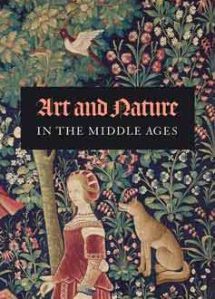
This splendidly illustrated book explores the universal and multifaceted theme of nature as manifested in Western European art of the Middle Ages. Fascinating essays consider the concept in the context of medieval philosophy, theology, and poetry. The masterpieces highlighted here,  from the distinguished collection of the Musée de Cluny, span the 12th through the 16th centuries and include an impressive array of objects destined for both religious and secular purposes—from exquisite stained glass and carved capitals to spectacular enameled jewelry, illuminated manuscripts, and woven tapestries. Art and Nature in the Middle Ages provides an essential understanding of the symbolism and significance of motifs taken from the natural world, as well as the technical mastery of the medieval artisans who produced these remarkable objects.
Nicole R. Myers is the Lillian and James H. Clark Curator of European Painting and Sculpture at the Dallas Museum of Art.

CONF: Riemenschneider In Situ (Rothenburg/Wuerzburg, 21-24 Jun 17)

220px-Tilman_Riemenschneider_Barbara-1Rothenburg and Würzburg, 21. – 24.06.2017

Conference Program

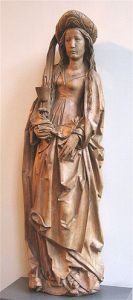
In 1980, Michael Baxandall introduced the sculptor Tilman Riemenschneider and his artistic milieu to English-speaking art historians — specialists and non-experts alike — with his book The Limewood Sculptors of Renaissance Germany. This publication appeared just a year prior to the first major exhibition of Riemenschneider’s early works in Würzburg’s Mainfränkisches Museum (1981). In the wake of Baxandall’s contribution, several major exhibitions, including those in Washington, Nuremberg, and Würzburg, have been dedicated to the sculptor vis-a-vis his contemporaries in southern Germany. These exhibitions and accompanying volumes have promoted inquiry into Riemenschneider’s commissions, his workshop practice, and the contemporary artistic climate.  But they have also led the sculptor’s works that survive in situ—and thus too large, heavy, or fragile to travel—to receive comparatively less scholarly attention. The Riemenschneider in Situ conferen e aims to redress this gap in art historical scholarship not only by examining the in situ artworks themselves but also the physical and discursive spaces in which they were installed.

Continue reading “CONF: Riemenschneider In Situ (Rothenburg/Wuerzburg, 21-24 Jun 17)”

CFP: Journal for Art Market Studies – Issue on “Translocations and the Art Market”

Deadline: Jun 15, 2017

Technische Universität Berlin, Institut für Kunstwissenschaft und Historische Urbanistik

Call for Papers

Deadline abstract (2,000 characters): 15 June 2017
Deadline article (30,000 characters): 31 October 2017

cropped-Hogarth-Schlacht-d.-Bilder

Journal for Art Market Studies – Issue on “Translocations and the Art Market”
https://www.fokum-jams.org

Since 2017 the Institute for Art History and Historical Urban Studies at Technische Universität Berlin has been publishing the Open Access Journal for Art Market Studies (JAMS). As part of the Institute’s well established Centre for Art Market Studies, the publication presents interdisciplinary research results on the past and present art market. The Journal conforms to Open Access standards including website submission through www.fokum-jams.org and peer reviews. Articles are published both as pdf and in HTML format, they are DOI registered and usually subject to a CC BY-NC copyright license.

For January 2018 we are planning an issue on the subject of “Translocations and the Art Market”, guest-edited by Professor Bénédicte Savoy. It will focus on the role of the art market in territorial displacements of cultural assets since antiquity. The context for this issue of the journal will be the wide research area outlined in the Leibniz Project Cluster “Translocations”, which will explore different forms, consequences, directions and backgrounds of such translocations. However, contributions to this issue of the journal should focus specifically on art market research.

Continue reading “CFP: Journal for Art Market Studies – Issue on “Translocations and the Art Market””

TOC: Art History and the Global Challenge. Artl@s Bulletin vol. 6,1

journalWe are pleased to announce the publication of the new issue of the Artl@s Bulletin devoted to Art History and the Global Challenge.

http://docs.lib.purdue.edu/artlas/

For this special issue of the Artl@s Bulletin, we asked a diverse group of scholars to share with us their perspectives on the “Global turn” and the ways the “Digital turn” is affecting it.

This survey must be regarded as a dialogue in progress: other conversations will follow and will contribute to widening the range of critical perspectives on art history and the Global challenge gathered in this issue.

Continue reading “TOC: Art History and the Global Challenge. Artl@s Bulletin vol. 6,1”

Publication en ligne – Annales de Janua, n° 5

Accès aux articles : ici

janua

Sommaire :

Editorial – Amélie Rigollet

Souverains et instruments de pouvoir

Les instruments de pouvoir : Excalibur, de la force du guerrier à la puissance du roi – Justine Breton
L’arc, la flèche et le carquois, symboles du pouvoir monarchique dans l’Antiquité – Benoît Lefebvre
Le pouvoir improvisé ? Pourpre impériale et diadème des usurpateurs dans l’Antiquité tardive – Maxime Emion
Nommer le pouvoir. La titulature seldjoukide (XIe-XIIe siècles) – Jean-David Richaud

Des arts aux registres en passant par le paysage urbain : les instruments de pouvoir et leurs multiples facettes

Les trépieds d’Apollon au sanctuaire du Ptoion : instruments religieux du pouvoir politique du Koinon Béotien à l’époque hellénistique ? – Anne-Charlotte Panissié
Communautés religieuses et pouvoirs laïques à Rouen (Xe-XVe siècle) : une histoire de l’appropriation des territoires – Lise Levieux
La domus et son décor de peintures murales : une pratique spatiale et décorative de la rhétorique au service du pouvoir des élites pompéiennes – Clémence Arnault
Les compilations d’archives, instruments du pouvoir ? L’exemple de l’échevinage de Reims au XVe siècle – Emmanuel Melin

CFP: Ars et Scientia (Cleveland, 27 Oct 17)

oresmeCase Western Reserve University, Cleveland, OH, October 27, 2017
Deadline: Jul 16, 2017

Ars et Scientia: Intersections of Science and the Visual Arts

October 27th, 2017

Despite the semantic divide that seems to separate art and science in modern culture, the boundaries between the two disciplines have always been fluid and permeable. From the earliest recorded botanical illustrations, painted on papyrus scrolls in Egypt in the 2nd century AD, to contemporary artist Josh Kline’s use of 3D printing in his work, art and science have long been used in tandem to make sense of the world and explore our place within it. The working notes of printers like Louis-Marin Bonnet as they experimented with the technique of chalk-manner engraving resemble nothing so much as a scientist recording data and observations for his experiments. Representations of the scientist at work in his laboratory also abound, from Pieter Bruegel’s Alchemist to Joseph Wright of Derby’s An Experiment on a Bird in the Air Pump, and serve as social commentaries on the role of the scientist in society. More recently, scientific technologies have proven to be invaluable tools for the modern art historian and museum curator, allowing us to better understand artists’ working methods and materials through the use of imaging technology and chemical analysis. This symposium seeks to foster a re-examination of the complex interactions between artistic and scientific disciplines that are more interdependent than they first appear.

We welcome innovative research papers from graduate students of all disciplines that challenge the divide between humanities and STEM fields. Papers may explore aspects of this topic across any time period, medium, or geographical region.

Topics may include, but are not limited to:

  • depictions of scientists, doctors, astronomers, engineers, etc. at work
  • visual evidence for the transmission of scientific knowledge between cultures scientific diagrams: anatomical, botanical, astronomical, alchemical, etc.
  • technical art history
  • art that incorporates the use of novel technologies: for example early printing or photography, video art, 3D printing aestheticized technology, such as astrolabes and globes microphotography or photographs of patients/specimens
  • descriptions of artistic methodologies in terms of scientific
    experimentation

    For consideration, please submit a 350-word abstract and CV to clevelandsymposium@gmail.com by July 16, 2017. Selected participants will be notified by early August. Paper presentations will be 20 minutes in length, and participants will be invited to author a blog post about their research to be published at clevelandsymposium.tumblr.com.

    Please direct all questions to Aimee Caya and Erin Hein at clevelandsymposium@gmail.com.

CFP: The Image of the Multitude in Art and Philosophy (London, 10 Mar 18)

medieval peasant revolts.jpgThe Courtauld Institute of Art, London., March 10, 2018
Deadline: Sep 15, 2017

Imago Multitudinis. The Image of the Multitude in Art and Philosophy

An International Conference at the Courtauld Institute of Art London, on the 10th of March.

The Courtauld Institute of Art, The British Academy and the Collège International de Philosophie are pleased to announce a one-day interdisciplinary conference focusing on the philosophical representation and the artistic conceptualisation of the multitude and its associated concepts: the many, the masses, the crowd, the mob and the commonality.

A spectre is haunting our times: the spectre of the multitude. Uprisings, popular unrests, mass migrations, revolutions—the past ten years have been marked by unprecedented quests for freedom, embodied by unconventional political subjects pointing to the possibility of alternative outcomes of the crisis of both authoritarian regimes and representative democracies. Through the masterful drawing of Abraham Bosse, Hobbes attempted to tame the multitude forever. Constrained within the body politic of the monstrous Leviathan (1651), the multitude was transfigured into an obedient people and its potentia was (apparently) usurped. Yet, the multitude resisted—and still resists—this movement, challenging the predominant definitions of sovereignty. Following the collapse of modern master narratives, such as in the nascent seventeenth century, the multitude has returned.

Our investigation revolves around the political and aesthetic meanings of this omnipresent, if elusive, collective being. In particular, we would like to ask the following questions: how do philosophers represent the multitude and translate their concepts into cogent images? How do artists think about the multitude and its agency? This enquiry, which spans from the Middle Ages to the present, concentrates on the way in which images and iconographic motifs are elaborated in philosophy, as well as how political concepts are articulated in the visual arts. In order to understand the images pervading, and the concepts informing, recent collective political action (from Tahrir Square to the streets of Tunis, New York, Madrid, Ferguson via Rojava and Lampedusa), we intend to focus on their modern and contemporary genealogies. This is not only a historical enquiry. The history of the multitude can help us better understand the present. The aesthetic, agency and ambitions of this political subject do not only survive in books and museums, they also live on among us. The multitude resists, and if this is the conflict that characterises political modernity, then modernity has begun again.

Invited speakers: Horst Bredekamp (Humboldt-Universität); Claire Fontaine (artist); Sandro Mezzadra (Università di Bologna).

We invite submissions on the following topics including, but not limited to:
– Political iconography (from the Revolt of the Ciompi to the Arab Spring via the German Peasants’ War),
– Feminism and the multitude,
– The multitude in the USSR,
– The multitude and the English Civil Wars,
– Hobbes’ Behemoth,
– Spinoza’s, Machiavelli’s, Negri’s, Deleuze’s and Schmitt’s depictions of the multitude,
– The “popular hydra” in nineteenth-century Paris,
– Baroque and the multitude,
– The multitude and migrations in contemporary art.

Please send a title and an abstract of no more than 500 words together with a short CV to jacopo.galimberti@manchester.ac.uk by the 15th of September. Successful candidates will be notified in early October. Papers should not exceed 25 minutes in length.

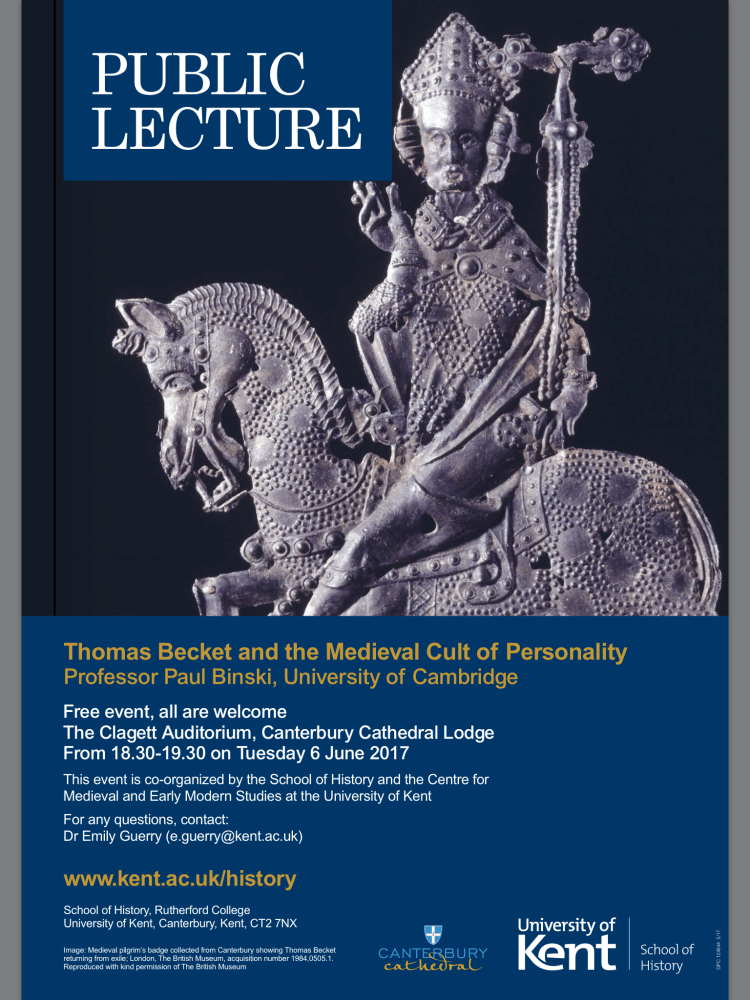
Lecture: The Library of Saint Thomas Becket, Christopher de Hamel, The Society of Antiquaries, 2017

becket

The Library of Saint Thomas Becket Collection

Lecture by Fellow Christopher de Hamel

Archbishop Thomas Becket, martyred in Canterbury Cathedral in 1170, was among the earliest private book collectors in English history.  The richly-illustrated lecture looks at the manuscripts he owned and what happened to them, and it concludes with the unexpected and recent discovery of Becket’s Psalter, which was kept on his shrine in the Cathedral throughout the Middle Ages.

CFP – PISTOIA CAPITALE ITALIANA DELLA CULTURA 2017

In occasione di PISTOIA CAPITALE ITALIANA DELLA CULTURA 2017, il Gruppo di Ricerca NUME ha ottenuto la concessione dal Comune di Pistoia per l’organizzazione di una sessione di conferenze (con data da definirsi) che abbiano per oggetto la Pistoia medievale.

pistoia

Pistoia fu già a partire dal V secolo sede vescovile, e vide avvicendarsi numerosi popoli conquistatori, tra Goti, Bizantini, Longobardi, Franchi. Da libero comune nel 1105 alla dominazione fiorentina e lucchese, secondo Villani proprio a Pistoia nacque la lotta tra guelfi e ghibellini. La sua storia e le sue testimonianze materiali sono l’oggetto della nostra indagine.

1. I temi accettati possono spaziare dalla pittura, all’architettura, all’urbanistica, alla storia medievale di Pistoia. Particolare attenzione sarà data ai contributi che affrontino il culto di San Jacopo, patrono della città, e di cui si conserva lo splendido Altare argenteo (1287-1456) nella cattedrale di San Zeno. Il tema può essere affrontato sotto molteplici sfaccettature, dalla questione iconografica a quella storica, dalla dimensione sociale e politica ai rapporti con le grandi vie di pellegrinaggio;

2. Si ricercano massimo n. 5 relatori;

3. Ogni intervento dovrà avere durata massima di 30 minuti;

4. Per partecipare, si prega di inviare un abstract di 300 parole, corredato di un CV, all’indirizzo di posta elettronica: info@nuovomedioevo.it

5. Il termine ultimo per l’invio di una proposta è il 10 MAGGIO 2017;

6. Entro il 15 MAGGIO sarà comunicato l’esito della valutazione. Il giudizio del Gruppo NUME è insindacabile;

7. Il Gruppo NUME si riserva l’utilizzo futuro (previa comunicazione all’autore) del materiale che gli perviene, in pubblicazioni cartacee o sul web.

Maggiori informazioni sul progetto PISTOIA CAPITALE ITALIANA DELLA CULTURA 2017 all’indirizzo web:

http://www.pistoia17.it/it/

CONF: Streets, Routes, Methods I (Florence, 5-6 May 17)

Florence, Kunsthistorisches Institut in Florenz – Max-Planck-Institut, Palazzo Grifoni Budini Gattai, Via dei Servi 51, May 5 – 06, 2017

Streets, Routes, Methods I: Reflections on Paths, Spaces and Temporalities International Conference
khi_florenz
A cooperation of the Kunsthistorisches Institut in Florenz – Max Planck Institute and eikones – NCCR Iconic Criticism, University of Basel Organized by Hannah Baader, Adam Jasper, Stefan Neuner, Gerald Wildgruber and Gerhard Wolf

Paths can be serpentine, straight and anything in between; they might traverse barely accessible mountains, like the Inca Trail, or be straight, like desire lines. Paths come before roads, survive into the time of roads, or reappear in response to them. Paths tend to be overgrown, to disappear—in the desert sand—to be overbuilt or abandoned. They have their temporalities, seasons and spatialities, between proximity and distance. Paths are therefore not purely spatial affairs. Paths have a genuine temporal dimension beyond the duration of a traveler’s journey. Paths can be seen as chronotopoi, with literary, pictorial and cinematographic histories. Paths must be trodden in order to survive, exemplifying the Heraclitian formula μεταβάλλον ἀναπαύεται (‘it is in changing that things find repose’). The temporal dimension of paths ultimately allows us to overcome the sterile dichotomy between real and imagined paths (metaphors, allegories, models). They have a rich life in the world of metaphors, intrinsic to the notion of met-hodos, based on the Greek word for way, or path. This allies paths to language and, more specifically, writing, whose elements are also repetitions, tracks that are ‘inked in’. It is the remembered, the described, and thereby the reusable and transferable path. Paths within language can become ritual tools for the creation of new ones.

Beyond the above mentioned approaches to paths, the conference will explore their relationship to the environment, in line with the eco-art historical project at the KHI. How do paths, trails and routes shape or even create landscape? What is the interplay of geomorphology, flora and fauna, animal and human agency? Paths introduce directionalities, itineraries and nets into the environment, they are linked to technologies of transport and movement; they offer viewpoints, changing horizons or deep immersion into flora or architecture; experiencing them is a multisensorial endeavor. Under the hodological conditions of global urban environments and post/industrial landscapes, paths run across streets, they can be subversive, democratic or pragmatic. They can be reinstalled as nostalgic evocations of a lost or overcome past,
of rural or pastoral life, or serve mass tourism as well as new ecological approaches.

Continue reading “CONF: Streets, Routes, Methods I (Florence, 5-6 May 17)”