[1] Venice, Materiality, and the Byzantine World
[2] De-Centering the Romanesque
[3] Creative Modes of Activating the Early Medieval Manuscript
[4] Creative Strategies of Intellectual Engagement with Tradition and the Auctores
[5] “Manuscripts in the Curriculum”: New Perspectives on Using Medieval Manuscripts in the Undergraduate Classroom from Special Collection Librarians, Faculty, and Booksellers (A Roundtable)
[6] Moving People, Shifting Frontiers: Re-contextualising the Thirteenth Century in the Wider Mediterranean
————–
[1]
Venice, Materiality, and the Byzantine World
Sponsored by the Italian Art Society,
Deadline: Sep 15, 2017
The Dumbarton Oaks Byzantine Symposium leading to the 2010 publication of San Marco, Byzantium, and the Myths of Venice introduced new perspectives on Byzantine and Venetian visual and material culture that extended Otto Demus’s survey of Saint Mark’s basilica. The authors’ application of more recent approaches—such as the social function of spolia, the act of display, the construction of identity, and cultural hybridity—brought fresh analyses to a complex and richly decorated monument. This panel seeks to expand this methodological discourse by taking into account questions related to materials, materiality, and intermediality between Venice and Byzantium. The arrival of material culture from the Byzantine world to Venice as gifts, spoils, or ephemera during the centuries surrounding the Fourth Crusade allowed for both appropriation and conceptual transformation of material culture. In light of the renewal in interest of Venice’s Byzantine heritage, this panel seeks to reflect on the interaction of material culture between la Serenissima and the Byzantine world, especially during the eleventh through fifteenth centuries. Topics may be wide-ranging, including, but not limited to: issues of reception and cultural translation; changing concepts of preciousness; different valuation of materials between Venice and Byzantium; the fluctuating simulation of material visual effects; the transformation of Byzantine objects incorporated into Venetian frames; intermedial dialogue between Byzantine and Venetian art; and the process and technique of manufacture of works between Byzantium and Venice. Some points of departure may include: the building of San Marco itself; Byzantine objects in the Treasury; Byzantine manuscripts included as part of the Cardinal Bessarion gift to the Republic; the monuments on Torcello; or issues raised as a result of recent conservation projects. New cross-cultural methodologies from art historical, anthropological, or sociological fields are welcome.
Please submit a 300-word abstract and a completed Participant
Information Form (http://www.wmich.edu/medievalcongress/submissions) by
September 15 to the session organizers:
Brad Hostetler, Kenyon College, hostetler1@kenyon.edu, Joseph Kopta, Pratt Institute, jkopta@pratt.edu
In addition to the travel awards available to all Congress participants (http://www.wmich.edu/medievalcongress/awards), the Italian Art Society offers competitive travel grants: http://italianartsociety.org/grants-opportunities/travel-grant-information/
————–
[2]
De-Centering the Romanesque
Dommuseum Hildesheim & The J. Paul Getty Museum
The canonical emphasis of Romanesque studies on regional centers and monuments has overshadowed aspects of transregional exchange that defined the art and culture of medieval western Europe circa 1000-1250. One of the key characteristics of this period is movement — of peoples, ideas, and materials. This session will explore the themes of portability and exchange, with possible topics addressing Mediterranean and Baltic trade networks, transcultural objects in the western treasuries, pseudo-scripts and their varied meanings, and hoards versus monuments. Participants are encouraged to address the concept of nexus versus center and the pedagogical implications for presenting a de-centered and global Romanesque, with papers that either challenge or affirm the Romanesque frame for teaching medieval art, both in the classroom and in the museum.
Please send your proposal of up to one page with your Participant Information Form (PIF) http://wmich.edu/medieval/congress/submissions/index.html#PIF to the organizers: Kristen Collins, J. Paul Getty Museum, KCollins@getty.edu or Gerhard Lutz, Dommuseum Hildesheim, gerhard.lutz@dommuseum-hildesheim.de
————–
[3] and [4]
Deadline: Sep 1, 2017
Two sessions for, “Identifying Creative Impulses in Early Medieval Art and Culture,” will convene at the 53rd International Congress on Medieval Studies (May 10-13, 2018) in Kalamazoo, MI.
Papers are solicited that encourage novel—even experimental—approaches, to the exploration and identification of various conceptions of early medieval, creative cultural activity.
The first panel seeks to engage with the actual haptic and experiential practice of manufacturing, reading and studying the early medieval book.
The second panel focuses upon culturally apposite forms of interpretative and compositional fashioning that can be discerned in manuscripts belonging to the liberal arts traditions of the Early Middle Ages.
Abstracts and paper proposals of not more than 250 words can be submitted via email on or before September 1, 2017 to the session organizers: Eric Ramírez-Weaver (emr6m@virginia.edu) and Lynley Anne Herbert (lherbert@thewalters.org). Please copy both co-organizers when submitting a proposal, posing a question, or requesting additional information via email.
Complete panel descriptions follow. We particularly encourage inventive strategies promising new approaches to the investigation of early medieval creativity.
Identifying Creative Impulses in Early Medieval Art and Culture
Special Sessions organized by Eric Ramírez-Weaver (emr6m@virginia.edu) and Lynley Anne Herbert (lherbert@thewalters.org)
I. Creative Modes of Activating the Early Medieval Manuscript
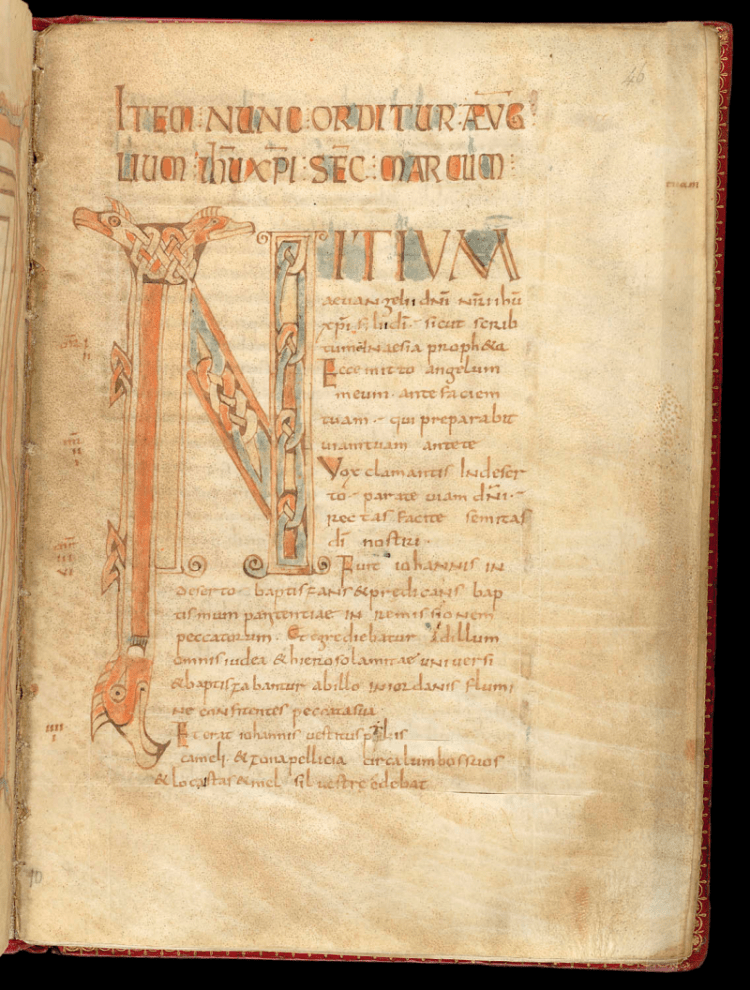
The way a manuscript behaves when used “in the flesh,” so to speak, can at times reveal layers of creativity built into them, which must be actively experienced rather than passively seen. Often as modern scholars we work from digitized images of individual folios, or at best openings, and “page flipping” technologies (such as the Walters’s “Ex Libris” platform or the British Library’s “Turning the Pages” program) provide a false sense that we are experiencing the physical book. Evidence of the performative qualities of a manuscript can at times be rediscovered, not just in the sense of how a reader might perform the text written in the book, but how the user activated the book as an object during use. Does an image show through a page and become part of the visual experience on the other side, and was there intentionality there? Do images interact across an opening? Does imagery function together from recto to verso? How is the artist creating an experience for the user, or conversely, how did the user alter the book to create a personal experience? This session seeks papers that explore creative approaches that open up new possibilities regarding how early medieval manuscripts functioned as objects.
II. Creative Strategies of Intellectual Engagement with Tradition and the Auctores
Recent scholarship (consider Benjamin Anderson, Lynda Coon, Paul Edward Dutton, Rosamond McKitterick, Lawrence Nees, Eric Ramírez-Weaver, and Immo Warntjes), has increasingly emphasized the creative strategies for intervention and manufacture of meaning that were acutely linked to early medieval eastern and western engagements with various aspects of the liberal art traditions. From star pictures to poetic acrostics, devotion to erudition and pious personal reform transformed the possibilities for innovation that proliferated during the Carolingian period. Interlocking networks of artists, chroniclers, historians, and poets communicated their translations, textual redactions, and visual records of classical tradition and contemporary study with one another, engaged in debate or collaboration, but advancing science. This session seeks papers willing to reconsider methodologically apposite ways to reinterpret the various brands of early medieval creativity manifest in texts pertaining (as broadly as possible) to the seven liberal arts, including texts of astronomical, computistical, rhetorical, geometric, arithmetic, musical, lyrical, philosophical, diagrammatic, or historical significance.
————–
[5]
“Manuscripts in the Curriculum”: New Perspectives on Using Medieval Manuscripts in the Undergraduate Classroom from Special Collection Librarians, Faculty, and Booksellers (A Roundtable)
Deadline: Sep 10, 2017
Integrating medieval manuscripts into an undergraduate curriculum changes the game. Students are transformed from passive learners to active scholars; observing objects and seeking to understand and interpret their context teaches critical thinking. Implementing programs to give students this opportunity requires the cooperation of special collection librarians and faculty, two disciplines that speak slightly different languages. Inspired by Les Enluminures’s new program Manuscripts in the Curriculum<http://www.textmanuscripts.com/curatorial-services/manuscripts>, this session will also introduce a third perspective and explore the practical issues of how to build collections for teaching.
The session organizers wish to bring people together from these communities to share their experiences, to discuss successful results, to analyze problems, and to envision future directions. We invite papers that explore efforts to bring manuscripts into the classroom, and the challenges of implementing these programs at specific institutions from the perspectives of librarians, faculty, and booksellers. The session will be structured as a roundtable with a series of short ten- and fifteen-minute papers (the number and duration to be determined depending on response), with ample time for discussion.
Please send abstracts of no more than a page, along with a current CV and the Participation Information Form (available on the Medieval Congress Submissions page: http://wmich.edu/medievalcongress/submissions) to lauralight@lesenluminures.com<mailto:lauralight@lesenluminures.com> by September 10, and sooner if possible.
Emily Runde, Text Manuscripts Specialist
Les Enluminures
http://www.lesenluminures.com<http://www.lesenluminures.com>
http://www.textmanuscripts.com<http://www.textmanuscripts.com>
————–
[6]
Moving People, Shifting Frontiers: Re-contextualising the Thirteenth Century in the Wider Mediterranean
Deadline: Sep 10, 2017
(Courtauld Institute of Art) and Katerina Ragkou (University of Cologne). Deadline: 10 September 2017
Every day we witness people moving, with them objects and skills, knowledge and experience; either forcibly or willingly; for work or for pleasure. The communities living along the shores of the Mediterranean and the hinterlands of the Balkans during the thirteenth century share many of the characteristics of our contemporary world: military campaigns and religious wars; the intensification of pilgrimage and the relocation of refugees; the shifting of frontiers and the transformation of socio-political orders.
The transformations of the thirteenth century span from east to west, from northern Europe to the Byzantine Empire and from the Balkans to the Levant. The geographic breadth is paralleled by crucial events including the fourth crusade, the fall of Acre, the empowerment of the Serbian Kingdom and the Republic of Venice, the loss and following restoration of the Byzantine Empire, and the creation of new political entities, such as the Kingdom of Naples and that of Cyprus, the Empire of Trebizond, and the Principality of Achaia. Eclectic scholarly tradition has either focused geographically or thematically, losing sight of the pan-Mediterranean perspective. These societies had multifaceted interactions, and comprised a variety of scales, from the small world of regional and inter-regional communities to the broader Mediterranean dynamics.
This session aims to address questions such as which are the various processes through which military campaigns and religious wars affected the urban landscape of these regions and their material production? Is there a difference in economic and artistic trends between “town” and “countryside” in the thirteenth-century wider Mediterranean? What observations can we make in regards to trade, diplomatic missions, artistic interaction and exchange of the regional, interregional and international contacts? How did these shape and transform cultural identities? How did different social, political and religious groups interact with each other?
This session welcomes papers focused on, but not limited to: the role played by economic activity and political power in thirteenth-century artistic production and the shaping of local and interregional identities; the production and consumption of artefacts and their meaning; the transformation of urban and rural landscapes; religious and domestic architecture and the relationship between the private and public use of space.
Proposals for 20 min papers should include an abstract (max.250 words) and brief CV. Proposals should be submitted by 10 September 2017 to the session organizers: Katerina Ragkou (katerina.ragkou@gmail.com) and Maria Alessia Rossi (m.alessiarossi@icloud.com).
Thanks to a generous grant from the Kress Foundation, funds may be available to defray travel costs of speakers in ICMA-sponsored sessions up to a maximum of $600 ($1200 for transatlantic travel). If available, the Kress funds are allocated for travel and hotel only. Speakers in ICMA sponsored sessions will be refunded only after the conference, against travel receipts. For more information visit: http://www.medievalart.org/kress-travel-grant/


 Palfreys and rounceys, hackneys and packhorses, warhorses and coursers, not to mention the mysterious ‘dung mare’ – they were all part of everyday life in the Middle Ages. Every cleric and monk, no matter how immersed in his devotional routine and books he would be, every nun, no matter how reclusive her life, every peasant, no matter how poor his household, would have some experience of horses. To the medieval people, horses were as habitual as cars in the modern times. Besides, there was the daily co-existence with horses to which many representatives of the gentry and nobility – both male and female – were exposed, which far exceeds the experience of most amateur riders today. We cannot reconstruct or re-experience the familiar and casual communication between humans and equids of the Middle Ages – or can we? At our sessions on the Medieval Horse, we will try to deduce, describe and debate the place of the horse in medieval society.

 Medieval Art Research