Conference: Mobility and Conflict in the Mediterranean, UNED, Madrid, 26 October 2018

Mobility and conflict in the Mediterranean: sociability networks and artistic creation in the Late Medieval and Early Modern periods
UNED, Madrid 26 de octubre de 2018.

9.30. Presentación
SESIÓN 1: Alteridades móviles: La visión del otro en la literatura y el arte
Modera: Juan Carlos Ruiz Souza (UCM)
10:00-10:20: Representando al otro: tejidos y vestidos en los espacios de sociabilidad en el siglo XV castellano. Elena Paulino Montero (UNED)
10:20-10:40: The Fifth Column: rethinking the Morisco’s visual representation. Borja Franco Llopis (UNED).
10:40-11:00: La visión del cristiano como “otro”. Alteridad en el Mediterráneo Otomano. Miguel Ángel de Bunes Ibarra (CSIC).
11:00-11:30: DEBATE
11:30-12:00: PAUSA-CAFÉ

Sesión 2: Redes de saber, redes de poder: Objetos y conocimientos en circulación
Modera: Consuelo Gómez López (UNED)
12:00-12:20: Movilidad, circulación, interacción. La formación de un grupo de presión belicista en la monarquía policéntrica de los Habsburgo (Génova, Madrid, País Vasco – siglo XVI) Bastien Carpentier (Université Littoral Côte d’Opale)
12:20-12:40: No solo inventarios. Bibliotecas en movimiento en el Mediterráneo. Margarita Vázquez Manassero (UNED)
12:40-13:00: Un mar en papeles para los ojos de Felipe II: la ciencia y el dibujo del ingeniero. Alicia Cámara Muñoz (UNED)
13:00-13:30: DEBATE
13:30-15:30: COMIDA

Sesión 3: El Mediterráneo: espacio de conflicto, espacio de intercambio.
Modera: Fernando Rodríguez Mediano (CSIC-CORPI)
15.30-15:50: Los espías del rey. La inteligencia hispano-imperial contra el turco (siglo XVI) Gennaro Varriale (Università degli Studi di Napoli “Federico II”)
15:50-16:10 Caravaggio in Malta and his connection to the Ottoman Art. Filiz Çakir Phillip (Aga Khan Museum Toronto).
16:10-16:30: Between objects and subjects: slaves and religious artifacts in the 17th Mediterranean. Daniel Hershenzon (University of Connecticut)
16:30-17:00 DEBATE
17:00-17:30: PAUSA CAFÉ

Sesión 4: Un Mediterráneo global. Dinámicas transoceánicas  del siglo XVI
Modera: Elena Paulino Montero (UNED)
17:30-17:50 Lepanto in the Americas: Global Storytelling and Mediterranean History. Stefan Hanß (University of Manchester)
17:50-18:10: American objects at the beginning of the sixteenth century Antonio Urquízar Herrera (UNED).
18:10-18:30: DEBATE

18.30 CONCLUSIONES Y CLAUSURA

Evento patrocinado por la Facultad de Geografía e Historia y el Departamento de Historia del Arte de la UNED y organizado dentro del proyecto: HAR2016-80354-P. IMPI. Antes del orientalismo: Las “imágenes” del musulmán en la Península Ibérica (siglos XV-XVII) y sus conexiones mediterráneas (Ministerio de Ciencia, Tecnología y Universidades- Fondos FEDER).
Actividad del Grupo de Investigación: Arte y Pensamiento en la Edad Moderna y Contemporánea

Dirección científica: Elena Paulino Montero
Coordinación científica: Borja Franco Llopis

Click here for more information

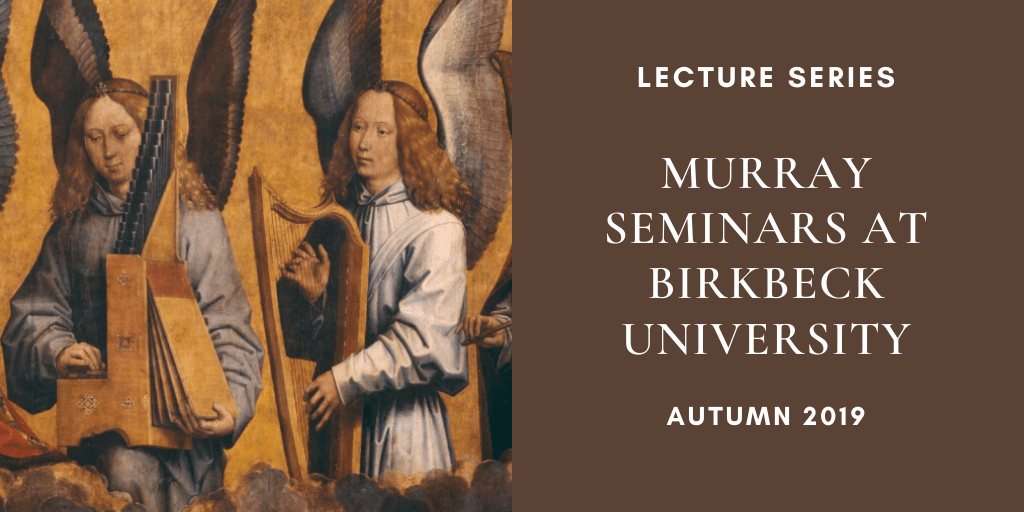
Lecture Series: Murray Seminars at Birkbeck, Autumn 2019

16 October, Lisa Monnas

Vestments and Textiles in Hans Memling’s ‘God with Singing and Music-making Angels 

Three large panels in the Royal Museum of Fine Arts in Antwerp, painted by Hans Memling in the 1480’s, represent a heavenly scene framed by clouds, which part to reveal the central figure of God attended by sixteen singing and music-making angels. Thye once formed the top of the high altarpiece of the Benedictine Abbey of Santa Maria la Réal in Nájera, in Spain. In the central panel, God is depicted vested as priest and ruler, and the angels in this and in the flanking scenes wear clerical dress. The work has been interpreted as relating to the Good Friday liturgy and the Exaltation of the Cross, but since the panels originally formed the top of an altarpiece whose main subject was the Assumption of the Virgin, this is open to doubt. This paper will re-examine the vestments and textiles in the newly conserved panels, assessing their ‘realism’ and their contribution to the heavenly scene. It will also consider them in the wider context of some of Memling’s other works.

14 November, Jana Gajdosova

Sculpted Genealogies: The Effigies of Bohemian rulers in Prague Cathedral

With the death of Wenceslas III, the Přemyslid dynasty, which had ruled Bohemia for over four centuries, came to an end. The murder of the young king created chaos in the kingdom for several decades; however, after the marriage of Elizabeth of Přemyslid and John of Luxembourg and the subsequent birth of Charles IV (1316 – 1378), Bohemia reached the height of its political and cultural power in Europe. Charles IV saw himself as a bridge between two Bohemian dynasties – the Přemyslids of the past and the Luxembourgs of his envisioned future. This link was communicated with painted genealogies in at least three of Charles’ castles, and with staged genealogies across Prague. The fascination that Charles had with re-imagining and visualizing his role within the dynastic shift that occurred also found expression in the sculpted genealogies which are the subject of this paper—specifically the effigies of Přemyslids rulers commissioned by Charles IV for Prague Cathedral, which were made to communicate these ideas in sculpture and across real space.

5 December, Marie-Louise Lillywhite 

Blood is Thicker than Water: Artists, Friends and Family Alliances in Seventeenth-Century Venice

How did Venetian artists forge alliances to advance their interests and ensure the continuation of their workshops? Focusing on the painter Palma il Giovane, this paper explores his concerted efforts to continue his family name through strategic marriages, and safeguard his success through advantageous friendships. This study will demonstrate how these potentially positive relationships impacted artistic production in Venice for better, or indeed worse.

All this term’s seminars take place in the History of Art Department at Birkbeck (43, Gordon Sq., London WC1H 0PD) in Room 114 (The Keynes Library) at 5pm.  Talks finish by 5.50pm (allowing those with other commitments to leave) and are then followed by discussion and refreshments.  We hope to see you there.

CFP: The Saint Enshrined: European Tabernacle-altarpieces, c.1150-1400, Valladolid, June 7–8, 2019

unspecified
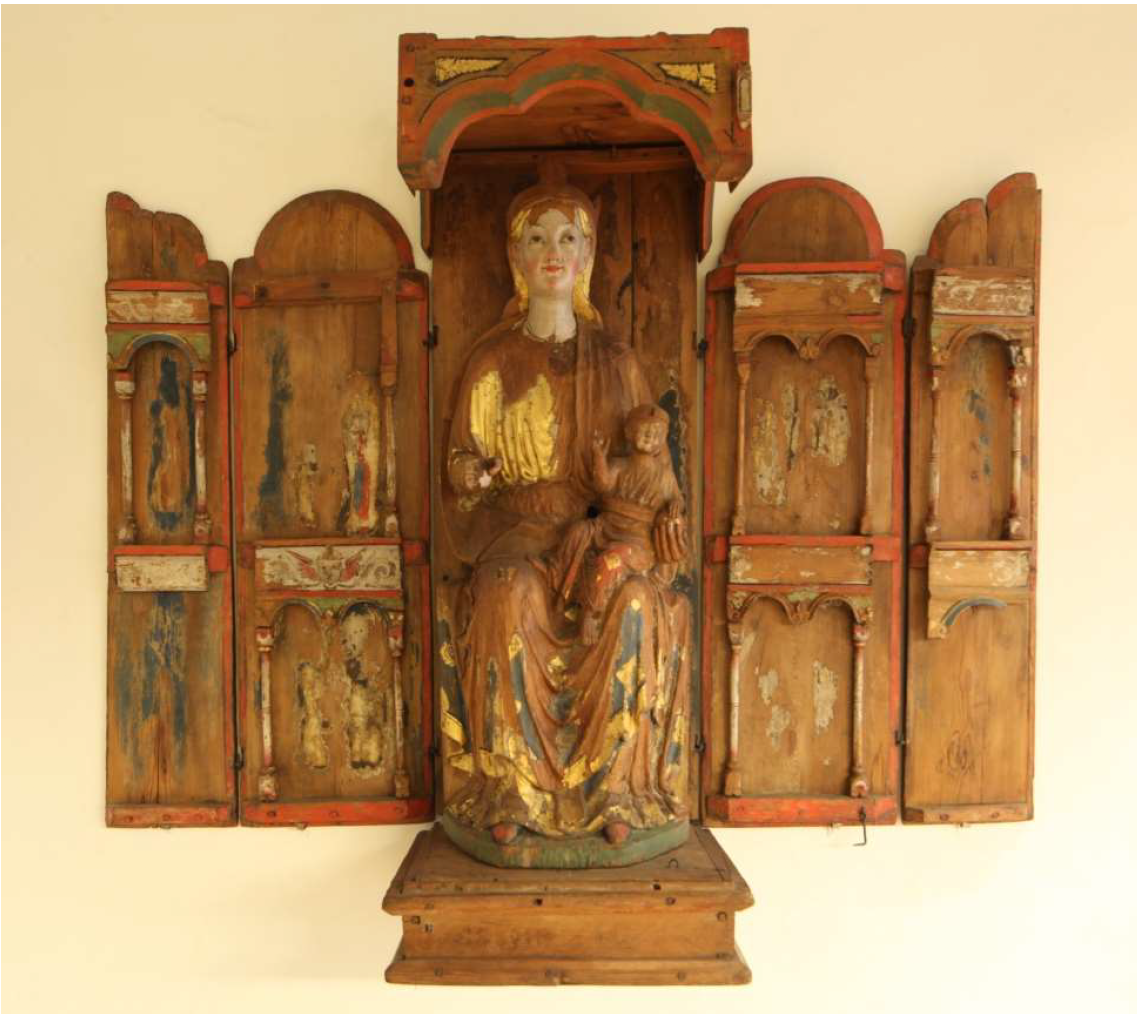
 Tabernacle-shrine from Mule,
Iceland, now in the Nationalmuseet
in Conpenhagen; c.1250.
Photo: Justin Kroesen

Almost every Medieval church had one or more sculptures of saints, many of which were placed on altars, in wall niches or in so-called tabernacle-altarpieces. This last category refers to three-dimensional, canopied structures, embellished with bright colours and equipped with movable wings that housed cult images of the Virgin and Child or saints. This early type of altarpiece became widespread in Europe between c.1150 and 1400. Nowadays, examples are scarce and often fragmented, overpainted and reconstructed. Most of them come from the geographical periphery of Europe and almost all of them are now without their original context, as they hang on museum walls or in churches as isolated relics.

The purpose of this international symposium is to explore and discuss early tabernacle-altarpieces in different regions of Europe: their provenance, patronage, function, and role in popular piety. We invite speakers to submit proposals for 15-minute papers to be presented during the symposium. Proposals should go beyond case studies and look at such topics as the use and re-use of tabernacle-altarpieces, media involved in their creation, regional differences, etc.

How to Submit: Proposals of c.300 words should be submitted to Fernando Gutiérrez Baños, fbanos@fyl.uva.es.

Deadline: Friday 18th of January 2019.

All proposals will be examined by the Scientific Committee. It is hoped that an edited volume of the symposium proceedings will be published. Successful candidates will be offered free registration.

SCIENTIFIC COMMITTEE: Fernando Gutiérrez Baños, Universidad de Valladolid; Justin Kroesen, Universitetsmuseet i Bergen; Elisabeth Andersen, Norsk institutt for kulturminneforskning.

KEYNOTE SPEAKERS: These will include members of the Scientific Committee; Stephan Kemperdick, Staatliche Museen zu Berlin, Gemäldegalerie; Teresa Laguna Paúl, Universidad de Sevilla; Cristiana Pasqualetti, Università degli Studi dell’Aquila; and Alberto Velasco Gonzàlez, Museu de Lleida: diocesà i comarcal.

PROGRAM (PROVISIONAL): Friday 7th  of June, session held in the Universidad de Valladolid (Facultad de Filosofía y Letras, Sala de Juntas); Saturday 8th  of June, field trip to sites in the Diocese of Vitoria.

Lecture Series: European History, 1150-1550 Seminar Series at the Institute of Historical Research

All are welcome to attend the opening lecture of the 2018 autumn term for IHR’s seminar, European History, 1150-1550. Julien Théry ( University of Lyon) will present his lecture entitled, ‘The French Way. The Rift between The Papacy and Capetian Monarchy under Philip the Fair (1285-1314)’ this Thursday, 27th September.

The complete 2018-19 programme can be found here.

Lecture Series: History of Liturgy 2018 Seminar Series at the Institute of Historical Research

The Institute of Historical Research continues its History of Liturgy seminars for the 2018 and 2019 terms. For more information, please visit their website.

image003

Lecture Series: London Society for Medieval Studies 2018-19 Programme

The London Society for Medieval Studies is back for the new academic year!

We are very excited that our autumn programme of seminars will be commencing soon. Please find attached our full programme for the autumn and spring terms 2018-19. Make sure to get those dates into your diary!

Continue reading “Lecture Series: London Society for Medieval Studies 2018-19 Programme”

New Book: The Power of Textiles: Tapestries of the Burgundian Dominions

The Power of Textiles: Tapestries of the Burgundian Dominions (1363-1477)

By Katherine Anne Wilson

BURG_26

ISBN 978-2-503-53393-3

More Info: http://bit.ly/2qCFz0a

Textiles were used as markers of distinction throughout the Middle Ages and their production was of great economic importance to emerging and established polities. This book explores tapestry in one of the greatest textile producing regions, the Burgundian Dominions, c.1363-1477. It uses documentary evidence to reconstruct and analyse the production, manufacture, and use of tapestry. It begins by identifying the suppliers of tapestry to the dukes of Burgundy and their ability to spin webs between city and court. It proceeds by considering the forms of tapestry and their functions for urban and courtly consumers. It then observes the ways in which tapestry constructed social relations as part of gift-giving strategies. It concludes by exploring what the re-use, repair, and remaking of tapestry reveals about its value to urban and courtly consumers. By taking an object-centred approach through documentary sources, this book emphasises that the particular characteristics of tapestry shaped the strategies of those who supplied it and the ways it performed and constructed social relations. Thus, the book offers a contribution to the historical understanding of textiles as objects that contributed to the projection of social status and the cultural construction of political authority in the Burgundian polity.

Katherine Anne Wilson is Senior Lecturer in Medieval History at the University of Chester. Her research interests lie in understanding the relationship between social and cultural change, and shifting patterns in the use of material culture in the later Middle Ages. She has worked and published on the circulation of tapestry and luxury goods of the Burgundian Netherlands as well as the biographies of their producers and consumers.

Free Online Course: The Book of Kells, Trinity College Dublin

bok_social_web

Trinity College Dublin is offering a new online course started 8 October. This course is intended for any and all interested in the history, crafting, and enduring legacy of one of the world’s most famous medieval manuscripts.

The Book of Kells manuscript, housed at Trinity College Dublin is world famous – it attracts almost one million visitors a year. But what can this book tell us about Irish history? And what significance is the manuscript in today’s world?

On this course you will use the Book of Kells as a window through which to explore the landscape, history, faith, theology, and politics of early medieval Ireland. You will also consider how the manuscript was made, its extended biography and how it has affected different areas of the contemporary world.

Please the visit the course’s website for more information.

CFP: ‘Recovering the Ritual Object in Medieval and Early Modern Art,’ AAH Conference, Brighton, 4–6 Apr 2019

DjWmmKBXcAUB1yCDeadline: Nov 5, 2018

“Recovering the Ritual Object in Medieval and Early Modern Art”

Session Convenors: Dr Catriona Murray, University of Edinburgh, c.a.murray@ed.ac.uk; Dr Halle O’Neal, University of Edinburgh, halle.o’neal@ed.ac.uk

In the medieval and early modern worlds, ritual served as a legitimising process, a dynamic mechanism for mediating a transference or transformation of status. Objects played an essential part in this performative practice, charged with symbolism and invested with power. Distanced from their original contexts, however, these artefacts have often been studied for their material properties, disconnecting function from form and erasing layers of meaning. The relationships between ritual objects and ritual participants were identity-forming, reflecting and shaping belief structures. Understanding of how these objects were experienced as well as viewed, is key to revealing their significances.

DjWniZ5XsAAAiJ0This panel intends to relocate ritual objects at the centre of both religious and secular ceremonies, interrogating how they served as both signifiers and agents of change. The organisers specialise in early modern British art and medieval Japanese art, and so we invite proposals from a range of geographical perspectives, in order to investigate this subject from a cross-cultural perspective. We particularly encourage papers which discuss medieval and early modern ritual objects—broadly defined —as social mediators.

Issues for discussion include but are not limited to:
– Recovery of the everyday in ritual objects
– Embodiment
– Audiences and interactions
– Performativity
– Ritual object as emotional object
– Spatiality and temporality
– Re-use, recycling, removal
– Illusion and imagination
– Memory
– Thing theory

How to apply: Please email your paper proposal direct to the session convenors, details above. Provide a title and abstract (250 words maximum) for a 25-minute paper, your name and institutional affiliation (if any).

Conference: En route pour Compostelle, Montpellier/Saint-Guilhem-le-Desert, September 28-29, 2018

photo20pour20colloque20montpellierEN ROUTE POUR COMPOSTELLE : UN MOYEN ÂGE DE PÈLERINAGES

Colloque international

Dans le cadre des manifestations du 20e anniversaire de l’inscription du bien « chemins de Saint-Jacques-de-Compostelle en France » sur la liste du patrimoine mondial de l’UNESCO

Président d’honneur
Xavier BARRAL I ALTET – Universités Rennes 2 et Ca’ Foscari de Venise

PROGRAMME

VENDREDI 28 SEPTEMBRE
Montpellier – Médiathèque Émile Zola

9h – 9h30
Accueil des participants

9h30 – 9h45
Mot d’accueil
Géraldine MALLET – Université Montpellier 3, CEMM EA 4583
Sophie DUCRET – Université Montpellier 3, CEMM EA 4583
Sylvain DEMARTHE – Université de Bourgogne, UMR 6298 ArTeHis

ÉDIFICES & CULTES
Présidence
Xavier BARRAL I ALTET – Universités Rennes 2 et Ca’ Foscari de Venise

9h45 – 10h05
La crypte de Saint-Gilles-du-Gard : archéologie d’un haut lieu de pèlerinage sur la ‘via Ægidiana’ vers Compostelle
Andreas HARTMANN-VIRNICH – Université d’Aix-Marseille
Heike HANSEN – Université d’Aix-Marseille, UMR LA3M

10h05 – 10h25
Culte des reliques, cadre monumental et prétention communautaire : réflexion sur la collégiale Notre-Dame-du-Port à Clermont
Denis HÉNAULT – Université Clermont Auvergne, MSH

10h25 – 10h45
Pause

10h45 – 11h05
Édifier un sanctuaire de pèlerinages : ambitions monumentales, concurrences et stratégies visuelles à Saint-Léonard-de-Noblat
Éric SPARHUBERT – Université de Limoges

11h05 – 11h25
La construcción como metáfora divina: el modelo de los Santos constructores en el Camino de Santiago
Carles SÁNCHEZ MÁRQUEZ – Université Autonome de Barcelone

11h25 – 11h45
Discussions

12h – 14h
Repas

CULTES
Présidence
Manuel CASTIÑEIRAS – Université Autonome de Barcelone

14h – 14h20
Culto dei santi, medicina e pratiche magico-folkloriche nel pellegrinaggio a Santiago
Marco PAPASIDERO – Université de Messine

14h20 – 14h40
‘Là sont ellez près de la mer /Celles que Dieux voult tant amer’ : calamitare i pellegrini a Saintes-Maries-de-la-Mer
Simone SARI – Université de Barcelone, Centre de documentation Ramon Llull

14h40 – 15h
Pause

15h – 15h20
L’image du pèlerin dans l’art gothique polonais
Arkadiusz ADAMCZUK – Université catholique de Lublin, Bibliothèque universitaire

15h20 – 15h40
Les reliques de saint Jacques le Majeur à Toulouse : une série d’énigmes
Michelle FOURNIÉ – Université Toulouse Jean-Jaurès

15h40 – 16h
Discussions

17h-18h
Conférence plénière
Saint Jacques et Charlemagne
Adeline RUCQUOI – CNRS, Centre de Recherches Historiques

SAMEDI 29 SEPTEMBRE
Saint-Guilhem-le-Désert – Musée de l’abbaye

ÉDIFICES, CHEMINS & TERRITOIRES
Présidence
Géraldine MALLET – Université Montpellier 3

9h – 9h30
Accueil des participants

9h30 – 9h50
Saint-Jacquème, étape lyonnaise du chemin de Compostelle
Nicolas REVEYRON – Université Lyon 2

9h50 – 10h10
Le passage à Saint-Antoine-en-Viennois : le sanctuaire dauphinois et les pèlerins en route vers Saint-Jacques-de-Compostelle au XVe siècle
Julie DHONDT – Université Lyon 3, UMR Ciham

10h10 – 10h30
San Antón de Castrojeriz (Burgos, Castille-et-León) : une fondation hospitalière antonine sur le chemin de Saint-Jacques
Sylvain DEMARTHE – Université de Bourgogne, UMR ArTeHis

10h30 – 10h50
Pause

10h50 – 11h10
‘Marmora’ verso Santiago: strategie del decoro musivo tra Francia e Italia
Maddalena VACCARO – Université de Salerne

11h10 – 11h30
The Genesis of a Twin-Tower Façade: the West Towers of the Cathedral of Santiago de Compostela
Annette MÜNCHMEYER – Université technique brandebourgeoise de Cottbus

11h30 – 11h50
Plonger le pèlerin dans une expérience sensorielle totale : mise en scène de l’arrivée dans la cathédrale de Saint-Jacques-de-Compostelle
Manuel CASTIÑEIRAS – Université Autonome de Barcelone

11h50 – 12h10
Discussions

12h15 – 13h30
Repas

CHEMINS & TERRITOIRES
Présidence
Philippe MACHETEL – Maire de Saint-Guilhem-le-Désert

14h – 14h20
L’historiographie des églises de pèlerinage en Auvergne
Dominique ALLIOS – Université Rennes 2

14h20 – 14h40
Rêver le réseau compostellan : les chemins de Saint-Jacques dans le temps et l’espace
Robert MAXWELL – Université de New-York

14h40 – 15h
Pause

15h – 15h20
Dans la cour des grands : naissances et relances de pèlerinages en pays de Figeac au Moyen Âge
Benjamin PHILIP – Service du patrimoine de Figeac

15h20 – 15h40
La réactivation moderne des ‘Chemins de Saint-Jacques-de-Compostelle’ : le reflet de leurs origines au Moyen Âge
Manuel SECO LAMAS – Université Toulouse Jean-Jaurès, étudiant de Master 2

15h40 – 16h
Discussions

16h – 17h30
Visite conférence de l’abbaye de Gellone à Saint-Guilhem-le-Désert
Géraldine MALLET – Université Montpellier 3
Sophie DUCRET – Université Montpellier 3, CEMM

17h30 – 17h50
Conclusions
Xavier BARRAL I ALTET – Universités Rennes 2 et Ca’ Foscari de Venise

Concert de clôture (Horaires et lieu à préciser ultérieurement)

« Domine Deu devemps lauder… »
Chansons narratives, épiques et hagiographiques du Xe au XIIe siècle ; extraits de « La Cansò de santa Fides », « La Passion de Clermont », « La vie de saint Léger » et des « Chansons de Croisades »
Brice DUISIT – Voix et vièle à archet

Organisation : Gisèle CLÉMENT – Université Montpellier 3, CEMM EA 4583 & CIMM

How to apply: Ouvert à tous dans la limite des places disponibles. pelerinages.saint-guilhem@gmail.com