
We’ve now had a week to digest the photos, the fashion, and the inevitable memes of Met Gala 2018. Hopefully a week has been enough time to take in the weird, wonderful, and worshipful experience that was this year’s annual fundraiser for the Metropolitan Museum’s Costume Institute. Each year the gala’s theme is based on the Institute’s summer exhibition, and on 10 May Heavenly Bodies: Fashion and the Catholic Imagination opened at both the Met’s 5th Avenue and Cloisters locations. Kim Kardashian was compared to a Eucharist chalice, haloes abounded, and ‘Rihanna going full pope’ is now a phrase.
Conference: Manuscripts from Ethiopia and Eritrea (Oxford, 1 Sept 2018)

This free study day will act as an introduction to Ethiopian and Eritrean manuscripts dating from the 4th to 18th centuries. Context, production, and patronage will be discussed by leading experts from institutions such as The British Library and SOAS. See the detailed schedule and link to register below.
Continue reading “Conference: Manuscripts from Ethiopia and Eritrea (Oxford, 1 Sept 2018)”
New Publication: The Idea of the Gothic Cathedral. Interdisciplinary Perspectives on the Meanings of the Medieval Edifice in the Modern Period, edited by Stephanie Glaser

The essays in this book focus on various social, political, cultural, and aesthetic meanings ascribed to Gothic cathedrals in Europe in the post-medieval period.
Central to many medieval ritual traditions both sacred and secular, the Gothic cathedral holds a privileged place within the European cultural imagination and experience. Due to the burgeoning historical interest in the medieval past, in connection with the medieval revival in literature, visual arts, and architecture that began in the late seventeenth century and culminated in the nineteenth, the Gothic cathedral took centre stage in numerous ideological discourses. These discourses imposed contemporary political and aesthetic connotations upon the cathedral that were often far removed from its original meaning and ritual use.
This volume presents interdisciplinary perspectives on the resignification of the Gothic cathedral in the post-medieval period. Its contributors, literary scholars and historians of art and architecture, investigate the dynamics of national and cultural movements that turned Gothic cathedrals into symbols of the modern nation-state, highlight the political uses of the edifice in literature and the arts, and underscore the importance of subjectivity in literary and visual representations of Gothic architecture. Contributing to scholarship in historiography, cultural history, intermedial and interdisciplinary studies, as well as traditional disciplines, the volume resonates with wider perspectives, especially relating to the reuse of artefacts to serve particular ideological ends.
Table of Contents
Introduction: The Medieval Edifice in the Modern Period — STEPHANIE A. GLASER
Part I — The Cathedral and the Nation
The Moorish-Gothic Cathedral: Invention, Reality, or Weapon? — MATILDE MATEO
Acting Medieval, Thinking Modern, Feeling German — MICHAEL J. LEWIS
L’Histoire d’une cathédrale: Viollet-le-Duc’s Nationalist Pedagogy — ELIZABETH EMERY
The Gothic Cathedral and Historiographies of Space — KEVIN D. MURPHY
Part II — The Cathedral between Art and Politics
The Anarchist Cathedral — MAYLIS CURIE
L’Imaginaire de la cathédrale à l’épreuve de la Grande Guerre — JOËLLE PRUNGNAUD
Church, Nation, and ‘The Stones of France’ — RONALD R. BERNIER
Part III — The Cathedral in the Arts
Patterns of Behaviour Architectural Representation in the Romantic Period — KLAUS NIEHR
Frozen Music and Symphonies in Stone. Gothic Architecture and the Musical Analogy: Intersecting Trajectories in German and French Thought from the Eighteenth through the Nineteenth Centuries — STEPHANIE A. GLASER
Délires opiomanes et gothicomanes de Thomas De Quincey à Wilfred Sätty — JEAN-MICHEL LENIAUD
The Cathedral as Time Machine: Art, Architecture, and Religion — RICHARD UTZ
Select Bibliography
Index
Call for Papers: 54th International Congress on Medieval Studies, May 9 – 12 2019 – Mary Jaharis Center sponsored panel (Deadline: 27 May 2018)
 To encourage the integration of Byzantine studies within the scholarly community and medieval studies in particular, the Mary Jaharis Center for Byzantine Art and Culture seeks proposals for a Mary Jaharis Center sponsored session at the 54th International Congress on Medieval Studies, Western Michigan University, Kalamazoo, May 9–12, 2019. We invite session proposals on any topic relevant to Byzantine studies.
Session proposals must be submitted through the Mary Jaharis Center website (https://maryjahariscenter.org/sponsored-sessions/54th-international-congress-on-medieval-studies). The deadline for submission is May 27, 2018. Proposals should include:
**Title
**Session abstract (300 words)
**Intellectual justification for the proposed session (300 words)
**Proposed list of session participants (presenters and session presider)
**CV
Successful applicants will be notified by May 30, 2018, if their proposal has been selected for submission to the International Medieval Congress. The Mary Jaharis Center will submit the session proposal to the Congress and will keep the potential organizer informed about the status of the proposal.
The session organizer may act as the presider or present a paper. The session organizer will be responsible for writing the Call for Papers. The CFP must be approved by the Mary Jaharis Center. Session participants will be chosen by the session organizer and the Mary Jaharis Center.
If the proposed session is approved, the Mary Jaharis Center will reimburse up to 5 session participants (presenters and presider) up to $600 maximum for North American residents and up to $1200 maximum for those coming abroad. Session organizers and co-organizers should plan to participate in the panel as either a participant or a presider. Funding is through reimbursement only; advance funding cannot be provided. Eligible expenses include conference registration, transportation, and food and lodging. Receipts are required for reimbursement.
Please contact Brandie Ratliff (mjcbac@hchc.edu), Director, Mary Jaharis Center for Byzantine Art and Culture with any questions. Further information about the International Congress on Medieval Studies is available at https://wmich.edu/medievalcongress.
On this day in 1337…
Reposted from IAS Blog
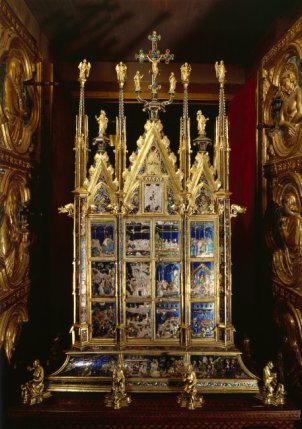
On 7 May 1337 goldsmith Ugolino di Vieri received the first payment for his masterpiece, the reliquary of the Santo Corporale of Bolsena. Payments are recorded for the following two years, reflecting the long process of creating an artwork as complex and monumental as this.
Wikimedia Commons.
The work was commissioned by the Bishop and Canons of Orvieto Cathedral to celebrate a miracle which had taken place in the nearby town of Bolsena in 1263. A priest in the town had become increasingly sceptical of the religious dogma of transubstantiation, namely the real conversion of the wine and bread used at Mass into the body and blood of Christ at the moment of their consecration. As the priest was celebrating the Eucharist one day, the consecrated host started bleeding on the corporal, the linen cloth used to cover the altar at this point of the celebration. Awed by the supernatural event, the priest described it to Pope Urban IV, who recognised it as a miracle and ordered the preservation of the blood-stained corporal as a relic.
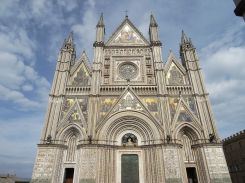
Conceived to contain the square corporal, Ugolino di Vieri’s reliquary abandoned the circular or polygonal shape typical of earlier objects of this type. Instead, it adopted a flat, rectangular structure which evokes an altarpiece or the façade of a church. The gables crowning the object are in fact very similar to those of Orvieto cathedral’s own façade.
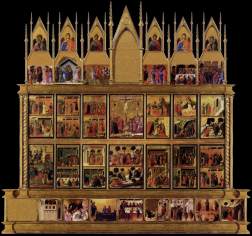
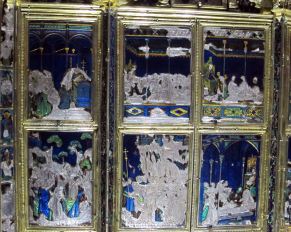
The iconography of the reliquary is as innovative as its form. It is decorated with 32 scenes representing the Passion of Christ and the Miracle of Bolsena in colourful basse taille enamel. The former narrative is illustrated with scenes copied from the famous Maestà altarpiece painted by Duccio di Buoninsegna for Siena Cathedral in 1308–11. Instead, the miracle had never been represented in art before, and Ugolino had to invent a completely new iconography to represent the event. Proud perhaps of his great achievement, Ugolino inscribed the reliquary with his name and with its date of completion.
On the day of Corpus Christi, 1338, a solemn procession transported the completed reliquary from Ugolino’s workshop to the cathedral. The procession evokes the similar celebration held for Duccio’s Maestà in 1311, as narrated by an anonymous Sienese chronicler:
On the day on which [the Maestà] was carried to the Duomo, the shops were locked up and the Bishop ordered a great and devout company of priests and brothers with a solemn procession, accompanied by the Signori of the Nine and all the officials of the Comune, and all the populace and all the most worthy were in order next to the said panel with lights lit in their hands, and then behind were women and children with much devotion; and they accompanied it right to the Duomo making procession around the Campo, as was the custom, sounding all the bells in glory out of devotion for such a noble panel as was this.
In Orvieto, Ugolino’s reliquary is still paraded every year during Corpus Christi celebrations.
Reference: Geddes, Helen. “Ugolino di Vieri.” Grove Art Online. http://www.oxfordartonline.com/groveart/view/10.1093/gao/9781884446054.001.0001/oao-9781884446054-e-7000086908.
CONFERENCE: Pantokrator 900: Cultural Memories of a Byzantine Complex (August 7-10 2018), ANAMED Istanbul
CONFERENCE: Pantokrator 900: Cultural Memories of a Byzantine Complex, 7-10 August 2018, ANAMED Istanbul
The Christ Pantokrator Complex (Zeyrek Camii, a UNESCO World Heritage Site) that included the mausoleum of the imperial dynasty, a monastery, a hospital, an orphanage, a home of the elderly and a poorhouse was founded in 1118 by Empress Piroska-Eirene and Emperor John II Komnenos. The second largest Byzantine church still standing in Istanbul after the Hagia Sophia, the Pantokrator was the most ambitious project of the Komnenian renaissance and the most impressive construction of twelfth-century Byzantine architecture. To commemorate the nine hundred years of the Pantokrator Complex, the Department of Medieval Studies at CEU Budapest and the Hungarian Hagiography Society organize, in collaboration with LABEX RESMED of Sorbonne-Paris, Ludwig-Maximilians University, Munich, and the Hungarian Institute in Istanbul an international conference that brings together scholars from diverse scholarly traditions to discuss the social, architectural and spiritual meanings of this outstanding monument.
Tuesday, August 7
9- 9:30 Marianne Sághy (CEU and ELTE Budapest), Gábor Fodor, director of the Hungarian Cultural Istitute in Istanbul – welcome and opening of the workshop
9:30-10 Albrecht Berger (Ludwig-Maximilians University, Munich) – Celebrating foundations: from the Pantokrator to Zeyrek Camii
10:30-11 coffee break
11-11:30 Béatrice Caseau (Université Paris IV, Sorbonne) — Spiritual and physical healing at the Pantokrator Monastery
11:30-12:30 Roundtable Discussion: Monuments and New Trends in Byzantine Studies
12:30 -2 pm lunch break
2 pm-2:30 pm Floris Bernard (University of Ghent – CEU Budapest) – Empress Eirene in Komnenian Poetry: Perceptions of Gender, Empire and Space
3-3:30 coffee
3:30-4 Zoltán Szegvári (PhD student, University of Szeged) The Image of the Latins in Late Byzantine Epistolography
4:30-5 Etele Kiss (Hungarian National Museum, Budapest) – Visual and Spiritual Portraits of Eirene, the Co-Founder of the Pantokrator
5:30-6 Cicek Dereli (PhD student, CEU Budapest) Cultural Heritage in Istanbul – Monasteries in Focus
Wednesday, August 8On-the-Spot: Monument and museum visits guided by David Hendrix and Şerif Yenen
Thursday, August 9
10-10:30 Marianne Sághy Greek Culture in Early Árpádian Hungary
11-11:30 Coffee break
11:30-12 Béla Zsolt Szakács (Pázmány Péter Catholic University, Budapest) – Between Byzantium and Italy: the Art of Twelfth-Century Hungary
12:30-2 pm lunch break
2-2:30 pm Márton Rózsa (PhD student, ELTE University of Budapest) — The Byzantine Second-Tier Élite in the Komnenian Period
3-3:30 Lioba Theis (University of Vienna) – Light Symbolism in the Pantokrator
4-4:30 coffee break
4:30-5 Hâluk Çetinkaya (Mimar Sinan University, Istanbul) Funeral Spaces in the Pantokrator Monastery
5:30-6 Etele Kiss (Hungarian National Museum, Budapest) Cosmology between Byzantium and the Occident in the Twelfth Century: Piroska-Eirene and the Opus Sectile Floor of the Pantokrator Monastery
6-6:30 Discussion and conclusions
Friday, August 10
On-the-Spot: Byzantine City Walks guided by David Hendrix and Şerif Yenen
CONFERENCE: ‘L’oeuvre en mouvement, de l’Antiquité au XVIIe siècle’, Amiens (June 7-8 2018)
Conference: L’oeuvre en mouvement, de l’Antiquité au XVIIe siècle
Amiens, Logis du Roy, 9 passage du Logis du Roy F-80000, June 7 – 08, 2018
Le laboratoire TrAme (Textes, représentations, archéologie et mémoire de l’Antiquité à la Renaissance), EA 4284 de l’Université de Picardie Jules Verne à Amiens (axe « Objets, matérialité, représentations »), organise un colloque pluridisciplinaire sur l’œuvre en mouvement de l’Antiquité au XVIIe siècle.
Jeudi 7 juin
9h-9h10 : accueil des participants
9h10-9h30 : Introduction : Mohammed Benlahsen (Président, Université de Picardie Jules Verne), Tiphaine Barthélémy (directrice, École Doctorale Sciences Humaines et Sociales, Université de Picardie Jules Verne), message de Laurence Boulègue (directrice, TrAme – EA 4284, Université de Picardie Jules Verne), Véronique Dominguez
I. Geste et création
Présidente de séance : Marie-Laurence Haack
9h30-9h50 : Gérard Gros (Université de Picardie Jules Verne, TrAme – EA 4284)
Remarques sur la représentation littéraire du mouvement au Moyen Âge : hiératisme, convention, réalisme
9h50-10h10 : Giuseppe Pucci (Università degli Studi, Sienne / Società Italiana di Estetica)
Punctum temporis, forma fluens
10h10-10h30 : Audrey Gouy (Université de Pau et des Pays de l’Adour / ITEM – EA 3002)
Mouvements et gestes au prisme de la cinétique. Réflexion à partir des représentations étrusques de danse (VIe-Ve siècle avant J.-C.)
10h30-10h50 : discussion
10h50-11h05 : pause
II. Mouvement dans la pierre
Président de séance : Arnaud Timbert (Université de Picardie Jules Verne, TrAme – EA 4284)
11h05-11h25 : Sébastien Biay (Institut national d’histoire de l’art, Paris)
Mouvements rythmiques dans l’ornementation des portails romans
11h25-11h45 : Nicolas Reveyron (Université Lumière Lyon 2, ARAR – UMR 5138)
Le geste et l’action. Rhétorique du mouvement dans les figurations médiévales (XIIe-XIIIe siècles)
11h45-12h05 : Anne Vuillemard-Jenn (École d’arts appliqués MJM, Strasbourg / Institut National des Sciences Appliquées, Strasbourg)
La spatialisation et les parcours visuels induits par la polychromie gothique
12h05-12h25 : discussion
12h25-13h45 : pause déjeuner
III. Mouvement dans l’image
Président de séance : Philippe Sénéchal
13h45-14h30 : Conférence plénière
Jean-Claude Schmitt (École des Hautes Études en Sciences Sociales, Centre de Recherches Historiques – UMR 8558)
Rythmes et mouvement dans l’Occident médiéval
14h30-14h50 : Véronique Dalmasso (Université de Picardie Jules Verne, TrAme – EA 4284)
Chute du corps, envol de l’âme, fixité iconique
14h50-15h10 : David Zagoury (Bibliotheca Hertziana – Max-Planck-Institut für Kunstgeschichte, Rome)
The Early Modern Rotating Shield
15h10-15h30 : Matthieu Creson (Faculté des Lettres, Sorbonne Université, Centre André Chastel -UMR 8150)
Le mouvement dans les natures mortes peintes en France dans la première moitié du XVIIe siècle
15h30-16h : discussion
16h-16h15 : pause
IV. Objets en circulation
Président de séance : Giuseppe Pucci
16h15-16h35 : Flavia Morandini (Université Bordeaux Montaigne, Ausonius – UMR 5607)
Déplacements rituels des objets de culte : le cas des dépôts votifs dans l’Italie centrale
16h35-16h55 : Dominique Frère (Université Bretagne Sud, Lorient, TEMOS – FRE 2015)
Parfums en mouvements
16h55-17h15 : Sabrina Valin (Université Paris Nanterre, HAR – EA 4414)
Le symbole du mouvement représenté sur les jetons et leur distribution au sein de la monarchie française du XVIIe siècle
17h15-17h35 : discussion
19h : Conférence-spectacle au théâtre “Chés Cabotans”
Ce corps qui parle, par Yves Marc (Compagnie “Théâtre du Mouvement” – 31, rue Édouard David, 80000 Amiens)
Vendredi 8 juin
V. Objets et mécanismes
Présidente de séance : Véronique Dominguez
9h-9h20 : Xavier Barral i Altet (Université de Rennes 2 / Université de Venise, Ca’ Foscari / Bibliotheca Hertziana – Max-Planck-Institut für Kunstgeschichte, Rome)
Marionnettes et statues articulées : stratégies scénographiques du discours religieux médiéval
9h20-9h40 : Jelle Koopmans (Université d’Amsterdam)
Machinerie théâtrale et théâtre des machines (XVe-XVIe siècles)
9h40-10h : Marie-Domitille Porcheron (Université de Picardie Jules Verne, CRÆ – EA 4291)
Mouvoir l’œuvre d’art. Représentations et perceptions dans l’Europe de la Renaissance et du maniérisme
10h-10h30 : discussion
10h30-10h45 : pause
VI. Processions
Président de séance : Xavier Barral i Altet
10h45-11h05 : Véronique Bücken (Musées royaux des Beaux-Arts de Belgique, Bruxelles)
Le char de procession de sainte Gertrude de Nivelles : un véhicule animé du XVe siècle
11h05-11h25 : Raphaële Skupien (Centre de Recherche et de Restauration des Musées de France – Département des Archives et des Nouvelles Technologies de l’Information / Université de Lille / TrAme – EA 4284)
En marche ! L’expérience de la rue dans les images de processions parisiennes du XVe au XVIIIe siècle
11h25-11h45 : Valentina Fiore (Polo Museale della Liguria – Ministero dei Beni Culturali, Gênes) et Sara Rulli (Ministero per i Beni e le attività culturali e del turismo, Gênes)
Muovere gli affetti, muovere le « casse »: suggestioni di movimento nei riti professionali a Genova tra Seicento e Settecento
11h45-12h15 : discussion
12h15-14h : pause déjeuner
VII. Genre, mouvement, objets
Présidente de séance : Morgan Dickson
14h-14h20 : Irina Dumitrescu (Rheinische Friedrich-Wilhelms-Universität, Bonn)
Mixed Moves and Sinful Women
14h20-14h40 : Denis Ferhatović (Connecticut College, New London, CT)
The Paradox of Motion While Being Affixed in Exeter Riddles 14 (“Horn”) and 20 (“Sword”)
14h40-15h : Anna Russakoff (American University of Paris)
Miracles and Movements: Miraculous Images of the Virgin Mary in Medieval Illuminated Manuscripts
15h-15h20 : Thor-Oona Pignarre-Altermatt (École des Hautes Études en Sciences Sociales, Centre de Recherches Historiques, – UMR 8558, groupe AHLoMA)
Prier à l’image de la Vierge : dispositifs mobiles et dévotion domestiques à travers les scènes d’Annonciation flamandes au XVe siècle
15h20-15h50 : discussion
15h50-16h05 : pause
VIII. Danse
Présidente de séance : Dominique Paris-Poulain
16h05-16h25 : Isabelle Marchesin (Institut national d’histoire de l’art, Paris / Université de Poitiers, CESCM – UMR 7302 / École nationale des chartes, centre Jean-Mabillon – EA 3624)
Entre lexis et semiosis : la jongleresse danseuse dans la sculpture romane aragonaise
16h25-16h45 : Anne-Zoé Rillon-Marne (Université catholique de l’Ouest, Angers / CESCM, Poitiers – UMR 7302 / IReMus, Paris – UMR 8223)
Les rondeaux latins du manuscrit de Florence (Pluteus 29.1) : clercs en mouvement et mutations de l’Église au début du XIIIe siècle
16h45-17h05 : discussion
17h05 : conclusions
Organisateurs :
Morgan Dickson (Littérature anglaise du Moyen Âge) : morgan.dickson-farkas@wanadoo.fr
Véronique Dominguez (Langue et littérature françaises du Moyen Âge): veronique.dominguez@aliceadsl.fr
Marie-Laurence Haack (Histoire ancienne) : marie-laurence.haack@u-picardie.fr
Dominique Poulain (Histoire de l’art médiéval) : dp-poulain@orange.fr
Philippe Sénéchal (Histoire de l’art moderne) : philippe.senechal@u-picardie.fr
Colloquium: International graduate student colloquium in Amiens (May 29th – 30th 2018)
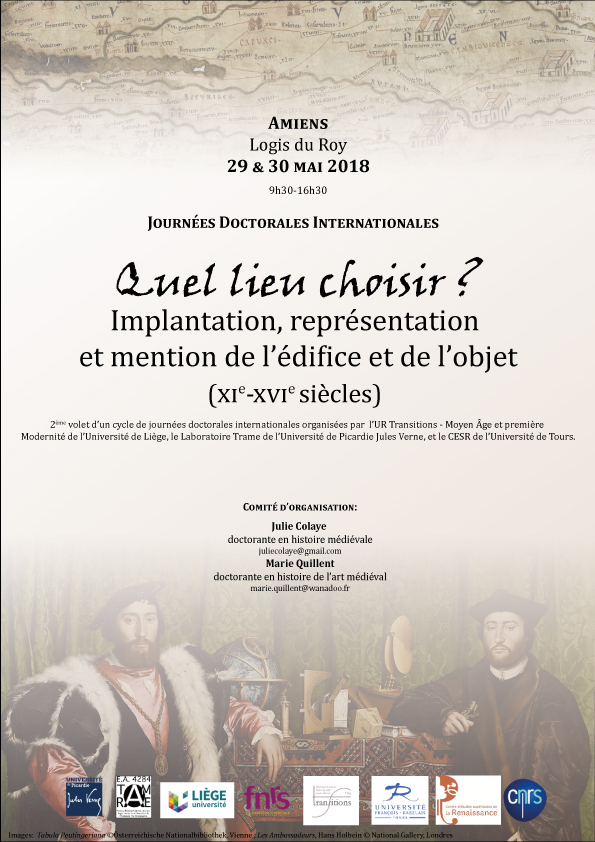
Journées doctorales internationales – « Quel lieu choisir ? Implantation, représentation et mention de l’édifice et de l’objet (XIe-XVIe siècles) » – Amiens 29 et 30 mai 2018 [FR et EN]
Le laboratoire Trame (Textes, représentations, archéologie et mémoire de l’Antiquité à la Renaissance) de l’Université de Picardie Jules Verne s’est associé à l’UR Transitions. Moyen Âge et première Modernité de l’Université de Liège et au Centre d’Etudes Supérieures de la Renaissance de l’Université de Tours à l’occasion de rencontres doctorales en trois volets. Leur but est de favoriser les échanges et les débats entre doctorants, jeunes chercheurs et collègues expérimentés. Le premier volet a lieu à Liège les mardi 30 et mercredi 31 janvier 2018, avec pour thème « Transition(s) : concept, méthodes et études de cas (XIVe-XVIIe siècles) ».
Le deuxième volet de ces journées aura lieu à Amiens les mardi 29 et mercredi 30 mai 2018, et aura pour thème :
« Quel lieu choisir ?
Implantation, représentation et mention de l’édifice et de l’objet (XIe-XVIe). »
Ces journées seront divisées en deux temps : tout d’abord le choix du lieu de l’édifice, puis le choix du lieu de l’objet. La construction d’un nouvel édifice démarre généralement par une importante réflexion sur son lieu d’implantation. Le choix de ce dernier peut être stratégique ou symbolique, voire les deux, et dépend de sa fonction, de son commanditaire et de l’environnement dans lequel il doit être situé : un monastère qui souhaite s’implanter dans un endroit reculé ou au cœur d’un centre urbain ; un lieu de pouvoir qui doit dominer un territoire donné ; une forteresse militaire qui doit avoir un emplacement stratégique… Il est ainsi intéressant d’étudier l’ensemble des facteurs, des acteurs et des enjeux rencontrés dans ce processus d’implantation, que le lieu concerné soit urbain, péri-urbain, rural ou isolé.
Il en va de même pour les objets : tableaux, sculptures, objets précieux, reliquaires, bijoux, monument funéraires, meubles, attributs liés à une fonction ou à un pouvoir, objets porteurs de symbole… Un grand nombre d’entre eux nécessite d’être placés dans un lieu spécifique, qu’il s’agisse d’un lieu réel ou de la composition d’une œuvre bidimensionnelle. L’objet et le lieu ou l’édifice qui l’accueille interagissent et peuvent être conçus ou modifiés en conséquence.
L’objectif de ces journées doctorales est ainsi d’apprécier la notion de lieu dans toutes ses déclinaisons afin de mieux comprendre sa conception et son importance au cours du Moyen Âge et de la première Modernité.
Pour plus d’informations vous pouvez contacter les organisatrices:
Julie Colaye: juliecolaye@gmail.com
Marie Quillent: marie.quillent@wanadoo.fr
[EN]
The research laboratory Trame (Texts, Representations, Archaeology and Memory from Antiquity to the Renaissance) of the University of Picardie Jules Verne associated with the research unit Transitions. Middle Ages and First Modernity (University of Liège) and with the Center for Advanced Studies in the Renaissance of the University François Rabelais (Tours) on the occasion of international PhD students ‘ Meetings in three parts. Implemented by PhD students of these three institutions, the aim of the meetings is to enable exchanges and discussions between PhD students, junior researchers and experimented colleagues. The first part will be held in Liège on Tuesday the 30th of January and Wednesday the 31st of January 2018 on the theme « Transition(s) : concept, methods and case studies (14th-17th centuries) ».
The second meeting will be held in Amiens on Tuesday the 29th of May and Wednesday the 30rd of May 2018 on the theme :
« Why did they choose this place? Settlements, Representations and References of Buildings and Objects (11th-16th centuries) »
This meeting will be divided into two parts: first, the choice of the place of the building, and then the choice of the place of the object.
The construction of a new building usually start with an important thinking concerning the localization. The choice is strategic or symbolic, sometimes both, and depend on its function, its sponsor and its geographical context. For example, a monastery will set up on a secluded place or, in the contrary, on an urban center; a military fortress must occupy a strategic place to dominate a territory etc. In this way, it’s interesting to study all these factors, actors and issues regarding the establishment process in a rural, urban or suburban context.
In the same way, objects (such as paintings, sculptures, precious objects, reliquaries, pieces of jewellery, funerary monuments, pieces of furniture, symbols of power etc.) are interesting to study. Lot of them need to be placed on a specific location, whether it’s in a real place or in the composition of a bidimensional work. The place where the object is arranged can be modified in consequence as there are interactions between them.
The goal of this Meeting is to gauge the notion of place in all its forms in order to understand its meaning and its importance during the Middle Ages and First Modernity.
More informations can be asked at:
Julie Colaye: juliecolaye@gmail.com
Marie Quillent: marie.quillent@wanadoo.fr
Conference: Encounters East/West: Byzantium – Ottoman Empire (Munich, 29 Jun 18)
Zentralinstitut für Kunstgeschichte, München, June 29, 2018
Workshop Encounters East/West: Byzantium – Ottoman Empire
Program:
13.00 Chair: Franz A. Bauer, Ludwig-Maximilians Universität München
Ivan Valchev, Universität Sofia: Roman Religious Artifacts After Antiquity (Examples from modern Bulgaria)
Georgi Sengalevich, Universität Sofia: Signs and Symbols of the Elite on Luxury Objects of the Late Byzantine World
Ella Beaucamp, Ludwig-Maximilians Universität München: From Romania to Rialto and Back. Venetian Objects in Byzantine Collections (13th/14th c.)
14.30 Coffeebreak
15.00 Chair: Andrea Lermer, München
Mariya Kiprovska, Universität Sofia: Conspicuous Display: Visual Representation and Political Legitimacy in the Early Modern Ottoman Realm
Emine Küçükbay, Otto-Friedrich-Universität Bamberg: Hilye-i Şerīf: A verbal portrait of the Prophet Muhammad from the 17th century Ottoman Empire and conceivable adaptation features of Byzantine art
Maximilian Hartmuth, Universität Wien: Consolidating Rule, Fine-tuning Its Instruments: Monumental Architectural Projects in the Ottoman Balkans Between the Conquests of Thessaloniki (1430) and Bosnia (1463)
16.30 Coffeebreak
17.00 Chair: Maria Baramova, Universität Sofia
Annette Kranen, Freie Universität Berlin: History and Territory. Drawings from a French Reconnaissance Mission to the Ottoman Coasts, 1685-1687
Kirila Atanasova, Universität Sofia: The “Forbidden” Luxury and the “Desired” Piety: Coffee and Royal Female Architectural Patronage in Istanbul’s 17th-century neighborhood of Eminönü
Robert Born, Universität Leipzig: Minarets and Fountains. Reflections on the Reception of Ottoman Architectural Forms in Eastern and Western Europe
Conference: Pillaging Sacred Spaces (Cologne, 3-4 May 18)
Internationales Kolleg Morphomata, Universität zu Köln, Weyertal 59 (Rückgebäude), 3. Stockwerk, Bibliothek, 50937 Köln, Germany, May 3 – 04, 2018
Pillaging Sacred Spaces. Diachronic and Cross-Cultural Perspectives
While plundering has been an intrinsic part of warfare throughout human history, his workshop will explore the specifi c notion of pillaging sacred space from iachronic and cross-cultural perspectives. How is looting and destroying sacred space negotiated, conceived, and judged within the framework of conquest? Are individual ‘arch-plunderers’ discernible in various ancient and medieval cultures? How should we read accounts of pillaging sacred space? The speakers address these and related questions by analysing the plundering histories of particular sites and by tackling broader cultural trends and infl uences such as economic factors, religious zealotry, and the possibility of creating or enforcing norms.
Program
Thursday, 3rd May 2018
9:30 Welcome and Introduction
Mabi ANGAR (Cologne) and Yvonne PETRINA (Munich)
JERUSALEM THROUGH THE CENTURIES
Chair: Hansgerd BRAKMANN
10:00 Yuval LEVAVI (Ramat Gan)
Pillaging the First Temple: Nebuchadnezzar in 586 BCE
10:45 Galit NOGA-BANAI (Jerusalem)
Seconda Casa Gerusalemme – Roma: The Arch of Titus and Jerusalemite Relics in Rome
11:30 Katharina PALMBERGER (Jerusalem)
The Church of the Holy Sepulchre and Its History of Plundering
12:15 Lunch Break
CONSTANTINOPLE AND THE FOURTH CRUSADE
Chair: Susanne WITTEKIND
14:00 Peter ORTH (Cologne)
Plundering Constantinople in 1204. The Latin Accounts
14:45 Mabi ANGAR (Cologne)
The Plundering of Hagia Sophia in 1204 as Pictured by Niketas Choniates
15:30 Coffee Break
THE ARABIAN PENINSULA AND THE INDIAN SUBCONTINENT
Chair: Beate FRICKE
16:00 Konstantin KLEIN (Bamberg)
Letters of Stone: Narratives of Destruction in the Late Antique East (4th–7th centuries)
16:45 Han Hsien LIEW (Cambridge, MA)
Caliph Yazid ibn Mu‘awiya‘s Attack on Mecca and Medina in Islamic Historical Memory
17:30 Eva ORTHMANN (Göttingen)
Plundering Hindu and Buddhist Sanctuaries in India under Mahmud of Ghazna
Friday, 4th May 2018
PILLAGING IN ANTIQUITY
Chair: Karl-Joachim HÖLKESKAMP
10:00 Sonya NEVIN (Roehampton)
Pillaging Sacred Space in Late Archaic and Classical Greek Warfare
10:45 Sema KARATAŞ (Cologne)
How to Plunder Thoroughly? – C. Verres and the Sacred Island of Sicily
11:30 Béatrice CASEAU (Paris)
Religious Rage or Economic Reasons: Pillaging Sacred Spaces in Late Antiquity
12:15 Lunch Break
PILLAGING IN THE MIDDLE AGES
Chair: Sabine von HEUSINGER
14:00 Miriam CZOCK (Duisburg-Essen)
Pillaging Churches in the West During the Early Middle Ages
14:45 Susanne WITTEKIND (Cologne)
Cities Destroyed, Treasures Removed. How Medieval Chronicles Report on Pillaging in the Iberian Peninsula
15:30 Felicitas SCHMIEDER (Hagen)
The Mongolian Sack of Bagdad in 1258 and Its Perception in the West
16:15 Final Discussion
 Medieval Art Research