CFP: Museums and Identities, Warsaw, Poland (Deadline 1 May 2018)

Museums and Identities

Museum of King Jan III’s Palace at Wilanów                                                                      Warsaw, Poland, November 21 – 23, 2018
Deadline: May 1, 2018

By ICOM Austria, ICOM Czech Republic, ICOM Slovakia, ICOM Poland
and Museum of King Jan III’s Palace at Wilanów

“Museums and landscapes are an essential element of humanity’s physical, natural, social and symbolic environment.” Based on this first sentence from the ICOM Resolution of the 24th  ICOM General Conference in Milano 2016 “The Responsibility of Museums Towards Landscape” we want to continue the discussion initiated during the first Seminar in 2017, about the impact museums have and how they react to the landscape that surrounds them, urban or rural. What particular responsibility for protecting this natural heritage and to promote sustainable development do museums have?

But the term “Landscape” also implies other perspectives: How are museums influencing the cultural, social, economic or political identity of the area and society they are situated in? They choose what objects are collected, presented and protected, what stories are told and how. They define what is handed on to future generations. “With Great Power Comes Great Responsibility” to quote Winston Churchill, Theodore Roosevelt and Spider-Man. Therefor we want to question the role of governmental authorities or financial sponsor and how they might influence the presentation or content of exhibitions. How do museums react to financial dependencies or state-ideologies?

As we are celebrating the European Year of Cultural Heritage this year, we celebrate the diverse cultural heritage across Europe. We want to raise the question if museums not only preserve Europe’s cultural heritage at national, regional and local level, but if they also are in the position to be an important factor to contribute to build an European identity that is felt to be still missing.

Call for Papers:

Topics of interest for submission include:
1. Perspectives: Different Identities and Missions of Museums
2. Neighbours: Impact of Museums on Cultural Landscapes and Social Networks
3. Politics: Museums in Historical and Contemporary Context
4. Nature: Environmental Impact of Museums
5. Economy: Impact of Museums on Local Development & Financial Sustainability
6. European Union: Impact of Museums on European Identity

We invite to send an original research abstracts, case studies before the Abstract submission deadline. All research papers will be evaluated by international Committee.  All the accepted abstracts will be eligible to be presented at the seminar after the confirmation of participation.

Applications:
Please complete the attached application form and send it to:
konferencja@muzeum-wilanow.pl

Downloads:
CFP:
http://icom-oesterreich.at/sites/icom-oesterreich.at/files/attachments/call_for_papers.pdf

Application:
http://icom-oesterreich.at/sites/icom-oesterreich.at/files/attachments/cfp_app_form.docx

Important Dates:
Abstract submission deadline: May 1, 2018
Notification of accepted applications: May 31,2018

Language:
English

Publication:
Selection of lectures will be published
CFP: The Global Turn in Medieval Studies (Deadline 15 June 2018)

The Global Turn in Medieval Studies: the 94th Annual Meeting of The Medieval Academy of America


University of Pennsylvania

7-9 March 2019 | http://www.medievalacademy.org

The 94th Annual Meeting of the Medieval Academy of America will take place in Philadelphia on the campus of the University of Pennsylvania. The meeting is jointly hosted by the Medieval Academy of America, Bryn Mawr College, Delaware Valley Medieval Association, Haverford College, St. Joseph’s University, the University of Pennsylvania, and Villanova University.

Medievalists across various disciplines are taking a more geographically and methodologically global approach to the study of the Middle Ages. While the Organizing Committee invites proposals for papers on all topics and in all disciplines and periods of medieval studies, this year’s conference spotlights the “global turn” in medieval studies. To this end, we encourage session and paper proposals that treat the Middle Ages as a broad historical and cultural phenomenon, encompassing the full extent of Europe as well as the Middle East, southern and eastern Asia, Africa, and beyond.  We also invite proposals that explore departures from traditional teleological discourses rooted in national interests, ones that apply disciplinary and interdisciplinary methods to study a broad array of subjects.

We especially encourage proposals that provoke explorations of the following “big questions”:

1) Periodization and the drawing of geographic borders in medieval studies can be helpful, but can also limit our ability to make connections, see patterns, or entertain dialogue among specialists in individual sub-fields. What do we mean when we speak of the “Middle Ages” in geographic, temporal, or disciplinary terms? What do we mean when we use contemporary geographical concepts, such as Europe or Asia? What do we mean when we say “Global Middle Ages”? What is in and what is out?

2) If we are to turn away from national models, what is an alternative?  For instance, how can methodologies that highlight networks further our understanding of the “Global Middle Ages”? How might they contribute, for example, to understanding mechanisms of knowledge sharing and the development and use of religious, economic, and political systems?

3) Across all cultures in the medieval world, philosophers, theologians, scholars, healers, poets, artists, and musicians sought to understand the natural world and to apply that understanding to concrete ends. How do we make sense of their efforts? How might traditional paradigms of what we call “science,” philosophical inquiry, literary, and artistic practice be challenged?

4) Medieval studies has been at the forefront of the “digital turn” over the past few decades. How have digital approaches to scholarship altered the landscape for better or worse? In a global context, have new technologies broken barriers or created new ones? How do we create and evaluate digital scholarship in medieval studies vis à vis traditional methods?

Within the framework of these “big questions”, the organizing committee proposes the following threads:

*    Uses of the Medieval
*    Expanding Geographies of the Medieval
*    Re-thinking Periodization: Beyond Eurocentrism and Postcolonialism
*    Medieval Foundations of Contemporary Politics
*    Alexander the Great and World Thinking
*    Medieval Cosmologies
*    The Trojan Myth and Genealogies
*    What is Medieval/European/Literature?
*    Transmission and Technologies of Knowledge
*    Doing Science at Court
*    The Locations of Learning
*    Myths and Legends of Languages and Letters
*    Dante, Local and Global: Towards 2021
*    Deconstructing “National” Legal Traditions
*    Gender Matters
*    Ars/Arts: Intersections Across Disciplines and Borders
*    Global Manuscript Markets and Movements
*    Digitizing the Global Middle Ages: Practices, Sustainability, and Ethics
*    Approaches to Historiography
*    Interfaith Encounters, Real and Imagined
*    Religious and Cultural Ethics across Cultures: Conversation or Confrontation?
*    Saints and Sages
*    Words and Music

Proposals
Individuals may propose a:
*    single paper for a listed thread
*    full session on a listed thread
*    single paper not designated for a specific thread
*    full session on a topic outside the listed threads
*    poster, paper, full session, or workshop that explores the role and uses of digital technologies

Sessions are 90 minutes long, and typically consist of three 20-minute papers. Proposals should be geared to that length. The committee is interested in other formats as well: poster sessions, roundtables, workshops, etc. The Program Committee may suggest a different format for some sessions after the proposals have been reviewed.

Any member of the Medieval Academy may submit a proposal; others may submit proposals as well but must become members in order to present papers at the meeting. Special consideration will be given to individuals whose field would not traditionally involve membership in the Medieval Academy.
In order to be considered, proposals must be complete and include the following:

(1) A cover sheet containing the proposer’s name, statement of Medieval Academy membership (or statement that the individual’s specialty would not traditionally involve membership in the Academy), professional status, email address, postal address, home or cell and office telephone numbers, fax number (if available), and paper title;

(2) A second sheet containing the proposer’s name, session for which the proposal should be considered, title, 250-word abstract, and audio-visual equipment requirements.

(3) Additional sheets as necessary containing all of the above information, plus a session abstract, when a full panel for a session is being proposed.

Submissions: Proposals should be submitted as attached PDFs to the MAA Program Committee by email to MAA2019@TheMedievalAcademy.org

The deadline is 15 June 2018.

Please do not send proposals directly to the Organizing Committee members.

Selection Procedure: Paper and panel proposals will be reviewed for their quality and for the significance and relevance of their topics. The Organizing Committee will evaluate proposals during the summer of 2018 and the Committee will inform all successful and unsuccessful proposers by 10 September 2018.

Organizing Committee Members:
Lynn Ransom & Julia Verkholantsev, University of Pennsylvania (co-chairs)
Daud Ali, University of Pennsylvania
Chris Atwood, University of Pennsylvania
Kevin Brownlee, University of Pennsylvania
Mary Caldwell, University of Pennsylvania
Linda Chance, University of Pennsylvania
Paul M. Cobb, University of Pennsylvania
Catherine Conybeare, Bryn Mawr College
Talya Fishman, University of Pennsylvania
Fr. Allan Fitzgerald, Villanova University
Scott Francis, University of Pennsylvania
Nicholas Herman, University of Pennsylvania
Tom Izbicki, Rutgers University & Delaware Valley Medieval Association
Ada Kuskowski, University of Pennsylvania
Ann Matter, University of Pennsylvania
Maud McInerney, Haverford College
Paul Patterson, St. Joseph’s University
Montserrat Piera, Temple University
Dot Porter, University of Pennsylvania
Jerry Singerman, University of Pennsylvania Press
Emily Steiner, University of Pennsylvania
Eva del Soldato, University of Pennsylvania
Elly Truitt, Bryn Mawr College
David Wallace, University of Pennsylvania (ex officio as MAA president)


Lecture Series: London Society for Medieval Studies Summer Term 2018 Lecture Series

List of upcoming lectures with the London Society for Medieval Studies

Venue: Wolfson Room NB01, Basement, IHR, North block, Senate House unless otherwise stated

Time: Tuesdays 19:00

Chair: Stephen Spencer (stephen.spencer@sas.ac.uk)

Joint secretaries: Ella Kilgallon

Treasurer: Giorgio Lizzul

Committee: Ella Kilgallon, Anaïs Waag, Helen Rampton, Emma Knowles, Calum Cockburn, Karel Fraaije

Summer Term 2018

17 April 19:00 – The Royal Anglo-Saxon Burials of Winchester  – Barbara Yorke (University of Winchester), IHR Wolfson Room NB01, Basement, IHR

1 May 19:00 – Domesticating the Devil: The Early Medieval Contexts of Aldhelm’s Cat Riddle – Megan Cavell (University of Birmingham), Room G7, Ground Floor

15 May 19:00 – “Structuring the Sacred”: considering framing, space and place on the Easby Cross – Meg Boulton (University of York), IHR Wolfson Room NB01, Basement, IHR

29 May 19:00 – Is it all about the money? Joan of Navarre and the economic element of queenship  – Elena Woodacre (University of Winchester), IHR Wolfson Room NB01, Basement, IHR

12 June 19:00 – London Society for Medieval Studies TBC, Room 246, Second Floor

Workshop: Art and Court Cultures in the Iberian World (1400-1650), Harvard University, 23 April 2018

2nd International Workshop: Art and Court Cultures in the Iberian World (1400-1650)

Real Colegio Complutense at Harvard University
Harvard University, Cambridge, MA, USA, April 23, 2018

Visual strategies of legitimization became increasingly important for Iberian monarchies during the late medieval and early modern periods. Their dynastic, diplomatic, and military endeavors called for effective propaganda, both in the metropolis and in viceregal territories. Such efforts include architecture, both ephemeral and permanent, the decoration of palaces, court portraiture, and historiography. The advent of the Monarchia Hispanica under Habsburg rule required careful elaborations of national, religious, racial, and gender identities, across a mosaic of multilingual and multiethnic populations. This second workshop aims to highlight some of these strategies, and to consolidate a forum for discussion of further research avenues, under the guidance of scholars from Spanish and American universities. It is made possible thanks to the collaboration of Real Colegio Complutense at Harvard University, and University of Valencia.

16.00 Welcome, opening remarks and panel.
Panelists:
– Replicating the Royal Image: Philip III’s portrait at Harvard Art Museums.
Cristina Morilla, Associate Paintings Conservator, Harvard Art Museums.

– Alliance, Emulation and Competition in the Habsburg Netherlands: The Case of a 16th-Century Alabaster Funerary Monument in Heverlee.
Jessie Park, Rousseau Curatorial Fellow in European Art, Harvard Art Museums.

– Sofonisba Anguissola’s Self-Portraiture, from Court Propaganda to Meta-Artistic Sign. Jorge Sebastián Lozano, Assistant Professor of Art History, University of Valencia; Research Fellow, Real Colegio Complutense at Harvard University.

17.30 Q & A
Discussion moderated by Prof. Felipe Pereda, Fernando Zóbel de Ayala Professor of Spanish Art, Harvard University.

Location:
RCC Conference Room
26 Trowbridge St.
Cambridge, MA

Free registration. Please RSVP at
https://rcc.harvard.edu/event/2nd-international-workshop-art-and-court-cultures-iberian-world-1400-1650

CFP: Crossing Rivers in Byzantium and Beyond (Vienna, 2-3 Nov 18) (Deadline 1 June 18)

Crossing Rivers in Byzantium and Beyond

Department of Art History, University of Vienna, 02. – 03.11.2018
Deadline: Jun 1, 2018

“It is always dramatic to cross a frontier, even though the frontier is only a brook”
(V. S. Pritchett, Geographical Magazine, December, 1942)

This workshop is organized as part of the project “Byzantine Stone Bridges: Material Evidence and Cultural Meaning,” managed by Dr. Galina Fingarova at the Department of Art History of the University of Vienna. It is generously funded by the Austrian Science Fund (FWF), Elise-Richter-Program. For further information, see http://bridges.univie.ac.at/.

This project focuses on a long-overlooked aspect of architectural and cultural history – Byzantine stone bridges. It investigates the particularities of this type of architectural monuments built from the fourth to the fifteenth centuries on territories under imperial Byzantine rule. It addresses the following enquiries: 1) reconstructing the
significance of Byzantine stone bridges in the context of architectural history by analyzing the structural and technical innovations that are evident in the preserved monuments; and 2) understanding the importance of bridges as sources for a Byzantine cultural and social history, in particular, on a political, symbolic, and metaphorical level.

This workshop will expand on the project’s research questions and methodological approaches by placing these in a broader context. The workshop encourages an interdisciplinary discourse on the unique characteristic of rivers to define territories and boundaries and on their crossing as a means of connection in a real and figurative sense. It seeks to transcend both the territorial and chronological limits of the Byzantine Empire.

Confirmed Keynote: Professor Jim Crow (University of Edinburgh)

Scholars working in the fields of Roman, Late Antique, Byzantine, Medieval, Ottoman, and Middle Eastern Studies
are invited to submit proposals for 20-minute papers connected with but not limited to the following topics:
• Riverine landscapes;
• River crossings as political, social, military, or commercial events;
• Urban and rural communities on and along rivers;
• Architectural and engineering achievements in hydrology;
• Ford and ferry;
• Pontoon, wooden, and stone bridges;
• Related structures such as aqueducts, mills, etc.;
• Mythological and religious aspects of river crossings;
• Emotional experiences at or traversing rivers.

Please send proposals of no more than 300 words, including a title and an abstract, together with a short CV to Dr. Galina Fingarova (galina.fingarova@univie.ac.at) by June 1, 2018.

CFP: Studienkurs des Warburg-Hauses: Medialitaet des Sakralen (Hamburg, 24-28 Sep 18) (deadline: 7/05/18)

CFP: Studienkurs des Warburg-Hauses: Medialitaet des Sakralen (Hamburg, 24-28 Sep 18)

Hamburg, Warburg-Haus, 24. – 28.09.2018
Deadline: May 7, 2018

Call for Papers

Medialität des Sakralen:
Bilder und Vermittlungsstrategien des Heiligen in Mittelalter und früher Neuzeit

Studienkurs des Warburg-Hauses
Leitung: Prof. Dr. Peter Schmidt und Lena Marschall, M.A., Universität Hamburg

Wird die Welt in getrennten Sphären von Diesseits und Jenseits, von Göttlichem und Kreatürlichem gedacht, bedarf es Strukturen der Vermittlung. Medialität ist deshalb in den letzten Jahren von den Kulturwissenschaften und der Theologie als zentraler Aspekt des Christentums herausgearbeitet worden. Christus und die Heiligen sind Medien im Sinne der Vermittlungsstrukturen zwischen der Menschheit und Gott. Das Heilige kann in seiner sinnlich wahrnehmbaren Konkretisierung – etwa in Form heiliger Orte, Objekte, Reliquien etc. – zum Medium werden. Gleichzeitig bedarf das Heilige selbst der Vermittlung: Denn der Mensch ist, wie etwa Gregor des Großen es formuliert, durch den Sündenfall so stumpf geworden, dass er das Göttliche nur über Hilfsmittel wie die sinnliche Vorstellung erkennen kann.

Hier kommt das Bild ins Spiel. Über die Präsenz des Heiligen in oder gleichsam hinter den Bildern ist in der Kunstwissenschaft viel gesprochen worden; über die medialen Funktionen von Bildern in Hinblick auf das Heilige noch nicht genug. Das ist nun Ziel des diesjährigen Studienkurses des Warburg-Hauses. Denkbare Aspekte könnten dabei sein:

– Bilder vervielfältigen / verbreiten Heiliges
– neue Bildmedien vermitteln Heiliges
– Bilder und heilige Orte / heilige Objekte
– die Körper der Heiligen – unsichtbar, sichtbar
– die Sakramente (als media salutis) und das Medium des Bildes
– Bilder thematisieren Vermittlungsprozesse zwischen dem Menschlichen und Göttlichen
– Reformationen der Vermittlungsfunktion von Bildern

Diese Punkte sind nur als Anregungen und Vorschläge zu verstehen.

Der jährlich im Warburg-Haus stattfindende Studienkurs, der gemeinsam vom Kunstgeschichtlichen Seminar der Universität Hamburg und der Aby-Warburg-Stiftung veranstaltet wird, bietet ein Forum für Nachwuchswissenschaftlerinnen und -wissenschaftler (http://www.warburg-haus.de/). Wir versprechen uns vom genius loci Motivation und Inspiration.

Erwünscht sind Bewerbungen von fortgeschrittenen Studierenden oder AbsolventInnen der Kunstgeschichte oder eines einschlägigen Bereichs der Kulturwissenschaften, die im weit gefassten thematischen Feld des Studienkurses eine Master- oder Doktorarbeit begonnen oder kürzlich abgeschlossen haben. Fortgeschrittene Studierende im Haupt- bzw. Masterstudium, die ein einschlägiges und konkretes Interesse entwickelt haben, sind ebenfalls eingeladen, sich zu bewerben. Die TeilnehmerInnen stellen in einem 30-minütigen Beitrag ihr Forschungsthema oder einen einschlägigen Aspekt vor. Intensive Diskussion und Austausch über diese Beiträge, über ausgewählte Aspekte des Rahmenthemas und einschlägige Texte soll im Mittelpunkt stehen. Außerdem ist eine eintägige Exkursion vorgesehen. Diskussionssprache des Studienkurses ist Deutsch, Nicht-MuttersprachlerInnen können ihre eigenen Beiträge jedoch auch in Englisch vortragen. Die Kosten für die Anreise (2. Klasse) und Unterbringung im Doppelzimmer trägt die Aby-Warburg-Stiftung.

Bewerbungen zur Teilnahme können in Deutsch oder Englisch verfasst sein und sollen die folgenden Unterlagen enthalten (alles in einem zusammenhängenden PDF):

1. Tabellarischer Lebenslauf
2. Kurze Skizze eines Vortragsthemas und Darlegung der Motivation für die Teilnahme (zusammen max. 500 Wörter)
2. Angabe der ungefähren Fahrtkosten

Die Bewerbungen sind bis zum 7. Mai 2018 zu richten an:
Prof. Dr. Peter Schmidt und Lena Marschall, M.A.,
unter der E-Mail-Adresse: lena.marschall@uni-hamburg.de

CFP: ‘Hurt and healing: people, texts, and material culture in the Eastern Mediterranean’ – 19th Postgraduate Colloquium of the Centre for Byzantine, Ottoman and Modern Greek Studies (University of Birmingham) (deadline 21st April 2018)

Hurt and Healing: people, texts, and material culture in the Eastern Mediterranean’.

The 19th Annual CBOMGS Postgraduate Colloquium

2nd June 2018

The Committee is pleased to announce the Call for Papers for the 19th Postgraduate Colloquium of the Centre for Byzantine, Ottoman and Modern Greek Studies at the University of Birmingham, UK.

The concepts of hurt, trauma and healing cross between the different disciplines that deal with Eastern Mediterranean. The colloquium aims to explore transformations and multifarious dimensions of the notions of trauma and wreckage, and their opposition, healing, from the Late Antiquity to the Present.

Whilst serving as antitheses to one another they are also complementary. After destruction and breakage, comes the need for repair. However, when a broken textile’s ripped edges are joined again, the visible seam signifies the damage that has happened. Trauma and healing are key concepts in medicine, psychology, and sociology. However, political ideology has constantly used them in order to justify the rising and the existence of authoritarian regimes. In the past, medicine, saints, and magic offered different ways for healing the body and the soul. The current aim of restoration practices is to heal remnants of cultural heritage after damage and to prevent damage with appropriate conservation strategies.

Suggested topics include, but are not limited to:

  • Healing power of saints and healing people in society;
  • Medicine and magic;
  • Cultural heritage and material culture: restoration and preservation practices, as well as preventive actions for the preservation;
  • The individual aspects of trauma, especially in relation to the politics of gender, sexuality, class, race, and identity (sexual abuse, domestic violence, shame and fear, death and mourning or melancholia);
  • Collective experiences of trauma (war, genocide, terrorism, victims and perpetrators, practices of memory and oblivion);
  • Migration from the Late Antiquity to the current migration crisis and harrowing events in refugee camps;
  • Public health and medical, therapeutic approaches to illnesses and trauma;
  • Texts and images related to medical practices

Papers of approximately 20 minutes related to any of the fields covered by Byzantine, Ottoman and Modern Greek Studies are welcome. Please submit abstracts of no more than 250 words no later than Saturday 21st April 2018 to 2018cbomgscolloquium@gmail.com.  Applicants will be notified of selection by 28th April 2018.


For more information click here: https://cbomgs2018colloquium.wordpress.com/

New Book roundup: Boydell & Brewer, 2018

Boydell & Brewer have announced their new publications for 2018. You can see the full list here: https://boydellandbrewer.com/media/wysiwyg/Catalogues/Medieval_Studies_Catalogue_-_2018.pdf 

Here are four that were featured in the Boydell & Brewer: Medieval Herald 32.

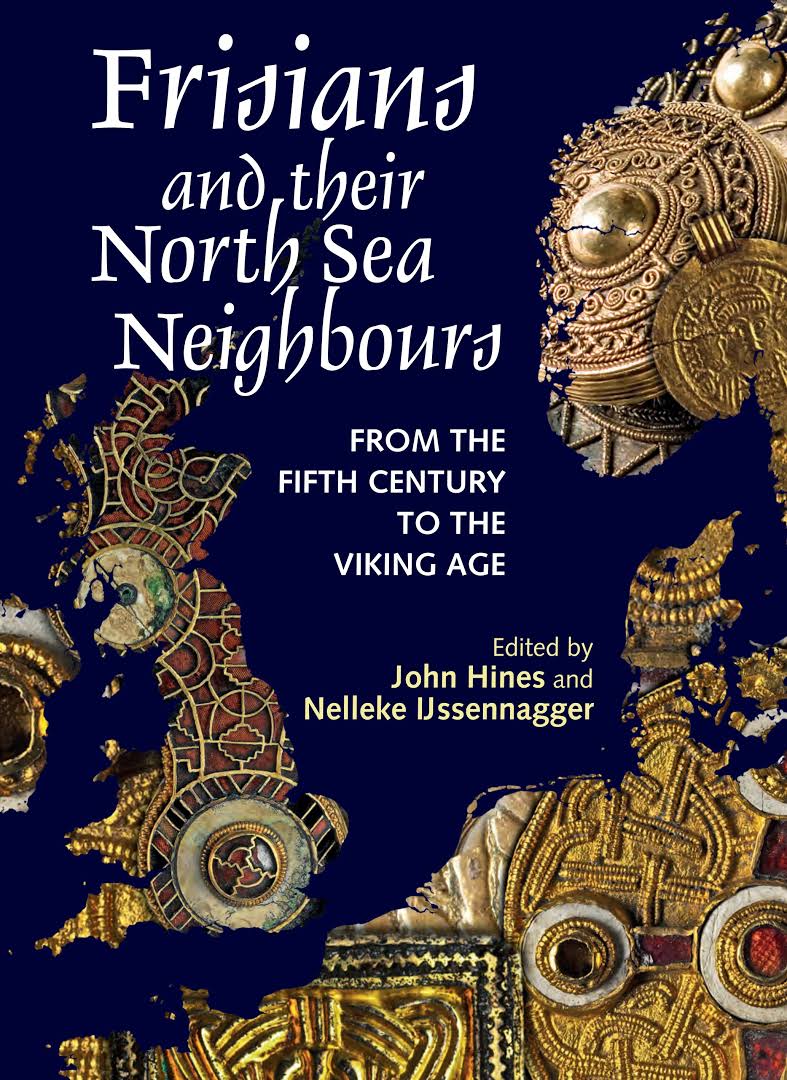
Frisians and their North Sea Neighbours
Frisians and their North Sea Neighbour
Although Frisians neighboured Anglo-Saxons, Franks, Saxons and Danes in north-western Europe, the details of their lives, communities and culture have remained little-known. Why is this? Well, largely because Frisia and Frisian have meant different things to different people through time, and partly because Frisians had no tradition of writing until relatively late. We trust that this new collection, edited by John Hines and Nelleke IJssennagger, will help change that and broaden knowledge of and interest in the previously mysterious Frisians.
Church Monuments in South Wales, c.1200-1547, by Dr Rhianydd Biebrach
Despite the modest distances that separate them, monuments in south Wales can differ greatly from those in north Wales or the west of England. And although they can tell us much about religious and cultural practices of the time and place, they have until now been sadly understudied. Rhianydd Biebrach explains their special significance, reveals her two favourite monuments and how she undertook her extensive research (losing her dining table in the process). And why we should all (continue to) be grateful to Michael Praed.
The Saint and the Saga Hero- Hagiography and Early Icelandic Literature
The Saint and the Saga Hero: Hagiography and Early Icelandic Literature, by Dr Siân E. Grønlie
While they might not seem to be natural literary bedfellows, Siân E. Grønlie’s new book explains the profound impact that the medieval saint’s life had on the saga literature of Iceland. Predating sagas by several centuries, the Latin lives of saints could, in some ways, be said to provide a model for the (anti-)heroes of the later written sagas, though these protagonists had of course usually led largely un-saintly lives. Here Dr Grønlie provides a quick introduction to both genres and guides us through the results of their intermingling.
The Medieval Merlin Tradition in France and Italy
The Medieval Merlin Tradition in France and Italy: Prophecy, Paradox, and Translatio, by Dr Laura Chuhan Campbell
Dr Campbell uses the figure of Merlin to demonstrate how language and culture shaped different takes on the same character and story. And what an ideal focus he makes, for within him texts, languages, events real and fictional all converged. Crucially, the language barrier between France and Italy proved highly porous and the fluidity of cultural exchange brought new translations with new narrative possibilities. Dr Campbell explains the remarkable process.

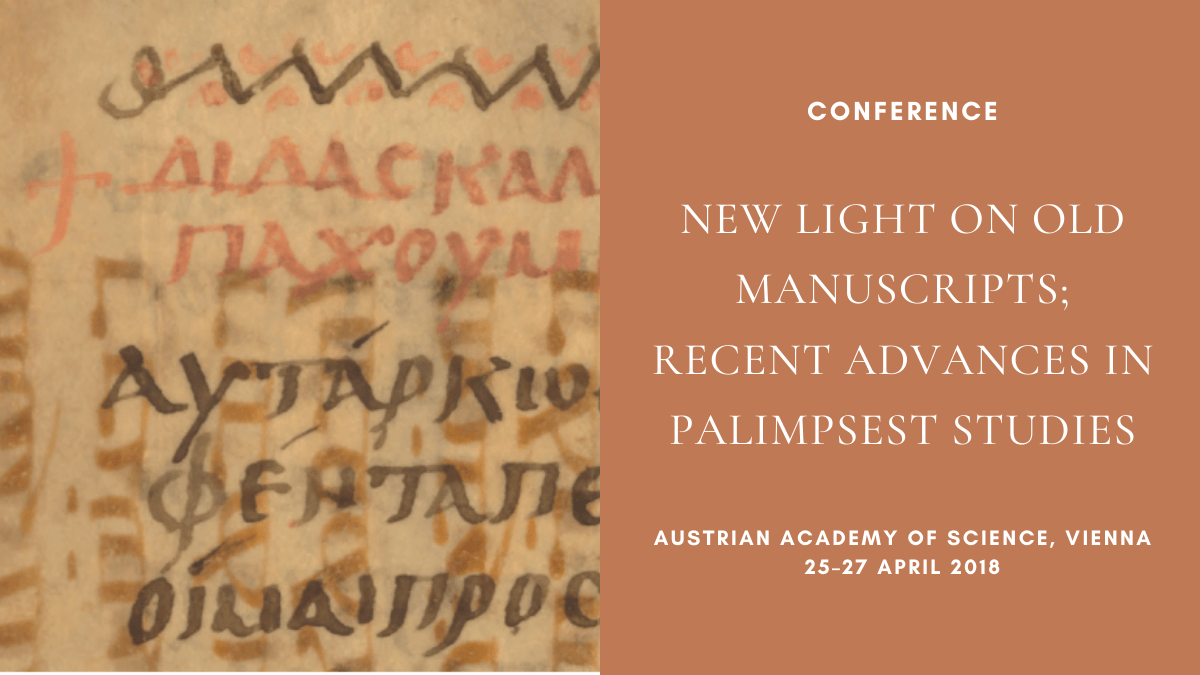
Conference: New Light on Old Manuscripts; Recent Advances in Palimpsest Studies, 25–27 April 2018

Austrian Academy of Sciences Sitzungssaal Dr. Ignaz Seipel-Platz 2 1010 Vienna, Austria

“New Light on Old Manuscripts: Recent Advances in Palimpsest Studies” brings together an international assembly of scholars who have been in the forefront of palimpsest studies in recent years, either in reading and analysing palimpsests texts, or in making them legible through advanced imaging and image processing methods. The conference will also feature work that has been accomplished in the course of the Sinai Palimpsests Project (http://sinaipalimpsests.org).

See full programme here: https://rchivecom.files.wordpress.com/2018/03/palimpsests-conference-programme-25-27-2018.pdf

Programme:

WEDNESDAY, 25 APRIL 2018

09:00–10:30 Moderator: Otto Kresten

Michael B. Phelps – The Sinai Palimpsests Project: its History, Philosophy, and Contributions

Claudia Rapp – The Palimpsest Corpus at St. Catherine’s Monastery in the Sinai Preliminary Observations

Giulia Rossetto – Greek under Arabic: Behind the Lines of Sinaiticus arabicus NF 66

10:30–11:00 REFRESHMENT BREAK

11:00–12:30 Moderator: Otto Kresten

Pasquale Orsini – Greek Scripts, Books and Texts: New Materials from Sinai

Agamemnon Tselikas – Textual Observations on Some Sinai Majuscule Palimpsests

Steve Delamarter – Getatchew Haile The Ethiopic Undertext of Sinai Greek NF 90: Discovery and Analysis

12:30–14:00 LUNCH BREAK

14:00–14:45 Moderator: Manfred Schreiner

Damianos Kasotakis – Implementing Spectral Imaging in the Sinai Desert

Kenneth Boydston – Beyond Discovery: Bringing More Good Things to Light

14:45–15:00 REFRESHMENT BREAK

15:00–16:00 Moderator: Manfred Schreiner

Keith T. Knox – Recovery of Erased Text Using Unsupervised Methods

Roger L. Easton Jr. – Customized Processing of Multispectral Imagery of Palimpsests Based on Spectral Statistics

Dave Kelbe – Is it Magic? The Science Behind Image Processing: Perspectives and Possibilities

16:00–16:30 REFRESHMENT BREAK

16:30–17:15 Moderator: Bernadette Frühmann

Michael B. Toth – Dispersed Palimpsest Offers Digital Insight into St. Catherine’s Library

Doug Emery – Reflections on the Digital Palimpsest: Data Modeling and Data Management

THURSDAY, 26 APRIL 2018

09:00–10:00 Moderator: Ernst Gamillscheg

Sebastian P. Brock – What Can Be Learnt, and What Not, from the Experience of the Syriac and Christian Palestinian Aramaic Palimpsests

Grigory Kessel – Codex Arabicus (Sinai Arabic 514) Revisited

10:00–10:15 REFRESHMENT BREAK

10:15–11:30 Moderator: Basema Hamarneh

Christa Müller-Kessler – A Florilegium of Christian Palestinian Aramaic Palimpsests from St. Catherine’s Monastery

Alain J. Desreumaux – L’apport des palimpsestes du Sinaï à la codicologie araméenne christopalestinienne et aux versions anciennes des textes bibliques

11:30–12:00 REFRESHMENT BREAK

12:00–13:00 Moderator: Kurt Smolak

Michelle P. Brown – Arabic NF 8 and the Latin Manuscripts of St. Catherine’s, Sinai

Heinz Miklas – ‘Excavating’ the Slavonic Palimpsests in the New Sinaitic Finds

13:00–14:30 LUNCH BREAK

14:30–16:00 Moderator: Hans-Jürgen Feulner

Zaza Aleksidze – Dali Chitunashvili Palimpsest N/Sin Geo 7 Kept at the St. Catherine’s Monastery on Mount Sinai (Identification of the Texts)

Bernard Outtier – New Insights in Christo-Palestinian Aramaic and Georgian Literatures

Jost Gippert – New Light on the Caucasian Albanian Palimpsests of St. Catherine’s Monastery

16:00–16:30 REFRESHMENT BREAK

16:30–18:00 Moderator: Katharina Kaska

Irmgard Schuler – Imaging for Manuscript Inspection

Simon Brenner – Photometric Stereo for Palimpsest Analysis

Leif Glaser – X-Ray Fluorescence Investigations on Erased Text Written in Iron Gall Ink

Ivan Shevchuk – Full Field Multispectral Imaging as a Tool for Text Recovery in Palimpsests

18:30 DINNER FOR INVITED GUESTS

FRIDAY, 27 APRIL 2018

09:00–11:00 Moderator: Andreas E. Müller

Felix Albrecht – Chiara Francesca Faraggiana di Sarzana – A Carbonized Septuagint Palimpsest of the Libri Sapientiales in Biblical Majuscule, Codex Taurinensis, Biblioteca Nazionale Universitaria, C.V. 25 (Rahlfs-Ms. 3010): Its Text and Context

Jana Grusková – Giuseppe De Gregorio – Neueste Einblicke in einige palimpsestierte Handschriftenunikate aus den griechischen Beständen der Österreichischen Nationalbibliothek

Bernard H. Stolte – Editing the Basilica and the Role of Palimpsests. The Case of Vindob. Suppl. gr. 200

11:00–11:30 REFRESHMENT BREAK

11:30–13:00 Moderator: Christian Gastgeber

Dieter Harlfinger – Palimpsest-Forschung am Beispiel der Athener Handschrift EBE 192 mit juristischen Texten und Aristoteles-Kommentaren

André Binggeli – The Making of a Greek Palimpsest from the Patriarchal Library in Istanbul

Carla Falluomini – The Gothic Palimpsests: New Readings and Discoveries

13:00–14:30 LUNCH BREAK

14:30–16:00 Moderator: Bernhard Palme

Peter E. Pormann – The Syriac Galen Palimpsest: Between Philology and Digital Humanities

Ronny Vollandt – Palimpsests from Cairo and Damascus: A Comparative Perspective from the Cairo Genizah and the Qubbat al-Khazna

Alba Fedeli – A Few Remarks on Qur’anic Palimpsests

16:00–16:15 REFRESHMENT BREAK

16:15–17:45 Moderator: Gerda Wolfram

Andreas Janke – Challenges in Working with Music Palimpsests

András Németh – Interactive Learning of Palimpsest Research: Virtual Guided Tour from the Invisible to the Abstract Reconstruction

Gregory Heyworth – From Technology to Text: Reading and Editing the Lacunose Manuscript

17:45–18:00 REFRESHMENT BREAK

18:00–18:30 Discussion and Concluding Remarks

Course: Summer Programme in Byzantine Epigraphy, Koç University, September 3–9, 2018 – DEADLINE: 15th April, 2018.

Summer Programme in Byzantine Epigraphy, Koç University Research Center for Anatolian Civilizations (ANAMED), September 3–9, 2018

DEADLINE: 15th April, 2018 (for 8 places)

We are delighted to announce that the Summer Programme in Byzantine Epigraphy 2018 will take place between 3 and 9 September, in Istanbul, Turkey. The Programme will be convened by Ida Toth and Andreas Rhoby, and it will include contributions from over twenty leading specialists exploring Istanbul’s Byzantine inscriptional heritage, and its significance for the discipline of Byzantine Epigraphy as a whole.

Drawing on a wide range of topics such as display, taxonomy, context, ideology, and performance, the Programme will combine daily seminars, evening lectures, practical sessions in Istanbul’s museums, and guided visits to Byzantine monuments and excavation sites. It will provide an interactive platform for exchange of ideas among more experienced scholars of Byzantine epigraphic culture as well as involving younger academics, who require instruction and expert guidance in dealing with Byzantine inscriptional material.

Although contribution to the Programme is by invitation only, we welcome expressions of interest from scholars in early and/or middle stages of their academic career, whose research stands to significantly benefit from attending an intensive, week-long exploration of Byzantine epigraphic traditions. Please, note that the number of available places is limited to the maximum of eight.

Fees will not be charged. However, full funding will be offered only to three exceptional applicants. Non-funded participants should expect to cover their own travelling and accommodation costs.

DEADLINE: 15th April, 2018 (for 8 places)

Find out more information here: https://maryjahariscenter.org/blog/summer-programme-in-byzantine-epigraphy-koc-university-2018