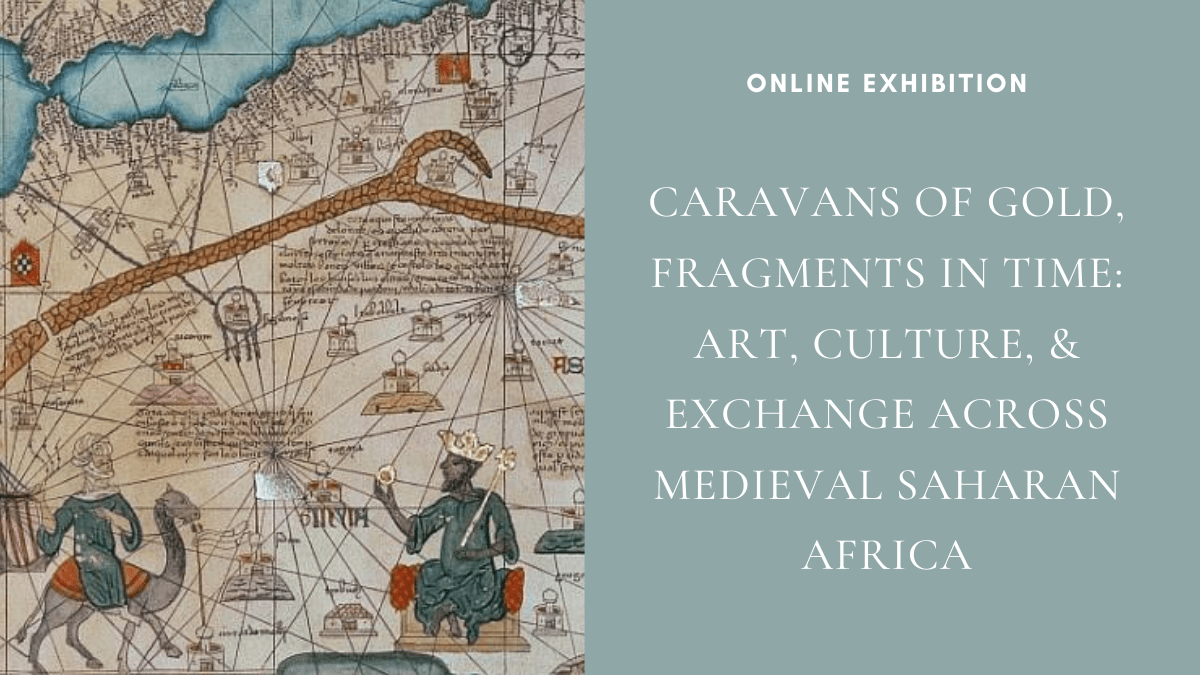
Online Exhibition: Caravans of Gold, Fragments in Time: Art, Culture, & Exchange Across Medieval Saharan Africa

Journey to a medieval world with Africa at its center.

Travel along routes crossing the Sahara Desert to a time when West African gold fueled expansive trade and drove the movement of people, culture, and religious beliefs. Caravans of Gold is the first major exhibition addressing the scope of Saharan trade and the shared history of West Africa, the Middle East, North Africa, and Europe from the eighth to sixteenth centuries. Weaving stories about interconnected histories, the exhibition showcases the objects and ideas that connected at the crossroads of the medieval Sahara and celebrates West Africa’s historic and underrecognized global significance.

Journey across the various sections of the online exhibition here.

The exhibition Caravans of Gold has been developed in consultation with an international group of advisors, each experts in a specialized area that contributes to the big picture that the exhibition conveys. It has also emerged in partnership with institutions and individuals in Mali, Morocco, and Nigeria. In the exhibition and the interviews below we hear directly from the individuals whose work and perspective shaped the exhibition – you can watch some of these interviews here.

CFP: Communicating Objects: Material, Literary & Iconographic Instances of Objects in a Human Universe in Antiquity & the Middle Ages, Online Conference (27–29 November 2020), deadline 14 September 2020

Communicating Objects: Material, Literary and Iconographic Instances of Objects in a Human Universe in Antiquity and the Middle Ages, University of Bucharest [Online], 27–29 November 2020

Material culture occupies a special place in most research conducted on Antiquity and the Middle Ages. Interdisciplinary approaches have allowed for the enrichment of traditional paradigms used by archaeologists and historians, as a follow-up to the valorisation of the social life of things, or of the agency characterising objects in any given society. Objects which are deliberately associated are more susceptible of becoming expressive in the presence of humans. From this perspective, associating objects, and exploring potential reasons for their association and for their compatibility, opens up multiple possibilities for reflection.

Here are some suggested topics, meant to inspire, without limiting, the participants’ choice of subject matter:

  • the place of associated objects in literary sources. Suggested lines of investigation: the place of associated objects in literary discourses, their role in the construction of characters or as vehicles used to advance the action, to create images or to emphasize key moments in the economy of the texts; the practices of writing about objects, ways of selecting and including them in texts, and the study of certain characteristics of objects judged as indispensable to the fulfillment of said objects’ narrative roles.
  • the place of associated objects in constructing images, be they objects carrying images or objects being represented. Suggested lines of investigation: the manners of representing objects, the objects’ insertion in representations and their contributions to visually illustrated discourses.
  • the intrinsic materiality of objects places the discussion in the field of archaeology. From this perspective and for the purpose of a better investigation of associated objects and their potential meanings, one (though by no means the only) possible line of enquiry would turn the researcher’s gaze towards funerary archaeology.

Beyond these suggestions, the synchronic and comparative approaches to various media where objects are placed in association (texts, materiality, images) are strongly encouraged, in order to better assess multiple perspectives and perceptions to which the objects could be subjected, as well as the ways in which objects, once put together in particular and deliberate ways, acquire the capacity of acting as agents.

Accepted languages: English, French, Italian, Spanish.

Abstracts: no more than 300 words to be submitted at the e-mail address objetsdialogue@gmail.com. The abstract should also contain the title of the presentation, the name of the author(s) and the home institution(s).

Duration of each presentation: 20 minutes followed by 10 minutes for discussions.

Announcement of accepted proposals: September 30th 2020.

Digital poster section: a poster gallery will also be available for researchers preferring to send their presentation in this form. The gallery will be open to the public for the whole duration of the conference. On demand, the posters may be accompanied by a recorded audio presentation, no more than 10 minutes in length. Technical details will be available shortly, on the dedicated page at http://www.daaia.ro/.

More information can be found here.

New Publication: Moving with the Magdalen: Late Medieval Art and Devotion in the Alps

Moving with the Magdalen is the first art-historical book dedicated to the cult of Mary Magdalen in the late medieval Alps. Its seven case study chapters focus on the artworks commissioned for key churches that belonged to both parish and pilgrimage networks in order to explore the role of artistic workshops, commissioning patrons and diverse devotees in the development and transfer of the saint’s iconography across the mountain range. Together they underscore how the Magdalen’s cult and contingent imagery interacted with the environmental conditions and landscape of the Alps along late medieval routes.

Author Joanne W. Anderson is a Lecturer in Art History at The Warburg Institute.

Visit Bloomsbury’s website for more information on this publication.

CFP: ‘Seeing Climate through Medieval Art & Architecture’, IMC Leeds (5–8 July 2021), deadline 25 September 2020

Call for Papers for ‘ICMA Student Committee’ Session Proposal

In keeping with this year’s theme at the Medieval Congress, this session aims to explore medieval objects and buildings created with an awareness of climate. Climate is intimately intertwined with nature and environments, with as much of a profound impact on medieval lives as on ours today. It can be a cooperative partner, nourishing and stimulating growth, or a hostile threat to life—with scorching heat or forbidding storms preventing sustainable human settlement. Medieval climate might be construed as the literal, experiential, or perceived weather, geography, topography, or environment. We are especially interested in medieval awareness of change in climate that impacts well-being, health, and security—similar to effects felt today. How did the Medieval Warm Optimum or Little Ice Age affect the objects of trade or the construction of buildings and towns? 

While there is much to be found in written sources on the effects and changes in climate, we hope to organize a session around the traces of climate in the material record of medieval art and architecture. Climate may be grasped through regional differences in architecture—whether through mundane changes in irrigation or the complex physics of buttresses. It can be seen in depictions of weather or landscape, as images reveal attitudes towards both quotidian and extraordinary natural phenomena. Climate can also emerge in the uses of certain materials—like the quality and availability of ivories or the uses of certain types of wood. 

Suggested topics may include, but are not limited to: 

  • Depictions of weather, nature, landscape, or natural disasters 
  • The portability and utility of media as related to climate 
  • Variances in architectural form as responses to climate 
  • The impact of these artistic choices on people’s living experiences in the Middle Ages

Please submit a 250-word proposal for a 15–20-minute paper. Proposals should have an abstract format and be accompanied by a one-page CV, including e-mail and current affiliation. Please notice that this session is primarily intended for graduate students and first-time presenters. Please submit all relevant documents, as PDF or Word.doc, by 25 September, 2020, to both: 

New Publication: The Oxford Handbook of Islamic Archaeology, edited by Bethany Walker, Timothy Insoll, & Corisande Fenwick

Born from the fields of Islamic art and architectural history, the archaeological study of the Islamic societies is a relatively young discipline. With its roots in the colonial periods of the late 19th and early 20th centuries, its rapid development since the 1980s warrants a reevaluation of where the field stands today. This Handbook represents for the first time a survey of Islamic archaeology on a global scale, describing its disciplinary development and offering candid critiques of the state of the field today in the Central Islamic Lands, the Islamic West, Sub-Saharan Africa, and Asia. The international contributors to the volume address such themes as the timing and process of Islamization, the problems of periodization and regionalism in material culture, cities and countryside, cultural hybridity, cultural and religious diversity, natural resource management, international trade in the later historical periods, and migration. Critical assessments of the ways in which archaeologists today engage with Islamic cultural heritage and local communities closes the volume, highlighting the ethical issues related to studying living cultures and religions. Richly illustrated, with extensive citations, it is the reference work on the debates that drive the field today.

You can pre-order the book here.

Table of Contents:

Section One – Editors’ Introduction (Walker, Insoll, and Fenwick)

Section Two – Central Islamic Lands
Section Introduction (Bethany J. Walker)
Chapter 1. Northern Syria (Marie-Odile Rousset)
Chapter 2. Southern Syria (Bethany J. Walker)
Chapter 3. Mesopotamia (Alastair Northedge)
Chapter 4. Egypt (Alison Gascoigne)
Chapter 5. Persia (Rocco Rante)
Chapter 6. Medieval Anatolia (Scott Redford)
Chapter 7. Ottoman Anatolia (Filiz Yeni?ehirlio?lu)
Chapter 8. Arabia and the Gulf (Andrew Petersen)
Chapter 9. Ottoman Europe (Ibolya Gerelyes, Vesna Bikic, Svitlana Bilyayeva, Niculina Dinu, and Athanasios Vionis)

Section Three – The Islamic West
Section Introduction (Corisande Fenwick)
Chapter 1. North Africa (Corisande Fenwick)
Chapter 2.Morocco and the Western Maghreb (Abdallah Fili)
Chapter 3. Saharan Africa (Sam Nixon)
Chapter 4. al-Andalus (Sonia Gutiérrez Lloret and Patrice Cressier)
Chapter 5. Sicily and the central Mediterranean (Alessandra Molinari)
Chapter 6. Northern Europe and Scandinavia (Marek Jankowiak)

Section Four – Sub-Saharan Africa
Section Introduction (Timothy Insoll)
Chapter 1. The Eastern African coast (Jeffrey Fleisher and Stephanie Wynne-Jones)
Chapter 2. The Nilotic Sudan (Intisar Soghayroun El Zein)
Chapter 3. Ethiopia and the Horn of Africa (Timothy Insoll)
Chapter 4. West Africa (Timothy Insoll)
Chapter 5. The Central Sudan and Sahel (Carlos Magnavita and Abubakar Sani Sule)

Section Five – Asia
Section Introduction (Timothy Insoll)
Chapter 1. Central Asia (Pierre Siméon)
Chapter 2. South Asia (Mehrdad Shokoohy and Natalie H. Shokoohy)
Chapter 4. China (Jackie Armijo)
Chapter 5. Southeast Asia (Alexander Wain)

Section Six – Islamic Archaeology Today: Heritage Management and Community Development
Section Introduction: Moving Beyond the “Academy”: Islamic Archaeology and Heritage Management (Bert de Vries)
Chapter 1. Community Engagement in Site Presentation (Øystein S. LaBianca, Maria Elena Ronza, and Noël Harris)
Chapter 2. Heritage in Context (Nasser Rabbat)
Chapter 3. “Islamic” and “Western” Concepts of Heritage Compared (Trinidad Rico)
Chapter 4. War and Recovery (Stephennie Mulder)
Chapter 5. Islamic archaeologies and narratives about the Islamic heritage in three peninsulas (Jose Carvajal, Jelena Zivkovic, Al Kindi Al Jawabra, and Reem Lababidi)

Index

Editors:

Bethany Walker is Research Professor and Director of the Islamic Archaeology Research Unit at the University of Bonn, Germany. A historically trained archaeologist and specialist of peasant societies, her archaeological fieldwork in the eastern Mediterranean spans nearly thirty years. Walker is the Senior Editor of the Journal of Islamic Archaeology and serves on the Board of the American Center of Oriental Research in Amman.

Corisande Fenwick is Lecturer in Mediterranean Archaeology at UCL. Awarded her PhD in 2013 from Stanford University, she held postdoctoral fellowships at Brown University and the University of Leicester before moving to London in 2015. She has published extensively on Islamic North Africa, and currently directs field projects in Morocco and Tunisia. 

Timothy Insoll was educated at the Universities of Sheffield (BA, 1992), and Cambridge (PhD, 1996). He was awarded a Research Fellowship at St John’s College, Cambridge (1995) and was appointed lecturer at the University of Manchester in 1998 and was awarded a personal chair in 2005. In 2016 he was appointed to an Al-Qasimi Professorship at the University of Exeter. He is the author or editor of several books and special journal issues, and numerous articles and reviews. He has completed archaeological fieldwork in Mali, Ghana, western India, Bahrain, Eritrea, Ethiopia, and Uganda.

CPF: ‘Representations of Temperate/Intemperate Emotions in Visual Art and Literature’, IMC Leeds (5–8 July 2021), deadline 15 September 2020

Organizer: Dafna Nissim, Ben-Gurion University of the Negev

In medieval philosophy, excessive joy, fear, or anger were signs of an imbalance in the human organism that had implications on one’s moral behavior, decision-making, and, ultimately, salvation. Medieval theological treatises, mirror for princes genre texts, fictional literature, and chivalric manuals wrote of temperance as a virtue that has to be practiced and achieved, a quality that demonstrated the balanced path between the extremes of excess and deficiency. Medieval texts and visual culture reflect many allusions to the importance of temperate emotions in realizing the virtue of moderation.

Proposals exploring medieval texts and/or images looking for cues that indicate excessive or temperate feelings, the range of their expression, and the rhetorical devices employed will be welcome. The session will look at the audiences that observed, heard, and acquired these cultural products and the contexts of their creation to determine the ultimate objectives of these representations in the social, ethical, and spiritual arenas.

Please send abstracts of 250 words and a short bio to dafnani@post.bgu.ac.il by 15 September 2020.

New Publication: A Globalised Visual Culture?: Towards a Geography of Late Antique Art, edited by Fabio Guidetti & Katharina Meinecke

Late Antique artefacts, and the images they carry, attest to a highly connected visual culture from ca. 300 to 800 C.E. On the one hand, the same decorative motifs and iconographies are found across various genres of visual and material culture, irrespective of social and economic differences among their users – for instance in mosaics, architectural decoration, and luxury arts (silver plate, textiles, ivories), as well as in everyday objects such as tableware, lamps, and pilgrim vessels. On the other hand, they are also spread in geographically distant regions, mingled with local elements, far beyond the traditional borders of the classical world. At the same time, foreign motifs, especially of Germanic and Sasanian origin, are attested in Roman territories. This volume aims at investigating the reasons behind this seemingly globalised visual culture spread across the Late Antique world, both within the borders of the (former) Roman and (later) Byzantine Empire and beyond, bringing together diverse approaches characteristic of different national and disciplinary traditions. The presentation of a wide range of relevant case studies chosen from different geographical and cultural contexts exemplifies the vast scale of the phenomenon and demonstrates the benefit of addressing such a complex historical question with a combination of different theoretical approaches.

Table of Contents

Introduction
Fabio Guidetti and Katharina Meinecke

I. Dynamics of provincial visual cultures in the late Roman empire

1. Becoming glocal! Glocalisation, the victorious charioteer from the villa of El Pomar (Hispania Baetica) and the emergence of a regional visual koiné in 4th-century Augusta Emerita (Hispania Lusitana)
Rubén Montoya González

2. Clothing differentiation in a shared visual culture: Dress imagery in mosaic iconography
Amy Place

3. Act locally, think globally: Late antique funerary painting from the territory of present-day Serbia
Jelena Anđelković Grašar, Dragana Rogić and Emilija Nikolić

4. The emperors in the province: A study of the Tetrarchic images from the imperial cult chamber in Luxor
Nicola Barbagli

II. Iconography- or genre-related case studies

5. Images of the rider on horseback in the eastern Mediterranean in the 1st millennium AD
Renate Rosenthal-Heginbottom

6. The ‘child with grapes’ from Britain to Bahrain: Shared iconography, meaning and mobility on funerary monuments, AD 100–400
Lindsay R. Morehouse

7. Baptism and Roman gold-glasses: Salvation and social dynamics
Monica Hellström

8. ‘First-generation diptychs’ and the reception of Theodosian court art
Fabio Guidetti

III. Connections with Roman visual culture in extra-Roman and post-Roman contexts

9. Buckles and bones: Central Asiatic influences and the making of post-Roman Gaul
Carlo Ferrari

10. South Arabia in Late Antiquity: A melting pot of artistic ideas
Sarah Japp

11. The mosaic pavement beneath the floor of al-Aqṣā mosque: A case study of late antique artistic koiné
Michelina Di Cesare

IV. Modes of transfer: iconographies, motifs, objects

12. Circulating images: Late Antiquity’s cross-cultural visual koiné
Katharina Meinecke

13. Bracteates with Byzantine coin patterns along the Silk Road
Guo Yunyan

14. Small worlds of long Late Antiquity: Global entanglements, trade diasporas and network theory
Johannes Preiser-Kapeller

ISBN: 9781789254464 | Published by: Oxbow Books | Year of Publication: 2020 | Language: English 416p, H240 x W170 (mm) Colour illustrations

Order the book here.

CFP: Gender and Medieval Studies conference 2021: ‘Gender and Mobility’ (11–13 January 2021), deadline 31 August 2020

We have three plenary speakers:

  • Professor Liz Herbert McAvoy (Swansea University)
  • Dr Rachel Moss (University of Northampton) 
  • Dr Mine Sevinc (University of Surrey) Early Career Plenary. 

Postgraduate workshop by Professor Elaine Treharne (Stanford University)We also have a storytelling performance, Mappa Mundi by Dr Daisy Black (University of Wolverhampton)

In 2020, the Covid-19 pandemic led to heavy restrictions on mobility across the globe; borders were closed, lockdowns imposed and communications moved further online. As we adapt to a new normal with less freedom to roam, travel and physically connect with people and materials, this conference aims to open up a dialogue about the tensions between mobility and immobility in the medieval world. The organisers welcome proposals on any aspect of gender and mobility in the medieval world from scholars at any stage of study or career. Proposals for papers may include, but are not limited to:

• Mobility/Immobility • Orientation/disorientation • Social mobility • Manuscript circulation and transmission • Mobility and disability • Literary narratives of mobility • The Global Middle Ages • Representations of mobility/immobility in art • Race and borders • Medieval cartography/imagined geographies • Borders and thresholds • Transgressive/queer/monstrous mobilities • Networks • Geopolitics • Travel • Ecocriticism

We anticipate contributors giving papers of 10-15 minutes. Proposals for panels of 3-4 papers are also warmly welcomed, as are proposals for roundtables (90 minutes) of 3-5 participants. The conference aims to be as inclusive as possible and encourages participation from around the globe. As such the sessions and activities will be a mixture of live and pre-recorded material.

Please submit proposed titles and abstracts of 300 words, with a short biography to Amy Louise Morgan (gmsconference2021@gmail.com) by 31st August 2020

Visit the Gender and Medieval Studies website at http://medievalgender.co.uk/ and find us on Twitter @medievalgender.

CFP: Research Group on Manuscript Evidence at the ICM Kalamazoo (13–16 May 2021), deadline 15 September 2020

Call for Papers for the 2021 Congress: 5 Sessions

I. Sponsored by the Research Group on Manuscript Evidence

1–2. Seal the Real: Documentary Records, Seals & Authentications

Part I.  Signed & Sealed

Part II. × Marks the Spot

Organizer: Mildred Budny (Research Group on Manuscript Evidence) director@manuscriptevidence.org

These session explore the presentation and attestation of documentary records in the medieval and early modern periods, in the long transition to the modern custom of signatures as autographs — as distinct (partly) from earlier ‘signatures’ often made by proxy, whether by cross-signs, names inscribed by others on behalf of the signatory, personal or official seals, or other forms. The fields of consideration include forgeries (‘signatures’, seals, and questionable documents), reported records of documents perhaps otherwise lost (as in cartularies, chronicles, and other narratives), and the occasional preservation of fingerprints upon the records themselves.

The time-honored human determination to establish recognized — that is, effective — modes of authenticating intentions and actions by individuals and institutions alike underpins the historical transmission (or disruption, willful and otherwise) of formal records of agreements, sales, transfers, decisions over grievances and feuds, and other impactful official arrangements across the centuries. Examining case studies for this session, we encourage multiple approaches, subject matters, and methodologies for analyzing the strategies adopted (successfully or otherwise) in the pursuit of such a quest for authentication.

The desire effectively to express identity and authenticity as a matter of record may well resonate with many participants. The Session considers aspects of the historical traditions, improvisations, inventions, and (it may be) occasional failures of earlier centuries in such a quest. Perchance we might learn instructively from the past.

Please send your Proposals by 15 September 2020 via Submissions for the 2021 Congress.

Please also inform the Session Organizer as well.  Perhaps an easy way of informing the Organizer of your proposal would be to forward the confirmation email which the Confex system would send for your completed proposal (title, abstract, contact information).

Also, see our blog for on-going discoveries in the study of documents, seals sometimes included: Manuscript Studies.  See its Contents List.


II. Co-Sponsored with the Societas Magica

Session 3. Medieval Magic in Theory: Prologues to Learned Texts of Magic

Organizer: Vajra Regan (Centre for Medieval Studies, University of Toronto) vajra.regan@utoronto.ca

The prologues to medieval texts of learned magic could serve a variety of functions.  They were a space for their authors to announce the theme of the work, to situate the work within a specific literary, philosophical, or theological landscape, and to lay special claim to the reader’s attention.  Consequently, these prologues have much to tell us about the traditions and beliefs underlying certain magical texts. Moreover, because many magical texts are substantially anonymous compilations, their prologues often provide unique access to the lives and contexts of the men and women behind the parchment.

The aim of this session is to explore these still largely understudied prologues which testify to the variety of medieval approaches to ‘magic’.  We are especially interested in how magic is theorized in these prologues.  What insights do these prologues offer into contemporary debates about the epistemological status of magic?  Moreover, what can they tell us about the social, religious, and institutional contexts of their authors and readers?

Pdf for this proposal here.

Please send your Proposals by 15 September 2020 via Submissions for the 2021 Congress.

Please also inform the Session Organizer as well.  Perhaps an easy way of informing the Organizer of your proposal would be to forward the confirmation email which the Confex system would send for your completed proposal (title, abstract, contact information).


Sessions 4–5:  Revealing the Unknown, Parts I–II

4. Revealing the Unknown I: Scryers and Scrying in the Middle Ages and Early Modern Period

Organizers: Sanne de Laat, English Department, Radboud University Nijmegen sannede.laat@student.ru.nl or by September: S.p.a.m.de.laat@gmail.com; László Sándor Chardonnens, English Department, Radboud University Nijmegen, The Netherlands

From the little boy on the lap of the priest to the astrologer physician Richard Napier, scryers have fulfilled a significant role in spirit communications throughout the Middle Ages and early modern period. That children were instrumentalized by clergy doubling as ritual magicians has been known for a long time. The activities of professional adult scryers, such as Edward Kelley and Sarah Skelhorn, are likewise well-documented. Recently, however, attention has moved to the scrying activities of medical and astrological professionals, as Ofer Hadass’s study of Richard Napier bears out. The autobiography of William Lilly and the manuscripts of Elias Ashmole suggest that early modern astrologer physicians utilized scrying in different ways from the medieval clerical underworld.

This session offers an opportunity to reassess older notions about scryers and scrying, and to engage with current research on the identity and activities of professional scryers. Topics for papers could feature, for instance, the techniques used by scryers, the necessary instruments for this craft, as well as the goals for which a scryer’s services could be used. Diachronic approaches to the topic are welcome, and papers that consider cross-cultural approaches, such as Jewish or Arabic scryers and scrying practices, are encouraged.

5. Revealing the Unknown II: Sortilège, Bibliomancy, and Divination

Organizers: Sanne de Laat, English Department, Radboud University Nijmegen sannede.laat@student.ru.nl or by September: S.p.a.m.de.laat@gmail.com; László Sándor Chardonnens, English Department, Radboud University Nijmegen, The Netherlands

Organizer: Phillip A. Bernhardt-House (Skagit Valley College – Whitbey Island) phillip.bernhardthouse@gmail.com

From earliest times, humans have sought methods to contact supernatural entities to obtain knowledge of the present or future, known as divination. In ancient and medieval contexts, two such methods that were sometimes connected were sortilège and bibliomancy: for example, the Lots of Mary, Sortes Astramphysychi, Homeric Oracles, and Virgilian Oracles.

These practices involved numerological processes to select specific passages from canonical texts in order to divine on desired topics. This session focuses on these and other methods of divination, so as to understand how textual and other authorities became invested with powers far greater than the impacts of their literary merits.

Please send your Proposals by 15 September 2020 via Submissions for the 2021 Congress.

Please also inform the Session Organizer as well.  Perhaps an easy way of informing the Organizer of your proposal would be to forward the confirmation email which the Confex system would send for your completed proposal (title, abstract, contact information).


For updates, please visit this site, our News & Views, and our Facebook Page .

Also, follow our blogs:

Please Contact Us with your questions and suggestions.

For our nonprofit educational mission, with tax-exempt status, donations in funds and in kind (expertise, materials, time) are welcome. Join us!

New Publication: Dissimilar Similitudes: Devotional Objects in Late Medieval Europe, by Caroline Walker Bynum

From an acclaimed historian, a mesmerizing account of how medieval European Christians envisioned the paradoxical nature of holy objects.

Between the twelfth and the sixteenth centuries, European Christians used in worship a plethora of objects, not only prayer books, statues, and paintings but also pieces of natural materials, such as stones and earth, considered to carry holiness, dolls representing Jesus and Mary, and even bits of consecrated bread and wine thought to be miraculously preserved flesh and blood. Theologians and ordinary worshippers alike explained, utilized, justified, and warned against some of these objects, which could carry with them both anti-Semitic charges and the glorious promise of heaven. Their proliferation and the reaction against them form a crucial background to the European-wide movements we know today as “reformations” (both Protestant and Catholic).

In a set of independent but inter-related essays, Caroline Bynum considers some examples of such holy things, among them beds for the baby Jesus, the headdresses of medieval nuns, and the footprints of Christ carried home from the Holy Land by pilgrims in patterns cut to their shape or their measurement in lengths of string. Building on and going beyond her well-received work on the history of materiality, Bynum makes two arguments, one substantive, the other methodological. First, she demonstrates that the objects themselves communicate a paradox of dissimilar similitude—that is, that in their very details they both image the glory of heaven and make clear that that heaven is beyond any representation in earthly things. Second, she uses the theme of likeness and unlikeness to interrogate current practices of comparative history. Suggesting that contemporary students of religion, art, and culture should avoid comparing things that merely “look alike,” she proposes that humanists turn instead to comparing across cultures the disparate and perhaps visually dissimilar objects in which worshippers as well as theorists locate the “other” that gives their religion enduring power.

Caroline Walker Bynum is Professor emerita of Medieval European History at the Institute for Advanced Study, and University Professor emerita at Columbia University in the City of New York. She studies the religious ideas and practices of the European Middle Ages from late antiquity to the sixteenth century. In the 1980s, she worked on women’s spirituality in Europe; in the 1990s, she turned to the history of the body. Her recent work, Wonderful Blood (2007) and Christian Materiality (2011), locates the upsurge of new forms of art and devotion in the fourteenth and fifteenth centuries against the background of changes in natural philosophy and theology and reinterprets the nature of Christianity on the eve of the reformations of the sixteenth century. Her essays “In Praise of Fragments” (in Fragmentation and Redemption), “Why All the Fuss About the Body?” (in Critical Inquiry and reprinted in The Resurrection of the Body, expanded edition, 2017), and “Wonder” (in Metamorphosis and Identity) are widely cited as discussions of historical method. Bynum has taught at Harvard, the University of Washington in Seattle, and Columbia University. She was a MacArthur Fellow from 1986 to 1991 and has won the Ralph Waldo Emerson Prize of Phi Beta Kappa, the Jacques Barzun Prize of the American Philosophical Society, the Gründler Prize in Medieval Studies, and the Haskins Medal of the Medieval Academy of America. She has won three undergraduate teaching awards, one from the University of Washington and two from Columbia University. She is a past president of the Medieval Academy of America and the American Historical Association, a member of the American Academy of Arts and Sciences, the American Philosophical Society, and the Orden Pour le Mérite für Wissenschaften und Künste of the Federal Republic of Germany, and a Fellow of the Medieval Academy of America and the British Academy.

Pre-order your own copy of the book here.

Hardcover

Price: $32.95 / £28.00

ISBN: 9781942130376 

Illustrations: 97 b/w illustrations

Size: 6 x 9 in.

Publication date: September 2020