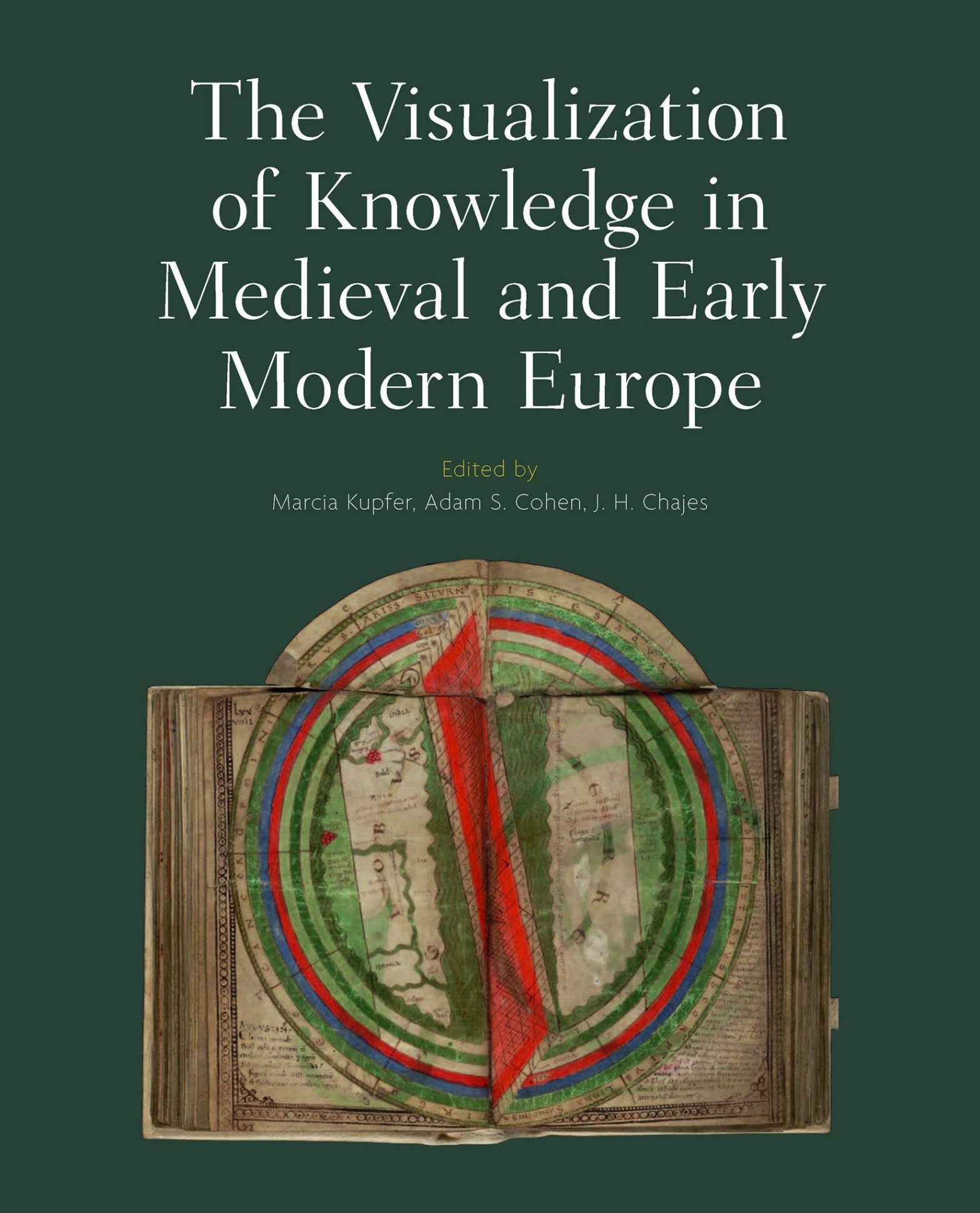
New Publication: The Visualization of Knowledge in Medieval and Early Modern Europe, edited by Marcia Kupfer, Adam Cohen, and J. H. Chajes

This collection of essays by leading scholars reflects new interest in how graphic devices contributed to the production of knowledge during a formative period of European history.

All of us are exposed to graphic means of communication on a daily basis. Our life seems flooded with lists, tables, charts, diagrams, models, maps, and forms of notation. Although we now take such devices for granted, their role in the codification and transmission of knowledge evolved within historical contexts where they performed particular tasks. The medieval and early modern periods stand as a formative era during which visual structures, both mental and material, increasingly shaped and systematized knowledge. Yet these periods have been sidelined as theorists interested in the epistemic potential of visual strategies have privileged the modern natural sciences. This volume expands the field of research by focusing on the relationship between the arts of memory and modes of graphic mediation through the sixteenth century. Chapters encompass Christian (Greek as well as Latin) production, Jewish (Hebrew) traditions, and the transfer of Arabic learning. The linked essays anthologized here consider the generative power of schemata, cartographic representation, and even the layout of text: more than merely compiling information, visual arrangements formalize abstract concepts, provide grids through which to process data, set in motion analytic operations that give rise to new ideas, and create interpretive frameworks for understanding the world.

Pre-order the book here.

Table of Contents

Marcia Kupfer, Introduction

I. Visualization between Mind and Hand

Mary Carruthers, Geometries for Thinking Creatively

Lina Bolzoni, Visualization of a Universal Knowledge: Images and Rhetorical Machines in Giulio Camillo’s Theatre of Memory

Jeffrey F. Hamburger, Mindmapping: The Diagram Paradigm in Medieval Art – and Beyond

II. The Iconicity of Text

Beatrice Kitzinger, Framing the Gospels, c. 1000: Iconicity, Textuality, and Knowledge

Lesley Smith, Biblical Gloss and Commentary: the Scaffolding of Scripture

David Stern, The Topography of the Talmudic Page

Ayelet Even-Ezra, Seeing the Forest beyond the Trees: A Preliminary Overview of a Scholastic Habit of Visualization

Yuval Harari, Functional Paratexts and the Transmission of Knowledge in Medieval and Early Modern Jewish Manuscripts of Magic

A. Mark Smith, More than Meets the Eye: What Made the Printing Revolution Revolutionary

III. Graphic Vehicles of Scientia

Barbara Obrist, The Idea of a Spherical Universe and its Visualization in the Earlier Middle Ages (Seventh–Twelfth Centuries)

Marcia Kupfer, The Rhetoric of World Maps in Late Antiquity and the Middle Ages

Faith Wallis, Visualizing Knowledge in Medieval Calendar Science: a Twelfth-Century Family of ‘Graphic Glosses’ on Bede’s De temporum ratione

John Haines, The Visualization of Music in the Middle Ages: Three Case Studies

Peter Murray Jones, Visualization in Medicine between Script and Print, c. 1375–1550

IV. Diagrammatic Traditions

Linda Safran, A Prolegomenon to Byzantine Diagrams

Adam S. Cohen, Diagramming the Diagrammatic: Twelfth-Century Europe

Madeline H. Caviness, Templates for Knowledge: Geometric Ordering of the Built Environment, Monumental Decoration, Illuminated Page

Lucy Freeman Sandler, Religious Instruction and Devotional Study: The Pictorial and the Textual in Gothic Diagrams

J. H. Chajes, The Kabbalistic Tree

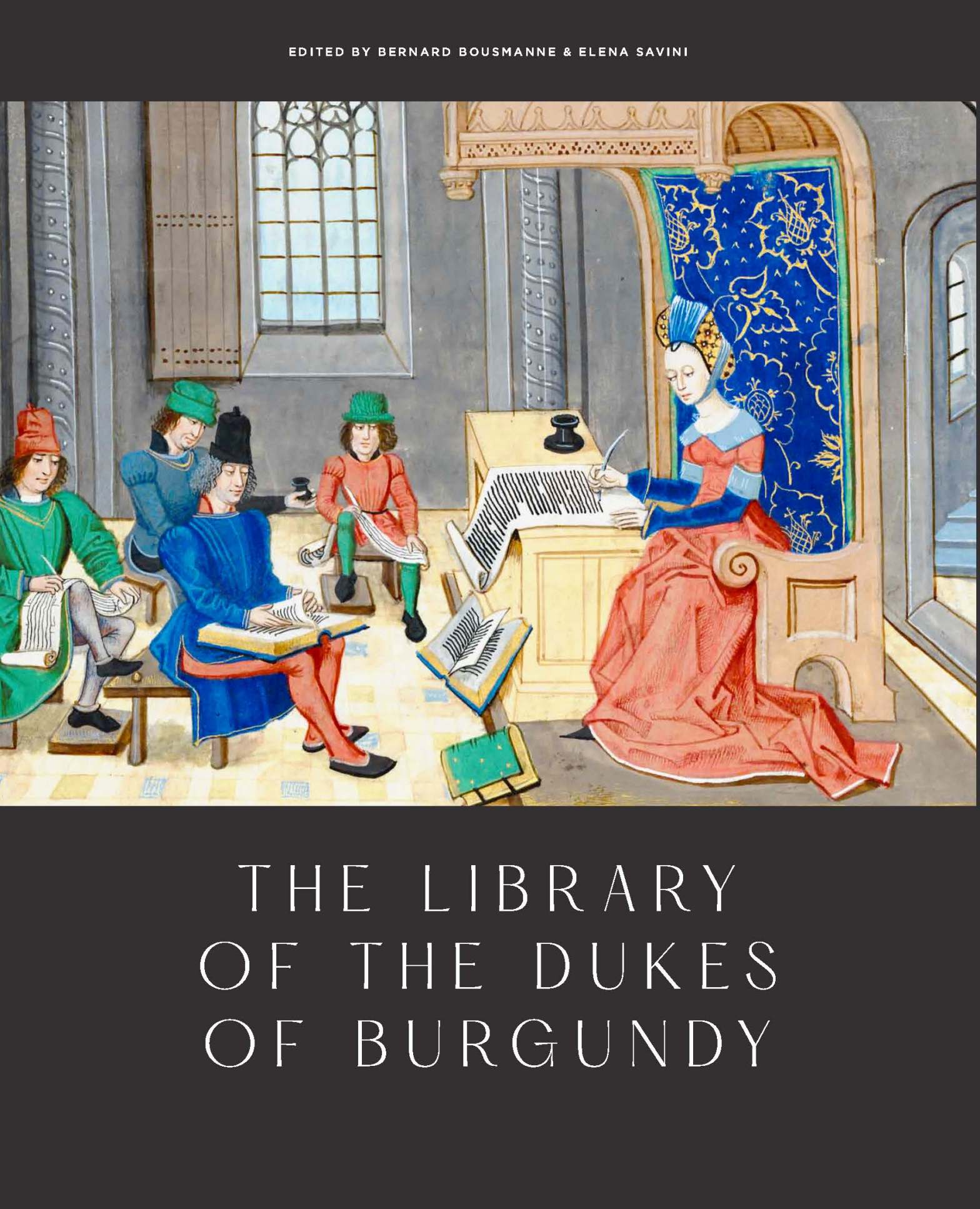
New Publication: The Library of the Dukes of Burgundy, edited by Bernard Bousmanne and Elena Savini

Very richly illustrated, this volume re-frames this exceptional library within its political, economic, historical and artistic context, examining closely both scholarly literature and more than sixty manuscripts considered to be the jewels of the Library.

Formed under Philip the Bold and passed down to his successors, John the Fearless and Philip the Good, the Library of the Dukes of Burgundy comprised no less than nine hundred manuscripts copied and illuminated by the greatest artists of the Middle Ages by the time of Charles the Bold. This extraordinary and unique library included essential texts of medieval literature such as the works of Christine de Pizan, the Roman de la Rose by Jean de Meung and Guillaume de Lorris, the History of Charles Martel, as well as the Ethics and Politics of Aristotle. It was one of the largest collections of books of its time alongside those of the King of France Charles V, the Duke of Berry, the Medici and the papacy.

The two hundred and eighty manuscripts of the collection preserved today in the Royal Library of Belgium cover all fields of medieval thought: literature, ancient history, sciences, morals, religion philosophy, but also law, poetry and chivalric romance. The oldest of these works date back to the fourteenth century while the most recent date from the end of the feudal period. Many of them were transcribed at the express request of the dukes by renowned copyists such as Jean Miélot, Jean Wauquelin, and David Aubert. Many of these codices are absolute masterpieces of the French or Flemish miniature and have been illuminated by Willem Vrelant, Loyset Liédet, Jean le Tavernier, Philippe de Mazerolles, Simon Marmion, and Liévin Van Lathem, miniaturists whose fame and talent competed with Flemish Primitives such as Jan Van Eyck, Rogier Van der Weyden or Hans Memling. In the unanimous opinion of researchers, manuscripts that belong to the collection such as the Chronicles of Hainault by Jacques de Guise, the Hours of the Duke of Berry, the Psalter of Peterborough or the Cronic and Conquest of Charlemagne, are among the fifty most prestigious manuscripts in the world.

Mr Bernard Bousmanne is curator of the Manuscripts Room at the Royal Library of Belgium in Brussels.

Find out more and order the book here.

Study Day: British Archaeological Association, Old Sarum Study Day, Saturday 10 October 2020

Programme:

 Meet in front of Salisbury Cathedral at 11.00 (in west walk of cloister if raining). There is a train from Waterloo at 9.20 which arrives at Salisbury station at 10.50 for anyone travelling from London. 

 11:00 – 13:00 Salisbury cathedral and Museum with Tim Tatton-Brown and John McNeill.

 We will look at the material from Old Sarum which survives in the precinct and divide into two groups at 12.00. Tim Tatton-Brown will take group 1 into the cathedral to look at the Osmund shrine base and tomb of Roger; John McNeill will take group 2 into the museum – and then we swop groups at 12.30. 

 13:00 – 14:15 Lunch break 

14:30 – 16:30 Old Sarum with Tim Tatton-Brown and John McNeill 

The study day fee is £20 for members (please bring this with you; cheque or cash) and free for students. All participants will have to book into Old Sarum, for which there is a fee of £5.90 (free for English Heritage Members). The students who have to pay the £5.90 booking fee for Old Sarum will be reimbursed the fee along with their travel expenses. The Study Day is limited to a maximum of 20 people – 10 students and 10 members. Email studydays@thebaa.org to register. 

IMPORTANT: We will ask everyone to make individual online bookings for Old Sarum via the English Heritage booking system. HOWEVER, NUMBERS ARE LIMITED SO PLEASE FIRST CONFIRM YOU HAVE A PLACE AND YOU WILL THEN BE GIVEN DETAILS ON HOW TO PROCEED. 

Current regulations for visits to the Cathedral, Museum and Old Sarum require all visitors to wear face masks 

Lecture Series: British Archaeological Association Programme of Meetings 2020-2021

The British Archaeological Association holds regular monthly lectures on the first Wednesday of each month between October and May in the rooms of the Society of Antiquaries of London, Burlington House, Piccadilly, London W1J 0BE.

Please note: However, it may be that precautions against the spread of Covid-19 make this impossible, in which case the lectures will be given online. Details on a lecture-by-lecture basis will be posted on the BAA website.

At the Society of Antiquaries of London: Tea is served from 4.30 p.m. and the Chair is taken at 5.00 p.m. 

The lectures are open to all and provide an opportunity for professionals, students and independent scholars to present research that falls within the BAA’s areas of interest. 


7 October 2020

The Fabric accounts of St Stephen’s Chapel, Westminster

by Professor Tim Ayers, University of York


4 November 2020

The Medieval Stained Glass at Holy Trinity, Long Melford

by Anna Eavis, English Heritage


2 December 2020

‘The face of one making for Jerusalem’: The Angel Choir of Lincoln Cathedral and Joy

by Katherine Turely, Birkbeck College


6 January 2021

Three historical oddities, from the fall of the Roman Empire to the BC/AC divide and the continent of Europe

by Professor Eric Fernie, Courtauld Institute of Art


3 February 2021

Living Legends: the art of adventure in English Manuscripts c.1240-1340

by Dr Amy Jeffs, University of Cambridge


3 March 2021

Angels on the edge: constructing sacred space in the art and architecture of early medieval England

by Dr Meg Boulton, Edinburgh College of Art


7 April 2021

Tracing the past: 3-D analysis of medieval vaults

by Dr Alexandrina Buchanan, Dr Nicholas Webb and Dr James Hillson, University of Liverpool


5 May 2021

Women and the built environment in late medieval Scotland

by Dr Rachel Delman, University of York


Call for Submissions: Byzantine and Medieval Art and Architecture, deadline 1 November 2020

Editors: Lech Koscielak, Paschal is Androudis, and Ilkgiil Kaya Zenbilci

Special Issue – volume 2.

Deadline for submissions: 1 November 2020

Topics:

  • Art and Artists
  • Architectural History
  • Church Architecture
  • Conflicts on Art
  • Emperors’ Power on Art
  • Jewellery
  • Icons
  • Ivories
  • Illuminated Manuscripts
  • Interaction between East and West
  • Monastic Art
  • Mosaics
  • Schools and Workshops
  • Wall Paintings
  • Theology and Art

For Submission and information: historiaetorbis@gmail.com

New Journal Issue: Different Vision, ‘Are We Post-Theoretical?’, Issue 6, July 2020

We are excited to present this new issue of Different Visions featuring four essays that engage with the relevance of theory to medieval art history – and to art history in general – today. The essays were inspired by Gerald Guest’s session at the 2019 International Congress on Medieval Studies at Western Michigan University in Kalamazoo entitled “Medieval Art History: Are We Post-Theoretical?” The issue also includes a conversation between the four authors.

View the new issue here.

Contents

Jennifer Borland, Oklahoma State University and Nancy Thompson, St. Olaf College. Introduction: Relaunching Different Visions.

Gerald B. Guest, John Carroll University. Embodiment and Devotion in the Très Riches Heures (or, the Possibilities of a Post-Theoretical Art History). 

Zachary Stewart, Texas A&M University. Other Spaces: Medieval Architectural History Between Theory and Practice.

Marian Bleeke, Cleveland State University.Ivory and Whiteness.

Jessamine Batario, Colby College. History, Theory, and the Risks of Being Wrong.

Are We Post-Theoretical? A Conversation between Gerry Guest, Zachary Stewart, Marian Bleeke, and Jessamine Batario.

New Publication: Ritual, Gender, and Narrative in Late Medieval Italy: Fina Buzzacarini and the Baptistery of Padua, by Anne Derbes

This volume is the first English-language study of the baptistery of Padua and its extraordinarily rich fresco program, commissioned by a woman, Fina Buzzacarini, in the 1370s.  She had the sacred space reshaped into a family mausoleum, though it continued to function as the town’s baptistery.  This study uses close visual analysis to argue that the frescoes, painted by Giusto de’ Menabuoi, dovetail with the interests of Fina Buzzacarini and at the same time participate in the ritual of baptism; and that ritual and gender are ultimately interlayered in this complex space.

Ritual, Gender, and Narrative in Late Medieval Italy is the first English-language study of the baptistery of Padua and its extraordinarily rich fresco program, which opens with Genesis and closes with the Apocalypse.  Remarkably, when the building was refashioned and frescoed by Giusto de’ Menabuoi in the 1370s, it was a woman, Fina Buzzacarini, who funded the enterprise.  In late medieval Italy, baptisteries were potent symbols of civic identity, solidarity, and pride, and towns spent lavishly on them – but no other baptistery was so radically reworked at the behest of a woman.   Remarkably, too, though the building continued to function as Padua’s baptismal church, the renovations transformed it into the mausoleum of Fina Buzzacarini and her family. This volume takes an interdisciplinary approach, using close visual analysis to argue that to a surprising degree, Fina exerted control over the images.  The author argues too that ritual is equally important in understanding the frescoes: that in multiple ways that have rarely been considered, the images respond to and participate in the ritual enacted in this sacred space.  The prayers intoned at the font, the actions of the officiant, the hymns chanted in procession and inside the baptistery, and even details of the rite all find visual echoes on the baptistery’s walls.  Ultimately, gender and ritual intersect in the multilayered frescoes of the Padua baptistery.

Anne Derbes, professor emerita of art history at Hood College, is the author of Picturing the Passion in Late Medieval Italy: Narrative Painting, Franciscan Ideologies, and the Levant, the co-author of The Usurer’s Heart: Giotto and Enrico Scrovegni in the Arena Chapel, Padua, and co-editor of The Cambridge Companion to Giotto.  Her articles have appeared in The Art Bulletin, Gesta, Speculum, The Journal of the Warburg and Courtauld Institutes, and other scholarly publications.

384 p., 0 b/w ill. + 188 colour ill., 215 x 280 mm, 2020, ISBN 978-2-503-57968-9

More Info via: http://www.brepols.net/Pages/ShowProduct.aspx?prod_id=IS-9782503579689-1

Table of Contents

Introduction

Chapter 1   Fina Buzzacarini in Carrara Padua

Local chroniclers say little about Fina, but recount one salient aspect of her life: after marrying Francesco I Carrara in 1345, she failed for over a decade to produce the requisite son and heir.  After crises at court over succession, in 1359 she gave birth to a son.  Though the couple’s marriage was strained by her husband’s blatant philandering, previously overlooked records show that Fina, a very wealthy woman, gradually emerged as a powerful presence at court.  While some have minimized the degree of Fina’s responsibility for the baptistery’s program, I cite a number of documents from the later trecento that attest to a woman’s ability to shape the subject matter of a work that she funded. I next discuss Fina’s tomb monument, which emulates those of earlier Carrara lords but outshines them, and her votive portrait, which places her on the dexter side, as sole donor, and excludes her husband.  Finally, I consider the extraordinary small portraits of Fina inserted into several of the narratives and interpret them as assertions of her authority, overt claims of agency, injected through the program. 

Chapter 2   Baptistery as Mausoleum: Ambitions and Motivations

Why would Fina have sought the baptistery as a burial site, and why did Francesco and the local bishop, whose approval would have been required, agree?  The sacred space of a baptistery had long been understood as a desirable funerary site.  For Francesco, the project meant the embellishment of one of the most important buildings in the city, burnishing the stature of the regime; co-opting the preeminent symbol of civic harmony; and creating a prestigious–and presumably spiritually advantageous—setting for his own tomb.  For the bishop, given the brief tenures of his predecessors who dared to cross Francesco, attempting to thwart the project was not a viable option.  Fina likely had reasons of her own, which I consider further in Chapter 6, for choosing the baptistery as her burial place.  Here I note that baptisteries were uncommonly welcoming to women. The rite offered them a rare opportunity to participate in the liturgy: women took their place at the font next to men.  Finally, in electing her burial in the baptistery, Fina insured that her tomb would be seen, and her memory preserved, by future generations.

Chapter 3 Narrative, Ritual, Exegesis:  The Genesis Cycle

This chapter opens with an account of the baptismal ritual as performed in late medieval Italy– the choreography of prayers, chants, readings, ritual actions, and attendant customs for both the solemn rite and the individual rite.  The rest of chapter 3, and chapters 4 and 5, analyze the frescoes in the narrative cycles, arguing that they are as carefully choreographed as the rite, and work in concert with it.  They respond as well to baptismal theology, depicting themes that offer pictorial glosses on the rite, echoing typological parallels drawn by medieval exegetes.  The Genesis cycle in the drum of the dome includes narratives both familiar and more obscure (the Death of Adam; Lamech Slaying Cain; Jacob’s Prayer after his Dream; Jacob’s Rods; the Reunion of Jacob and Esau). The obscure episodes are distinctly baptismal, and even the familiar ones are rendered in unusual ways that heighten their baptismal resonance.

Chapter 4: Narrative, Ritual, Exegesis:  The New Testament Cycle

The baptismal themes introduced in the drum continue below, in the New Testament cycle, where the frescoes are often strategically sited to respond to others, each accruing meaning from those nearby.  Because of these pictorial and thematic correspondences, it is most productive to analyze the frescoes spatially, wall by wall, rather than purely chronologically.  While most of the New Testament episodes depicted here are commonly seen in trecento visual narrative, almost all have been adapted in ways that make them singularly appropriate to the site.  For instance, in the Massacre of the Innocents, the slain babies, normally shown nude in trecento painting, wear white tunics that evoke the white garments given to infants after baptism; the jugs in the Marriage of Cana are enlarged versions of the ewer used in the baptismal rite.

Chapter 5: Narrative, Ritual, Exegesis:  The Apocalypse Cycle

In the baptistery’s apse is a remarkably detailed depiction of the book of Revelation, a subject seldom seen in trecento painting and never on this scale.  The choice was well considered: from late antiquity into late medieval Italy, exegetes found in the text repeated allusions to the sacrament.  Again, uncommon narrative inclusions, such as the opening of the fifth seal, with the giving of white garments to the souls under the altar, or idiosyncratic features, like the setting of scenes in dramatic seascapes that attest to the salvific potency of water, highlight the relationship between the images and the rite enacted here.

Chapter 6:   Gender Matters:  Maternity, Sexuality, and Visual Rhetoric

If the Padua baptistery is a site for the celebration of the liturgy, it is also a site for the celebration, and commemoration, of its patron.  Chapter 6 returns to the visual evidence to examine Fina’s role in the baptistery more closely.  The gender symmetry of the dome, where women and men appear in equal numbers in the largest circle of Paradise, is suggestive.  So is the Genesis cycle’s insertion of women into the narrative, at times almost rewriting sacred history to insist on their active participation at critical junctures.  Moreover, many of the women featured in the dome and the drum are, unlike most women in the Christian pantheon, mothers – significantly, mothers of sons.  Several (Sarah, Rebecca, Rachel, Elizabeth) conceived and delivered sons only after a long delay. Important, too, is the Apocalyptic Woman of Rev. 12, prominently depicted in the apse, who gave birth to a son born to rule.  All of these women serve as Fina’s exemplars – and as reminders of her success in delivering her own long-awaited son. Finally, the frescoes also feature malevolent, and specifically sexually transgressive, women: Herodias, the wife of Lot, and the Whore of Babylon; all are visually juxtaposed with virtuous mothers, and Herodias, who had an adulterous relationship with a ruler, with Fina herself. 

New Publication: ‘Pilgrimage and England’s Cathedrals: Past, Present, and Future’, edited by Dee Dyas and John Jenkins

Pilgrimage and England’s Cathedrals looks at England’s cathedrals and their relationship with pilgrimage throughout history and in the present day. The volume brings together historians, social scientists, and cathedral practitioners to provide groundbreaking work, comprising a historical overview of the topic, thematic studies, and individual views from prominent clergy discussing how they see pilgrimage as part of the contemporary cathedral experience.

Find out more about the book here.

Table of Contents:

Pilgrimage and Cathedrals in Early Medieval Britain, Jonathan M. Wooding

Pilgrimage and Cathedrals in the Later Middle Ages, Eamon Duffy

Visiting England’s Cathedrals from the Reformation to the Early Nineteenth Century, Ian Atherton

Pilgrimage and Cathedrals in the Victorian Era, Elizabeth Macfarlane

Pilgrimage and Cathedrals from the 1900s to the Present Day, Michael Tavinor

The Multivalent Cathedral, Simon Coleman and John Jenkins

Cathedrals, Community, and Identity, John Jenkins and Tiina Sepp

The Role of Sensory Engagement with Place, Past, and Present, Dee Dyas

Leaving and Taking Away: Cathedrals and Material Culture, Marion Bowman and John Jenkins

Canterbury and Becket Today, Christopher Irvine

Pilgrimage and Cathedrals Today, Michael Tavinor

Cultivating Pilgrimage to Westminster Cathedral, Mark Langham

Pilgrimage, Cathedrals and Shrines Today, John Inge

About the Editors:

Dee Dyas is a Reader in the History of Christianity at the University of York, UK.
John Jenkins is a Research Associate and Teaching Fellow at the University of York, UK.

Postdoctoral Fellowships: ‘Musical and Poetic Creativity in the Western Christian Liturgy, c.1000-1500’, Two 4-Year Postdoctoral Research Fellowships, University of Oslo, deadline 1 October 2020

Musical and Poetic Creativity in the Western Christian Liturgy, c.1000-1500

Two Post-Doctoral Research Fellowships in Musical and Poetic Creativity in the Western Christian Liturgy, c.1000-1500 are available at the Department of Musicology, University of Oslo.

The two successful candidates will pursue postdoctoral research as part of the €2m European Research Council-funded project, BENEDICAMUS: Musical and Poetic Creativity for A Unique Moment in the Western Christian Liturgy, c.1000-1500. The candidates will work as part of a team lead by Principal Investigator Catherine A. Bradley, alongside doctoral researchers, an international Advisory Board, and the performing ensemble Sequentia. The postdoctoral fellows are expected to publish both independently and in collaboration with the BENEDICAMUS team, to present research papers at workshops and international conferences, and contribute to wider public communication of the research results.

We seek candidates whose work intersects with at least one of the specilised areas of the BENEDICAMUS project as well as its broader themes. BENEDICAMUS pursues a transformative focus on creative practices surrounding a particular moment in the Western Christian liturgy: the exclamation Benedicamus Domino (“Let us Bless the Lord”), which sounded in song several times a day from c.1000 to 1500. BENEDICAMUS undertakes the first longue durée study of musical and poetic responses to an exceptional liturgical moment, using this innovative perspective to work productively across established historiographical and disciplinary boundaries. The project encompasses half a millennium of musical and ritual activity, hundreds of musical compositions, poetic texts, and manuscript sources. It engages with the beginnings of musical and poetic genres and techniques that were crucial in shaping practices still current today, reflecting on music’s enduringly complex relationship with spirituality, ritual, and the sacred.

Successful candidates may have a disciplinary background in cultural studies, history, musicology, Latin language and/or literature, liturgy, medieval studies, renaissance studies, ritual studies, or theology. Ideally, candidates would already have experience in at least two of these fields.

Candidates are asked to provide a Project Description, in which they outline how their research record, interests, and skills align with the BENEDICAMUS project (see detailed proposal here).

The Project Description should explain exactly how candidates would undertake one of the specific postdoctoral projects sketched in the BENEDICAMUS proposal. Candidates may suggest ways in which they would tailor or adapt one of these postdoctoral projects to better suit and develop their existing expertise. Alternatively, they are free to design a project that may differ in the specific methodology, reportorial focus, or disciplinary orientation of the postdoctoral projects stipulated in the BENEDICAMUS proposal, but which must still fall within the purview of and further the overall aims and outputs of either Work Package 1 or Work Package 3.

The successful candidates will receive a competitive salary and have access to dedicated funds for research and conference travel. They will participate actively in and assist with BENEDICAMUS’s international conferences, workshops, and publications. Postdoctoral fellows are expected to live in Oslo, to engage with wider research networks in the faculty of humanities and the department of musicology and to contribute to their development. The main purpose of postdoctoral research fellowships is to better qualify researchers for future academic positions.

The postdoctoral fellowships are available for an appointment period of four years. The posts are available from February 1st 2021 (candidates must take up the posts before September 1st 2021).

Find out more and apply here.

Qualification requirements

  • A PhD in cultural studies, history, musicology, Latin language and/or literature, liturgy, medieval studies, renaissance studies, ritual studies, theology, or other fields that can be demonstrated to offer a solid foundation for research into Musical and Poetic Creativity in the Western Christian Liturgy, c.1000-1500
  • Doctoral dissertations must have been submitted for evaluation before the application deadline
  • Strong skills in written and oral English
  • Personal suitability and motivation for the position.

Evaluation Criteria

  • Scholarly merit and relevance of research proposal for the BENEDICAMUS project
  • Knowledge and experience of the study of music, Latin poetry, liturgy, and ritual in the period c. 1000-1500
  • The candidate’s track-record and their potential to complete the proposed project within the time frame and to contribute actively to the BENEDICAMUS project
  • Good team-working and communication skills and the ability to collaborate within and across disciplines.

We offer

Submissions

Candidates must submit the following attachments with the electronic application, preferably in pdf format:

  • Application Letter describing the candidate’s qualifications and motivation for the position
  • Curriculum Vitae (complete list of education, positions, teaching experience, administrative experience and other qualifying activities, including a complete list of publications)
  • Project Description (approximately 3-5 pages). The project description must include a feasible progress plan. It is expected that the applicant will complete the project during the period of appointment.
  • Diplomas, certificates, doctoral thesis and other academic works will be requested later.

Please note that all documents must be in English or a Scandinavian language.

The short-listed candidates will be invited to an interview at the University of Oslo or we will arrange for an interview on Skype.

Formal regulations

Please see the guidelines and regulations for appointments to Postdoctoral fellowships at the University of Oslo.

Following the Freedom of Information Act (Offentleglova) § 25, Chapter 2, information about the applicant may be used in the public list of applicants even if the applicant opts out from the entry in the public application list.

The University of Oslo has an Acquisition of Rights Agreement for the purpose of securing rights to intellectual property created by its employees, including research results.

The University of Oslo aims to achieve a balanced gender composition in the workforce and to recruit people with ethnic minority backgrounds.

Contact information

Head of Department Peter Edwards, peter.edwards@imv.uio.no, phone number: +47 99 52 64 75

HR Adviser Hilde Kristine Sletner, h.k.sletner@hf.uio.no

Call for Participants: Studying East of Byzantium VII: In Conversation with Anti-racism, Pandemic, and Social Inequality, deadline 15 September 2020

  • Respondents: Zsuzsanna Gulácsi, Northern Arizona University | Sergio La Porta, California State University, Fresno
  • Dates: November 20, 2020 | February 26, 2021 | June 3–4, 2021
  • Format: Virtual (with possible live final event at Tufts University, Medford, MA)

A three-part workshop that intends to bring together doctoral students studying the Christian East to discuss how the events of 2020, from the intensified conservations about systemic racism and economic inequality stemming acts of police violence on Black men and women in the United States to the dramatic changes to life and work brought about by the coronavirus pandemic, have impacted their research with a diverse group of colleagues and senior specialists in the field. Participation is limited to 10 students. Those interested in attending should submit a C.V. and 200-word abstract no later than Tuesday, September 15, 2020.

LEARN MORE AND APPLY
 

EAST OF BYZANTIUM is a partnership between the Arthur H. Dadian and Ara Oztemel Chair of Armenian Art at Tufts University [http://ase.tufts.edu/art/people/maranci.htm] and the Mary Jaharis Center for Byzantine Art and Culture at Hellenic College Holy Cross in Brookline, MA. It explores the cultures of the eastern frontier of the Byzantine Empire in the late antique and medieval periods.