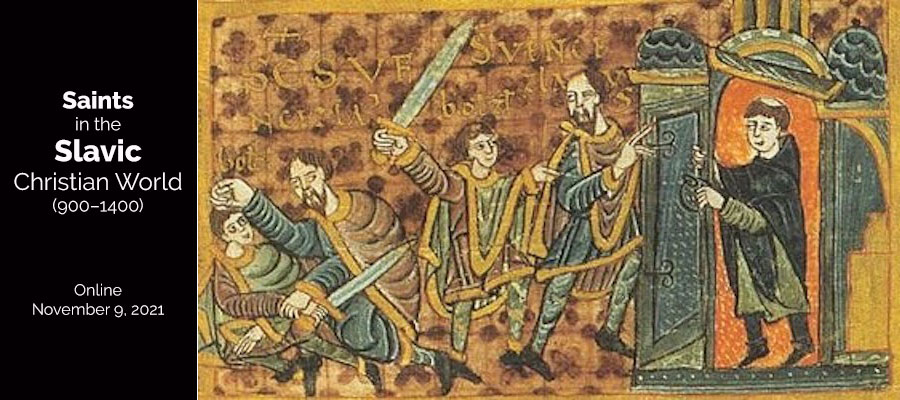
Call for Papers: ‘Saints in the Slavic Christian World (900-1400)’, 9 November 2021 (Deadline 30 September 2021)

Saints in the Slavic Christian World (900–1400): Assessing Culture, Power, Religion and Language in Slavic Hagiographies and Religion Literature, Online, November 9, 2021

Prof. dr. Dieter Stern, University of Ghent: ”Founder saints and the consolidation of Christianity among the Slavs”

Research fellow, Emil Hilton Saggau, Lund University: ”Killing the Tsar again – power, revenge and warriors in early Slavic hagiographies”

The various Slavic realms of the early medieval period converted to Christianity in different pace and modes. This religious turn was also one that encompassed cultural and social change, which is mostly visible in the broad ranges of Slavic hagiographies and religious literature airings after 900. The formation of Slavic saints provide in-roads into the Slavic societies and their cultivation and localization of Christian culture and religion. The early Christian Slavic literature calls for further examination and assessment to shed further light on the shaping of culture, power, religion and language, which we hope this seminar will provide room for.

In this seminar, a range of scholars are invited to present and discuss this particular Slavic sense of Christianity in order to bring together different perspectives and methods on the topic. The session invites speakers to focus on the brokering and shaping of Slavic Christian culture, power, religion and language, as its comes to the surface in these types of sources.

Papers focusing on conversion, power and hagiographies are in particular welcomed, as well as papers that discuss the development of Slavic saints and hagiographies in relations to Byzantium, Scandinavia or Western Europe.

Please send a title, abstract (200 word) and short bio to emil.saggau@ctr.lu.se before 30th September 2021.

Jointly hosted by Lund University, Ghent University, and the Balkan History Association.

Conference: What Does Animation Mean in the Middle Ages?, the A. Zelwerowicz National Academy of Dramatic Art in Warsaw, Poland and the University of Bergen, Norway, 16-19 September 2021

The conference will take place in Białystok at the A. Zelwerowicz National Academy of Dramatic Art in Warsaw – Branch Campus in Białystok, H. Sienkiewicza 14, 15–092 Białystok, Poland. The conference will run in a hybrid form. Members of the public who want to participate in it virtually, through Microsoft Teams, are kindly asked to contact Ms. Anna Lach: anna.lach@e-at.edu.pl

Conference Programme:

September 16th (Thursday)
10.00 – 12.00 Registration
12.00 – 13.00 Opening session
Welcome speech from Head of The Aleksander Zelwerowicz National Academy of Dramatic Art in Warsaw – Branch Campus in Białystok, Prof. Marta Rau
Welcome speech of Prof. Henning Laugerud – Department of Linguistic, Literary, and Aesthetic Studies University of Bergen, Norway

13.15 – 13.45 KEYNOTE LECTURE:
Prof. Hans Henrik Lohfert Jørgensen – Aarhus University, Denmark
Four Fundamental Concepts Of Animation – Mechanical And Organic, Supernatural And Phenomenological
13.45 – 14.00 Discussion

SESSION 1: FRAMEWORKS OF MOVEMENT
14.00 – 14.20 Dr. Kamil Kopania – The Aleksander Zelwerowicz National Academy of Dramatic Art in Warsaw – Branch Campus in Białystok, Poland)
What Does It Mean: Animation In The Middle Ages?
14.20 – 14.40 Jordan Koel – University of Michigan, USA
The Reciprocity Of Medieval Images:Interaction And Exchange With Medieval “Things”
14.40 – 14.50 Q&A
14.50 – 16.00 Lunch break
16.00 – 16.20 Dr. Michelle Oing – Stanford University, USA
Staging Signs of Life: Art, Theater, and the Animated Image
16.20-16.40 Dr. Mads Vedel Heilskov – The Courtauld Institute of Art, London, UK
The Divine Interface: Surface Treatments of Medieval Movable Crucifixes
16.40 – 17.00 Q&A

SESSION 2: ANIMATION AND AGENCY
17.00 – 17.20 Prof. Jørgen Bakke – University of Bergen, Norway
Technological Animation Of Images And Byzantine Iconoclasm
17.20 – 17.40 Dr. Vladimir Ivanovici – University of Vienna / Universita’ della Svizzera Italiana, Mendrisio, Switzerland
Animating Disembodied Presence In Late Antique Martyria
17.40 – 18.00 Dr. Ruth Sargent Noyes – National Museum of Denmark, Copenhagen, Denmark
Re-Animating The Middle Ages: Manufacturing Corpisanti Roman Catacomb Relic-Sculptures And Early Modern Revivals Of Agentive Matter
18.00 – 18.20 Q&A
18.20 – 18.40 Dr. Alessia Zubani – University of Bologna, Italy
Technological Animation As Expression Of Caliphal Authority At The Abbasid Court
18.40 – 19.00 Laurens Hwai-Gi Tan – Katholieke Universiteit Leuven, Belgium
Animation Within The West Javanese Wayang Golek As Bearer Of Life
19.00 – 19.15 Q&A
19.30 “HOW I UNLEASHED THE END …”
“How I Unleash the End …” is a stop-motion animation with live music performed by third-year students of The National Academy of Dramatic Art in Warsaw – Branch Campus in Białystok. A short story revealing one of the possible scenarios of the end of the world. An attempt to answer such questions as What (or who) is death? What would make the world cease to exist? The answer to these puzzling questions will be given in a light, humorous and poetic way.
Authors of animations and music: Aleksandra Muszyńska, Karina Maria Giemza, Dawid Mkrtchyan, Maciej Grzegorczyk
Artistic supervision: Dr. Agnieszka Makowska
Duration: 15 minutes
19:45 END OF THE FIRST DAY OF THE CONFERENCE

September 17th (Friday)
09.00 – 09.30 KEYNOTE LECTURE:
Prof. Carla Bino – Università Cattolica del Sacro Cuore, Brescia, Italy
Screen, Window, Door. Three Devices To Understand Animation In The Middle Ages
09.30 – 09.45 Discussion
09.45 – 10.00 Coffee break

SESSION 3: MATERIALIZING THE MOVE
10.00 – 10.20 Dr. Laura Katrine Skinnebach – Aarhus University, Denmark
An Animated Saint – The Case Of St George In Sweden
10.20 – 10.40 Elisabeth Andersen – Norsk institutt for kulturminneforskning, Oslo, Norway
Motion And Emotion – Animated Angels In The Rite Of Baptism
10.40 – 11.00 Wojciech Sowała – Jagiellonian University, Cracow, Poland
Strategies Of Animation. The Case Of Saint John The Baptist’s Head On The Platter
11.00 – 11.20 Q&A
11.20 – 11.40 Dr. Zuzanna Sarnecka – University of Warsaw, Poland
Sculpture On The Move: Three-Dimensional Animation In Italian Late Medieval Home
11.40 – 12.00 Agnieszka Dziki – University of Warsaw, Poland
“I Carve My Figures Fine And Make Them Come To Life”. The Animation Of Late Medieval Kleinplastik
12.00 – 12.20 Diana Rafaela Pereira – CITCEM, University of Porto, Portugal
Enshrinement And Animation: Clothing Statues In Early Modern Portugal And Spain
12.20 – 12.40 Q&A
12.40 – 13.40 Lunch break

SESSION 4: ANIMATED CRUCIFIXES
13.40 – 14.00 Dr. Christophe Chaguinian – University of North Texas, USA
Were There Articulated Christs Before The 14Th Century?
14.00 – 14.20 Dr. María José Martínez Martínez – Universidad de Valladolid, Spain
The Santo Cristo De Burgos, Spain. An Articulated, Gothic Crucified With Great Devotional, Artistic And Anthropological Impact
14.20 – 14.40 Agata Stasińska – National Museum in Wrocław, Poland
Animated Sculpture Of The Crucified Christ From Oleśnica – A Unique Trace Of Late Gothic Piety In Silesia
14.40 – 15.00 Q&A
15.00 – 15.20 Coffee break
15.20 – 15.40 Dr. Alexandra R. A. Lee – New York University London, UK
Blood, Sweat And Tears: Animated Crucifixes And The Bianchi Devotions Of 1399
15.40 – 16.00 Vincenzo Amato – Independent scholar, restorer, Molfetta, Italy
The Dramatic Peculiarities Of The “Speaking” Crucifix From The Church Of Our Lady Of Sorrows In Norcia (Umbria, Italy): Comparison And Grouping Hypothesis Of Mechanical Tongue Animations Of German-Made Crucifixes In Italy, During The XV Century
16.00 – 16.20 Dr. Sara Carreńo – University of Santiago de Compostela, Spain
Materiality, Naturalism And Animation In The 14Th-Century Santos Cristos Of Ourense And Fisterra (Galicia)
16.20 – 16.40 Q&A
16.40 – 17.00 Coffee break

17.00 – 17.30 KEYNOTE LECTURE:
Dr. Peter Dent – University of Bristol, UK
“To Which The Crucifix Replied”: The Phenomenology Of The Animate Image
17.30 – 17.50 Discussion

SESSION 5: SHIFTING BETWEEN TEXTS AND IMAGES
17.50 – 18.10 Dr. Elena Paroli – ENS – École Normale Supérieure de Lyon, France
From “Imago Loquens” To “Imago Eloquens”: The Animation Of Painting In Petrarch And Boccaccio, As A Form Of Mental Animation
18.10 – 18.30 Dr. Joanna Sikorska – National Museum in Warsaw, Poland
Animated Printmaking: Critical Approach
18.30 – 18.50 Dr. Martin Roland – Österreichische Akademie der Wissenschaften, Austria
Performance And Image Cycles – How The Middle Ages Use The “Popular Style”
18.50 – 19.10 Q&A
19.10 – 19.20 Coffee break
19.20 – 19.40 Hartley Roxanne Miller – Independent Scholar, Bucharest, Romania
“Ces Ymages Bien Avisé”: The Texture Of Animation And Interpretation In Guillaume De Lorris’s Roman De La Rose
19.40 – 20.00 Prof. Nicola Pasqualicchio – University of Verona, Italy
Tervagant And Saint Nicholas. A Duel Between Images In Jean Bodel’s Li Jus De Saint Nicholai
20.00 – 20.15 Q&A
20.15 END OF THE SECOND DAY OF THE CONFERENCE

September 18th (Saturday)
08.30 – 09.00 KEYNOTE LECTURE:
Dr. Amy R. Whitehead – Massey University, New Zealand
Marian Personhood And A Matter Of Power: Animism and The Dynamics Of Devotion In Andalusia, Spain
09.00 – 09.20 Discussion

SESSION 6: ENLIVENED BY THE LIGHT
09.20 – 09.40 Dr. Kaja Kollandsrud – Museum of Cultural History, University of Oslo, Norway
The Holy Animated Through Light Embodied In Medieval Church Art
09.40 – 10.00 Prof. Barbara Schellewald, Dr. Peter Fornaro – University of Basel, Switzerland
Images And Their Animation/Vitalization Through Light In The Middle Ages
10.00 – 10.20 Dr. Vera Henkelmann – University of Erfurt, Germany
“And There Appeared A Great Wonder In Heaven” (Rev 12,1) – Staging The Maria Apocalyptica In The Late Medieval Church Interior By Means Of Chandeliers Of The Virgin Mary
10.20 – 10.35 Q&A
10.35 – 10.50 Coffee break

SESSION 7: MENTAL AND SPIRITUAL ANIMATION
10.50 – 11.10 Eleonora Tioli – Scuola Normale Superiore, Pisa, Italy / University of Fribourg, Switzerland
Moving Images, Living Images. The Possibilities Of Miraculous Movement In The Middle Ages
11.10 – 11.30 Katharina Roßmy – Independent scholar, Munich, Germany
Mental Animation Of Early Pietàs
11.30 – 11.50 Kaja Merete Hagen – University of Oslo, Norway
“Protect Me And All Christian People From All That Can Harm Us”. Miraculous Crosses And Crucifixes In Late
Medieval Norway
11.50 – 12.10 Dr. Lieke Smiths – Ruusbroec Institute, University of Antwerp, Belgium
Scripted Embraces: The Song Of Songs, Spiritual Role-Play And The Animation Of The Crucified Christ
12.10 – 12.30 Q&A
12.30 – 13.30 Lunch break

SESSION 8: ANIMATION AND SPACE
13.30 – 13.50 Anna Zakova – Charles University, Prague, The Czech Republic
Animation Of Holy Week From Saint-Georges Monastery In Prague. From Repertory To Architectural Elements
13.50 – 14.10 Dr. Ferenc Veress – Szeged University, Hungary
Staging The Eucharist. Sacred Space And Liturgical Practices During The Celebration Of The Epiphany (6Th–15Th C.)
14.10 – 14.30 Dr. Maeve O’Donnell-Morales – University of Bristol, UK
Altarpieces As Aids To Animation: Marian Retables And Tabernacle Retables In Medieval Spain
14.30 – 14.50 Q&A
14.50 – 15.10 Helene Seewald – Christian-Albrecht University of Kiel, Germany
The Carved Altarpiece As A Projected Image: High Altar Retable In St. Nicolai Church In Kalkar
15.10 – 15.30 Prof. Cora Dietl – Universität Gießen, Germany
Animation As Means To Illustrate An Active Threat: Dragons In Fifteenth-, Sixteenth- And Twenty-First-Century Plays About St George
15.30 – 15.50 Dr. Letha Ch’ien – Sonoma State University, USA
Moving Pieces, Permanent Parts
15.50 – 16.10 Laura Stefanescu – University of Sheffield, UK
Animating Heaven In Fifteenth-Century Florence: From Theatrical Materiality To The Collective Imaginary
16.10 – 16.30 Q&A
16.30 – 17.00 Coffee break

SESSION 9: PAINTED ANIMATION
17.00 – 17.20 Dr. Heather A. Reid – Pacific Union College, California [retired Professor]
Animating Early Netherlandish Genre Painting With Strategically Placed Artists’ Signatures
17.20 – 17.40 Andrei Dumitrescu – New Europe College, Bucharest, Romania / Central European University in Vienna, Austria
The Virgin In The Whirling Star: Questions On The Performative Dimension Of Ecclesiastical Wall Paintings From Late 15Th – And Early 16Th-Century Moldavia
17.40 – 18.00 Dr. Yuko Katsutani – University of Strasbourg, France
The Function Of Images And The Memory Of A Place. Angel Musicians Vault Decorations At The End Of The Middle Ages
18.00 – 18.20 Maria D. Anghel – Central European University in Vienna, Austria
The Animated Man Of Sorrows: Staging The Bodily Presence Of Christ In 14Th- And 15Th-Century Wall Paintings From The Former Hungarian Kingdom
18.20 – 18.40 Q&A
C. 18.45: END OF THE THIRD DAY OF THE CONFERENCE
19.30 – 24.00 OFFICIAL DINNER

September 19th (Sunday)
SESSION 10: MOVEMENT REENACTED
10.00 – 10.20 Marta Soares – Universidade Nova de Lisboa, Portugal
Medieval Modern Puppets: Animation And The Medieval Imaginary In El Misterio De Los Reyes Magos And El Retablo
De Maese Pedro
10.20 – 10.40 Francesca Cecconi – University of Verona, Italy
Playing (With) Puppets: Jigging Puppets From The Middle Ages To The 20Th Century
10.40 – 11.00 Dr. Daria Ivanova-Hololobova – Kyiv National Kaparenko-Karyi University of Theatre, Cinema and Television, Ukraine
Revival And Professionalization Of Vertep Puppet In The Activities Of The Agitation Puppet Theatre “Revolutionary
Vertep” (1923-1925)
11.00 – 11.20 Q&A
11.20 – 11.40 Coffee break
11.40 – 12.00 Dr. Karol Suszczyński – The Aleksander Zelwerowicz National Academy of Dramatic Art in Warsaw – Branch Campus in Białystok, Poland
Thinking With A Figure – Different Ways Of Animating Sculptures Of Saints In Polish Puppet Theatre Of The End
Of The 20Th Century
12.00 – 12.20 Dr. Małgorzata Dawidek – Slade School of Fine Art / University College London, UK
From Marginalia To The Democracy Of The Image. Mediaeval Manuscripts As An Interactive Tool For Contemporary Artistic Practice And Post-Research
12.20 – 12.40 Q&A
12.40 – 13.00 CLOSING REMARKS
13:00 END OF CONFERENCE

Full information about the conference can be found here: https://atb.edu.pl/blog/2021/08/24/what-does-animation-mean-in-the-middle-ages/
Call for Papers: ‘Legacy and Afterlife of the Middle Ages’, ICMA Sponsored Session, CAA Annual Conference 2022, 16-19 February (Deadline 16 September 2021)

How are the Middle Ages remembered? In recent years the Middle Ages have set the scene for a variety of popular TV series; contemporary identity is often connected to a medieval past; and medieval history has even been appropriated to justify the horrific actions of extremist groups. As scholars we know that popular views of the Middle Ages are often absurdly and dangerously misrepresented, but if a false vision of the Middle Ages is accepted as true on screen, in objects, or architecture, what effect does that have on the psyche of viewers today?

This session invites papers from diverse fields to interrogate how memory, legacy, and myths of the Middle Ages live on today, in tangible or intangible ways. Possible topics may include neo-Gothic revivals, the endurance of religious expression for faith communities today, as well as 19th-century and fantasy medievalisms from Tolkien to Game of Thrones. In light of the content thread recommended by CAA for 2021 –social justice— we specifically encourage submissions that consider race, gender equality, sexuality, including queer pre-modern identities, and justice for Indigenous communities in the Americas. For example, potential topics might examine the appropriation of medieval symbols in contemporary hate groups or how medieval women are portrayed on screen. At a time when popular culture has renewed attention on the Middle Ages, it is critical to reflect not just on medieval attitudes towards their own material culture and visual arts, but how our own perspectives are shaped by their real and imagined legacies.

Please submit abstracts directly to the chair by September 16th. More specific submission instructions can be found at the CAA Annual Conference website here.

Job Opportunity: University Professor of Economic and Social History of the Late Medieval and Early Modern Ages (Deadline 29 September 2021)

At the Faculty of Historical and Cultural Studies of the University of Vienna the position of a University Professor of Economic and Social History of the Late Medieval and Early Modern Ages (full time, permanent position) is to be filled.

The professorship focuses on the field of Economic and Social History of the Late Medieval and Early Modern Ages (13th–17th centuries). Research and teaching experiences should cover both periods, and successful candidates are expected to offer classes crossing topics and periods at the Bachelor, Master, and PhD level and for the Teacher training programme: History, Social Studies and Political Education (Teaching Subject). With respect to research and research-based teaching, the professorship will contribute to the established main research area “Economy and Society – A view from history and cultural studies” of the Faculty for Historical and Cultural Studies. Successful candidates are expected to have a strong interest in theories and methods of social sciences and economics.

The University of Vienna expects the successful candidate to acquire, within three years, proficiency in German sufficient for teaching in bachelor’s programmes and for participation in university committees. In addition, the University of Vienna expects the successful candidate to be prepared to take over responsibility on the organisational level of the Faculty and the University, if necessary.

The deadline to apply is 29th September 2021. To apply, visit https://personalwesen.univie.ac.at/en/jobs-recruiting/professorships/detail-page/news/economic-and-social-history-of-the-late-medieval-and-early-modern-ages/

Call for Papers: ‘The Materiality in the Fourteenth Century II: Art and Architecture’, ICMS Kalamazoo, 9-14 May 2022 (Deadline 15 September 2021)

The art and architecture of the fourteenth century reflect the social changes and political upheavals that defined the period in Europe. Scholars have increasingly employed the materiality of art—its physical features and characteristics—to critically investigate expanding trade networks, modes of production, and the relationship between artist, patron, and viewer. This session builds on this momentum to explore the social and cultural function of art and architecture in the fourteenth century. Submissions are invited to examine the materiality of art and architecture from any disciplinary and theoretical perspective; interdisciplinary approaches are particularly encouraged. Potential papers might comprise, but are not limited to, investigations of the relationship between an object’s material and form; examinations on shifts in artistic production; applications of visual and formal analysis; or considerations of the ritual, political, and economic significance of objects and their materials. This session invites submissions on all forms of art and architecture including from Latin, Byzantine, and Islamic contexts.

This session is the second of three panels sponsored by the 14th Century Society centered on the discussion of materiality during the fourteenth century. Please submit paper proposals by September 15th through the ICMS Confex website (https://icms.confex.com/icms/2022am/cfp.cgi). Please contact Gabriela Chitwood (gchitwoo@uoregon.edu) with any questions and concerns.

Call for Papers: ‘Digital Methods in Preservation of Medieval Cultural Heritage: New Approaches and Technologies’, ICMS Kalamazoo, 9-14 May 2022 (Deadline 15 September 2021)

In many parts of the world, medieval monuments, sites, and artifacts are facing a threat of devastation, either due to political crises resulting in armed conflicts or acts of vandalism, or deteriorating climate effects, inadequate conservation practices, as well as other adverse natural or social circumstances. Access to some of them is restricted on account of these conditions- a problem that became worldwide during the ongoing pandemic. For all the above-mentioned reasons, digital preservation of material cultural heritage has become a matter of utmost necessity and urgency.

This session aims to present various methods in digital recording and presentation of medieval visual culture that has been recently developed and implemented, as well as to highlight the importance of digitization in certain groups of monuments or objects particularly vulnerable at the present moment.

Blago Fund, which is sponsoring the session, is an organization devoted to the preservation and promotion of Serbian cultural heritage, primarily through the creation of online digital collections that preserve detailed visual records of architectural elements, interior decoration, and the surroundings of churches and monasteries built on the territories of the Serbian medieval state. Owing to the efforts of volunteers and experts from the fields of photography, art history, and internet technologies, all the material created is readily available on the Blago Fund website under a CC license.

The session seeks proposals that will address some of the issues related to practices in digital humanities used in the preservation of the material heritage of the Middle Ages- technical advancements created or employed in digitization, innovative approaches taken, and particular obstacles faced in the process. The organisers also invite scholars and professionals to present their insights and experiences working with digital visual databases in studying and teaching the Middle Ages.

Please submit abstracts no later than 15 September through the ICMS Confex website (https://icms.confex.com/icms/2022am/cfp.cgi). For any questions or concerns, please contact Ida Sinkevic (sinkevic@lafayette.edu) or Ivana Lemcool (ivana.lemcool@blagofund.org).

Call for Papers: ‘Decentering the Self: Liminality and Marginality in Self-Presentation’, International Congress on Medieval Studies, deadline 15 September 2021

Recent work on subjecthood and patronage in Byzantine studies has shown the import of formulas and models, especially in light of liturgical and literary ones, for understanding and presenting the self. At the same time, theories of queerness and intersectionality have been used to bring greater awareness to previously overlooked medieval identities. Drawing on these discourses, this panel revisits traditional sites of self-presentation, such as seals, donation images, and objects of commemoration to ask how these issues were visualized. How did patrons with marginal or liminal identities represent themselves? Or why would a patron choose to represent themselves via a figure whose identity did not fit neatly into societally defined categories? For example, why would a man choose an angel as his emblem? At stake is how we recognize and interpret medieval self-identification. Speakers are encouraged to address de-centered subjects, either patrons or iconographies, and ask how the arena of self-presentation can aid our understanding of what liminal and marginal meant to medieval patrons and viewers. 

The organisers welcome papers exploring these themes from Late Antiquity to the Late Middle Ages and from any geographic area.

Please submit abstracts of 300 words via the ICMS Website. For questions please contact the organizers.

Session organizers
Alexis Gorby, University of Oxford
Lora Webb, Stanford University

Session sponsor
Center for Medieval and Early Modern Studies, Stanford University

Call for Participants: Studying East of Byzantium VIII: Material Culture (Deadline 13 September 2021)

The Arthur H. Dadian and Ara Oztemel Chair of Armenian Art at Tufts University and the Mary Jaharis Center for Byzantine Art and Culture at Hellenic College Holy Cross in Brookline, MA, are pleased to invite abstracts for the next Studying East of Byzantium workshop: Studying East of Byzantium VIII: Material Culture.

The three-part workshop intends to bring together doctoral students studying the Christian East to reflect on how to study the material world of the Christian East, to share methodologies, and to discuss their research with workshop respondents, Marica Cassis, University of Calgary, and Kate Franklin, Birkbeck, University of London. The workshop will meet on November 19, 2021, February 18, 2022, and June 6–7, 2022, on Zoom. The timing of the workshop meetings will be determined when the participant list is finalized.

The workshop invites doctoral students working in any discipline of East Christian studies to discuss the role of material culture—monuments, archaeological sites, artifacts, images—in their research and to consider questions such as: how can the tools of the study of material culture assist in understanding the realities of the Christian East? What is the difference between material culture and art-historical and archaeological approaches? How does attention to the non-verbal world harmonize with or challenge historical narratives based on textual study?

Participation is limited to 10 students. The full workshop description is available on the East of Byzantium website (https://eastofbyzantium.org/upcoming-events/). Those interested in attending should submit a C.V. and 200-word abstract through the East of Byzantium website no later than September 13, 2021.

For questions, please contact East of Byzantium organizers, Christina Maranci, Arthur H. Dadian and Ara Oztemel Chair of Armenian Art, Tufts University, and Brandie Ratliff, Director, Mary Jaharis Center for Byzantine Art and Culture at contact@eastofbyzantium.org.

East of Byzantium is a partnership between the Arthur H. Dadian and Ara Oztemel Chair of Armenian Art at Tufts University and the Mary Jaharis Center for Byzantine Art and Culture at Hellenic College Holy Cross in Brookline, MA. It explores the cultures of the eastern frontier of the Byzantine Empire in the late antique and medieval periods.

Job Opportunity: Assistant Professor, History of Medieval Christianity, Princeton Theological Seminary (Deadline 15 September 2021)

Princeton Theological Seminary invites applications for a tenure-track position in the History of Medieval Christianity. The research and publication specialization is open. We invite applications from scholars who work on medieval Christianity’s theological, cultural, and social aspects. Candidates must be prepared to teach an introductory survey course on early and medieval church history. Ability and/or experience in teaching courses on the varieties of medieval Christianity beyond Europe, and on the interactions among Christians, Jews, and Muslims in the middle ages is desirable.

The successful candidate will teach in all of the Seminary’s degree programs (M.Div., M.A.C.E.F., M.A.T.S., Th.M., and Ph.D.), pursue an active scholarly research agenda, and participate in the life of the Seminary. As Princeton Theological Seminary is related to the Presbyterian Church (USA), faculty members are expected to work constructively within an ecumenical ethos informed by the Reformed Tradition. 

A letter of interest and curriculum vitae (including bibliography) should be uploaded to the online application site at: https://tns-apps.ptsem.edu/FacultyApplicationMedieval/. The appointment is expected to commence July 1, 2022. Review of applications will begin September 15, 2021.

Those wishing to nominate others for this position are invited to contact Jacqueline Lapsley, Dean of Academic Affairs, at academic.dean@ptsem.edu.

Online Lecture: ‘Romanesque Sculpture in Devon and Cornwall’, with Dr Alex Woodcock, The Society for Church Archaeology, 7 September 2021, 19–20pm (BST)

The Society for Church Archaeology is delighted to welcome Dr Alex Woodcock who will deliver an online lecture on the topic of ‘Romanesque Sculpture in Devon and Cornwall’. Alex is a writer, artist and former cathedral stonemason with a background in buildings archaeology. Their last book, King of Dust, was published in 2019 by Little Toller Books. Alex has written about medieval and modern art for magazines and journals including Resurgence, Elementum, Reliquiae, Shima and The Debutante. Alex had written about medieval sculpture for academic books and journals, and their PhD was on the grotesque in medieval sculpture.

The lecture will be hosted through Zoom and will take place on Tuesday 7th September 2021 from 19:00 to 20:00.

Register here.

Unfortunately this lecture will not be recorded.

Please note: When you register for this talk you will receive an email (with reminders leading up to the event) with a link to a unique Online Event Page. This is where you will be able to access the talk at the scheduled time and date as listed.