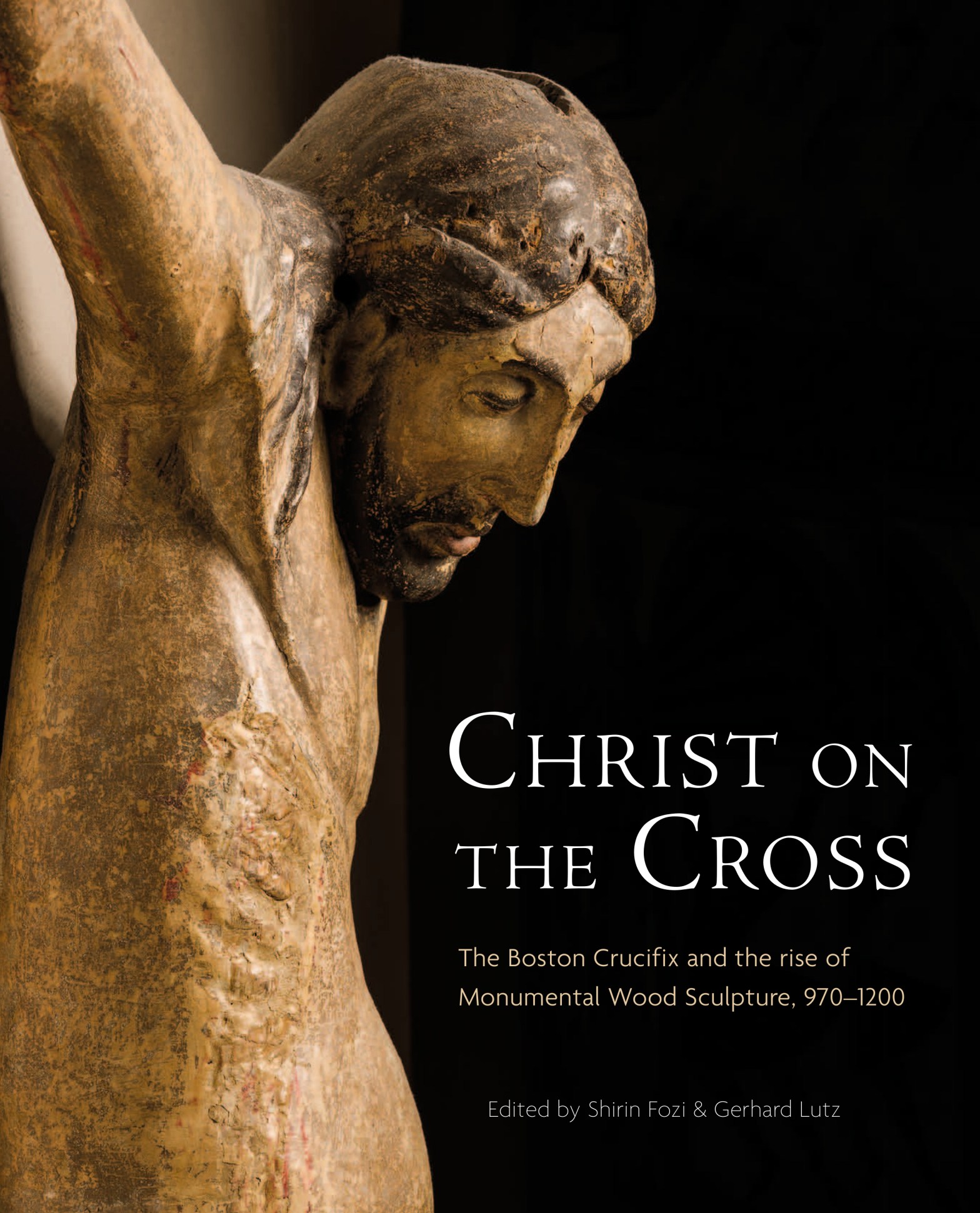
New Publication: Christ on the Cross, edited by Shirin Fozi and Gerhard Lutz

Volume 14 in the series Studies in the Visual Cultures of the Middle Ages, this publication provides a comprehensive view of the first generation of monumental crucifixes to appear in medieval Europe, which balances examinations of the history, theology, styles, and material properties of these evocative objects.

Continue reading “New Publication: Christ on the Cross, edited by Shirin Fozi and Gerhard Lutz”

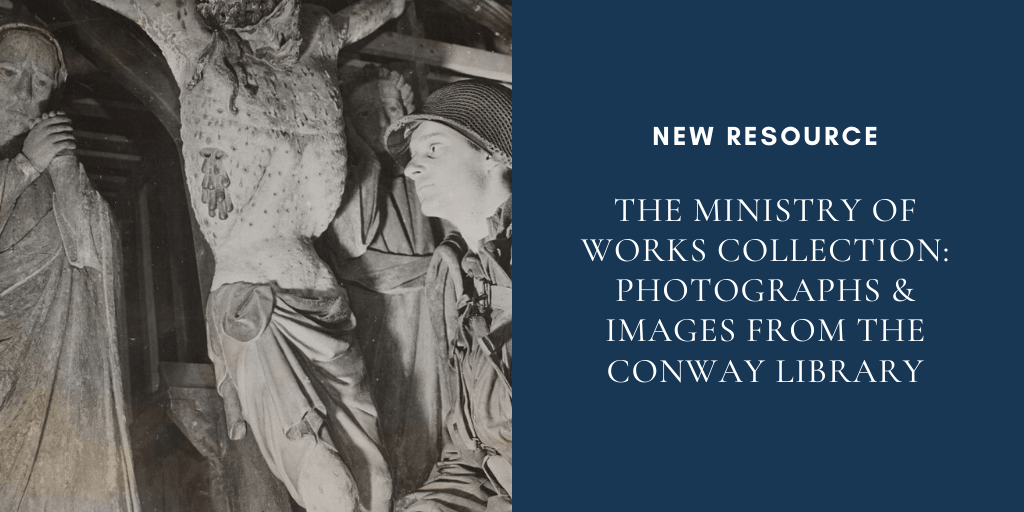
Exhibition: The Ministry of Works collection: Photographs and images from the Conway Library

The Courtauld has created a new online exhibition of photos from the Conway library, including a set of extraordinary photos taken in the aftermath of WWII. Medievalists will find much of interest here, including this striking photo of Private William Scollie of Chicago examining art works in the Siegen caves near Cologne in April 1945.


Online Resources: Les Enluminures

Les Enluminures, a gallery specializing in medieval illuminated manuscripts with locations in NYC, Chicago, and Paris, provides several digital resources for specialists, collectors, and the public alike to learn about medieval manuscripts. Here is a list of some of their online offerings:

Podcasts
Screen Shot 2020-05-06 at 12.48.44 PM

Begun in 2019, here you can listen to untold stories of medieval and Renaissance artworks, medieval manuscripts and jewelry. Join us for illuminating lectures, gallery talks, recent research, and interviews with collectors and scholars. Les Enluminures podcasts transform the past into the present.

TextManuscripts.com
Screen Shot 2020-05-06 at 12.48.04 PM

This is the oldest digital initiative of Les Enluminures, launched not quite twenty years ago. The online site dedicated to the description and sale of text manuscripts http://www.textmanuscripts.com first appeared in September 2002. It offers the largest and most wide-ranging inventory of text manuscripts currently on the market. Beginning with Text Manuscript 1 (TM1), manuscripts on the site number well over 1,000. The majority belong to college and university libraries worldwide, and many have been the subject of scholarly study – articles, books, colloquia, and so forth. Fulfilling a service to the larger manuscript community, Les Enluminures maintains an Archive in which all sold manuscripts remain online for citation and study. New items are posted bi-annually, in the Fall and in the Spring.

Blog
Screen Shot 2020-05-06 at 12.55.19 PM

Begun in 2015, this occasional blog highlights what makes our text manuscripts particularly interesting and appealing to us. Here we explore what these books disclose about how they were made and used. We also share what we know of their most fascinating and unusual contents, makers, and owners. Some of our discoveries are quite significant, some merely amusing, and some bizarre. Some blogs spill over into other areas of our inventory, like Books of Hours and miniatures. All medieval manuscripts have much to reveal to their attentive modern audiences.

To learn more about Les Enluminure’s resources, as well as to see their available artworks, please visit their website.

CFP: Materiality and Conversion

Materiality and Conversion: The Role of Material and Visual Cultures in the Christianization of the Latin West

November 30 – December 1, 2020

The Center for Early Medieval Studies at Masaryk University invites you to submit to their call for papers on material and visual culture in the early medieval Mediterranean. Please submit your proposals by May 30, 2020.

Materiality&Conversion_WEB-page-001Materiality&Conversion_WEB-page-002


Online Resources: Teaching Art History

In light of our current global crisis, most of us are facing drastic changes to every area of our lives—including how we study art and interact with teachers, students, and colleagues. The International Center of Medieval Art (ICMA) has pulled together a fantastic master list of online resources for art history academics and enthusiasts.

Browse blog posts, Youtube videos, power points, and more. Find content but also tips and tricks on how to learn online. And always remember, learning art history is supposed to be fun!

Conference: Materiality and the Virtual, a virtual symposium, 1 May 2020

The MARGIN (Medieval and Renaissance Graduate Interdisciplinary Network) team at New York University cordially invite you to attend their first-ever virtual symposium! Tune in to this highly relevant symposium, Materiality and the Virtual, this Friday, May 1. RSVP is required to receive the link to the Zoom conference call. Please click here to RSVP.

0002

CFP: Within and Without the Manuscript, deadline 22 May 2020

Within and without the manuscript: interactions between illumination and the other arts

Université de Lausanne

October 22nd-23rd, 2020

Due April 19, 2020 May 22, 2020

Since at least the 1960s, book illumination has been fully recognized as an important sector of the arts and as an integral part of the historical studies of the book. The study of this branch takes place not only in libraries and archives, but also in universities, with dedicated chairs and specific journals, as well as its own research institutes and congresses. However, the increasing specialisation should not make us forget that this field of artistic production has never been isolated from the others.

Throughout the history of this technique the links between the arts of the book and other media have been deep, continuous and fruitful. Painters have often practiced equally on panel, fresco, parchment and glass. The composite and complex nature of the book has often encouraged artists working in its pages and on its binding (whether goldsmiths or ivory carvers) to inspire each other. Patrons of manuscripts and illuminators shared the same background as other patrons and artists; formal ideas, iconographic solutions, and compositions have thus circulated to and from codices. While there is no shortage of studies addressing these issues. Nonetheless, it seems valuable to create a collective discussion and reflection centered entirely on this issue.

Continue reading “CFP: Within and Without the Manuscript, deadline 22 May 2020”

CFP: Medieval Passions and Proclivities, Deadline 5 June, 2020

Southeastern Medieval Association, 2020 Conference
Spartanburg, South Carolina
November 5-7, 2020
Hosted by Wofford and Converse Colleges

Plenary Speakers:
Michelle M. Sauer, University of North Dakota
Wan-Chuan Kao, Washington and Lee University

The Southeastern Medieval Association (SEMA) will hold its 2020 conference on November 5-7, 2020, with the theme of “Medieval Passions and Proclivities.” Proposals are welcome for individual papers, whole sessions, or round tables on the conference theme. Papers might consider any interpretation of medieval passions, interests, habits and obsessions, both religious and secular, and may include the impact or permutations of such passions in later periods.

Continue reading “CFP: Medieval Passions and Proclivities, Deadline 5 June, 2020”

Resources: Index of Medieval Art open to all until June 1, 2020

We are all aware that researchers, students, curators, and others in the field are adjusting to new (and at times difficult) working conditions due to COVID-19. In light of this, the Index of Medieval Art by Princeton University is now open-access until June 1, 2020.

The database can be accessed at https://theindex.princeton.edu/.  Take advantage of this free resource for your research needs until June 1.

CFP: (In)materiality in Medieval Art, Deadline: 15 May 2020

Ovid’s aphorism “Materiam superabat opus”, evoked throughout the Middle Ages and beyond, reveals the special consideration given to skill, technique and craft in the artistic creation processes. Thus, ingenuity and mastery have been privileged qualities in our approach to works of art, according to a restricted vision assumed by Art History as a discipline. However, both the aesthetic reflections and the documents related to artistic commissions in the Middle Ages show the great importance given to the material and sensory aspects of artefacts and monuments. In line with this perception, once again valued in light of the «material turn» of the discipline in the last decades, the 14th Jornadas Complutenses de Arte Medieval propose to focus on materiality as an essential factor in the artistic production, as well as on the poetics of immateriality and the intangible condition of the aesthetic experience.

Beyond the technical analyses, which in recent decades have allowed us to reconsider common places in the study of the medieval artistic production, this congress aims to establish transversal debates in order to open up new perspectives. In this sense, the material conditions of artistic production (properties, supply, cost, transport or technology, among others), as well as their reflection in the written sources –from technical treatises to documentary and literary references– will be discussed. On the other hand, the congress will address issues related to the sensorial features of the medieval works of art and their relationship with intangible aspects, such as the material and chromatic qualities, the incidence of light, the acoustic and olfactory effects, and the impact of the natural environment. The poetics of the materials, their meaningful uses, and the symbolic values of the immaterial will have room in the debates. Likewise, it will be of interest to consider new interpretative concepts, such as «transmateriality» and «transmediality», which may include the morphological transformation of elements across different materials, the transfer and circulation of ornamental patterns, or the physical traces of mental, invisible or transient phenomena. Contributions that address non-hegemonic and / or under-treated practices and media in historiography are especially welcomed.

Proposed topics:

  • Material conditions of artistic creation.
  • Underrated practices and media.
  • Poetics and semantic uses of the material and the intangible.
  • Cultural history of materials.
  • Sensoriality and immateriality.
  • «Transmateriality» and «transmediality»

Call for papers:

Researchers interested in submitting a 20-minute paper on any of the topics listed above are invited to send their proposals in Spanish, English, French, Italian and Portuguese, including the following information:

  • Title of the paper proposal.
  • Name and surname of the author and email address.
  • Abstract of about 500 words.
  • Brief academic and research CV of about 300 words.

The proposals should be sent to the email address inmaterial@ucm.es by 15 May 2020.

Authors will be notified of the outcome by 1 June 2020. Selected papers will be published later in a collective volume after peer review.