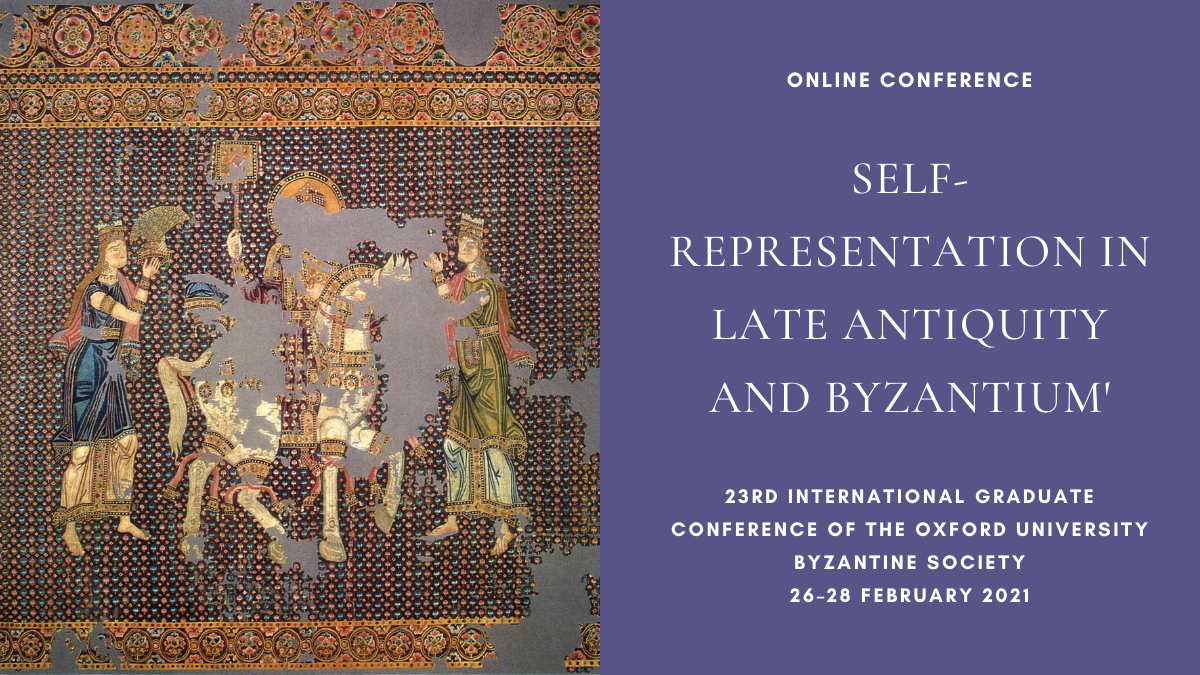
Self-representation is a process by which historical actors – individuals, communities and institutions – fashioned and presented a complex image of themselves through various media.
Referring to Byzantine portraits, Spatharakis claimed that this “form of representation cannot be divorced from its purpose and the requirements of the society in which the given visual language gains currency”. Equally, self-representation provides an original way to interpret the past, because this artificial and reflected image cannot be divorced from the cultural, social, economic, religious and political context of its time. As a methodological tool, it has received increasing attention in the field of Late Antique and Byzantine Studies, following the interest it has created in neighbouring fields such as Western Medieval or Early Modern studies.
The present conference aims to explore the cultural outputs of the Late Antique and Byzantine world – e.g. architecture, material culture, literary works – which conventionally or unconventionally can be understood as acts of self-representation. The Late Antique and Byzantine world was filled with voices and images trying to present and represent an idea of self. Some of the most famous examples of this are the lavish mosaics sponsored by imperial and aristocratic patrons, whose splendour still dazzles their observers and gives an idea of the kind of self-fashioning that they embody. Urban elites, such as churchmen, bureaucrats and intellectuals, constructed idealised personae through their literary works and the careful compilation of letter collections, while those of the provinces displayed their power through images on seals and inscriptions. In monastic typika, the founders presented themselves as pious benefactors, while donor epigraphy in rural churches secured the local influence of wealthier peasants. However, self-representation is not only a matter of introspection but also of dialogue with the “other”: such is the case of spolia, used to reincorporate a supposed classical past in one’s self-portrayal, or to create an image of continuity by conquerors. It is the conscious use of Byzantine motifs in Islamicate architecture, the fiction of Digenes Akritas, or the religious polemics of late Byzantium, pitting Muslim, Jews and Christians against one other. Through depicting what they were not, historical actors were (consciously or unconsciously) shaping their own identity.
This conference seeks to join the ongoing dialogue on self-representation in Late Antique and Byzantine Studies by providing a forum for postgraduate and early-career scholars to reflect on this theme in a variety of cultural media. In doing so, we hope to facilitate the interaction and engagement of historians, philologists, archaeologists, art historians, theologians and specialists in material culture.
This conference was conceived and organised by the OUBS Committee: Lorenzo Saccon (President); Alberto Ravani (Secretary); James Cogbill (Treasurer)
With the support of the: Oxford Centre for Byzantine Research; Oxford Centre for Late Antiquity; Society for the Promotion of Byzantine Studies; Arts and Humanities Research Council; Oxford Medieval Studies; The Oxford Research Centre for Humanities; History Faculty, University of Oxford.
Advance registration required – register here.
Find out more here.
Conference Programme
Day 1: Friday 26 February 2021
9:30am – Opening Remarks
Speaker: Lorenzo Saccon (OUBS President)
10:00am – Session 1: Self-Representation in Early and Middle Byzantine Religious Writings.
Chair: Callan Meynell
- Speaker 1.1: Paul Ulishney (Christ Church, Oxford), References to Islam in Anastasius of Sinai’s Hexameron
- Speaker 2.1: Blake Lorenz (KU Leuven)Psalm 78 and the Self in Pseudo-Methodius; Speaker 3.1: Arie Neuhauser (St Cross College, Oxford), Negotiating Legitimacy Between a Rebel and Lazaros of Mount Galesion
- Speaker 4.1: Cristina Cocola (Ghent University-KU Leuven), A Repentant Sinner: Representing the Self in Nikephoros Ouranos’ Katanyktic Alphabet
11:40am – Break until 12:00pm
12:00pm – Session 2: Representing Power and Legitimacy from Late Antiquity to Middle Byzantium.
Chair: Raymond Ngoh
- Speaker 2.1: Matt Hassall (University of Cambridge), Devolved Networks of Self-Representation and Propaganda during the Reign of Justinian the 1st
- Speaker 2.2: Silvio Roggo (University of Cambridge), The Self-Portrayal of Eutychios of Constantinople as Legitimate Patriarch, 577-582
- Speaker 2.3: Zhang Kaiyue (St Stephen’s House, Oxford), The Lawgivers and the Idol-Breakers: Self-Representation of the Isaurian Emperors as Old Testament Kings
- Speaker 2.4: Tom Alexander (St John’s College, Oxford), A Prince of Armenia between Byzantium and the Caliphate: Tʿēodoros Ṙshtuni as Depicted in Seventh- and Eighth-Century Armenian Historiography.
13:40pm – Break until 15:00pm
15:00pm – Session 3: Ut Pictura Poesis: Representing Art, Literature and Self
Chair: Kelly McClinton
- Speaker 3.1: Julian Wood (University College, Oxford), ‘For this does not define Peter only, but also Paul and John’: Theodore of Stoudios on Representing the Unique Self
- Speaker 3.2: Ana C. Núñez (Stanford University), Lost Mosaics and Religious Chant: Fashioning Royal Power in the Kingdom of Jerusalem
- Speaker 3.3: Joshua Hitt (St Hilda’s College, Oxford), ‘I Scrape off the Old Age of the Painting’s Colours’: The Rhetoric of Restoration in Twelfth-Century Byzantium
- Speaker 3.4: Dorota Zaprzalska (The Jagiellonian University), Composite Icons as a Means of Presenting and Interpreting the Past
16:40pm – Break until 17:00pm
17:00pm – Keynote Lecture
Professor Cecily Hilsdale (McGill University), Genres of Imperial Self-Representation in Later Byzantium
Day 2: Saturday 27 February 2021
11:00am – Session 4: Self-representation in Late Antique literature
Chair: Arie Neuhauser
- Speaker 4.1: Filomena Giannotti (University of Siena), Self-Representation and Fictional Portraits of a Key Figure in Late Antiquity: Sidonius Apollinaris
- Speaker 4.2: Ben Kybett (University of Cambridge), Religious Self-Representation in Fourth-Century Panegyric
- Speaker 4.3: Elia Otranto (University of Granada), Let’s Talk About Me: Dialogue and Self-Representation in Emperor Julian’s Writings
- Speaker 4.4: Frederick Bird (Regent’s Park College, Oxford), The ‘Dead Self’ in Byzantine Sepulchral Epigrams
12:40pm – Break until 14:00pm
14:00pm – Session 5: Negotiating Identity within and outside Late Byzantium
Chair: Lorenzo Saccon
- Speaker 5.1: Christina Nicole Conti (Independent Researcher), Heir to An Ancient Empire and the Illusion of Power: The Examination of Imperial Propaganda Under Alexios III of Trebizond in the Greek Alexander Romance Codex gr. 5
- Speaker 5.2: Francesca Samorì (University of Padua), Shaping History for an Autobiographical Outline: the Historia Dogmatica of George Metochites
- Speaker 5.3: Benjamin Sharkey (Magdalen College, Oxford), Forming a Christian identity: Syriac funerary inscriptions in Kyrgyzstan (1201-1345)
- Speaker 5.4: Bella Radenović (Courtauld Institute of Art), Artistic Self-Representation in Medieval Georgian Metalwork
15:40pm – Break until 17:00pm
17:00pm – Session 6: Buildings, Images and patrons
Chair: Katerina Vavaliou
- Speaker 6.1: Kelly E. McClinton (Merton College, Oxford), Elite Identity and Self-Representation in Domestic Spaces in Rome: Redecoration in Late Antique Houses
- Speaker 6.2: Veronika Poláková (National Autonomous University of Mexico), Self-Representation as a Marian Devotee: A Comparison of Donor Portraits in Byzantine and New Spanish Paintings
- Speaker 6.3: Maria Elisavet Samoili (Independent Researcher), The Modified Portrayals of the Founders Th. Limniotis and A. Radini in Frescoes at Agioi Anargyroi in Kastoria, Greece: From Aristocracy to Monasticism?
- Speaker 6.4: Alevtina Tanu (Independent Researcher), Two Examples of Comparison of Royal Women to the Theotokos in the Eastern Orthodox World.
Day 3: Sunday 28 February 2021
9:30am – Session 7: Society and its Representation in Middle and Late Byzantium
Chair: Joshua Hitt
- Speaker 7.1: Emma Huig (Christ Church, Oxford) Title: Dynamics of the Identification of Female Characters in the Slavic and Greek Digenis Akritis
- Speaker 7.2: Zuzana Mitrengová (Masaryk University), Self-Representation of the Female Protagonist in Late Byzantine Romances
- Speaker 7.3: Michael Kiefer (University of Heidelberg), What to Wear in Byzantium? – On the Portrait Habitus of Middle and Late Byzantine Elites
- Speaker 7.4: Anna Adashinskaya (New Europe College), Pious Offerings to Meteora Monasteries (1348-1420s): Between Political Representation, Family Belonging, and Personal Agency
11:10am – Break until 12:00pm
12:00 – Session 8: Beyond the Border and across the Sea: Constructing Identities around Byzantium
Chair: Benjamin Sharkey
- Speaker 8.1: William Neubauer (Balliol College, Oxford), The Fourteenth Sibylline Oracle: Eschatology and Identity among the Jews of Seventh-Century Alexandria
- Speaker 8.: Valentina A. Grasso (University of Cambridge), Kingship, Self-Representation and Cross-Cultural Assimilation: A Reading of Late Antique pre-Islamic Arabian Epigraphic Testimonies
- Speaker 8.3: Fermude Gülsevinç (Bilkent University), ‘We Are Pilgrims in an Unholy Land’: Christianizing the Seascape of Naxos and Chios in the Late Antiquity (Fourth to Sixth Centuries)
- Speaker 8.4: Prolet Decheva (University College, Dublin), An Abstract Way of Self-Representation: Personified Virtues in Late Antique Mosaics and Beyond.
13:40pm – Break until 14:30pm
14:30pm – Session 9: Self-Representation in the Socio-Economic Sphere
Chair: Thomas Laver
- Speaker 9.1: William Bunce (Wadham College, Oxford), Roman Law as Roman Self-Representation: A Case Study in Holiday Law
- Speaker 9.2: Gemma Storti (The Ohio State University), Mismatched Eyes, Penny-Pinchers, and Eaters: Byzantine Nicknames and Self-Representation
- Speaker 9.3: Carlo Berardi (University of Michigan, Ann Arbor), A Lion, not an Angel: Heraldic Devices and Dynastic Identity in the Frescoes of Saint Panteleimon, Nerezi
- Speaker 9.4: Yunus Doğan (Bilkent University), ‘S(igillum) Felicis (Fran)Corum Exercitus in Rom(a)nie F(..)Bus(?) Comorantis’: Seal of the Catalan Company.
16:10pm – Break until 17:15pm
17:15pm Keynote Lecture 2
Professor Stratis Papaioannou (University of Crete), The Literature of the Self in Byzantium; Closing Remarks



 Medieval Art Research