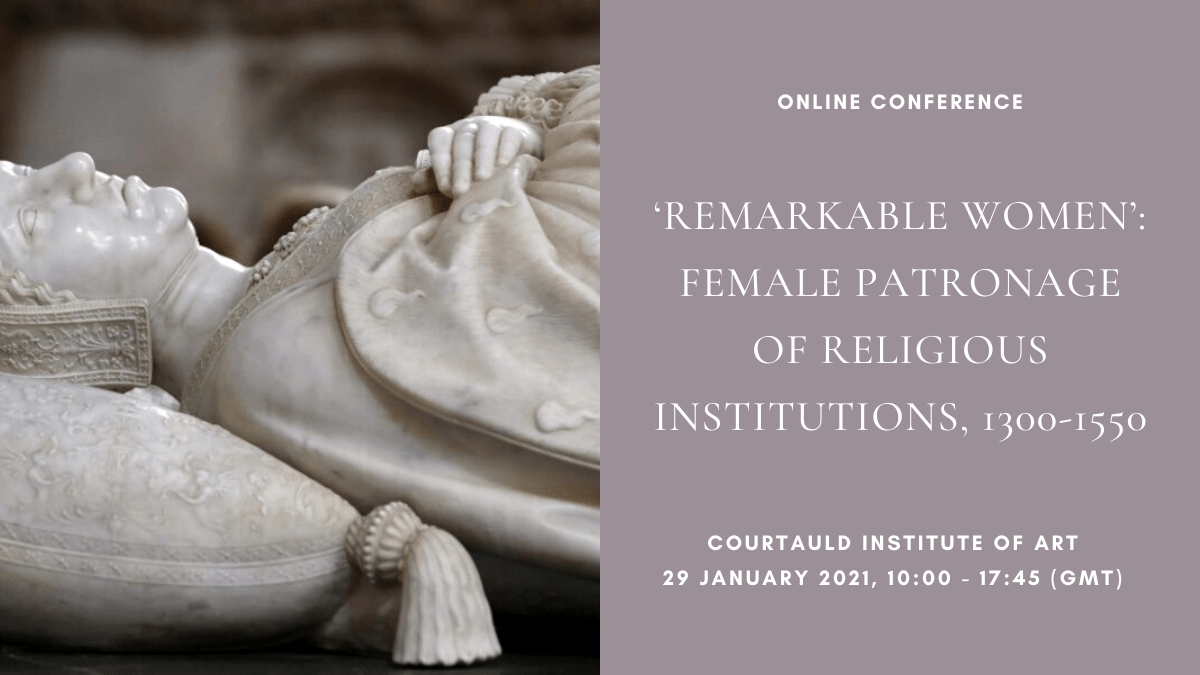
Online Conference: ‘Remarkable women’: Female patronage of religious institutions, 1300-1550, Courtauld Institute of Art, 29 January 2021, 10:00 – 17:45 (GMT)
Register and find out more here.

Please register for more details. The platform and log in details will be sent to attendees at least 48 hours before the event. Please note that registration closes 30 minutes before the event start time. If you have not received the log in details or have any further queries, please contact researchforum@courtauld.ac.uk

This conference seeks to explore the ways in which women patronised and interacted with monasteries and religious houses during the late Middle Ages, how they commissioned devotional and commemorative art for monastic settings, and the ways in which these donations were received and understood by their intended audiences. The artistic donations of lay patrons to religious institutions has become a fruitful area of study in recent years, but the specific role played by women in these networks of patronage has been subject to less thorough scrutiny. Similarly too, the interests of female patrons have often been considered separately from the contexts of the places to which they made their donations, without a thorough consideration of their very different status from their male counterparts and how this shaped their pursuit for commemoration and memorial after death and their reception as patrons by monastic houses and religious institutions. 

The speakers will consider these issues and to think about the placement of objects and works of art commissioned by women within religious buildings, the devotional practices and beliefs of various religious orders, the physical materials of donations, and the ways in which female patrons situated themselves within monastic spaces. Was there a dialogue between these benefactors and the religious institutions they patronised? What can such donations tell us about the role and position of women in late medieval society and the ways in which they used religious patronage to articulate their own status? By examining a category of patrons that was clearly highly aware of a variety of devotional and commemorative practices, this conference seeks to gain a better understanding of art commissioned for monasteries by female lay donors, and how this more broadly reflects the position of women in late-medieval Europe. 

10:00 Welcome and Opening Remarks – Nicholas Flory (The Courtauld) 

10:05 PANEL 1: Chapels and Devotion – Session chaired by Charlotte Wytema (The Courtauld) 

Dr. Giorgia Mancini (University of Cambridge) – At the heart of devotion in fifteenth century Ferrara: female donors in San Giorgio fuori le Mura 

Maria Lesimple (University of Grenoble-Alpes/LUHCIE) – Margaret of Austria’s ‘Treasure of Brou’: between Arts, Religion and Politics 

Yeidy Rosa (University of Durham) – Hidden and Revealed: Women’s Power, Family Feuds and Jewish-Muslim-Christian Relations through a recently uncovered mural of the Lamentation in the Cathedral of Albarracín 

11:05 Discussion – Chaired by Charlotte Wytema (The Courtauld) 

11:30 BREAK  

11:45 PANEL 2: Patronage choices – Session chaired by Jessica Gasson (The Courtauld) 

Dr. Mija Oter Gorenčič (France Stele Institute of Art History) –Women as Benefactors and Art Patrons in Male Medieval Cistercian and Carthusian Monasteries in Present-Day Slovenia

Dr. Diana Lucía Gómez-Chacón (Universidad Complutense de Madrid) – Beyond the Realms of Castile. Queenship, Devotion and Artistic Patronage in the times of Queen Violante of Aragon (1236-1300/01) 

12:25 Discussion – Chaired by Jessica Gasson (The Courtauld) 

12.55 LUNCH 

14:15 PANEL 3 Dynastic Concerns – Session chaired by Bella Radenovic (The Courtauld) 

Iliana Kandzha (Central European University) – Wives and Widows in aMonastic Space: Kunigunde of Austria (1465-1520) and the Carthusian Monasteru of Prüll 

Isabel Barros Felix (Université Catholique de Louvain) – The funerary monument of prince Afonso of Portugal (1390-1400): A 15th century commission by duchess Isabel of Portugal (1397-1471)? 

Dr. Richard A. Leson (University of Wisconsin-Milwaukee) – “Remembering Enguerrand of Coucy”: Jeanne of Flanders’ Memorial Campaigns at Longpont and Laon 

15:15 Discussion – Led by Bella Radenovic (The Courtauld) 

15:45 BREAK 

16:00 PANEL 4 Objects of Devotion – Session chaired by Susannah Kingwill (The Courtauld) 

Dr. Bryony Coombs(University of Edinburgh) –Devotion in Text and Stone: Female Authority and Agency in Margaret of Scotland’s Foundation of a Royal Chapel at Thouars and her ‘Speciosissimas’ Book of Hours

Dr. Joni M. Hand (Southeast Missouri State University) – Playing by the “Rule”: Monastic Order and Identity in the Psalter of Bonne of Luxembourg 

Amy Neff, Professor Emerita (University of Tennessee) and Anne Derbes, Professor Emerita (Hood College) – Which Remarkable Woman? The Passion Altarpiece for Santa Clara, Palma de Majorca 

17:00 Discussion – Led by Susannah Kingwill (The Courtauld) 

17:30 Closing Remarks 

Register and find out more here.

Online Lecture: Dr Robert Mills’ LGBT History Month Lecture: ‘Recognising Wilgefortis’, Manchester Met, 24 February 2021, 17:30 – 19:00 (GMT)
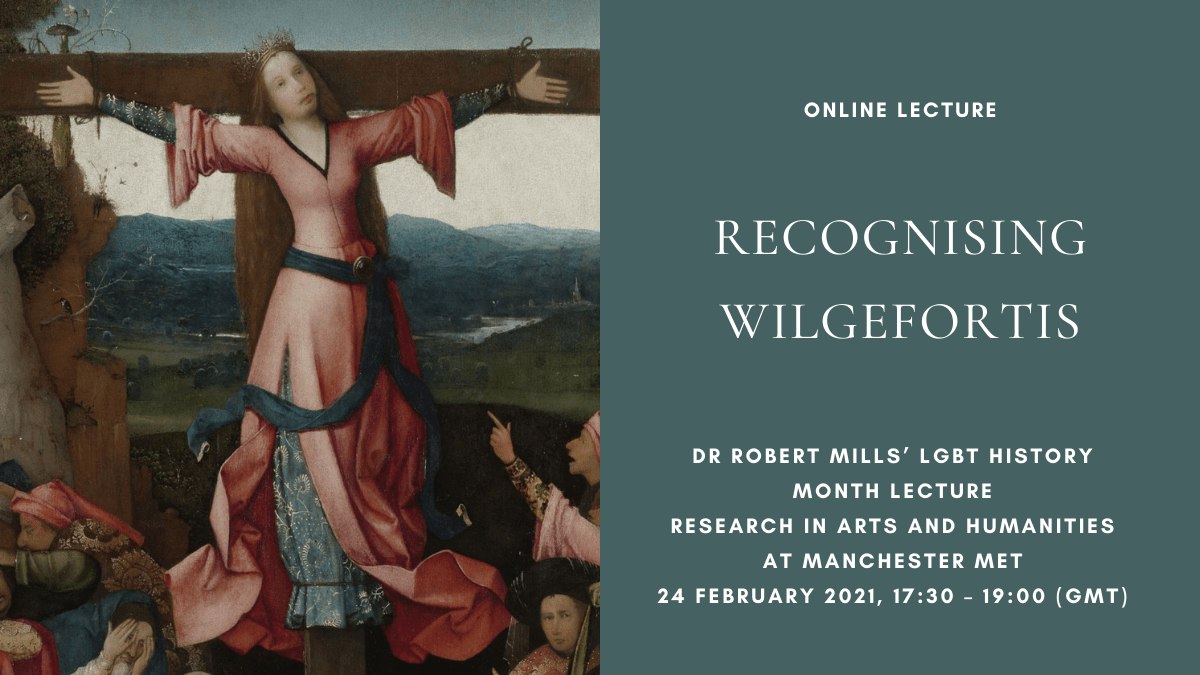
The point of departure for this talk is a painting by Hieronymus Bosch depicting a crucified saint whose identity, including their gender identity, has sparked controversy.

Current consensus is that the image represents the bearded female martyr, Saint Wilgefortis, also known as Uncumber, Ontcommer, Kümmernis etc. But other identifications have been proposed.

Contextualising the artwork with reference to medieval and early modern understandings of gender diversity and transformation, this paper will stage a dialogue between Bosch’s painting and current debates about the role of identity categories and terminology in histories of gender and sexuality.

What happens when a premodern image is viewed through the prism of modern notions of trans identity and genderqueerness?

What’s in a name?

Dr Robert Mills is Professor of Medieval Studies and Head of the History of Art Department at UCL. Between 2015 and 2018 Mills directed qUCL, UCL’s LGBTQ research network. Previously he was director of the Queer@King’s research centre at King’s College London. Mills’s publications include Suspended Animation: Pain, Pleasure and Punishment in Medieval Culture (2005), Seeing Sodomy in the Middle Ages (2015) and Derek Jarman’s Medieval Modern (2018). He also contributed the medieval section to A Gay History of Britain (2007).

Free online event. Joining instructions will be sent automatically via email nearer the date of the event. Register here.

Queries can be addressed to Heather Shore – H.Shore@mmu.ac.uk, Craig Griffiths – C. Griffiths@mmu.ac.uk or Haseeb Khan – Mohammed.Khan@mmu.ac.uk

Online Lecture: ‘The Great Church which is called Sophia’, with Alessandro Taddei, Centre for Byzantine, Ottoman & Modern Greek Studies University of Birmingham, 28 January 2021, 17:15 – 18:30 (GMT)
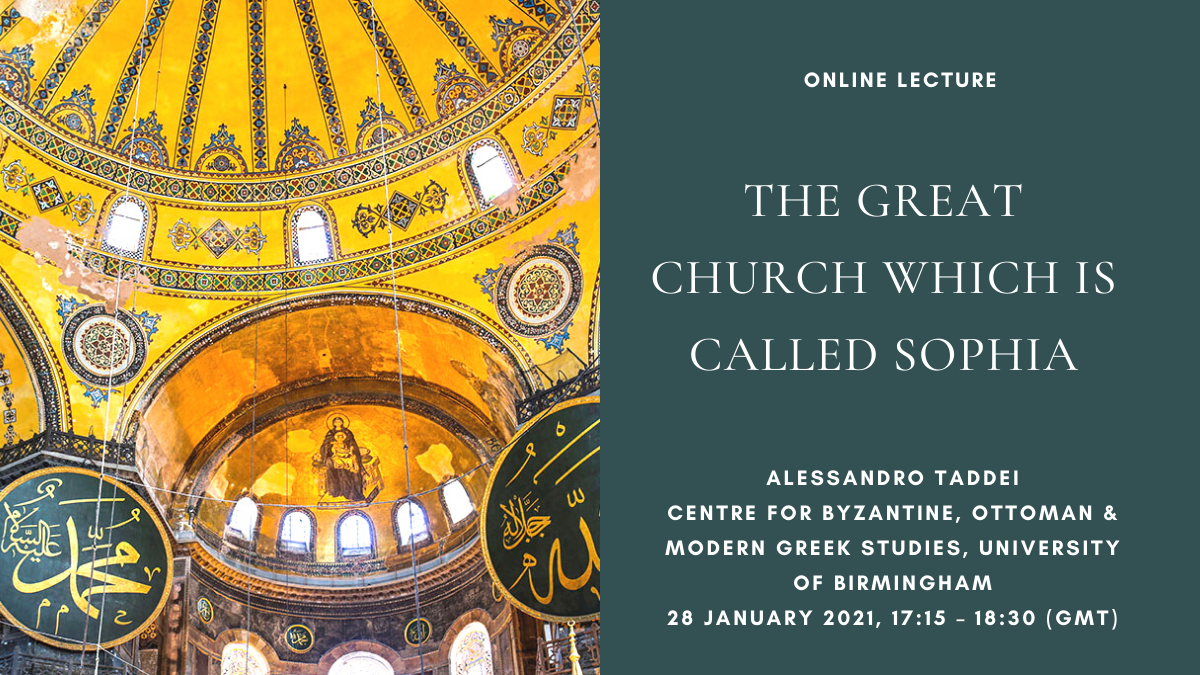
Join Alessandro Taddei (La Sapienza) for their talk on ‘The Great Church which is called Sophia’: The History and archaeology of the episcopal church of Constantinople before Justinian.

Register here.

Online Lecture: ‘The stronghold of shields: Two 12th-century kite shields discovered in Poland’ with Keith Dowen, 4 February 2021 14:00 – 15:00 (GMT)

Although the kite shield was a key part of the early medieval warrior’s equipment, only two examples of the type survive. Keith Dowen, Royal Armouries’ Assistant Curator of Arms and Armour, will examine their design and construction as well as the circumstances of their discovery.

Depictions of the early medieval knight, from the Bayeux Tapestry to the silver screen, present the elongated kite shield as an intrinsic and iconic part of a warrior’s equipment. However, while swords, spearheads and armour from the period can be found in various collections including the Royal Armouries, for many years it appeared that no examples of kite shields survived. During archaeological excavations in the Polish city of Szczecin in 2000, however, two extraordinary finds came to light. In different parts of the old stronghold, archaeologists unearthed the partial remains of two kite shields. Possibly connected to the Danish attacks of the late 12th century, these shields are the only known examples of their type to have survived. They are therefore invaluable to our understanding not just of the development of protective technology, but warfare in the early Middle Ages more generally. This lecture will discuss the circumstances of the discovery of these shields, and examine various aspects of their design and construction through detailed analysis and comparison to other shields from England and Scandinavia. This will show that far from being decorative or ceremonial objects, as has previously been suggested, there can be little doubt that the shields from Szczecin were fully functional battlefield pieces.

Register here.

New Publication: ‘Emerging Naturalism: Contexts and Narratives in European Sculpture 1140-1220’ edited by Gerardo Boto Varela, Marta Serrano Coll & John McNeill

Artistic production in Europe between the mid-12th and early 13th centuries is notoriously difficult to categorise. Terms such as ‘Late Romanesque’ or ‘Early Gothic’ have not travelled well. Attempts have been made to get round this by applying alternative stylistic descriptors like ‘Transitional’ or ‘Year 1200’, particularly as regards stained glass, manuscript illumination, and metalwork, but their application is similarly contestable. ‘Emerging Naturalism: Contexts and Narratives in the Architectural Sculpture of the Latin Church 1140-1220’ offers a number of different perspectives on this question, while offering a panoramic analysis of the period as expressed in the medium of stone sculpture.

Editors:

Gerardo Boto Varela teaches art history at the Universitat de Girona (Spain), is leader of the international research group Templa, and scientific editor of the journal Codex Aquilarensis. Revista de Arte Medieval. His research concentrates on spatial, pictorial, and liturgical aspects of Spanish ecclesiastical architecture from the tenth to thirteenth centuries, as well as on dynastic tombs and memorial culture in Medieval Iberia.

Marta Serrano Coll teaches art history at the Universitat Rovira i Virgili in Tarragona (Spain) and specializes in Medieval architecture and sculpture, particularly in Catalonia. Her research interests include the display of power through artworks and royal patronage in the Iberian Peninsula during the Middle Ages. In addition, she has published in the field of Romanesque sculpture and hagiographical studies.

John McNeill teaches at Oxford University’s Department of Continuing Education, and is Honorary Secretary of the British Archaeological Association, for whom he has edited and contributed to volumes on Anjou, King’s Lynn and the Fens, the medieval cloister, and English medieval chantries. He was instrumental in establishing a biennial International Romanesque Conference Series and has a particular interest in the design of medieval monastic precincts.

Find out more here.

Table of Contents

Emerging Naturalism and a New Medieval Morphology — Herbert L. Kessler

I.Shaping Late Romanesque Sculpture. Balance and Perspective

The Attainment of a Compelling Naturalism in Sculpture c. 1200 — Gerardo Boto Varela

What is So-Called Late Romanesque Sculpture? — Xavier Barral i Altet

II. Late Romanesque / Early Gothic Sculpture in European Cathedrals (1140–1220)

The Role of Burgundy in the Development of the First Column-Statues — Marcello Angheben

Late Romanesque Sculpture and the Cathedrals of South-Western France — Quitterie Cazes

An Enigma Put Aside. The Origin and Interpretation of a Decontextualized Capital from Saint Trophime at Arles — Juan Antonio Olañeta

Around and After 1200. Old and New Concepts of Monumental Sculpture in the German Territories of the Holy Roman Empire — Claudia Rückert

Sculpture and Liturgy: Monuments and Art Histories of Southern Italy (c. 1150–1250 and Beyond) — Elisabetta Scirocco

Old Testament Sacrifice and Thirteenth-Century Tithe: Cain and Abel in the Architectural Sculpture of the Holy Roman Empire — Stephanie Luther

Late Romanesque Sculpture in England. How Far Can the Evidence Take Us? — John McNeill

The Gothic Last Judgment Portal c. 1210. Visual Strategies and Communicative Function — Bruno Boerner

Aesthetics and the Imitation of Antiquity in Early Gothic Sculpture — Laurence Terrier Aliferis

III. Sculptural Visualisations in the Cathedrals of the Iberian Kingdoms (1160–1220)

The Reception of Burgundian Models in the Second Half of the Twelfth Century and the Naturalist Redefinition of Romanesque Sculpture in Castile — Marta Poza Yagüe

Master Mateo and the Cathedral of Santiago at the End of the Twelfth Century — Ramón Yzquierdo Peiró

Late Romanesque Sculpture in the Kingdoms of Leon and Castile: Continuity or Change? — José Luis Hernando Garrido & Antonio Ledesma

Romanesque Sculpture in Portuguese Cathedrals: Models, Continuity and Adaptation — Carla Varela Fernandes & Paulo Almeida Fernandes

The Meaning of the Romanesque Sculpture in the Cámara Santa at the Cathedral of Oviedo — César García de Castro Valdés

Images and Stories: The Transformation of Space in the Cathedrals of the Ebro Valley — Esther Lozano López

The Vault Corbels in the Cloister of Tarragona Cathedral: Shaping a New Pictorial Corporeality that Goes Beyond the Late Romanesque — Gerardo Boto Varela & Marta Serrano Coll

Online Lecture: East of Byzantium Lecture: ‘Back to Byzantium: Translation, Legitimacy, and Worlding on the Byzantine Frontier’ with Sergio La Porta, 2 February 2021 3:00pm (EST)

The Arthur H. Dadian and Ara Oztemel Chair of Armenian Art at Tufts University and the Mary Jaharis Center for Byzantine Art and Culture at Hellenic College Holy Cross in Brookline, MA, are pleased to announce an upcoming East of Byzantium lecture:

Sergio La Porta (California State University, Fresno) discusses the translation of the martyrology of St. Step‘anos Ulnec‘i and its place in the larger Mediterranean world.

Advance registration required. Registration closes at 10:00 AM (EST) on February 2, 2021. Register: https://eastofbyzantium.org/upcoming-events/

CFP: ‘Self & Selves’, White Rose Medieval Graduate Conference (Virtual, 17-18 June 2021), deadline 1 April 2021

How did medieval people think about themselves? What did selfhood mean in the middle ages? How was the medieval self constructed or performed? This conference explores how medieval people expressed and conceptualised the self and selves. We encourage investigations of medieval selves in all of its expressions in medieval cultural productions from a variety of disciplinary backgrounds and methodologies: such as archaeological, art historical, literary, scientific, theological, and political approaches. Participants are also encouraged to critically reflect on the ways in which medieval selves were intersectional: informed, expressed, and challenged by ability, class, gender, sexuality, race, religion and other manifestations of identity. By fostering a discussion on what self-identity means within a medieval context, this conference also aims to illuminate contemporary interpretations of identity today.

Topics may include:
◆ Self-Representation (autobiography, self-portraiture, patronage)
◆ Self-fashioning (perception, posturing and performance)
◆ Material Expressions of the Self (archaeological, visual and financial selves)
◆ Constructions of race, nationality, and ethnicity and intersections of the self
◆ Gender identities, sexuality and queerness
◆ Medical Identities (healthy/unhealthy selves, disabled selves, etc.)
◆ Religious Identities (hermits, mystics, and clergy, etc.)
◆ Political Identities (class, social status, etc.)
◆ The Self in Life and Afterlife (the relationship between medieval body, soul and self)
◆ Thinking and feeling the self (emotions, subjectivity, empathy, etc.)
◆ Modern and Medieval selves (in politics, reenactment, or performance)

Applicants are invited to submit an abstract of 250 words and an accompanying 100 word biographical note by 1 April 2021 to:
whiterosemedievalgraduateconference@gmail.com

Find out more here.

Our conference is an international event hosted by the Universities of York and Leeds. Our aim is to provide postgraduates from any area of medieval studies with opportunities for personal and professional development in a supportive and welcoming environment. Our annual themed conference consists of numerous panels, workshops, roundtables, and keynote speaks from a variety of disciplinary and methodological backgrounds.

Call for Journal Submissions: ‘Sacred Spaces in Motion’, deadline 1 May 2021

Our contemporary world witnesses contrasting approaches to sacred spaces. While in some regions (especially in Western Europe) there is a decrease in the interest for religious buildings as places for worship due to the decline of the number of practicing believers, and they are sometimes reused as public institutions, hotels or restaurants, in other regions one can testify for a revival of an intense attention to religious architecture. This is manifested either through the large-scale construction of national churches (e.g., Church of Saint Sava, Belgrade; People’s Salvation Cathedral, Bucharest), the reconversion of former museums into places of worship (e.g., Chora or Hagia Sophia Museums), or shifts in their religious status (e.g., recent transformation of churches into mosques, as with the former Lutheran Church of Capernaum in Hamburg, Germany or the former church of Santa Maria Valverde in Venice). These contradictory tendencies and dynamics in understanding the role of sacred buildings highlights the exploitation of sacred spaces as areas for the affirmation of religious identity and negotiation of power resorts. Buildings concentrate different values, expectations, and social projections of a religious community, and most times the physical place itself where the building is consecrated bears an importance of its own (e.g., Al-Aqsa Mosque, Dome of the Rock and proposed third Temple of Solomon in Jerusalem, Great Mosque of Mecca). The highly controversial call for a third Temple of Solomon exemplifies just how important the exact geography for worshiping God may be. But when different denominations request the same place (e.g., Temple Mount/Noble Sanctuary of Jerusalem), or the same building (e.g., the Hagia Sophia) neither immediate nor long-lasting solutions are easily found.

This unique and topical issue of RES aims to bring together papers that deal with (but will be not be limited to) questions such as: How do sacred buildings reflect the interferences of the political with the religious? What are the legal and theological bases for the (re)conversion of churches into mosques and of mosques into churches? To what extent and what foreseeable consequences building, decommissioning, repurposing, or converting religious spaces represent a form of domination and exclusion? Can one envision sacred spaces as communion places for different confessions or religions? Can historical sacred buildings become ecumenical edifices, in which different confessions and religions could worship under the same roof? We are also looking for contributions that discuss the complex significance that religious edifices bear in the architectural language of sacred spaces, from architects, archaeologists, art historians, historians of religions, theologians, philosophers or political scientists. Contributions are welcome on the confessional, ethical, political and aesthetical importance of historical sacred spaces in Abrahamic religions, such as the Hagia Sophia and historic Asia Minor, those in Jerusalem and the Holy Land, the Tigris-Euphrates Basin region and the wider Middle East, as well as from the Balkans.

Deadline: May 1, 2021

Email: res@ecum.ro

Contributions will be published in English or German and are to follow RES editorial guidelines: http://www.res.ecum.ro/guidelines/

Find out more information here.

CFP: Water in towns in North-West Europe in the early Middle Ages: an agent of urban spatial transformation (4th−12th centuries), University of Tours (France) (21-23 October 2021), deadline 1 March 2021

Towns or, rather, urban societies maintained multiple and complex relations with water in the past. In its different forms, stagnant or dynamic, water was a prerequisite for human settlement. Most towns are located on a watercourse used for various purposes (food provision, craft production, energy, defence, transport…). Medieval towns were places where water was omnipresent and this constitutes a subject of choice for researchers, as shown by the many studies published on the subject (eg Leguay 2002, Guillerme 1983). Among all the symposia organised up till now on water in the medieval period, most papers have concerned the end of the period, for which written sources are more numerous and detailed. At the same time, at conferences and in publications devoted to towns in the early Middle Ages, the role of water has not been treated in much depth (Hodges and Hobley 1988), even if there are some well-known examples from this period, such as the harbour of Dorestad (Van Es and Verwers 1980) or Douai (Louis, Demolon and Louis-Vanbauce 1990). In 2004, publication of a symposium on rivers and marshes lent new impetus to approaches to human interaction with rivers and management of wetlands, including urban examples such as Tours (Burnouf and Leveau 2004).

Starting from the premise that a variety of towns existed during the early Middle Ages (towns of Roman origin, or growing up around a monastery, a defensive site or an economic hub), we propose to assess the role of water in these towns at three progressive levels: i) that of different users within a town, ii) at the level of the town as a whole, and iii) in the creation of urban networks. Our purpose is to draw together the most recent research, highlighting this subject through archaeological discoveries as well as critical analysis of written sources.

1 – Living by water, living with water in the early medieval town

In this first section, we will start by examining the uses of water in everyday life as well as in productive contexts, laying stress on structures and facilities that served these needs at the level of people operating within urban space.

Everyday use of water

Water supply and discharge in towns provides a first theme. Access to water for everyday needs was achieved in two ways: an on-site supply (pumping or carrying water from rivers, uptake of groundwater, or collection of rainwater in cisterns) or bringing water from a more distant source (through new constructions or maintenance of antique aqueducts). Archaeological remains (wells, cisterns, water- supply systems, aqueducts) raise questions about the degree of technological know- how of early medieval societies, as well as the contribution of towns of antique origin and the extent of continued use of inherited systems. Papers might also cover hygienic aspects of water (baths), as well as its liturgical or ritual uses (baptisteries, mikvehs…).

Production using water in the urban setting

This theme involves activities of production and transformation associated with water. It will particularly focus on fisheries mentioned in Carolingian charters, and remains of fish traps and weirs consisting of wooden stakes discovered in riverbeds. Twenty years after the ‘Rencontres internationales de Liessis sur la pêche en eau douce au Moyen Âge et à l’époque moderne’, this will provide an opportunity to take stock of new discoveries. An important place here is envisaged for contributions on water- mills (with horizontal or vertical wheel) which were often associated with fishing activities in early medieval towns. With the development of rescue archaeology in the last twenty years, many such structures of the early Middle Ages have been excavated across Europe, and we wish to showcase here urban or suburban examples from North-West Europe. Finally, this will also be an opportunity to deal with industrial activities requiring access to water, such as tanning and cloth working, which are sometimes difficult to apprehend at this period.

Transport and crossings

The archaeology of low-water or dry channel beds has developed rapidly in the last twenty years, showing the value of these areas for studying installations linked with transportation and traffic by water (harbours, docks, quays) or crossings over it (bridges, ferries, fords). The evolution of ‘waterfront archaeology’ and rescue archaeology has allowed some notable excavations of harbour structures in an urban context, as at Namur in Belgium and Bordeaux and Lyon in France. In the Loire valley, several sites are still being investigated, such as the antique port of Rezé near Nantes which lasted into the early Middle Ages, or the town of Blois with its bridges and medieval fisheries. Attention will be focused on case-studies involving the discovery of archaeological remains.

2 – Water in towns

Through this second theme, we will seek to broaden the scope by looking not so much at the archaeological remains of structures for their own sake, but rather at those structures’ imprint on the urban landscape. Thanks to André Guillerme’s work, we now know that the period in question witnessed the creation of surface water networks in towns that were sometimes very dense, and which resulted from two phenomena: the construction of successive defensive works, and the use of water for artisanal purposes both intra and extra muros. It was the age of ‘dynamic’ water which came to an end in the middle of the 14th century, to be succeeded by the age of ‘stagnant’ water resulting from developments in military technology which required large defensive ditches and ushered in a new era in the relationship between urban society and water. This observation prompts two different lines of enquiry: the first concerning the creation and functioning of these hydrographic systems, and the second concerning the impact of these early medieval installations on the urban fabric.

Understanding the hydrographic system through activities of the inhabitants

These ‘little Venices’, which are revealed to us by written sources starting in the 11th but especially from the 12th century, were the result of many centuries of infrastructure projects responding to very varied needs. We might focus our attention on identifying initial projects, their scale, their instigators, and the knowledge applied in their implementation, but also on their transformation which was never seamless. The erection of a new mill or a new tanning quarter required a fresh start that would have disrupted the existing water-management system achieved through hard-won compromise. Hence this section will seek to understand what the hydrographic network is telling us was at stake at different times in a town’s history, and to reconstruct from surviving remains a ‘hydraulic system’ which will necessarily imply things about the approach of the creators: the choice of site according to topographical potentiality (marsh, damp zones), the availability of land for acquisition, hydrological resources, suitability for being organised to serve multiple activities (milling, fish farming, textile working…), but also with a view to defence. Even if most of the answers will certainly be of a hypothetical nature, they should nevertheless open the way to consideration of such questions as the possibility of analysing urban growth in the Middle Ages in relation to the development of hydrographical networks.

Assessing the role of water in the early Middle Ages in the urban fabric

Once having discussed the chronology and siting of hydrographic networks and the objectives of the people involved, we can focus on the role of water as a structuring element of urban space in the long term. We would suggest reassessing the part played by the early Middle Ages in the establishment of hydrographic networks of the ‘little Venices’, as well as the impact of the nature of the site (marsh, paleochannels) on the form assumed by a town (morphogenesis). Is it possible to detect a chronological emphasis in different uses of the channels over time: in a defensive role, as a reach, or in wetland drainage?

3 – Water and urban networks in North-West Europe

A final level that could be debated at this symposium is that of networks of cities. Indeed, the continuity and growth of towns of antique origin, as well as the foundation of new towns, are often linked in traditional historiography with an economic flowering whose origin is still debated. In both cases, the geographical location close to water (riverbank, coastal, estuarine…) and allowing ease of water-borne transportation (whether riverine or maritime) was certainly the cause of this flowering. Thus one might ponder the role of water in these networks of towns, their origins and development, as well as that of the big players in this commerce (the great abbeys, royalty and aristocracy…) who were able to establish true inter-regional networks.

Communication or poster proposals should be submitted by 1 March 2021. Proposals should provide a title, a summary of 300 words in French or English and the institutional affiliation of the author. They must be filed on the website of the conference : eauvillehma@sciencesconf.org.

It is planed to publish the proceedings of this conference.

The registration cost will be €20. Attendance is free of charge for students but they need to register. A buffet is organised for lunch for the first two days of the symposium (€15 for attendance). On the third day, a visit of the city of Vendôme will be offered to all the participants of the symposium.

For further information, please visit the website of the conference on eauvillehma@sciencesconf.org.

Online Lecture: Dr Zsuzsanna Gulácsi, ‘Sideways-Oriented Images of Manichaean and Armenian Liturgical Books’, East of Byzantium Lecture, 29 January 2021, 3pm (EST)

East Central Asian Manichaean sources discovered at Kocho from the Uygur era of Manichaean history (755-1024 CE) constitute prominent examples of Silk Road art and text. Despite the closeness of Chinese culture and the dominant presence of Buddhism in the region during this era, Manichaean books maintain a distinctly “West Asiatic” character. In order to further explore the latter, this study assesses the codicological similarities between Manichaean manuscripts from East Central Asia (that were written in Parthia, Middle Persian, Sogdian, and Uygur languages) and the earliest Eastern Christian and Islamic manuscripts from Syro-Mesopotamia (that were written in Syrian, Armenian, Arabic, and Persian languages between the 5th and 11th centuries). The two groups compare favorably based on a variety of codicological criteria. These similarities point beyond the mid 3rd-century Syro-Mesopotamian roots of Uygur-era Manichaean book culture and indicate that there was a continued contact between the Manichaean communities in East Central Asia and their Mesopotamian homeland well into the medieval period.

Zsuzsanna Gulácsi is professor of art history, Asian studies, and comparative religious studies at Northern Arizona University. She is a historian of religious art, specializing in the contextualized art historical study of pan-Asiatic religions that adapted their arts to a variety of cultures as they spread throughout the continent. Her research has been supported by the National Humanities Center, the Japan Society for the Promotion of Scholarship, the American Council of Learned Societies, the American Philosophical Society, the Guggenheim Memorial Foundation, and most recently the Getty Foundation. Her many publications include Manichaean Art in Berlin Collections (Brepols, 2001), Medieval Manichaean Book Art: A Codicological Study of Iranian and Turkic Illuminated Book Fragments (Brill, 2005), Mani’s Pictures: The Didactic Images of the Manichaeans from Sasanian Mesopotamia to Uygar Central Asia and Tang-Ming China (Brill, 2016), and the edited volume Language, Society, and Religion in the World of the Turks: Festschrift for Larry Clark at Seventy-Five (Brepols, 2018).

This lecture will take place live on ZOOM, followed by a question and answer period. Please register to receive the Zoom link. An email with the relevant Zoom information will be sent 1–2 hours ahead of the lecture. Registration closes at 10:00 AM (EST) on January 29, 2021. REGISTER FOR LECTURE

EAST OF BYZANTIUM is a partnership between the Arthur H. Dadian and Ara Oztemel Chair of Armenian Art at Tufts University and the Mary Jaharis Center for Byzantine Art and Culture at Hellenic College Holy Cross in Brookline, MA. It explores the cultures of the eastern frontier of the Byzantine Empire in the late antique and medieval periods.