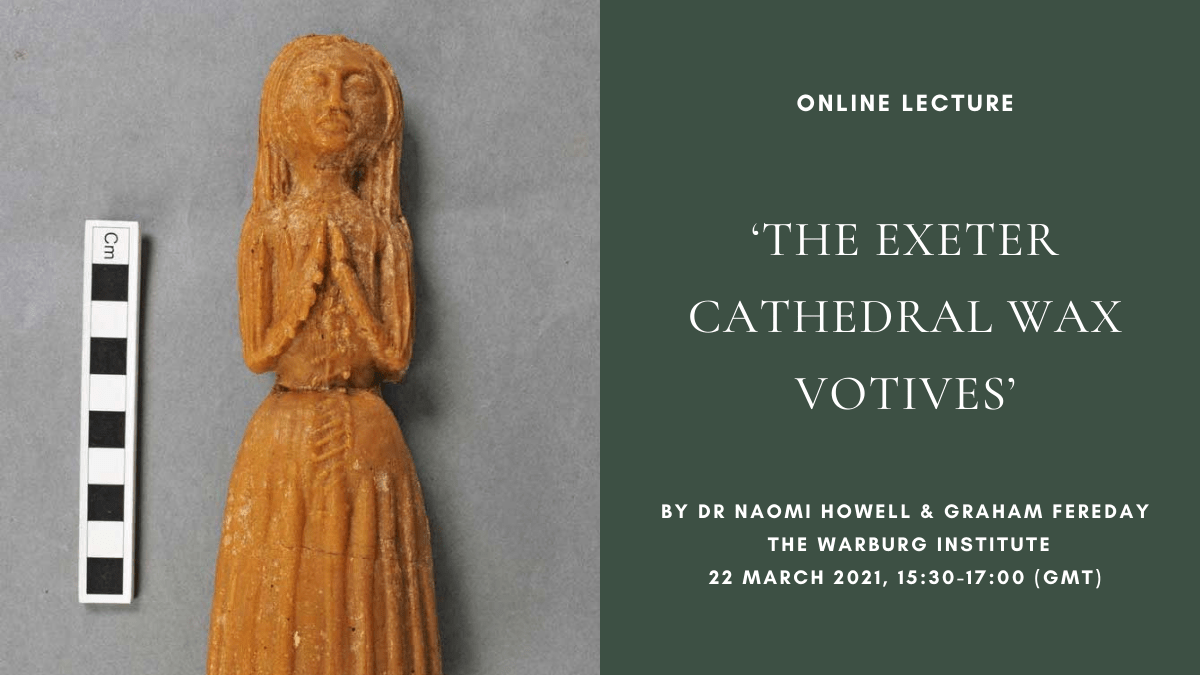
In 1943, following the bombing of Exeter Cathedral, a trove of wax votive objects was found at the tomb of Bishop Edmund Lacey. Many were in small fragments, but one whole figure remained – a unique survival of what was once a vibrant religious practice. In this seminar, Dr Naomi Howell and Graham Fereday from Exeter University will discuss the history, study and ongoing conservation of these extremely rare, fragile objects using a combination of high-definition photography, 360-degree videos and 3D-printed models. Combining medieval history and digital humanities, this seminar offers students and others who are interested an opportunity to discover more about this important archaeological find. Presented in conjunction with Exeter Cathedral Library and Archives.
This event is part of the A Material World: Devotion events series, which brings together academics and heritage professionals from a wide range of disciplines to discuss issues concerning historical devotional materials, their conservation, presentation, display, and reconstruction.
Organisers: Rembrandt Duits (Acting Curator, The Photographic Collection, The Warburg Institute) and Louisa McKenzie (PhD student, The Warburg Institute).
Online Lecture: Mining the Collection: The Cleveland Museum of Art, ICMA, 4 March 2021, 11am (ET)

The International Center of Medieval Art (ICMA) invites you to another installment of Mining the Collection. Mining the Collection is lecture series where museum curators take an in-depth look at fascinating, often puzzling, objects in their collections. Gerhard Lutz, Robert P. Bergman Curator of Medieval Art at The Cleveland Museum of Art, and Elina Gertsman, Professor of Art History at Case Western Reserve University, will present two fascinating sculptures from Cleveland’s collection.
Please join us Thursday, March 4th at 11:00 am ET for a brief presentation of these works followed by an informal discussion. Sign up here!
Additional events in this series to follow.
The mission of the International Center of Medieval Art is to promote and support the study, understanding, and preservation of visual and material cultures produced primarily between ca. 300 CE and ca. 1500 CE in every corner of the medieval world. To this end the ICMA facilitates scholarship and education and sponsors public lectures, conferences, publications, and exhibitions. Become a member here!
Image credit: Virgin and Child, late 1200s. Mosan (Valley of the Meuse), Liège(?), late 13th century. Wood (oak) with polychromy and gilding; overall: 83 x 24 x 20 cm (32 11/16 x 9 7/16 x 7 7/8 in.). The Cleveland Museum of Art, John L. Severance Fund 2014.392
Online Lecture: ‘A Library of Memories: Textual Preservation at the Monastery of St. Michael in Egypt’ with Dr Andrea M. Achi, UCLA’s Annual Richard & Mary Rouse History of the Book Lecture, 1 March 2021, 17:00-18:00 (Pacific Time)
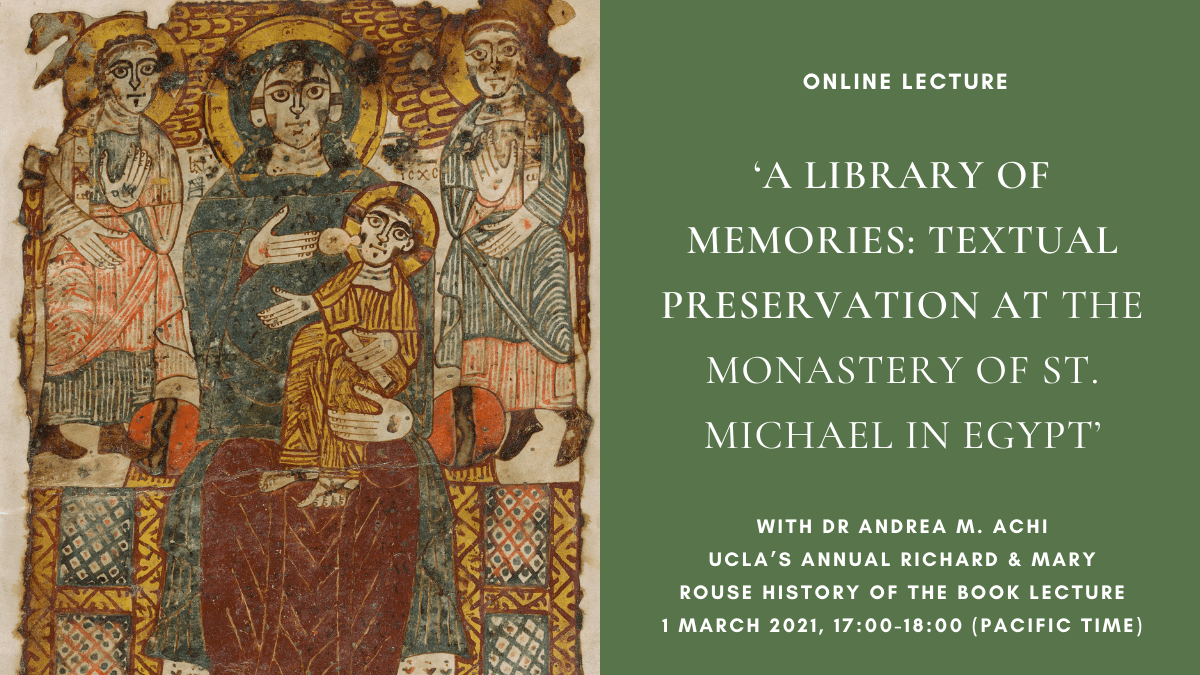
This year’s speaker is Dr Andrea M. Achi, Assistant Curator in the Department of Medieval Art and The Cloisters at The Metropolitan Museum of Art in New York.
In 1910, a group of Egyptian farmers claimed they discovered a hoard of Coptic manuscripts in a stone vat outside the village of al-Hamuli of the Fayyum Oasis in Egypt. Sold to J. Pierpont Morgan in 1911, the find amounted to forty-seven manuscripts with a total of 2,481 folios. Most of the manuscripts are associated with a single monastery called the Monastery of St. Michael. Every manuscript from the hoard has ornamental flourishes, marginalia, borders, and frames; twenty-seven contain frontispieces with both figural and ornamental decoration. Almost all of the texts are copies of late antique works. Yet, as their colophons indicate, the manuscripts were, to the extent that they have preserved dates, produced between 822 and 914 CE. As a group, the manuscripts represent the contents of a monastic library.
This talk explores the function of the collection, as a library, within its medieval Egyptian monastic context. Emphasizing the materiality of the manuscripts, I suggest that the manuscripts represented more than textual objects to the Monastery of St. Michael. Ultimately, I argue that the production, use, and storage of The St. Michael Collection rested upon the importance of memory to its monastic community. These discoveries give insights into libraries produced in other Christian communities in Medieval Africa.
Co-sponsored by the UCLA Center for Near Eastern Studies.
Call for Applications: A Research Seminar Programme for Early Career Researchers into Medieval Eastern Mediterranean Cities as Places of Artistic Interchange, SOAS University of London, (March-May 2021), deadline 8 March 2021

Medieval Eastern Mediterranean Cities as Places of Artistic Interchange, SOAS University of London, March – May, 2021
The School of Arts at SOAS University of London is pleased to announce the launch of a new research seminar programme for young and early career researchers in the art and archaeology of the medieval eastern Mediterranean, supported by the Getty Foundation as part of its Connecting Art Histories initiative.
Medieval Eastern Mediterranean Cities as Places of Artistic Interchange is an online seminar programme for emerging academics which focuses on the role played by cities in the medieval eastern Mediterranean, from the 12th to the 14th centuries CE, in the production, consumption, transformation and understanding of works of art and architecture.
During this time cities in the region were places of exchange of raw materials, manufactured goods, artists and craftsmen, and ideas. With exchange came transformation, either intentional through novel creations, or through creative repurposings and misunderstandings. The mixed populations of cities, in this context mainly ports, contributed to transformation as well, but also to the creation of international languages, whether actual, such as the pidgin of lingua franca which arose at this time, or visual, like the technological transformation of artefacts from the pigments used in manuscript illustration to enamelled glass and glazed ceramics. This led to stylistic developments such as international koinai in architecture (commercial, palatial, military), heraldry (to use the western medieval term: the arts of war and sport) and procession.
This seminar pairs cities, scholars and the site-specific questions that arise from them to explore these and other aspects of artistic and cultural interchange in the medieval eastern Mediterranean region, with a particular focus on new research in lesser-known cities to highlight recent archaeological and other scholarly discoveries.
The project is open to early career academic researchers (who have received their doctorates in the last three years) and tutors, research students (PhD students) at an advanced stage of their studies and those working in historical research institutes (such as archaeology centres, museums, government and non-governmental agencies dealing with history, art or archaeology) who are from the countries of the eastern Mediterranean region and the Middle East.
The target audience for this seminar programme is young professionals with advanced degrees (or equivalent work experience) in art history and/or archaeology of the period from the 12th to the 14th centuries who are from the countries of the eastern Mediterranean or Middle East.
Participants selected to take part in the programme will receive £2000 (British pounds) each to be used for research purposes: this includes the purchasing of books or other scholarly resources, upgrading of internet access, purchase of headphones, and the like.
The seminar programme will take place online in English and a high level of English language proficiency is required from participants.
Scholars currently residing and working in the Eastern Mediterranean region are especially encouraged to apply.
Online Lecture: ‘Pictorial invention in the early Trecento: the case of the Vele in Assisi’, with John Renner, Murray Research Seminar at Birkbeck, 16 March 2021, 16:55 – 19:30 (GMT)

The crossing vaults of the Lower Church of the Basilica of San Francesco at Assisi, known as the Vele, were frescoed by Giotto and his workshop c.1 310-15 with scenes of St Francis in Glory and three densely-populated tableaux allegorizing the principal vows of the Franciscan Rule: Poverty, Chastity and Obedience. The paper re-examines some of the complex and enigmatic imagery in search of the sources, meanings and functions of the frescoes in their key position above the high altar and the tomb of St Francis. It argues that the Vele can offer an insight into the process of artistic invention in the early Trecento, as a case study in the creative collaboration of client and painter.
John Renner took his MA in Art History at Birkbeck and his PhD at the Courtauld Institute of Art, where he is an Associate Lecturer. His research and publications focus on the art and patronage of the Franciscan Order in Italy in the thirteenth and fourteenth centuries.
Register via the official event page here: https://www.eventbrite.co.uk/e/pictorial-invention-in-the-early-trecento-the-case-of-the-vele-in-assisi-tickets-132821902887
Essay Prize: International Center of Medieval Art, deadline 7 March 2021

The International Center of Medieval Art (ICMA) wishes to announce its annual Graduate Student Essay Award for the best essay by a student member of the ICMA. The theme or subject of the essay may be any aspect of medieval art, and can be drawn from current research. Eligible essays must be produced while a student is in coursework. The work must be original and should not have been published elsewhere. We are pleased to offer First Prize ($400), Second Prize ($300), and Third Prize ($200).
We are grateful to an anonymous donor for underwriting the Student Essay Award competition. This member particularly encourages submissions that consider themes of intercultural contact — for instance, between Latin Christendom and the Byzantine realm; among Jews, Muslims, and Christians; or the dynamics of encounters connecting Europe, Africa, and Asia. These are not requirements, however, and the awards will be granted based on quality of the papers, regardless of topic.
The deadline for submission is 7 March 2021. The winners will be announced at the Spring Board Meeting in May.
Applicants must submit:
1. An article-length paper (maximum 30 pages, double-spaced, not including footnotes) following the editorial guidelines of our journal Gesta.
2. Each submission must also include a 250-word abstract written in English regardless of the language of the rest of the paper.
3. A Curriculum vitae.
All applicants must be ICMA members.
All submissions are to be uploaded here for 2021.
Email questions to Ryan Frisinger at awards@medievalart.org. The winning essay will be chosen by members of the ICMA Grants and Awards Committee, which is chaired by our Vice-President.
The mission of the International Center of Medieval Art is to promote and support the study, understanding, and preservation of visual and material cultures produced primarily between ca. 300 CE and ca. 1500 CE in every corner of the medieval world. To this end the ICMA facilitates scholarship and education and sponsors public lectures, conferences, publications, and exhibitions.
Online Conference: Regional Furniture Society: ‘Research in Progress: New Thinking about Medieval Furniture’, 13 March 2021, 10:00am – 16:45pm (GMT)

The next Regional Furniture Society meeting in the series of Research in Progress meetings will take place on 13 March 2021 as a Zoom meeting. As with the previous two themed meetings, (Sixteenth-century Furniture and The Regional Chair), speakers will present current research from a variety of perspectives.
Programme
10.00 Introduction (Liz Hancock, RFS Newsletter Editor)
Morning session (Chair: Chris Pickvance)
10.15am – Agnès Bos (University of St Andrews) ‘A Reappraisal of the ‘Medieval’ Arconati-Visconti Dressoir at the Louvre’) Agnès Bos is a Lecturer in Art History at the University of St Andrews. She was a curator at the Louvre from 2006 to 2016 specialising in decorative arts from the late middle ages to the 17th century, with a focus on furniture, tapestries and textiles. In 2019 she published the catalogue raisonné of the Medieval and Renaissance furniture of the Louvre. For her articles see Agnès Bos | University of St Andrews – Academia.edu
11.00am – Cécile Lagane (Centre Michel de Boüard /CRAHAM, Caen), ‘Evolution and Transformation of Furniture in its Architectural Environment: the Armoires of Bayeux (Normandy) and Aubazine (Limousin)’. Cécile’s doctoral thesis on Medieval furniture and furnishings from 500-1300 will be published shortly.
11.45am – Discussion
12.00 pm – Nick Humphrey (Furniture, Textiles and Fashion Dept., Victoria and Albert Museum, London), ‘A Fifteenth-century Desk-cupboard at the Victoria and Albert Museum’. Nick is the curator responsible for pre-1700 furniture, woodwork and leatherwork and was involved in creating the British Galleries (2001), the Medieval and Renaissance galleries (2009), the Dr Susan Weber (Furniture) Gallery (2012), and the Europe galleries 1600-1815 (2015). His most recent publication revisits the museum’s most famous piece of furniture, the Great Bed of Ware; current research includes cypress wood chests and Latin-American lacquer.
12.45 pm – Jens Kremb (Independent scholar, Bonn), ‘The Chest of Drawers: a Late Medieval Piece of Furniture?’ His doctoral thesis about painted tabletops in the late Middle Ages, was published as Bemalte Tischplatten des Spätmittelalters (Böhlau Verlag, 2015). He has created a research initiative on medieval furniture (www.inimm.de) and his articles are on www.jkremb.academia.edu
1.30 pm – Discussion
1.45 pm – Break
Afternoon session (Chair: Nick Humphrey)
2.15pm – Chris Pickvance (Chairman, RFS), ‘A Closer Look at a Group of English Clamped Chests from 1250-1350: Timber, Construction and Decoration’. Chris has been researching medieval chests for over ten years using dendrochronology. His articles have appeared in Regional Furniture, The Antiquaries Journal and archaeological journals; see www.researchgate.net
3.00pm – Noah Smith (Scouloudi Fellow, Institute for Historical Research), ‘The ‘Courtrai chest’ at New College, Oxford: Iconography and Materiality’. This controversial chest, a focus of Noah’s research on Flemish medieval art, has been viewed both as a fake and a Belgian national treasure. This paper will explore the material and art historical aspects of the chest, addressing its potential provenance and suggesting a new iconographic reading of its frontispiece. Noah is in the final year of his PhD at the University of Kent, and has work forthcoming in several publications.
3.45pm – Rachel Sycamore (MRes student in Medieval Archaeology, Worcester University), ‘Dug-out Church Chests in Herefordshire and Worcestershire’. Rachel is in the third and final year of her Master’s degree. Her research focuses on dug-out church chests and has used dendrochronology to date four in the two counties so far. Her paper will discuss the construction methods, ironwork and physical characteristics of examples, comparing and contrasting those which have been dated.
4.30pm – Discussion
4.45pm – Close
The event is free and open to non-members, but registration is necessary. Please email Jeremy Bate, RFS Events Organizer events.rfs@gmail.com. The last date for registration is Thursday 11 March. Zoom Meeting Invitations will be sent on 12 March. The waiting room will be open from 9.30 on 13 March. The day will be recorded.
Online Conference: Reclaiming Losses: Recovery, Reconquest, and Restoration in the Middle Ages, Princeton University, 6 March 2021
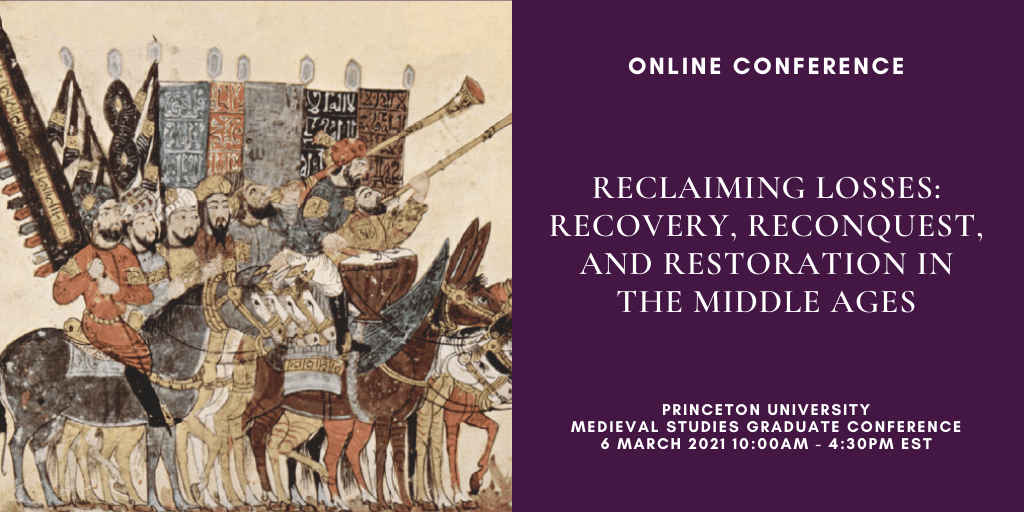
Princeton University cordially invites you to their Medieval Studies Graduate Conference, 2021: Reclaiming Losses: Recovery, Reconquest, and Restoration in the Middle Ages. The conference will be held on Zoom on Saturday, March 6, 2021 from 10:00am – 4:30pm EST. Registration is open to the public.
The conference will begin with a keynote address given by Professor Hussein Fancy, Associate Professor of History at the University of Michigan, entitled: “The Law is an Imposter: Restoring Imperial Authority around the Medieval Mediterranean.”
The keynote address will be followed by six graduate student papers reflecting a range of historical contexts and disciplinary entry points. Diverse in their subjects, geographies, chronologies, and approaches, these papers share a common objective—to explore the circumstances under which medieval people made claims to past legacies, how they asserted those claims, and what it meant to express them as calls for restitution.
To view the conference schedule, paper abstracts, and to register, please visit the conference website here. Graduate student speakers will include:
Javier Albarraìn (RomanIslam: Center for Comparative Empire and Transcultural Studies, Universität Hamburg): “Shaping an Islamic ‘Reconquest’: The Loss of Al-Andalus, 11th Century and Beyond”
Maia Ruth Béar (Department of Medieval Studies, Yale University): “Making Things, Making Up for Things, Making Things Up: Female Creativity in a Middle English Romance”
Camila Marcone (Center for Medieval Studies, Fordham University): “From Battleground to Hunting Ground: Recreational Spaces and ‘Reconquista’ in Alfonso XI’s Libro de la monteriìa”
Michael J. Sanders (Fordham University): “1492, the End of the ‘Reconquest?’: Ferdinand II, Martín García, and the Iter per Hispaniam to Jerusalem”
Bailey Sullivan (University of Michigan): “‘The statue I came to see is not here anymore’: The Restoration of Notre-Dame du Pilier at Chartres Cathedral”
Kevin Vogelaar (Affiliated Scholar, Tufts University): “The Medieval Armenian Foundation Rite and the Construction of Loss”
This year’s conference is organized by Rachel Gerber and Eric Medawar. The Program in Medieval Studies at Princeton University encourages interdisciplinary study of the European Middle Ages: its art, literature (Latin and vernacular), music, religion, science, philosophy, politics and economic and social structures.
Online Conference: ‘Visions of the End: Medieval & Renaissance Apocalyptic Cultures’, Marco Institute’s 17th annual symposium, 5-7 March 2021
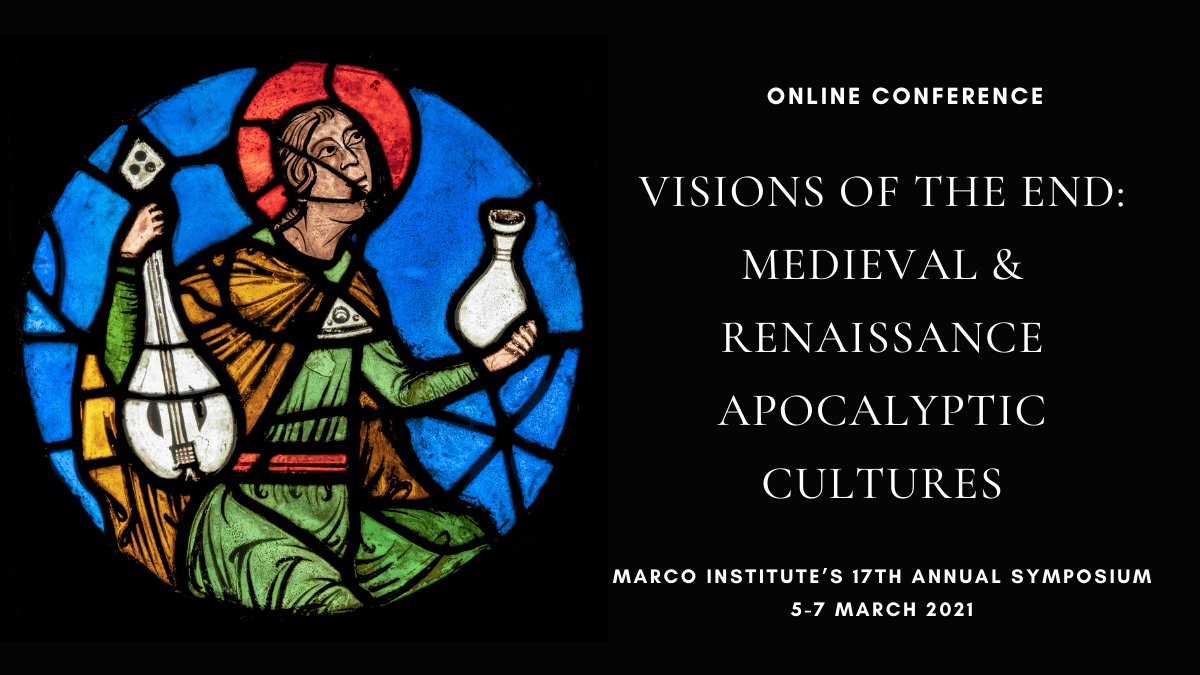
The Marco Institute’s 17th annual (virtual) symposium will explore apocalyptic themes. During the course of three days, eleven leading scholars will discuss medieval and Renaissance responses to the Book of Revelation written by John of Patmos and the end-times he predicted. During the virtual sessions, scholars working in the disciplines of art history, history, literary studies, and religious studies will present their current research on the celestial visions and the millennial fears of pre-modern times.
The “Visions of the End” Symposium is hosted by the Marco Institute for Medieval and Renaissance Studies at the University of Tennessee, Knoxville. Additional support comes from the Samuel H. Kress Foundation and the UT Office of Research SARIF Scholarly Projects Fund.
Registration Information:
The Symposium is free and open to the public. The 2021 Symposium will be hosted online and will require advance registration. To register click here.
Please email our Program Coordinator, Dr. Katie Hodges-Kluck, at marco@utk.edu, with questions.
Conference Programme
Day 1: Friday, 5 March 2021
12:30-12:35 EST | 17:30-17:35 GMT – Welcome
Jay Rubenstein, University of Southern California and Gregor Kalas, University of Tennessee
12:35-2:15 EST | 17:35-19:15 GMT – Prophecy & Pilgrimage
Moderator: Tina Shepardson, University of Tennessee
Stephen Shoemaker (University of Oregon) Constantine and the Birth of Medieval Apocalypticism: Imperial Eschatology in Eusebius, Lactantius, Ephrem, Aphrahat, and the Tiburtine Sybil
Kathryn Beebe (University of North Texas) Gender of the Apocalypse in the Late-Medieval Pilgrimage Works of Felix Fabri
2:15-2:30 EST | 19:15-19:30 GMT – Break
2:30-4:00 EST | 19:30-21:00 GMT – Images of the Beginning & The End
Moderator: Katie Hodges-Kluck, University of Tennessee
Jennifer Feltman (University of Alabama, Tuscaloosa) Ecclesiology and Typology in the Apocalypse Sculptures of Reims Cathedral
Roger Wieck (Morgan Library and Museum) Visions of the Beginning: The Parliament of Heaven
Day 2: Saturday, 6 March 2021
11:00-12:30 EST | 16:00-17:30 GMT – Navigating the Apocalypse
Moderator: Jay Rubenstein, University of Southern California
Benjamin Saltzman (University of Chicago) Enigmas Near the End
Jennifer Jahner (California Institute of Technology) Apocalypse Unfurled: End-Times Management from Codex to Roll
12:30-12:45 | 17:30-17:45 – Reenvisioning The End
Moderator: Gregor Kalas, University of Tennessee
Jason Stubblefield (University of Tennessee) Visions of the End: From Museum to Virtual Exhibition
12:45-1:45 EST | 17:45-18:45 GMT – Lunch Dinner
1:45-3:30 EST | 18:45-20:30 GMT – Visions of the End in Augsburg
Moderator: Gina Di Salvo, University of Tennessee
Laura Ackerman Smoller (University of Rochester) Reading the End in Late Medieval Augsburg: Wolfgang Aytinger’s Commentary on the Revelations of Pseudo-Methodius
Robert Bast (University of Tennessee) Prophecy as Policy: Maximilian I as Last World Emperor in Theory and Practice
3:30-4:00 EST | 20:30-21:00 GMT – Break
4:00-5:15 EST | 21:00-22:15 GMT – Keynote Lecture
Welcome: Theresa Lee, Dean of the College of Arts & Sciences, University of Tennessee
Introduction: Tom Heffernan, University of Tennessee
Richard Emmerson (Florida State University) The Apocalypse of the Duc de Berry and the Apocalyptic Great Schism
Day 3: Sunday, 7 March 2021
11:00-12:30 EST | 16:00-17:30 GMT – Cosmos & Communication
Moderator: Anne-Hélène Miller, University of Tennessee
Brett Whalen (University of North Carolina) The End Times and the Medieval Cosmos
Mayte Green-Mercado (Rutgers University, Newark) Prophecy as Diplomacy in the Fifteenth-Century Mediterranean
12:30-12:45 EST | 17:30-17:45 GMT – Break
12:45-1:30 EST | 17:45-18:30 GMT Conclusions & Reflections
Jay Rubenstein – University of Southern California
About the annual Marco Symposium
The Marco Symposium is held every year in March or April. The Symposium brings leading experts in their field to the University of Tennessee for two days of talks on that year’s theme. A round-table discussion by all the participants concludes the weekend.
The Symposium is Marco’s signature event of the year, and typically attracts members of the larger Knoxville community in addition to students and faculty at UT and scholars from across the region. The theme of the Symposium changes each year. Faculty who are interested in submitting a proposal should contact marco@utk.edu
Grant: ICMA Student Travel Grants, deadline 7 March 2021

The International Center of Medieval Art (ICMA) offers grants for graduate students in the early stages of their dissertation research, enabling beginning scholars to carry out foundational investigations at archives and sites. Winners will be granted $3,000, and if needed, officers of the ICMA will contact institutions and individuals who can help the awardees gain access to relevant material. Three grants are awarded per year, and they are designed to cover one month of travel.
The grants are primarily for students who have finished preliminary exams, and are in the process of refining dissertation topics. Students who have already submitted a proposal, but are still very early on in the process of their research, may also apply.
All applicants must be ICMA members.
Applicants must submit:
1. Outline of the thesis proposal in 800 words or less.
2. Detailed outline of exactly which sites and/or archives are to be visited, which works will be consulted, and how this research relates to the proposed thesis topic. If you hope to see extremely rare materials or sites with restricted access, please be as clear as possible about contacts with custodians already made.
3. Proposed budget (airfare, lodging, other travel, per diem). Please be precise and realistic. The total need not add up to $3,000 precisely. The goal is for reviewers to see how you will handle the expenses.
4. Letter from the thesis advisor, clarifying the student’s preparedness for the research, the significance of the topic, and the relevance of the trip to the thesis.
5. A curriculum vitae.
Upon return, the student will be required to submit a letter and financial report to the ICMA and a narrative to the student section of the Newsletter.
NOTE: Due to COVID-19 travel restrictions and closures, we can delay disbursements until international travel is safe.
Applications are due by 7 March 2021. The ICMA will announce the winners of the three grants at the Spring Board Meeting in May.
Applicants submit materials here.
Thesis advisor submit letter of recommendation here.
Email Ryan Frisinger at awards@medievalart.org with any questions.
The mission of the International Center of Medieval Art is to promote and support the study, understanding, and preservation of visual and material cultures produced primarily between ca. 300 CE and ca. 1500 CE in every corner of the medieval world. To this end the ICMA facilitates scholarship and education and sponsors public lectures, conferences, publications, and exhibitions.
 Medieval Art Research