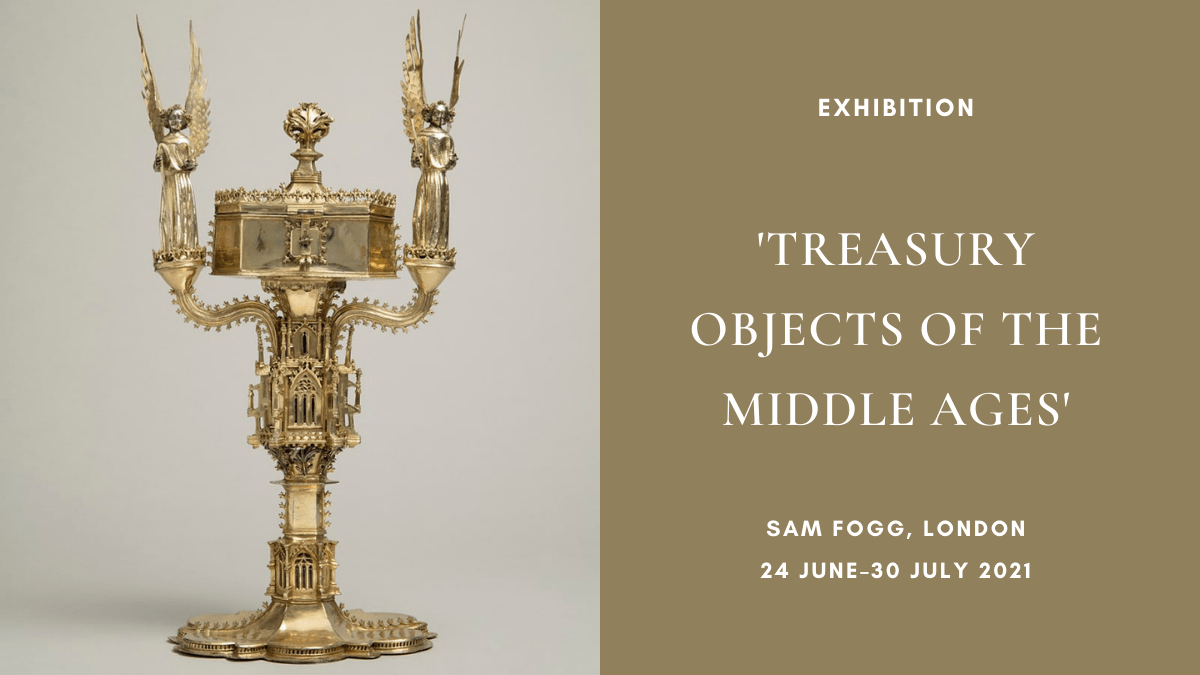
Exhibition: ‘Treasury Objects of the Middle Ages’, Sam Fogg, London, 24 June–30 July 2021

Treasury Objects of the Middle Ages (24th June – 30th July 2021) is the first selling exhibition of its type in more than a century. Devoted entirely to the subject of medieval goldsmiths’ work, it provides a unique survey of the varied types of precious, small-scale metalwork objects that were produced between the 12th and 16th centuries for use in cathedrals, churches, monasteries, and private chapels across Europe. Uniting the forty-five objects in this exhibition are the rich and glittering materials they were produced from – gold, silver, copper and its alloys (brass and bronze), many enriched with meticulous enamelling or studded with large cabochons of polished rock crystal.

Some of these objects would have enjoyed daily use as part of the celebration of Mass: gold and silver chalices for administering the Holy Communion, cast bronze censers for the burning of incense, gilded crosses for carrying in processions or venerating at the altar. But many are so sumptuous that they would have been carefully protected in treasuries for much of their lives and only brought out at particularly significant moments in the year, such as high feast days or even royal visits. Materials were lavished on the most spectacular and refined of them, like gilded reliquaries whose surfaces are enveloped in vivid coloured enamels and have tooled designs worked into the surrounding metal. Others are covered in delicate filigree, micro-architectural structures, or small-scale cast figures of the saints and angels.

Treasury objects were among the most potent bearers of meaning in the Middle Ages. Significance and symbolism were not only entwined with their craftsmanship and materiality, but more importantly also with their perceived sacredness. Many treasury objects protected holy relics, or the body and blood of Christ, but since most people never actually saw the relics or sacraments themselves, these objects came to embody and visualise the magical properties associated with what they contained, or with the miraculous moment of transubstantiation on the altar table. They were often modelled on descriptions of the heavenly Jerusalem, or keyed in to Biblical doctrine through representations of characters from the Old and New Testaments. Powerful, striking, sometimes even intended to shock, treasury objects existed to transport the medieval viewer from the material to the heavenly.

Treasury Objects of the Middle Ages celebrates the ingenuity of the Medieval metalworkers and the astonishing objects of devotion they crafted upwards of half a millennium ago.

Find out more here.

Exhibition opens from 24 June – 30 July 2021

Sam Fogg will also be open on the following weekends: 26 – 27 June & 3 – 4 July 2021

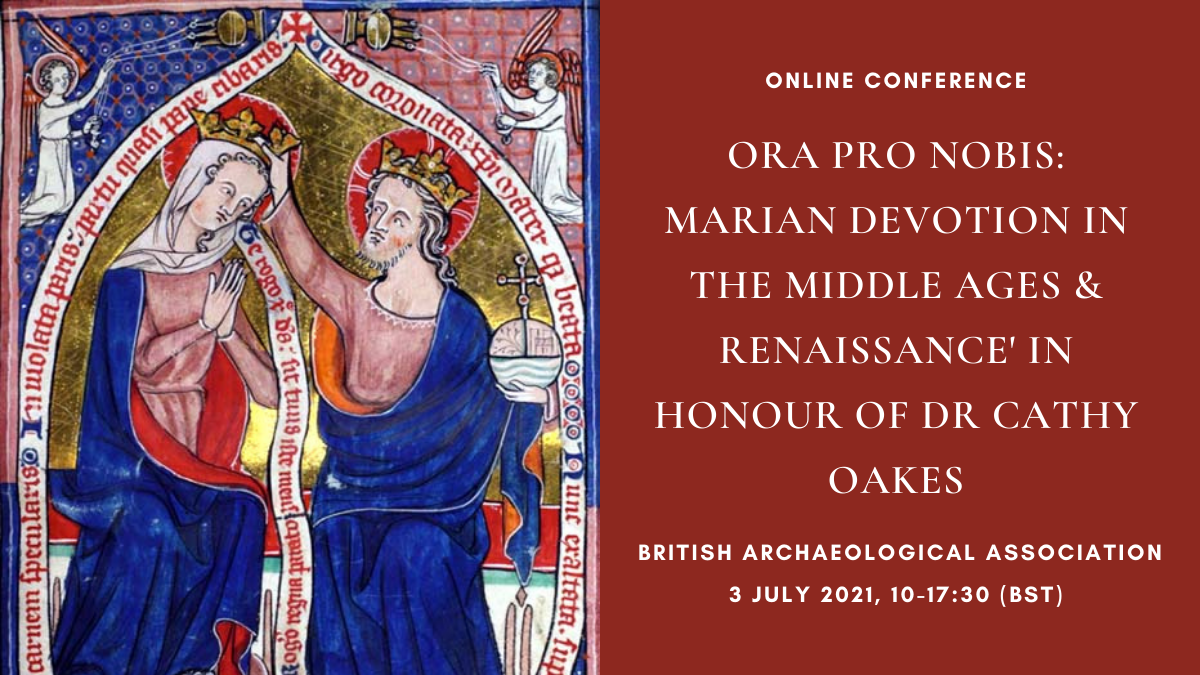
Online Conference: ‘Ora Pro Nobis: Marian Devotion in the Middle Ages and Renaissance’ in honour of Dr Cathy Oakes, The British Archaeological Association, 3 July 2021, 10-17:30 (BST)

An online day in honour of Dr Cathy Oakes

SATURDAY 3 JULY 2021

Cathy Oakes was Director of Studies in the History of Art at Oxford University’s Department of Continuing Education and a Fellow of Kellogg College, Oxford, co-founder of the Centre for Marian Studies, and a lecturer for the Learning Department of the V&A, The Arts Society (formerly NADFAS), Art Pursuits Abroad, ACE, and many other organisations, Dr Oakes inspired countless students by her knowledge of, and passion for, the visual culture of the Middle Ages. This study day is hosted by the British Archaeological Association, of which Cathy was a longstanding member. It will concentrate of various aspects of Marian devotion a subject close to Cathy’s heart and the focus of her book, Ora Pro Nobis: The Virgin as Intercessor in Medieval Art and Devotion (2008), from which this day takes its title.

To register please follow the link below:
https://us02web.zoom.us/webinar/register/WN_JFRhiN9oS7yV_6wE5s8zNg

DRAFT PROGRAMME

SESSION 1. Chair – Sally Dormer

10.00 Introduction

10.05-10.30 William Wykeham’s devotion to Mary – mostly in relation to the glass at New College – Anna Eavis

10.30-10.55 Cult and Image at Our Lady’s Well, Hempsted Gloucestershire) – Sarah Boss

10.55-11.05 Questions

BREAK

SESSION 2. Chair – John McNeill

11.30-11.55 Revisiting the Quinity – the Virgin Mary in Ælfwine’s Prayerbook (London, BL MS Titus D. xxvi and D. xxvii) – Teresa Lane

11.55-12.20 The Lady and the Lion in the Map Psalter (London, British Library, Add. MS 28681) – Sally Dormer

12.20-12.45 The mystery of the Mother of God and her companion in the Homilies of James Kokkinobaphos – Cecily Hennessy

12.45-13.00 Questions

LUNCH BREAK

SESSION 3. Chair – Sarah Boss

14.00-14.25 Metope North 32 on the Parthenon: False Virgins and Cultural Vandals – Steve Kershaw

14.25-14.50 The Reception of Sancta Maria Rotunda: Recent Interpretations and Open Questions – Richard Plant

14.50-15.15 Crowned in Glory: The Virgin Mary enthroned – Eileen Rubery

15.15-15.30 Questions

BREAK

SESSION 4. Chair – Richard Plant

16.00-16.25 The Virgin by the Chapter-House: The life and times of a carved relief at St-Aubin in Angers – John McNeill

16.25-16.50 Imagery and Meaning in Michelangelo’s Bruges Madonna – Paula Nuttall

16.50-17.15 The Virgin Mary in Fragments – Julian Luxford

17.15-17.30 Questions

In memoriam Cathy Oakes, 1956-2019

Online Lecture: ‘Becket: charismatic cathedral & sacred storytelling’ with Professors Paul Binski & Alixe Bovey, British Museum, 30 Jun 2021, 17.30–18.30 (BST)

Becket’s final days, murder, and posthumous career as a miracle-worker are among the best-documented episodes from the Middle Ages.

This conversation, between art historians Paul Binski and Alixe Bovey, will explore the way Becket’s universality as a martyr was embodied in the architecture of Canterbury Cathedral, evoking the heroic age of early Christian martyrdom. 

As the objects in the exhibition Thomas Becket: murder and the making of a saint reveal, Becket’s story was codified in word and image with extraordinary speed, in England and across Europe. What was the role of images and objects in promoting Becket’s cult, and how and why did Becket’s cult so rapidly come to define its age?

To attend this event

Book now(Opens in new window) to secure your place. We’re hosting the event on Zoom – a free video conferencing system that requires users to register in advance. If you do not already use Zoom, you can sign up using this registration link(Opens in new window).

If the event is fully booked, or you do not wish to use Zoom, you can also watch the event streamed live – as well as other events in the series – on the Museum’s live events YouTube channel(Opens in new window).

Register for your place here.

About the speakers

Paul Binski is Emeritus Professor of the History of Medieval Art at Cambridge University and a Fellow of Caius College. He writes widely on the visual arts in the Middle Ages, and his many books include Becket’s Crown: Art and Imagination in Gothic England, 11701300 (Yale University Press 2004).

Professor Alixe Bovey is a Canadian medieval art historian. She’s currently Dean and Deputy Director and the Head of Research at the Courtauld Institute of Art, London University. Bovey is also a member of the Fabric Advisory Committee of Canterbury Cathedral.

New Publication: ‘Images and Indulgences in Early Netherlandish Painting’ by Miyako Sugiyama

This book demonstrates the relationships between images and indulgences in fifteenth- and early sixteenth-century Netherlandish art. In the Roman Catholic Church, indulgences served as a way to reduce temporal punishment in purgatory for one’s sins. Indulgences could be obtained by reciting prayers and performing devotional practices. Penitents could earn this type of devotional indulgence with the aid of paintings and other artifacts that possessed theological, historical, and aesthetic values as well as performative and promissory ones. In this study, we explore not only the power of indulgenced images but also the power of their audiences, creating a way to communicate with the divine.

Miyako Sugiyama is an art historian specializing in early Netherlandish art. She received her Ph.D. in Art Science from Ghent University in 2017. She was the recipient of a Flemish government scholarship (2013–14), a Kress Foundation Travel Grant (2016), and a Japan Student Services scholarship (2015–17). She is currently a postdoctoral researcher at the Japan Society for the Promotion of Science, Tokyo. Her research focuses on the functions of images and the relationships between art and devotional practices in the Netherlands in the fifteenth and early sixteenth centuries.

Harvey Miller: Distinguished Contributions to the Study of the Arts in the Burgundian Netherlands (HMDC)

IV+193 p., 10 b/w ill. + 126 colour ill., 220 x 280 mm, 2021
ISBN: 978-1-912554-58-4
Languages: English
Retail price: EUR 50,00 excl. tax

Order and find out more here.

Online Conference: ‘Pluriversality at Play: Art and material culture in the thirteenth-century Mediterranean’, University of St Andrews, 17-18 June 2021, 2:15pm-6pm (BST)

The Mediterranean has always been a ‘contact zone’, a place of convergence and divergence, of peaceful co-existence, as well as of war and conflict. Although the medieval Mediterranean was an area of cultural commonalities, it was also a place of religious, political and military oppositions.

It was a fluid space of communication, negotiation and contestation for Muslim, Jewish and Christian worldviews, as well as a locus of ambiguities, syncretism and blurred boundaries, a zone that enabled borderline cultures to emerge and flourish.

This workshop, organised by Dr Anthi Andronikou, aims to relocate regional arts and cultures within a broader Mediterranean context from an interdisciplinary point of view. Scholars in the fields of Byzantine, Islamic, Jewish and Western Medieval studies will probe interconnections across different ethnic, political, artistic and confessional spheres through historical and art historical perspectives. The workshop is part of the global encounters and exchanging theme of the School of Art History.

Keynote Lectures by Anne Derbes, Robert Hillenbrand, Katrin Kogman-Appel, Amy Neff.

Advance registration required. Register here.

If you would like to join this online conference, please complete this form so that we may add you to the Microsoft Team.

More information about this event

Online Lecture: ‘Representing Dante’s Steps in Illuminated Manuscripts of the Divine Comedy’ with Dr Lucy Donkin, Murray Seminar at Birkbeck, 30 June 2021, 16:45–18:30 (BST)

In the Divine Comedy, at the entrance to Purgatory, Dante encounters three steps made from stone of different colours and textures. These have attracted attention since the earliest commentaries on the poem, and are often seen as alluding to interior states, especially associated with penance. This paper understands the steps and their interpretation to reflect the wider expressive potential of corporeal contact with the surface of the ground. Exploring how they were depicted in illuminated manuscripts, it draws comparisons with ecclesiastical pavement decoration and the treatment of the ground in rites of passage, as well as with the ground trodden by Christ, saints, and personifications of the virtues, as depicted in Italian art of the period. It also relates the steps to other passages in the Divine Comedy that reference church interiors and to the terrain walked by Dante elsewhere in the poem.

Lucy Donkin is a Senior Lecturer in History and History of Art at the University of Bristol. Her research explores medieval perceptions of place, especially the definition, decoration and depiction of holy ground, and the symbolic movement of soil. Her book Standing on Holy Ground in the Middle Ages will be published by Cornell University Press later this year.

Booking link for Lucy Donkin’s seminar on 30th June 2021.

Post-Doctoral Position: ERC Project ‘SenSArt: The Sensuous Appeal of the Holy Sensory Agency of Sacred Art and Somatised Spiritual Experiences in Medieval Europe (12th-15th century)’, Deadline 8 July 2021, University of Padua

The ERC Starting Grant project SenSArt “The Sensuous Appeal of the Holy Sensory Agency of Sacred Art and Somatised Spiritual Experiences in Medieval Europe (12th-15th century)”, led by Prof. Zuleika Murat (Principal Investigator) is accepting applications by highly motivated candidates to cover four post-doctoral positions, starting on 1st September 2021. The project is based at the University of Padua and is funded for five years by the ERC.

The deadline to apply is 8th July 2021. Details on the project, candidates’ profiles and skills, and application procedure are given below.

The Project
Art moves the eyes. However, is sight the only sense we use to appreciate it? This is a crucial question for Western culture, dominated today by the hegemony of vision and the suppression of the other senses. By challenging the current ocularcentric paradigm and assimilating notions on the cultural values of sensation, SenSArt provides an examination of medieval sacred art from the unconventional lens of its sensory agency.

Between the 12th and the 15th century, Europe underwent an extraordinary artistic evolution and an impressive cultural revitalization, which sparked a reassessment of the role of sensory perception in systems of knowledge and spiritual enlightenment. SenSArt explores and compares different social environments in six selected regions, pursuing three groundbreaking objectives: A) it will analyse quantitatively and qualitatively the perceptual schemes that oriented the reception of sacred art, scrutinizing how art solicited its beholders through multiple sensory inputs; B) it will investigate the notion of ‘sensory agency’ of art, establishing sacred art as a primary actor capable of exerting, through sensorial stimulation or deprivation, a social agency on its audience; C) it will provide an overall phenomenology of experiences on a European scale, by comparing the diverse patterns that different social groups lived on a local, regional and supranational scale.
SenSArt will achieve its goals by developing a new combined approach at the crossroads of Art History, Philosophy and Text Studies; it will establish a multidisciplinary team of scholars to delve into a comparative set of materials, including normative texts on the senses and works of art.

Tasks
We are looking for four highly motivated and creative post-doctoral fellows, three with an art-historical profile and one with a background in History of Medieval Philosophy. They will work in team with the Principal Investigator, two doctoral fellows, and associate researchers.

In line with the objectives and methodologies of the ERC project SenSArt, the three post-doctoral fellows with an art-historical profile will focus on France, Germany, and Spain respectively. They will examine the types of artworks adopted in the Socio-Sensory Environments of the region surveyed, considering both the survived works of art and those cited in the archival documents and now lost, together with immaterial practices. The study of objects will contemplate different aspects and will focus on two features in particular: 1) the mechanisms through which the artworks stimulated the senses of the beholder; 2) the procedures by which the beholder activated the multisensory potential of the objects, through dynamic devotional practices. In addition to works of art, and in relation to the specific materials of investigation, the post-doctoral fellows will also examine texts about the senses in practice, including records of people’s daily lives and archival materials.

The post-doctoral fellow with a background in History of Medieval Philosophy will work on theoretical and normative texts on the senses and sensory perception, i.e. texts that contain norms meant for shaping the sensoria and establish the interpretive schemes that were intended to orientate the responses of the devotees, including in particular: 1) philosophical and theological texts connected to the Aristotelian tradition, including works produced by a number of scholastic authors; 2) treatises meant at educating the senses. The candidate will focus in particular on two features related to sensory perception: how perception and the senses were to be used, and the kinds of spiritual reactions that the sensory experience was expected to induce in the devotees.

In addition to the above-mentioned research activities, the four post-doctoral fellows will take part in seminars and conferences, and in all the scheduled internal workshops and team meetings. They will present papers and produce on a regular base journal articles and book chapters as envisaged by the project outline. Moreover, they will provide raw data, entries and reports for the envisaged digital archive and website.

Qualifications and Required Skills
– Post-doctoral fellows with an art-historical profile: PhD in Art History, with a focus on the Middle Ages. Good knowledge of French, German, and Spanish respectively, and of Latin, to be able to examine primary and secondary sources. They should also be proficient in English. Candidates are expected to be familiar with the major historical, artistic, spiritual, and socio-cultural phenomena of the region under examination in the selected period. Furthermore, they should have previous research experience in areas related (in terms of objectives, approaches, and methodologies) to those considered by the project, with particular regard to the concepts of art agency, theories of reception, and the multisensory experience of art.
– Post-doctoral fellow with a background in History of Medieval Philosophy: PhD in History of Medieval Philosophy. The ideal candidate needs to have a good command of Latin and should also be proficient in English. She/he should have a background in research topics and methodologies which are in line with the objectives and approaches of the ERC project SenSArt, with specific respect to concepts related to perception and to the senses in medieval philosophy and culture in general.

In addition, applicants should have a taste for interdisciplinary studies, excellent analytical skills, and willingness to work in a team.

Working Conditions and Modalities
– Location: University of Padua, Department of Cultural Heritage. Some travels abroad are required to conduct research.
– Employer: University of Padua
– Type of contract: fixed-term contract
– Duration of contract: 3 years, with a possible renewal of 2 years
– Working time: 100%
– Starting date of the contract: 1st September 2021
– Remuneration: 26.868,59 € per year

How to Apply:
Applications may only be submitted by completing the online procedure at https://pica.cineca.it/unipd.
Instructions on how to complete the application are given at https://www.beniculturali.unipd.it/www/lavorare/bacheca-di-dipartimento/
The application should include:
– A Curriculum Vitae
– Three samples of written works in pdf (PhD thesis and/or published materials)
– A Letter of Motivation, detailing the candidate’s professional skills and reasons for applying
– Names and contact details of two referees

In addition, an interview will be held online (via Zoom) in July (20th – 23rd July 2021).

For any queries please write to: dipartimento.beniculturali@unipd.it and zuleika.murat@unipd.it

More information can be found here:https://www.beniculturali.unipd.it/www/lavorare/bacheca-di-dipartimento/

Online Lecture: Ethiopic Manuscripts & Global Books with Kristen Herdman, Beinecke Library, June 21 2021, 16:00PM (Eastern Time)

Kristen Herdman is a PhD Candidate in the Medieval Studies program. Her research interests are rooted in art historical approaches to manuscript studies, with special attention to fifteenth-century medieval devotional books and the complex relationship between text and image.

Herdman will discuss Ethiopic Manuscripts in the Beinecke Library collections and the overall Global Books initiative: https://beinecke.library.yale.edu/collections/highlights/global-books-beinecke-library

Although best known for Western books and manuscripts, the Beinecke has a rich collection of non-Western materials that has been part of its teaching and research collection since the nineteenth century. As part of its Global Books initiative, new pages will be posted approximately every other week that explain the history of these books with extensive images and links to other materials, both in Yale’s collections and beyond. These pages were authored by Herdman under the direction of Ray Clemens, curator of Early Books and Manuscripts.

Register for the lecture here.

Call for Submissions: ‘Relationship between narration, art and art history’, Perspective: actualité en histoire de l’art, deadline 1 July 2021

The journal Perspective: actualité en histoire de l’art will explore, in its 2022 – 2 issue, the relationships between narration, art and art history.

From the stories that inspire images and art objects, to those (re)constituted by its viewers, to the “story-telling” of art historians, this issue is intended to make use of the act of narrating as a productively destabilizing heuristic tool. Even in the absence of figured diegetic content, the image and the art object narrate, if only as witnesses of an era or practices, as vehicles of narrativity.

The history of art, rooted in the works of Giorgio Vasari and Karel van Mander, is based on a narrative exercise, from the ekphrasis of Antiquity to the epic narratives of modernist autonomy, but also anecdotes and biographical legends. The way art historians have forged their discipline by freeing themselves from a willfully mythical literary practice and gradually adopting, fashioning, and discussing “scientific” methods bears witness to a complex relationship with the narrative and narration – otherwise stated, a kind of fiction.

While no one will deny that the image and the narrative act go hand in hand, the precedence of one over the other remains an eternal subject of debate, as are the relaying and embedding processes that engender them, from the time of the paragone to modernist discourse predicting the end of narrative artworks. These different oppositions and complex transmission phenomena can be approached from a variety of vantage points, provided that the analysis is situated within a historiographical perspective addressing the narrative processes at work in the creation and reception of art from the origins to the present day, from symbolic Paleolithic expressions to contemporary cinema.

Proposals should correspond to the journal’s editorial policy, which is aimed at going beyond simple case studies in order to bring out specific historiographical issues and, in this instance, analyze the ways art history, cultural heritage history and archeology make use of the relationships between narration, art and art history in order to rethink their methods and scholarly frameworks.

Please submit your proposal ( 2,000-3,000-character / 350 to 500-word summary, with a provisional title, a short bibliography on the topic, and a 2-3 line biography) to the editorial address (revue-perspective@inha.frby July 1st, 2021.

Authors of selected articles will be informed of the committee’s decision by the end of July 2021. Full texts of accepted contributions will need to be sent by December 15, 2021. These will be definitively accepted after the journal’s anonymous peer-review process.

For additional information, visit the journal’s page on the INHA website and browse Perspective online.


La revue Perspective : actualité en histoire de l’art consacrera son n° 2022 – 2 à la question des relations entre narration, art et histoire de l’art.

Qu’il s’agisse des récits sur lesquels se fondent les images et les objets d’art, de ceux que (se) constituent ses regardeurs, ou des « mises en récits » opérées par les historiens et les historiennes de l’art, ce numéro entend s’emparer de l’acte de raconter comme d’un outil heuristique aussi fécond que déstabilisant. L’image et l’objet d’art racontent, même en l’absence de contenu diégétique figuré, ne serait-ce qu’en tant que témoins d’une époque ou de pratiques – ne serait-ce qu’en tant que vecteurs de narrativité.

Enracinée dans les travaux de Giorgio Vasari et de Karel van Mander, l’histoire de l’art est, depuis l’Antiquité, fondée sur un exercice narratif, de l’ekphrasis aux grands récits de l’autonomie moderniste, en passant par l’anecdote ou la légende biographique. La manière dont les historiens et les historiennes de l’art ont façonné leur discipline, s’extrayant d’une pratique littéraire, volontiers mythique, pour embrasser, forger et discuter peu à peu des méthodes « scientifiques », témoigne d’un rapport complexe au récit, à la narration – à la fiction en quelque sorte.

Que l’image et la mise en récit marchent main dans la main, nul ne le contestera : l’antériorité de l’une sur l’autre, en revanche, est à jamais objet de débats, de même que les phénomènes de relais ou d’enchâssement dont elles semblent procéder, du paragone au discours moderniste ne cessant de raconter la fin des œuvres qui racontent. Ces séries d’oppositions et ces phénomènes complexes de transmission pourront être abordés sous différents angles, pourvu que la réflexion soit toujours ancrée dans une perspective historiographique – des processus de narration à l’œuvre dans la création et la réception en art, des origines à nos jours, des expressions symboliques paléolithiques au cinéma.

Les propositions devront s’inscrire dans la ligne éditoriale de la revue : sans jamais se limiter à de simples études de cas, les contributions veilleront à développer une réflexion sur la manière dont l’histoire de l’art, l’histoire du patrimoine et l’archéologie se saisissent des relations entre narration, art et histoire de l’art pour penser leurs méthodes et leurs cadres scientifiques.

Prière de faire parvenir vos propositions (un résumé de 2 000 à 3 000 signes, avec un titre provisoire, une bibliographie succincte sur le sujet, et une biographie de 2 ou 3 lignes) à l’adresse de la rédaction (revue-perspective@inha.fravant le 1er juillet 2021. Les auteurs des articles retenus seront informés de la décision du comité à la fin du mois de juillet 2021, tandis que les articles seront à remettre le 15 décembre 2021. Les articles soumis seront définitivement acceptés à l’issue d’un processus anonyme d’évaluation par les pairs.

 > retrouver le texte complet de l’appel à contributions en pièce jointe

> accéder à l’appel à contributions

Pour en savoir plus, consultez la page de la revue sur le site de l’INHA et parcourez Perspective en ligne ici

CFP: Interdisciplinarity in the Study of the Image (Universitat de València, 27-29 October 2021), deadline 15 June 2021

III International Symposium on Visual Culture. Interdisciplinarity in the Study of the Image

Iconology seeks an approach to cultural history by studying the image. To accomplish this, one must first master and draw upon a wide variety of disciplines, as Panofsky had, among which history, literature or theology usually stand out. However, as we propose in this symposium, interdisciplinarity is not necessarily limited to the humanities.

Despite the time that has elapsed since Panofsky published his discipline-defining works, a real integration has not always been achieved between Art History and the rest of disciplines. In this period, too, Art History — as the study of the image — has expanded to include Visual Culture Studies. Sometimes understood as a methodological imposition, interdisciplinary interaction has often been superficially resolved.

Faced with this problem and the difficulty of implementing it, we propose a theoretical topic to reflect on the scope of interdisciplinarity, which in no case should be understood as a product of disciplinary pluralism. It opposes, therefore, other relational categories, such as multi-disciplinarity, in which two or more disciplines cooperate, but without achieving methodological integration.

On the contrary, the aim of this symposium is to promote genuine interrelationships between disciplines for the study of the image. Concretely, we propose an approach that addresses both the meaning of the image and its cultural function in different contexts, from innovative perspectives. Such innovative perspectives include reflecting on gender, which is proposed as transdisciplinary and, consequently, can be taken into account in each of the topics.

Six topics have been suggested, one of a theoretical nature and five thematic axes, in which the image has to support the construction of the different discourses (historical, political, ideological, archaeological, etc.) in each of them. However, we proposed some flexibility between the topics, to allow the correct implementation of the method. According to the disciplines that have been integrated in the studies of the image, some papers, at the proposal of their authors/s, will have a place in several topics, that can even be reorganized according to the papers received.

EVENT DATES AND PLACES
The symposium will be held on 27-29 October 2021, at the Facultat de Geografia i Història de la Universitat de València.
Depending on the health situation, the symposium would be organised on-site and online.

TOPIC AREAS
The disciplines under each topic appear as examples. The symposium is open to researchers from disciplines not covered by these lists.

  • Image and word I. History, Sociology, Politics, Audiovisual communication
  • Image and word II. Philology, Palaeography, Epigraphy
  • Image and thought. Philosophy, Aesthetics and Theory of the Arts, Theology, Psychoanalysis
  • Image, music and entertainment. Music, Theatre, Dance, Opera, Performance, Cinema, Audiovisual communication, Informatics
  • Image and material culture. Archaeology, Ethnography, Anthropology Conservation and Restoration
  • Image and nature. Botany, Zoology, Geology, Medicine, Pharmacology, Astronomy, Physics, Chemistry, Mathematics

SUBMISSION OF PROPOSALS
Those interested in submitting a paper should fill in a form, with their personal data, a short curriculum vitae and the summary of their proposal (4.000-6.000 characters), at the following link: https://links.uv.es/apesgrup.
The deadline for submission of proposals is 15 June 2021. Acceptance of the proposals will be communicated in July.
Oral presentations shall not exceed 20 minutes.
Proposals received will be submitted to a peer review process for acceptance.

REGISTRATION
With the communication of the acceptance will be sent the data for the payment of the registration (60 €).
CEHA members have a 50% discount on the registration fee.