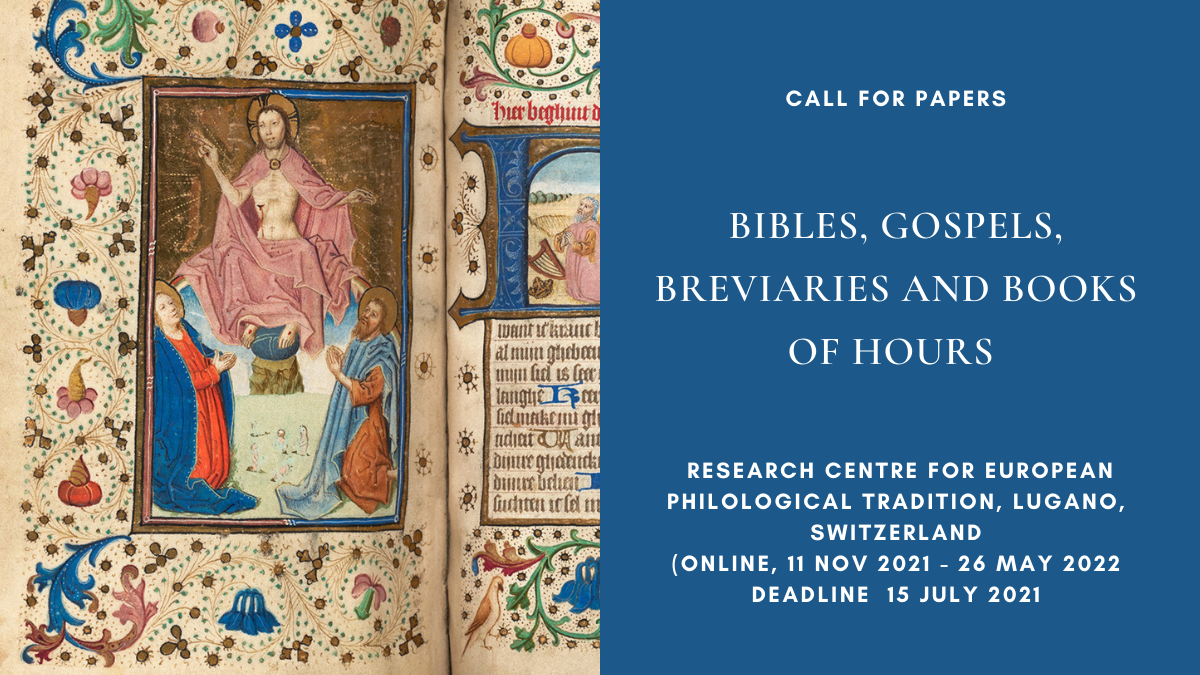
CFP: ‘Bibles, Gospels, Breviaries and Books of Hours’, Research Centre for European Philological Tradition (online, 11 Nov 2021 – 26 May 2022), deadline 15 July 2021

In the context of the public seminar entitled Bibles, Gospels, Breviaries and Books of Hours, organised by the Research Centre for European Philological Tradition (Zurich, Lugano, Florence, Rome), which will take place via Zoom every Thursday from the 11th of November 2021 to the 26th of May 2022 and aiming to gather as many experts on the subject as possible, we are launching a call for proposals. Interested parties are invited to send their proposals (max 100 words) by the 15th of July in Italian, English, French or Spanish to info@receptio.eu, indicating their academic role and university. Independent researchers who are conducting research on the topic are also welcome.


Versions of the Apocalypse in Medieval French Verse

Nell’ambito del seminario pubblico dal titolo Bibbie, Vangeli, Breviari e Libri d’Ore, organizzato dal Research Centre for European Philological Tradition (Zurigo, Lugano, Firenze, Roma), che si svolgerà via Zoom ogni giovedì dall’11 novembre 2021 al 26 maggio 2022 e che mira a raccogliere il maggior numero di esperti dell’argomento, lanciamo una call for proposals.

Gli interessati sono invitati a inviare le proposte (max 100 parole) entro il 15 luglio in Italiano, Inglese, Francese, Spagnolo all’indirizzo: info@receptio.eu, indicando il proprio ruolo accademico e l’Università di appartenenza. I ricercatori indipendenti che stanno svolgendo ricerche sul tema saranno altresì i benvenuti.

CFP: ‘The (Un)Needed Sciences: Perspectives of Discussion Among Archaeology, Cultural Anthropology, and History’, deadline 25 July 2021

La scienzia in(utile). Prospettive di riflessione e confronto tra archeologia, antropologia culturale e storia. Workshop organizzato nell’ambito del corso di Dottorato in Scienze Storiche e Archeologiche. Memoria, Civiltà e Patrimonio. Scadenza per la presentazione dei papers: 25 luglio 2021.

From the University of Bologna:

‘In the framework of the multidisciplinary PhD Program in History and Archaeology. Studies on Heritage, Memory and Cultures (Department of History and Cultures – DISCI, University of Bologna), the 35th cycle PhD students are organising a workshop with the aim to connect researchers embracing a variety of methodological approaches. We would like to address the problems pertaining the importance of social sciences and humanities and their role in the ongoing global situation.
How could historical, archaeological and anthropological researches be useful? Which social, ethical, relational function might social sciences and humanities fulfill? Which are the possible perspectives of the critical study of our past, while living in a future-oriented society? How could social sciences and humanities contribute to the discussion and understanding of contemporary issues?
The aim of the workshop is to discuss, in an informal and thought-provoking way, the role played by archaeological, historical and anthropological research and its ways of inter-acting or communicating with the society. Young researchers, PhD students, Post- Doctoral fellows and independent scholars are invited to submit their proposals focusing on their personal experience. The research areas should be (but are not restricted to) Archaeology, Ancient, Medieval and Modern History, Cultural Anthropology.’


General topics might be related to:
• Utility and social value of the research activities;
• Resilience and crisis adaptation;
• Gender balance: beyond the gender equality idea;
• Cultural heritage and museums: what challenges to be addressed?
• Public History, public archaeology and digital humanities.

The workshop will be held via Teams (hosted by the University of Bologna) on 5th – 6th October 2021. Participation is free and open to everyone.


The university asks all those interested in participating to submit their proposals for papers suitable for 15 minutes presentations. Please send abstracts to disci.scienzainutile- phdworkshop@unibo.it. The deadline will be 25th July 2021 and notification of acceptance will be sent by 5th September 2021.


Proposals must contain:
– Name of the applicant
– Institution (if present)
– A brief CV
– A proposed title for the paper
– Abstract (max 250 words)


We accept papers in Italian, English and Spanish.


Papers will be organised in panels, according to common topics or areas of interest. At the end of the workshop, a round table will allow the general discussion and the results will be finalised in a report and through a mindmap, which will contribute in the public debate concerning the topics of the workshop.


For further information please contact us by sending an email to: disci.scienzainutile- phdworkshop@unibo.it

Job: Visiting Assistant Professor (History of Art and Architecture Department), University of Pittsburgh, deadline 7 June 2021

The History of Art and Architecture (HAA) Department at the University of Pittsburgh invites applications for a full-time Visiting Assistant Professor for academic year 2021–22 (September 1, 2021–April 30, 2022). This position, which is outside the tenure stream, may be renewable based on need, funding, and performance. Salary and benefits are competitive. Candidates must have a PhD in hand by August 31, 2021, and be able to demonstrate university-level teaching experience in the history of art, architecture, or a closely related field. We seek a colleague whose teaching, research, mentorship, and service will contribute diverse perspectives and experiences to departmental and university initiatives.

The Visiting Assistant Professor will teach two courses per semester at our Pittsburgh campus, at the undergraduate and graduate levels. Courses will be assigned based on the Visiting Assistant Professor’s expertise and departmental teaching needs. In addition to classroom teaching, the Visiting Assistant Professor will be expected to mentor undergraduate and graduate students beyond the classroom as appropriate to their educational needs, and to contribute to departmental initiatives and committees. 

This position is open to scholars with expertise in all subfields of and methodological approaches to the history of art, architecture, and related fields. Preference will be given to candidates with university-level teaching experience, and whose teaching and research would enhance our curricular offerings in the arts and/or architecture of Africa, the African diaspora, Asia, the Caribbean, Latin America, or the Middle East, or of African American, Asian American, Indigenous, or U.S. Latinx art. Preference will also be given to candidates who are able to offer an introductory-level course on the arts of Asia, or an introductory-level course on modern art (broadly conceived in terms of geography and period in either case). 

Applications should include: 

  1. Cover letter of 1–2 pages, addressed to Jennifer Josten, Interim Chair. Include a description of your teaching experience.
  2. Current CV. Include a list of courses taught.
  3. Teaching Portfolio (15 pages max.) Include a sample syllabus for a course. Also include evidence of teaching effectiveness, such as student evaluations.
  4. Diversity statement of 1–2 pages, in which you share how your past, planned, or potential contributions or experiences relating to diversity, equity, and inclusion will advance the University of Pittsburgh’s commitment to inclusive excellence.
  5. Contact information (full name, title, and email) for three persons able to provide confidential professional letters of recommendation. We do not need the letters themselves at this time, only the contact information.

Review of applications will begin on June 7, 2021, and will continue until the position is filled. Questions may be directed to Karoline Swiontek, Administrative Officer, HAA Department (karoline@pitt.edu). 

Duties 

  • Teach 2 (3-credit) courses in the History of Art and Architecture per semester
  • Meet with undergraduate and graduate students beyond the classroom as may be appropriate to their educational needs
  • Carry out departmental service as needed

Minimum Requirements 

  • PhD in the history of art, architecture, or a closely related field, in hand by August 31, 2021
  • Some university-level teaching experience in the history of art, architecture, or a closely related field
  • Commitment to the values of equity, inclusion, accessibility, and diversity 

Preferred Requirements

  • Experience as the instructor of record for a university-level course in the history of art or architecture 
  • Ability to offer undergraduate and graduate courses in the arts and/or architecture of Africa, the African diaspora, Asia, the Caribbean, Latin America, or the Middle East, and/or on African American, Asian American, Indigenous, or U.S. Latinx art
  • Ability to offer an introductory-level course on the arts of Asia, or an introductory level-course on modern art 

The Dietrich School of Arts and Sciences is committed to building and fostering a culturally diverse environment.  Excellent interpersonal and relationship-building skills and the ability to work effectively with a wide range of individuals and constituencies in support of a diverse community are required.

The University of Pittsburgh is an Affirmative Action/Equal Opportunity Employer and values equality of opportunity, human dignity and diversity. EOE, including disability/vets

Find out more here.

Online Conference: ‘Mod Gothic? Medieval Architecture in the Modern Ages’, Courtauld Institute of Art, 1-2 July 2021, 2pm (BST)

Online Conference, Courtauld Institute of Art, Thursday 1st and Friday 2nd July 2021, 2pm (BST)

Scholars have long recognised the close connections between Gothic revival, restoration and architectural history in the nineteenth century. But how did personal, institutional and political circumstances shape understanding of medieval architecture in the twentieth century? In tribute to the extraordinary scholarship and teaching of Peter Kidson (1925-2019) and Paul Crossley (1945-2019), speakers at this online conference consider the personalities, technologies and geographies that determined how medieval architecture was studied and taught after 1945. ‘Each age builds its own Gothic cathedral’, wrote Paul Crossley: what did the Modern Ages make of the Middle Ages?

Organised by Tom Nickson (The Courtauld) 

Register and find out more here.

Thursday 1st July 2021

2pm:                Deborah Swallow: Welcome

2.15pm:            Elizabeth Sears, ‘Panofsky on the Gothic Style: New Texts’.

2.45pm:            Paul Binski, ‘Christine de Pizan, Pevsner and Panofsky’.

3.15pm:            Discussion and break

4pm:                Alexandra Gajewski, ‘Two Sugers: Kidson, Crossley and Saint-Denis’.

4.30pm:            Peter Kurmann and Brigitte Kurmann-Schwarz, ‘Royal images in Strasbourg Cathedral’s Gothic nave: their conceptual transformations and place in historiography’.

5pm:                Discussion and break

5.30pm:            Eric Fernie, ‘The Study of Medieval Architectural Proportions in the Twentieth Century’.

6pm:                Sarah Pearson, ‘Peter Kidson’s Book, From Greek Temples to Gothic Cathedrals: Studies of Architectural Design in Classical Antiquity and the Middle Ages’.

6.15pm:            Discussion and break

Friday 2nd July 2021

2pm:                Zoë Opačić and Klára Benešovská, ‘Bohemian Gothic ‘ (TBC)

2.30pm:            Tomasz Węcławowicz, ‘Paul Crossley’s fascinations: Gothic in Lesser Poland’.

3pm:                Discussion and break

3.45pm:            Lindy Grant, ‘Photography and the Architectural Historian: a perspective from the Conway Library’.

4.15pm:            Jeffrey Hamburger, ‘Paul on the Road’.

4.45:                Discussion and break.

5.30pm:            Stephen Murray, ‘Historiographical reflections’

6pm:                Tom Nickson, Concluding remarks


Conference Abstracts

‘Panofsky on the Gothic Style: New Texts’, Elizabeth Sears, University of Michigan

In February 1943 Erwin Panofsky submitted a proposal to Princeton University Press for a book titled ‘The Gothic Style’. It was to be based on three lectures – the Page-Barbour Lectures – that he had delivered at the University of Virginia in May 1942. The one-page proposal, preserved in the archives of the Press, was my own starting point for a venture that is now leading to the publication of texts unknown to the field, housed in the Leo Baeck Institute in New York: the three lectures, handwritten, and over 100 pages of the book, typed. The incomplete project – rooted in earlier work but very much a product of his American phase – throws fresh light on the classic studies that Panofsky did complete in the following decade: Abbot Suger, Gothic Architecture and Scholasticism, and Early Netherlandish Painting.

Christine de Pizan, Pevsner and Panofsky, Paul Binski, University of Cambridge

Chapter 11 of Christine de Pizan’s Le Livre des Fais et Bonnes Moeurs du Sage Roy Charles V (1404) is an account of Charles’s virtue and wisdom as an ‘artist’ possessed of knowledge of the Liberal Arts. Her account is strongly Thomist in its understanding of the ‘regiminal’ nature of the arts, i.e. that patrons and artists are causally speaking ‘rulers’ in their domain. This paper will reflect on the strongly aristotelianized character of Christine’s thinking in relation to medieval thought about ars and scientia and will also follow the fortunes of these ideas in the writings of Pevsner and Panofsky.

Two Sugers: Kidson, Crossley and Saint-Denis, Alexandra Gajewski

Sharply analytical and unflinchingly critical in exposing ideological flights of fancy, Peter Kidson and Paul Crossley both rejected Erwin Panofsky’s influential portrayal of Suger as a naïve and covetous abbot who, in order to justify his love of bling, became a student of Pseudo-Dionysian light metaphysics, in a league with Roger Bacon and Pico della Mirandola. In his magisterial essay from 1987, Kidson dryly commented that ‘if it may be said of a great scholar, [this] is just silly’. For Kidson, Suger was an orthodox churchman, not an intellectual. Crossley discussed Suger in a 2009 essay that challenged the notion of ‘the integrated cathedral’; Kidson’s article was approvingly mentioned. However, in the concluding paragraphs Crossley examined a different aspect of the multi-faceted Suger, that of a choreographer of cult and liturgy, animated not just by aesthetics as Panofsky had argued, but by deep devotion and knowledge of Christian exegesis. Although these differing interpretations may to some extent express the individual concerns of the two scholars, they are also a reflection of the twenty years of scholarship that lie between these essays. This paper will trace the changing perceptions of the great abbot, suggesting that if each generation creates its own cathedral, it also creates its own Suger.

Royal images in Strasbourg Cathedral’s Gothic nave: their conceptual transformations and place in historiography, Peter Kurmann and Brigitte Kurmann-Schwarz

Prior to 1945, assessment of the stained-glass windows in Strasbourg Cathedral and the royal images in the northern aisle of its nave varied greatly. At first, the stained glass was mainly the subject of local research; from 1870 onwards, Alsace’s territorial affiliation with France or the German Empire influenced interpretations of the glass. Only after World War II, and especially after the founding of the Corpus Vitrearum in 1952, an approach appropriate to medieval glass began to prevail. This shift of perspective concerns the windows’ dating, their authenticity, their place in architecture and art history more broadly, and finally, interpretation of their contents.

The Study of Medieval Architectural Proportions in the Twentieth Century, Eric Fernie, Courtauld Institute of Art

The paper examines and disagrees with some claims that have been made about proportions in medieval architecture. They fall into two categories, the first concerning the history of the subject. These are that units of measure were not used, that irrational proportions were not used in the second half of the first millennium, and that they did not use plans before the thirteenth century. The second category concerns two methods which have been employed, namely drawing lines on plans and the introduction of computing. A concluding section presents aspects of Peter Kidson’s work on the history of units of length.

Peter Kidson’s Book, From Greek Temples to Gothic Cathedrals: Studies of Architectural Design in Classical Antiquity and the Middle Ages, Sarah Pearson, independent

PK, as Peter Kidson was known to most of his colleague and students, wrote his Ph D on ‘Systems of Measurement and Proportion used in Early Medieval Architecture’. Throughout his life he continued to develop and refine the topic, publishing only one or two papers on the subject. The delay in publication was caused by the need to take the study back in time to the roots of the systems used by medieval architects and masons. The book was nearly, but not completely, finished when he died in 2019. It should, however, be available in some format before too long.

Bohemian Gothic, Zoë Opačić and Klára Benešovská

Abstract to follow

Paul Crossley’s fascinations: Gothic in Lesser Poland, Tomasz Węcławowicz

Paul Crossley arrived in Krakow in 1969 to prepare a monograph on Krakow cathedral. The cathedral was in fact relatively easy to interpret in terms of iconography for it was the Koenigskirche, the coronation church and royal necropolis. Paul, however, was mostly fascinated by smaller two-nave churches, with their complex vault designs, elegant proportions and fine stonework. Like the cathedral, these churches have undergone a certain amount of ‘purist’ restoration that has made their structure clearer, one reason, perhaps, for Paul’s fascination with their style, proportions and details. This paper explores Paul’s many years of research on Krakow and the how he inspired new generations of Polish scholars.

Photography and the Architectural Historian: a perspective from the Conway Library, Lindy Grant, University of Reading & Courtauld Institute of Art

The Conway Library is one of the most important collections of photographs of buildings and the built environment in the world. It sits alongside national collections, like the Historic England collection at Swindon (which was formed from the Conway), or the Archives of the Monuments Historiques in France. Like other university collections, aimed at the study of art and architecture, notably Photo Marburg in Germany, its range is wider than British Architecture. The aim, to study art and architecture, gives it a different focus and complexion from collections of photography and photographs, such as the National Art Library Photographic Collection at the V and A, or the Royal Photographic Society Collection. This paper will explore the use that historians of architecture and the built environment have made of photography, and the way that that is reflected in the Conway collection – in its inception by Lord Conway, its adoption by the nascent Courtauld Institute, and its development in the post-war period, especially under the leadership of two great medievalists, George Zarnecki and Peter Kidson.  

Paul on the Road, Jeffrey Hamburger, Harvard University

The talk, very informal in nature, will look back on excursions undertaken as collaborations between the Department of the History of Art & Architecture, Harvard University, and the Courtauld Institute, both as a way of underscoring the value of such undertakings but, still more, as a way of recalling what made Paul Crossley such an effective and memorable teacher.

Historiographical Reflections, Stephen Murray, University of Columbia

Asked to present an overview of the twentieth-century historiography of French Gothic, I defer to Paul Crossley’s magnificent introduction to Paul Frankl’s Gothic Architecture (2000), andindulge here in some reflections about my own engagement in art historical scholarly exchange during half a century in the discipline. How did the methods and conclusions of the great synthesizing works of the mid-century (von Simson, Panofsky, Frankl, Bony, Jantzen, Branner etc) hold up in subsequent decades, and how useful were they for the young scholar embarking on the investigation of “Gothic”?  And what next?

Register and find out more here.

PhD Funding: PhD Candidate (in the Field of Medieval Art), ZRC SAZU Ljubljana, Slovenia, deadline 29 June 2021

The France Stele Institute of Art History is a part of the Research Centre of the Slovenian Academy of Sciences and Arts (ZRC SAZU) based in Ljubljana. The Institute is the central scientific research institution in the field of art history in Slovenia. We are currently looking for a junior researcher who wishes to write a PhD thesis in the field of medieval art. The public call with all the relevant information and application forms is available here.

For the purpose of attaining a doctorate, the ZRC SAZU will conclude a fixed-term employment contract with the chosen candidate for the financing period from 1 October 2021 to 30 September 2025.

Junior researcher candidates who have completed their studies abroad must have all the necessary documentation for employment in the Republic of Slovenia until 26 August 2021. If junior researcher candidates have not completed a first-cycle study programme, a second-cycle study programme, or a master’s study programme in the Republic of Slovenia, they must obtain a decision from the higher education institution on the recognition of the foreign education in question to study in the Republic of Slovenia.

Deadline to apply is 29 June 2021. For complete information, visit the job posting.

CFP: British Archaeological Association Post-Graduate Conference (27 November 2021), deadline 31 July 2021

The BAA invites proposals by postgraduates and early career researchers in the field of medieval history of art, architecture, and archaeology.

Papers can be on any aspect of the medieval period, from antiquity to the later Middle Ages, across all geographical regions.

The BAA postgraduate conference offers an opportunity for postgraduate students and early career researchers at all levels from universities across the UK and abroad to present and discuss their research, and exchange ideas.

Proposals of around 250 words for a 20-minute paper, along with a CV, should be sent by 31st July 2021 to postgradconf@thebaa.org

CFP: (Re-)Constructing Late Antique Armenia (2nd-8th Centuries CE): Historiography, Material culture, Immaterial heritage (Masaryk University, Czech Republic, 21-22 February 2022), deadline 30 June 2021

What is the place of Armenian arts and culture within the Late Antique Mediterranean space? Since the eighteenth century, scholars have attempted to provide answers to this thorny question. In doing so, researchers from Western Europe and Russia have often approached Armenia from a colonial or orientalist perspective, marginalizing or neglecting elements of its material and literary cultures. Armenia was thus presented, amongst others, as a bridge between the “Persian East” and the “Byzantine West”. Conversely, Armenian scholars have defended the uniqueness and originality of what became their “national” heritage. Both perspectives, ultimately, contributed to the isolation of Armenian arts and culture.

Recent investigations, however, highlight the necessity of re-considering Armenian material and literary cultures within broader Mediterranean area and emphasize the Late Antique cultural exchanges and interactions rather than specific cultures. Furthermore, the continuous contacts with other cultures of Western Asia cannot be neglected either.

The present conference aims to tackle these issues in two distinctive ways: on the one hand, by recontextualizing of the historiographical frameworks from the nineteenth to the twentieth century; on the other hand, by introducing new perspectives that examine the place of Armenia within the Late Antique world through the analysis of its material, visual, literary, and immaterial heritage. Our aim is to bring together scholars from different fields of
studies, including, but not limited to, art history, history, archaeology, religious
studies, as well as philology.

Papers proposing a transdisciplinary approach – including collaborative contributions – are warmly welcome. At the same time, we are interested in contributions exploring a larger framework.

The conference is sponsored by the Center for Early Medieval Studies, Masaryk University, Brno, which will provide partial or complete funding of travel expenses as well as full accommodation.

The conference is organized as part of the project Cultural Interactions in the Medieval Sub-Caucasian Region: Historiographical and Art-Historical Perspectives (Czech Science Foundation – Swiss National Science Foundation); in collaboration between the Department of Art History, University of Fribourg and the Center for Early Medieval Studies, Department of Art History, Masaryk University, Brno.

Organizers:
Ruben Campini, Ivan Foletti, Annalisa Moraschi, Adrien Palladino – Masaryk University, Brno, Czech Republic

Paper proposals of no more than one page, accompanied by a short CV, shall be submitted until June 30, 2021 to palladino.adrien@gmail.com.

Acceptance notification will be sent by July 15, 2021.

More information can be found here: https://www.earlymedievalstudies.com/EN/index.html

Call for Papers: History of the Book Conference, Durham University Online (Deadline 30th June 2021)

The Institute of Medieval and Early Modern Studies at Durham University asks for paper submissions for its upcoming History of the Book Conference online, 8th-9th September 2021. They hope to attract contributions from scholars working on premodern book cultures from anywhere across the globe, and we hope to organize the conference to facilitate discussions that include comparative and/or connected perspectives.

The institute invites proposals for papers on the following topics:

  • The material organization of knowledge (dictionaries, encyclopaedias, philosophical, scientific, technical, medical or natural-historical texts and libraries, catalogues, taxonomies, storage, margins, rubrics, annotations, indices or tables of contents)
  • The organization of knowledge about other cultures (dictionaries, encyclopaedias, etc., and epistemic, cultural, linguistic or religious difference)
  • The disorganization of knowledge (the movement, circulation, sale, forgery, theft, or dispersal of knowledge texts or knowledge’s changing meaning as it is appropriated, edited, altered or moved between contexts)

Please send an abstract of max. 250 words, along with your name, affiliation and title to admin.imems@durham.ac.uk. Deadline for submissions is 30th June.

CFP: ‘Image & Narrative in Romanesque Art’, British Archaeological Association International Romanesque conference, British School at Rome (28-30 March 2022), deadline 31 July 2021

The British Archaeological Association will hold the seventh in its series of biennial International Romanesque conferences in association with the British School at Rome on 28-30 March, 2022.

The theme of the conference is Image and Narrative in Romanesque Art, and the aim is to examine the deployment and nature of imagery in the 11th and 12th centuries. While illustrated codices, sequential pictorial narratives, apse mosaics, devotional statues were well established before c.1000, several important new image types and settings came into being over the Romanesque period – moralizing programmes, historiated cloisters, figuratively enriched portals, imagery in glass. How might we understand image and narrative in the Latin West between c.1000 and c.1200? We welcome proposals for papers concerned with narrative modes, the significance of spatial positioning, accessibility and visibility, the uses and physical trappings of devotional images, the relationship between static and portable forms, and the extent to which media play a role in the development or importation of new iconographical formulae. Are images invested with singular meanings, or are they intentionally polysemous? Does the interest in architectural ‘articulation’ initiate a new understanding of the expressive and aesthetic potential of imagery, and/or emphasise its didactic purpose?  Are viewers provided with guidance as to interpretation – through inscriptions or compositional and visual triggers? What are the preconditions for change – theology, monasticism, political and ecclesiastical reform? How does medium and setting affect imagery?

Proposals for papers of up to 30 minutes in duration should be sent to John McNeill and Grazia Fachechi on romanesque2022@thebaa.org by 31 July, 2021. Papers should be in English. Decisions on acceptance will be made by the end of August.

The Conference will be held in the British School at Rome (immediately north of the Borghese Gardens) from 28-30 March, with the opportunity to stay on for two days of visits to buildings in and around Rome on 31 March and 1 April.

Online Conference: Liturgy, Literature & History: Oswald of Northumbria and the Cult of Saints in the High Middle Ages, 5th-6th August 2021

From the Institute of Medieval and Renaissance Studies at the University of London:

‘The centrality of the cult of saints to medieval Christianity is reflected in surviving liturgical, historical, literary and administrative texts, material culture and architecture.  Too often, however, disciplinary boundaries mean these sources are studied in isolation from one another.  A multi-disciplinary approach is needed if we are to properly understand both the mechanisms by which saints’ cults spread and also the manner in which veneration of the saints drove other forms of political, cultural and social expression.  This conference, focussed on the cult of Oswald of Northumbria in the high Middle Ages, brings together historians, literary scholars, musicologists and art historians to explore the cult of saints through texts, objects, space, sound and the senses and particularly interrogates the influence of the liturgy on society.  The conference was intended to include a performance of Oswald’s feast-day liturgy drawn from Peterborough manuscripts and enacted in the space for which it was originally envisioned, we hope this recreation will be possible on Oswald’s feast day in 2022.’

This conference will take place via Zoom Webinar. Video presentations of the papers will be available to view from 2 weeks before the conference and the live element on 5th & 6th August will consist of discussion sessions. Delegates will be sent a link to access the video presentations and details of how to join the webinar nearer the time. There will also be an optional informal social/discussion session on Thursday evening – details about how to join this will be shared during the webinar.

All the pre-recorded videos will have the option to turn on accurate closed caption subtitles and the discussion sessions will feature live captioning via a Caption Viewer URL. A transcript of the discussion sessions will be available after the conference by emailing history.oswald@ucl.ac.uk with ‘transcript’ as the subject heading. If you have any other access requirements that could support your involvement in the conference then please email history.oswald@ucl.ac.uk with ‘access’ as the subject heading.

Registration

The conference is free and open to all. Please register for the live Webinar sessions using the links below. There is no need to register for the informal discussion as details about how to join this session will be shared during the Thursday Webinar.

If you are interested in the conference but do not reside in a time zone that makes attendance at the live element plausible then you are still welcome to register for the conference. By registering you will be able to access the pre-recorded videos at times to suit you, to submit questions to speakers in advance of the live sessions and, by emailing history.oswald@ucl.ac.uk with ‘transcript’ as the subject heading, to be sent a written transcript of the discussions after the conference ends.


Draft Programme (All times BST)

Thursday 5th August

14:30 Welcome

14:45 Panel 1

Professor Tessa Webber (Cambridge), ‘Public reading and the celebration of the feast of St Oswald at Peterborough: the knowns and unknowns’

Dr Nicholas Karn (Southampton), ‘Towards a new edition of Hugh Candidus’s Peterborough chronicle’

Chair: Professor Elisabeth van Houts (Cambridge)

15:30 Short break

15:45 Panel 2

Professor David Hiley (Regensburg), ‘Old and new in the liturgical chants for the feast of St Oswald’

Dr Johanna Dale (UCL), ‘King Oswald’s Arm: Liturgy and Material Culture at Peterborough Abbey’

Chair: Dr Helen Gittos (Oxford)

16:30: break

17:00 Panel 3

Professor Julian Luxford (St Andrews), ‘Images and Relics of Oswald in Later Medieval England’

Professor Nicholas Vincent (UEA), ‘Oswald and England’s Kings, 1066-1307’.

Chair: Dr Philippa Hoskin (Cambridge)

18:00 Informal social gathering

Friday 6th August

14:00 Welcome

14:05 Panel 4

Dr Benjamin Müsegades (Heidelberg), ‘An Englishman abroad. The cult of St Oswald in the medieval Empire’

Dr Diarmuid O’Riain (Munich), ‘The Lives of Oswald and other English saints in the twelfth-century Magnum Legendarium Austriacum’

Chair: Professor Björn Weiler (Aberystwyth)

14:50 Short break

15:00 Panel 5

Dr Henry Parkes (Nottingham), ‘Oswald’s Office in the Bodenseeraum’

Dr Gerhard Lutz (Cleveland Museum), ‘Oswald and Hildesheim Reconsidered’

Chair: Dr Jonathan Lyon (Chicago)

15:45 Break

16:15 Panel 6

Dr Sean Dunnahoe (California State), ‘The transmission of Oswald’s liturgy into Scandinavia’

Professor Brigitte Meijns (KU Leuven), ‘The Abbey of Bergues-Saint-Winnoc and the Cult of St. Oswald in Eleventh-Century Flanders’

Chair: Dr Erik Niblaeus (Cambridge)

17:00 Short break

17:15 Panel 7

Dr Sarah Bowden (King’s College London), ‘St Oswald’s raven: sanctity, sovereignty and animality in the Munich Oswald

Dr Francesca Brooks (York), ‘Falling into precipice of mind and monastery’: Lynette Roberts (1909-95) and the Lives of the Cambro-British Saints’

Chair: Dr Emily Ward (UCL)

18:00 Concluding remarks

This conference has been organised with support from The British Academy, Peterborough Cathedral, and UCL.