Online Lecture: ‘The Anatomy of Ritual: Votive Body Parts in Greco-Roman Antiquity and Beyond’, The Warburg Institute, 8th June 2021 17:30 – 19:00 GMT

Dr Jessica Hughes works at The Open University and is a co-founder of The Votives Project, a website and network for people who study, create or use votive offerings or other related ways of communicating with the divine. In this paper, she will introduce her research on anatomical votives in classical antiquity, the models of human body parts which were dedicated in sanctuaries all over the Greco-Roman world. She will discuss a range of votive materials, techniques, forms, and findspots, and consider how these objects can help us understand changing ideas about divine power and human frailty in the ancient Mediterranean. The seminar will also look at how the anatomical votive tradition developed in later times, drawing in particular on material from the Catholic Shrine of the Blessed Virgin of the Rosary in the modern Italian city of Pompeii. How do these nineteenth- and twentieth-century metal anatomicals relate to the terracotta models that were dedicated in Roman temples down the road in ancient Pompeii? And how can this kind of comparative work contribute to our debates about material devotion and cultural memory? 

Register here.

This event is part of the A Material World: Devotion events series, which brings together academics and heritage professionals from a wide range of disciplines to discuss issues concerning historical devotional materials, their conservation, presentation, display, and reconstruction.

Organisers: Rembrandt Duits (Acting Curator, The Photographic Collection, The Warburg Institute) and Louisa McKenzie (PhD student, The Warburg Institute).

All sessions during 2020-2021 will be delivered online.

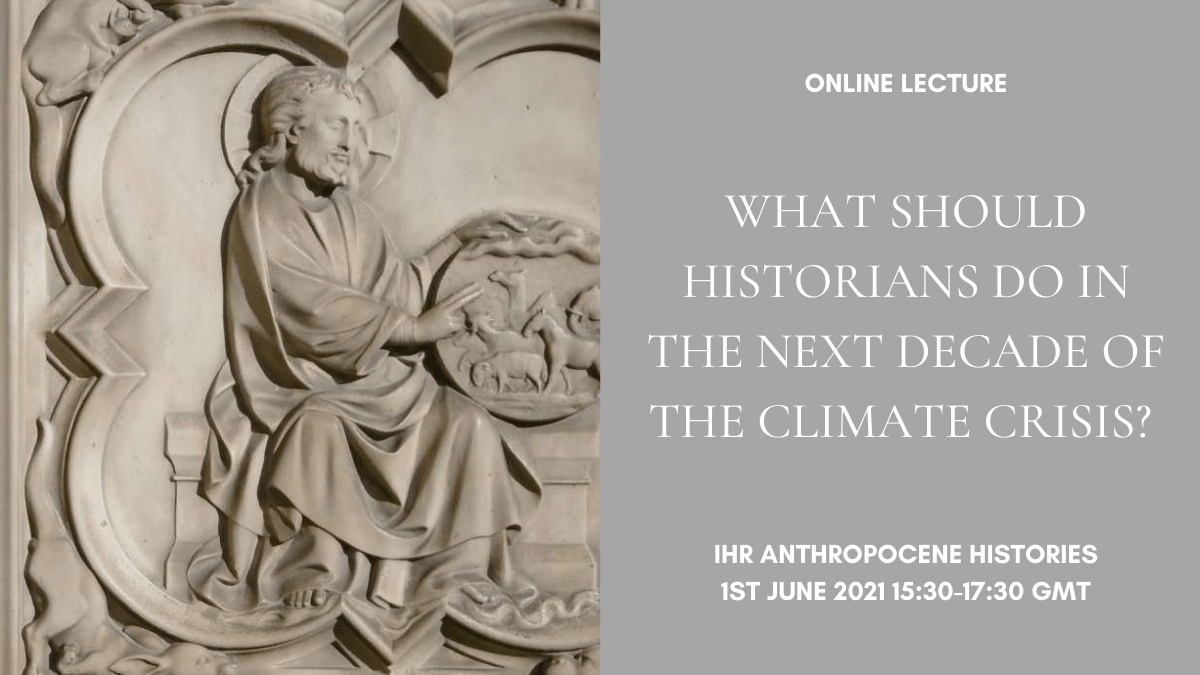
Online Lecture: What should historians do in the next decade of the climate crisis?, 1st June 2021 (15:30-17:30 GMT)

The final seminar of this year’s Anthropocene Histories series will be a panel discussion with Andreas Malm (Lund), Julia Adeney Thomas (Notre Dame), and Ling Zhang (Boston College), online on 1st June 2021 from 15:30-17:30 BST.

In the run-up to the UN climate change conference in Glasgow this November, much attention is focused on the political and social adaptations needed to address the climate crisis. Going into and beyond that however, there are also questions for historians and the discipline of history. From to activism, to reparative climate justice, to the shape of the wider historical narratives we offer, historians too face a question about we should do in the next decade of the climate crisis.

  • Andreas Malm is Senior Lecturer in Human Ecology at the University of Lund, and author most recently of How to Blow Up a Pipeline: Learning to Fight in a World on Fire.
  • Julia Adeney Thomas is Associate Professor of History at the University of Notre Dame, and co-author most recently of The Anthropocene: A Multidisciplinary Approach.
  • Ling Zhang is Associate Professor of History at Boston College, and author of The River, the Plain, and the State: An Environmental Drama in Northern Song China, 1048-1128.

Advanced registration is essential. Book here.

Post-doctoral Fellowship: ‘Global at Venice – Research and Training for Global Challenges’ Cofund Fellowship Programme 2021 (Deadline 30th June 2021)

The first call for the “Global at Venice – Research and Training for Global Challenges” Cofund Fellowship Programme is now open.

The programme, funded through the Marie Skłodowska-Curie Actions COFUND scheme, gives 15 talented researchers from all over the world the opportunity to undertake their research and training activity at Ca’ Foscari University of Venice. The programme is supported by the University’s corporate partners, including research centres, non-academic networks of spin-offs, and small and medium enterprises, where Fellows will have the opportunity to complete secondments, bridging the gap between academic and applied research, and between research and market.

The first call for proposals will award a maximum of 8 Fellowships each lasting 24 months.

Applicants are requested to submit their research proposal in one of the six interdisciplinary Research for Global Challenges Institutes (RGCI) that will support them with their individual research and training needs: 

  • Research Institute for Complexity (Science of complex economic, human and natural systems)
  • Research Institute for Digital and Cultural Heritage (Creative arts, cultural heritage and digital humanities)
  • Research Institute for Social Innovation (Public governance, welfare and social innovation)
  • Research Institute for International Studies (Cross cultural and area studies)
  • Research Institute for Green and Blue Growth (Environmental technology and green economy)
  • Research Institute for Innovation Management (Economics and management of innovation and entrepreneurship)

Applicants are required to choose a potential supervisor whose role is to integrate the research within the Research for Global Challenge Institute.

Research Fellows of any nationality on the date of the deadline (5 pm CET 30 June 2021) must meet the following criteria to apply:

  • Be in possession of a PhD degree awarded not later than 8 years prior to this call deadline.
  • Have at least one major publication without their PhD supervisor (either accepted, in press or published) at the time of deadline.
  • Have not resided or carried out their main activity in Italy for longer than 12 months during the 3 years prior to the call deadline, in compliance with the MSCA mobility rule.

Deadline for applications is 30th June 2021. To apply, visit the Institute for Global Challenges site.

Call for Papers: Greek Islands under the Control of Western Rulers, 13th-15th Cent.: Searching for Their Identity through Their Patronage (Deadline 30th June 2021)

After the Fall of Constantinople in 1204 to the armies of the Fourth Crusade and the signing of the treaty of Partitio Terrarum Imperii Romaniae, the majority of the Greek islands (in the Aegean, the Ionian Sea and Crete) gradually passed under the control of the Latins, initiating a new era of conflict and coexistence between the local populations, the new rulers and the settlers.

The Venetians, the Genoese, the Hospitallers et al., within this cultural environment, funded the construction, the decoration, or the renovation of secular and religious  buildings, as well as the production of artefacts. These initiatives constitute the irrefutable evidence of their presence in the Greek islands. Documents, inscriptions, coats of arms, donor portraits and other visual material can provide us with crucial information about the identities of the commissioners and their role within the local communities, and thus help us fill in some of the missing pages of the history of each island or complexes of islands.

With the financial support of the Society for the Medieval Mediterranean, through the Simon Barton Postgraduate & ECR Conference Prize, the Organizing and Scientific Committees would like to invite you to the virtual conference Greek Islands under the Control of Western Rulers (13th-15th cent.): Searching for their Identity through their Patronage, which will take place on 3 and 4 December 2021 via Zoom.

The conference aims to promote research on Latin patronage and how this reflects the status of the patrons in the Greek islands under western rule (13th-15th c.) and the interrelationship between the Byzantines and the Latins. Papers are expected to focus on the investigation of the various aspects of the patronage and what these initiatives can tell us about the process of the production of architecture and art (physical materials of the monuments and the objects, aesthetic taste of the commissioners, etc.), their profile (financial and social status, education), their social position within the local communities, their relations with the central or the local administration and the ways they used patronage to promote their status. Broader issues, such as the integration of the two cultures and their parallel development, devotional practices and beliefs, the social and political fermentations created by this coexistence, et al. are expected to be examined as well.

Postgraduate students and early career researchers from various disciplines (history, archaeology, history of art, epigraphy and palaeography) are particularly encouraged to participate. Emphasis will be given to interdisciplinary approaches.

Presentations will be given in Greek or in English. Please send your title and an abstract (about 300 words), written in Greek or in English, to latinpatronageconference@gmail.com, no later than the 30th of June 2021. Paper proposals should also contain the full name of the participant, affiliation, e-mail address, phone number and 5 keywords that best represent the content of your paper. Notifications of acceptance and relevant information will be sent via e-mail by July 2021.

The complete announcement is available from academia.edu

Job Opportunity: Associate Lecturer/Lecturer in History (pre-1700), University of Sydney (Deadline 17th June 2021)

The School of Philosophical and Historical Inquiry (SOPHI) is seeking to appoint an Associate Lecturer / Lecturer in History (pre-1700) from candidates who hold a relevant PhD, an outstanding research profile and demonstrated teaching excellence. The Associate Lecturer / Lecturer in History (pre-1700) will be expected to pursue an active research program, produce high quality publications, participate in the department’s research culture, contribute to teaching at all levels and undertake appropriate administrative roles and curriculum development as required. 

We are seeking an academic who can bring their expertise in areas outside of Western Europe and North America as well as one or more of the following thematic areas – Indigenous history (including comparative Indigenous history); race and cultural identity; mobility and migration; women, gender and sexuality; environment and climate. Interdisciplinary expertise, with versatility and breadth across geographic areas and time periods also forms a key component to this opportunity.

The successful candidate will teach large introductory units of study in History and INGS (International and Global Studies) as well as the opportunity to develop specialised higher-level units and to supervise Honours, Masters and PhD students in their fields of speciality. The successful candidate will also be expected to participate in the curriculum transformation currently underway at the University and to be willing to teach into interdisciplinary units.

The school is seeking applications from scholars who are committed to decolonizing methodologies/approaches and public engagement and outreach, including utilising museum collections.

To be considered for this position please ensure you submit the below documents as part of your application:

– Current CV (including two referees of international standing)

– Supporting statement which addresses the below criteria:

  • a PhD (in hand or near completion) in History or a closely related discipline
  • an active research program with significant potential for publication in highly regarded peer-reviewed international journals and presses
  • demonstrated teaching excellence (including capacity to teach introductory units of study as well as specialised higher-level courses) and ability to supervise Honours students, doctoral and other postgraduate research, in fields of speciality
  • capacity to communicate their research in well-regarded peer-reviewed international publications as well as community outreach and public engagement channels
  • capacity to seek research funding from internal and external sources
  • a collegial approach and ability to contribute to curriculum development and undertake other academic administrative duties

The application form can be found here.

New Publication: A Prophet Has Appeared: The Rise of Islam Through Christian and Jewish Eyes, A Sourcebook, by Stephen J. Shoemaker

Early Islam has emerged as a lively site of historical investigation, and scholars have challenged the traditional accounts of Islamic origins by drawing attention to the wealth of non-Islamic sources that describe the rise of Islam. A Prophet Has Appeared brings this approach to the classroom. This collection provides students and scholars with carefully selected, introduced, and annotated materials from non-Islamic sources dating to the early years of Islam. These can be read alone or alongside the Qur’an and later Islamic materials. Applying historical-critical analysis, the volume moves these invaluable sources to more equal footing with later Islamic narratives about Muhammad and the formation of his new religious movement.

Included are new English translations of sources by twenty authors, originally written in not only Greek and Latin but also Syriac, Georgian, Armenian, Hebrew, and Arabic and spanning a geographic range from England to Egypt and Iran. Ideal for the classroom and personal library, this sourcebook provides readers with the tools to meaningfully approach a new, burgeoning area of Islamic studies.

Stephen J. Shoemaker is Professor of Religious Studies and Ira E. Gaston Fellow in Christian Studies at the University of Oregon. He is a specialist on early Christian apocrypha, devotion to the Virgin Mary, and the rise of Islam. He is the author of The Death of a ProphetThe Apocalypse of Empire, and Mary in Early Christian Faith and Devotion, among many other publications.

Available from The University of California Press.

Job Opportunity: Lecturer in Late Medieval History, King’s College London (Deadline 14th June 2021)

The Department of History at King’s College London seeks to appoint a Lecturer specialising in Late Medieval History (1200-1500). Preference may be given to applicants specializing in Southern Europe and/or the Mediterranean region. You will conduct and publish high quality research in the subject, seek external research funding and engage in impact-generating activities. You will develop new modules in your area of specialism, and contribute to the planning, organisation and delivery of other teaching activities. You will assume pastoral and administrative responsibilities, and participate actively in the life and culture of the department. A strong research track record, excellent teaching ability, outstanding interpersonal skills and a collaborative ethos are essential for the role.

KCL particularly welcomes applications from black and minority ethnic candidates as they are under-represented in the Department of History. All applications from members of groups with protected characteristics that have been marginalized on any grounds enumerated under the Equality Act are welcomed.  This post will be offered on an indefinite contract.This is a full-time post – 100% full time equivalent.

Skills, knowledge and experience

Essential criteria 

1. PhD in Medieval History completed

2. Excellent research expertise in Late Medieval History

3. Ability to convene, teach and assess modules relating to medieval history across the undergraduate curriculum

4. Ability to engage students and support their learning

5. Demonstrable administrative and interpersonal skills, a collaborative ethos, and capacity for team-working

6. Strong track record in research relative to career stage

7. Experience of teaching and supporting students at UG level 

Desirable criteria 

1. Experience of teaching and supporting students at PG level

Further information

Interviews for shortlisted candidates will be held in early July. The selection process will include a presentation and an interview. To assist in the shortlisting process, applicants are asked to include a copy of an article or chapter (either published or intended for publication) and a proposal for a collaboratively taught module.They should make clear in their supporting statement how they meet each of the selection criteria for the post using examples of their skills and experience. This may include experience gained in employment, education, or during career breaks (such as time out to care for dependants). Applicants should include a separate short statement describing past experience that promotes diversity and inclusion, broadly understood, and/or plans to make future contributions to more inclusive representation of racialized and other minorities in the applicant’s core discipline, or in the academy more broadly. Please note that we are able to offer visa sponsorship for this role.

Deadline to apply is 14th June 2021. For complete information, visit the job posting here.

Online Lecture: ‘”I saw wonders, I saw horrors”: Reconsidering Enguerrand Quarton’s Coronation of the Virgin’, with Emma Capron, The National Gallery, London, 9 June 2021, 5-6pm (BST)

Enguerrand Quarton’s Coronation of the Virgin—a vividly coloured, densely populated tableau of heaven, earth, and the underworld—is one of the best preserved, visually complex, and finely executed altarpieces to survive from fifteenth-century France. It is also one of the best documented: its lengthy contract reveals that it was commissioned in 1453 by Jean de Montagny, a canon in Avignon, to be placed at the Carthusian monastery of Villeneuve-lès-Avignon, just across the Rhône from the papal city. The panel was specifically intended for an altar that stood in the funerary chapel of Pope Innocent VI, who had founded the monastery in 1356.

Scholarship on the altarpiece has primarily focused on its sprawling imagery, following an iconographic method notable for neglecting information extrinsic to the image. The complexity of its patronage, its intended audience of enclosed Carthusians and, crucially, its physical location at the Villeneuve charterhouse were broadly overlooked. This paper addresses these very issues and in so doing challenges the interpretation that has held authority up to now. In recovering the Coronation’s context, it argues that in addition to reflecting Montagny’s devotional interests, the altarpiece played a key role in articulating the monastery’s institutional memory—a pressing concern as it was nearing its centenary—by commemorating its papal founder and celebrating the visionary event that led to its foundation.

Emma Capron is Associate Curator of Renaissance Painting at the National Gallery. Previously she was the Anne L. Poulet Curatorial Fellow at the Frick Collection in New York, where she curated the exhibition The Charterhouse of Bruges: Jan van Eyck, Petrus Christus, and Jan Vos (2018-19). She also worked for Christie’s Old Masters in London and held fellowships at the Metropolitan Museum and the Musée du Louvre. Among other publications, her discovery of Simone Martini’s last documented work appeared in The Burlington Magazine in 2017. She completed her PhD on altarpieces in late medieval Avignon at the Courtauld Institute under the supervision of Susie Nash in 2019.

Speaker: Emma Capron – Associate Curator of Renaissance Painting, The National Gallery, London 

Organised by: Tom Nickson – The Courtauld

This is a live online event.  

Please register for more details. The platform and log in details will be sent to attendees at least 48 hours before the event. Please note that registration closes 30 minutes before the event start time.  

If you have not received the log in details or have any further queries, please contact researchforum@courtauld.ac.uk. 

Book now via this link.

Call for Papers: ‘Theatrum Libri: The Press, Reading and Dissemination in Early Modern Europe’ (Deadline 30th June 2021)

Martynas Mažvydas National Library of Lithuania kindly invites you to an international academic conference ‘Theatrum Libri: The Press, Reading and Dissemination in Early Modern Europe’ (Martynas Mažvydas’s Readings), which will be held on December 1-2, 2021 (Vilnius, Lithuania/Virtual).


In the early modern period, the word theatrum (Latin for “theater,” area or work, space of action, arena) was used quite often metaphorically in book titles, for example, Theatrum mundi, et temporis (“World and Time Theater”), Theatrum politicum (“Theater of Politics”), Theatrum cometicum (“Theater of Comets”), Theatrum botanici (“Theater of Plants”), Theatrum patientiae (“Theater of Suffering”), Theatrum virtutum (“Theater of Virtues”), and others. The representatives and publishers of the Renaissance and Baroque era very quickly realized the appeal of the word “theater,” which usually meant the accumulation, systematization, and orderly sorting of inexhaustible knowledge on a subject. One of the most famous works of that time is the encyclopedia Theatrum vitae humanae (“Theater of Human Life” or “The Life of Man”) by the Swiss humanist, doctor Theodor Zwinger (1533-1588). The book presented systematical and comprehensive information about man. In this historical period, the archiving of knowledge was understood as a conscious and purposeful action.

The conferences invites participants to look at the printed book and manuscript as an archival phenomenon in terms of content (accumulation of knowledge) and form (accumulation of books). The conference is also aimed at the reflection on the creation of the book and its structure, the press, its dynamics in socio-cultural processes, highlighting the role of the author, publisher, distributor, reader, and book collector. Since the narratives of the past are created by both selected individual elements of the book and personal or institutional archives, the topic of the presentation can be very broad and varied.


The library encourages scholars from various disciplines to reflect on and share their new research, methods and applications, including the application of digital humanities and open data in research of the book:

– The 15-19th century book as an archival phenomenon (accumulation of knowledge and books) in Lithuania and Europe;

– The role of knowledge accumulators and book collectors, systematizers and sorters in forming a personal or institutional archive;

– The materiality of the book and its various elements (book marks, structure, parts, details, a title page, covers, inscriptions, typography, illustrations, vignettes, decorative elements, etc.) as a means of generating ideas, tool for creating a narrative or result of historical circumstances;

– Book economics: market and business strategies (prices, book fairs, catalogs, advertising, and reviews);

– Applying digital technology and interactive, unique tools for data storage and use.


Conference venue: Martynas Mažvydas National Library of Lithuania, Gedimino Ave. 51, Vilnius. Participants who travel from abroad will be accomodated to present their papers on-line.
Conference language: Lithuanian, English (simultaneous translation).
Duration of the presentation: 20 minutes.


The deadline for sending abstracts (up to 200 words) is June 30, 2021. Abstracts should include name, affiliation, and an email address. Please send them and other inquires to the following email address: skaitymai2021@lnb.lt Articles based on the conference papers will be published in the peer-reviewed scientific journal ‘Aktualu rytoj’.

Online Lecture: Subterranean Hagia Sophia: Revealing the Waters Below the Hagia Sophia, 1st June 2021 17:00 pm GMT

Since 2005, Çiğdem Özkan Aygün has directed an interdisciplinary survey of the subterranean remains in the area of Hagia Sophia. Speleologists, professional photographers and divers have also supported the survey and documentation. Most finds have been new to scholarship and unexpectedly rich and informative about the history and construction techniques of the structures. They have opened a door into the monument’s unexplored relation with water management. This survey has proven that the area around Hagia Sophia was crucial for the water supply distribution over the first hill of the city, where the ancient water supply line ended. Further exploration beneath the Hippodrome and Topkapı Palace area revealed connections in the water supply. This talk will explain the relation of subterranean structures to the water supply system and present their 3D models and a short documentary. 

Discussant: James Crow, University of Edinburgh

Advance registration required.