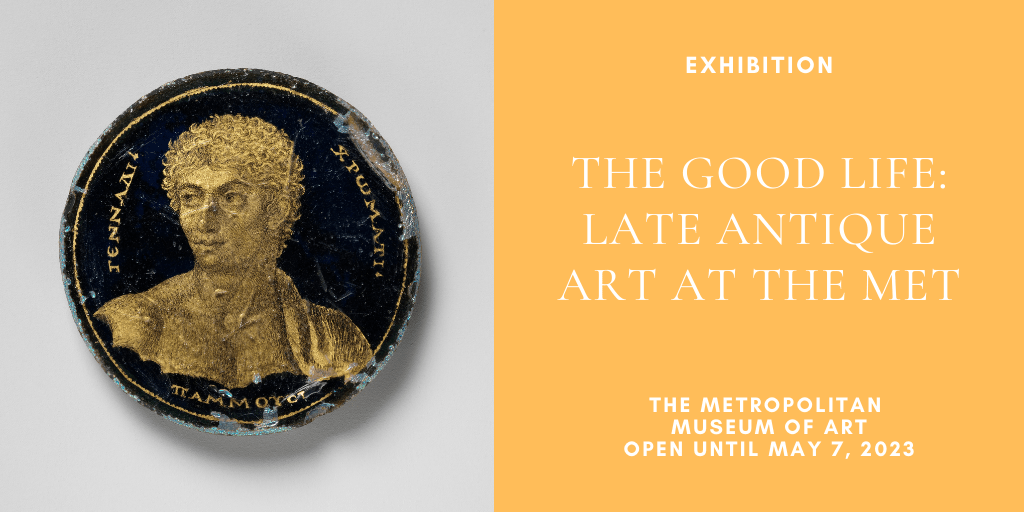
The Good Life: Collecting Late Antique Art at The Met showcases the Museum’s important and rare collection of third- to eighth-century art from Egypt and reevaluates it through the lens of late antique ideas about abundance, virtue, and shared classical taste.
Continue reading “Exhibition: The Good Life: Collecting Late Antique Art at The Met now open”Videos: ‘Persian Arts of the Book’ at the Bodleian Libraries
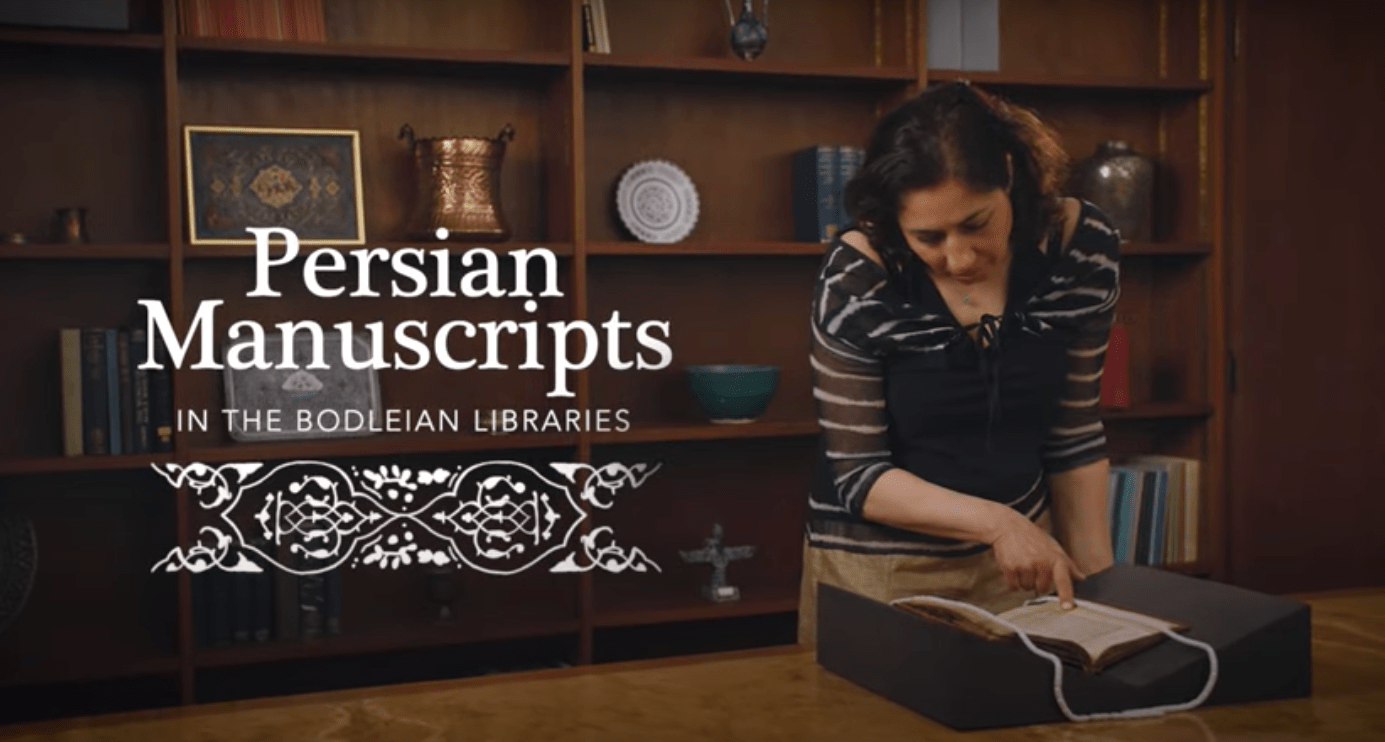
A series of five films celebrating the Bodleian Libraries’ Persian arts of the book conference (13-14 July). ‘Persian Arts of the Book’ gathers scholars from around the world with expert curators from Oxford and beyond to reflect on the Persian manuscript tradition.
The whole collection can be found here.
The History and Highlights of the Persian Collections
Hidden Treasures of the Persian Collections
Making Manuscripts for a Prince of the Black Sheep
The Painted Page and its Colours
Conserving Akbar’s Luxury Manuscript of the Baharistan
New Publication: The Absent Image: Lacunae in Medieval Books by Elina Gertsman
Guided by Aristotelian theories, medieval philosophers believed that nature abhors a vacuum. Medieval art, according to modern scholars, abhors the same.
Continue reading “New Publication: The Absent Image: Lacunae in Medieval Books by Elina Gertsman”Online Lecture: ‘Sliding Doors: Considering the symbolic significance of decorated thresholds in Early Medieval Churches’, with Dr Meg Boulton, The Society for Church Archaeology, 4 August 2021, 19–20pm (BST)

The Society for Church Archaeology is delighted to welcome Dr Meg Boulton who will deliver an online lecture on the topic of ‘Sliding Doors: Considering the symbolic significance of decorated thresholds in Early Medieval Churches’.
Dr Meg Boulton studied Fine Art as an Undergraduate, and completed her doctorate in Art History in 2013. Since then she has taught at various Institutions, including the Department of Continuing Education at Oxford, the University of Leeds and the V & A. Research interests include: Sculpture, space, theories of viewing and reader reception/s. She has special interests in theory and in a transhistorical practice of the History of Art.
The lecture will be hosted through Zoom and will take place on Wednesday 4th August 2021 from 19:00 to 20:00.
Please note: When you register for this talk you will receive an email (with reminders leading up to the event) with a link to a unique Online Event Page. This is where you will be able to access the talk at the scheduled time and date as listed.
CFP: ‘The Art of Copying in Early Modern Europe’, The Medici Archive Project, Florence (21 January 2022), deadline 1 September 2021
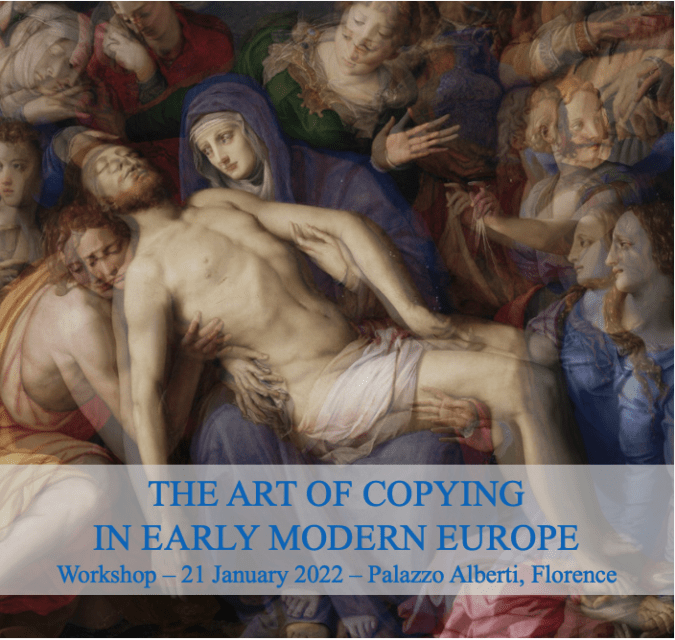
Announcing the Call for Papers for the interdisciplinary workshop, organized by The Medici Archive Project, which will take place at Palazzo Alberti in Florence on Friday, 21 January 2022:
In recent years, attention has been directed towards copies, with a particular emphasis on their meaning, function, provenance, production, patronage, collecting and dating. The aesthetic and conceptual tenets underlying this corpus of scholarly research focused primarily on works of art. However, this impulse to recreate images has also been transferred to other artistic and intellectual media. As such, the copy carries within itself a great number of intrinsic nuances, depending on the cultural context and the historical moment. The organizers of this workshop (Maddalena Bellavitis and Alessio Assonitis) invite papers that address issues that can shed new light and provide new interdisciplinary research trajectories on the mechanisms that regulate the practice and reception of copies. For this reason, we encourage submission for presentation proposals from disciplines such as book history, media history, history of science, history of medicine, history of food and history of diplomacy.
To be considered for participation, please provide a single document in Microsoft Word, consisting of a one-page proposal for a 20-minute presentation of unpublished work, followed by a short curriculum vitae. Presentations can be in Italian or English. Applications may be sent to education@medici.org by 1 September 2021 (participants will be notified by the end of September).
Online Lecture: ‘Manuscript journeys: from German lands to digital libraries’, Bodleian Libraries, 7 July 2021, 5.30-6.45pm (BST)

This event marks the completion of a three-year digitization project delivered by the Bodleian Libraries, Oxford and the Herzog August Bibliothek in Wolfenbuttel. The ‘Manuscripts from German-Speaking Lands’ project, funded by The Polonsky Foundation, has digitized hundreds of medieval manuscripts from collections at The Herzog August Bibliothek and the Bodleian and made these freely available online to scholars and the public.
The panel discussion will explore the journey of these manuscript collections from their origins in the religious houses of medieval Germany, their acquisition by the libraries in Wolfenbüttel and Oxford and their digitization and publication online.
Registration closes at 5pm on 5 July 2021
Find out more and book your place here.
Speakers
- Richard Ovenden OBE, Bodley’s Librarian
- Julia Gross, Chargé d’ Affaires a.i. of the German Embassy London
- Marc Polonsky, The Polonsky Foundation
- Peter Burschel, Herzog August Bibliothek
- Henrike Lähnemann, University of Oxford
- Joanna Story, University of Leicester
Booking information
When you have booked your place, the ticketing system will send you an automated confirmation.
A link to access the online event will be sent by the morning of the event to the email address associated with your booking.
See our project website for more information about the project and to see the digitized collections.
Online Conference: ‘Le Psautier de Paris (BnF, Grec 139)’, École nationale des chartres, 2–3 July 2021
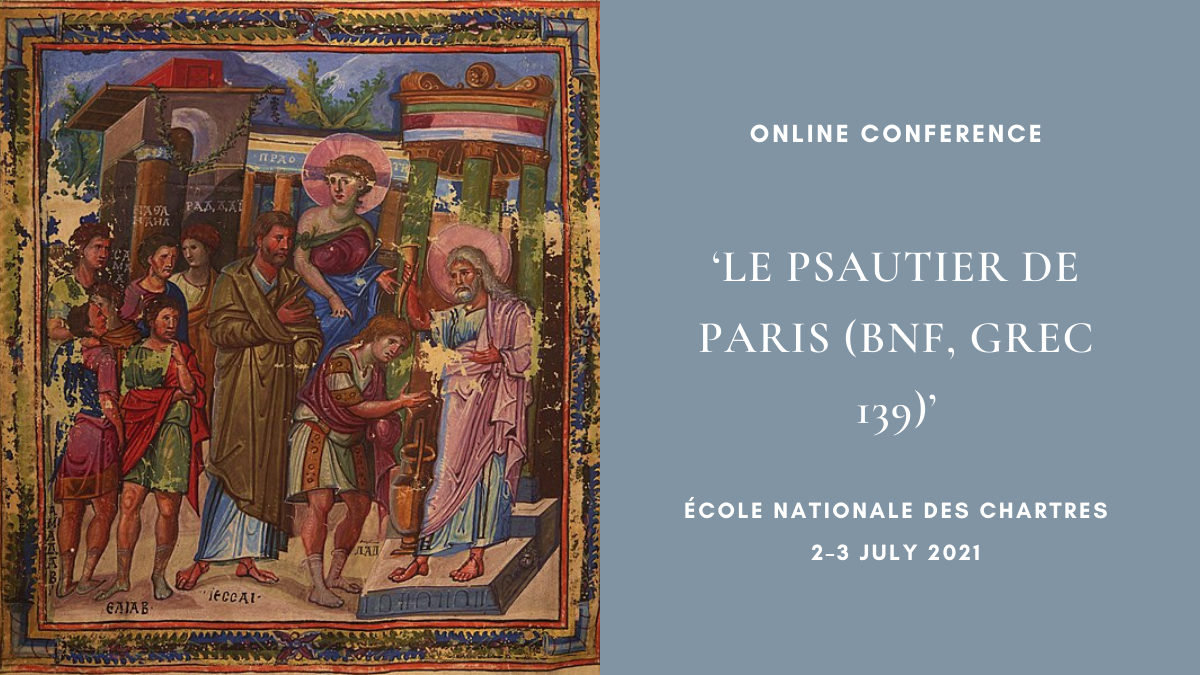
The École nationale des chartres will host the colloquium ‘Le Psautier de Paris (BnF, Grec 139, 10th century)’ on Friday, July 2 and Saturday July 3, 2021. The colloquium is organized by Christian Förstel, Vasileios Koukousas, Delphine and Frederick Lauritzen. Its organization was made possible, in particular, by Sorbonne University.
The Paris Psalter is one of the most famous creations of the Macedonian “Renaissance”. This colloquium is the first research enterprise devoted exclusively to this exceptional manuscript. Its aim is to bring together in an interdisciplinary group of scholars specializing in codicology and philology, biblical exegesis and theology, and the history of art and aesthetics with the goal of putting the manuscript in context, studying its genesis and sources and its internal organization as well as its influence on Byzantine art.
Advance registration required. Registration closes June 30, 2021.
Conference Programme
Friday 2 July 2021
9h15 : salutations
- Michelle BUBENICEK, directrice de l’École nationale des chartes
- Isabelle LE MASNE DE CHERMONT, directrice des manuscrits, Bibliothèque nationale de France
- Vincent DEROCHE, Sorbonne, directeur de l’équipe « Monde byzantin », UMR 8167 Orient et Méditerranée
9h30 : introduction
- Konstantinos VLASIS, secrétaire d’État aux Affaires étrangères de la République hellénique en charge de la Diaspora grecque
- Christian FÖRSTEL, Delphine LAURITZEN et Frederick LAURITZEN, organisateurs
Session I — Perspectives d’ensemble
Président : Jean-Claude CHEYNET (Sorbonne Université)
- 10h : « Le Psautier de Paris, un chef d’œuvre de l’art byzantin », par Jannic DURAND, directeur du département des Objets d’art, Musée du Louvre
- 10h30 : « Books and Prayer in the Long 10th Century: People, Manuscripts, Contexts », par Claudia RAPP, Universität Wien, Österreichische Akademie der Wissenschaften,
- 11h : pause
- 11h30 : « Le Psautier de Paris et la minuscule bouletée 40 ans après (vidéo) », par Maria-Luisa AGATI, Università di Roma II Tor Vergata
- 12h : « De Constantinople à Paris : le manuscrit BnF, Grec 139, entre le xvie et le xxe siècle », par Christian FÖRSTEL, département des Manuscrits, Bibliothèque nationale de France
- 12h30 : discussion
Session II — Iconographie et esthétique
Présidente : Raphaëlle ZIADE (Petit Palais, Ville de Paris)
- 14h30 : « Adjusting Antiquity: On the Principles of Design in the Paris Psalter and their Application in Practice », par Anthony CUTLER, Pennsylvania State University
- 15h : « Les personnifications comme marqueur d’une esthétique tardo-antique ? », par Delphine LAURITZEN, Sorbonne Université, UMR 8167 Orient et Méditerranée
- 15h30 : pause
- 16h : « La diffusion et l’impact des modèles iconographiques du Psautier de Paris », par Elisabeth YOTA, Sorbonne Université, Centre André Chastel
- 16h30 : « Narration et speculum principis », par Ioanna RAPTI, École Pratique des Hautes Études et Anne-Orange POILPRE, Université Paris I Panthéon-Sorbonne
- 17h15 : discussion
- 18h15 : présentation du Psautier de Paris (BnF Grec 139) dans la grande salle de lecture des manuscrits de la Bibliothèque nationale de France, site Richelieu
Saturday 3 July 2021
Session III — Le texte : les psaumes et les chaînes exégétiques
Président : François PLOTON-NICOLLET, École nationale des chartes
- 9h : « An unconventional Catena on the Psalms: the composition and textual structure of the type III catena », par Leontien VANDERSCHELDEN, Université catholique de Louvain
- 9h30 : « Catenae sur les psaumes et théologie. Les tendances révisionnistes du xie siècle et la chaîne de Nikitas de Serres », par Christos ARABATZIS, Université Aristote de Thessalonique et Vasileios KOUKOUSAS président de l’Institut hellénique des études byzantines et post-byzantines de Venise
- 10h : pause
- 10h30 : « Codex Parisinus gr. 139 (Rahlfs 1133) as a Witness to the Hexapla of Psalms », par Felix ALBRECHT, Akademie der Wissenschaften zu Göttingen
- 11h : « Apollinaris of Laodicea and the Paris Psalter », par Frederick LAURITZEN, Institut hellénique et Scuola Grande di San Marco, Venise
- 11h30 : discussion
- 12h : conclusions, par Peter SCHREINER, Universität zu Köln
IMC 2021: Medieval Art related papers & panels, 5 – 9 July 2021
We’ve had a look through the programme and have brought together all the Medieval Art related papers and panels. Please let us know if we’ve missed a panel or paper that you think Medieval Art Researchers would like to know about! You can see the full programme here.
Monday 5 July 2021
11.15-12.45 (BST)
Session: 101
Fieldwork and Analysis: Ongoing Work of the Corpus of Romanesque Sculpture in Britain and Ireland
Sponsor: Corpus of Romanesque Sculpture in Britain & Ireland (CRSBI)
Organiser: Xavier Dectot, Corpus of Romanesque Sculpture in Britain & Ireland (CRSBI), London
Moderator: Ron Baxter, Corpus of Romanesque Sculpture in Britain & Ireland (CRSBI), London
Paper 101-a: An Hour in the Life of a Fieldworker (Language: English), Rita Wood, Corpus of Romanesque Sculpture in Britain & Ireland (CRSBI), London
Paper 101-b: New Perspectives on Two Cotswold Doorways (Language: English), John Wand, Corpus of Romanesque Sculpture in Britain & Ireland (CRSBI), London
Paper 101-c: The Elephant in the Room: Romanesque Sculpted Elephants in Britain and Their Sources (Language: English), Xavier Dectot
14.15-15.45 (BST)
Session: 201
Urban Architecture and its Development
Moderator: Michael Carter, Curatorial Department, English Heritage, London
Paper 201-a: A Rare Example of Medieval Residential Architecture in Boka Kotorska Bay, Montenegro (Language: English), Katarina Nikolić Krasan, Independent Scholar, Montenegro
Paper 201-b: The Dynamics of the Medieval Town Square: An Archaeological Study of an Open Space (Language: English), Lisa Renn, Institut für Archäologische Wissenschaften, Albert-Ludwigs- Universität Freiburg / Zentrum für Kulturwissenschaftliche Forschung Lübeck (ZKFL)
Paper 201-c: The Dialogue between the Castle and the Monastery within the Medieval Town (Language: English), Monica Ruset Oanca, Facultatea de Limbi și Literaturi Străine, Universitatea din Bucureşti
14.00-17.00 (BST)
Price: £10.00
Discover Cyrillic Calligraphy and Illumination: A Workshop on the Theory and Practice of an Ancient Art
Directed by Edgar Rops and Anastasija Ropa
Cyrillic calligraphy is an ancient art, dating back to the creation of the Cyrillic alphabet in the ninth century. It is also a living tradition, as Cyrillic scripts are widely used today: you can see them on icons, in decorations for devotional literature and fairy tales, and in many other contexts.
This workshop will begin with a presentation about the history of Cyrillic calligraphy and a description of different styles and scripts (the uncial, the half-uncial, and the cursive). Participants will learn about the differences between traditional illumination styles in medieval and early modern manuscripts and will see examples of illuminated manuscripts that can be used as inspirations for their own work. In the practical part, participants will be introduced to the basics of creating simple objects of art, such as cards, name tags, and bookmarks, as well as learning the steps for creating more complex art, such as copying the page of an existing historical manuscript or creating their own manuscript page by combining elements of existing manuscripts.
The first, theoretical part will last for 40 minutes and will be followed by a 20-minute question and answer section. In the second, practical part, the tutors will demonstrate how to shape letters in uncial, from the simplest to the more complex ones. The participants will then be able to practice some simple words and phrases. This part of the workshop will last for an hour, with 40 minutes for the explanation and 20 minutes for individual practice, questions, and discussion. During the last hour, the tutors will outline the principal steps in producing illuminated calligraphic art: laying out the page, writing the text, tracing the design on a separate slip of paper and copying it onto the page, and finally coloring the illumination. The participants can then practice creating a bookmark with the first words from the Gospel of John (‘In the beginning was the word’, which in the Gospel of Miroslav and other lectionaries is preceded by a decorated initial).
Participants in the workshop will need to provide their own materials, including a calligraphy pen (or nib(s), holder, and ink), paper (ruled paper and/or watercolour or other good quality paper), ruler, soft pencil, eraser, paint (watercolour paints or pencils. gouache, or tempura paint).
Edgar and Anastasija study the medieval and early modern documents produced in Livonia, at the crossroads of eastern and western traditions of writing, and the artistic practices that went into the decoration of historical documents, presenting their research at international venues, with peer-reviewed publications to their credit. Edgar is a lawyer and legal historian by education, with a passion for historical calligraphy. He has also organised calligraphy workshops for general audiences, both with and without experience in calligraphy, and calligraphy-based team-building activities. Anastasija’s PhD research involved a study of medieval romance, with a long-standing interest in manuscripts and charters produced and circulated in medieval Livonia.
This workshop can only accommodate a limited number of participants. Early booking is recommended.
14.15-15.45 (BST)
Session: 209
Rituals and Representations of Rulership: On Expressions of Female and Male Power and Authority in 15th-Century Sweden
Sponsor: Malmö universitet
Organiser: Thomas Småberg, Institutionen för samhälle, kultur och identitet, Malmö universitet
Moderator: Kurt Villads Jensen, Historiska institutionen, Stockholms universitet
Paper 209-a: Regency, Power, and Ritual: On the Construction of the Image of the Regent in the Late Middle Ages (Language: English), Thomas Småberg
Paper 209-b: Images of Queenship in 15th-Century Sweden (Language: English), Margaretha Nordquist, Historiska institutionen, Stockholms universitet
Paper 209-c: Queenly Emotions, Rhetoric, and Rituals of Intercession: The Roles of Royal and Aristocratic Women in Times of Rebellion and Civil War (Language: English), Kim Bergqvist, Historiska institutionen, Stockholms universitet
14.15-15.45 (BST)
Session: 217
Byzantine Alchemy Between Art and Science
Sponsor: Mary Jaharis Center for Byzantine Art & Culture
Organiser: Alexandre Roberts, Department of Classics, University of Southern California
Moderator: Charles Burnett, Warburg Institute, University of London
Paper 217-a: Terms, Concepts, and Perceptions of Alchemy in Byzantium (Language: English), Gerasimos Merianos, Institute of Historical Research, National Hellenic Research Foundation (NHRF), Athens
Paper 217-b: Philosophers, Chemists, and the Sacred Art: The Greco-Arabic Intellectual Context of Byzantine Alchemy (Language: English), Alexandre Roberts
Paper 217-c: Alchemy in Medieval Byzantium: An Artisanal Turn (Language: English), Shannon Steiner, Art History Department, Binghamton University, New York
16.30-18.00 (BST)
Session: 301
Colouring Outside the Lines: New Perspectives on the Borders of Manuscripts
Organiser: Emily Shartrand, Independent Scholar, Philadelphia
Moderator: Christine Bachman, Department of Art History, University of Delaware
Paper 301-a: Networked Borders: A Computational Analysis of Images in the Margins of Gothic Manuscripts (Language: English), Alexander Brey, Art Department, Wellesley College, Massachusetts and Maeve Doyle, Department of Art & Art History, Eastern Connecticut State University
Paper 301-b: Visual Genealogies in Manuscript Borders: Heraldic Decoration as Commemorative Device (Language: English), Jessica Savage, Index of Medieval Art, Princeton University
Paper 301-c: Denigrated Images: ‘Marginalia’ and the mise-en-page (Language: English), Emily Shartrand
16.30-18.00 (BST)
Session: 314
Weather Saints, II: Water in Texts and Images
Organiser: Andrea-Bianka Znorovszky, Dipartimento di Studi Umanistici, Università Ca’ Foscari Venezia
Moderator: Andrea-Bianka Znorovszky
Paper 314-a: Worlds of Storms, Hail, Floods, and Drought: Weather in 14th- Century Church Slavonic Manuscripts Translated from the Byzantine Metaphrastic Menologion (Language: English), Marijana Vuković, Institut for Historie, Syddansk Universitet
Paper 314-b: The Chants against a Tempest: The Chants as Part of the Prayers for Protection in a Storm Found in Medieval Manuscripts, 14th-15th Centuries (Language: English), Laine Tabora, Pontificium Institutum Musicae Sacrae, Roma
Paper 314-c: The ‘Folding Altarpiece’ as a Means of Praising the Relics and the Miracles of the Patron Saints of the Venetian Republic (Language: English), Pasquale Francesco Antonino Giambo, Dipartimento dei Beni Culturali, Università degli Studi di Padua
Paper 314-d: An Image between Miracle and Climate: The Iconography of Our Lady of the Snows in Italian Illuminated Manuscripts (Language: English), Michela Giuntoli, Independent Scholar, Lucca
16.30-18.00 (BST)
Session: 322
Studies in Manuscripts, I: The Data
Organiser: N. Kıvılcım Yavuz, Kenneth Spencer Research Library, University of Kansas
Moderator: N. Kıvılcım Yavuz
Paper 322-a: Discovering and Digitizing Pre-1600 Manuscripts in the United States: A Progress Report (Language: English), Lisa Fagin Davis, Medieval Academy of America, Massachusetts
Paper 322-b: Distant Cataloguing, or How to Catalogue the Vatican Manuscripts on One Dollar a Day (Language: English), Aaron Macks, Harvard Business School, Harvard University
Paper 322-c: Linked Data (Language: English), Toby Burrows, Oxford e-Research Centre, University of Oxford / School of Humanities, University of Western Australia, Perth
16.30-18.00 (BST)
Session: 323
A Saint Beyond Borders: New Work on Birgittao of Sweden in Medieval England
Sponsor: Norwegian Research Council ‘Young Research Talents’ Project / ReVISION: Re-Assessing St Birgitta and Her Revelations in Medieval England: Circulation and Influence, 1380-1530
Organiser: Julia King, Institutt for Fremmedspråk, Universitetet i Bergen and Laura Saetveit Miles, Institutt for Fremmedspråk, Universitetet i Bergen
Moderator: Ian Johnson, St Andrews Institute of Mediaeval Studies / School of English, University of St Andrews
Paper 323-a: St Birgitta of Sweden in English Manuscript Miscellanies (Language: English), Caitlin Branum Thrash, Department of English, University of Tennessee, Knoxville
Paper 323-b: St Thomas More and Syon Abbey: Brigittine Devotional Culture and Early Modern Catholic Humanism (Language: English), Nancy Bradley Warren, Department of English, Texas A&M University, College Station
Paper 323-c: The Vitae of St Birgitta and Syon Abbey: Questioning the Evidence (Language: English), Veronica O’Mara, Institute for Medieval Studies, University of Leeds
16.30-18.00 (BST)
Session: 324
Women, Patronage, and Textuality in Medieval Europe
Moderator: Charlotte Pickard, Centre for Continuing & Professional Education, Cardiff University / Faculty of Arts & Social Sciences, Open University
Paper 324-a: Pious Expression and Personal Safety: Margaret of Scotland’s Deliberate Use of Religious Patronage (Language: English), Lisa Cruikshank, Centre for Medieval Studies, University of Toronto
Paper 324-b: Literacy and Learning in the Dominican Nunneries of Late Medieval Portugal (Language: English), Paula Freire Cardoso, Instituto de Estudos Medievais (IEM), Universidade Nova de Lisboa
Paper 324-c: Ivories and Inventories: Tracing Production and Patronage in Late Medieval French Household Records (Language: English), Katherine Rush, Department of the History of Art, University of California, Riverside
Paper 324-d: Pilgrimage, Gender, and Materiality: The Virgin Mary as a Souvenir Hunter (Language: English), Emily Price, Department of History, University of Michigan
19.00-20.30 (BST)
Session: 402
New Ways to use the Index of Medieval Art at Princeton: A Workshop
Organiser: Maria Alessia Rossi, Index of Medieval Art, Princeton University and Jessica Savage, Index of Medieval Art, Princeton University
Moderator: Jessica Savage
In 2017, the Index of Medieval Art launched a new custom database to better serve 21st-century researchers of medieval iconography. This workshop, led by Index specialists Maria Alessia Rossi and Jessica Savage, demonstrates how to use advanced search options, filters, and browse tools, in addition to the new subject classification network to locate iconographic subjects in the Index. This workshop will show participants not just what types of art historical data can be found in the database, but how to locate and interpret the Index’s records to learn more about the Middle Ages. Participants are encouraged to bring research questions to the workshop.
Tuesday 6 July 2021
09.00-10.30 (BST)
Session: 501
Acting Personifications and Aesthetic Reflection in Word and Image
Sponsor: Sonderforschungsbereich 1391 ‘Andere Ästhetik’, Eberhard-Karls- Universität Tübingen
Organiser: Sandra Linden, Sonderforschungsbereich 1391 ‘Andere Ästhetik’, Eberhard-Karls-Universität Tübingen and Daniela Wagner, Kunsthistorisches Institut, Eberhard-Karls-Universität Tübingen
Moderator: Daniela Wagner
Paper 501-a: Action and Interaction: Personifications at the Boundary between Human Embodiment and Artificial Construct (Language: English), Julia Fischer, Sonderforschungsbereich 1391 ‘Andere Ästhetik’, Eberhard-Karls-Universität Tübingen
Paper 501-b: Human Relationships and Meaningful Acts: An Insight into Personifications in Medieval Art (Language: English), Katharina Bauer, Sonderforschungsbereich 1391 ‘Andere Ästhetik’, Eberhard-Karls-Universität Tübingen
Paper 501-c: Speech Act: The Linguistic Activity of Medieval Personifications as Aesthetic Transgression (Language: English), Jan Stellmann, Sonderforschungsbereich 1391 ‘Andere Ästhetik’, Eberhard-Karls-Universität Tübingen
09.00-10.30 (BST)
Session: 502
Buildings, Patronage, and Policy
Moderator: Duncan Berryman, School of Natural & Built Environment, Queen’s University Belfast
Paper 502-a: Archaeology of the Construction of Religious Buildings in Early Byzantine Ravenna: The Case of Stone Materials (Language: English), Giulia Marsili, Dipartimento di Storia Culture Civiltà, Università di Bologna
Paper 502-b: The St Mary Cathedrals of Hamburg, Hildesheim, and Paderborn in the Early Middle Ages (Language: English), Rona Ettlin, Institut für Geschichte / Institut für Katholische Theologie, Universität Hildesheim
Paper 502-c: The Reception of Roman Baths in 15th-Century Italy (Language: English), Giacomo Savani, School of Classics, University College Dublin
09.00-10.30 (BST)
Session: 514
The Borders of Climates
Sponsor: National Science Centre Poland Project ‘Alberic of Trois-Fontaines & the 13th-Century Cistercian Vision of the Historical & Cultural Community of Europe’ / Christianitas
Organiser: Antoni Grabowski, Tadeusz Manteuffel Institute of History, Polish Academy of Sciences, Warszawa
Moderator: Polina Ignatova, Independent Scholar, Lancaster
Paper 514-a: The Iconographical Traditions of the Medieval Headless Men and the Type Having His Eyes on His Shoulders (Language: English) Adrienn Orosz, Institute of Library & Information Science, Eötvös Loránd University / National Library of Foreign Literature, Budapest
09.00-10.30 (BST)
Session: 515
Domesticities
Sponsor: Department of Medieval Studies, Central European University, Budapest/Wien
Organiser: Gerhard Jaritz, Department of Medieval Studies, Central European University, Budapest/Wien
Moderator: Gerhard Jaritz
Paper 515-a: The Material Culture of Domestic Devotion in Livonia (Language: English), Anu Mänd, Institute of History, Archaeology & Art History, Tallinn University
09.00-10.30 (BST)
Session: 523
A Climate of Devotional Change
Organiser: Philippa Stazicker, Department of History, University of Nottingham
Moderator: Eleanor Cox, Department of History, University of Nottingham
Paper 523-c: ‘A new image of alabaster’: Changes in Ownership and Devotional Use of Midlands Alabaster in Late Medieval England (Language: English), Philippa Stazicker
11.15-12.45 (BST)
Session: 610
Products of Their Environment, II: Ecclesiastical and Monastic
Organiser: Daniel Booker, Department of History, University of Bristol
Moderator: Victoria Hodgson, Department of History, University of Bristol
Paper 610-b: Heaven Sensed: Angel Roofs of East Anglia (Language: English), Oliver Coulson, Department of History of Art & Architecture, Brown University
14.15-15.45 (BST)
Session: 701
Manuscript Production in England, France, and Central Europe: Patrons, Collections, Artists, and Context
Moderator: Katherine Rush, Department of the History of Art, University of California, Riverside
Paper 701-a: Climate of Change: The Case of Production of the Hamburg Apocalypse (Staats- und Universitätsbibliothek Hamburg, Carl von Ossietzky, Codex In Scrinio 87) (Language: English), Polina Yaroslavtseva, Exzellenzcluster ‘Understanding Written Artefacts’, Universität Hamburg
Paper 701-b: ‘Ici faut glose et tixt et premier fuill suivant a tieu signe la troverez’: New Suggestions about Early Ownership of the Paris Apocalypse (Bibliothèque nationale de France, MS Fr. 403), c. 1250-1470 (Language: English), Emerson Richards, Department of Comparative Literature, Indiana University
Paper 701-c: The Voynich Manuscript’s Intellectual Climate and Authorship (Language: English), Keagan Joel Brewer, Medieval & Early Modern Centre, University of Sydney
14.15-15.45 (BST)
Session: 702
Dust, Diet, and Isotopes: Scientific Analysis of Material Evidence
Moderator: David Stocker, Institute for Medieval Studies, University of Leeds
Paper 702-a: Hike to Holy Heights: Movement of the Non-Local Saint-Jean-de- Todon Elite (Language: English), Jane Holmstrom, Department of Anthropology, University of Central Florida
Paper 702-b: Elemental and Isotopic Analysis of Dust for Authentication of Historic Manuscripts: Part I (Language: English), Johanna Irrgeher, Lehrstuhl für Allgemeine und Analytische Chemie, Montanuniversität Leoben
Paper 702-c: Elemental and Isotopic Analysis of Dust for Authentication of Historic Manuscripts: Part II (Language: English), Patricia Engel, Department für Bauen und Umwelt / Zentrum für Kulturgüterschutz, Donau-Universität Krems
14.15-15.45 (BST)
Session: 713
Climate, the Environment, and the Natural World In Byzantium, II: Art, Climate, Death, and Disease
Sponsor: Centre for Byzantine, Ottoman & Modern Greek Studies, University of Birmingham
Organiser: Leslie Brubaker, Centre for Byzantine, Ottoman & Modern Greek Studies, University of Birmingham
Moderator: Daniel K. Reynolds, Centre for Byzantine, Ottoman & Modern Greek Studies, University of Birmingham
Paper 713-a: Nature into Art the Byzantine Way (Language: English), Liz James, Department of Art History, University of Sussex
Paper 713-b: Mosaic-Making and Climate Change in the Holy Land (Language: English), Henry Maguire, Department of the History of Art, Johns Hopkins University
Paper 713-c: Health and Disease in Early Byzantine Burials (Language: English), Laura M. Clark, Centre for Byzantine, Ottoman & Modern Greek Studies, University of Birmingham
16.30-18.00 (BST)
Ticket Price (lesson only): £20
Ticket Price (including kit): £40 (plus shipping)
Opus Anglicanum Embroidery Workshop
Directed by Tanya Bentham
‘Opus Anglicanum’ (English work) is fine needlework of medieval England created for ecclesiastical or secular use on clothing, hangings, or other textiles, often using gold and silver threads on rich velvet or linen fabric. This embroidery, usually filled with elaborate imagery including people, animals, and plants, was in great demand across Europe, particularly from the late 12th to mid-14th centuries. A luxury product, it was often used for diplomatic gifts. In 2017, Opus Anglicanum was the subject of an exhibition at the Victoria and Albert Museum.
This workshop provides a rare opportunity to learn the techniques of Opus Anglicanum. Participants will learn the basic stitches – split and underside – and then put these techniques in practice to create the face of a young woman.
Participants will receive full instructions by PDF including a list of required materials; they will also have the option of purchasing a materials kit from Tanya’s website (Opus Anglicanum Embroidery). The materials kit will include a needle, marked linen canvas, as well as silk and gold threads. While every effort will be made to ensure that the kits can be posted to as many countries as possible, before ordering your kit, please take note of any postal restrictions in your country, as well as any possible customs restrictions. Please bear in mind that some of these restrictions have recently changed due to Brexit coming fully into effect this year.
The class will be delivered via pre-recorded video demonstrations so that participants can work at their own pace. IMC delegates booking the course will also have access to an exclusive Q&A session on Pathable with Tanya during the conference.
Tanya Bentham has been a re-enactor for many years, working the last 20 as a professional living historian. Her main focus has always been on textiles, especially embroidery, but also making detours into costume, natural dyeing, weaving, millinery, and silver-smithing. She has delivered workshops for numerous museums, schools, and community organisations throughout Yorkshire. Her books, Opus Anglicanum: A Handbook and Bayeux Stitch: A Practical Handbook are forthcoming as part of the Crowood Press embroidery series.
If you are interested in participating in this workshop, please express interest when you register for the IMC. Everyone who has expressed interest will be contacted by email nearer to the time and invited to sign up and pay for the workshop via the Opus Anglicanum Embroidery website.
16.30-18.00 (BST)
Session: 801
Images of the Dead, Buried, and Resurrected
Moderator: Diane J. Reilly, Department of Art History, Indiana University, Bloomington
Paper 801-a: Likeness and Legends of Cephalophore Saints (Language: English), Lindsey Johnson, College of Arts & Sciences, Lee University, Tennessee
Paper 801-b: The Visual Ecosystem of the End of Times (Language: English), Katja Fält, Finnish Social Science Data Archive, University of Tampere
Paper 801-c: The Mystery of the Tree of Jesse Tomb Slab in Lincoln Cathedral (Language: English), Jack Wilcox, Centre for Medieval & Early Modern Studies (MEMS), University of Kent
16.30-18.00 (BST)
Session: 820
The Materiality of Noble Power, IV: Material Culture
Sponsor: Sonderforschungsbereich 933 ‘Materiale Textkulturen’, Ruprecht-Karls- Universität Heidelberg
Organiser: Abby Armstrong, Sonderforschungsbereich 933 ‘Materiale Textkulturen’, Ruprecht-Karls-Universität Heidelberg
Moderator: Abby Armstrong
Paper 820-a: A Visual Game: Meetings and Comparisons in the Imaging of Power between Francesco and Galeazzo Maria Sforza, Milan, 1450-1476 (Language: English), Carolina Manfredini, Dipartimento di Storia Culture Civiltà, Università di Bologna
Paper 820-b: Shiny Jewels, Embalmed Bodies: Material Culture, Gift Giving, and the Courtly Surface of Power Struggles in Wolfram of Eschenbach’s Parzival (Language: English), Christoph Witt, Friedrich Schlegel Graduiertenschule für literaturwissenschaftliche Studien (FSGS), Freie Universität Berlin
Paper 820-c: Costume and Ostentation to Legitimise the Meteoric Rise of a Nobleman in the Chronicle of Miguel Lucas de Iranzo in 15th- Century Jaén, Spain (Language: English), Julia Roumier, Amérique latine, Pays ibériques (AMERIBER EA 3656), Université Bordeaux Montaigne
Wednesday 7 July 2021
14.15-15.45 (BST)
Session: 1219
Erasure in Late Antiquity, I: Erasing Text and Image?
Sponsor: Postgraduate & Early-Career Late Antiquity Network
Organiser: Becca Grose, Department of Classics, University of Reading, Rebecca Usherwood, Department of Classics, Trinity College Dublin and Guy Walker, Department of Classics, Trinity College Dublin
Moderator: Samuel James Barber, Medieval Studies Program, Cornell University
Paper 1219-a: Erasing Manuscripts: The Palimpsests of the Monastery of St Catherine in the Sinai (Language: English), Giulia Rossetto, Institut für Mittelalterforschung, Österreichische Akademie der Wissenschaften, Wien
Paper 1219-b: A Word Is Worth a Thousand Images: The Iconophilic Floor Mosaic of the Church of the Virgin in Madaba, Jordan (Language: English), Mathilde Sauquet, Department of Art & Archaeology, Princeton University
Paper 1219-c: Collateral Image?: Rethinking Iconoclasm in Byzantine and Umayyad-Era Jordan and Palestine (Language: English), Fabian Stroth, Institut für Archäologische Wissenschaften, Albert- Ludwigs-Universität Freiburg
14.15-15.45 (BST)
Session: 1222
Watch Your Language: Palindromes, Etymology, and Inscriptions
Moderator: Marco Mostert, Utrecht Centre for Medieval Studies, Universiteit Utrecht
Paper 1222-c: Monumental Brasses and Language Choice before and after the Reformation (Language: English), Lena Wahlgren-Smith, Centre for Medieval & Renaissance Culture / Department of English, University of Southampton
16.30-18.00 (BST)
Ticket Price (Lesson Only): £5
Ticket Price (Including Kit): £30 (Vegan) / £35 (Leather) (Plus Shipping)
Folded Almanac Girdle Book: A Bookbinding Workshop
Directed By Linette Withers
Girdle books were small portable books worn by monks, clergymen, and aristocratic nobles as a popular accessory to medieval costume between the 13th and 16th centuries. They consisted of a book whose leather binding continued loose below the cover of the book in a long tapered tail with a large knot at the end which could be tucked into one’s girdle or belt. The knot was usually strips of leather woven together for durability. The book hung upside down and backwards so that when swung upwards it was ready for reading.
This class is an irreverent look at making your own useable ‘medieval’ almanac to hang off your belt, loosely inspired by Oxford, Bodleian Library MS. Ashmole 6, a girdle book from the 15th century which contains an astronomical and astrological calendar. Participants can decorate their girdle book pages with their own useful facts and images before or after binding their book. There will also be an option to print out decorative pages, supplied by Anachronalia in advance of the course.
Participants will be sent the full instructions by PDF including a list of required materials and suggested tools and have the option of purchasing a materials kit from Anachronalia in advance of the conference. The materials kit will contain paper, cover materials, glue, thread, needle, and printed instructions. Leather and vegan options are available. Prices shown above do not include shipping. While every effort will be made to ensure the kit can be posted to as many countries as possible, before ordering your kit, please take note of any postal restrictions in your country in regards to leather and glue, as well as any possible customs restrictions. Please bear in mind that some of these restrictions have recently changed in the UK due to Brexit coming fully into effect this year.
The class will be delivered via pre-recorded video demonstrations so that participants can work at their own pace. IMC delegates booking the course will also have access to an exclusive Q&A session on Pathable with Linette during the conference.
Linette Withers completed an MA in Medieval Studies at the University of Leeds before joining the IMC team as Senior Congress Officer. She has been binding books since 2005 and since 2012 has worked as a professional book binder, producing codices that are inspired by historical books. One of her works was shortlisted for display at the Bodleian Library at the University of Oxford as part of their ‘Redesigning the Medieval Book’ competition and exhibition. She also regularly works with library conservation projects and teaches binding techniques in her studio in Leeds.
If you are interested in participating in this workshop, please express interest when you register for the IMC. Everyone who has expressed interest will be contacted by email nearer to the time and invited to sign up and pay for the workshop via Anachronalia’s website.
16.30-18.00 (BST)
Session: 1301
Materials, Manufacture, Movement: Tracing Connections through Object Itineraries
Sponsor: International Center of Medieval Art
Organiser: Therese Martin, Instituto de Historia, Consejo Superior de Investigaciones Científicas (CSIC), Madrid
Moderator: Therese Martin, Instituto de Historia, Consejo Superior de Investigaciones Científicas (CSIC), Madrid
Paper 1301-a: Linen, Wool, and Silk: Climate Conditions and Textile Production from Egypt to Iberia (Language: English), Ana Cabrera-Lafuente, Instituto del Patrimonio Cultural de España, Madrid
Paper 1301-b: Exquisite yet Handy: On Ivory / Ebony Caskets and the Egypt / Iberia Debate (Language: English), Silvia Armando, Department of Art History & Studio Art, John Cabot University, Rome
Paper 1301-c: Treasuries as Windows to the Medieval World: San Isidoro de León and St Blaise at Braunschweig (Language: English), Jitske Jasperse, Institut für Kunst- und Bildgeschichte, Humboldt- Universität zu Berlin
Paper 1301-d: Women’s Influence, Modern Perceptions, and the Transmission of ‘Culture’ in Medieval Central and Eastern Europe (Language: English), Christian Raffensperger, Department of History, Wittenberg University, Ohio
19.00-20.30 (BST)
Session: 1402
Mass Digitisation of Medieval Manuscripts: How And Why? – A Round Table Discussion, Bodleian Library, Oxford
Matthew L. Holford, Bodleian Library, University of Oxford
Stewart J. Brookes, Bodleian Library, University of Oxford
This round table discussion looks back on two major three-year manuscript digitisation projects. We will explore expectations and lessons learned, and discuss ways to increase the impact of medieval manuscript digitisation and cataloguing projects for both public and academic audiences.
Both projects were generously funded by the Polonsky Foundation. ‘Manuscripts from German-Speaking Lands’ was a three-year collaboration between the Bodleian Libraries in Oxford and the Herzog August Bibliothek in Wolfenbüttel, digitising 600 medieval manuscripts of Germanic origin or provenance. The Polonsky Foundation ‘Greek Manuscripts Project’ saw a significant collaboration between Cambridge University and Heidelberg University. The project conserved, catalogued, and digitised all the medieval and early modern Greek manuscripts in Cambridge libraries. It also digitised and catalogued the Greek manuscripts of the Bibliotheca Palatina, now physically divided between the Vatican Library and Heidelberg University Library, providing access in total to over 800 Greek manuscripts.
Participants include Tuija Ainonen (University of Oxford), Andrew Dunning (University of Oxford), Suzanne Paul (University of Cambridge), and Torsten Schaßan (Herzog-August-Bibliothek, Wolfenbüttel).
Thursday 8 July 2021
09.00-10.30 (BST)
Session: 1513
Representations of Temperate / Intemperate Emotions in Visual Art and Literature, I: Text and Image
Organiser: Dafna Nissim, Department of the Arts, Ben-Gurion University of the Negev, Beer-Sheva
Moderator: Vered Tohar, Department of Literature of the Jewish People, Bar-Ilan University, Ramat-Gan
Paper 1513-a: Getting Wild: Giant’s Feelings in Schloss Runkelstein (Language: English), Assaf Pinkus, Department of Art History, Tel Aviv University
Paper 1513-b: Unexpected and Immoderate: Grinning Heads and Bewildered Grimaces in the 13th Century (Language: English), Elena Lichmanova, School of History, Higher School of Economics, Moscow
Paper 1513-c: Knowledge and Affect in an Illustrated Meditationes vitae Christi Manuscript (Oxford, Corpus Christi College, MS 410) (Language: English), Renana Bartal, Department of Art History, Tel Aviv University
09.00-10.30 (BST)
Session: 1515
British Archaeological Association, I: The Impact of Religious, Political, and Meteorological Climates on Buildings and Landscapes
Sponsor: British Archaeological Association
Organiser: Harriet Mahood, Graduate Centre for Medieval Studies, University of Reading
Moderator: Harriet Mahood, Graduate Centre for Medieval Studies, University of Reading
Paper 1515-a: Cosmos, or, Building the Phaenomena: A Practical Guide to Space-Travel in English Medieval Church Architecture and Its Universe (Language: English), Caroline Novak, Independent Scholar, Toronto
Paper 1515-b: Tapping the Wild Wood: Managing the Elite Hunting Landscape in the Medieval Vale of York – Perspectives from Hornby and Kirkby Fleetham Castles (Language: English), Erik Matthews, Hornby Castle Project, Northallerton
Paper 1515-c: Changing Religious Climates and the Material Culture of the Tudor Parish Church: St Michael le Belfrey (Language: English), Lisa Reilly, School of Architecture, University of Virginia
11.15-12.45 (BST)
Session: 1613
Representations of Temperate / Intemperate Emotions in Visual Art and Literature, II: Fear and Anger
Organiser: Dafna Nissim, Department of the Arts, Ben-Gurion University of the Negev, Beer-Sheva
Moderator: Tovi Bibring, Department of French Culture, Bar-Ilan University, Ramat-Gan
Paper 1613-a: What Are You So Afraid of?: Scare Tactics in Hebrew Illuminated Manuscripts (Language: English), Sara Offenberg, Department of the Arts, Ben-Gurion University of the Negev, Beer-Sheva
Paper 1613-b: Illustrating Anger: Divine Retribution in ‘Pèlerine’ (La Vie des pères) (Language: English), Karen G. Casebier, Department of Modern & Classical Languages & Literatures, University of Tennessee, Chattanooga
Paper 1613-c: Self-Control, Rationality, Illusion, and Mutual Respect: A Dominican Poet Addresses His Audience – Ulrich Bonerius’s The Gemstone, 1350 (Language: English), Albrecht Classen, Department of German Studies, University of Arizona
11.15-12.45 (BST)
Session: 1614
British Archaeological Association, II: Climate and The End of The World in Beatus’s Manuscripts and The Osteological Record
Sponsor: British Archaeological Association
Organiser: Harriet Mahood, Graduate Centre for Medieval Studies, University of Reading
Moderator: Harriet Mahood, Graduate Centre for Medieval Studies, University of Reading
Paper 1614-a: The Subversion of Nature and Cosmic Upheaval in Illuminated Beatus Manuscripts (Language: English), Rose Walker, Courtauld Institute of Art, University of London
Paper 1614-b: What Goes around Comes around: Tracking Plague Epidemics and Changes in Climate, 400-1400 (Language: English), Elliot Elliott, Independent Scholar, Cambridge
Paper 1614-c: ‘Honey out of the rock’: Late Medieval Bee Hives at Rosslyn Chapel (Language: English), Lizzie Swarbrick, School of Art History, University of Edinburgh
14.15-15.45 (BST)
Session: 1713
Representations of Temperate / Intemperate Emotions in Visual Art And Literature, III: Virtues and Vices
Organiser: Dafna Nissim, Department of the Arts, Ben-Gurion University of the Negev, Beer-Sheva
Moderator: Renana Bartal, Department of Art History, Tel Aviv University
Paper 1713-a: How Can We Talk about Emotions When We Discuss Virtues and Vices in Art? (Language: English), Dafna Nissim
Paper 1713-b: The Concepts of Legitimate and Illegitimate Laughter in Jewish Pre-Modern Writings (Language: English), Vered Tohar, Department of Literature of the Jewish People, Bar-Ilan University, Ramat-Gan
Paper 1713-c: Between Love and Lust in Some Medieval Bed Scenes (Language: English), Tovi Bibring, Department of French Culture, Bar-Ilan University, Ramat-Gan and Revital Refael-Vivante, Department of Literature of the Jewish People, Bar-Ilan University, Ramat-Gan
Friday 9 July 2021
09.00-10.30 (BST)
Session: 2015
British Archaeological Association, III: Architecture, Decoration, and The Meanings Within
Sponsor: British Archaeological Association
Organiser: Harriet Mahood, Graduate Centre for Medieval Studies, University of Reading
Moderator: Harriet Mahood, Graduate Centre for Medieval Studies, University of Reading
Paper 2015-a: Shelter from the Storm: The Importance of Buildings for Protecting Agricultural Produce (Language: English), Duncan Berryman, School of Natural & Built Environment, Queen’s University Belfast
Paper 2015-b: Holy Fountain Heads: How the Shapes and Decoration of English Medieval Water Towers, Chapter Houses, and Sacristies Proclaimed Their Function as Sources of Divine Water (Language: English), Lesley Milner, Courtauld Institute of Art, University of London
Paper 2015-c: A 14th-Century Funerary Effigy at Furness Abbey (Language: English), Michael Carter, Curatorial Department, English Heritage, London
09.00-10.30 (BST)
Session: 2016
(Un)Bound Bodies, I
Organiser: Lauren Rozenberg, Department of History of Art, University College London
Moderator: Jack Ford, Department of History, University College London
Paper 2016-a: Castrating Ovid: Christine de Pisan and the Medieval Ovidian Body (Language: English), Rebecca Menmuir, Faculteit der Letteren, Rijksuniversiteit Groningen
Paper 2016-b: Beyond Anatomy: Guido da Vigevano’s Corporeal Work (Language: English), Lauren Rozenberg
Paper 2016-c: Flesh Side: Sharing Bodies with New Haven, Beinecke Rare Books & Manuscripts Library, MS 84 (Language: English), Kayla Lunt, Department of Art History, Indiana University, Bloomington
14.15-15.45 (BST)
Session: 2205
Bringing Texts Back from The Dead, Sealing Practices, And Good Vibrations…
Organiser: Stewart J. Brookes, Bodleian Library, University of Oxford
Moderator: Stewart J. Brookes, Bodleian Library, University of Oxford
Paper 2205-a: Old Texts in a New Light: Multispectral Imaging in the Archive and the Classroom (Language: English), Helen Davies, Department of English, University of Colorado, Colorado Springs
Paper 2205-b: Measuring Change through Time and Space: Exploring the Potential of Large Sigillographic Datasets (Language: English), John McEwan, Center for Digital Humanities, Saint Louis University, Missouri
Paper 2205-c: Haptics in Manuscript Studies: Virtual Reality as a Road to Inclusion and Better Scholarship (Language: English), Bill Endres, Department of English, University of Oklahoma
14.15-15.45 (BST)
Session: 2223
The Many Beckets, II: The Cult of St Thomas Becket and Material Culture
Sponsor: Exploring the Past Pathway, Cardiff University
Organiser: Paul Webster, Exploring the Past Pathway, Cardiff University
Moderator: Louise J. Wilkinson, School of History & Heritage, University of Lincoln
Paper 2223-a: Links between Canterbury Pilgrims’ Ampullas and the Imposition of the Tabula Badge on Jews in Early 13th-Century England (Language: English), Rachel Koopmans, Department of History, York University, Toronto
Paper 2223-b: The Cult of Becket and the Material Culture of Devotion in Later Medieval London (Language: English), Eliot Benbow, School of History, Queen Mary University of London / Museum of London
Paper 2223-c: Four Candles: Royal Gifts of Objects in Honour of St Thomas of Canterbury (Language: English), Paul Webster
16.30-18.00 (BST)
Session: 2303
Representing The Natural World
Moderator: Cathy Hume, Department of English, University of Bristol
Paper 2303-a: Caterpillars in the Garden: Divine Agricultural Intervention in Gregory I’s Dialogues (Language: English), Alyssa Van Haitsma Kotva, Department of History, Ohio State University
Paper 2303-b: ‘Le printemps perpétuel’: Art, Nature, and the Impossible Garden in Medieval French Literature, Visual, and Material Culture (Language: English), Charlotte Spencer, School of Modern Languages & Cultures, Durham University
Paper 2303-c: Nature between Human and God: Floristic Ornaments in the 14th-Century Book of Hours (Language: English), Oleksandr Okhrimenko, Department of Ancient & Medieval History, Taras Shevchenko National University of Kyiv
Paper 2303-d: From natura to Nature: The Pastoral Mode and Rising Humanism in Medieval Poetic Debates (Language: English), Kathleen Burt, Department of English, Middle Georgia State University
16.30-18.00 (BST)
Session: 2316
Textiles in the Climate of Political, Economic, and Religious Change
Sponsor: Discussion, Interpretation & Study of Textile Arts, Fabrics & Fashion (DISTAFF)
Organiser: Gale Owen-Crocker, Centre for Medieval & Early Modern Studies, University of Manchester
Moderator: Monica L. Wright, Department of Modern Languages, University of Louisiana, Lafayette
Paper 2316-a: The Crossover of Design Motifs in Early Medieval Art from Early Medieval England: Metalwork to Embroidery, Embroidery to Metalwork, or Wider Material Cultural Influences? (Language: English), Alexandra M. Lester-Makin, School of Humanities (Archaeology), University of Glasgow
Paper 2316-b: A Climate of Exchange: Saintly Bones, Imported Silks, and Religious Devotion to Cologne’s Cult of the Virgin Martyrs in the 14th Century (Language: English), Claire Kilgore, Department of Art History, University of Wisconsin- Madison
Paper 2316-c: Reflecting a Woven Identity: The Impact of a Global Economic Climate on Two Lucchese Church Façades (Language: English), Tania Kolarik, Department of Art History, University of Wisconsin- Madison
Online Conference: ‘Royal Nunneries at the Center of Medieval Europe. Art, Architecture, & Aesthetics’, 1-3 July 2021

This conference is dedicated to the art, architecture and material culture of female monasteries patronized by the ruling dynasties in medieval Europe between the 11th and the 14th centuries. This subset has been studied mostly within national academic schools resulting in separate parallel narratives of phenomena which in most cases were, in fact, related on a trans-regional scale thanks to dynastic and diplomatic connections, and also to female networks based on ties of faith and blood.
The meeting gathers scholars interested in both testing and transcending these historiographic borders and in challenging the interpretative scheme of a top-down oriented power structures in favour of a network perspective. The final aim is to detect and discuss artistic, architectural, and aesthetic discourses acting on a synchronic and diachronic scale across late medieval Europe.
Scientific Organization:
- Klára Benešovská – Institute of Art History, Czech Academy of Sciences
- Tanja Michalski, Elisabetta Scirocco – Bibliotheca Hertziana – Max Planck Institute for Art History, Rome
- Daniela Rywiková – Faculty of Arts, Vivarium, University of Ostrava
This event takes place online on Zoom. Please register.
Conference Programme
1 July 2021
Chair: Elisabetta Scirocco (Rome)
14:30 – Welcome
- Tanja Michalsky Director at the Bibliotheca Hertziana – Max Planck Institute for Art History, Rome
Welcome
- Tomáš Winter Director of the Institute of Art History of Czech Academy of Sciences, Prague
Greetings
- Alicja Knast General Director of the National Gallery Prague
Greetings
14:45 – Introduction
- Tanja Michalsky & Elisabetta Scirocco (Rome)
Introduction
15:00
Klára Benešovská & Daniela Rywiková (Prague – Ostrava)
Royal Nunneries in the Czech Lands: Old and New Questions and Approaches
15:30 – NETWORKING AND COMMUNICATION
Chair: Cristina Andenna (Graz)
- Dragoş Gh. Năstăsoiu (Moscow)
A Holy Abbess between Byzantium and the West: St. Euphrosyne of Polotsk as Monastic Founder and Saint
- Michaela Zöschg (London)
Beyond Naples. Fourteenth-Century Queens and their Clarissan Foundations in a Transregional Perspective
- Eszter Konrád (Budapest)
“Helisabet filia Stephani regis ungarorum illustris”: The Image of a Saintly Nun from the Arpad Dynasty as Reflected in the Dominican Sources (Fifteenth to Seventeenth Century)
2 July 2021
14:30 – ARCHITECTURE: SPACES AND FUNCTIONS
Chair: Marius Winzeler (Prague)
- Jakub Adamski & Piotr Pajor (Warsaw – Cracow)
The Architecture of the Dynastic Nunnery of Poor Clares in Stary Sącz and the Artistic Relations between Lesser Poland and Upper Rhine in the Early Fourteenth Century
- Angelica Federici (Rome)
Rome, Barons and Nunneries: Art, Architecture and Aesthetics in Convents in Medieval Latium
- Jennifer S. Vlček Schurr (Glasgow)
Function and Faith: Revisiting the Roles of Hospital, Church, Chapel and Oratory in the Convent of St. Francis, Prague
Break
16:30 – LITURGY, SPIRITUALITY, MEDITATION, DEVOTION
Chair: Daniela Rywiková (Ostrava)
- Kristina Potuckova (New Haven)
Fanning the Faith: Hohenburg Flabellum and the Visual Environment of Medieval Nunneries
- Agnieszka Patała (Wrocław)
“Congratulamini mihi omnes qui diligitis Dominum…” – The Monastery of Poor Clares in Wrocław and its Medieval Furnishing
- Teresa D’urso (Naples)
Book Patronage and Spiritual Agendas in Angevin Naples: The Painted Breviaries of Two Poor Clares from the Corpus Domini Monastery
3 July 2021
14:30 – MEMORY, IDENTITY AND REPRESENTATION
Chair: Alexandra Gajewski (London)
- Avital Heyman (Tel Aviv)
A Duel in the Abbey: Abbess Agnès and her Façade in the Abbaye aux Dames at Saintes
- Susan Marti (Bern)
Agnes from Habsburg (ca. 1281–1364) and Her Franciscan Double Monastery in Königsfelden
- Giulia Rossi Vairo (Lisbon)
Seeing Double in Odivelas: Nuns and Monks in the Monastery of St Denis, a Royal Pantheon in Medieval Portugal
Break
16:30 – FINAL ROUNDTABLE DISCUSSION
Chair: TANJA MICHALSKY (Rome)
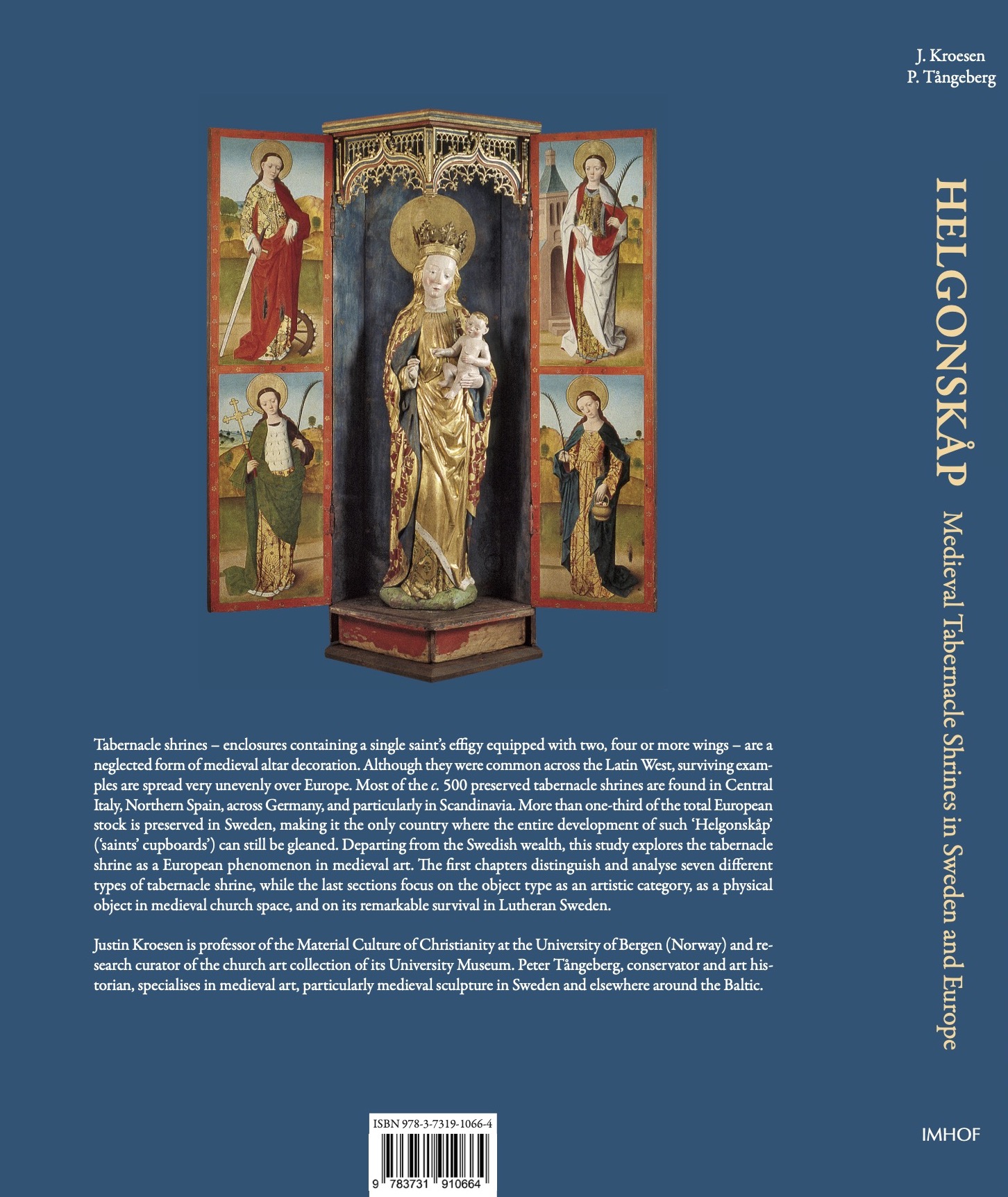
New Publication: ‘Helgonskåp: Medieval Tabernacle Shrines in Sweden and Europe’ edited by Justin Kroesen and Peter Tångeberg

Tabernacle shrines – enclosures containing a single saint’s effigy equipped with two, four or more wings – are a neglected form of medieval altar decoration. Although they were common across the Latin West, surviving examples are spread very unevenly over Europe. Most of the c. 500 preserved tabernacle shrines are found in Central Italy, Northern Spain, across Germany, and particularly in Scandinavia. More than one-third of the total European stock is preserved in Sweden, making it the only country where the entire development of such ‘Helgonskåp’ (‘saints’ cupboards’) can still be gleaned. Departing from the Swedish wealth, this study explores the tabernacle shrine as a European phenomenon in medieval art. The first chapters distinguish and analyse seven different types of tabernacle shrine, while the last sections focus on the object type as an artistic category, as a physical object in medieval church space, and on its remarkable survival in Lutheran Sweden.
On the authors:
Justin Kroesen is professor of the Material Culture of Christianity at the University of Bergen (Norway) and research curator of the church art collection of its University Museum. Peter Tångeberg, conservator and art historian, specialises in medieval art, particularly medieval sculpture in Sweden and elsewhere around the Baltic.
- 22.5 × 30 cm, 352 pages, 414 color and 21 b / w illustrations
- Hardcover, English, ISBN: 978-3-7319-1066-4
 Medieval Art Research