Call for Participants: Studying East of Byzantium VIII: Material Culture (Deadline 13 September 2021)

The Arthur H. Dadian and Ara Oztemel Chair of Armenian Art at Tufts University and the Mary Jaharis Center for Byzantine Art and Culture at Hellenic College Holy Cross in Brookline, MA, are pleased to invite abstracts for the next Studying East of Byzantium workshop: Studying East of Byzantium VIII: Material Culture.

The three-part workshop intends to bring together doctoral students studying the Christian East to reflect on how to study the material world of the Christian East, to share methodologies, and to discuss their research with workshop respondents, Marica Cassis, University of Calgary, and Kate Franklin, Birkbeck, University of London. The workshop will meet on November 19, 2021, February 18, 2022, and June 6–7, 2022, on Zoom. The timing of the workshop meetings will be determined when the participant list is finalized.

The workshop invites doctoral students working in any discipline of East Christian studies to discuss the role of material culture—monuments, archaeological sites, artifacts, images—in their research and to consider questions such as: how can the tools of the study of material culture assist in understanding the realities of the Christian East? What is the difference between material culture and art-historical and archaeological approaches? How does attention to the non-verbal world harmonize with or challenge historical narratives based on textual study?

Participation is limited to 10 students. The full workshop description is available on the East of Byzantium website (https://eastofbyzantium.org/upcoming-events/). Those interested in attending should submit a C.V. and 200-word abstract through the East of Byzantium website no later than September 13, 2021.

For questions, please contact East of Byzantium organizers, Christina Maranci, Arthur H. Dadian and Ara Oztemel Chair of Armenian Art, Tufts University, and Brandie Ratliff, Director, Mary Jaharis Center for Byzantine Art and Culture at contact@eastofbyzantium.org.

East of Byzantium is a partnership between the Arthur H. Dadian and Ara Oztemel Chair of Armenian Art at Tufts University and the Mary Jaharis Center for Byzantine Art and Culture at Hellenic College Holy Cross in Brookline, MA. It explores the cultures of the eastern frontier of the Byzantine Empire in the late antique and medieval periods.

Job Opportunity: Assistant Professor, History of Medieval Christianity, Princeton Theological Seminary (Deadline 15 September 2021)

Princeton Theological Seminary invites applications for a tenure-track position in the History of Medieval Christianity. The research and publication specialization is open. We invite applications from scholars who work on medieval Christianity’s theological, cultural, and social aspects. Candidates must be prepared to teach an introductory survey course on early and medieval church history. Ability and/or experience in teaching courses on the varieties of medieval Christianity beyond Europe, and on the interactions among Christians, Jews, and Muslims in the middle ages is desirable.

The successful candidate will teach in all of the Seminary’s degree programs (M.Div., M.A.C.E.F., M.A.T.S., Th.M., and Ph.D.), pursue an active scholarly research agenda, and participate in the life of the Seminary. As Princeton Theological Seminary is related to the Presbyterian Church (USA), faculty members are expected to work constructively within an ecumenical ethos informed by the Reformed Tradition. 

A letter of interest and curriculum vitae (including bibliography) should be uploaded to the online application site at: https://tns-apps.ptsem.edu/FacultyApplicationMedieval/. The appointment is expected to commence July 1, 2022. Review of applications will begin September 15, 2021.

Those wishing to nominate others for this position are invited to contact Jacqueline Lapsley, Dean of Academic Affairs, at academic.dean@ptsem.edu.

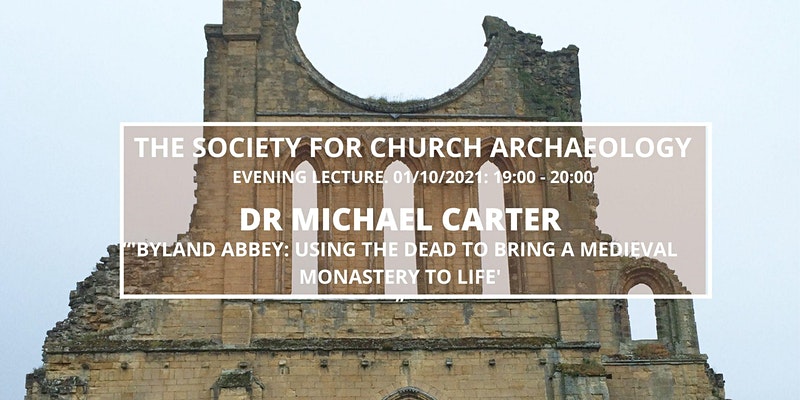
Online Lecture: ‘Romanesque Sculpture in Devon and Cornwall’, with Dr Alex Woodcock, The Society for Church Archaeology, 7 September 2021, 19–20pm (BST)

The Society for Church Archaeology is delighted to welcome Dr Alex Woodcock who will deliver an online lecture on the topic of ‘Romanesque Sculpture in Devon and Cornwall’. Alex is a writer, artist and former cathedral stonemason with a background in buildings archaeology. Their last book, King of Dust, was published in 2019 by Little Toller Books. Alex has written about medieval and modern art for magazines and journals including Resurgence, Elementum, Reliquiae, Shima and The Debutante. Alex had written about medieval sculpture for academic books and journals, and their PhD was on the grotesque in medieval sculpture.

The lecture will be hosted through Zoom and will take place on Tuesday 7th September 2021 from 19:00 to 20:00.

Register here.

Unfortunately this lecture will not be recorded.

Please note: When you register for this talk you will receive an email (with reminders leading up to the event) with a link to a unique Online Event Page. This is where you will be able to access the talk at the scheduled time and date as listed.

Conference Announcement: Fifteenth Century Conference Programme Now Available, Centre for Medieval Studies, University of Bristol, 2-4 September 2021

The draft programme is now available and can be downloaded here.

There is also an information sheet available here

A list of hotels is available here. Hotels need to be booked separately from the registration process for the conference.

(Please note these documents may be updated between now and the conference.)

Registration will open very shortly, with the link posted on the Fifteenth Century Conference website.

All enquiries to: Helen.fulton@bristol.ac.uk

Call for Papers: ‘Medicine in Early Modern Italy: Between Theory and Practice, 1500-1700’, Palazzo Alberti, 19 November 2021 (Deadline 16 September 2021)

Traditionally, the history of medicine in early modern Italy was a field divided sharply into the study of theory and the study of practice, yet this separation was neither equal nor historically justified. Whereas serious attention was given early on to the intellectual foundations of the discipline, far less attention was directed to the consideration of how and when this body of knowledge was translated into practical expressions such as recipes, cures, procedures, and public measures (and vice-versa). A corrective to this imbalance has emerged in the past decades, with scholars adopting, for instance, patient-centered perspectives an exploration of the role of the body, emotions and gender, and the full range of formal and informal practitioners. Further opportunities for understanding the practice of medicine have arisen whenever historians of medicine have engaged with other disciplines, including art and architectural history, religious studies, environmental history, book history, and economic history.


The aim of this conference is to redress the historiographic bifurcation of studies of medical theory and studies of medical practice. We seek papers that reveal the entangled interrelationship between these two realms in a period that was characterized by the rise of empirical experimentation, as well as the growing need to incorporate novel drugs and unfamiliar diseases into the hoary paradigms of professional medicine. The following are examples of the questions that animate interest in this topic: Did physicians’ casebooks make reference to either the utility and/or limitations of medical theory? In what contexts do we encounter recipes that indicate implementation and modification of a theory, such as Galenic humoral medicine or Paracelsian iatrochemistry? What were the challenges and impact on theory and practice of the importation of new medicines through the growth in global trade? What consequences did the academic debate around the influence of Arabic writings have for medical practice? To what degree did an understanding of medical theory matter in the licensing of apothecaries? With the emergence of the printing industry, did the tension between practice and theory expand or shrink? Did prevailing medical theories facilitate or hamper the integration of new discoveries in anatomy and medical botany into the physician’s practice? To what degree was penning a theoretical treatise a catalyst to a lucrative career as a court physician? Did empiricists and quacks ever find it beneficial to adopt the language and concepts of medical theory? Did religious reforms make their impact felt differently in theory versus practice? To what degree could a prince-practitioner eschew theory yet maintain credibility in elite circles?


The conference organizers (John Henderson, Sheila Barker and Rose Byfleet) invite proposals for 25-minute unpublished papers in English or Italian that address the tensions and interplay of practice and theory in medicine, with reference to a wide range of early modern actors and contexts:

  • Botanical Gardens
  • Court physicians
  • Nurses, barber surgeons, wet nurses, midwives, etc
  • Domestic Medicine
  • Apothecaries
  • Recipe Books
  • Hospitals
  • Monasteries and convents
  • Medical Guilds and licensing boards
  • Hippocratic non-naturals and manuals on healthy living
  • Cosmetics and cosmeceuticals
  • Lapidaries and the historical use of gemstones


Confirmed participants: Evelyn Welch, David Gentilcore, Sandra Cavallo, Paolo Savoia, Lavinia Maddaluno, and Sharon Strocchia (pending Covid-19 university policy regulations).

To apply: please prepare a single .pdf document that contains the following items in this sequence: your name, contact information, and institutional affiliation; a one-page summary of your presentation topic; and a maximum of a one-page CV that highlights relevant publications or conference papers. Please send this to education@medici.org by 16 September 2021.

For complete information, visit https://www.medici.org/theoryandpractice/

Call for Papers: ‘Identity Abroad in Central and Late Medieval Europe and the Mediterranean’, University of Cambridge 7-8 January 2022 (Deadline 12 September 2021)

Life in the central and late Middle Ages was characterised by high levels of mobility and migration. Shifts in political, economic, cultural and religious life encouraged and sometimes forced individuals and groups to move ‘abroad’ permanently or temporarily, to places nearby or further afield.

Organisers from the Universities of Cambridge and Oxford invite papers for their upcoming conference Identity Abroad in Central and Later Medieval Europe and the Mediterranean, to be held at Cambridge 7-8 January 2022.

The position and impact of these ‘foreigners’ in societies has been widely discussed. However, what is less considered is how they understood and (re)presented themselves. This conference aims to explore the construction, expression, and practical significance of different forms of social identity among individuals and groups living ‘abroad’ in Europe and the Mediterranean in the period from the eleventh to the fifteenth century.

The conference invites proposals for 20-minute papers from graduate and early career researchers working across all relevant disciplines in the Humanities and Social Sciences. By bringing together a variety of different perspectives, the conference not only aims to consider how ‘identity abroad’ functioned in specific contexts, but also to emphasise developments, patterns, and divergences. Topics of interest include, but are not limited to:

  • Individuals and groups living ‘abroad’, such as merchants, artisans, pilgrims, scholars, diplomats, soldiers, exiles, ethnic and religious minorities, and captives and enslaved people
  • Voluntary or forced, temporary or permanent migration
  • Importance of political allegiance, language, cultural heritage, and faith in identity construction
  • Means of identity expression, such as written production and material culture
  • Relations between different ‘foreign’ individuals and groups
  • Interaction and assimilation/resistance to assimilation with ‘local’ populations, institutions, and rulers
  • Impact of gender, socio-economic background, and other types of differences
  • Theoretical treatments of the concepts of ‘identity’, ‘foreignness’, and ‘abroad’ in the Middle Ages

To submit a proposal, please send an abstract of up to 250 words and a short biographical note to identityabroad22@gmail.com no later than 12th September 2021.

The organisers plan to hold the conference in person in Cambridge, UK. However, this may change to reflect developments relating to Covid-19.

Registration Now Open: Communities and Networks in Late Medieval Europe, International Virtual Conference, 9-10 September 2021

Registration is now open for Communities and Networks in Late Medieval Europe. Register at https://www.eventbrite.co.uk/e/communities-and-networks-in-late-medieval-europe-c-13001500-registration-165407840303

Historical research has witnessed a rapidly growing interest in ‘networks’ since the turn of the twenty-first century, as seen in ambitious endeavours such as the foundation of the Journal of Historical Network Research in 2017. This is due not only to the utility of networks in describing interrelations between historical actors, but also to the adoption of the concepts and methodologies associated with social network analysis (SNA).

Communities and Networks in Late Medieval Europe aims to build on and contribute to this expanding field of research by exploring how the descriptive, conceptual, and methodological tools provided by the study of networks can deepen our understanding of the complex sets of relationships between and within different types of communities in the specific context of the last two centuries of the European Middle Ages. The fourteenth and fifteenth centuries were a time of great political, socio-economic, and cultural change in Europe: the period in question, therefore, offers numerous exciting opportunities (and challenges) for the application of network-based approaches to the study of community dynamics.

You can find the conference programme at https://communitiesandnetworks21.files.wordpress.com/2021/08/communities-and-networks-in-late-medieval-europe-c.-1300e280931500.pdf

You can also visit the website (https://communitiesandnetworks21.wordpress.com) and follow on Twitter at @commsandnets21.

Call for Papers: ‘New Research on Medieval Parish Church Art & Architecture I & II’, ICMS Kalamazoo, 9-14 May 2022, (Deadline 15 September 2021)

Parish churches were a fundamental feature of the cities, towns, and villages of medieval Europe. Founded to serve the spiritual needs of local populations, these buildings quickly became epicenters of public life, accommodating functions that ranged from religious services, processions, and pageants to secular assemblies, tax collection, and alms distribution. Surviving examples, which number in the tens of thousands, are home to countless works of architecture, sculpture, stained glass, wall painting, and liturgical furniture–much of it vastly understudied. These sessions seek to explore this extensive corpus of material from a range of temporal, regional, disciplinary, theoretical, and methodological perspectives. Especially welcome are contributions that reflect on how evolving research on the art and architecture of the parish church broadens, deepens, and transforms our understanding of medieval society.

For further information, please contact Zachary Stewart (zstewart@arch.tamu.edu). Proposals should be submitted online at https://wmich.edu/medievalcongress/call. The deadline to submit is 15 September 2021.

Post-Doctoral Fellowship: Research Fellowship in the History and Culture of the Countries of the Silk Roads, 2022-2026, King’s College, Cambridge (Deadline 6 September 2021)

Through a generous donation, King’s College Cambridge is able to invite applications for a four-year Research Fellowship from those who are completing or have recently completed a doctorate and who intend to pursue a research project on some aspect of the Silk Road countries, societies, and cultures of Asia from the Western borders of China to the Mediterranean Sea, as well as their relationships with China in the East and Europe in the West. The research project’s discipline may address, amongst other issues, Environmental History, Religion, Art, Maritime History, China before 1911, Ottoman Empire, and Russian Central Asia, but applicants should not feel constrained by this list.

This Research Fellowship is part of a broader programme of studies of the countries of the Silk Roads, which includes lectures, seminars and conferences, as well as graduate scholarships and further Research Fellowships. As well as pursuing their own research project, the successful candidate will be expected to play an active role in developing the programme and in organizing academic activity concerned with the countries of the Silk Road.

This post-doctoral Fellowship is intended to encourage research into the Silk Roads and the countries of the Silk Roads by enabling the successful candidate to complete a substantial research project on their own choosing. Projects may concern any aspect of the countries, societies, and cultures of the Silk Roads, from the Western borders of China to the Mediterranean Sea, and of the Silk Roads themselves, that is to studies of relationships and the movement of materials, knowledge, and technologies between China and the Mediterranean, at any period to the present day.

The ideal candidate for this Research Fellowship will have a strong background in a relevant discipline and be completing or have completed an outstanding doctoral thesis. It is not a requirement that the candidate’s doctoral studies or the work that they submit in support of their application should have concerned questions of the Silk Roads specifically, but candidates will be expected to show in their applications both how their future work relates to the work that they have already done. The successful candidate will be expected to engage broadly with the whole college community.

Graduates of any university are eligible. Candidates will usually have completed their PhD but must not have undertaken more than 3 years of postdoctoral work by 1 October 2022 (i.e. your PhD cannot have been granted before 30 September 2019).

For complete information and instructions on how to apply, visit https://www.kings.cam.ac.uk/research/research-fellowships

Call for Papers: The Dynamics of Media and Technology: From the Middle Ages to the Modern Classroom (Deadline 1 September 2021)

As the digital age has shaped our ways of viewing ourselves, society, and culture is has also reframed and revealed new perspectives on viewership and ritual. We invite proposals for an edited volume that seeks to explore the effects of this digital age on Medieval and Early modern studies. This collection of essays aims to engage in both the examination of medieval media, mediation, and technology from a theoretical framework. The second grouping of essays aims to explore how the digital humanities have shaped Medieval and Early Modern studies today. 

We seek papers that explore these topics. Among others, we encourage submissions that are concerned with issues of technological and material manipulation, as well as mnemonic devices, perception, tech methodology, and pedagogy. Essays should be 5000-7000 words. Authors are responsible for securing copyrights to all images, diagrams, graphs, etc.

We welcome all aspects of Medieval and Early Modern studies (musicology, art history, history, literature, language, philosophy, science, religion, law, history of the church, etc.) Trans-European, visual culture, global medievalism, modern medievalism, and interdisciplinary approaches are particularly welcome.  

Submissions: To apply, please submit two abstracts : 1 ) 400-500 words; and 2) about 100 words. a short biographical note of no more than 100 words, and your institutional affiliation (if any), to Katharine.d.Scherff@ttu.edu. Deadline extended 1 Sept 2021.