CFP: Sequitur – BU Graduate Student Art History Journal

Department of History of Art & Architecture at Boston University
Deadline: Feb 12, 2018
titlebar
SEQUITUR Issue 4: 2
Spring 2018
CFP: Extra

The editors of SEQUITUR, a graduate student journal published by the Department of History of Art & Architecture at Boston University, invite current graduate students in art history, architecture, fine arts, and related fields to submit content on the theme of Extra for the Spring 2018 issue.
Continue reading “CFP: Sequitur – BU Graduate Student Art History Journal”

CFP: Digital Humanities for Academic and Curatorial Practice (Rome, 23 – 24 May 18)

Biblioteca Angelica di Roma and American Academy in Rome, Italy, May 23 – 24, 2018
Deadline: Mar 1, 2018
DIGITAL HUMANITIES FOR ACADEMIC AND CURATORIAL PRACTICE

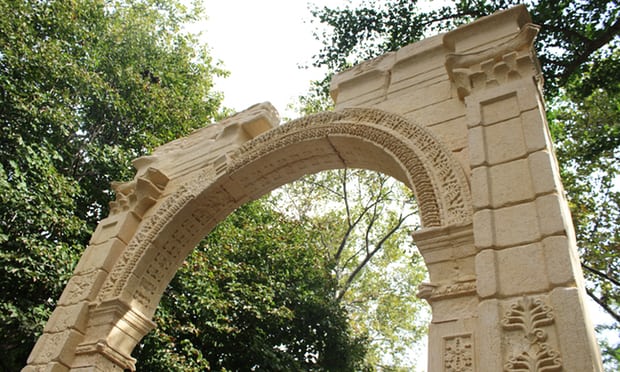
The Digital Humanities have challenged all disciplines of Art History to engage with new interdisciplinary methodologies, learn new tools, and re-evaluate their role within academia. In consequence, art historians occupy a new position in relation to the object of study. Museums have been equally transformed. The possibilities of creating virtual realities for lost/inaccessible monuments poses a new relationship between viewer and object in gallery spaces. Digital Humanities interventions in museums even allow us to preserve the memory of endangered global heritage sites which cease to exist or are inaccessible (celebrated examples including the lost Great Arch of Palmyra reconstructed with a 3D printer). Curatorial practices are now trending towards a sensorial and experiential approach.

arch of palmyra.jpg
Continue reading “CFP: Digital Humanities for Academic and Curatorial Practice (Rome, 23 – 24 May 18)”

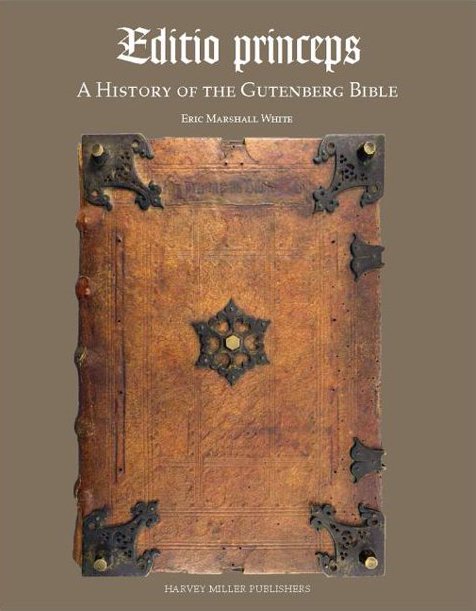
Book round-up: A History of the Gutenberg Bible, by Eric Marshall White

The Gutenberg Bible is widely recognized as Europe’s first printed book, a book that forever changed the world. However, despite its initial impact, fame was fleeting: for the better part of three centuries the Bible was virtually forgotten; only after two centuries of tenacious and contentious scholarship did it attain its iconic status as a monument of human invention. Editio princeps: A History of the Gutenberg Bible is the first book to tell the whole story of Europe’s first printed edition, describing its creation at Mainz circa 1455, its impact on fifteenth-century life and religion, its fall into oblivion during the sixteenth and seventeenth centuries, and its rediscovery and rise to worldwide fame during the centuries thereafter. This comprehensive study examines the forty-nine surviving Gutenberg Bibles, and fragments of at least fourteen others, in the chronological order in which they came to light. Combining close analysis of material clues within the Bibles themselves with fresh documentary discoveries, the book reconstructs the history of each copy in unprecedented depth, from its earliest known context through every change of ownership up to the present day. Along the way it introduces the colorful cast of proud possessors, crafty booksellers, observant travelers, and scholarly librarians who shaped our understanding of Europe’s first printed book. Bringing the ‘biographies’ of all the Gutenberg Bibles together for the first time, this richly illustrated study contextualizes both the historic cultural impact of the editio princeps and its transformation into a world treasure.

Eric Marshall White, PhD, became Curator of Rare Books at Princeton University Library in 2015 after eighteen years as Curator of Special Collections at Southern Methodist University’s Bridwell Library. A specialist in early European printing, he has published numerous articles and exhibition catalogues on rare books.

More Info: http://bit.ly/2kuyQW8

CFP: (Re-)Forming Sculpture (Leeds, 26-27 Jun 18)

350px-Perrecy-les-Forges_01University of Leeds and The Hepworth Wakefield, June 26 – 27, 2018
Deadline: Mar 16, 2018

Call for Papers for the Association for Art History’s 2-day Summer Symposium organised by the Doctoral and Early Career Research Network.

Keynote Speakers:

Martina Droth, Deputy Director of Research, Exhibitions, and Publications | Curator of Sculpture, Yale Center for British Art

Dr Rebecca Wade, Assistant Curator (Sculpture), Leeds Museums and Galleries, based at the Henry Moore Institute

Paper proposal deadline: 16 March 2018

Continue reading “CFP: (Re-)Forming Sculpture (Leeds, 26-27 Jun 18)”

Re-opening the Workshop: Medieval to Early Modern (London, 31 Jan-27 Jun 18)

Warburg Institute, Woburn Square, London WC1H 0AB, January 31 – June 27, 2018

Re-opening the Workshop: Medieval to Early Modern

e986ba7faa2ca55eff27486400168447--leather-apron-workshop-designWorkshop and workshop practices represent a core and dynamic research strand in the history of art. This strand encompasses the study of canonical artists but equally of the anonymous producers whose activities can be deduced from the surviving art objects, thanks to ever developing research questions and methodologies. This topic helps us to think about the agents and their networks (artists, patrons and other market consumers), objects and socio-economic factors (making, buying and trading) as well as the broader cultural issues of the transmission of skills and ideas (the movement of artists, objects and imagery). Our lecture series brings together leading experts in medieval and early modern historical periods in and beyond Europe, particular highpoints for the study of workshop practices, and also those researching workshop continuities and changes in later centuries, including digital mediation.

Continue reading “Re-opening the Workshop: Medieval to Early Modern (London, 31 Jan-27 Jun 18)”

Book roundup: New titles in medieval art

JOANNA CANNON, BETH WILLIAMSON (ed.). Art, Politics and Civic Religion in Central Italy 1261-1352: Essays by Postgraduate Students at the Courtauld Institute of ArtRoutledge, 2017 (reedición), 328 p.
ISBN: 978-1138702585

central-italy-religionThis was first published in 2000: Introduced by Joanna Cannon, this volume of essays by postgraduate students at the Courtauld Institute, University of London, explores some of the ways in which art was used to express, to celebrate, and to promote the political and religious aims and aspirations of those in power in the city states of central Italy in the thirteenth and fourteenth centuries. The contributions focus on four centres: Siena, Arezzo, Pisa and Orvieto, and range over a number of media: fresco, panel painting, sculpture, metalwork, and translucent enamel. Employing a variety of methods and approaches, these stimulating essays offer a fresh look at some of the key artistic projects of the period. The dates cited in the title, 1261 and 1352, refer to two well-known works, Coppo di Marcovaldo’s Madonna del Bordone and the Guidoriccio Fresco in the Palazzo Pubblico of Siena, here newly assigned to this date. By concentrating on individual cases such as these, the essays provide rewardingly sustained consideration, at the same time raising crucial issues concerning the role of art in the public life of the period. These generously-illustrated studies introduce new material and advance new arguments, and are all based on original research. Clear and lively presentation ensures that they are also accessible to students and scholars from other disciplines. Art, Politics and Civic Religion in Central Italy, 1261-1352 is the first volume in the new series Courtauld Institute Research Papers. The series makes available original recently researched material on western art history from classical antiquity to the present day.


ANDREA DE MARCHI, CRISTINA GNONI. Legati da una cintola. L’«Assunta» di Bernardo Daddi e l’identità di una cittàMandragora, 2017, 255 p.
ISBN: 978-8874613571

mandragoraLa Sacra Cintola, la cintura della Vergine custodita nel Duomo che per secoli è stata il tesoro più prezioso di Prato, è un simbolo religioso e civile, fulcro delle vicende artistiche della città ed elemento cardine della sua identità. La sottile striscia (di 87 centimetri) di lana di capra broccata in filo d’oro è il fulcro di un’esposizione che comprende altre opere di valore, prima tra tutte la pala di Bernardo Daddi del 1337-1338 che racconta la leggenda di come la reliquia sia stata consegnata a San Tommaso dalla Madonna al momento dell’Assunzione, sia stata portata a Prato verso il 1141 dal mercante pratese Michele Dagomari e da questi donata nel 1172, alla pieve della città.
Il catalogo dell’esposizione illustra, oltre naturalmente alla reliquia solitamente conservata nella cappella di Agnolo Gaddi nel Duomo, la serie di dipinti, sculture e miniature in mostra, che testimoniano le varie elaborazioni del tema dell’Assunta che dona la propria cintola.
In aggiunta, testi e foto propongono lo studio della cappella affrescata da Gaddi, la prepositura di Santo Stefano, le ostensioni che abitualmente avvengono a Prato e la storia del suo culto nei secoli.


LIZ JAMES. Mosaics in the Medieval World: From Late Antiquity to the Fifteenth CenturyCambridge University Press, 2017, 625 p.
ISBN: 978-1107011984

mosaicsIn this book, Liz James offers a comprehensive history of wall mosaics produced in the European and Islamic middle ages. Taking into account a wide range of issues, including style and iconography, technique and material, and function and patronage, she examines mosaics within their historical context. She asks why the mosaic was such a popular medium and considers how mosaics work as historical ‘documents’ that tell us about attitudes and beliefs in the medieval world. The book is divided into two part. Part I explores the technical aspects of mosaics, including glass production, labour and materials, and costs. In Part II, James provides a chronological history of mosaics, charting the low and high points of mosaic art up until its abrupt end in the late middle ages. Written in a clear and engaging style, her book will serve as an essential resource for scholars and students of medieval mosaics
Read more at http://www.cambridge.org/gb/academic/subjects/arts-theatre-culture/western-art/mosaics-medieval-world-late-antiquity-fifteenth-century#MoOXkhqSpjBV534f.99

New Publication: St. Albans and the Markyate Psalter: Seeing and Reading in Twelfth-Century England, Edited by Kristen Collins and Matthew Fisher

One of the most compelling and provocative books of twelfth-century England, the Markyate Psalter was probably produced at St. Albans Abbey between 1120 and 1140. The manuscript has been known by many names: the St. Albans Psalter, the Albani Psalter, the Hildesheim Psalter, and the Psalter of Christina of Markyate. Heralded as a high point of English Romanesque illumination, the manuscript contains the earliest known copy of the saint’s life known as Chanson de St. Alexis. This volume explores the manuscript’s many contexts, reading its texts and images amidst the rising internationalism of the period, marked by the circulation of objects, ideas, and peoples. Some of the leading scholars of twelfth-century manuscript studies here explore the Markyate Psalter, understanding it through new methodologies, pursuing innovative lines of inquiry. The collection shines fresh light on a well-known manuscript, and promises to open important lines of discourse about the book and its readers.

Contents

Abbreviations
Illustrations
Introduction by Kristen Collins and Matthew Fisher
Saint Anselm’s “Grand Tour” and the Full-Page Picture Cycle in the Markyate Psalter by T. A. Heslop
The Patronage and Ownership of the Markyate Psalter by Nigel Morgan
Handling the Letter by Aden Kumler
The Repainting of Psalm 101 and Meaningful Change in the Markyate Psalter by Kristen Collins and Nancy K. Turner
Voicing the Psalms in the Markyate Psalter: Devotional Experience and Experiments with Images and Words by Kerry Boeye
Intercessory Prayer and the Initials of the Markyate Psalter by Rachel Koopmans
La Vie de Saint Alexis and the Alexis Quire in the Crusading Context by Zrinka Stahuljak
The Psalmist and the Saint: David, Alexis, and the Construction of Meaning in a Twelfth-Century Composite Manuscript by Kathryn Gerry
Blindness and Insight, Seeing and Believing: Reading Two Emmaus Sequences from St. Albans by Morgan Powell
Praying with Pictures in the Gough Psalter by Martin Kauffmann
Madness and Innocence: Reading the Infancy Cycle of a Romanesque Vita Christi by Kristen Collins
The St. Albans Psalter Monograph of 1960: Fifty Years Later by J. J. G. Alexander

Author Bio(s)

Kristen Collins is associate curator in the Department of Manuscripts at the J. Paul Getty Museum.

Matthew Fisher is associate professor of English at the University of California, Los Angeles.

CONF: Medieval and Early Modern Spaces and Places (Milton Keynes, 23-24 Feb 18)

MEM posterThe Open University, Milton Keynes, UK, February 23 – 24, 2018

The Open University will be hosting their annual two-day conference on Medieval and Early Modern Spaces and Places
The conference will examine life in buildings, institutions and broader geographical areas from a variety of perspectives and will consider the following questions:

How were medieval and early modern spaces adapted and transformed through the movement of material and immaterial things?
Which particular aspects of political, social and economic infrastructures enabled the exchange of objects and ideas?
To what extent did a sense of place depend upon the activities taking place there?

further details here: http://www.open.ac.uk/arts/research/medieval-and-early-modern-research/spaces-places

Registration here: https://www.eventbrite.co.uk/e/medieval-and-early-modern-spaces-and-places-23-24-february-2018-tickets-42041521322

Continue reading “CONF: Medieval and Early Modern Spaces and Places (Milton Keynes, 23-24 Feb 18)”

Seminar-Workshop “Medieval Royal Imagery: Politics or Religion ?”

Wenceslaus_IV_Charles_V_of_France_Emperor_Charles_IV.jpgUniversity of Fribourg
March 12th 2018
Room MIS04 Jäggi

Prof. Michele Bacci (University of Fribourg)
Prof. Ludger Körntgen (University of Mainz)
Prof. Knut Görich (University of Munich)
Dr. Mirko Vagnoni (University of Fribourg)

Continue reading “Seminar-Workshop “Medieval Royal Imagery: Politics or Religion ?””

Lecture: Felipe Pereda, ‘Images’ Oblivious Memory: Funerary Laments from Ancient Greece to El Greco’. Courtauld Institute of Art, London, 4pm, Thursday 25th January, 2018

Pereda

Felipe Pereda (Harvard), will give the inaugural lecture for the 2018-19 Coll & Cortes Medieval Spain Seminar Series at 4pm on Thursday 25th January in the Kenneth Clark Lecture Theatre of the Courtauld Institute of Art, London.

An old narrative tradition going back to Ancient Egypt but documented across the Mediterranean – from the Middle East to Greece — shows women attending funerals performing theatrical, but also highly ritualized gestures that express unbearable pain. This visual trope corresponds to a practice that was surveyed and prosecuted in this part of the world well before the arrival of Christianity. The practice continued in Iberia throughout the Middle Ages, producing from the 12th century onwards an extraordinary tradition of painting and monumental sculpture. This lecture will explore the persistence, survival and repression of this practice and discuss the contribution of the visual arts to the production of cultural memory.


Felipe Pereda is Fernando Zóbel de Ayala Professor of Spanish Art at Harvard University. Born in Madrid, he studied at the Universidad Complutense, and the Autónoma University where he received his PhD (1995) and taught until 2011. In more recent years, he has also taught at the Instituto de Investigaciones Estéticas (Universidad Autónoma de México), and Johns Hopkins University (2011-15). He has worked on Spanish late medieval and early modern art, art theory, image theory and history of architecture.

His books include, La arquitectura elocuente (1999), El atlas del Rey Planeta (3rd. ed. 2003), and Images of Discord. Poetics and Politics of the Sacred Image in 15th century Spain (Spanish ed. 2007; English translation, Harvey Miller, forthcoming). He has recently published on artists such as Luis de Morales, Ribera, or Zurbarán.