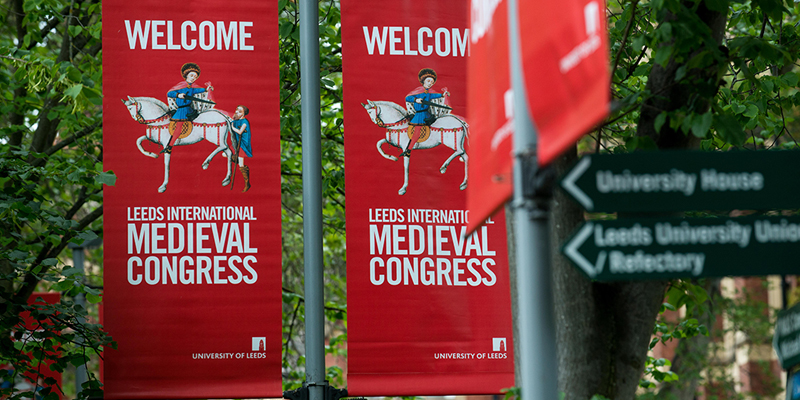
Whilst the International Medieval Congress cannot take place in person, the wonderful committee have organised a virtual conference to take place. Drawing medievalists from around the world, the virtual International Medieval Congress 2020 (vIMC) is their first foray into the world of virtual conferencing. There are over 500 speakers across 5 days, as well as virtual exhibitions, book and craft fairs, socialising and networking opportunities aplenty.
We’ve had a look through the programme and have brought together all the Medieval Art related papers and panels. Please let us know if we’ve missed a panel or paper that you think Medieval Art Researchers would like to know about! You can see the full programme here.
vIMC will run from Monday 6 July – Friday 10 July 2020, 09.00-18.00 BST.
Monday 6th July 2020
16.30-18.00
Session: v3-06 | Virtual Session Room 6 | Panel: Manuscripts, Texts, and Transmission, III
Paper v3-06-a: Imaging Techniques for the Classification of Ink Types in Medieval Manuscripts: Revealing More than Text, Ivan Shevchuk, Exzellenzcluster ‘Understanding Written Artefacts’, Universität Hamburg
Paper v3-06-b: Deploying Linked Data for Medieval Manuscript Provenance Research, Toby Burrows, Oxford e-Research Centre, University of Oxford
Paper v3-06-c: Within the Limits: Keeping the Outer Edge of Text Straight, Linda Mikulenková, Department of Auxiliary Historical Sciences & Archival Studies, Univerzita Karlova, Praha
Paper v3-06-d: The Protection of Manuscripts during Medieval Times: Techniques Crossing Borders, Hassan Ebeid, Postgraduate Institute of Papyrology, Inscriptions & Conservation (PIPIC), Ain Shams University, Cairo
18.30-19:00
Fringe Session: Blogging Manuscripts with Polonsky German
Organiser: Oxford Medieval Studies / Bodleian Libraries / The Oxford Research Centre in the Humanities (TORCH), University of Oxford
Speakers: Tuija Ainonen, Merton College, University of Oxford, Andrew Dunning, Bodleian Libraries, University of Oxford, Henrike Lähnemann, Faculty of Medieval & Modern Languages, University of Oxford & Matthew Holford, Bodliean Libraries, University of Oxford
How can we best use the wealth of digitized medieval manuscripts to bring medieval studies to new audiences? The Bodleian Library launches the #PolonskyGerman blogging challenge with reflections on how universities and libraries can expand their public reach through teaching palaeography, the history of the book, and digital humanities. This is the first of three interactive sessions that will give participants the opportunity to collaborate on presenting everyday manuscripts to the public.
Pre-booking is required to attend this free event. Instructions to book your place will be available within the vIMC app.
19.30-21.00
Virtual Session Room 9 | Discover Cyrillic Calligraphy
Organiser: Anastasija Ropa, Department of Management & Communication Science, Latvian Academy of Sport Education, Riga and Edgar Rops, Independent Scholar, Riga
Cyrillic calligraphy flourished throughout the Middle Ages and well into the early modern period; today, it is experiencing a revival among Slavic practitioners, even though it largely remains a mystery in the western world.
This workshop will introduce the historical and modern practice of Cyrillic calligraphy, not only presenting the alphabet in the uncial and the semi-uncial scripts, but also presenting the numerical symbols and the most common abbreviations. We will also show some traditional decorative patterns using pen and ink.
The workshop will be interesting also for those familiar with other calligraphy traditions, but no prior calligraphy experience or knowledge of Old Church Slavonic is necessary. During the workshop, we will show a step-by-step process of copying a medieval illuminated chronicle or gospel fragment. We will also give the participants a list of recommended materials to practice and produce your own calligraphic work.
Edgar and Anastasija study the medieval and early modern documents produced in Livonia, at the crossroads of eastern and western traditions of writing, and the artistic practices that went into the decoration of historical documents, presenting their research at international venues, with peer-reviewed publications to their credit. Edgar is a lawyer and legal historian by education, with a passion for historical calligraphy. He has also organised calligraphy workshops for general audiences, both with and without experience in calligraphy, and calligraphy-based team-building activities. Anastasija holds a PhD for a study of romance, with a long-standing interest in manuscripts and charters produced and circulated in medieval and Renaissance Livonia.
Tuesday 7th July 2020
11.15-12.45
Session: v5-06 | Virtual Session Room 6 | Panel: The Artefactuality of the Codex: Form and Content in Manuscript Making in Medieval Europe
Paper v5-06-a: ‘In my own hand’: Homemade Prayer Books, Anne Mette Hansen, Den Arnamagnæanske Samling, Københavns Universitet
Paper v5-06-b: Mise-en-page as Data Structure: Fredegar’s (Mis)Epitomisation of Jerome, Alessandro Gnasso, Independent Scholar, Rome
Paper v5-06-c: The Codex as a Compilatio: Historiography in Multitext Manuscripts, N. Kıvılcım Yavuz, Kenneth Spencer Research Library, University of Kansas
16.30-18.00
Session: v7-02 | Virtual Session Room 2 | Panel: The Fantastic, The Monstrous, and the Grotesque, II
Paper v7-02-a: Borders, Fluidity, and Infinity in the Images of the 10,000 Martyrs, Yael Elias, Department of Art History, Tel Aviv University
Paper v7-02-b: Enslaved Giants: Ascopard’s Monstrosity and Mitigation in the Middle English Bevis of Hampton, Charlotte Ross, Independent Scholar, Bristol
Paper v7-02-c: Dancers from Abroad: Gothic Marginal Illustrations Featuring ‘Others’, Zofia Marianna Załęska, Institute of Art History, University of Warsaw
19.00-20.00
Zoom via vIMC app | Fringe Session: The Trouble with Dragons: Book Discussion and Q&A Session about Paradise: The World of Romanesque Sculpture by Rita Wood
A discussion and Q&A session with Rita Wood, author of Paradise: The World of Romanesque Sculpture. Rita’s interest goes beyond art history and this session will be of interest to medieval historians of religion and society. Attendees will have the opportunity to raise and discuss questions as well as learn more about the author’s reasons for writing the book.
This event will be hosted on Zoom and a link will be available within the vIMC app.
Wednesday 8th July 2020
09.00-10.30
Session: v8-08 | Virtual Session Room 8 | Panel: Affect and Effect: Experiencing and Sharing Emotions
Paper v8-08-a: Humour on the Borders of Texts and Images: The Case of the Rutland Psalter, Elena Lichmanova, School of History, Higher School of Economics, Moscow
Paper v8-08-b: Atheism and the Emotions in the Long 12th Century, Keagan Brewer, Medieval & Early Modern Centre, University of Sydney
Paper v8-08-c: An Illuminated Book of Comedies for the Duke of Berry, Kleio Pethainou, Edinburgh College of Art, University of Edinburgh
Paper v8-08-d: Humour and the Individual, c. 1150-1250, Peter J. A. Jones, School of Advanced Studies, University of Tyumen, Russia
11.15-12.45
Session: v9-07 | Virtual Session Room 7 | Panel: British Archaeological Association: Borders Of Authority and Death
Paper v9-07-a: Life in the Shadow: Power Relations in Medieval Wensleydale, Erik Matthews, Hornby Castle Project, Northallerton
Paper v9-07-b: Havens for Burial: The Convents of Constantinople and Their Female Founders, Cecily Hennessy, Christie’s Education, London
11.15-12.45
Session: v9-08 | Virtual Session Room 8 | Panel: Visualising the World in Christianity and Islam
Paper v9-08-a: The Shebanization and the Birth of the Ethiopian Nation, 14th-16th Centuries, Deresse Ayenachew, Institut de Recherches et d’Études sur les Mondes Arabes et Musulman (IREMAM – UMR 7310), Aix-Marseille Université / Department of History & Heritage Management, Debre Berhan University, Ethiopia
Paper v9-08-b: The Legacy of Classical Antiquity in Early al-Andalus, Jorge Elices Ocón, Escola de Filosofia, Letras e Ciências Humanas, Universidade Federal de São Paulo
Paper v9-08-c: The Idea of Borders and its Realisation in the Geographical Compendium of the 10th-Century ‘Kitab al-Alak al-Nafisa’ (‘A Book of Precious Things’) by Ibn Rusta, Iryna Arlova, Centre for Medieval Studies, National Research University Higher School of Economics, Moscow
14.15-15.45
Session: v10-08 | Virtual Session Room 8 | Panel: Blurred Boundaries Between the Sacred and the Secular, I: Manuscripts’ Decorations and Representations
Organiser: Dafna Nissim, Department of the Arts, Ben-Gurion University of the Negev, Beer-Sheva
Moderator: Vered Tohar, Department of Literature of the Jewish People, BarIlan University, Ramat-Gan
Paper v10-08-a: Secular and Devotional Symbolism in Jewellery Depictions: A Comparison between Flemish and Italian Book Illumination, Serena Franzon, Dipartimento dei Beni Culturali, Università degli Studi di Padova
Paper v10-08-b: The Secular and the Sacred in an Illustrated Opening from the Book of Hours of Louis of Laval, Dafna Nissim, Department of the Arts, Ben-Gurion University of the Negev, Beer-Sheva
Paper v10-08-c: The Economics of Penitential Pedagogy: Accounting for Sin in the Vernon Paternoster Diagram, Haijiang Jiang, Department of English, Northwestern University
Paper v10-08-d: The Heavenly Banquet: Musical Imagery in the Archbishop’s Palace of Santiago de Compostela, Earthly and Heavenly United, Avia Shemesh, Department of Art History, Hebrew University of Jerusalem
16.30-18.00
Session: v11-03 | Virtual Session Room 3 | Panel: Ecclesiastical Borders
Paper v11-03-a: Erasing Antiquity: Spolia as a Form of Damnatio Memoriae in the Church of Mary in Ephesus, Mali Skotheim, Warburg Institute, University of London
Paper v11-03-b: The Stave Church as Border Control: An Art-Historical Examination of Norse Church Portals and their Role in Legitimising Christian Norms, Ryan Stone, Independent Scholar, Vancouver
Paper v11-03-c: A Fixed Point in Time: Enclosed Textuality in the Anchorhold, Brenna Duperron, Department of English, Dalhousie University, Nova Scotia
16.30-18.00
Session: v11-07 | Virtual Session Room 7 | Panel: Patrons and Elites
Paper v11-07-a: Where Did 15th-Century English Patrons Get Their Tapestries From?, Lesley Fraser, School of History of Art, Edinburgh College of Art / Centre for Open Learning (COL), University of Edinburgh
Paper v11-07-b: Stained Glass Patronage in the Late Middle Ages: Salvation and Status in the Church of St Michael-le-Belfrey, Lisa Reilly, Department of Architectural History, University of Virginia
Paper v11-07-c: ‘With modest men they modest be, with sober they be graue’ / ‘With lewd and naughtie companie, they also play the knaue’: Minstrels and Class Boundaries in Renaissance England, Csilla Virág, Department of Medieval & Early Modern History, Eötvös Loránd University, Budapest
18.30-19.00
Fringe Session: Teaching the Digital Codex
Organiser: Oxford Medieval Studies / Bodleian Libraries / The Oxford Research Centre in the Humanities (TORCH), University of Oxford
Speakers: Mary Boyle (Oxford), Julia Walworth (University of Oxford), Leonor Zozaya-Montes (University of Las Palmas de Gran Canaria)
How can we best use the wealth of digitized medieval manuscripts to bring medieval studies to new audiences? Since 2016, Teaching the Codex has brought together teachers to develop more engaging pedagogical approaches to palaeography and codicology, with both regular colloquia and a long-running blog. Mary Boyle shares the knowledge she gained in launching a successful manuscripts movement from scratch, with reflections from Leonor Zozaya-Montes on the process of writing for the project blog. Julia Walworth will present some of Merton’s digitised manuscripts as possible subjects for a blog post. The challenge here would be to use digitised items fora ‘teachable feature’; for examples look at previous ‘teachable features’ blogs.
Pre-booking is required to attend this free event. Instructions on how to book your place will be found within the vIMC app.
19.00-19:30
Zoom through vIMC app | Online International Summer School in Medieval Palaeography (Università di Verona and Biblioteca Capitolare, 7th-11th September 2020) Presentation
Organiser: Marco Stoffella, Dipartimento Culture e Civiltà, Università degli Studi di Verona
During this event we will briefly present the second edition of the online International Summer School in Medieval Palaeography. Due to the effects of the Covid-19 pandemic outbreak, the 2020 edition is offered only via a digital platform (Moodle). Exploring the outstanding original Late Antique and Medieval writing materials preserved at the Biblioteca Capitolare, the ‘Queen of all Late Antique and Medieval Libraries’ (according to E.A. Lowe), we will provide an overview of the main elements of Latin palaeography. The course consists of pre-recorded talks and lectures and of live Zoom meetings with practical exercises, reading, and transcribing several different types of script. It is also open to students with some experience in Latin and Greek palaeography who wish to refresh or improve their skills.
This event will be hosted on Zoom and a link will be available within the vIMC app.
Thursday 9th July 2020
09.00-10.30
Session: v12-01 | Virtual Session Room 1 | Panel: Approaches to Medieval Sculpture
Paper v12-01-a: From Wendron to the Western Isles: Cross-Border Approaches to High Crosses, Christina Cowart Smith, Department of Archaeology, Durham University
Paper v12-01-b: Death, Burial, and Memorialisation at Furness Abbey, Michael Carter, Curatorial Department, English Heritage, London
09.00-10.30
Session: v12-03 | Virtual Session Room 3 | Panel: Constructing and Deconstructing Medieval Boundaries
Organiser and Moderator: Rob Meens, Departement Geschiedenis en Kunstgeschiedenis, Universiteit Utrecht
Paper v12-03-c: Draconcopedes in the Iconography of the Fall, Isabelle van Leeuwen, Utrecht Centre for Medieval Studies, Universiteit Utrecht
11.15-12.45
Session: v13-05 | Virtual Session Room 5 | Interreligious Relations
Paper v13-05-b: Rebellious and Well-Fortified: Murcia’s Border Architecture in the Prism of Iberia’s Interreligious Relations, Michael A. Conrad, Kunsthistorisches Institut, Universität Zürich
11.15-12.45
Session: v13-06 | Virtual Session Room 6 | Panel: Bodily Dimensions: Sensual and Supernatural Borders, I
Organiser: Jack Ford, Department of History, University College London
Moderator: Ann R. Christys, Independent Scholar, Leeds
Paper v13-06-c: Imagined Bodies in Medieval Sufism: Bodily Discipline and Representation in Sufi Dream Manuals, Eyad Abuali, Departement Filosofie en Religiewetenschap, Universiteit Utrech
11.15-12.45
Session: v13-07 | Virtual Session Room 7 | Panel: Pagans, Iconoclasts, and Medieval Violence
Paper v13-07-b: The Floor Mosaic in the Church of the Virgin in Madaba, Jordan: A Case of Iconoclasm?, Mathilde Sauquet, Faculty of History / St Stephen’s House, University of Oxford
14.15-15.45
Session: v14-04 | Virtual Session Room 4 | Panel: Responses to English Saints
Paper v14-04-a: Replacing Becket: Building a 12th-Century Shrine in 1930s Canterbury, John Jenkins, Centre for the Study of Christianity & Culture, University of York
Paper v14-04-b: Virtual Pilgrimage and After-Vitae: Revisiting Saints’ Lives, Emma Nuding, Centre for Medieval Studies, University of York
Paper v14-04-c: Becket in the Holy Land: Recording Thomas Becket in William of Tyre’s Historia, Giles Connolly, Department of History, University of Birmingham
14.15-15.45
Session: v14-05 | Virtual Session Room 5 | Panel: Jewish Manuscripts and Manuscript Art
Paper v14-05-a: Beyond the Borders of Jewish and Christian Art and Exegesis in Illustrated Copies of Nicholas of Lyra’s Postilla, 1333-1481, Sarah Bromberg, Department of Humanities, Fitchburg State University, Massachusetts
Paper v14-05-b: Mesianismo judío en los comienzos de la iconoclastia, c. 720- 725 (Language: Espanol) Carlos Martínez Carrasco, Centro de Estudios Bizantinos, Neogriegos y Chipriotas, Universidad de Granada
18.00-18.30
Fringe Session: Iconophilia: Politics, Religion, Preaching, and the use of images in Rome, c.680 – 880: Book Presentation and Discussion
Organiser: Francesca Dell’Acqua, Dipartimento di Scienze del Patrimonio Culturale (DISPAC), Università degli Studi di Salerno, Celia Chazelle, Department of History, College of New Jersey, and Clemens Gantner, Institut für Mittelalterforschung, Österreichische Akademie der Wissenschaften, Wien
A Presentation and discussion open to all participants of the book Iconophilia: Politics, Religion, Preaching, and the Use of Images in Rome, c.680 – 880, published in May 2020 by Francesca Dell’Acqua with Routledge. By drawing evidence from texts and material culture – some of which have yet to be discussed against the background of the iconoclastic controversy – and by considering the role of oral exchange, Iconophilia assesses the impact of the debate on sacred images and of coeval theological controversies in Rome and central Italy.
This presentation is aimed at early medievalists with interests in Rome, Byzantium, iconoclasm, the power of images, text/image relationship, papal politics, or the cult of the Virgin Mary
This event will be hosted on Zoom and a link will be available within the vIMC app.
18.30-19.00
Fringe Session: Blogging Manuscripts for the General Public
Organiser: Oxford Medieval Studies / Bodleian Libraries / The Oxford Research Centre in the Humanities (TORCH), University of Oxford
Speakers: Alison Hudson (University of Central Florida), Alison Ray (Canterbury Cathedral Archive and Library)
Alison Hudson and Alison Ray distil their wide-ranging expertise from the British Library’s Anglo-Saxon Kingdoms exhibition; the Medieval England and France, 700–1200 project; and and Canterbury Cathedral’s collaborative ‘Picture This’ website. Participants will challenge one another to engage audiences in 280 characters or less with selected images digitized online the British Library’s Medieval England and France, 700-1200 curated website.
Pre-booking is required to attend this free event. Instructions on how to book your place will be found within the vIMC app.
Evening
Session: v15-06 | Virtual Session Room 6 | Panel: Approaches to Medieval Drama
Paper v15-06-a: Blurred Borders between Painting and Performance: Angel Costumes in Mural Paintings, Therese Novotny, Department of English, Modern Languages & Philosophy, Carroll University, Wisconsin
20.30-22.00
Virtual Session Room 9 | Fringe Session: IMC Virtual Disco
Cinderella, you SHALL go to the ball! The IMC Disco will take place, as always, on the penultimate day of the Congress. South Leeds Radio will be broadcasting the playlist.
Friday 10th July 2020
09.00-10.30
Session: v16-07 | Virtual Session Room 7 | Panel: Experiencing Death and Resurrection: Late Antique Initiation as a Spiritual and Embodied Frontier, I
Organiser: Ivan Foletti, Centre for Early Medieval Studies / Department of Art History, Masarykova univerzita, Brno & Adrien Palladino, Centre for Early Medieval Studies / Department of Art History, Masarykova univerzita, Brno
Paper v16-07-b: Dividing the plebs Dei: The Spatial Arrangements of the Basilica Patriarcale at Aquileia, Klára Doležalová, Centre for Early Medieval Studies, Masarykova univerzita, Brno
Paper v16-07-c: A New Beginning: The Mosaics of San Giovanni in Fonte, Naples – Between Art, Architecture, and Ritual?, Chiara Croci, Section d’histoire de l’art, Université de Lausanne
11.15-12.45
Session: v17-04 | Virtual Session Room 4 | Panel: Breaking Temporal Boundaries: Medievalism and Modernity
Paper v17-04-a: Receiving the Body: How Medieval Representations of the Exposed Body Inform the Reading of Contemporary Life-Cast Sculpture, Lisi Linster, School of Culture & Creative Arts (History of Art), University of Glasgow
Paper v17-04-b: Thinking Outside the Glass Box: Digital Engagement with Burrell’s Late Medieval Collection, Lynn Verschuren, School of Humanities (Information Studies), University of Glasgow
Paper v17-04-c: Great Expectations: The Imagery of the Book of Kells in the Age of Technical Reproduction, Leila Rangel Silva Geroto, Faculdade de Filosofia, Letras e Ciências Humanas, Universidade de São Paulo
Paper v17-04-d: Tracing the Editorial Origin of Comital Charters in Flanders and Hainaut in the Second Half of the 13th Century: Using a Semi-Automated Technique for Analysis, Rayek Vereeken, Vakgroep Geschiedenis, Universiteit Gent
11.15-12.45
Session: v17-07 | Virtual Session Room 7 | Panel: Experiencing Death and Resurrection: Late Antique Initiation as a Spiritual and Embodied Frontier, II
Organiser: Ivan Foletti, Centre for Early Medieval Studies / Department of Art History, Masarykova univerzita, Brno & Adrien Palladino, Centre for Early Medieval Studies / Department of Art History, Masarykova univerzita, Brno
Paper v17-07-a: Purifying Body and Soul: Combing as Ritual and Apotropaic Act, Adrien Palladino, Centre for Early Medieval Studies / Department of Art History, Masarykova univerzita, Brno
Paper v17-07-b: Place of Radical Transformation: Rebirth, Space, and Limits, Katarína Kravčíková, Centre for Early Medieval Studies / Department of Art History, Masarykova univerzita, Brno
Paper v17-07-c: ‘Accessing the Sacred’: Liminal Spaces of Devotion in Georgian Church Architecture, 5th-11th Centuries, Thomas Kaffenberger, Département d’histoire de l’art et d’archéologie, Université de Fribourg
14.15-15.45
Session: v18-06 | Virtual Session Room 6 | Panel: The Cistercians and Their World
Organiser: Ivan Foletti, Centre for Early Medieval Studies / Department of Art History, Masarykova univerzita, Brno & Adrien Palladino, Centre for Early Medieval Studies / Department of Art History, Masarykova univerzita, Brno
Paper v18-06-a: Older Cistercian Abbots, the ‘Dying Role’, and Relocation in Later Life, Amelia Kennedy, Department of History, Yale University
Paper v18-06-b: ‘A place of horror and vast solitude’: The Siting of Cistercian Abbeys in Yorkshire and Lincolnshire, Glyn Coppack, Independent Scholar, Goxhill
Paper v18-06-c: The Demise of Granges at Fountains Abbey, Mike Spence, Institute for Medieval Studies, University of Leeds
16.30-18.00
Session: v19-02 | Virtual Session Room 2 | Panel: Representing the Ineffable
Paper v19-02-a: Crossing Temporal Borders: The Zodiac on 12th-Century Church Portals, Shelley Williams, Department of Comparative Arts & Letters, Brigham Young University, Utah
Paper v19-02-b: Icon Revetments as Iconostases in a Dynamic Sacred Space, Özlem Eren, Department of Art History, University of Wisconsin Madison
Paper v19-02-c: A Divine Presence: Approaches to the Representation of Spiritual Agency in the Buddhist, Christian, and Hindu Traditions, Gamble Madsen, Art Division, Monterey Peninsula College, California
16.30-18.00
Session: v19-05 | Virtual Session Room 5 | Panel: Textual Borders
Paper v19-05-a: The Narrative Framework of The Life of Antichrist and Its Iterations in Late 15th-Century German Book Illustration, Britt Boler Hunter, Department of Art History, Florida State University
Paper v19-05-b: ‘As it was written down in old book?’: The Long Life of Prophecies from the 12th Century, Manuel Kamenzin, Historisches Institut, Ruhr-Universität Bochum
Paper v19-05-c: The 1604 Bedford Manuscript of Chester’s Whitsun Plays: A Practical Antiquarian Exercise, Ted Lerud, Department of English, Elmhurst College, Illinois
Exhibitions & Performances available throughout vIMC 2020
Leeds University Library and Galleries – Medieval Takeover
Although we can’t welcome you through the door this July, we still want to invite you to get your cultural fix with Leeds University Library Galleries. Throughout IMC week we will be doing a medieval takeover on our Twitter, Facebook and Instagram – so get involved to see our wonderful medieval collections and more.
Keep an eye on our social media to find out more about:
- Cecil Roth Manuscripts Collection
- Digitising Incunabulum
- Spotlight on… medieval manuscripts
- Video Treasures: Ovid
- Elves, witches, and fairy folk
- And even the opportunity to design your own illuminated letter!
If you want to explore what else we have been getting up to recently, check out this round up, which highlights everything from virtual exhibitions, online activities and free resources: https://bit.ly/2y3B31C
Gold, Garnet, and Lead: A Response to the West Yorkshire Hoard – A Virtual Exhibition of Artwork
Organiser: Lorna Johnson, School of Art, Art History & Cultural Studies, University of Leeds
This exhibition looks to discuss the curated group of objects brought together and then bound together through time and space: a hoard. The focus of this exhibition is the West Yorkshire Hoard, which was buried and found in Yorkshire. Through a series of new artwork, made in response to this hoard, the exhibition and tour aims to spark discussion about the material binds that brought these objects together. By considering their physical and material makeup as the catalyst for their eventual hoard-bound state, this next stage in these objects’ use-life can be contemplated.
Lorna Johnson is a visual artist and practice-led PhD student at the University of Leeds, based at the School of Fine Art, Art History & Cultural Studies. Working predominantly to make artist-made objects and sculptural installations/assemblages, Johnson’s work is inclusive and experimental. Her instinct is to cherry-pick, and she sees this as part of her role as an artist. She is drawn to objects and materials where the monetary value is questionable; visually this is explored through the combinations of materials and quantities of items that she chooses to use and make, and the associations people may have with both material and object. This is currently taking a central role in the work she is conducting as part of her practice-led thesis research: Yorkshire Hoards – Understanding the objective / subjective value of the objects we continue to earmark, lay, maintain, stow, put away through the artist’s edit. Johnson exhibits both nationally and internationally.
To take a virtual walk round the exhibition please click on this link -TBC
For further information about the artist’s work, please visit www.lornamilnerjohnson.com
Virtual Booths: The Publishers
Here are just a few of the publishers and their discounts that are available throughout the virtual conference. For more information, click here.

Boydell & Brewer are providing 40% conference discount and FREE worldwide delivery (on every order that includes a hardback). Browse a selection of highlights or view many more in our new Medieval Studies catalogue – all are included in the special offer, just use code BB870. Offer ends 31 July 2020.
Yale University Press is delighted to offer 30% off a selection of our Medieval Studies titles. To redeem the 30% discount online, enter Y2083 at the checkout. See all the titles here. Offer ends on 31st August 2020.
From the 1st of June to the 31st of August University of Wales Press have up to 70% off our Medieval titles while stock lasts. Click here to view our Medieval Titles flyer. More information here. Offer ends on 31st of August.

Princeton University Press is offering 30% off plus free shipping with coupon code IMC20. Discount ends 15 August 2020. Browse the titles here.

Cambridge University Press are offering up to 30% off their Medieval related books. You can see the collection of books here.
Combined Academic Publishers are offering an exclusive 30% off on any of their Medieval Studies titles through the CAP website with the discount code CSF2020IMC. Browse all the titles here.

Liverpool University Press are offering 30% conference discount available online (UK & RoW: IMC30 / USA: ADISTA5) as well as 50% off ebooks (EBOOKLUP)! Discount codes valid for the entirety of July 2020. Browse their titles here.
Dumbarton Oaks Medieval Library are offering all their volumes are available for 20% off from July 1 to July 31 2020. Browse the titles here.
The University of Chicago Press are offering 20% off their IMC journals as well as other deals on books that that would have been displayed at IMC. Click here for their full medieval studies book list.




 Medieval Art Research