
The Arthur H. Dadian and Ara Oztemel Chair of Armenian Art at Tufts University and the Mary Jaharis Center for Byzantine Art and Culture at Hellenic College Holy Cross in Brookline, MA, are pleased to announce an upcoming East of Byzantium lecture:
Sergio La Porta (California State University, Fresno) discusses the translation of the martyrology of St. Step‘anos Ulnec‘i and its place in the larger Mediterranean world.
Advance registration required. Registration closes at 10:00 AM (EST) on February 2, 2021. Register: https://eastofbyzantium.org/upcoming-events/
CFP: ‘Self & Selves’, White Rose Medieval Graduate Conference (Virtual, 17-18 June 2021), deadline 1 April 2021

How did medieval people think about themselves? What did selfhood mean in the middle ages? How was the medieval self constructed or performed? This conference explores how medieval people expressed and conceptualised the self and selves. We encourage investigations of medieval selves in all of its expressions in medieval cultural productions from a variety of disciplinary backgrounds and methodologies: such as archaeological, art historical, literary, scientific, theological, and political approaches. Participants are also encouraged to critically reflect on the ways in which medieval selves were intersectional: informed, expressed, and challenged by ability, class, gender, sexuality, race, religion and other manifestations of identity. By fostering a discussion on what self-identity means within a medieval context, this conference also aims to illuminate contemporary interpretations of identity today.
Topics may include:
◆ Self-Representation (autobiography, self-portraiture, patronage)
◆ Self-fashioning (perception, posturing and performance)
◆ Material Expressions of the Self (archaeological, visual and financial selves)
◆ Constructions of race, nationality, and ethnicity and intersections of the self
◆ Gender identities, sexuality and queerness
◆ Medical Identities (healthy/unhealthy selves, disabled selves, etc.)
◆ Religious Identities (hermits, mystics, and clergy, etc.)
◆ Political Identities (class, social status, etc.)
◆ The Self in Life and Afterlife (the relationship between medieval body, soul and self)
◆ Thinking and feeling the self (emotions, subjectivity, empathy, etc.)
◆ Modern and Medieval selves (in politics, reenactment, or performance)
Applicants are invited to submit an abstract of 250 words and an accompanying 100 word biographical note by 1 April 2021 to:
whiterosemedievalgraduateconference@gmail.com
Our conference is an international event hosted by the Universities of York and Leeds. Our aim is to provide postgraduates from any area of medieval studies with opportunities for personal and professional development in a supportive and welcoming environment. Our annual themed conference consists of numerous panels, workshops, roundtables, and keynote speaks from a variety of disciplinary and methodological backgrounds.
Call for Journal Submissions: ‘Sacred Spaces in Motion’, deadline 1 May 2021

Our contemporary world witnesses contrasting approaches to sacred spaces. While in some regions (especially in Western Europe) there is a decrease in the interest for religious buildings as places for worship due to the decline of the number of practicing believers, and they are sometimes reused as public institutions, hotels or restaurants, in other regions one can testify for a revival of an intense attention to religious architecture. This is manifested either through the large-scale construction of national churches (e.g., Church of Saint Sava, Belgrade; People’s Salvation Cathedral, Bucharest), the reconversion of former museums into places of worship (e.g., Chora or Hagia Sophia Museums), or shifts in their religious status (e.g., recent transformation of churches into mosques, as with the former Lutheran Church of Capernaum in Hamburg, Germany or the former church of Santa Maria Valverde in Venice). These contradictory tendencies and dynamics in understanding the role of sacred buildings highlights the exploitation of sacred spaces as areas for the affirmation of religious identity and negotiation of power resorts. Buildings concentrate different values, expectations, and social projections of a religious community, and most times the physical place itself where the building is consecrated bears an importance of its own (e.g., Al-Aqsa Mosque, Dome of the Rock and proposed third Temple of Solomon in Jerusalem, Great Mosque of Mecca). The highly controversial call for a third Temple of Solomon exemplifies just how important the exact geography for worshiping God may be. But when different denominations request the same place (e.g., Temple Mount/Noble Sanctuary of Jerusalem), or the same building (e.g., the Hagia Sophia) neither immediate nor long-lasting solutions are easily found.
This unique and topical issue of RES aims to bring together papers that deal with (but will be not be limited to) questions such as: How do sacred buildings reflect the interferences of the political with the religious? What are the legal and theological bases for the (re)conversion of churches into mosques and of mosques into churches? To what extent and what foreseeable consequences building, decommissioning, repurposing, or converting religious spaces represent a form of domination and exclusion? Can one envision sacred spaces as communion places for different confessions or religions? Can historical sacred buildings become ecumenical edifices, in which different confessions and religions could worship under the same roof? We are also looking for contributions that discuss the complex significance that religious edifices bear in the architectural language of sacred spaces, from architects, archaeologists, art historians, historians of religions, theologians, philosophers or political scientists. Contributions are welcome on the confessional, ethical, political and aesthetical importance of historical sacred spaces in Abrahamic religions, such as the Hagia Sophia and historic Asia Minor, those in Jerusalem and the Holy Land, the Tigris-Euphrates Basin region and the wider Middle East, as well as from the Balkans.
Deadline: May 1, 2021
Email: res@ecum.ro
Contributions will be published in English or German and are to follow RES editorial guidelines: http://www.res.ecum.ro/guidelines/
CFP: Water in towns in North-West Europe in the early Middle Ages: an agent of urban spatial transformation (4th−12th centuries), University of Tours (France) (21-23 October 2021), deadline 1 March 2021

Towns or, rather, urban societies maintained multiple and complex relations with water in the past. In its different forms, stagnant or dynamic, water was a prerequisite for human settlement. Most towns are located on a watercourse used for various purposes (food provision, craft production, energy, defence, transport…). Medieval towns were places where water was omnipresent and this constitutes a subject of choice for researchers, as shown by the many studies published on the subject (eg Leguay 2002, Guillerme 1983). Among all the symposia organised up till now on water in the medieval period, most papers have concerned the end of the period, for which written sources are more numerous and detailed. At the same time, at conferences and in publications devoted to towns in the early Middle Ages, the role of water has not been treated in much depth (Hodges and Hobley 1988), even if there are some well-known examples from this period, such as the harbour of Dorestad (Van Es and Verwers 1980) or Douai (Louis, Demolon and Louis-Vanbauce 1990). In 2004, publication of a symposium on rivers and marshes lent new impetus to approaches to human interaction with rivers and management of wetlands, including urban examples such as Tours (Burnouf and Leveau 2004).
Starting from the premise that a variety of towns existed during the early Middle Ages (towns of Roman origin, or growing up around a monastery, a defensive site or an economic hub), we propose to assess the role of water in these towns at three progressive levels: i) that of different users within a town, ii) at the level of the town as a whole, and iii) in the creation of urban networks. Our purpose is to draw together the most recent research, highlighting this subject through archaeological discoveries as well as critical analysis of written sources.
1 – Living by water, living with water in the early medieval town
In this first section, we will start by examining the uses of water in everyday life as well as in productive contexts, laying stress on structures and facilities that served these needs at the level of people operating within urban space.
Everyday use of water
Water supply and discharge in towns provides a first theme. Access to water for everyday needs was achieved in two ways: an on-site supply (pumping or carrying water from rivers, uptake of groundwater, or collection of rainwater in cisterns) or bringing water from a more distant source (through new constructions or maintenance of antique aqueducts). Archaeological remains (wells, cisterns, water- supply systems, aqueducts) raise questions about the degree of technological know- how of early medieval societies, as well as the contribution of towns of antique origin and the extent of continued use of inherited systems. Papers might also cover hygienic aspects of water (baths), as well as its liturgical or ritual uses (baptisteries, mikvehs…).
Production using water in the urban setting
This theme involves activities of production and transformation associated with water. It will particularly focus on fisheries mentioned in Carolingian charters, and remains of fish traps and weirs consisting of wooden stakes discovered in riverbeds. Twenty years after the ‘Rencontres internationales de Liessis sur la pêche en eau douce au Moyen Âge et à l’époque moderne’, this will provide an opportunity to take stock of new discoveries. An important place here is envisaged for contributions on water- mills (with horizontal or vertical wheel) which were often associated with fishing activities in early medieval towns. With the development of rescue archaeology in the last twenty years, many such structures of the early Middle Ages have been excavated across Europe, and we wish to showcase here urban or suburban examples from North-West Europe. Finally, this will also be an opportunity to deal with industrial activities requiring access to water, such as tanning and cloth working, which are sometimes difficult to apprehend at this period.
Transport and crossings
The archaeology of low-water or dry channel beds has developed rapidly in the last twenty years, showing the value of these areas for studying installations linked with transportation and traffic by water (harbours, docks, quays) or crossings over it (bridges, ferries, fords). The evolution of ‘waterfront archaeology’ and rescue archaeology has allowed some notable excavations of harbour structures in an urban context, as at Namur in Belgium and Bordeaux and Lyon in France. In the Loire valley, several sites are still being investigated, such as the antique port of Rezé near Nantes which lasted into the early Middle Ages, or the town of Blois with its bridges and medieval fisheries. Attention will be focused on case-studies involving the discovery of archaeological remains.
2 – Water in towns
Through this second theme, we will seek to broaden the scope by looking not so much at the archaeological remains of structures for their own sake, but rather at those structures’ imprint on the urban landscape. Thanks to André Guillerme’s work, we now know that the period in question witnessed the creation of surface water networks in towns that were sometimes very dense, and which resulted from two phenomena: the construction of successive defensive works, and the use of water for artisanal purposes both intra and extra muros. It was the age of ‘dynamic’ water which came to an end in the middle of the 14th century, to be succeeded by the age of ‘stagnant’ water resulting from developments in military technology which required large defensive ditches and ushered in a new era in the relationship between urban society and water. This observation prompts two different lines of enquiry: the first concerning the creation and functioning of these hydrographic systems, and the second concerning the impact of these early medieval installations on the urban fabric.
Understanding the hydrographic system through activities of the inhabitants
These ‘little Venices’, which are revealed to us by written sources starting in the 11th but especially from the 12th century, were the result of many centuries of infrastructure projects responding to very varied needs. We might focus our attention on identifying initial projects, their scale, their instigators, and the knowledge applied in their implementation, but also on their transformation which was never seamless. The erection of a new mill or a new tanning quarter required a fresh start that would have disrupted the existing water-management system achieved through hard-won compromise. Hence this section will seek to understand what the hydrographic network is telling us was at stake at different times in a town’s history, and to reconstruct from surviving remains a ‘hydraulic system’ which will necessarily imply things about the approach of the creators: the choice of site according to topographical potentiality (marsh, damp zones), the availability of land for acquisition, hydrological resources, suitability for being organised to serve multiple activities (milling, fish farming, textile working…), but also with a view to defence. Even if most of the answers will certainly be of a hypothetical nature, they should nevertheless open the way to consideration of such questions as the possibility of analysing urban growth in the Middle Ages in relation to the development of hydrographical networks.
Assessing the role of water in the early Middle Ages in the urban fabric
Once having discussed the chronology and siting of hydrographic networks and the objectives of the people involved, we can focus on the role of water as a structuring element of urban space in the long term. We would suggest reassessing the part played by the early Middle Ages in the establishment of hydrographic networks of the ‘little Venices’, as well as the impact of the nature of the site (marsh, paleochannels) on the form assumed by a town (morphogenesis). Is it possible to detect a chronological emphasis in different uses of the channels over time: in a defensive role, as a reach, or in wetland drainage?
3 – Water and urban networks in North-West Europe
A final level that could be debated at this symposium is that of networks of cities. Indeed, the continuity and growth of towns of antique origin, as well as the foundation of new towns, are often linked in traditional historiography with an economic flowering whose origin is still debated. In both cases, the geographical location close to water (riverbank, coastal, estuarine…) and allowing ease of water-borne transportation (whether riverine or maritime) was certainly the cause of this flowering. Thus one might ponder the role of water in these networks of towns, their origins and development, as well as that of the big players in this commerce (the great abbeys, royalty and aristocracy…) who were able to establish true inter-regional networks.
Communication or poster proposals should be submitted by 1 March 2021. Proposals should provide a title, a summary of 300 words in French or English and the institutional affiliation of the author. They must be filed on the website of the conference : eauvillehma@sciencesconf.org.
It is planed to publish the proceedings of this conference.
The registration cost will be €20. Attendance is free of charge for students but they need to register. A buffet is organised for lunch for the first two days of the symposium (€15 for attendance). On the third day, a visit of the city of Vendôme will be offered to all the participants of the symposium.
For further information, please visit the website of the conference on eauvillehma@sciencesconf.org.
Online Lecture: Dr Zsuzsanna Gulácsi, ‘Sideways-Oriented Images of Manichaean and Armenian Liturgical Books’, East of Byzantium Lecture, 29 January 2021, 3pm (EST)
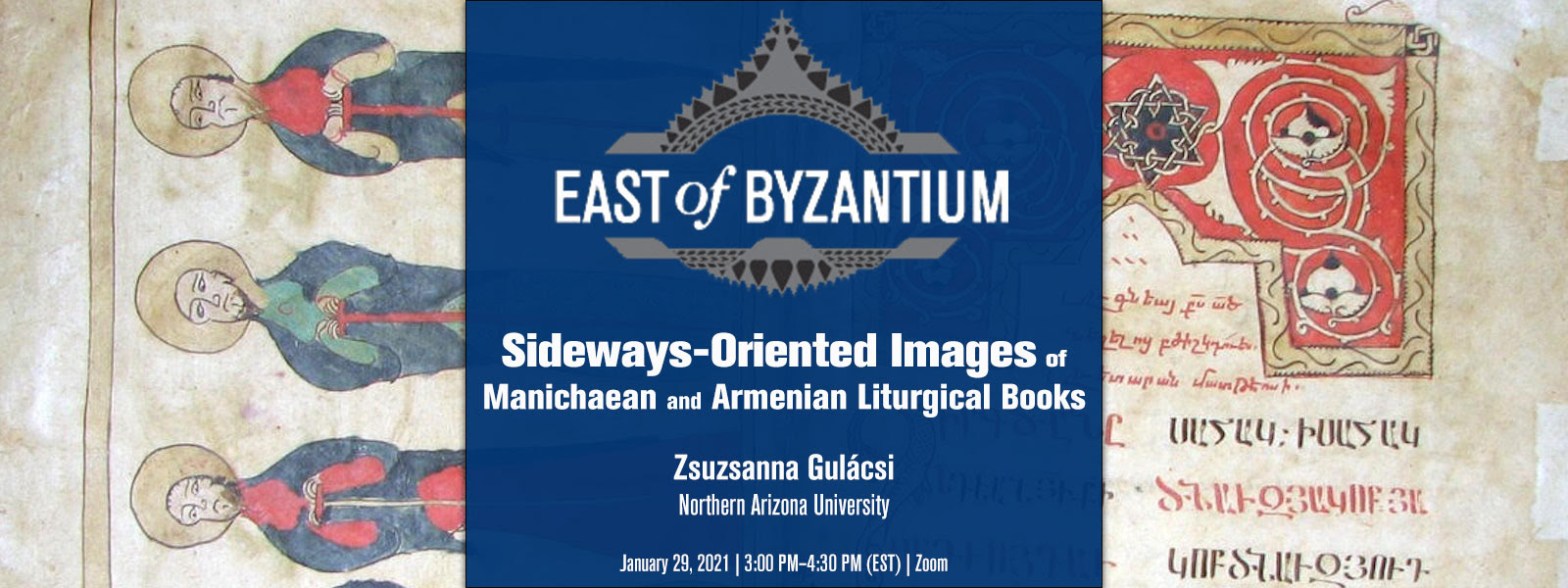
East Central Asian Manichaean sources discovered at Kocho from the Uygur era of Manichaean history (755-1024 CE) constitute prominent examples of Silk Road art and text. Despite the closeness of Chinese culture and the dominant presence of Buddhism in the region during this era, Manichaean books maintain a distinctly “West Asiatic” character. In order to further explore the latter, this study assesses the codicological similarities between Manichaean manuscripts from East Central Asia (that were written in Parthia, Middle Persian, Sogdian, and Uygur languages) and the earliest Eastern Christian and Islamic manuscripts from Syro-Mesopotamia (that were written in Syrian, Armenian, Arabic, and Persian languages between the 5th and 11th centuries). The two groups compare favorably based on a variety of codicological criteria. These similarities point beyond the mid 3rd-century Syro-Mesopotamian roots of Uygur-era Manichaean book culture and indicate that there was a continued contact between the Manichaean communities in East Central Asia and their Mesopotamian homeland well into the medieval period.
Zsuzsanna Gulácsi is professor of art history, Asian studies, and comparative religious studies at Northern Arizona University. She is a historian of religious art, specializing in the contextualized art historical study of pan-Asiatic religions that adapted their arts to a variety of cultures as they spread throughout the continent. Her research has been supported by the National Humanities Center, the Japan Society for the Promotion of Scholarship, the American Council of Learned Societies, the American Philosophical Society, the Guggenheim Memorial Foundation, and most recently the Getty Foundation. Her many publications include Manichaean Art in Berlin Collections (Brepols, 2001), Medieval Manichaean Book Art: A Codicological Study of Iranian and Turkic Illuminated Book Fragments (Brill, 2005), Mani’s Pictures: The Didactic Images of the Manichaeans from Sasanian Mesopotamia to Uygar Central Asia and Tang-Ming China (Brill, 2016), and the edited volume Language, Society, and Religion in the World of the Turks: Festschrift for Larry Clark at Seventy-Five (Brepols, 2018).
This lecture will take place live on ZOOM, followed by a question and answer period. Please register to receive the Zoom link. An email with the relevant Zoom information will be sent 1–2 hours ahead of the lecture. Registration closes at 10:00 AM (EST) on January 29, 2021. REGISTER FOR LECTURE
EAST OF BYZANTIUM is a partnership between the Arthur H. Dadian and Ara Oztemel Chair of Armenian Art at Tufts University and the Mary Jaharis Center for Byzantine Art and Culture at Hellenic College Holy Cross in Brookline, MA. It explores the cultures of the eastern frontier of the Byzantine Empire in the late antique and medieval periods.
CFP: Reviving the Trinity: New Perspectives on 15th-Century Scottish Culture (27th March 2021), deadline 1 February 2021

This collaborative, interdisciplinary project looks again at the Trinity Altarpiece by Hugo van der Goes, Trinity Collegiate Church, and Trinity Hospital as emblems of Scotland’s inventive and ambitious cultural milieu, and its active, outward looking engagement with Europe and beyond. The network will re-examine the Trinity, and establish its cultural relevance today. Taking innovative approaches to materialities, geographies, and the wider artistic, intellectual, and cultural networks that connect them during the reigns of James II, III and IV, and the regency of Queen Mary of Guelders, it seeks to identify contemporary networks and reassess the significance of knowledge exchange.
With the Trinity Altarpiece c.1476, Trinity Collegiate Church and Trinity Hospital as central points of reference, the project will open scholarly debates on all aspects of 15th-century Scotland.
In the first of a series of events we invite academic colleagues and students, and those working in the heritage sector, museums and galleries to submit papers for a Virtual Symposium on 27th March 2021.
We welcome twenty minute papers which focus on any aspects of the Trinity – altarpiece, church, or hospital or which take them as a point of departure. Topics could include art, politics, trade, architecture, diplomacy, material and court culture, the idea of a Scottish Renaissance, gender, medicine and botany, heraldry, music, religion, and related networks.
Papers may be pre-recorded and submitted in advance or delivered live but virtually. The symposium will consist of live (virtual) and pre-recorded papers, live virtual discussion, and a virtual drinks reception. Please submit proposals of c.300 words with your preference for live or pre-recorded, to Trinitynetwork@gmail.com by 1st February 2021. We will notify accepted proposals by 8th February.
We expect to curate a selection of papers from the symposium, which demonstrate the breadth of the topic and yet make a coherent volume, into a book proposal.
Job: Research Associate in Hebrew Manuscripts, John Rylands Library, Manchester, deadline 25 January 2021

More information can be found here.
Applications are invited for the post of Research Associate in Hebrew Manuscripts, to produce an online catalogue, compliant with current cataloguing and metadata standards and to promote The University of Manchester Library’s Hebrew collection. The post is part-time and fixed term from 1 March 2021 to 30 June 2022.
The Library’s Hebrew collection is internationally renowned and is one of the top four collections in the UK, ranking alongside Oxford, Cambridge and the British Library. The manuscript collection of c.600 codices, scrolls and other texts in Hebrew script is highly diverse, covering all aspects of Jewish diaspora in Europe and the Middle East.
You should hold a Ph.D. in Jewish studies or a related area, ideally dealing with Jewish book culture, possess an excellent command of Hebrew and have extensive experience of cataloguing manuscripts in Hebrew script. Knowledge of other languages written in Hebrew (e.g. Judaeo-Arabic) will be a distinct advantage. In addition, applicants should be highly motivated and enthusiastic, have excellent interpersonal and organisational skills, and be able to work independently to meet strict deadlines.
As an equal opportunities employer we welcome applicants from all sections of the community regardless of age, sex, gender (or gender identity), ethnicity, disability, sexual orientation and transgender status. All appointments will be made on merit.
Happy to talk flexible working.
Blended working arrangements may be considered
Please note that we are unable to respond to enquiries, accept CVs or applications from Recruitment Agencies.
Enquiries about the vacancy, shortlisting and interviews:
Name: Professor Philip Alexander
Email: Philip.alexander@manchester.ac.uk
General enquiries:
Email: hrservices@manchester.ac.uk
Technical support:
Email: universityofmanchester@helpmeapply.co.uk
Tel: 0161 850 2004
This vacancy will close for applications at midnight on the closing date.
Please see the link below for the Further Particulars document which contains the person specification criteria.
Job reference: HUM-016115 Location: John Rylands Library, Deansgate, Manchester Closing date (DD/MM/YYYY): 25/01/2021 Salary: £32,816 to £40,322 per annum, pro rata (according to relevant experience) Employment type: Fixed Term | Faculty/Organisation: Humanities School/ Directorate: University of Manchester Library Research & Learning Services Hours per week: 0.9 Fte Contract Duration: Available from 1 March 2021 until 30 June 2022 |
Workshop: 16th Annual Marco Manuscript Workshop, 5-6 February, 2021
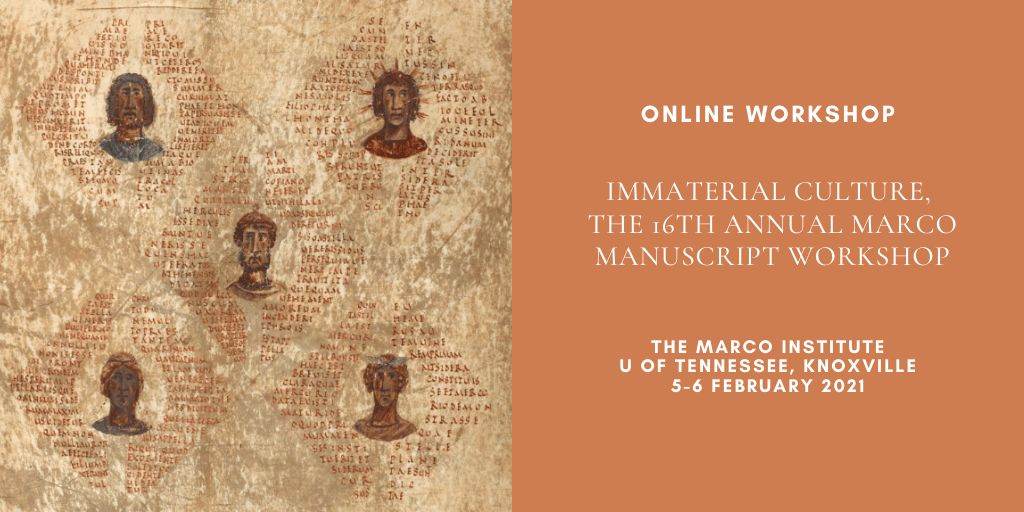
The Marco Institute for Medieval and Renaissance Studies at the University of Tennessee, Knoxville, invites you to join their annual manuscript workshop. The 2021 workshop will take place online via Zoom.
This year’s workshop will consider some of the recent challenges that researchers have faced with the suspension of travel, the closing of libraries and universities, and the quarantine restrictions that have kept so many of us in our homes. How can our field, which has always emphasized the importance of physical place and tactile artifacts, work successfully in isolation and at a distance? What does it mean for us when our work takes place in an incorporeal world of light and numbers rather than ink and flesh, in matrices of data rather than dusty rooms? We will explore the advantages and disadvantages of this “immaterial culture,” and think about how our work is shaped by access or lack of access to manuscripts, texts, catalogues, and objects.
In addition to the two-day schedule of talks, participants will also have the option to attend a bonus digital mapping event. Participants will use the time outside of the regularly scheduled workshop program to map locales named in three manuscript versions of a 15th century Italian geographic treatise, Goro Dati’s La Sfera.
To register, please visit the Marco Institute’s website. Registration is required.
The Marco Institute is an internationally acclaimed center for the study of the history and culture of the period from roughly 300 to 1700 C.E. With our rich schedule of lectures, workshops, and symposia; multiple fellowship opportunities for faculty and graduate students; graduate certificate and Summer Latin Program; and undergraduate major and minor, we pursue the research and teaching of the early periods at the highest levels.
Image: BL Harley MS 647 f. 13v
Online Lecture: Dr Tom Nickson, ‘(Im)material Devotions: Light and lighting devices in devotional practice’, Warburg Institute, 9 February 2021, 17:30 – 19:00 (GMT)
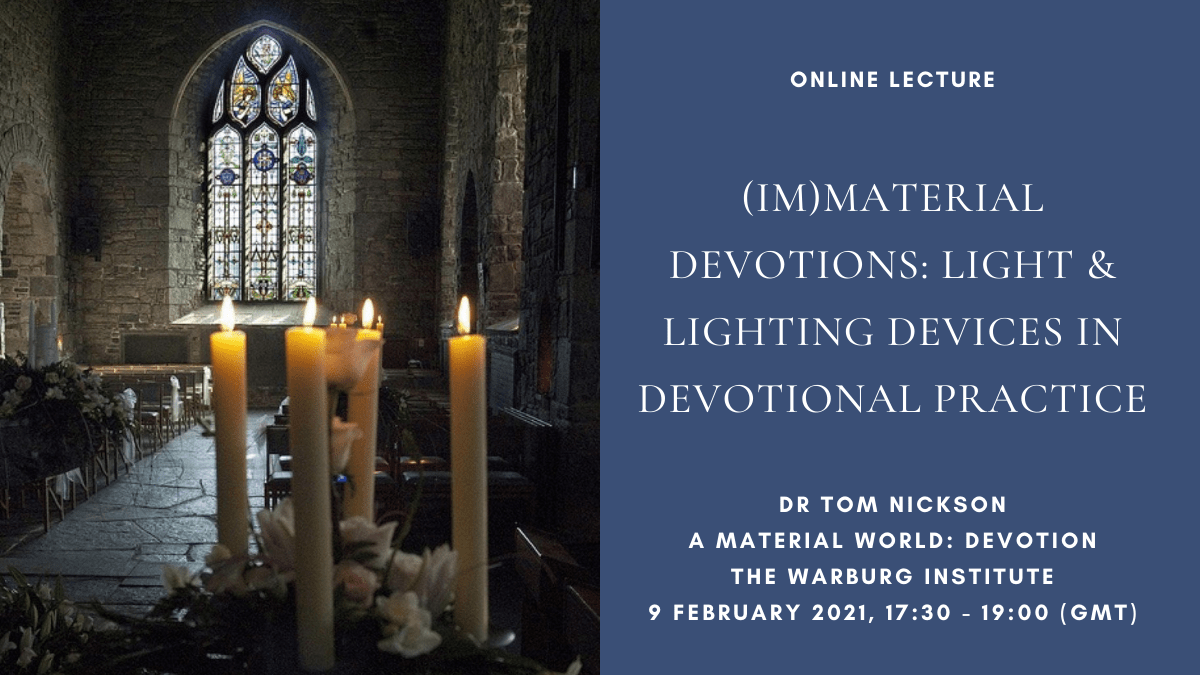
Dr Tom Nickson (Courtauld Institute) examines the role of candles, lamps and natural light in shaping devotional spaces and experiences. Drawing on written, visual and archaeological evidence, he will consider the role of different lighting devices in a range of spaces, from mosques to royal chapels and parish churches, showing how light and lighting were central to experiences of material and devotional cultures at all levels of society.
This event is part of the A Material World: Devotion events series, which brings together academics and heritage professionals from a wide range of disciplines to discuss issues concerning historical devotional materials, their conservation, presentation, display, and reconstruction.
Organisers: Rembrandt Duits (Acting Curator, The Photographic Collection, The Warburg Institute) and Louisa McKenzie (PhD student, The Warburg Institute).
This lecture will take place online via Zoom. Sign up for you place here.
New Publication: ‘The Portal of Glory: Architecture, Matter, and Vision’ Edited by Francisco Prado-Vilar

To celebrate the start of the Santiago de Compostela Jubilee Year (Xacobeo 2021), the Complutense Foundation publishes an open-access digital edition of the book ‘The Portal of Glory: Architecture, Matter, and Vision,’ which is the first publication of the A. W. Mellon Program for the study and conservation of the Portal of Glory.
The essays in this volume explore the constellation of images and creative processes that originate at the intersection between built architecture and imagined architecture, offering a unique vision of the Portal of Glory in its material reality, its constructive techniques, its scenographic design, its symbolic dimensions, and its phenomenological effects. In their totality, and in their individual contributions, the articles reveal yet-unknown aspects of Master Mateo’s intervention in the cathedral of Santiago, from the time he took over the direction of the works around 1168 to the moment of the temple’s consecration in 1211 – a long period that also witnessed the construction of two additional related projects: the magnificent stone choir, and the west façade. The book offers complete new architectural and digital reconstructions of both the stone choir and the west façade, with the restitution of all the displaced sculptures to their original locations and the analysis of the “avant-garde” enveloping scenography they were part of.
You can read the book here: https://issuu.com/fundacioncomplutense/docs/el_portico_de_la_gloria_b_150
 Medieval Art Research