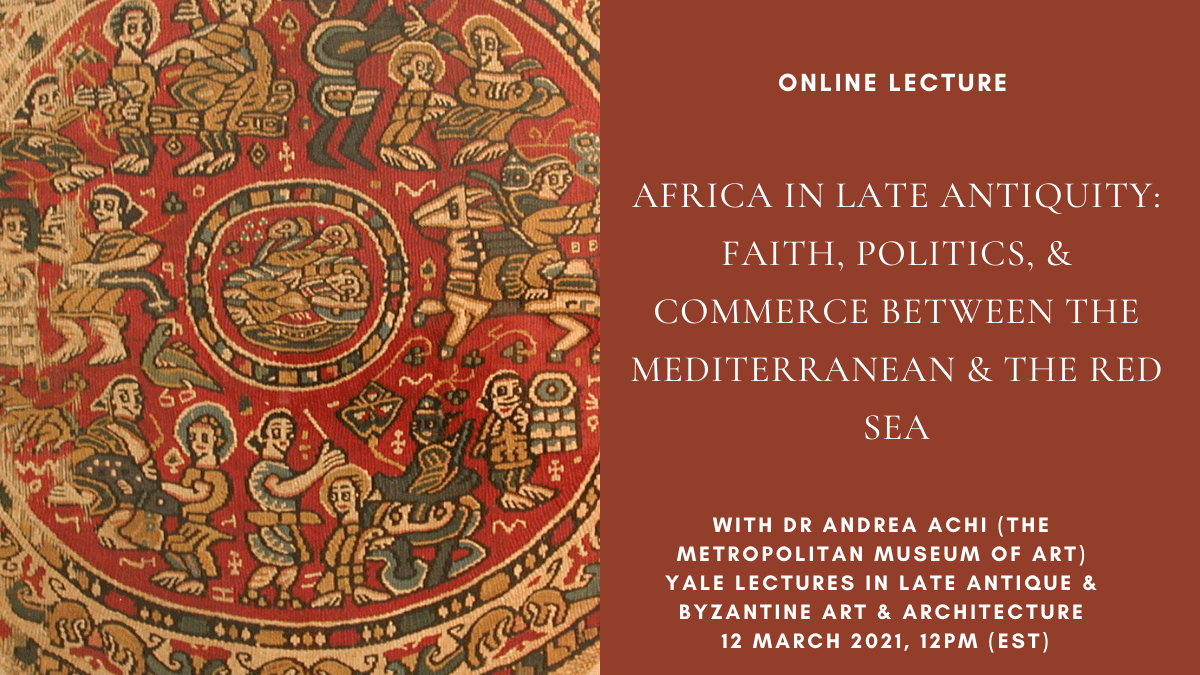
Online Lecture: ‘Africa in Late Antiquity: Faith, Politics, & Commerce between the Mediterranean & the Red Sea’ with Dr Andrea Achi, 12 March 2021, 12pm (EST)

Join Yale for their up-coming Lectures in Late Antique and Byzantine Art and Architecture series. In this online lecture, Dr Andrea Achi (The Metropolitan Museum of Art) will present ‘Africa in Late Antiquity: Faith, Politics, and Commerce between the Mediterranean and the Red Sea’

Respondent: Felicity Harley, Yale

This event is free, but you must register in advance here.

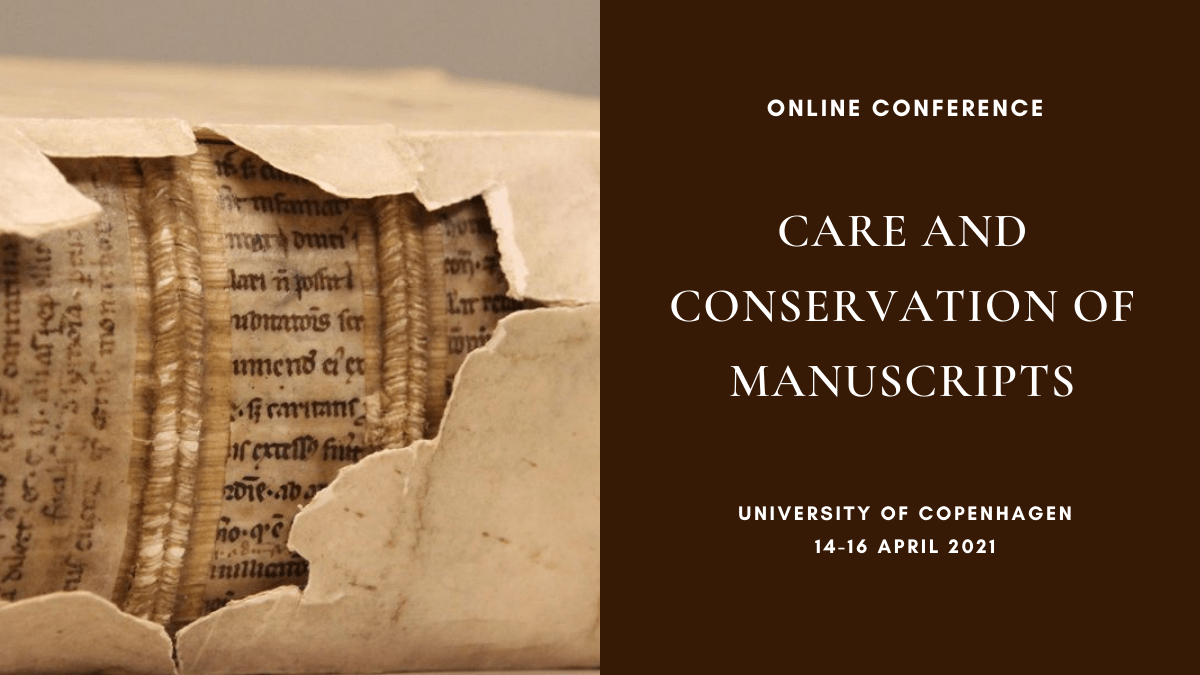
Online Conference: Care and conservation of manuscripts, University of Copenhagen, 14-16 April 2021

The 18th seminar on the Care and conservation of manuscripts will be held virtually from the 14th to the 16th of April 2021. Please note all times are in Copenhagen Time (CET).

The seminar is an international, interdisciplinary seminar which aim is to bring together conservators, librarians, archivists, scholar, curators and others who work with manuscripts and early printed books in any capacity.

Registration for the seminar is now open – please follow this link 

For further information, please contact Ragnheiður Mósesdóttir the seminar co-ordinator.

Participation is free of charge.

Find out more information here.

Conference Programme

Wednesday 14 April 2021

Opening of the conference (10:45–10:55)

Session 1 (11:00-12:30)

  • Vasarė Rastonis, Svanhildur Óskarsdóttir and Jiří Vnouček: The conservation of Flateyjarbók
  • Silvia Hufnagel, Vasarė Rastonis and Robert Fuchs: Paper trails in Iceland: Taking hyperspectral images of watermarks in paper in Icelandic collections
  • Élodie Lévêque, Matthew David Teasdale, Morten Tange Olsen, Sarah Fiddyment, Maiken Hemme Bro-Jørgensen, Claire Chahine and Matthew Collins: Biocodicology as an aid to locating the origin of materials: Investigation into the use of sealskins on manuscripts in the 12th and 13th centuries

Session 2A (12:45-14:15)

  • Katarzyna Schirmacher, Julia BispinckRossbacher and Christine Theuerkauf-Rietz: Precious and brittle: Conservation and research on the late medieval prayer book of Mary of Guelders
  • Ariane Langreder: The challenges of a Romanesque re-binding: The Psalter of St. Paul’s Cathedral
  • Andrew Honey: Winchester’s binder: Beatrice Forder at work 1947-1948

Session 2B (12:45-14:15)

  • Ekaterina Nosova, Ilona Teplouhova, Elena Shepilova, Julia Baskakova and Dmitriy Weber: Pigments of Western European wax seals: Norms and exceptions
  • Alessandro Scola: Conserving and preserving a 15th-century Italian antiphonary: Nontraditional binding conservation techniques and an innovative all-in-one housing, display and moving device
  • Athanasios Velios: St. Catherine’s conditionsurvey: Considerations for linked data

Session 3A (14:30-16:00)

  • Sarah Fiddyment and Matthew Teasdale: Biocodicology by numbers: How to? How many? How much?
  • Laura Viñas Caron, Ismael Rodríguez, Vladimir Vilde, Natasha Fazlic, Jiri Vnoucek, Matthew Collins: (Bio)codicological investigation of a medieval palimpsest: The Arnamagnæan manuscript AM 795 4to.
  • Tuuli Kasso and Matthew Collins: ArcHives: Biomolecular record of bees in medieval sealing wax

Session 3B (14:30-16:00)

  • Marlen Börngen, Bert Jacek, Maike Linden and Andrea Pataki-Hundt: Naumburger choir books: Oversized wooden-board conservation
  • Katherine Beaty and Kelli Piotrowski: From Florence to Rome: Conserving Italian stationery bindings at Harvard University
  • Patricia Engel and Andreas Gamerith: Care and conservation in Zwetti Cistercian monastery

Session 4A (16:15-17:45)

  • José María Pérez Fernández: Colombina 5-3-25, or how Hernando Colón processed information for his catalogues
  • Guy Lazure: Before Denmark: The Sevillian roots of the Arnamagnæan collection of Spanish manuscripts
  • Edward Wilson-Lee: Dehydrate, duplicate, distil: Preserving the Universal Library

Session 4B (16:15-17:45)

  • Nurçin Kural Özgörüş and Başak Emir: Recovery and conservation of the library collection in Virgin Mary Church of the Syriac community in Mardin, Turkey
  • Claudia Benvestito, Alberto Campagnolo and Stefanos Kaklamais: Archaelogical investigations into Code Marcianus Gr. VII, 22: Reconstruction its manufacture and structure
  • Tamar Abuladze: Georgian manuscripts on parchment from the Korneli Kekelidze Georgian National Centre of Manuscripts: Perspectives of interdisciplinary study

Session 5 (18:00-19:00)

  • N. Kıvılcım Yavuz: The missing piece of Hernando Colón’s library: Copenhagen, Den Arnamagnæanske Samling, AM 377 fol.
  • Matthew Driscoll, Matilde Malaspina, Alessandro Gnasso and Joana-Isabel Duyster Borredà: The Book of books: Hernando Colón’s Libro de los epitomes

Thursday 15 April 2021

Session 6A (11:00-12:30)

  • Per Cullhed: B68: Riddles and revelations
  • Lieve Watteeuw and Marina Van Bos: A manuscript for the head: The 13th-century illuminated parchment mitre of Jacques de Vitry
  • Morgane Plateau: Conservation treatment of the illuminated ancestor-table of “Josse de Lalaing”, knight of the Golden Fleece

Session 6B (11:00-12:30)

  • Gaia Petrella: ESTENSE Digital Library: Preparing materials for digitisation
  • Aida Nunes: Storing an oversized Museau de Lisboa textile banner collection
  • Silvia Pugliese, Sara Gottoli, Michael B. Toth and William Christens-Barry: The 3½ foot Marciana celestial globe of Coronelli, 1689: Scientific investigation and conservation

Session 7A (12:45-14:15)

  • Amélie Courvrat Desvergnes: Book culture in North-western India: An insight into the production of handwritten and graphic documents in the 19th century
  • Ina Fröhlich: An illuminated Egyptian manuscript from the 17th century: Codicology, ink and copper corrosion, conservation
  • Marleena Vihakara and Anna Aaltonen: Conservation of Coptic parchment fragments and a bifolium from a private collection

Session 7B (12:45-14:15)

  • Penelope Banou and Angeliki Stassinou: Letters Patent for the establishment of Roman Catholic Church confraternities in 17th-century Greece: Typology, materials and aspects of preservation
  • Paul Hepworth: An Islamic treasure binding and its conservation
  • Cécile Brossard: Original decorated remnants under a 16th-century Syriac re-binding

Session 8A (14:30-16:00)

  • Christa Hofmann, Sophie Rabitsch, Maurizio Aceto, Antonia Malissa, Katharina Uhlir and Martina Griesser: The miniatures of the manuscript The Vienna Genesis: A study of pigments and painters
  • Dan Paterson and Alan Haley: The conservation and digitization of 41 volumes of the Yongle Dadian, a Ming Dynasty era encylopedia at the Library of Congress
  • J.D. Sargan, Aleandra Gillespie and Jessica Lockhart: Manuscript ghosts: Uncovering early manuscript structures via MicroCT

Session 8B (14:30-16:00)

  • Mary French: Honouring the past while preparing for the future: Conservation of a 15thcentury manuscript on the life on St. Augustine
  • Grace Touzel: Lepidochromy at the Natural History Museum (London): Butterfly wings as a printing medium
  • Chantal Kobel: Revisiting the codicology of the Book of Ballycummin (RIA MS 23 N 10), a medieval Irish manuscript

Session 9 (16:15-18:00)

  • Aniko Bezur, Richard Hark, Marie-France Lemay, Pablo Londero, Marcie Wiggins, Paula Zyats, Sarah Fiddyment and Matthew Teasdale: The Ongoing Story of the Vinland Map and related manuscripts: New Analyses, New Evidence, Part I and Part II
  • Laurianne Robinet, Lucie Arberet, Stéphane Lecouteu, Anne Michelin, Véronique Rouchon, Sylvie Heu-Thao and Oulfa Belhadj: Mont Saint-Michel manuscripts: Focus on the scriptorium practices in the 11th century
  • Abigail Quandt: Real or fake? Conservators, scientists and scholars join forces in debunking manuscript forgeries.

Friday 16 April 2021

Session 10A (11:00-12:30)

  • Ana Tourais, Conceição Casanova, Catarina Barreira, Catarina Gonçalves and Catarina Pinheiro: Alcobaça bookbinding as a hidden treasure: The case study of an Expositio in Evangelium Matthei
  • Lisa Camilleri: Fantastic features and where to find them: Title-tabs and other unique features of the Notarial Bindings in Malta
  • Amy Baldwin: Risen from the ashes: Balancing the historic and archival in the conservation of Charlotte Canning’s Indian Journals

Session 10B (11:00-12:30)

  • Ilse Korthagen, Femke Prinsen and Lieve Watteeuw: Checklist for the digitisation of manuscripts
  • Gayane Eliazyn and Artur Petrosyan: Medieval Armenian miniature: Research and conservation of the paint-layer on the example of the Matenadran manuscripts
  • Michael Maggen: The renovated Israel Museum in Jerusalem

Session 11A (12:45-14:15)

  • Sam Foley and Shaun Thompson: A collaborative digitization project in progress: The Polonsky Foundation Greek Manuscripts Project
  • Alberto Campagnolo and Rachel Di Cresce: Recording bookbinding structures and their visualizations as communication tools
  • Heather Marshall: The conservation of an 11thcentury Greek binding: Its role as an artefact and a functioning binding

Session 11B (12:45-14:15)

  • Ekaterina Pasnak: 16th–century German-style bindings from the Special Collections of the University Library in Bergen
  • Fenella France and Andrew Forsberg: Accessible linked scholarly and scientific datavisualisation for manuscripts

Session 12A (14:30-16:00)

  • Guðvarður Már Gunnlaugsson: On lost manuscripts from the Arnamagnæan Collection Katarzyna
  • Anna Kapitan: Reconstructing the dispersed collection of manuscripts owned by the Danish royal historiographer Thormodus Torfæus
  • Seán Vrieland: How to count a manuscript: Cataloguing the Faroese manuscript material in the Arnamagnæan Collection

Session 12B (14:30–16:00)

  • Zinaida Vakhovskaya and Tolganay Egorova: Examination of the manuscript “Alexandria and the Legend of the Mamai Battle”
  • Valentina Yañez Langner: Inter-agency collaborations for the preservation of choir books at the National Museum of Viceroyalty, Mexico
  • Fezeh Rahimi: Conservation measurements on papers works of the National Museum of the Holy Qur’an, Tehran

Session 13 (16:15–17:15)

  • Toby Burrows: Tracing the histories of medieval manuscripts: A new digital environment for provenance research
  • Jiří Vnouček: Late Antique parchment: Basic characteristics, methods of preparation and conservation problems

Session 14 (17:15-??)

Closing of the conference and virtual drinks in the Monks’ Cellar

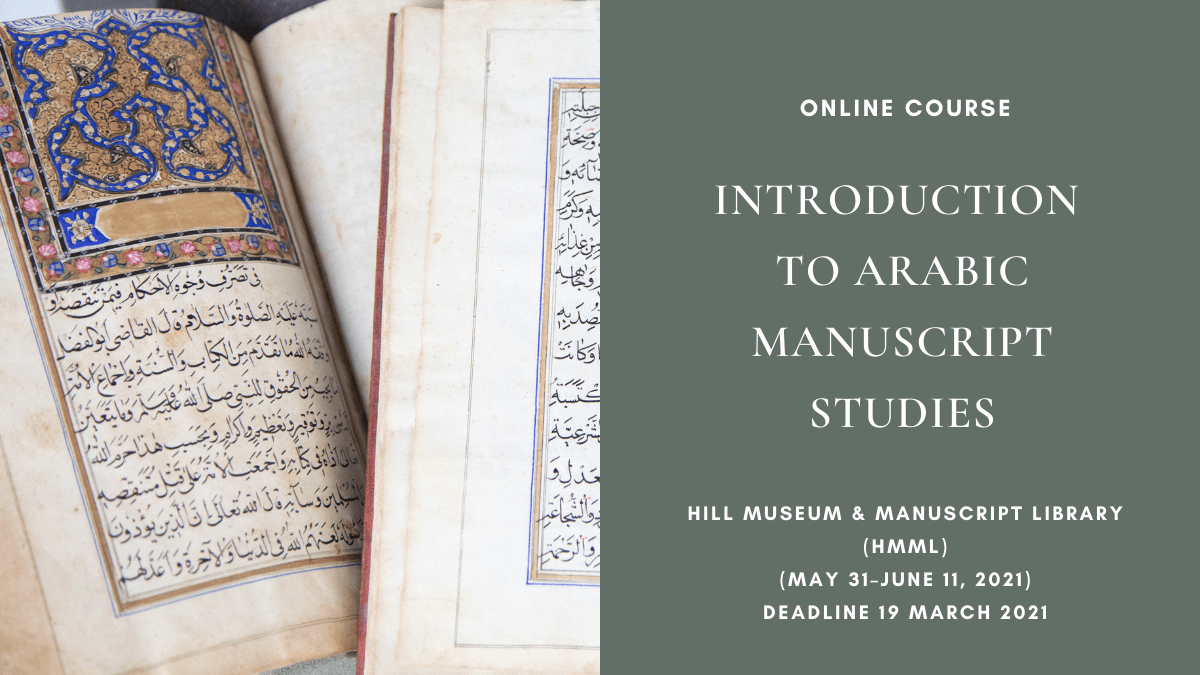
Online Course: Introduction to Arabic Manuscript Studies, Hill Museum & Manuscript Library (HMML), (May 31–June 11, 2021), deadline 19 March 2021

This two-week introductory course is open to graduate students, advanced undergraduates, faculty, and independent scholars with a research interest in Arabic manuscripts. The course will introduce students to the study of Arabic manuscripts in their historical, cultural, and material dimensions and to a diversity of Arabic manuscript traditions from West Africa and the Middle East, both Islamic and Christian; provide basic introduction to paleography, codicology, and philological practices, with a special focus on the application of these skills in a digital context; and highlight a wide range of scholarly reference tools for the study of Arabic manuscripts. By the end of the course, students will be able to contribute to the scholarly description of a previously uncataloged manuscript of their choice from the HMML collection.

Sessions will be held Monday-Friday from 9 a.m. to 11 a.m. CST.

Eligibility

  • Basic understanding of the classical Arabic language
  • Professional and scholarly interest in manuscripts 

Costs: $250 (U.S.)

Find out more information here.

Online Lecture: ‘The Exeter Cathedral Wax Votives’ by Dr Naomi Howell and Graham Fereday, The Warburg Institute, 22 March 2021, 15:30-17:00 (GMT)

In 1943, following the bombing of Exeter Cathedral, a trove of wax votive objects was found at the tomb of Bishop Edmund Lacey. Many were in small fragments, but one whole figure remained – a unique survival of what was once a vibrant religious practice. In this seminar, Dr Naomi Howell and Graham Fereday from Exeter University will discuss the history, study and ongoing conservation of these extremely rare, fragile objects using a combination of high-definition photography, 360-degree videos and 3D-printed models. Combining medieval history and digital humanities, this seminar offers students and others who are interested an opportunity to discover more about this important archaeological find. Presented in conjunction with Exeter Cathedral Library and Archives.  

This event is part of the A Material World: Devotion events series, which brings together academics and heritage professionals from a wide range of disciplines to discuss issues concerning historical devotional materials, their conservation, presentation, display, and reconstruction.

Organisers: Rembrandt Duits (Acting Curator, The Photographic Collection, The Warburg Institute) and Louisa McKenzie (PhD student, The Warburg Institute).

Register here. Find out more information here.

Online Lecture: Mining the Collection: The Cleveland Museum of Art, ICMA, 4 March 2021, 11am (ET)

The International Center of Medieval Art (ICMA) invites you to another installment of Mining the Collection. Mining the Collection is lecture series where museum curators take an in-depth look at fascinating, often puzzling, objects in their collections. Gerhard Lutz, Robert P. Bergman Curator of Medieval Art at The Cleveland Museum of Art, and Elina Gertsman, Professor of Art History at Case Western Reserve University, will present two fascinating sculptures from Cleveland’s collection.

Please join us Thursday, March 4th at 11:00 am ET for a brief presentation of these works followed by an informal discussion. Sign up here!

Additional events in this series to follow.

The mission of the International Center of Medieval Art is to promote and support the study, understanding, and preservation of visual and material cultures produced primarily between ca. 300 CE and ca. 1500 CE in every corner of the medieval world. To this end the ICMA facilitates scholarship and education and sponsors public lectures, conferences, publications, and exhibitions. Become a member here!

Image credit: Virgin and Child, late 1200s. Mosan (Valley of the Meuse), Liège(?), late 13th century. Wood (oak) with polychromy and gilding; overall: 83 x 24 x 20 cm (32 11/16 x 9 7/16 x 7 7/8 in.). The Cleveland Museum of Art, John L. Severance Fund 2014.392

Online Lecture: ‘A Library of Memories: Textual Preservation at the Monastery of St. Michael in Egypt’ with Dr Andrea M. Achi, UCLA’s Annual Richard & Mary Rouse History of the Book Lecture, 1 March 2021, 17:00-18:00 (Pacific Time)

This year’s speaker is Dr Andrea M. Achi, Assistant Curator in the Department of Medieval Art and The Cloisters at The Metropolitan Museum of Art in New York.

In 1910, a group of Egyptian farmers claimed they discovered a hoard of Coptic manuscripts in a stone vat outside the village of al-Hamuli of the Fayyum Oasis in Egypt. Sold to J. Pierpont Morgan in 1911, the find amounted to forty-seven manuscripts with a total of 2,481 folios. Most of the manuscripts are associated with a single monastery called the Monastery of St. Michael. Every manuscript from the hoard has ornamental flourishes, marginalia, borders, and frames; twenty-seven contain frontispieces with both figural and ornamental decoration. Almost all of the texts are copies of late antique works. Yet, as their colophons indicate, the manuscripts were, to the extent that they have preserved dates, produced between 822 and 914 CE. As a group, the manuscripts represent the contents of a monastic library.

This talk explores the function of the collection, as a library, within its medieval Egyptian monastic context. Emphasizing the materiality of the manuscripts, I suggest that the manuscripts represented more than textual objects to the Monastery of St. Michael. Ultimately, I argue that the production, use, and storage of The St. Michael Collection rested upon the importance of memory to its monastic community. These discoveries give insights into libraries produced in other Christian communities in Medieval Africa.

Co-sponsored by the UCLA Center for Near Eastern Studies.

Register here and find out more information here.

Call for Applications: A Research Seminar Programme for Early Career Researchers into Medieval Eastern Mediterranean Cities as Places of Artistic Interchange, SOAS University of London, (March-May 2021), deadline 8 March 2021

Medieval Eastern Mediterranean Cities as Places of Artistic Interchange, SOAS University of London, March – May, 2021

The School of Arts at SOAS University of London is pleased to announce the launch of a new research seminar programme for young and early career researchers in the art and archaeology of the medieval eastern Mediterranean, supported by the Getty Foundation as part of its Connecting Art Histories initiative.

Medieval Eastern Mediterranean Cities as Places of Artistic Interchange is an online seminar programme for emerging academics which focuses on the role played by cities in the medieval eastern Mediterranean, from the 12th to the 14th centuries CE, in the production, consumption, transformation and understanding of works of art and architecture.

During this time cities in the region were places of exchange of raw materials, manufactured goods, artists and craftsmen, and ideas. With exchange came transformation, either intentional through novel creations, or through creative repurposings and misunderstandings. The mixed populations of cities, in this context mainly ports, contributed to transformation as well, but also to the creation of international languages, whether actual, such as the pidgin of lingua franca which arose at this time, or visual, like the technological transformation of artefacts from the pigments used in manuscript illustration to enamelled glass and glazed ceramics. This led to stylistic developments such as international koinai in architecture (commercial, palatial, military), heraldry (to use the western medieval term: the arts of war and sport) and procession.

This seminar pairs cities, scholars and the site-specific questions that arise from them to explore these and other aspects of artistic and cultural interchange in the medieval eastern Mediterranean region, with a particular focus on new research in lesser-known cities to highlight recent archaeological and other scholarly discoveries.

The project is open to early career academic researchers (who have received their doctorates in the last three years) and tutors, research students (PhD students) at an advanced stage of their studies and those working in historical research institutes (such as archaeology centres, museums, government and non-governmental agencies dealing with history, art or archaeology) who are from the countries of the eastern Mediterranean region and the Middle East. 

The target audience for this seminar programme is young professionals with advanced degrees (or equivalent work experience) in art history and/or archaeology of the period from the 12th to the 14th centuries who are from the countries of the eastern Mediterranean or Middle East.

Participants selected to take part in the programme will receive £2000 (British pounds) each to be used for research purposes: this includes the purchasing of books or other scholarly resources, upgrading of internet access, purchase of headphones, and the like.

The seminar programme will take place online in English and a high level of English language proficiency is required from participants.

Scholars currently residing and working in the Eastern Mediterranean region are especially encouraged to apply.

Find out more information here.

Online Lecture: ‘Pictorial invention in the early Trecento: the case of the Vele in Assisi’, with John Renner, Murray Research Seminar at Birkbeck, 16 March 2021, 16:55 – 19:30 (GMT)

The crossing vaults of the Lower Church of the Basilica of San Francesco at Assisi, known as the Vele, were frescoed by Giotto and his workshop c.1 310-15 with scenes of St Francis in Glory and three densely-populated tableaux allegorizing the principal vows of the Franciscan Rule: Poverty, Chastity and Obedience. The paper re-examines some of the complex and enigmatic imagery in search of the sources, meanings and functions of the frescoes in their key position above the high altar and the tomb of St Francis. It argues that the Vele can offer an insight into the process of artistic invention in the early Trecento, as a case study in the creative collaboration of client and painter.

John Renner took his MA in Art History at Birkbeck and his PhD at the Courtauld Institute of Art, where he is an Associate Lecturer. His research and publications focus on the art and patronage of the Franciscan Order in Italy in the thirteenth and fourteenth centuries.

Register via the official event page here: https://www.eventbrite.co.uk/e/pictorial-invention-in-the-early-trecento-the-case-of-the-vele-in-assisi-tickets-132821902887

Essay Prize: International Center of Medieval Art, deadline 7 March 2021

The International Center of Medieval Art (ICMA) wishes to announce its annual Graduate Student Essay Award for the best essay by a student member of the ICMA.  The theme or subject of the essay may be any aspect of medieval art, and can be drawn from current research.  Eligible essays must be produced while a student is in coursework.  The work must be original and should not have been published elsewhere.  We are pleased to offer First Prize ($400), Second Prize ($300), and Third Prize ($200).

We are grateful to an anonymous donor for underwriting the Student Essay Award competition. This member particularly encourages submissions that consider themes of intercultural contact — for instance, between Latin Christendom and the Byzantine realm; among Jews, Muslims, and Christians; or the dynamics of encounters connecting Europe, Africa, and Asia. These are not requirements, however, and the awards will be granted based on quality of the papers, regardless of topic.
 

The deadline for submission is 7 March 2021.  The winners will be announced at the Spring Board Meeting in May.

Applicants must submit:

1.  An article-length paper (maximum 30 pages, double-spaced, not including footnotes) following the editorial guidelines of our journal Gesta.

2.  Each submission must also include a 250-word abstract written in English regardless of the language of the rest of the paper.

3.   A Curriculum vitae.

All applicants must be ICMA members.
All submissions are to be uploaded here for 2021.

Email questions to Ryan Frisinger at awards@medievalart.org. The winning essay will be chosen by members of the ICMA Grants and Awards Committee, which is chaired by our Vice-President.

The mission of the International Center of Medieval Art is to promote and support the study, understanding, and preservation of visual and material cultures produced primarily between ca. 300 CE and ca. 1500 CE in every corner of the medieval world. To this end the ICMA facilitates scholarship and education and sponsors public lectures, conferences, publications, and exhibitions.

Online Conference: Regional Furniture Society: ‘Research in Progress: New Thinking about Medieval Furniture’, 13 March 2021, 10:00am – 16:45pm (GMT)

The next Regional Furniture Society meeting in the series of Research in Progress meetings will take place on 13 March 2021 as a Zoom meeting. As with the previous two themed meetings, (Sixteenth-century Furniture and The Regional Chair), speakers will present current research from a variety of perspectives.

Programme 

10.00 Introduction (Liz Hancock, RFS Newsletter Editor)

Morning session (Chair: Chris Pickvance) 

10.15am – Agnès Bos (University of St Andrews) ‘A Reappraisal of the ‘Medieval’ Arconati-Visconti Dressoir at the Louvre’) Agnès Bos is a Lecturer in Art History at the University of St Andrews. She was a curator at the Louvre from 2006 to 2016 specialising in decorative arts from the late middle ages to the 17th century, with a focus on furniture, tapestries and textiles. In 2019 she published the catalogue raisonné of the Medieval and Renaissance furniture of the Louvre. For her articles see Agnès Bos | University of St Andrews – Academia.edu

11.00am – Cécile Lagane (Centre Michel de Boüard /CRAHAM, Caen), ‘Evolution and Transformation of Furniture in its Architectural Environment: the Armoires of Bayeux (Normandy) and Aubazine (Limousin)’. Cécile’s doctoral thesis on Medieval furniture and furnishings from 500-1300 will be published shortly.  

11.45am – Discussion

12.00 pm – Nick Humphrey (Furniture, Textiles and Fashion Dept., Victoria and Albert Museum, London), ‘A Fifteenth-century Desk-cupboard at the Victoria and Albert Museum’. Nick is the curator responsible for pre-1700 furniture, woodwork and leatherwork and was involved in creating the British Galleries (2001), the Medieval and Renaissance galleries (2009), the Dr Susan Weber (Furniture) Gallery (2012), and the Europe galleries 1600-1815 (2015). His most recent publication revisits the museum’s most famous piece of furniture, the Great Bed of Ware; current research includes cypress wood chests and Latin-American lacquer.

12.45 pm – Jens Kremb (Independent scholar, Bonn), ‘The Chest of Drawers: a Late Medieval Piece of Furniture?’  His doctoral thesis about painted tabletops in the late Middle Ages, was published as Bemalte Tischplatten des Spätmittelalters (Böhlau Verlag, 2015). He has created a research initiative on medieval furniture (www.inimm.de) and his articles are on www.jkremb.academia.edu

1.30 pm – Discussion

1.45 pm – Break

Afternoon session (Chair: Nick Humphrey)

2.15pm –  Chris Pickvance (Chairman, RFS), ‘A Closer Look at a Group of English Clamped Chests from 1250-1350: Timber, Construction and Decoration’. Chris has been researching medieval chests for over ten years using dendrochronology.  His articles have appeared in Regional FurnitureThe Antiquaries Journal and archaeological journals; see www.researchgate.net

3.00pm – Noah Smith (Scouloudi Fellow, Institute for Historical Research), ‘The ‘Courtrai chest’ at New College, Oxford: Iconography and Materiality’. This controversial chest, a focus of Noah’s research on Flemish medieval art, has been viewed both as a fake and a Belgian national treasure. This paper will explore the material and art historical aspects of the chest, addressing its potential provenance and suggesting a new iconographic reading of its frontispiece. Noah is in the final year of his PhD at the University of Kent, and has work forthcoming in several publications. 

3.45pm – Rachel Sycamore (MRes student in Medieval Archaeology, Worcester University), ‘Dug-out Church Chests in Herefordshire and Worcestershire’. Rachel is in the third and final year of her Master’s degree. Her research focuses on dug-out church chests and has used dendrochronology to date four in the two counties so far. Her paper will discuss the construction methods, ironwork and physical characteristics of examples, comparing and contrasting those which have been dated.

4.30pm – Discussion

4.45pm – Close

The event is free and open to non-members, but registration is necessary. Please email Jeremy Bate, RFS Events Organizer events.rfs@gmail.com. The last date for registration is Thursday 11 March. Zoom Meeting Invitations will be sent on 12 March. The waiting room will be open from 9.30 on 13 March. The day will be recorded.

Find out more information here.