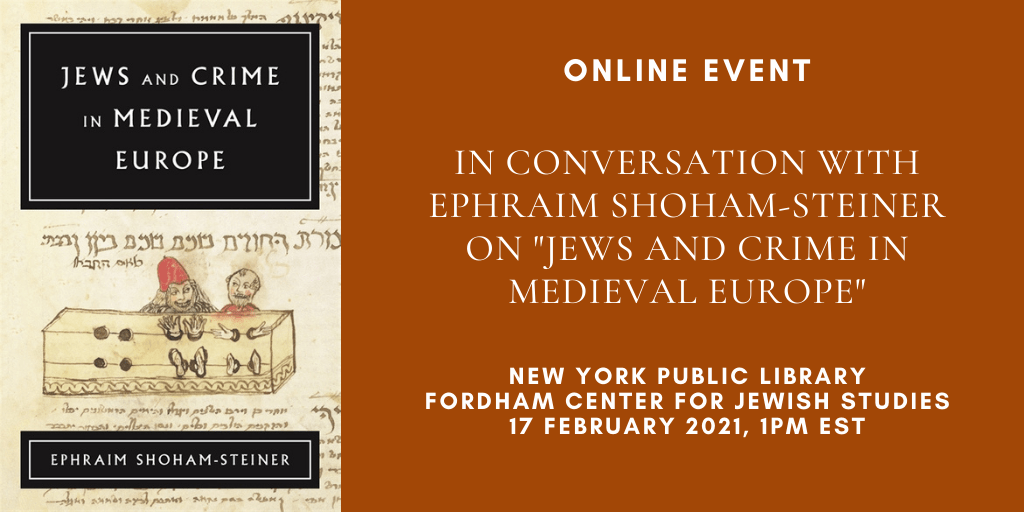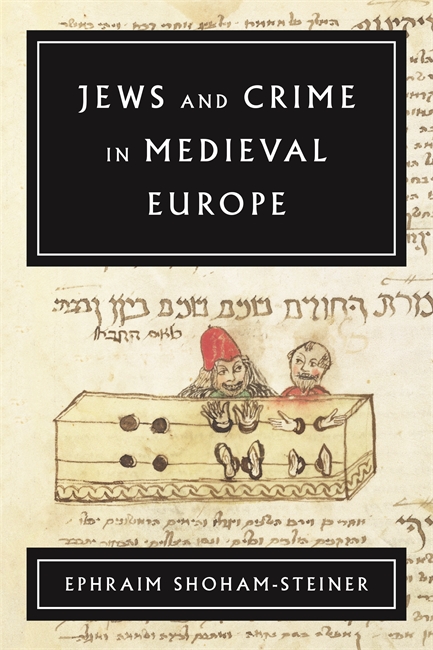
New Publication: Jews and Crime in Medieval Europe by Ephraim Shoham-Steiner

Jews and Crime in Medieval Europe is a topic laced by prejudice on one hand and apologetics on the other. Beginning in the Middle Ages, Jews were often portrayed as criminals driven by greed. While these accusations were, for the most part, unfounded, in other cases criminal accusations against Jews were not altogether baseless. Drawing on a variety of legal, liturgical, literary, and archival sources, Ephraim Shoham-Steiner examines the reasons for the involvement in crime, the social profile of Jews who performed crimes, and the ways and mechanisms employed by the legal and communal body to deal with Jewish criminals and with crimes committed by Jews. A society’s attitude toward individuals identified as criminals—by others or themselves—can serve as a window into that society’s mores and provide insight into how transgressors understood themselves and society’s attitudes toward them.

Ephraim Shoham-Steiner is professor of medieval Jewish history at Ben-Gurion University of the Negev in Be’ersheva Israel, where he is the director of the Center for the Study of Conversion and Inter-Religious Encounters (CSOC). He is the author of On the Margins of a Minority: Leprosy, Madness, and Disability among the Jews of Medieval Europe (Wayne State University Press, 2014) and the editor of Intricate Interfaith Networks in the Middle Ages: Quotidian Jewish-Christian Contacts.

Jews and Crime in Medieval Europe can be purchased here.

Online Lecture: ‘Art, Architecture & Reputation Management in Early Fourteenth-Century England’ by Dr Laura Slater, Courtauld Institute of Art, 17 February 2021, 5-6pm (GMT)

One’s good name or fama was of great importance in medieval society. Medievalists have long recognised that spin, smear campaigns and other ‘dark arts’ of public relations and propaganda strategies were practised as keenly and carefully in pre-modern politics as they are today. This paper explores the role of art and architecture in these processes of reputation management. It considers the efforts of Isabella of France, her allies and her opponents to steer public opinion on and interpretations of her potentially adulterous, treasonous and regicidal actions in England after 1326.

Dr Laura Slater is a Lecturer in the History of Medieval Art at the University of Cambridge and a Fellow of Peterhouse. Her book, Art and Political Thought in Medieval England, c. 1150-1350 was published in 2018. Her research interests centre on the relationships between art, ideas, power and politics in medieval Britain and Europe. She is also interested in medieval responses to antiquity and the Holy Land, particularly in the context of the crusades.

This is a live online event. Register here.

Please register for more details. The platform and log in details will be sent to attendees at least 48 hours before the event. Please note that registration closes 30 minutes before the event start time.

If you have not received the log in details or have any further queries, please contact researchforum@courtauld.ac.uk.

Online Lecture: ‘Intermedial Collaboration: Making the Double-Winged Altarpiece in the Late-Medieval Workshop’ with Dr Laura Tillery, Cambridge Graduate Seminar Series on Intermediality, 17 February 2021, 17:00 – 18:00 (GMT)

For the third ‘Intermediality’ Graduate Research Seminar, organised by the Department of History of Art, University of Cambridge, we are joined by art historian Dr Laura Tillery (Norwegian University of Science and Technology) who will be discussing intermedial collaboration in the medieval workshop, focusing on fifteenth-century multimedia winged altarpieces in Lübeck, Germany and Scandinavia.

Dr Laura Tillery is a Marie Skłodowska-Curie Postdoctoral Research Fellow based at the Department of Art and Media Studies at Norwegian University of Science and Technology. She is a historian of medieval and early modern art of Northern Europe (ca. 1000-1600), Scandinavia, and the Baltic Sea regions. Her current research investigates the mobility of objects across geographies and cultures, the intermediality of altarpieces, and methodological questions concerning medieval viewership.

The series is convened by Anneke de Bont (ad961@cam.ac.uk), Elisabetta Garletti (esg36@cam.ac.uk) and Stella Wisgrill (sw728@cam.ac.uk).

Register here.

Seminars will take place online via Zoom, hosted by the Department of History of Art, University of Cambridge

As the current pandemic is presenting artists and institutions with the challenge to rethink the ways in which art works can be displayed, mediated and circulated, the question of intermediality has returned with new urgency. In the study of art, the concept of intermediality allows us to consider the longstanding history of the arts’ interaction with each other and other disciplines, while challenging the very notion of media specificity that underlies traditional definitions of art historical and academic specialisms, as well as the organisation of museum collections. This seminar series covers a broad time frame, from antiquity to the present day and offers a fresh opportunity to examine and compare the relevance and productivity of this critical concept to the study of art history across different epochs and geographies.

Online Lecture: ‘From Domestic to Divine: The Mosaics of Late Antique Syria’ with Dr Sean Leatherbury, 12 February 2021, 12pm (EST)

Join Yale for their up-coming Lectures in Late Antique and Byzantine Art and Architecture series. In this online lecture, Dr Sean Leatherbury (University College, Dublin) presents: ”From Domestic to Divine: The Mosaics of Late Antique Syria.’

Respondent: Örgü Dalgıç, Yale 

This event is free, but you must register in advance here.

Online Conference: Medieval Crafts and Guilds Colloquium hosted by the London Medieval Society, 21 February 2021

The London Medieval Society’s second Medieval Crafts and Guilds Colloquium will be held online, via Zoom, on Saturday 21st February 2021.

The programme of the day is as follows:

10.20 Welcome and Introduction

10.30 Matthew Davies (Birkbeck) – London’s Guilds and Companies: Authority, Regulation, and Community

11.20 Break

11.30 Daniella Gonzalez (University of Kent) – Political Memory in Richard II’s London: The 1388 Guild Petitions, Civic Governance and the Burning of the Jubilee Book

12.15 Mark Whelan (King’s College London) – Wax and Guilds in Late Medieval Baltic and North Sea Communities

1.00 Lunch

1.45 Round Table (all speakers)

2.30 End of Event

Register for free on the official event page here: https://www.eventbrite.co.uk/e/medieval-crafts-and-guilds-tickets-132943237803

Online Conference: The Courtauld’s 26th Annual Medieval Postgraduate Colloquium: ‘Display and Displacement in Medieval Art and Architecture’, Courtauld Institute of Art, 18-19 February 2021, 11:00 – 16:00 (GMT)

Register and find out more here

Please register for more details. The platform and log in details will be sent to attendees at least 48 hours before the event. Please note that registration closes 30 minutes before the event start time.  If you have not received the log in details or have any further queries, please contact researchforum@courtauld.ac.uk

From the chalices that glisten behind glass museum cases to the ritual staging of powerful relics, from the architectural fragments of once towering cathedrals to fresco schemes designed to envelope the senses of the viewer, the display and location of medieval art and architecture matter. Though often meticulously designed and executed for specific temporal and physical loci, objects frequently moved – whether purposefully, forcefully or even only imaginatively – into new contexts and topographies. Natural disasters, wars and religious conflicts – the 1202 Syria earthquake, the 1204 Sack of Constantinople, St Lucia’s Flood in 1297, or the 1492 expulsion of Jews from Spain, amongst many others – contributed to the displacement of people, objects and buildings. 

Surviving sources – whether written or visual – affirm that the reciprocal relationships between objects and their sites were integral to medieval viewers’ experience of art and architecture. At a time when access to artworks and cultural sites has been largely disrupted by the current pandemic, addressing the question of how medieval art was uprooted and its display reconfigured is especially pertinent. The Courtauld’s 26th Annual Medieval Postgraduate Colloquium has invited speakers from various academic fields (including, but not limited to, art history, archaeology, material culture and conservation studies) to consider various forms of displacement and their visual and experiential implications for medieval art and architecture. 

The Courtauld’s 26th Annual Medieval Postgraduate Colloquium: ‘Display and Displacement in Medieval Art and Architecture’ 

Day 1 – Thursday 18th February, 11:00 – 15:45 

11:00 Welcome  

11:10 Session 1: Artworks on the Move 

Anna Henningsson (Technical University of Berlin) – Displaced Authenticity: Medieval Wall Paintings in Transformation 

Anja Katharina Frisch (Martin Luther University Halle-Wittenberg) – English Medieval Alabaster Sculpture in Context: Modes of Reframing and Use across Continental Europe 

11:50 Discussion  

12:10 Break 

12.25 Session 2: Displaying Communities 

Elena Lavrentyeva (Institute of Theory and History of Architecture and Urban Planning, Moscow) – “Talking” sculptural decoration of the Church of Resurrection in Jerusalem as the identification of the Christian communities guarding the Holy Sepulchre in the 12th century 

Yeidy Rosa (Durham University) – Hidden and Revealed: Jewish-Muslim-Christian Relations, Women’s Power and Family Feuds Through a Recently Uncovered Mural of the Lamentation in the Cathedral of Albarracín, Teruel, Aragon, Spain, XV Century 

13:05 Discussion 

13:25 Lunch 

14:15 Session 3: Accessing Place: Imagination and Proximity 

Michele Guida Conte (Università degli Studi di Bergamo) – When Sacred Objects Shape Architecture: Santa Corona in Vicenza 

Florian Abe (Bibliotheca Hertziana) – Visualising Measurements – The Problem of ‘Original’ and (Proto)Type in Late Medieval Stations of the Cross 

Kevin Vogelaar (Independent Researcher) – Hearts Hard as Flint: Frankish Reception of Chinese Pilgrims and Relic Accessibility in the Late 13th Century 

15:15 Discussion  

15:45 End of Day 1 

Day 2 – Friday 19th February, 11:00 – 16:00 

11:00 Welcome  

11:05 Session 4: Shifting Contexts: Display and Displacement  

Julia Faiers (University of St Andrews) – The displacement and re-presentations of the Combefa Entombment sculptures 

Jamie Haskell (The Courtauld)  Set in stone? Shifts in the display of sculpture and wall paintings in the cloister of Pamplona Cathedral  

Iñigo Salto Santamaría (Technische Universität Berlin) – The power of temporary exhibitions – The Bayeux Tapestry at the Louvre (1803/1944) 

12:05 Discussion  

12:35 Break 

12:50 Session 5: Destroying and Salvaging 

Chiara Capulli (University of Cambridge) – Salvaging the Beata Umiltà: Vallombrosan visual identity after the 1529 Guasto of Florence  

Julian Wood (Oxford University) – ‘Remnants of Consubstantiality? Shattered images and Immanence in Byzantine Iconoclasm’ 

13:30 Discussion 

13:50 Lunch 

14:50 Session 6: Enshrining the Past 

Samuel Dawson (The Courtauld) – Reframing Ambrogio Lorenzetti’s Badia a Rofeno altarpiece as a work of Olivetan patronage 

Claire Jensen (University of Toronto) – The Madonna of the Healed: [Re]framing an Annunciation Panel Painting in Aversa 

15:30 Discussion 

15:50 Closing Remarks by Dr Tom Nickson (The Courtauld) 

16:00 End of Day 2  

Register and find out more here

CFP: ‘Precarious Lives: Loss, Recovery and/or Survival of MSS & Early Printed Books, 1350-1550’, Early Book Society, Bangor University (12-16 July 2021), deadline 15 March 2021

This conference theme may be as narrowly or broadly interpreted as necessary, though always with reference to the history of MSS and books from 1350 to 1550 and their material culture. Why do some texts survive? Who are their readers or makers? Topics might include evidence of borrowed books or lost books, books or libraries reconstructed from mentions in wills, and MSS and books that clearly derive from a lost original, as well as medieval libraries that are still in existence. Other subjects for consideration are texts that exist only in a singular form but seem to refer to a lost source (lost and found?) or the examination of fragments in bindings or elsewhere. Images are also considered texts, and pictures copied from models no longer extant are another theme to be discussed. Scribes, printers and illustrators who survive shifts in the book trade might also be discussed.   

Theoretical approaches that engage directly with MSS and books are welcome. Proposals for papers that describe MSS and books owned, made or read by women, along with abstracts that engage with MSS and books from outside Western Europe and/or which place Western European MSS and books in dialogue with those from other parts of the globe and other cultures are especially encouraged.  

Proposals for lectures of not more than 15 minutes or groupings of lectures on a similar theme (bring your friends!) are welcome. Topics that consider the transition from script to print, bibliographic issues, or the movement of books within or into Wales are of particular interest. 

Because this conference will be online and in order to accommodate scholars in differing time zones, we are extending the number of days (with shorter time slots). Some papers will be pre-recorded with live session times used to discuss the ideas put forward in a paper or a cluster of papers that have been viewed previously by participants. There will also be informal gatherings where scholars can discuss specific topics as well as wine hours and virtual visits to collections of interest. We will attempt to accommodate all time zones as much as possible.    

Please send your title and abstract (350 words) to the program committee by March 15 2021. These are: Martha Driver at mdriver@pace.edu, Raluca Radulescu, r.radulescu@bangor.ac.uk, Niamh Pattwell at niamh.pattwell@ucd.ie, and Margaret Connolly at mc29@st-andrews.ac.uk (Please include EBS Conference Abstract VIRTUAL WALES 2021 in the subject line of your email). Those who wish to chair a panel or run an informal discussion are invited to volunteer. 

The conference is free to all paid EBS members, but donations of any amount to support graduate student help with IT issues are most welcome. Please send your membership dues or your donation either to Martha Driver (333 East 53 St Apt 12B NY, NY 10022) or to Margaret Connolly (Lauderdale, Cupar Road, Ceres, Fife Scotland, KY15 5LP UK).

Online Lecture: ‘The Art Historian and the Chapter Clerk: the joys and sorrows of ecclesiastical documentary evidence’ by Dr Lesley Milner, Society For Lincolnshire History & Archaeology, 10 February 2021, 19:30 (GMT)

Documents relating to cathedrals and churches are of immense value and are relatively scarce compared with the written evidence available to historians of other periods. During the period of study for my PhD thesis Secret spaces: English sacristies, vestries and treasure rooms, 1066-1300 I became aware of the potential of the rich field of sources housed in the Lincolnshire Archives, St Rumbold Street | Lincoln | LN2 5AB. These are the Chapter Act Books of Lincoln cathedral beginning in 1306 and the Accounts of the Common Fund, beginning in 1304.

This paper will consist of three parts. The first will show how the recorded minutes of a chapter meeting held in 1324 provided proof of the original function of the cathedral’s thirteenth century annex (known as the Song School). The second will show how the same minutes raise questions about the date of St Hugh’s golden shrine. The third part will examine puzzling evidence about the Great Seal of the dean and chapter contained within an early fourteenth-century annual account of chapter expenditure and will discuss the twelfth-century matrix in terms of its replication into seals during the pre-Reformation period, together with its conservation and preservation during that period.

Dr Lesley Milner is an Art and Architectural Historian specializing in the Medieval Period.

Organised by the Society For Lincolnshire History & Archaeology (SLHA).

Register here.

Online Lecture: ‘Notre Dame of Paris: Past and Present’ with Professor Sandron and Professor Cook, ICMA, 3 February 2021, 1pm (EST)

The Friends of ICMA invites you to an online lecture/webinar on Wednesday, February 3, 2021 at 1:00 p.m. (EST) by Dany Sandron and Lindsay Cook, Notre Dame of Paris: Past and Present.

Professor Sandron co-authored, with the late professor Andrew Tallon, Notre-Dame de Paris: Neuf Siècles d’Histoire (Parigramme, 2013/2019), whose English version, Notre Dame Cathedral, Nine Centuries of History (Penn State University Press, 2020), was translated by Professor Cook, Assistant Teaching Professor of Art History, Ball State University.

Nina Rowe, President of ICMA and Professor of Art History, Fordham University, and Nancy Wu, Friends of ICMA and Educator Emerita, The Metropolitan Museum of Art, will introduce the speakers and moderate the discussion.

To join us on February 3, please RSVP here. A Zoom link will be sent to participants closer to the lecture date.

Attendees will be offered a special discount on the publication.Find out more information here.

Podcast: The Illuminated World Chronicle with Nina Rowe, Les Enluminurers

In this episode Dr. Nina Rowe discusses her latest book The Illuminated World Chronicle: Tales from the Late Medieval City with our host Sandra Hindman. They discuss some of the thrilling and often titillating stories found in World Chronicle manuscripts including the tale of the Devil on Noah’s Ark. Dr. Rowe has uncovered the deep connections these texts have to the cities in which they were produced, and has found evidence of racial and ethnic diversity, curiosity, and intermingling in these late medieval German cities. In many ways the World Chronicle was structured like a medieval version of the play Hamilton or even the recently released Netflix drama Bridgerton. All three take the material of history and robe it in the vernacular of the present day, exploring race and place through an historical lens. An innovative literary form in the 14th century, the World Chronicle transformed history into entertainment.

This conversation was recorded on Tuesday January 12, 2021.

Listen to the podcast here.