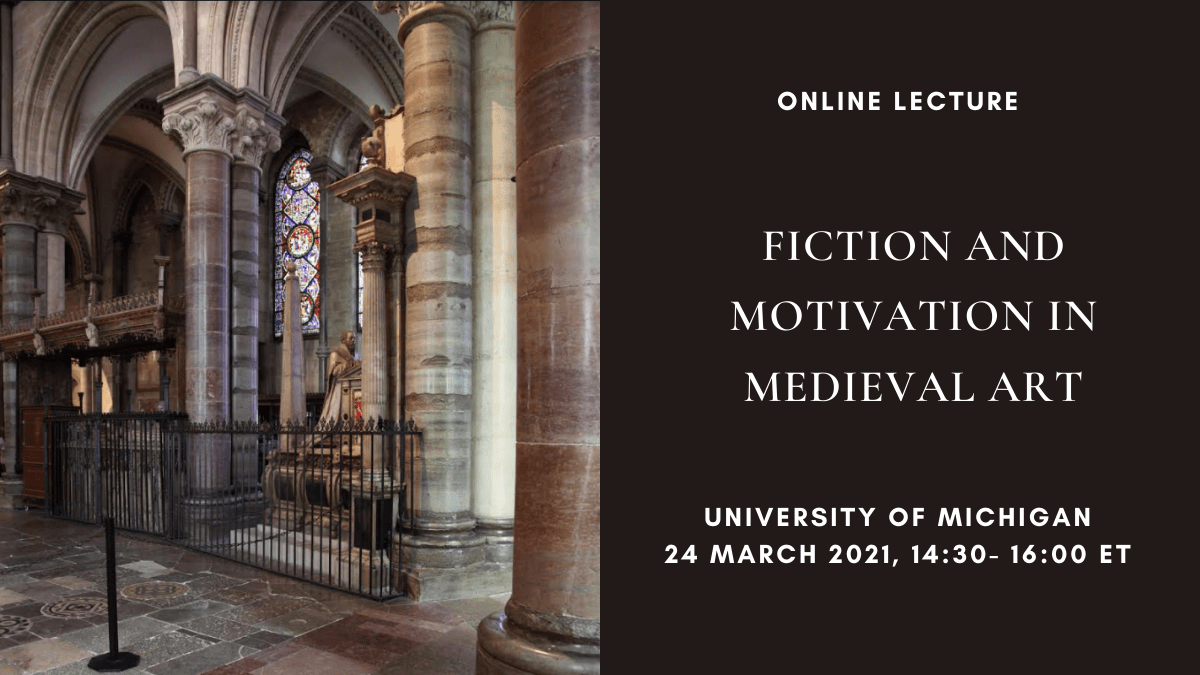
Online Lecture: ‘Fiction and Motivation in Medieval Art’ with Paul Binski, University of Michigan, 24 March 2021 14:30- 16:00 (ET)

Since the Ancient World, engagement with visual art has recognized that perception has tremendous powers to reconfigure ‘stuff’ imaginatively. Aquinas, for example, stated that it is possible to separate representation and configuration. Later aestheticians, informed by analytical philosophy, referred to this capacity as ‘aspectual seeing’: seeing something ‘in’ a configuration, or more radically seeing the configuration ‘as’ something. This lecture returns to ‘aspectual seeing’ in the belief that it illuminates current debates about materiality, illusion, emotion and fiction in medieval art. In particular, it will reflect on (if not solve) the question of what human engagement with fictions consists of, whether that engagement can motivate us to action and, if so, what that engagement tells us about the art-life divide as presently understood by some art historians and critics.

Paul Binski writes widely on general issues of aesthetics, rhetoric and the visual arts in the Middle Ages. He is Emeritus Professor of the History of Medieval Art at Cambridge University and a Fellow of Caius College, Cambridge. He is a Fellow of the British Academy and a Corresponding Fellow of the Medieval Academy of America, and was Slade Professor, Oxford University, 2006-7. He delivered the British Academy Aspects of Art Lecture, 2001, and the Paul Mellon Lectures, National Gallery, London and Yale University, 2002-3. His publications include Becket’s Crown. Art and Imagination in Gothic England 1170-1300 (2004), Gothic Wonder: Art, Artifice and the Decorated Style, 1290-1350 (2014) and most recently Gothic Sculpture (2019). Later this year he will be Franklin D. Murphy Lecturer at the University of Kansas.

To receive the Zoom link, please register here.

Call for Journal Submissions: ‘Image and Devotion’, Revista Cultura, Espaço e Memória (CEM), vol. 14 (2021), deadline 30 April 2021

The Transdisciplinary Research Centre for Culture, Space and Memory (CITCEM) invites the submission of article proposals for its journal Cultura, Espaço e Memória (CEM), vol. 14 (2021).

The fourteenth volume of CEM is dedicated to the theme of image and devotion and thus is framed within the scope of CITCEM ́s Tangible and Intangible Heritage Research Group. Following on previous scientific meetings focusing on the subject of image, namely the Research Workshop ‘Devotional practices and images’ organised by students of both the Masters Course in History of Art, Heritage and Visual Culture and the Doctoral Degree in Heritage Studies, this issue of CEM aims to promote a reflection on images and the devotional practices.

The proposals formulated by Herbert Kessler (2004) and Eric Palazzo (2010) for the study of the connections between art and liturgy focus themselves on the multidimensional approach to the artistic object and the exploration of its multiple aspects of functionality. Palazzo proposes, as an exploratory way, the study of the interaction between the artistic productions intended for the ritual, the images and the liturgical objects – and other elements that participate in the liturgy, sacred texts, light, smells, the ritual’s actors and the spatial organisation of the ceremony. The presence of light next to the sacred images corresponds to a very ancient practice. As demonstrated by J.-M- Sansterre, lamps accompanied the painted images on the church walls or in icons since the Early Middle Ages.
As summarized by García Avilés (2013), there have been important changes to history of art research in the last decades. From a perspective centred on the matters related to the production of the work of art, artist, promoters, aesthetic values, models, etc., a path has been taken towards the issues related to the reception of the Past’s visual culture. This evolution is forged in a double shift: iconic and anthropological.

Images miraculously moving into life, whose mentions are particular significant from the 14th century and throughout the Modern Age, actually have much earlier testimonies. García Avilés (2011) exemplifies how the Cantigas of Alfonso X reveal the effectiveness of prayer in evoking the action of Marian images as mediators of their sacred purpose. It has been widely debated in the last decades the complex functions of images in churches, defining them simultaneously as vehicle of the saint’s virtus represented by the art, as a material support for meditation or devotion and, as well, as elements that were part of the church symbolic decoration, where they could embody a certain objective presence of the represented supernatural reality (Sureda i Jubanay, 2012, 2013).

There are several interrogations on the function of images. What were their uses? Which practices and rituals were they a part of? How were images activated by gestures, words, sounds, rituals, prayers, deposition of ex-votos? Which other objects interacted with images? What was the importance of the travel in the diffusion of images? In which capacity can the image be understood as a support to cultural permeabilities? In which way is the devotion both a cause and effect of the artistic production?

We appeal for contributions on the study of images in the long duration and in an ample geographic context. Approaches that focus on the potential of the image as an appeal to the senses and transmission of meanings will also be valued. Beyond its thematic dossier, CEM accepts other works including news and critical reviews.

Author information

  • Accepted Languages: Portuguese, English, French and Spanish.
  • Submission proposal: Title, abstract (100 words – 150 words) and 3 to 5 keywords by April 30, 2021
  • Submission date: August 31, 2021
  • Notification date: October 15, 2021
  • Publication: December 2021

Authors must fully comply with the established deadlines, as well as the CEM’s norms of publication.

Contacts: citcem@letras.up.pt, tlf. +351 22 607 71 77 +info: www.citcem.org

Online Conference: ‘Testi e contesti. Fonti liturgiche e produzione artistica e tra Salerno e l’Europa nel Medioevo’, University of Salerno, 25-26 March 2021

On 25-26 March 2021, the international conference entitled “Texts and contexts. Liturgical sources and artistic production between Salerno and Europe in the Middle Ages ”, curated by Maddalena Vaccaro, Researcher of Medieval Art History at DISPAC (Dipartimento di Scienze del Patrimonio Culturale dell’Università degli Studi di Salerno), and Gionata Brusa, Researcher of Musicology at the University of Würzburg, will take place online.

The conference is dedicated to the relationship between artistic production, architecture and liturgical sources in the Middle Ages . Starting from Salerno and its heritage of illuminated manuscripts, the event opens up to the Campania context, Southern Italy and Europe with a plural approach between art, historical disciplines, liturgy and manuscript production.

The initiative foresees the participation of DISPAC teachers and Italian and foreign scholars, in collaboration with the Diocesan Museum “San Matteo” of Salerno and the Leone Museum of Vercelli, custodians of Salerno manuscripts.

To participate, you need to request the link by writing to testiecontesti2021@unisa.it 

CFP: ‘Art and Death in the Netherlands’, Netherlands Yearbook for History of Art 2022, deadline 15 April 2021

In premodern times, death was a more visible phenomenon than now, due to high mortality rates, but also to the fact that dying and death and the subsequent phases of deposition, bereavement and remembrance – more so than today – were collectively experienced, publicly performed, and commemorated in enduring monuments. Remembrance was held to extend into perpetuity, on personal grounds of love and affection, and for political and religious reasons, the latter normatively being related to the Christian doctrine of salvation, which, in Catholic contexts, called for unceasing prayer and other observances, like masses for the souls of the deceased. By continuing their existence in the afterlife, the dead remained present among the living.

Among the cultural responses and expressions related to dying and death, art and architecture had a prominent position. Art and cultural historians have made significant contributions to the study of the interrelatedness of art, dying and death. These range from focused studies of individual monuments or commemorative practices to more sweeping investigations of death as motivation for art. In Painting in Florence and Siena after the Black Death (1951), for example, Millard Meiss famously argued that the experiences of plague and large-scale death effected fundamental changes in the nature of the visual arts of central Italy. Many scholars have refuted parts of Meiss’s argument, but his book has gained renewed interest in our own time of plague as a cornerstone for exploring the relationship between art and death.

Volume 72 of the Netherlands Yearbook for History of Art is dedicated to the relationship of art and death in the Low Countries and its diaspora, from premodern times to the present. The editors welcome contributions on works of art and architecture (paintings, prints, sculptures, objects of applied arts, monuments, buildings) which in one or the other way can be related to the phenomena and cultural experiences of death, dying and deposition, as well as inquiries into how death and its public rituals shaped the visual arts. Contributions may deal with both human death and death and decay in plant and animal life.

It is essential for proposals to ask how these works not only expressed particular concepts and emotions (grief, fear, horror, hope, acquiescence, desire, etc.) related to (impending) death and afterlife, but also how they shaped and imprinted such ideas and aroused and channeled such emotions on the part of the living who engaged with them. Such engagement may include any physical or mental action or performance (moving, handling, touching, viewing, praying, singing, contemplating, etc.). These characteristically, though not exclusively, occurred within the context of a particular ritual or routine – personal or communal; private or public; secular or religious – related to the following: the preparation for death; deathbed observances, both pre- and post-mortem (e.g., the administration of the last sacraments, deathwatches); the post-mortem handling of the body (e.g., embalming, autopsy, dissection, anatomical lessons); funeral and burial preparations and their actual progress; commemorative activities (e.g., prayer, votive masses, services, gatherings); and consolation (e.g., pastoral visiting and counseling).

Any analysis of such engagement should take into account the social, demographic, ideological (including religious) as well as temporal and spatial circumstances and conventions under which it occurred. One may think here of: death in the public domain versus private dying and death; differences depending on political and social standing and meaning of the deceased (e.g., rulers, statesmen, national heroes); the theme of memoria and damnatio memoriae. Given the NKJ’s focus on Netherlandish art, we encourage prospective contributors to take into account circumstances specific to the Low Countries. In this respect, the topic of iconoclasm as the ‘death’ of the veristic object or veristic representation may be dealt with as well.

The works of art and architecture to be studied along the aforementioned lines of inquiry may include, but are not limited to:

  • memento mori and vanitas representations
  • illustrated consolation literature, funerary poetry; offices of the dead (as illustrated in books of hours and prayer books); artes moriendi
  • deathbed portraits; death masks; memory portraits (miniatures, lockets, rings, silhouettes, cameos); bereavement mementos
  • representations of funeral processions, burials and entombments
  • funerary decorations; burial customs and burial equipment; burial textiles; biers; grave gifts, coffins
  • mausoleums; funerary chapels, churches; mausoleums, churchyards and cemeteries
  • funeral monuments and tombs; tomb effigies; gravestones; wall memorials
  • public memorials for the dead
  • scenes of martyrdom; executions; killings; fatal accidents
  • last judgements and representations of heaven and hell
  • representations of anatomical lessons, autopsies and dissections
  • still lives/natures mortes

The NKJ is dedicated to a particular theme each year and promotes innovative scholarship and articles that employ a diversity of approaches to the study of Netherlandish art in its wider context. For more information, see: https://brill.com/view/serial/NKJ.

Contributions to the NKJ (in Dutch, English, German or French) are limited to a maximum of 7,500 words, excluding notes and bibliography.

Following a peer review process and receipt of the complete text, the editorial board will make final decisions on the acceptance of papers.

Please send a 500-word proposal and short CV by April 15, 2021, to the volume editors:

Bart Ramakers (b.a.m.ramakers@rug.nl)
Frits Scholten (f.scholten@rijksmuseum.nl)
Edward H. Wouk (edward.wouk@manchester.ac.uk)

Call for Blog Posts: ‘Liturgy, Literature & History: Oswald of Northumbria and the Cult of Saints in the High Middle Ages’, deadline 9 April 2021

On 5 & 6 August 2021, University College London will be holding an online conference, in collaboration with the British Academy and Peterborough Cathedral, which uses the cult of Oswald of Northumbria as a case study to examine the mechanisms by which saints’ cults spread and also the manner in which veneration of the saints drove other forms of political, cultural and social expression.

Although online conferences have the great benefit of enabling participation by delegates from across the world, it is harder to reproduce the informal in-person opportunities for PhD students and Early Career Researchers to talk about their work, connect with peers and mentors, and exchange ideas. To facilitate awareness of PhD/ECR projects and help researchers gain visibility for their projects the conference committee are issuing this call for blog posts.

Blog posts will be hosted on the conference website and publicised over social media. They are currently exploring the possibility of producing a physical newsletter for delegates – if they do this then blog posts would be advertised in this too.

If your research touches on the broader themes of the conference, including but not limited to, medieval liturgy, historical writing, material culture, architecture, the cult of saints, music, literature, or religious communities, and you would like to explore your ideas and share them with an international audience of medievalists interested in similar topics, please consider submitting an abstract. Blog posts of c.600-800 words, with 3-4 accompanying images, will be published in late June / early July.

Please send abstracts of up to 150 words, along with a brief description of yourself (name, stage, affiliation) by 9 April to history.oswald@ucl.ac.uk  with ‘blog’ as the subject line. The committee will let you know if we are able to host your blog post in early May.

Online Conference: 2021 Medieval Studies Student Colloquium, Cornell University (online), 26-27 March 2021 (EST)

We are pleased to announce the thirty-first annual Cornell Medieval Studies Student Colloquium which will be taking place virtually March 26th-27th, 2021 on the theme of “Movement”. We welcome all to attend. This year’s event has two distinguished keynote speakers as well as thirty presenters. You will receive the full conference program as a downloadable pdf file upon registration (the program contains the Zoom links to the conference sessions and the keynote lectures). Please register here

Our keynote addresses will be delivered by Sharon Kinoshita and Michael Gomez:

Friday, March 26th, 3:00-4:30pm EST

  • Sharon Kinoshita: On the Road with Marco Polo: Movement and Space in Le Devisement du monde

Saturday, March 27th, 3:00-4:30pm EST

  • Michael Gomez: The Concept of “Movement” in Early West Africa: A Fitting Framework

Please contact Alice Wolff at acw262@cornell.edu if you have any questions or if you need assistance.

Online Lecture: ‘Ps-Ptolemy’s Ὁ Καρπός and Byzantine Astrological Practice’, Darin Hayton, 1 April 2021, 16.00-17.00 (ET)

The Mary Jaharis Center for Byzantine Art and Culture at Hellenic College Holy Cross in Brookline, MA, is pleased to announce its final lecture for 2020–2021: “Ps-Ptolemy’s Ὁ Καρπός and Byzantine Astrological Practice.” Dr. Darin Hayton, Haverford College, will explore ps-Ptolemy’s Ὁ Καρπός to elucidate the culture of astrology in the later Byzantine empire.

This lecture will take place live on Zoom, followed by a question and answer period. Please register to receive the Zoom link. An email with the relevant Zoom information will be sent 1–2 hours ahead of the lecture. Registration closes at 11:00 AM (ET) on April 1, 2021. You can register here.

Abstract

The collection of astrological aphorisms that circulated under Ptolemy’s name raises a number of questions about the practice of astrology in the later Byzantine empire. The form and the content of the collection points to a thriving culture of astrology, one that possibly included social performances. In this lecture I will explore the various facets of this text — e.g., its material history and circulation, the aphorism as a form of authority and knowledge making, the arrangement and content of individual aphorisms and their sequence — in order to articulate some of those questions about the culture of astrology and to suggest some possible answers. Parts of this lecture will be speculative, but I hope generatively so.

About the Speaker

Darin Hayton is the Associate Professor of History of Science at Haverford College. He studied History and Philosophy of Science at the University of Notre Dame. He has held fellowships in Vienna, Munich, London, and Wolfenbüttel. He was also Research Officer at the History of Science Museum (Oxford), where he worked extensively with their collection of astrolabes. His research focuses on the various rhetorical and material ways scientific knowledge is recognized, articulated, and rendered authoritative. In particular, he studies the interplay between astrological practices and political authority in premodern Europe. His first book explored the place of astrology at the Holy Roman Court under Emperor Maximilian I. He is currently working on a series of case studies on the sciences of the stars that will illuminate the nature and practice of astrology in the later Byzantine Empire.

Contact Brandie Ratliff (mjcbac@hchc.edu), Director, Mary Jaharis Center for Byzantine Art and Culture, with any questions.

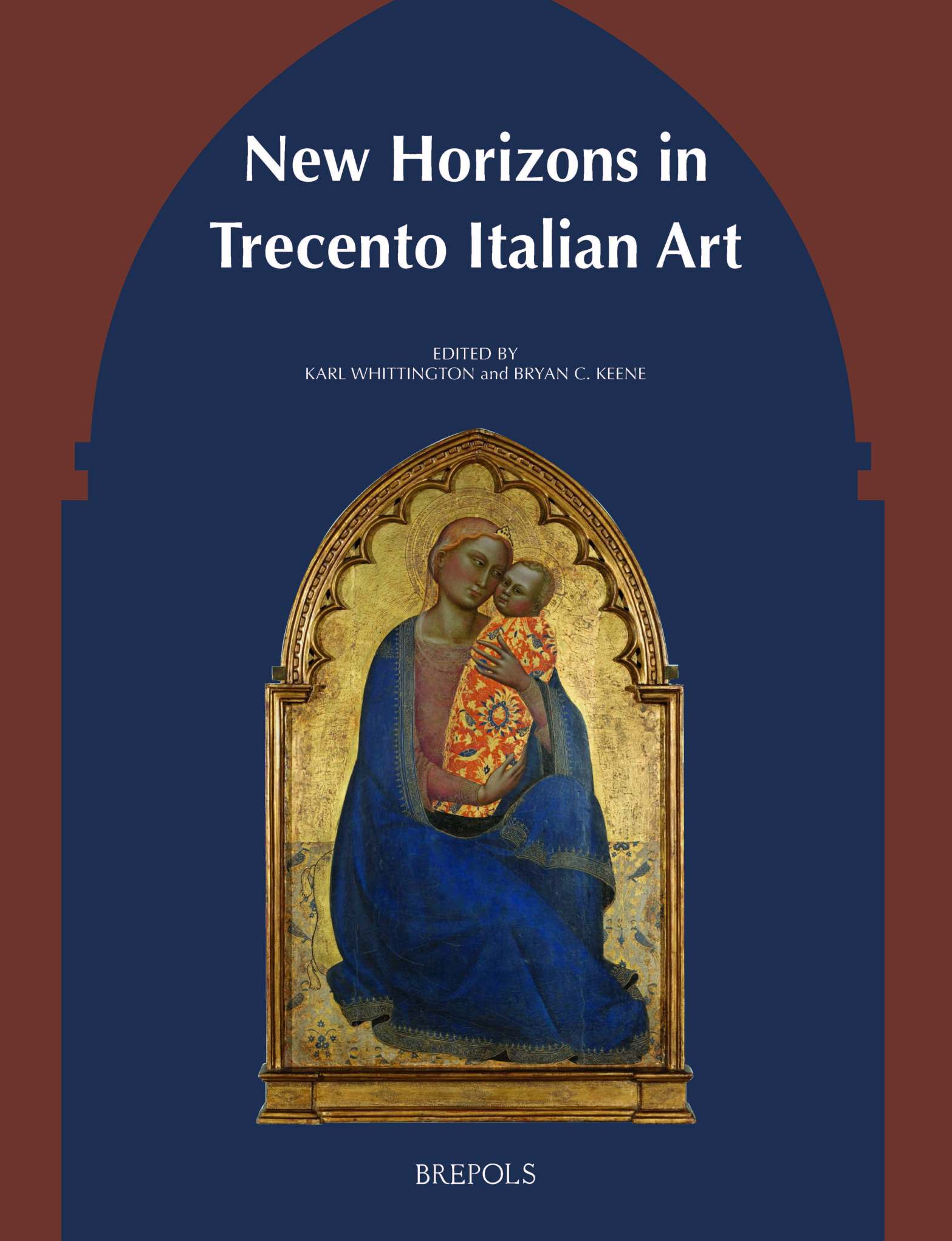
New Publication: ‘Imagining the Divine: Art in Religions of Late Antiquity across Eurasia’, edited by Jaś Elsner and Rachel Wood

This groundbreaking volume brings together scholars of the art and archaeology of late antiquity (c. 200−1000), across cultures and regions reaching from India to Iberia, to discuss how objects can inform our understanding of religions. During this period major transformations are visible in the production of religious art and in the relationships between people and objects in religious contexts across the ancient world. These shifts in behaviour and formalising of iconographies are visible in art associated with numerous religious traditions including, but not limited to, Buddhism, Christianity, Hinduism, Islam, Judaism, Zoroastrianism, religions of the Roman Empire, and paganism in northern Europe. Studies of these religions and their material culture, however, have been shaped by Eurocentric and post-Reformation Christian frameworks that prioritised Scripture and minimised the capacity of images and objects to hold religious content. Despite recent steps to incorporate objects, much academic discourse, especially in comparative religion, remains stubbornly textual. This volume therefore seeks to explore the ramifications of placing objects first and foremost in the comparative study of religions in late antiquity, and to consider the potential for interdisciplinary conversation to reinvigorate the field.

Table of Contents

Introduction (Jaś Elsner and Rachel Wood)
Chapter 1: The materiality of the divine: aniconism, iconoclasm, iconography (Salvatore Settis, with a response from Maria Lidova)
Chapter 2: Bodies, bases, and borders: framing the divine in Greco-Roman antiquity (Verity Platt, with a response from Dominic Dalglish)
Chapter 3: Kufa and Kells: the illuminated word as sign and presence in the 7th-9th centuries (Benjamin C. Tilghman and Umberto Bongianino, with an introduction by Katherine Cross)
Chapter 4: The Jewish image of God in late antiquity (Martin Goodman, with a response from Jaś Elsner and Hindy Najman)
Chapter 5: Empire and Faith: the heterotopian space of the Franks Casket (Catherine Karkov, with a response from Katherine Cross)
Chapter 6: Buddhapada: The Enlightened Being and the Limits of Representation at Amarāvatī (Jaś Elsner, with a response from Alice Casalini)
Chapter 7: From Serapis to Christ to the Caliph: faces as a re-appropriation of the past (Ivan Foletti and Katharina Meinecke, with an introduction by Nadia Ali)
Chapter 8: Uses of decorated silver plate in Imperial Rome and Sasanian Iran (Richard Hobbs, with a response from Rachel Wood)
Chapter 9: Material religion in comparative perspective: how different is BCE from CE? (Christoph Uehlinger, with a response from Stefanie Lenk)
Conclusion
Bibliography
Index

CFP: ‘Art and Religions in Antiquity: Crafting Religion in the Western Empire’, Society for Biblical Literature Annual Meeting (23 November 2021), deadline 23 March 2021

The Society for Biblical Literature calls for papers on ‘Art and Religions in Antiquity: Crafting Religion in the Western Empire’ as part of its 2021 annual meeting on 23 November.

‘Continuing a series of sessions that the Art and Religions of Antiquity program has held devoted to regional studies (Syria, the Aegean, etc.), we invite papers on art and religion in the Western Empire (Gaul, Spain, Italy, Britain). We particularly encourage studies that identify regional distinctiveness in art, religious practices, and even religious texts that can be connected to practices and/or arts unique to the region(s). We welcome papers examining not only spaces and objects typically seen as “religious” (churches, shrines, cemeteries and tombs, reliquaries, etc.) but also the ways art and religion were manifest in family estates, domestic spaces, and private commissions.’

Please email your proposal to program unit chairs Mark Ellison (mark_ellison@byu.edu) and Vasiliki Limberis (limberis@temple.edu) by 23 March 2021.

Please note it has not been confirmed whether or not the conference will be in person, or if presenters may contribute via Zoom if the meeting does meet in San Antonio (although a virtual option seems likely at this time)

CFP: ‘Materiality in the Eastern Mediterranean World’, Central European University, online (28-29 May 2021), deadline 5 April 2021

The Center for Eastern Mediterranean Studies (CEMS) at Central European University (Vienna/Budapest) is proud to announce the 7th International Graduate Conference on ‘Materiality in the Eastern Mediterranean World’, 28-29 May 2021. The conference will provide a forum for graduate and advanced undergraduate students working on the Eastern Mediterranean to present their current research, exchange ideas, and develop scholarly networks.

The aim of this conference is to explore how a turn towards materiality can help us to understand the Eastern Mediterranean world. The conference seeks research that investigates the role of physical “things” in history. How are material culture, technology, and the physical environment entangled in historical processes? How has the physical world shaped and been shaped by forms of social life in the Eastern Mediterranean? How have ideas and emotions been put into practice and how have they been embodied in material objects (e.g. artifacts, relics, and manuscripts)? How could materiality in the Eastern Mediterranean differ from other regions?

The committee welcomes approaches that focus on the relations between humans and their physical surroundings, the way they understand, perceive, and use them. Moreover, in turning towards the material, the conference intends to explore connections and entanglements between human/non-human, spiritual/physical, and phenomenological/epistemological.

The conference seeks innovative proposals by graduate students from all disciplines that relate to the Mediterranean world, including but not limited to Anthropology, Archeology, Art History, Classics, Environmental Science and History, Gender Studies, History, Languages and Literatures, Medieval Studies, Early Modern Studies, Philosophy, Religion, and Theology. 

Possible paper topics might include, but are not limited to:

  • Environmental and ecological histories
  • History of health and disease 
  • Texts as objects; cultures of documentation, archiving, and printing 
  • Economic and political practices
  • Architecture and urban history 
  • Commerce and trading systems
  • The physical manifestation and material life of symbols
  • Histories of affect and embodied physical experiences, such as pain, pleasure
  • The role of material culture in everyday life history 
  • Material history of empires. The objects of imperial formations
  • Histories of technology and science
  • Materiality and mobility in diplomacy; e.g. the role of gifts, travelogues
  • Aesthetics and design
  • Research employing economic and political approaches
  • Craftsmanship culture
  • Practices of warfare. Weapons and military technology
  • Rethinking units of analysis through materiality
  • Comparisons between the Eastern Mediterranean and other regions through materiality

Please submit by 5 April 2021 a short paper proposal (no more than 250 words, together with a brief biography and contact information) to the following address: cemsconference@ceu.edu. Results will be announced by 20 April 2021.