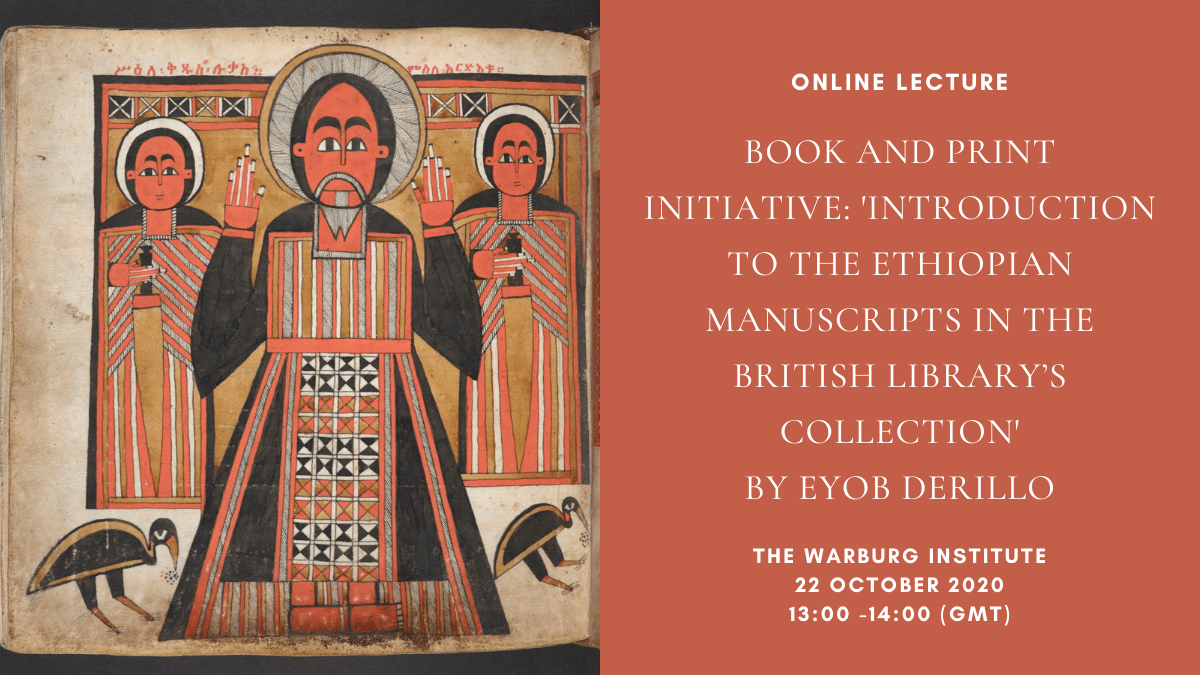
Online Lecture: Book and Print Initiative: ‘Introduction to the Ethiopian manuscripts in the British Library’s collection’, by Eyob Derillo, The Warburg Institute, 22 October 2020, 13:00 -14:00 (GMT)

Eyob Derillo (British Library): ‘Introduction to the Ethiopian manuscripts in the British Library’s collection’

The Book and Print Initiative was founded in 2017 to bring together scholars of books, printed material, and printing, at all career stages, across the School of Advanced Study (SAS). It is an umbrella for new and existing projects. As part of the UK’s research centre for the humanities, it provides a national focal point for the interdisciplinary, global study of word, image, and other written content from before the print era (manuscripts, palaeography, codicology) through to its future (digital humanities).

The Book and Print Initiative unites the study of printed material as a physical object with the information it contains and its influence on society. Rejecting the conventional limits of ‘text and image’, its inclusive remit spans artefacts of bindings to zoological illustrations.

The Book and Print Initiative’s directors are Raphaële Mouren (Warburg) and Elizabeth Savage (Institute of English Studies).

FREE VIA ZOOM. PLEASE BOOK IN ADVANCE – BOOK HERE.

Find out more information here.

CFP: 20th Vagantes Conference on Medieval Studies (University of Wisconsin-Madison 18-20 March 2021) Deadline for Submissions 30 November 2020

 The Vagantes Conference on Medieval Studies invites abstracts from graduate students and recently graduated Masters students from all disciplines on any topic that is related to the Middle Ages. 

Abstracts of 300 words, paper title, and a 1–2 page CV in one PDF are due Monday, November 30th, 2020 to vagantesboard@gmail.com

Your anonymized submission will be reviewed by an interdisciplinary panel fo graduate students. Since Vagantes is an interdisciplinary conference, you should provide a clear summary of your proposed paper with language that is accessible to non-specialists. 

All submissions will be considered for a CASH PRIZE, which will be awarded for the best paper!

For more information about the conference and paper submission, please see the link below:

http://vagantesconference.org/

CFP: ‘Sacred Scripted Images – The Iconic Presence of Script in Medieval Liturgical Space’ (Heidelberg, 20-22 Jan 2022), Deadline 13 November 2020

Inscribed artefacts in liturgical space, from apse mosaics to liturgical vessels, are not only evidence of the wide range of the use of script within the context of mass, but also testify to the presence of something written at a sacred place. “Presence”, here, is understood as a dynamic category, surpassing the act of reading as one form of reception and broaching the issue of the material quality of script and letters in liturgical space, as well as the visual implementation of sacred authority and power.

During the past years, the historical, art historical and liturgical sciences, as well as the visual culture studies have extensively researched the forms and requirements of presence effects (as in the exertion of sovereignty). Research has also been conducted on the different means, practices and strategies by which visual implementation (as in images, gestures and rituals) is achieved. The conference will build on this research, transferring these questions to the media of script – be it painted, chiselled, scratched, sewn or embossed. As previously indicated, the conference will focus less on the ways in which liturgical books served the reading and recitation during mass. Instead, we aim to question the material form, iconicity, and effectiveness – in short, the presence – of script in the context of mass: To which extent did script within liturgical space, especially script at and on top of the altar, produce presence and suggest sacredness? Was a sacred or sacramental significance attributed to the material appearance and presentation of single scripts and books, particularly to the “Holy script“ of the bible? Could we maybe even speak of a “sacramental presence of script” within this context? Last but not least, the conference has set the goal to test the scope and the limits of this questionable category by means of an interdisciplinary discussion. Consequently, we hope to receive contributions of art historians, theologists, historians, German philologists, liturgical science and visual culture specialists, as well as experts in other relevant scientific fields. We explicitly encourage junior scientists to submit their proposals.

Proposals for lectures of 20 – 30 minutes with a follow-up discussion can be submitted until November 13th, 2020. Please send the title for your submission, as well as a brief summary (max. 500 words), a short academic curriculum vitae (max. 1 page), and your contact information to: schriftbilder@zegk.uni-heidelberg.de.

Online Lecture:‘Early Rus’ Jewry: Byzantine Connections, Alexander Kulik, October 14 2020

‘Early Rus’ Jewry: Byzantine Connections, lecture by Alexander Kulik (Hebrew University of Jerusalem), University of Cambridge via Zoom, October 14, 2020, 5:00 pm BST

Join Cambridge Ukrainian Studies and the Byzantine Worlds Seminar for the 5th Annual Medieval and Early Modern Slavonic Studies Lecture at the University of Cambridge. 

The open lecture-webinar on the topic of ‘Early Rus’ Jewry: Byzantine Connections’ will be delivered by Alexander Kulik, Associate Professor and Chair of the Department of Russian and Slavic Studies at the Hebrew University of Jerusalem. The talk will reassess the evidence on the connections of early East European Jewry with Byzantium. It will focus on new or newly interpreted data which can help to define the origins of pre-Ashkenazi communities in Rus’ and possibly also help to solve some puzzles relating to literary activity in Kyivan Rus’.

Alexander Kulik is Associate Professor and Chairman of the Department of German, Russian and East European Studies at the Hebrew University of Jerusalem. His research in diverse fields concentrates on the cross-cultural transmission of texts and ideas. His scholarly interests encompass Slavic studies (palaeoslavica, medieval and modern Judeo-Slavica, and broader aspects of Russian and East European cultural history) and Jewish studies (Jewish literature and thought of the Hellenistic and Roman periods, early history of East European Jewry). 

Advance registration required. Register your interest via the link below!

https://zoom.us/webinar/register/WN_G6tq3RF-SkisWkiS4NRToQ

Virtual Exhibition: Black Monuments Matter – A Virtual Exhibition of Sub-Saharan Architecture

Please visit the exhibition website for more information via the link below:

https://black-monuments-matter.zamaniproject.org

Organisers: Professor Stephane Pradines and Professor (emeritus) Dr. Heinz Rüther 
The Aga Khan University Institute for the Study of Muslim Civilisations and the Zamani Project at the University of Cape Town are pleased to present the online exhibition “Black Monuments Matter”. 

Black Monuments Matter recognises and highlights African contributions to world history by exhibiting World Heritage Monuments and architectural treasures from Sub-Saharan Africa. 

In doing so, this exhibition sweeps away ideas based on racist theories and hopes to contribute to both awareness of African identity and pride of African Heritage. The exhibition is inspired by the “Black History Month” in the United Kingdom. 

Black monuments matter and Black cultures matter. Sites and monuments are physical representations of histories, heritage, and developments in society. This exhibition aims to display the diversity and richness of African cultures as part of world history through the study of African Monuments; bringing awareness and pride of African roots and contributions to other cultures. 

African cultures suffered extensively from slavery from the 16th to the 19th Century, and during the acceleration of European colonisation through the 19th and early 20th Century. Black Monuments Matter aspires to create links to living African heritage by making it visible, assessable, and known to as many people as possible. 

In general, we would like to raise awareness of and respect towards Black cultures and Africa’s past to a larger audience. At the Aga Khan University, the University of Cape Town and the Zamani Project, we believe in the relevance and knowledge of cultures, and the importance of education towards its understanding and appreciation. 

Through an approach founded on the latest knowledge and technology, this online exhibition offers visitors an opportunity to learn more about the glorious monuments and sites of African heritage and black cultures across Sub Saharan Africa. 

The African continent has numerous sites and monuments of historic and cultural importance, and our exhibition showcases some of its diversity and richness. From the Pyramids of Sudan, the Great Mosque of Timbuktu, to the Swahili cities of East Africa, each site is presented in a virtual room and is introduced by short texts written by African scholars. 

Many of Africa’s monuments are protected by UNESCO and have been given world heritage status. They are also protected and supported by national heritage authorities and by the support of international organisations such as the World Monument Fund and the Aga Khan Trust for Culture. 

Our hope is that visitors to this exhibition will recognise and support the work of national and international organisations committed to the support of African heritage. 

All the documentation presented in the exhibition are the result of many years of dedicated work by the Zamani team from the University of Cape Town in South Africa.  

Commentary on the Exhibition:

Dodé Houéhounha, African World Heritage Specialist 
Bryan Koffi Opoby, Junior African World Heritage Specialist

Patiently but surely, we make our way. As protests spread across the globe against systemic racism, police brutality, and injustice, 2020 turned out to be an exceptional year to reflect on what can be done to empower Black lives. This desire to correct an outdated and racially targeted system applies to many different areas such as education systems, employment opportunities, health care, and also, to the history and richness of the African continent. 

In “Black Monuments Matter”, as in the expression “Black Lives Matter”, it is the philosophical precision that counts. “To matter” is of course about the importance of social recognition, but what stands out in these words is surely the refusal of discrimination and the desire for equality. The desire of a community to rediscover, make known, and have its history and heritage recognised. It is this dynamic that currently drives the African heritage sector. 

Indeed, African experts are today multiplying actions in order to preserve and promote a heritage that is unfortunately endangered. Over the last few years, many actions have been carried out with the aim of continuously improving the conservation and management of African World Heritage sites. There are numerous examples testifying to the successes of recent years. 

The creation in 2006 of the African World Heritage Fund, whose objective is to provide financial and technical support for the effective conservation and protection of cultural and natural heritage, is one such example. This is also reflected in the growing involvement of motivated young people, in the increased participation of schools, and the growing number of training courses accessible in the heritage field. We should also note the increase in international funding collaborations, particularly in terms of capacity building workshops for site managers and, above all, in assistance provided to strengthen nomination files for the inscription of sites on the World Heritage List. These actions, taken collaboratively by a wide range of heritage actors, bear witness to the current dynamic. 

In this virtual exhibition, you will be guided through some of Africa’s World Heritage sites. The Old Towns of Djenné, inscribed in 1988 are an exceptional witness to the pre-Islamic civilizations of the inland Delta of the Niger, and an outstanding example of an architectural group of buildings that illustrate a significant historic period. The Rock-Hewn Churches, Lalibela represent a unique artistic achievement, in size and the variety and boldness of their forms. It is also an exceptional testimony to the medieval and post-medieval civilization of Ethiopia. As for the Asante Traditional Buildings, they are the last remaining testimony of the unique architectural style of the great Asante Kingdom. 
The diversity of the sites that are here presented is a reflection of the diversity of African heritage. With this exhibition, you will discover the richness and variety of a heritage that transcends time, ages and eras. 

In this exceptional context of health crisis, where these sites of exceptional value are now hardly accessible, it is this form of digital initiative that keeps our heritage alive. The use of new technologies to promote our incredible heritage and allow us to make it accessible to as many people as possible. It is only this way, by multiplying actions for its promotion and accessibility, that we will succeed in showing, raising awareness and educating people about the wealth of African history and heritage. This is a task that requires a lot of initiative yet, patiently but surely, we will make our way.

Funding: Rome Prize, American Academy in Rome, Deadline – November 1st 2020


For over a century, the American Academy in Rome has awarded the Rome Prize to support innovative and cross-disciplinary work in the arts and humanities. Each year, the prize is awarded to about thirty artists and scholars who represent the highest standard of excellence and who are in the early or middle stages of their careers.

Fellowships are awarded in the following disciplines:

  • Ancient studies
  • Architecture
  • Design: includes graphic, industrial, interior, exhibition, set, costume, and fashion design, urban design, city planning, engineering, and other design fields
  • Historic preservation and conservation
  • Landscape architecture: includes environmental design and planning, landscape/ecological urbanism, landscape history, sustainability and ecological studies, and geography
  • Literature: includes fiction, literary nonfiction, and poetry
  • Medieval studies
  • Modern Italian studies
  • Musical composition
  • Renaissance and early modern studies
  • Visual arts: includes painting, sculpture, drawing, photography, film and video, installation, new media, digital arts, and other visual-arts fields

Each Rome Prize winner is provided with a stipend, meals, a bedroom with private bath, and a private workspace. Those with children under eighteen live in partially subsidized apartments nearby. Winners of half- and full-term fellowships receive stipends of $16,000 and $28,000, respectively.

Rome Prize winners are the core of the Academy’s residential community, which includes Affiliated Fellows, Residents, and Visiting Artists and Scholars.

Owing to the fluctuating dollar/euro exchange rate and the high cost of living in Rome, the stipends offered may not cover all expenses. This is especially true for Rome Prize winners who come to Rome with families. The American Academy in Rome welcomes spouses, companions, and children of Rome Prize winners. However, Fellows with families often incur expenses that exceed the Fellow’s stipend, so those wishing to bring their families are advised to supplement their stipends with additional funds.

Full-term fellowships generally run from early September through the following June. Winners of half-term fellowships may indicate a preference to begin in September or February.

For further information on the Rome Prize, and guidance on applications, please see the link below:

https://www.aarome.org/apply/rome-prize

CFP: ‘What does Animation mean in the Middle Ages? Theoretical and Historical Approaches’ (Bialystok, Poland, September 16 – 19 2021), Deadline April 1 2021

International conference organized by:
A. Zelwerowicz National Academy of Dramatic Art – Branch Campus in Bialystok, Poland and University of Bergen, Norway

This conference is concerned with the agency and life of material objects and evolves around the investigation of two interlaced objectives. First, the project will shed light on understudied aspects of medieval visual culture, focusing in particular on the agency of images and material objects. Second, it will provide new cutting-edge theoretical reflections and methodologies concerning the study of material agency and “living images” today. We argue that the cultural use of and interaction with images may be regarded as more than mere historically or culturally specific phenomenon. Rather, it concerns the ontology of images and constitutes a fundamental aspect of our life with images, in the premodern as well as in the contemporary. It is our contention that images are embedded in social interaction and that animation is deeply constitutive of the production of meaning. Animation, we argue, is not only located in the mind of the beholder, but in the epistemology, creation, interaction and materiality of images. Furthermore, we will argue that medieval animation may inform contemporary views on animation and provide us with a more precise vocabulary to capture current phenomena for instance in the digital world. The conference aim to be interdisciplinary and transhistorical in its perspective. The conference targets scholars of visual studies, material studies, study of religions, anthropology, medieval studies and theology. It is also relevant more generally for current discussions about the life and agency of seemingly dead matter.

There are four main topics of the conference:
– Physical animation of art-works and other artefacts (sculptures, reliquaries, paintings etc.)
– Mental “animations” of objects (art-works, and other artefacts)
– Animation in a theatrical context (mystery-plays, liturgical plays and staging’s, puppets and other theatrical use of figures and sculptures) 
– Medieval and Early Modern animation in the 20th Century and contemporary theatrical practices.

The Conference takes as its point of departure the work of the newly organized international research-project: The Living Image (LIMA): On the ontology, agency and personhood of living images and objects – medieval and modern. This project is coordinated from the University of Bergen, Norway, and consists of a group of researchers from Belgium, Denmark, Ireland, Norway, Poland, United Kingdom, and USA, and the work of the international research network: The European Network on the Instruments of Devotion – ENID: https://enid.w.uib.no/

The conference in Bialystok is designed to be a platform for the exchange of opinions, ideas, and historical documentation, as well as the starting point for a publication. We plan to publish a collection of articles offering an interdisciplinary academic survey of the topic of animation in the Middle Ages, and its reception in the 20th Century.

Confirmed key-note speakers: Peter Dent, Ph.D., University of Bristol, GB; Prof. Cynthia Hahn, The City University of New York, USA; Prof. Hans Henrik Lohfert Jørgensen, University of Aarhus, Denmark; Amy Whitehead, Ph. D., Massey University, New Zealand

The language of the conference is English. Each contributor will be given 20 minutes to present his/her paper. Please send abstracts of no longer than 500 words, together with a short CV and personal data at the following email: medievalanimation@gmail.com

Deadline: April 1, 2021.

Conference fee: 25 Euros (15 Euros for Ph.D. students)

Conference organised by:
Kamil Kopania, Ph.D., A. Zelwerowicz National Academy of Dramatic Art – Branch Campus in Bialystok, Poland (https://atb.edu.pl/o-wydziale/pedagodzy/dr-kamil-kopania)
Henning Laugerud, Associate Professor, Dr. Art., Department of Linguistic, Literary, and Aesthetic Studies, University of Bergen, Norway (https://www.uib.no/en/persons/Henning.Laugerud)

Scientific committee:
Henrik von Achen, Professor, Director of the University Museum, University of Bergen, Norway
Kristin Bliksrud Aavitsland, Professor Ph.D., MF Norwegian School of Theology, Religion and Society, Norway
Barbara Baert, Professor, Ph.D., Art History, Faculty of Arts, Katholieke Universiteit Leuven, Belgium
Jørgen Bakke, Associate Professor, Dr. Art., Department of Linguistic, Literary and Aesthetic Studies, University of Bergen, Norway
Carla Maria Bino, Professor, Ph.D., Università Cattolica del Sacro Cuore, Brescia, Italy
Christophe Chaguinian, Associate Professor, Ph.D., College of Liberal Arts and Social Sciences, University of North Texas, USA
Peter Dent, Ph.D., Department of History of Art, University of Bristol, Great Britain 
Rob Faesen, Professor Ph.D., Department of History of Church and Theology, Katholieke Universiteit Leuven, Belgium
Cynthia Hahn, Professor, Ph.D., Medieval Art History, Hunter College, The City University of New York, USA
Hans Henrik Lohfert Jørgensen, Associate Prof., School of Communication and Culture – Art History, University of Aarhus, Denmark
Jon P. Mitchell, Professor, Ph.D., Social Anthropology, University of Sussex, Great Britain
David Morgan, Professor Ph.D., Religious Studies & Art, Art History and Visual Studies, Duke University, USA
Salvador Ryan, Professor. Ph.D., Ecclesiastical History, Pontifical University St Patricks College, Maynooth, Ireland
Zuzanna Sarnecka, Assistant Professor, Ph.D., Institute of Art History, University of Warsaw, Poland 
Laura Katrine Skinnebach, Ph.D., School of Communication and Culture – Art History, University of Aarhus, Denmark
Allie Terry-Fritsch, Associate Professor, Ph.D., School of Art – Art History, Bowling Green State University, USA

The conference will take place in Bialystok at the:
The A. Zelwerowicz National Academy of Dramatic Art 
Branch Campus in Białystok 
(Puppet Theatre Art Department) 
H. Sienkiewicza 14, 
15–092 Białystok, Poland
www.atb.edu.pl
e-mail: sekretariat@atb.edu.pl

Jobs: Wellman Chair in Medieval History, UCLA – Deadline 1 November 2020

The UCLA History Department seeks a senior historian of any region of Europe (including the Byzantine world) focusing on any period from late antiquity to 1400. We are searching for a senior Associate or a Full Professor with a distinguished research and publication record, who is a leader in the field as well as a dedicated teacher and mentor. A PhD in history or a related field is required. 

The department welcomes candidates whose experience in teaching, research or community service has prepared them to contribute to our commitment to diversity and excellence. This position is subject to final administrative approval.

Please see the link below for more information about the role, and how to apply:

https://recruit.apo.ucla.edu/JPF05574

Online Seminar: History of Liturgy Seminar Cycle – The Manuscript Remains of the Abbess-Saints of Barking Abbey by Katie Bugyis, 5 October 18:30

Tonights online lecture marks the first of the History of Liturgy seminar cycle hosted by the Institute of Historical Research. The cycle has been organised by Helen Gittos (Oxford), Sarah Hamilton (Exeter), John Harper (Bangor), Eyal Poleg (Queen Mary), Teresa Webber (Cambridge) and Henry Parkes (Nottingham). This terms events will be hosted via Zoom. Booking is essential.

To book your place to attend this lecture via zoom, follow the booking links on the link below:

https://www.history.ac.uk/events/manuscript-remains-abbess-saints-barking-abbey

Katie Bugyis is a historian of Christian theology, liturgical practice, and material culture, who is particularly interested in reconstructing the lived experiences of religious women in the Middle Ages through their documents of practice and other material remains. Her book, The Care of Nuns: Benedictine Women’s Ministries in England during the Central Middle Ages (Oxford University Press, 2019), recovers the liturgical practices of Benedictine nuns in England from 900 to 1225 primarily through detailed analyses of the books their communities produced and used.

Please contact ihr.events@sas.ac.uk for more information about this event.

For information about further events in this lecture cycle, please see the image below.

Online Lecture: Raphael 500: Raphael: Authorship, Networks, Workshop, The Warburg Institute, 15 October 2020, 17:30-19:00

Professor Ulrich Pfisterer (Director, Zentralinstitut)

In the first event in the Warburg’s new series Raphael 500, Professor Pfisterer will focus on two related works by Raphael to address key questions concerning the relevance of authorship for the painter and his workshop, his approach to theoretical thinking, and the composition and interaction of his social network.

Raphael’s work in painting, drawing, architecture and design had a profound effect on the arts, influencing not only his own time but also ours. Raphael 500 celebrates the painter’s life and marks the year of his death with a programme that considers elements of his approaches to the invention and production of works of art and looks at the way the study of Raphael widens our understanding of other Italian Renaissance artists. 

This event is also part of the Director’s Seminar series, which brings leading scholars and writers to the Institute to share new work and fresh perspectives on key issues in their fields.


FREE VIA ZOOM. PLEASE BOOK IN ADVANCE – BOOK HERE.

More information can be found here.