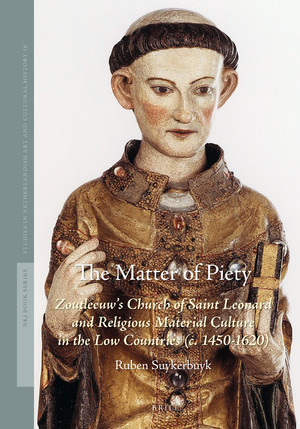
New Publication: The Matter of Piety – Zoutleeuw’s Church of Saint Leonard and Religious Material Culture in the Low Countries (c. 1450-1620) by Ruben Suykerbuyk

Studies in Netherlandish Art and Cultural History, Volume: 16

The Matter of Piety provides the first in-depth study of Zoutleeuw’s exceptionally well-preserved pilgrimage church in a comparative perspective, and revaluates religious art and material culture in Netherlandish piety from the late Middle Ages through the crisis of iconoclasm and the Reformation to Catholic restoration. Analyzing the changing functions, outlooks, and meanings of devotional objects – monumental sacrament houses, cult statues and altarpieces, and small votive offerings or relics – Ruben Suykerbuyk revises dominant narratives about Catholic culture and patronage in the Low Countries. Rather than being a paralyzing force, the Reformation incited engaged counterinitiatives, and the vitality of late medieval devotion served as the fertile ground from which the Counter-Reformation organically grew under Protestant impulses.

To download the PDF, or to purchase a Hardback copy, please follow the link below:

https://brill.com/view/title/54729

Online Seminar: ‘Merchants and Diaspora Round Table’, Miri Rubin (QMUL), Serena Ferente (KCL) and Kate Franklin (Birkbeck), Thursday 15th October 17.30

Image: Master of the Dresden Prayer Book (Flemish, active about 1480 – 1515) The Temperate and the Intemperate, about 1475–1480, Tempera colors and ink on parchment. The J. Paul Getty Museum, Los Angeles, Ms. 43, recto.

The IHR European History 1150-1550 seminar cycle for 2020 presents a lecture titled ‘Merchants and Diaspora Round Table’ for its second week. To attend the seminar, please book via this link.

‘Our seminar is now 15 years old and is as buoyant as ever. It  schedules research-based papers and occasional themed panels for discussion of the later centuries of the medieval period spanning continental Europe and the British Isles. Our programme reflects the  broad array of approaches and sources used by innovative scholars who come to us from UK universities and abroad. The seminar is convened by historians from the University of London’s and other London research institutes, and attracts academics at all stages of their careers, visitors on sabbaticals, scholars from libraries and archives, and interested members of the public. We treasure our doctoral students, who have the opportunity to present their advanced research at dedicated sessions. On occasion we combine with other seminars in planning joint sessions, reflecting our convergent interest. The presentations are followed by lively discussion, drinks in the IHR Common Room, and an informal and convivial supper.’

Miri Rubin’s research has ranged across the period 1100-1600, through the exploration of themes in the religious culture of Europe. Her latest book, ‘Cities of Strangers: Making Lives in Medieval Europe was published in March at Cambridge University Press.

Serena Ferente’s primary research interests lie in the political history of late medieval and Renaissance Italy. She has published widely on parties, partisan identities and supra-regional political networks in fifteenth-century Italy, with a particular focus on city-states and actors resisting processes of state-building. She is currently working on the Genoese diaspora in the Eastern Mediterranean and the Black Sea.

Kate Franklin has been working on collaborative projects in the Republic of Armenia for a decade, exploring the ways that local politics and Silk Road culture were tangled together in landscape and space-time. Her work at the moment at the moment is concerned with world-making as a locus of politics, with material culture as a mediator of spatio-temporal distances, and with the interpenetration of literary and ‘real’ landscapes in archaeological work.

For further information, please email enquiries to ihr.events@sas.ac.uk 

Fellowship: Swenson Family Fellowships in Eastern Christian Manuscript Studies, HMML, Winter/Spring 2021, Deadline: October 15 2020

The purpose of the Swenson Family Fellowships in Eastern Christian Manuscript Studies for Junior Scholars is to support residencies at HMML for graduate students or postdoctoral scholars with demonstrated expertise in the languages and cultures of Eastern Christianity. Awardees must be undertaking research on some aspect of Eastern Christian studies requiring use of the digital or microfilm manuscript collections at HMML. The program is specifically designed to aid new scholars in establishing themselves through research focused on manuscripts available through HMML. Postdoctoral scholars are understood to be those who at the time of application are within three years of being awarded a doctoral degree.

Awards will range from $2,500 – $5,000, based on project proposal and length of residency (two to six weeks). Funds may be applied toward travel to and from Collegeville, housing and meals at Saint John’s University, and costs related to duplication of HMML’s microfilm or digital resources. The Fellowship may be supplemented by other sources of funding but may not be held simultaneously with another HMML fellowship. Holders of the Fellowship must wait at least two years before applying again. 

Applications must be submitted by October 15 for residencies between January and June of the following year.

The Swenson Family Fellowship in Eastern Christian Manuscript Studies, established in 2012, will be awarded semi-annually. The Fellowship was established by Dr. Gregory T. and Jeannette Swenson, with their son Nicholas Swenson.

For more information, see the link below:

https://hmml.org/research/swenson/

Virtual Exhibition: Les Enluminures at Frieze Viewing Room – October 9 – 16, 2020

Les Enluminures have collaborated with Frieze to create a virtual showcase of selected medieval and early modern manuscripts and jewellery.

Their public statement is detailed below:

Les Enluminures is delighted to participate in Frieze Viewing Room, which opens to the general public at 12pm BST this Friday October 9. Our Viewing Room will showcase a curated selection of illuminated manuscripts, leaves and historic jewelry. 

Frieze Viewing Room is a new mobile app and web-based platform, giving collectors the opportunity to explore and acquire art from the world’s leading galleries. This edition showcases galleries selected to participate in Frieze London & Frieze Masters 2020.

In addition, we are thrilled thatSir Norman Rosenthal (Independent Curator), has selected one of our artworks for a special display called Forever within the Frieze Masters section of Frieze Viewing Room. This specially curated group of thirty-six artworks will explore the premise that great art is forever, selecting works that have stood – and in the curator’s mind will stand- the test of time.’

To register, please follow this link: https://viewingroom.frieze.com/?_ga=2.83279764.369259909.1602256998-1461121774.1602256998

Inbox

Call for Papers: International Conference – Handbook on the Later Crusades, deadline: 1 November 2020

[Image – Crusaders at the walls of Antioch, from the Histoire d’Outremer, Bruges, c. 1479–c.1480, Royal MS 15 E I, f. 101v ]

In the last decades, research on the “Later Crusades” has increased significantly. As a result of this a new consensus among researchers has been reached which considers that the crusading movement did not stop after the year 1400. Late Medieval and Early Modern Europe continued to be profoundly influenced by crusading desires across denominational boundaries and through all levels of society. The impact became certainly less “visible” as the centuries after 1400 no longer saw the dispatch of large international armies that had the specific goal of liberating Jerusalem. Yet, apart from the still manifold military activities, the crusading discourse retained a powerful influence and it profoundly shaped not only the European but also the Muslim societies that responded with their own (re-)conceptualization of a holy or just war.

This conference is intended to help in the preparation of a “Handbook on the Later Crusades” which will summarize the findings of the last three decades and serve especially for teaching at universities. We wish to prepare the Handbook with six larger chapters, which each containing 4-5 specific subchapters of 20-25 pages in English. The structure is as follows:

I. Spaces
II. Actors
III. Crusading plans IV. Reception
V. The Muslim World VI. Events

We invite experts on specific themes within this array to submit an application for a subchapter. A subchapter for the Handbook should have its “individualistic” tones but mostly it ought to be a presentation of the current state of research and thus be based on secondary literature. It should give a reader without specialist knowledge an insight into the topic and an orientation.

We would like to especially encourage proposals and applications that would treat topics from the Muslim world, whose manifold reception of and reaction to the movement of the later crusades should be presented in substantial complexity within the forthcoming Handbook. Contributions can range from historiography, literature, works of art etc. We would particularly welcome interdisciplinary contributions and submissions treating art or music history, literature studies or the history of ideas.

A two-day conference about the Handbook is to be held in Frankfurt am Main (Germany) on July 13-14, 2021. The keynote lecture about ‘Defining and delimiting the Later Crusades’ will be given by Norman Housley on the evening of July 13.

Each participant will be asked to send a five-page working summary of their chapter that shall be enlarged after the conference to the final subchapter for the Handbook. These preliminary texts will then be sent to all participants and intensely debated at the conference. The objective is to finish these chapters until the end of 2021 and then publish the Handbook soon after. If the conference cannot take place due to the COVID-19 pandemic, it will be changed to an online-event and presumably spread over several days.

Deadline and details:

This call for papers is now open for those researchers who are interested to participate in the conference. They are invited to submit their proposals with a title, an abstract (no more than 500 words) and a brief bio (maximum of 15 lines) before November 1, 2020 to: Dr. Magnus RESSEL (ressel@em.uni-frankfurt.de) or Dr. Emir O. FILIPOVIC (emirofilipovic@gmail.com).

Reimbursement of expenses:

CA1829 might be able to reimburse travel and accommodation expenses to a limited number of researchers not yet affiliated to the Action. Applications should be submitted along with the proposals.

More information: please, see https://is-le.eu/

https://www.facebook.com/CostActionISLEhttps://twitter.com/CostActionISLEhttps://www.instagram.com/CostActionISLE/

Online Course: London Art History Society presents – Early Christian Rome with John McNeill, 11 – 25 November 2020

Begins: Wednesday 11 November 2020 – Wednesday 25 November 2020 (11am-12pm)

Programme
Imperial capital until the early fourth century and home to the papacy, Rome was the city where Octavian was proclaimed Augustus and SS Peter and Paul were martyred. This online study event considers how Rome became a Christian city. The very earliest Christian art and architecture emerged, almost imperceptibly, out of the allusive religious art of the eastern Mediterranean. Its forms often amounted to no more than simple signs and inscriptions, and its monuments were almost invisible to view – an ordinary house front, an underground burial chamber. Constantine’s granting of a legal personality to the Church in 313 changed that. Henceforth, a public monumental Christian art and architecture was possible, and was actively embraced as vast ecclesiastical building projects transformed the city. This online study event is arranged as three one-hour lectures, which respectively discuss the emergence of Christian imagery in the catacombs between c.250 and c.400 AD, the development of ecclesiastical building types such as basilicas, baptisteries and martyria, and the birth of Christian narrative art.

Lectures:
Wednesday 11 November 2020, 11am-12pm
The Catacombs: Planning and Painting

Wednesday 18 November 2020, 11am-12pm
Architecture in Rome from Constantine to Pope Honorius I (625-38)

Wednesday 25 November 2020, 11am-12pm
Monumental Imagery: Apse mosaics and the emergence of Narrative Painting c.350-c.650

John McNeill lectures for the Department of Continuing Education at Oxford University and is a Vice-President of the London Art History Society. He is the Honorary Secretary of the British Archaeological Association, for whom he has edited and contributed to volumes on English medieval cloisters, chantries and Romanesque material culture. He has a longstanding interest in Rome and early Christian culture

*You must be a member of the London Art History Society*

Please note that you will need to be familiar with Zoom in order to participate – we do not have the capacity to provide any back-up or advice on the use of Zoom. We recommend that you log on to Zoom 15 minutes before the start time of the event even if you are familiar with the app since the process can take some time if a lot of participants are logging on at the same time. You will receive an email first thing on the day of each lecture with details of how to join the event. If you do not receive it please check your spam/junk mail folder.

Find out more here.

Conference: Fourteenth International Conference of Iconographic Studies – Iconography and Hagiography: Visualising Holiness, 15-16 October 2020

Center for Iconographic Studies – University of Rijeka, Société des Bollandistes and Hagiotheca Croatian Hagiography Society are organising the Fourteenth International Conference of Iconographic Studies – Iconography and Hagiography: Visualizing Holiness on 15th and 16th October 2020.
The range of literary sources that concern the saints has been immensely wide over the long period of time and has presented central feature of the Christian literary and visual culture. This conference seeks to explore the ways and mechanisms of the translation of these sources in visual language in Eastern and Western Christianity. Scholars will present proposals on different topics on the relation between hagiography and iconography such as: martyr acts and lives, hagiographical romances, and edifying tales represented in visual arts in East and West; individualization vs. generalization in hagiography and iconography; question and role of gender in visualizing sanctity; saintly bodies in visual arts – relics, spectacles, perfomances, and religious devotion; new research instruments for hagiographical texts and images; popular iconography in the age of the printing press; saints and the new media (movies, comic books etc.). Academic papers will approach these subjects from interdisciplinary and methodologically diverse angles.

Please see the programme of events via the link below:

http://cis.ffri.hr/wp-content/uploads/2020/10/PROGRAM-1.pdf

It will take place online on the ZOOM Pro platform. The participation is open to wider audience. The program and all the relevant info please find at: http://cis.ffri.hr/en/conference-2020/

The Zoom conference rooms can be accessed via the links below:

Thursday, 15 October:
https://zoom.us/j/93812581590?pwd=c0w1Ri9vWjh3ODR5YnlXN1lLVVN1dz09

Friday, 16 October:
https://zoom.us/j/93947492797?pwd=MHRDeC9kWHo0SlFNSFV4ZE9aeExLZz09

Call For Submissions: Transitioning Historic Houses to a Virtual Experience, Deadline: Nov 30, 2020

History Dis-placed: Transitioning Historic Houses to a Virtual Experience concentrates on the unique histories and challenges of house-museums. In addition to being historic landmarks, house-museums can be sites of civic engagement and reflection; centers for activism and cultural discourse; and places for public events and gatherings. In the digital age, house-museums have had to renegotiate these identities and interactions with contemporary audiences through innovative practices. This was further challenged when museums across the globe were suddenly forced to pivot to, for many, an unfamiliar online discourse during the 2020 Covid-19 crisis. Many of the educational tropes utilized to great affect by house-museums – including living history and other direct contact strategies with an active audience – had to be jettisoned for online engagement. Museum staff were challenged to create content, develop educational recourses, and provide access to collections with little preparation and amidst severe budget cuts. There has, perhaps, never been a greater challenge to museums around the globe, and historic homes are among the hardest hit in these unprecedented times.

This edited volume asks for submissions that address, but are not limited to, the tactics taken by house-museums after February 2020, when it was clear that closing was imminent and re-opening in the near future was not an option.  How do museums that strive to bring in-person encounters to life continue to do so through an online presence?  How can these site-specific museums re-create or re-produce an aura or indexicality of space and place – a interaction that differs somewhat from other types of museums? What types of decisions need to be made when re-creating the museum collection for online perusal, which, for most house museums, are traditionally and fully experienced through the domestic spaces in which the collection is housed and the site-specificity of the museum? How do those at house-museums envision these decisions to move content online affect the future engagement of the museums with visitors and educators?

We invite submissions for scholars, students, and those personally involved with the day-to-day operations of a house-museum that reflect upon of the strategies undertaken for both historical and financial survival in the precarious position that house-museums find themselves during and after 2020.

Submission Guidelines
Please send abstracts of no more than 500 words to Karen Shelby (karen.shelby@baruch.cuny.edu) and Emily Stokes-Rees (ewstokes@syr.edu) by November 30, 2020 with the subject heading “House Museum Submission.” Abstracts and a two-page CV should be sent as one PDF and titled with the author’s last name. Editors will respond to submissions by December 15. Final papers will be due June 15, 2021. Papers should range from 6,000-8,000 words in length.

Online Lecture: ‘Wording the Crucifixion: art, inscriptions and polemics of two Romanesque ivory crosses’ by Professor Sandy Heslop, 16 November 2020, 6-7pm

Carved crucifixes with long inscriptions are a rarity – usually the image of Christ on the Cross, whether shown triumphant or suffering, is deemed sufficient content. Two important exceptions, both made of walrus ivory, were created in the twelfth century. The earlier was commissioned c. 1110 by Gunhild, the daughter of King Sweyn Magnus of Denmark (he died 1075). Its imagery and biblical citations promote charity, especially of the wealthy to the poor. The more famous ‘Cloisters Cross’ of c. 1175 (now in New York) is more complex, emphasising the extent to which the Crucifixion was the fulfilment of prophecy. Unfortunately its place of origin is not known, but its links with Gunhild’s Cross have been acknowledged though not explored in any detail. Professor Heslop will explore how closely related both crucifixes may be.

Sandy Heslop is Professor of Visual Arts at the University of East Anglia. He has published widely on the art and architecture of medieval Europe, in various media. Current projects include a book on the Parish Churches of Medieval Norwich and another on St Anselm’s Canterbury.

*You must be a member of the London Art History Society*

Find out more information here.

New Publication: La Bouquechardière of Jean de Courcy-Critical Edition and Commentary by Catherine Gaullier-Bougassas

Jean de Courcy, lord of Bourg-Achard in Normandy, wrote la Bouquechardière at the beginning of the 15th century. In this broad, hitherto unpublished chronicle, he departs from the model of universal history, selecting above all the history of one part of the world: Greece and the European and Asian territories linked to it. His work offers a history of ancient Greece in six books, from the foundation of Argos and Athens to Alexander the Great and his successors. Choosing, at the beginning of the 15th century and in France, to devote an entire work to the history of ancient Greece is an innovation. The Bouquechardière then combined two major legacies that had not yet been reconciled on such a scale, that of the mythological fables of Antiquity and that of universal history. Its second originality is that Jean de Courcy continuously glosses the historical narrative, following the models of sermon writing. He then succeeds in reconciling two objectives: to amplify the narrative of the history of Ancient Greece, by praising the virtues of illustrious pagan figures, and to continually “moralize” it, giving his text the status of an edifying work, offered to the devotion of lay readers.

This first critical edition is based on an examination of all known manuscripts (31) and the present volume, the first, is devoted to the account of the origins of Greece, from the foundation of Argos and Athens to Hercules.

Catherine Gaullier-Bougassas is Professor of Medieval French Language and Literature at the University of Lille (France) and Senior Member of the Institut Universitaire de France. She is the author of numerous studies on the reception of Antiquity and the figure of Alexander the Great in the Middle Ages.

For more information about this new publication, please see the link below:

http://www.brepols.net/pages/ShowProduct.aspx?prod_id=IS-9782503581620-1