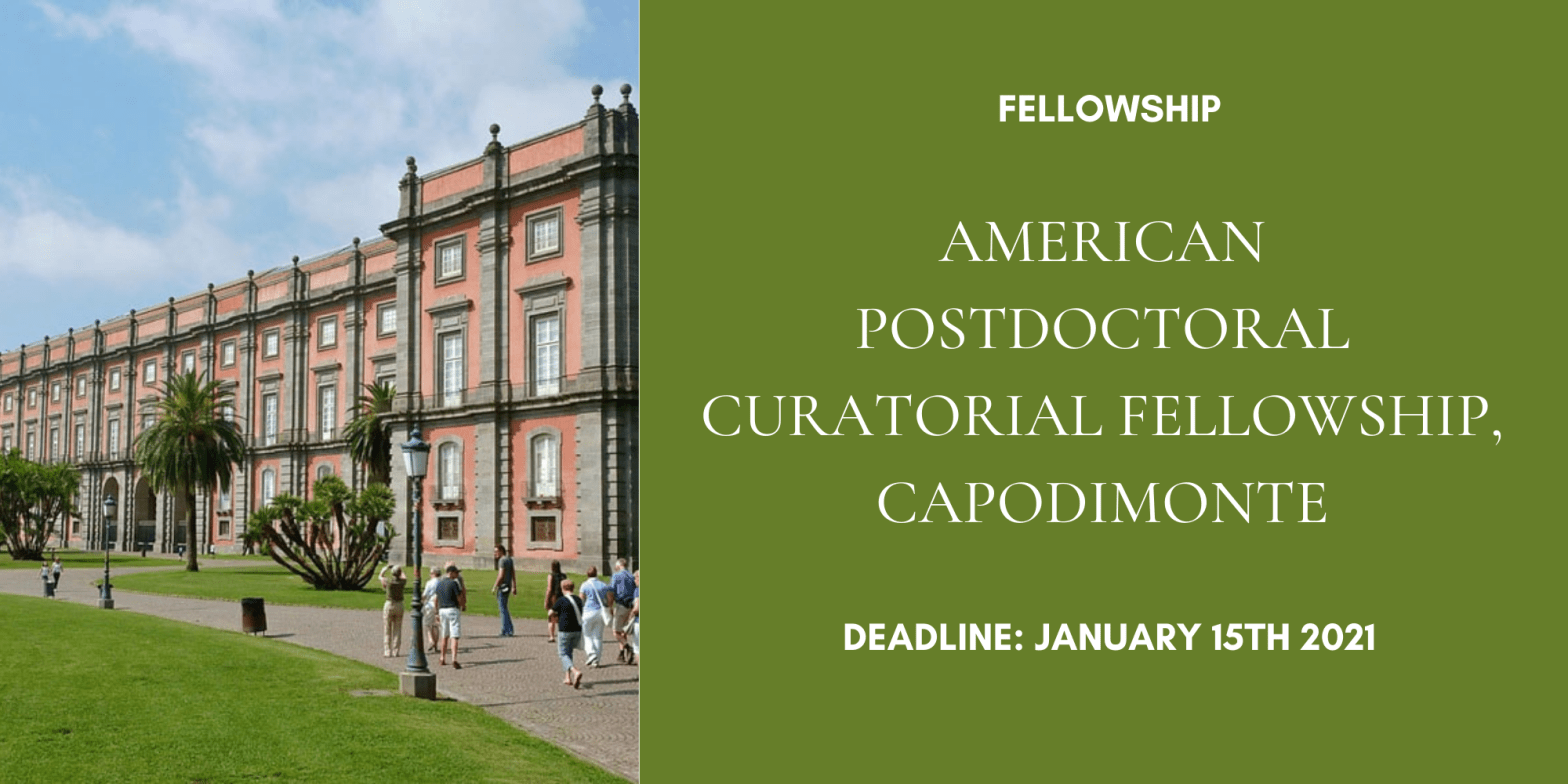
Fellowship: American Postdoctoral Curatorial Fellowship, Capodimonte, Deadline: January 15th 2021

The Capodimonte Museum, Naples, Italy, September 1, 2021 – August 31, 2022
Application deadline: Jan 15, 2021

The American Friends of Capodimonte Postdoctoral Curatorial Fellowship, 2021-2022

The American Friends of Capodimonte (AFC) and the Museum and Royal Park of Capodimonte welcome applicants for a Postdoctoral Curatorial Fellow funded by the AFC for the academic year commencing September 2021. The Fellow will be fully integrated into the Museum’s curatorial department and assist Director Sylvain Bellenger and his colleagues in a wide range of projects across the life of the Museum, including exhibitions, publications, interpretation and translations.

The mission of the AFC is to promote and raise awareness in an English-speaking audience of the Museum and Royal Park of Capodimonte, one of Europe’s greatest museums. The AFC is proud to be the only 501(c)(3) non-profit organization that funds and places promising young American curators directly into an Italian museum. In addition to curatorial responsibilities, the Fellow will also serve as an English-speaking ambassador from the Museum to visiting members of the AFC, international guests of honor, and members of the international press.

The demands and requirements of the job are, like Naples, not always straightforward and therefore a successful applicant will also need to demonstrate initiative, entrepreneurial skills and the ability to adapt to a variety of situations. Previous Fellows have worked on creating text for English and Italian wall labels for the permanent collection and temporary exhibitions, taken responsibility for curation of the Farnese collection of paintings and drawings, and written a catalogue for an exhibition of Capodimonte’s masterpieces that travelled to Seattle and Dallas in 2019-20.

The Fellow will have access to the rich cultural resources of Naples, including museums, opera and music at the Teatro di San Carlo, historic landmarks, and the Biblioteca Nazionale di Napoli, which is the largest Italian library after Florence and Rome. The Fellow will be encouraged to pursue areas of their own expertise within the Museum and may be able to define projects that will further their own research. Previous Fellows have gone on to be offered and to accept curatorial positions in major American museums. The unique access to the Museum and to Naples given to the Fellow during his or her tenure has been an important factor in securing these jobs.

The Fellow will be fully integrated into the inner workings of Capodimonte and is expected to focus on making the Capodimonte’s innumerable treasures more widely accessible to an international audience during this exciting period in the museum’s illustrious history.

Fellowship Period and Residency

The Fellowship period is from September 1, 2021 to August 31, 2022 during which the Fellow will be expected to reside in Naples and work full-time at the Museo di Capodimonte. The possibility of an extension for a second academic year may be reviewed by the AFC during the initial Fellowship.
The AFC Postdoctoral Curatorial Fellow will be provided with housing or a stipend towards housing for one person only in Naples.

Eligibility

Applicants for the 2021-2022 fellowship must hold a PhD degree in Art History not received before May 30, 2018. Pre-doctoral candidates may apply if the PhD degree will be awarded before commencement of the Fellowship. Applicants must be United States Citizens. Applications will be reviewed by the AFC Board and Director of Capodimonte. The applicant may not hold concurrent fellowships or awards during the fellowship period.

The applicant must also specialize in Early Modern European Art, preferably Italian Renaissance and/or Baroque art. A working knowledge of spoken and written Italian is essential.

Support

The American Friends of Capodimonte Postdoctoral Curatorial Fellowship award is $40,000 per year, in addition to housing or a housing stipend. Upon application to the Board, the Fellow may also be eligible for travel funds for targeted projects.

Applications and Deadline

Candidates for the American Friends of Capodimonte Postdoctoral Curatorial Fellowship must submit the enumerated materials below via email to americanfriendsofcapodimonte@gmail.com.

All materials must be submitted in PDF file format
All materials must be submitted in English

1. Cover letter addressing your interest in the Fellowship position and how you think you could contribute to the Museum and the AFC mission.
2. CV
3. 1 writing sample: PDF of published paper or recent writing sample (article, book chapter, dissertation chapter, etc.)
4. 3 references from professional art historians or museum professionals within the field.

For each reference (3) please indicate: 
– name
– title 
– institution (with address)
– email address
– phone number

The deadline for all materials is January 15, 2021, 5:00 pm (ET). Applications must be received on or before the deadline. Late applications will not be considered. Candidates will be contacted regarding the status of their application in early spring 2021.

Learn More about the AFC

http://www.americanfriendsofcapodimonte.info/

Online Lecture: ‘As We Heard from the Enemy Himself’: Intercultural Transmission in Early Medieval Armenia, lecture by Alison Vacca (University of Tennessee, Knoxville) October 21, 2020, 6:00–7:30 pm

University of Cambridge Byzantine Worlds Seminar via Zoom, October 21, 2020, 6:00–7:30 pm (UK) 

Alison Vaca is Associate Professor and Director of Graduate Studies in the Department of History at University of Tennessee, Knoxville. She is a historian of early Islam working on the caliphal provinces Armenia and Caucasian Albania. Her research explores intercultural transmission of historical texts, quick-changing alliances in moments of intercommunal violence, and intermarriage across ethnic and religious lines.

The Byzantine Worlds Seminar provides a venue for exploring the material and intellectual entanglements between the medieval worlds of the Middle East, North Africa, Central Asia and Eastern Europe. It is supported by the Centre for Research in the Arts, Social Sciences and Humanities (CRASSH) and Society for the Promotion of Byzantine Studies (SPBS).

Advance registration required. To register, please follow this link.

An event organised by Byzantine Worlds Research Network.

Administrative assistance: networks@crassh.cam.ac.uk

Online Lecture: ‘Go Forth and Learn’ The Artist Joel Ben Simeon and a Newly Discovered Hebrew Manuscript, Fordham University & Les Enluminures, October 22, 1:00 PM (ET)

Watch a short video here to see an introduction to the newly discovered manuscript.

Born in Germany, where he trained as an artist and scribe and from where he was probably expelled, Joel ben Simeon spent most of his itinerant career in the book arts in northern Italy.  We perhaps know more about him – from his colophons and his signed works – than any other illuminator-scribe, Jewish or Christian, in the fifteenth century.  He depicts himself as a traveler in one manuscript next to the words “Go forth and learn,” which we hope to accomplish in this Webinar. The discovery of a new manuscript with more than 300 drawings by his hand prompts a reassessment of his career at a time of great religious uncertainty, economic opportunity, and cultural exchange

Speakers: 

Keynote: Professor Katrin Kogman-Appel, University of Muenster, Institut fur Judische Studien, previously taught at Ben-Gurion University of the Negev (1996-2015). Professor Kogman-Appel has published extensively on medieval Jewish art and book culture and is particularly interested in Hebrew manuscript illumination and its cultural and social contexts. 

Professor Lucia Raspe, Goethe Universitaet, Frankfurt am Main. Professor Raspe has published widely on late medieval and early modern Jewish communities, including the migration of German Jews to Italy, on manuscript and print culture.  

This event is a joint program between Fordham Jewish Studies and Les Enluminures, organized by Sandra Hindman, Professor Emerita of Art History, Northwestern University, and President and Founder, Les Enluminures and Sharon Liberman Mintz, Curator of Jewish Art, The Library of the Jewish Theological Seminary, and Senior Consultant, Judaica, Sotheby’s

To register, follow this link.

Online Lecture: Dancing in the Streets: Urban Life in Medieval Constantinople, Leslie Brubaker (University of Birmingham), 20 October 2020, 7:00 pm

Professor Leslie Brubaker will give the 2020 SPBS Autumn Lecture “Dancing in the Streets – Urban Life in Medieval Constantinople” on Zoom on October 20, 2020 at 7pm. The lecture is organized in association with the Hellenic Society

Leslie Brubaker is Professor of Byzantine Art and Director of Byzantine, Ottoman and Modern Greek Studies at University of Birmingham, Centre for Byzantine, Ottoman and Modern Greek Studies.

Advance registration required. To register, please click here.

CFP: ‘Questioning the Crime of Witchcraft’, International Conference at the EHESS Paris, Deadline: 30 November 2020

In the last decades, the multiplications of works in the field of Witchcraft Studies made it possible to profoundly renew the approaches and the study designs of the repression of witchcraft in the late Middle Ages and in the beginning of the Early Modern Era. Consequently, research has substantially specified the methods and configurations (ideological, political and doctrinal) that contribute to the genesis of the “witch-hunt”. Research also uncovered that the repression of witchcraft could take a number of different forms depending on the contexts, the spaces studied, the sources and the aims they seem to pursue. It underlines the extreme plasticity of the accusation of witchcraft and the categories of such a crime. Hence, the conference aims to focus the discussions on three main areas: the definition of the crime of witchcraft, its different receptions and the question of its reality.

The goal of the conference is also to discuss the crime of witchcraft by highlighting new fields of research and unstudied sources. The variety of definitions, the modalities of reception and the different realities that the crime of witchcraft had undergone in the late Middle Ages and at the beginning of the Early Modern Era (14th-16th centuries) will be addressed and debated.

Potential topics include, but are not limited to:

– Medieval and Early modern discourses and conceptions on the crime of witchcraft
– Medieval and Early modern representations of the crime of witchcraft
– Theorization of repression
– Forms of resistance against the charge and repression
– Discourses and controversies on the reality and/or veracity of witchcraft
– History and epistemology of the repression of witchcraft

The conference will be in French and in English.

The conference is open to young researchers, PhD students, Post-doctoral researchers as well as advanced graduate students.

Submission:
You are invited to submit a 300-word abstract with key words in either English or French by November 30th, 2020 to the following email address: maxime.perbellini[at]ehess.fr. Please include: a brief résumé, the title of your presentation, as well as your name and your academic affiliation. Please send any additional questions you may have to the aforementioned email address. The presentations will have to be 20 minutes long maximum.

Practical information:
The conference is sponsored by the School for Advanced Studies in the Social Sciences (EHESS, Paris, France). It will take place on the premises of the School for Advanced Studies in the Social Sciences (EHESS, Paris, France) on May 20th-21st 2021. The conference would start on May 20th at 2pm and would end on May 21st at 5pm.

Conference organizers:
• Maxime Gelly-Perbellini, PhD student at the School for Advanced Studies in the Social Sciences (EHESS, Paris, France) and at the Free University of Brussels, Belgium, Research and Teaching Assistant at the University of Reims Champagne-Ardennes, France
• Olivier Silberstein, PhD student at the University of Neufchâtel, Switzerland

For more information, please click here

CFP: Fifteenth Conference of Iconographic Studies “Iconography and Religious Otherness”, Deadline: January 15 2021

University of Rijeka (Croatia), Faculty of Humanities and Social Sciences, June 10 – 11, 2021
Deadline: Jan 15, 2021

The creation of Otherness is a process by which a dominant group (Self, Us) constructs one or more outer groups (Them, Others) by assigning them different features and attributes, real or imagined. This continuous process was not only directed towards the outside, but also towards the inside, that is, towards dissident groups. With the recent political challenges, Otherness has become a highly relevant and frequently discussed topic among scholars from different disciplines, predominantly philosophy, anthropology, sociology, but also including literature (philology), art history and others. The aim of this conference is to put together scholars who would discuss and reconsider the concept of Otherness from an iconographic and iconological point of view. Scholars are invited to present proposals on different topics related to the construction of otherness in iconography i.e. the visualization of the Religious Other throughout all historical periods.

The themes may include, but are not limited to:
– Otherness in Antiquity and in the late antique Mediterranean (4th-9th centuries). This might include the interaction of Christianity with the previous monotheistic and polytheistic religions in the Mediterranean (notably Judaism, Manichaeism, paganism, Zoroastrianism). How did these cults influence the building of images of more recent religions and how did such images fit into their vision of history?
– Visual strategies in Christian-Muslim encounters
– Art and conversion. How were images used as a mechanism for the conversion of the religious Other: the image of the “converso” versus images for conversion
– Sources (textual, iconographic) used to build and represent Otherness, such as exotic, oriental and other distant places
– Images of religious dissent (heresy towards orthodoxy)
– Mental images of the Other
– How did political power participate in the process of building Religious Otherness?
– Otherness and the construction of the concept of race; ethnic and regional diversity and its reception in visual culture  
– Monstrosity and deformity as a visual expression of Otherness (mappa mundi)
– Visual evidence of social transgressions: breaking norms and rules in the creation of religious Otherness
– Theoretical approach to the perception of the Other
– Otherness in secular visual culture and marginal iconography  
– Otherness in contemporary art and visual culture

Paper proposals should be submitted electronically to cis@ffri.hr by January 15, 2021.
A paper proposal should contain:
1. Short CV with full name, institution, affiliation, address, phone number, e-mail address
2. Title
3. Abstract (maximum 2 pages – 500 words)

Final results and the invitations to participate will be sent out by email before February 15, 2021.

In case of Covid-19 pandemic the conference will be organized online!

There is NO registration fee. Administration and organizational costs, working materials, lunch and coffee breaks during conference, closing dinner as well as all organized visits are covered by the organizers.

The presented papers will be published in the thematic issue of IKON – journal of iconographic studies in May 2022.

Fellowship: 2021–2022 Metropolitan Museum of Art Fellowship in History of Art and Visual Culture, Deadline: November 6 2020

Fellowships at the Met are awarded to scholars in the fields of art history, archaeology, museum education, conservation, and related sciences, as well as scholars in other disciplines, whose dynamic and interdisciplinary projects require close study of objects in The Met collection. Fellowships at The Met are an opportunity for scholars from around the world to use the Museum as a place for exchange, research, and professional advancement.

Fellows are fully integrated into the life of the Museum and are given unique access to the inner workings of The Met through a rich program of tours, roundtable discussions, and workshops. Fellows are given a workspace and access to libraries, collections, research facilities, labs, and the time and space to think.

Met fellowships are awarded to junior scholars, postdoctoral and senior academics, and museum professionals for independent study or research.

All fellows, with the one exception of Theodore Rousseau Fellows, must be in residence at The Met during the fellowship period. Fellowships are 12 months in length, beginning on September 1 following the application deadline and ending August 31 of the following calendar year.

Eligibility

  • PhD candidates, postdoctoral researchers, and senior scholars are eligible to apply.
  • Predoctoral fellows are those applicants who are currently working on their PhD; senior fellows are those who hold a PhD on the date of application and/or are well-established scholars.
  • Applicants submit a specific research proposal that makes use of the Museum’s collection and/or resources, and accepted fellows spend the majority of their time working on that project.

See the link below for more information and application guidance:

https://www.metmuseum.org/about-the-met/fellowships

Online Conference: Jewish Romance in the Middle Ages: Literature, Piety, and Cultural Translation, October 25, 2020 – 11:00am to 2:00pm (EST)

Register for this conference (link is external)
Schedule and Biographies


In the late Middle Ages, Jewish authors engaged with non-Jewish, vernacular literature to create new texts for Jewish audiences in a style that resembles medieval romance. Drawing on the popular vernacular stories of King Arthur, Alexander the Great, and heroic knights, some Jewish authors employed a variety of techniques to make these texts appropriate for Jewish audiences, including references to biblical events or replacement of non-Jewish words with ones relating to the practice of Judaism. Other Jewish authors, however, avoided biblical or pious language when crafting their new versions, putting into question the common assumption of an inextricable link between medieval Jewish piety and culture.


The contribution of medieval Jews and their participation in the narration and transmission of courtly non-religious literature has been largely overlooked in the past. Only in the past few decades have scholars focused on texts that can be considered part of a corpus of Jewish romance.
This conference brings together scholars working on medieval Jewish literature from varied perspectives to enable a cross-disciplinary, trans-institutional, and international dialogue that aims to highlight understudied voices in medieval literature and their significance. This approach allows conversations between Jewish texts globally, rather than traditional distinctions between geographical regions. Our participants have affiliations in diverse university departments, including German Studies, Spanish and Portuguese Studies, English, and Medieval Studies, in addition to Jewish Studies. Their papers explore not only the role of cultural transmission and literary creativity in these Jewish texts but also the idea of narrative universality more broadly.

More information can be found here. This event is free, but you must register in advance.

Virtual Tour: Center for the Study of Material & Visual Cultures of Religion, Mosque of Christ of the Light, Toledo with Dr Tom Nickson

MAVCOR – the Center for the Study of Material & Visual Cultures of Religion – is delighted to announce the first in a series of virtual tours of buildings around the world.

The tour of the remarkable mosque of Christ of the Light in Toledo, Spain, is freely accessible at https://mavcor.yale.edu/material-objects/giga-project/christ-light-mosque-toledo. Users can explore the building in three dimensions, with additional texts, images and commentaries by Dr Tom Nickson.

For images of the site, click here.

New Publication: Bridging the Past – Life in Medieval and Post-Medieval Southwark: Excavations along the route of Thameslink Borough Viaduct and at London Bridge Station by Amelia Fairman, Steven Teague and Jonathan Butler

Excavations for the Thameslink project at Borough Viaduct and London Bridge Station have provided important new insights into the development of Southwark from the Saxon period up to the 19th century. The landscape of islands and waterways that characterised Roman Southwark was transformed through the 1st and 2nd millennia AD, as new areas were reclaimed for settlement. Lower-lying zones nonetheless remained prone to flooding through much of the medieval period, and the management of drainage channels was clearly a significant concern. A substantial ditch at Borough Market may have related to Southwark’s Saxon burh defences, and other late Saxon features lay within the probable limits of the burh. Occupation evidence in the form of building foundations and pits increased in the medieval period and into the post-medieval period. Dynamic development over time of the network of property boundaries, streets and alleys was revealed. Substantial assemblages of artefacts and environmental remains were retrieved, revealing differences in living standards between wealthier and poorer households. Southwark was historically a focus for craft and industry, and evidence was recovered for a range of occupations including bone working, tanning, leather working, pin making and clay pipe making. The large collections of timbers reused in the revetments of channels beneath London Bridge Station provide evidence of woodworking techniques used in timber-framed housing from the 12th century to the 18th century, and also include numerous fragments of medieval and post-medieval boats. Evidence relating to institutions such as almshouses and St Thomas’s Hospital was also encountered.