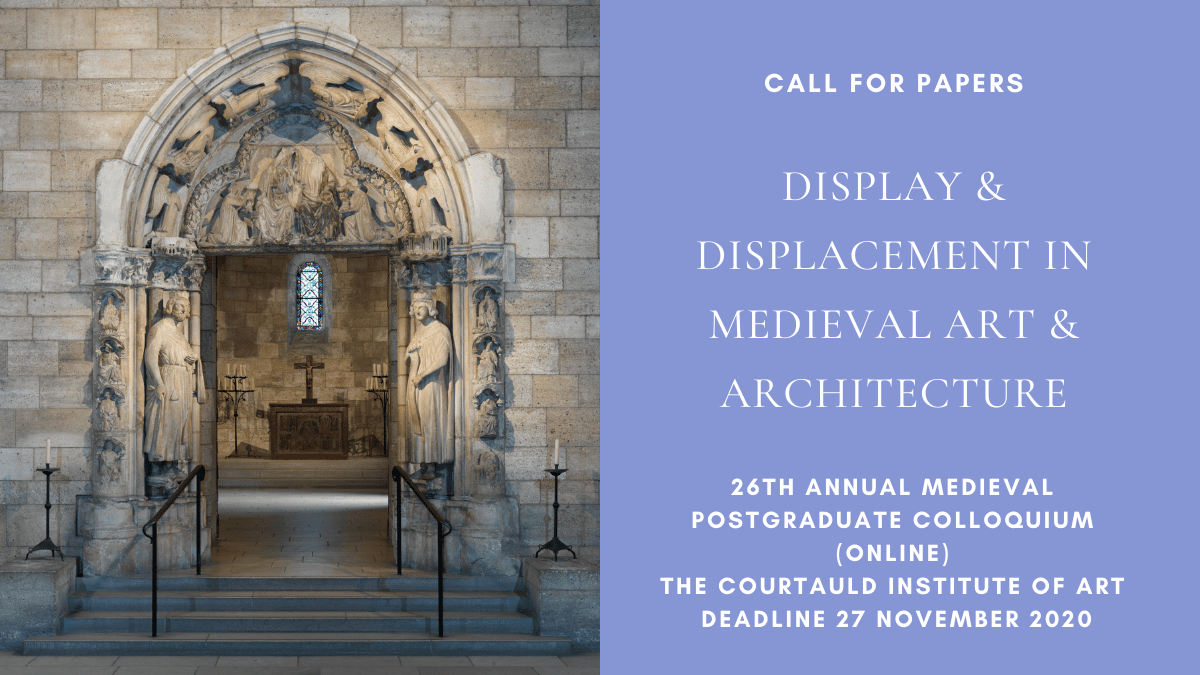
CFP: ‘Display and Displacement in Medieval Art and Architecture’, 26th Annual Medieval Postgraduate Colloquium (online), The Courtauld Institute of Art, deadline 27 November 2020

From the chalices that glisten behind glass museum cases to the ritual staging of powerful relics, from the architectural fragments of once towering cathedrals to fresco schemes designed to envelope the senses of the viewer, the display and location of medieval art and architecture matter. Though often meticulously designed and executed for specific temporal and physical loci, objects frequently moved – whether purposefully, forcefully or even only imaginatively – into new contexts and topographies. Natural disasters, wars and religious conflicts – the 1202 Syria earthquake, the 1204 Sack of Constantinople, St Lucia’s Flood in 1297, or the 1492 expulsion of Jews from Spain, amongst many others – contributed to the displacement of people, objects and buildings.

Surviving sources – whether written or visual – affirm that the reciprocal relationships between objects and their sites were integral to medieval viewers’ experience of art and architecture. At a time when access to artworks and cultural sites has been largely disrupted by the current pandemic, addressing the question of how medieval art was uprooted and its display reconfigured is especially pertinent. The Courtauld Institute of Art’s 26th Annual Medieval Postgraduate Colloquium invites speakers from various academic fields (including, but not limited to, art history, archeology, material culture and conservation studies) to consider various forms of displacement and their visual and experiential implications for medieval art and architecture. Speakers are encouraged to address the following and related questions, understood in the broadest geographical and chronological terms:

Considering original contexts
• What happens when the link between objects, their original sites and geographies is disrupted, and objects are re-imagined and re-configured in new contexts?
• How can primary sources help us to understand the relationships between medieval objects, their settings and viewers?
• How did medieval and later audiences and patrons recontextualise objects, within new sites, that had travelled thousands of miles?

Displaced communities and beholders
• How do medieval artworks testify to the displacement of religious communities and their beliefs?
• What challenges faced displaced craftspeople and how were they forced to innovate? How did displaced craftspeople act as engines of change?
• How did artworks and spatial settings produce a sense of displacement in the beholder?

Visualising Displacement
• How did artists visually articulate stories of travel, migration and displacement?
• How was displacement used to mitigate distance? How was this conceptualised (vis-à-vis creation of mental pilgrimage itineraries, architectural recreations of the Holy Sepulcher, etc.)?
• How did public or private rituals such as processions and religious ceremonies recontextualise objects or concepts of displacement?

Reconstruction and Preservation
• How can digital technologies aid us in the study of displaced art and architecture?
• How do, or could, treasuries, museums and other art repositories draw on the localism of the sites with which their objects are intimately associated in order to reconcile the displacement that is inherent in their collections?
• Is the displacement of objects, wall paintings and whole architectural structures a form of preservation and conservation?

The Medieval Postgraduate Colloquium encourages participation from postgraduate students and independent researchers from across the globe. To apply, please send a proposal of up to 250 words for a twenty-minute paper, together with a CV, to medievalcolloquium@courtauld.ac.uk no later than 27 November 2020.

Organised by Giosuè Fabiano, Chloe Kellow, Susannah Kingwill, Laura Melin and Bella Radenović.

Find out more here.

Online Lecture: Thomas Becket: His Portrayal Through Time, Dr Danica Summerlin, 16 December 2020, 7.30-9pm (GMT)

Join St Albans Cathedral to mark the 850th anniversary of the death of St Thomas Becket, Archbishop of Canterbury from 1162 until his murder at the hands of King Henry II’s men in Canterbury Cathedral in 1170.

His image is emblazoned on the walls of St Albans Cathedral – painted during the medieval period onto a pillar of the nave, and re-illuminated as part of the ‘Alban, Britain’s First Saint’ project. This talk explores how he has been portrayed in the centuries since his death. More information to follow.

Speaker: Dr Danica Summerlin, University of Sheffield

Date & Time: Wednesday 16 December, 7.30-9pm. Participants can join from 7pm. 

Price: £10 (£6 students)

Venue: Online via Zoom

As this talk will be hosted over Zoom, participants will need access to a computer/laptop/tablet/phone which has audio in order to be able to hear. You can also join by dialling in using a telephone, but won’t be able to see the speaker or any visual aids. 

Instructions for signing up and joining the talk will be sent via email between 5-5.30pm on the day of the event. If you have not received these details by 5.30pm, please call 01727 890205. Please ensure that you provide a current email address when you book. 

You can book online here, or call the Box Office on 01727 890290. Tickets will be on sale until 5pm on the day of the event.

Found out more here.

Job: Assistant Professor – Late Antiquity and/or Early Islam, University of Toronto Scarborough, deadline 30 November 2020

The Department of Historical and Cultural Studies at the University of Toronto Scarborough (UTSC) invites applications for a full-time tenure-stream position in the area of Late Antiquity and/or Early Islam. The appointment will be at the rank of Assistant Professor, with an expected start date of July 1, 2021, or shortly thereafter. The successful candidate will be joining a vibrant, multi-disciplinary scholarly community at UTSC and in the tri-campus University of Toronto with related regional, temporal, and thematic foci.

Applicants must have a Ph.D. in Classics, Middle East Studies, History, Religion, Art History, Archeology, or another, closely related discipline by the time of appointment or shortly thereafter. They must demonstrate a record of excellence in research and teaching  in the field of Late Antique studies and/or the study of early Islam both conceptually and methodologically. We are particularly interested in scholars with active, interdisciplinary research agendas focusing on one or more of the following thematic areas: Religious history, transnational connections, race, ethnicity, and identity, as well as postcolonial or decolonial approaches to the field. A significant element of applicants’ current and future research must look at Late Antiquity and/or early Islam in any region in the wider area from North and East Africa to the Indian Subcontinent, with evident attention to relevant sources and languages. The successful candidate’s research and teaching interests must complement our department’s strength in the study of mobilities of people, objects, ideas, and practices within and across imperial formations, and will share our commitment to non-Eurocentric, decolonial pedagogy. Candidates must be prepared to teach undergraduate courses in both Classical Studies and at least one other HCS undergraduate program, based on their thematic and/or regional specialization. They also must be able to contribute to one or more of the University of Toronto’s graduate programs, where they will hold a graduate appointment. 

More information can be found here.

New Publication: Icons of Sound: Voice, Architecture, and Imagination in Medieval Art, edited by Bissera V. Pentcheva

Icons of Sound: Voice, Architecture and Imagination in Medieval Art brings together art history and sound studies to offer new perspectives on medieval churches and cathedrals as spaces where the perception of the visual is inherently shaped by sound. The chapters encompass a wide geographic and historical range, from the fifth to the fifteenth century, and from Armenia and Byzantium to Venice, Rome, and Santiago de Compostela. Contributors offer nuanced explorations of the importance of intangible sonic aura to these spaces, including the temporal and performative nature of ritual music, as well as the use of digital technology to reconstruct historical aural environments.

Rooted in a decade-long interdisciplinary research project at Stanford University, Icons of Sound expands our understanding of the inherently intertwined relationship between medieval chant and liturgy, the acoustics of architectural spaces, and their visual aesthetics. Together, the contributors provide insights that are relevant across art history, sound studies, musicology, and medieval studies.

Table of Contents

Introduction – Bissera V. Pentcheva

01. Singing Doors: Images, Space, and Sound in the Santa Sabina Narthex – Ivan Foletti, University of Lausanne and University of Brno

02. Sights and Sounds of the Armenian Night Office, As Performed at Ani:
A Collation of the Archaeological, Historical, and Liturgical Evidence
– Christina Maranci, Tufts University

03. The Glittering Sound of Hagia Sophia and the Feast of the Exaltation of the Cross in Constantinople – Bissera V. Pentcheva, Stanford University

04. Transcendent Visions: Voice and Icon in the Byzantine Imperial Chapels – Bissera V. Pentcheva, Stanford University

05. Echoes and Silences of Liturgy:
Liturgical Inscriptions and the Temporality of Medieval Rituals
– Vincent Debiais, Centre de recherches historiques, EHESS-Paris

06. Sound, Space, and Sensory Perception: The Use of Digital Technology in Research into the Liturgy of San Marco, Venice – Deborah Howard, University of Cambridge

07. The Marble Tempest: Material Imagination, the Echoes of Nostos, and the Transfiguration of Myth in Romanesque Sculpture – Francisco Prado-Vilar, Harvard University and Real Colegio Complutense

Epilogue: A Voice from beyond the Grave: Tintoretto and the Art Historians – Alexander Nemerov, Stanford University

Bissera V. Pentcheva is Professor of Art History at Stanford University.

Pre-order the book here.

Tenure-Track Position: Faculty in Art History and Visual Culture, Bard College, deadline 1 December 2020

The Art History and Visual Culture Program at Bard College invites applications for an open field, tenure-track position. Candidates from the fields of art history, visual culture, archaeology, and material culture are encouraged to apply. The successful candidate for this position is dedicated to rethinking art history’s and visual culture’s canons, objects, and sites of inquiry. We especially seek applicants whose research and teaching portfolio approaches visual culture through the critical lens of diasporas, transnational histories, migration, and the legacies of colonialism, to name a few examples. Areas of expertise might include the indigenous cultures of Australia and the Americas, Africa and the Middle East, as well as the ancient and early modern worlds.

This position welcomes scholars committed to reimagining art history’s and visual culture’s methods and techniques, including approaches to research, fieldwork, and scholarly analysis. Preferred candidates will be ready to take advantage of Bard’s interdisciplinary matrix and liberal arts tradition in order to form connections with the Human Rights Program, the Experimental Humanities concentration, and the emerging Open Society University Network (OSUN).

Find out more information.

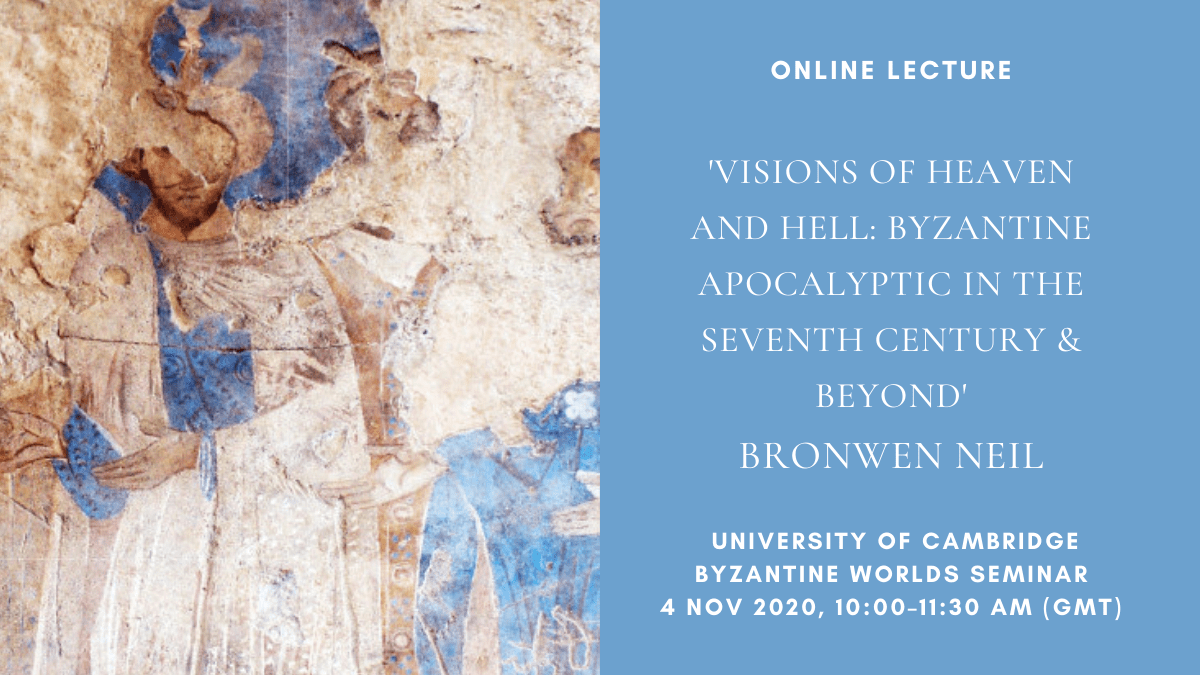
Online Lecture: Visions of Heaven and Hell: Byzantine Apocalyptic in the Seventh Century and Beyond, by Bronwen Neil (Macquarie University), November 4th 2020, 10:00–11:30 am (UK)

Bronwen Neil is is Professor of Ancient History at Macquarie University and member of the Macquarie University Ancient Cultures Research Centre.

The Byzantine Worlds Seminar provides a venue for exploring the material and intellectual entanglements between the medieval worlds of the Middle East, North Africa, Central Asia and Eastern Europe. It is supported by the Centre for Research in the Arts, Social Sciences and Humanities (CRASSH) and Society for the Promotion of Byzantine Studies (SPBS).

Advance registration required. Please click here to register.

Fellowships: Fields of the Future Fellowships, 2021–22, Bard Graduate Center, deadline 15 November 2020

Bard Graduate Center (BGC) is pleased to announce its annual Fields of the Future fellowship and mentorship program, which aims to help promote diversity and inclusion in the advanced study of the material world. It reflects our commitment to explore and expand the sources, techniques, voices, perspectives, and questions of interdisciplinary humanities scholarship. BGC studies the past in its own terms in order to better understand where the future has come from. We invite applicants to submit projects that they think map the fields of the future. In an effort to promote necessary diversity and inclusion in the fields of decorative arts, design history, and material culture, we particularly wish to encourage applicants from historically underrepresented groups and/or projects of related thematic focus.

BGC invites scholars from university, museum, and independent backgrounds with a PhD or equivalent professional experience to apply for these funded research fellowships. Doctoral students of exceptional promise are also encouraged to apply. The fellowships are intended to fund collections-based research at Bard Graduate Center or elsewhere in New York City, as well as writing or reading projects in which being part of our dynamic research environment is intellectually valuable. Fellows will be paired with BGC faculty and research librarians to connect with human and material resources.

Bard Graduate Center is a graduate research institute devoted to the study of the decorative arts, design history, and material culture, drawing on methodologies and approaches from art history, economic and cultural history, history of technology, material culture studies, philosophy, anthropology, and archaeology. 

More information can be found here.

Online Lecture: ‘Fragmentology: what, why and where next?’ Lisa Fagin Davis & Christoph Flueler, Institute of English Studies, School of Advanced Study, 3 November 2020, 5.30pm (GMT)

Lisa Fagin Davis (Medieval Academy of America) and Christoph Flueler (University of Fribourg, Director, Fragmentarium project)

This session brings together two leading experts in the field of fragment studies. Prof Davis will focus on the historical context of manuscript fragments, both chronological (i.e. the timeline for binding fragments vs. initial cuttings vs. leaf sets) and geographical (the development of the corpus of fragments in Europe vs. North America). Prof Flueler will ask `part of what?’ How do we work with fragments? How do descriptions of manuscripts differ from descriptions of fragments? What is the subject and working methods of fragmentology? What are the limits of this new discipline? This will be followed by a roundtable discussion allowing you to provide your insights.

Organisers: Julia Crick, King’s College London, and David Rundle, University of Kent

This lecture will be delivered via Zoom. Please follow the guidance here to register.

Find out more information here.

Postdoctoral Fellowships: University of Southern California Society of Fellows in the Humanities, 2021–2023, deadline 13 Nov 2020

The University of Southern California Society of Fellows in the Humanities invites applications for our 2021-2023 cohort of postdoctoral fellows.

The USC Society of Fellows in the Humanities supports advanced research by postdoctoral fellows and faculty members by promoting intellectual exchange and interdisciplinary approaches to research and teaching in the humanities and humanistic social sciences.

The USC Society of Fellows in the Humanities is an interdisciplinary community of postdoctoral scholars and faculty members in the humanities and humanistic social sciences. Fellows meet regularly in formal and informal settings to present and discuss advanced scholarly research. Postdoctoral fellows are affiliated with the Society as well as with a USC department of their choice, and have faculty mentors in both. Postdoctoral fellows in the humanities engage with each other as well as humanities departments, institutes, and centers at USC and in the broader Los Angeles area.

Each year the Society admits up to five postdoctoral fellows, who are appointed for two-year terms during which they pursue research and teach three courses over four semesters, with one semester for full-time research. They are expected to reside in the Los Angeles area during the academic year and to participate in the scholarly life of the Society, the host department, and the university.

Eligibility
To apply for the 2021–2023 cohort, candidates must have received their Ph.D. no earlier than July 1, 2017 and must have completed their doctoral degree by July 1, 2021. Scholars who received their doctorates from the University of Southern California are not eligible to apply. Non U.S. citizens are eligible to apply for this program. Applicants’ research and teaching must be in the humanities and humanistic social sciences.

Find out more here.

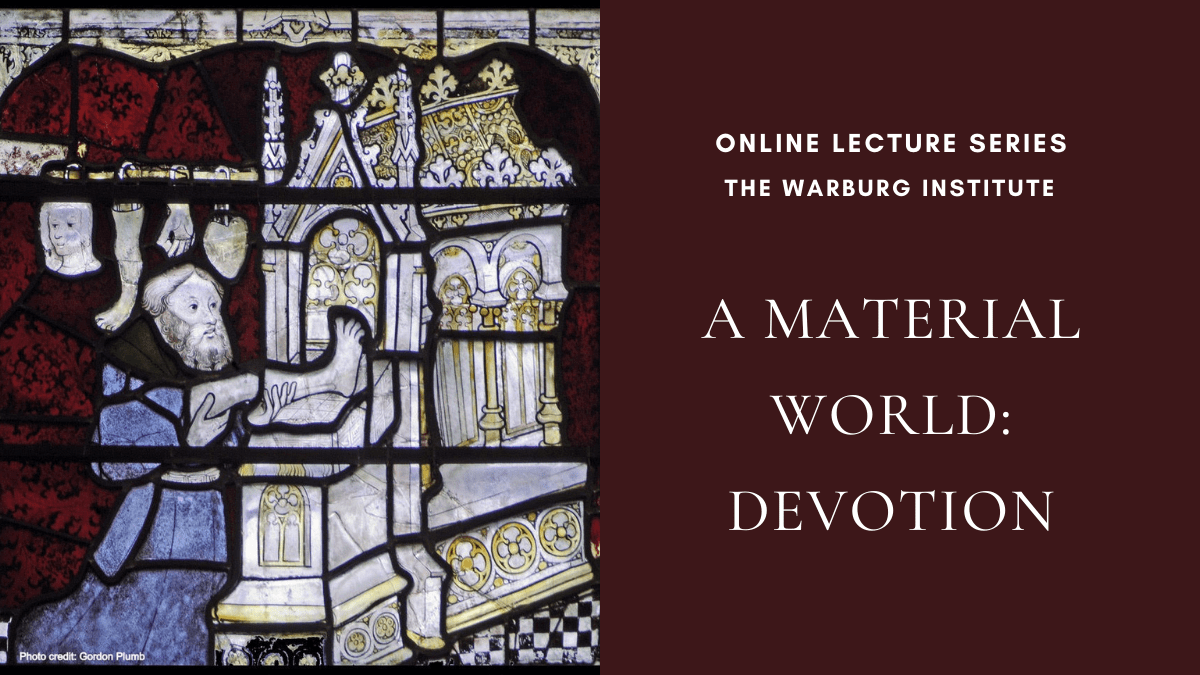
Online Lecture Series: A Material World: Devotion, The Warburg Institute

A Material World is a new events series hosted by the Warburg Institute which focuses on the reconstruction of life in the past through objects and materials, the people who made them and the people who used them. Combining public lectures, student seminars and live object-based presentations across three terms, the series brings together academics and heritage professionals from a wide range of disciplines including history, art history, cultural history, archaeology, anthropology, history of religion and museum studies. The series will discuss issues concerning historical objects, their materials, forms, and functions, as well as their conservation, presentation, display, and reconstruction. It offers a broad social perspective, being concerned not only with the highest strata of society, but also with marginalised peoples and their habits concerning the production and consumption of everyday items.

The three combined lecture-seminar sessions of 2020-21 will be on the theme of Devotion.

Photo: ©️ Gordon Plumb

Find out more information here.

Autumn 2020 Programmme

The Oxburgh Hall Finds

Thursday 26 November, 5.30pm – 7pm | Presented by Anna Forrest (National Trust)

Anna Forrest examines how the recent discoveries at Oxburgh Hall shed light on the vibrant material culture of recusant Catholics at a time of persecution. As the Oxburgh Hall project is still in its early stages, this lecture presents a key opportunity to discover how curators go about analysing objects, and start to formulate conclusions, while a project is still evolving. 

Book here.

Daily life and popular piety

Friday 27 November, 3pm – 4.30pm | Presented by Meriel Jeter (Museum of London)

Meriel Jeter, Museum of London curator and contributor to the new book, The Art of the Poor, will present some of the museum’s rich holdings of medieval pilgrims’ souvenirs in this object-based session, live from the Museum of London via Zoom. Meriel will address the manufacture and use of these objects, as well as issues involved in their conservation and curation, and how curators use material culture findings to help reconstruct aspects of life from the past.

This seminar is designed for postgraduates at MA and research level studying art history, cultural history, archaeology, anthropology, history of religion, museum studies and related fields.

Book here.