Princeton University Department of Art & Archaeology Conference, January 13–15, 2022
From October 15, 2021–January 23, 2022, the Pierpont Morgan Library & Museum in New York hosts an exhibition ten years in the making: Imperial Splendor: The Art of the Book in the Holy Roman Empire, 800–1500. The exhibition presents material that has never before been gathered together, treating topics including visual rhetorics of power in book media, the production and patronage of manuscripts, the relationship between vernacular and Classical languages, and the position of imperial cities in the fourteenth and fifteenth centuries.
The Princeton conference, Power, Patronage, and Production: Book Arts from Central Europe (ca. 800–1500) in American Collections expands the purview of the exhibition. The papers encompass material written in Czech, German, Hebrew, and Latin, made for both religious and non-religious contexts in the ninth, twelfth, and fifteenth centuries. Most of the focal material is very little published; some papers present new looks at superstar examples based on cutting-edge findings. Themes include the networked relationships among centers of production, the representation of male and female patrons, early print culture, and the role of books in key developments for liturgy, private devotion, chronicle writing, and the law.
In-person attendance is contingent on space; due to current campus public health policy, registration will be limited to Princeton University ID holders and visitors sponsored by the Department of Art & Archaeology. Please register your interest if you wish to attend in person; priority will be given to students.
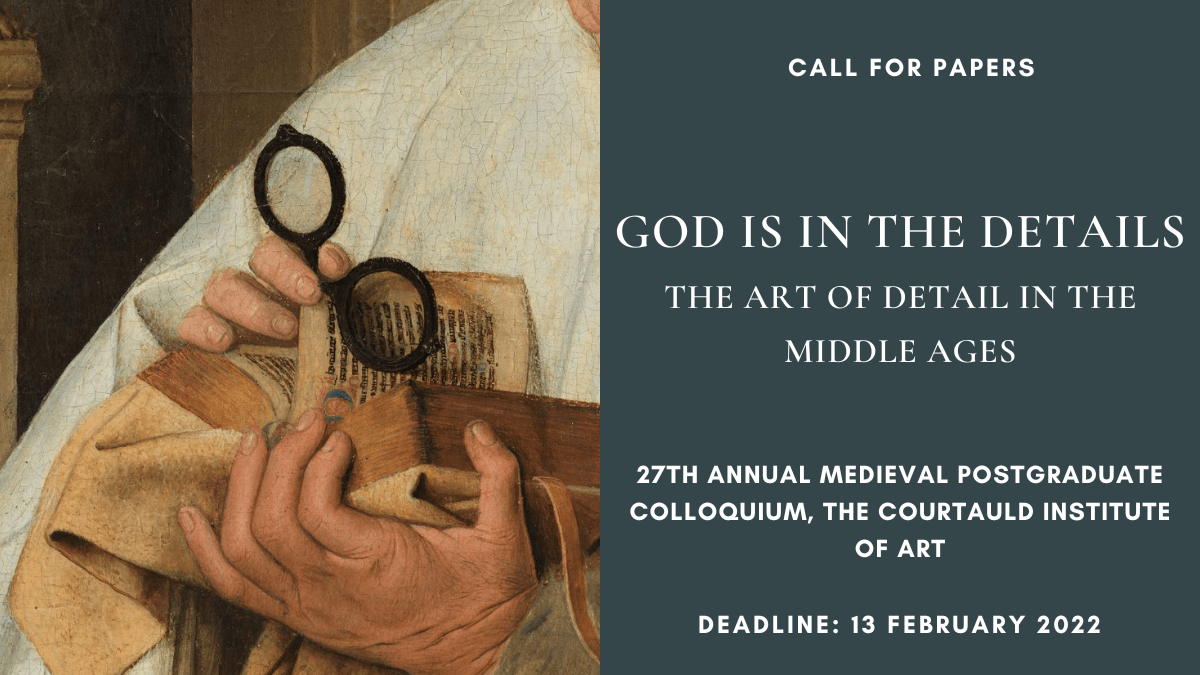
For Aby Warburg, God was in the details; for others they were the devil. From manuscript miniatures to carved altarpieces or richly decorated muqarnas , detail was highly valued in the Middle Ages. In different circumstances the deployment of detail displays, disguises and depends upon the materiality of objects, embedded in the woven structure of textiles, the techniques of Islamic metal inlay, and the varied receptivity to carved decoration of ivory, marble, alabaster and boxwood. The production of detail was demanding, often requiring fine materials, masterful skill, hours of time and technical innovation. Small things, then, as well as large, could speak to the sophistication and power of patrons, but did details also communicate in more subtle ways? Details could disrupt well-established iconographies and half-conceal subversive subtexts, or present subtle suggestions which only the most perceptive viewers would appreciate. Did details also affect scalar relationships between viewer and object, pointing beyond the material dimensions of the ordinary world? The production and reception of details are central to this colloquium.
The reception of detail also leads us to consider its place in the practice of art history. Close observation of apparently insignificant details lay at the heart of the connoisseurial, attribution-focused art history of the nineteenth century. More recently scholars have examined the cultural significance of detail, from Necipoğlu’s explication of the ‘scrutinizing gaze’ in Islamic art to Gell’s notion of ‘cognitive stickiness’. Others have closely engaged with detail in relation to craft, from Margaret Graves’ theory of the ‘intellect of the hand’ to Paul Binski’s explorations of the ‘human “poetics” of materials’. Gigapixel reproductions and microscopic analysis are also shaping art history today, a field which is ever more prone to specialization and micro-histories. But does this pursuit of detail distort the original viewing experience, or scholars’ capacity to frame questions in broad terms? Are there ways of reconstructing more historicised experiences of detail, through historical theories of vision and philosophies of the unseen? The Courtauld’s Medieval Postgraduate Colloquium offers the opportunity to delve into detail, in all its complex material, cultural and academic dimensions.
Speakers may consider the following, understood in the broadest geographical terms:
Material and Craft
How were objects of great detail produced?
How did materials affect the kinds of detail included?
What was the role of detail in the celebration of skilled craftsmanship in the Middle Ages?
Meaning and Messages
How was detail used to express subversive ideas or messages for specific people or groups?
Was detail valued differently depending on viewers’ social, economic, religious backgrounds?
How was the inclusion of details negotiated between patron, artist, architect, and craftsman?
How might detail serve to prompt meditation or contemplation?
Perception and Reception
Who had access to details, and in what conditions?
How does the 21st-century viewer gauge the importance of relatively small or subtle details in a medieval work?
What do primary sources—including medieval theories of vision and philosophies of the unseen—reveal about the value of detail?
How does the close scrutiny of detail affect the viewer’s experience of an object or building?
Technology and Methodology
How did medieval technological advances change the ability to create and see detail?
How does modern technology enhance or impair our ability to see and interpret detail in medieval art and architecture?
Can art historians lose sight of the entire object, or even broader art-historical issues, by focusing too closely on specific details and ‘micro-histories’?
This colloquium offers an opportunity for research students at all levels from universities across the United Kingdom and abroad to present, discuss and promote their research. We would also welcome unorthodox proposals, including short, ‘micro’ papers, and especially demonstrations of technologies related to the art-historical analysis of detail.
To apply, please send a proposal of up to 250 words for a 20-minute paper, or an alternative presentation, together with a CV to medievalcolloquium@courtauld.ac.uk no later than 13 February 2022. Please also state your preferences and constraints for presenting in person or remotely. Contributions may be available towards the cost of travel & accommodation.
Creating a memory of ancient pasts: Choices, constructions and transmissions from the 9th to the 18th Century. October 13th and 14th 2022, Paris
The ERC Advanced Grant AGRELITA project will organize workshops entitled “Creating a memory of ancient pasts” on October 13th and 14th 2022, Paris (Sainte-Barbe Library).
Mnemosyne, mother of the Muses, embodies a continuing relationship between memory, arts and sciences. This myth invites us to question ourselves over a long period of time, as soon as we study the memory of ancient pasts – the Egyptian, Greek, Roman, Biblical ones, among other – in texts as well in images. By taking a transdisciplinary look at memory, from anthropology to visual studies including history, sociology, literature and cognitive sciences, we aim to explore the strategies of how a memory of ancient pasts is created, and to highlight the processes which contribute to the constitution of distant pasts as a legacy. Yet, this appropriation is not obvious : a logic of alterity does indeed appear, in several forms and to varying degrees, between the present and these/its ancient pasts, due to a lack of continuity, not only temporal, but also spatial, documentary or religious and cultural.
In fact, for many decades, research on memory remarkably developed in a wide range of disciplines. Concepts and approaches, such as individual memory and collective memory, cultural memory, social memory, memorials, how tangible and intangible memory are linked to each other, how memory and imagination interact, cognitive mechanisms which act in memory processes, have provided new keys to understand the forms and the uses of memory (-ies) within communities.
Our objective is thus to continue the reflection on these notions by analyzing the methods of the creation of a memory of the ancient pasts, according to a chronology which starts from the 9th Century, which was a period when creative activity was intense, ancient texts were rediscovered by Western Europe, but also when written memory increased, until the 18th Century, when Antiquity was particularly mobilized, as much in the arts, with the emergence of archeology and neoclassicism, as in political speeches. Through the collected papers, the workshops aim to question the constants as well as the mutations of the strategies that authors and artists displayed in order to elaborate this (these) memory(-ies) of ancient pasts, since they selected and organised elements of the past to the detriment of others, which implies a range of recompositions.
Submitted papers may deal with theoretical reflections or case studies, and come within one or more the following themes, which do not exhaust the range of possibilities :
Epistemology and taxonomy of memory : cross-cutting reflections on the memory about the distant past, its functioning, the notions and concepts that must be mobilized.
“Memory entrepreneurs”: all those who participate in the creation of the memory of ancient pasts through their roles and activities such as writers, humanists, sponsors, readers, antique dealers, artists, translators, publishers-booksellers, collectors, archaeologists, and so on.
How this memory is developed, as well as the interactions of the conditions of such a development : how the text is set up into narrative and plot forms, images, recomposition as well as invention, re-uses, rewritings / palimpsests, quotations, imitations, emulations, mental and visual images, imagines agentes, and so on.
How this memory is transferred, as well as the interactions of the conditions of such a transmission : oral, written, visual, tangible and symbolic communications, the challenges of each of these modes of transmission as well as their effects on the representation of ancient pasts, their links with the “ars memoriae”, the functions and uses of emotions.
The elements making up this memory of ancient pasts : civilizations, periods, events, traditions, narratives, myths, figures, works and concepts resulting from the process of a selection, a transmission and a re-elaboration, and so on.
The stakes and aims of this creation of a memory of ancient pasts : the contexts and discourses in which it is shaped and represented, the objectives which are followed (didactic, ethical, aesthetic, linguistic, political, economic, religious, patrimonial ones).
The AGRELITA project ERC n° 101018777 was launched on October 1st 2021. It is a 5-year project (2021-2026) financed on an ERC Advanced Grant 2020 through the European Union’s Research and Innovation Programme Horizon 2020.
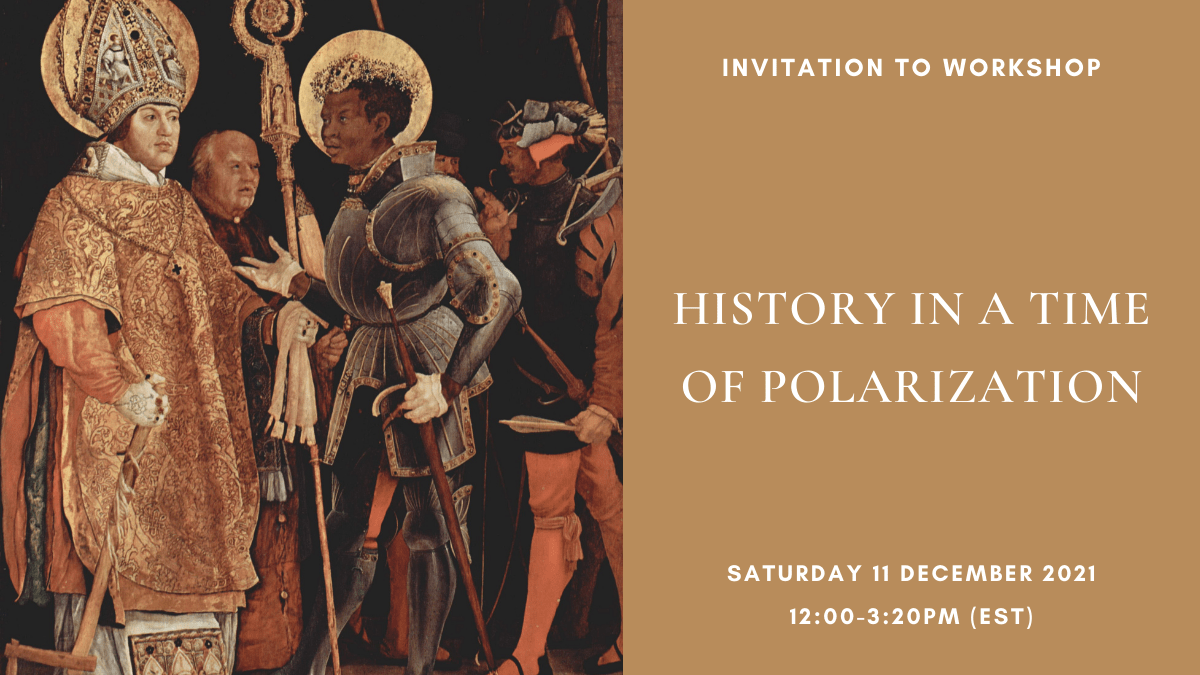
This virtual workshop brings together professionals from fields that deal with the violent far-right. Hate groups’ recruitment has consistently drawn from memories of the medieval past, and in recent years this effort has grown, particularly online. Scholars, social workers, and journalists all have unique viewpoints on this issue, but rarely have a single forum for discussion and problem solving. This workshop offers such a space.
Panelists: CordWhitaker (Wellesley College, History) Mary Rambaran-Olm (University of Toronto, Literary History) Eni Mustafaraj (Wellesley College, Computer Science) Bret Deveraux (UNC Chapel Hill, History) Shokoofeh Rajabzadeh (UC Berkeley, English) Andrew Guess (Princeton University, Politics and Public Affairs) Hannah Reall (Mount Carmel Health System, Social Worker) Matthew Gabriele(Virginia Tech, Religion and Culture)
After registering, you will receive a confirmation email containing information about joining the meeting.
Do not hesitate to reach out to us with any questions! Direct any questions to Sarina Kürsteiner (Haifa Center for Mediterranean History, University of Haifa), at sck2159@columbia.edu for the Medievalist Toolkit
The Medievalist Toolkit is a public history group founded by Columbia graduate students in the Fall 2017. The group aims to enable and facilitate conversation between academics and activists, journalists, and public service providers. Awarded the Lehman Center Public History Award (2020) and the History in Action Program Award (2018), we are currently creating a website to make knowledge about the Middle Ages easily accessible to our partners.
Ninth Annual Symposium on Medieval and Renaissance Studies June 21-23, 2022 Saint Louis University Saint Louis, Missouri
The Ninth Annual Symposium on Medieval and Renaissance Studies (June 21-23, 2022) will be held in person in beautiful Saint Louis, Missouri. This summer venue in North America provides scholars the opportunity to present papers, organize sessions, participate in roundtables, and engage in interdisciplinary discussion. The goal of the Symposium is to promote serious scholarly investigation into all topics and in all disciplines of medieval and early modern studies.
The plenary speakers for this year will be David Abulafia, of Cambridge University, and Barbara Rosenwein, of Loyola University, Chicago.
The Symposium is held annually on the beautiful midtown campus of Saint Louis University. On campus housing options include affordable, air-conditioned apartments as well as a luxurious boutique hotel. Inexpensive meal plans are also available, although there is a wealth of restaurants, bars, and cultural venues within easy walking distance of campus.
While attending the Symposium, participants are free to use the Vatican Film Library, the Rare Book and Manuscripts Collection, and the general collection at Saint Louis University’s Pius XII Memorial Library.
The Ninth Annual Symposium on Medieval and Renaissance Studies invites proposals for papers, complete sessions, and roundtables. Any topics regarding the scholarly investigation of the medieval and early modern world are welcome. Papers are normally twenty minutes each and sessions are scheduled for ninety minutes. Scholarly organizations are especially encouraged to sponsor proposals for complete sessions.
The deadline for all submissions is December 31, 2021. Late submissions will be considered if space is available. Decisions will be made in January and the final program will be published in February.
We are delighted to announce the Beyond Exceptionalism II conference which will take place on 12-14 July 2022 at John Rylands Library in Manchester, UK. The conference will adopt a hybrid format that simultaneously offers sessions both in-person and via Zoom.
In 2015, Beyond Exceptionalism I addressed the troubling situation that after over fifty years of intense research and publication, the study of medieval European women had not reversed the entrenched notion that elite woman with the authority and ability to influence their families, communities, and realms were somehow all exceptions to the normal situation of female powerlessness and passivity. The conference centered on a rhetorical question: how many ‘exceptional’ women in positions of authority does it take before active females become the rule? Hosted by Heather Tanner at the Ohio State University, the ‘Beyond Exceptionalism’ conference resulted in new avenues of research, fresh approaches to medieval women’s experiences and an edited volume: Medieval Elite Women and the Exercise of Power, 1100–1400: Moving beyond the Exceptionalist Debate (Palgrave 2018).
Six years and one global pandemic later, the question still resonates. The assumption that medieval women were marginalized remains at the center of medieval studies. Beyond Exceptionalism II will be an interdisciplinary conference that continues to address this misapprehension by fostering new avenues and interpretations of medieval women– elite and non-elite, secular and religious – and exploring new methodologies. We encourage papers that draw upon material culture, network analysis, gender, and space. Presentations that address a non-European perspective are most welcome. Papers that utilize items in the JRL collection are especially welcome. We also welcome submissions from scholars at all levels, from doctoral students to senior scholars.
Keynote Speakers: Valerie Garver, History Department Chair, Northern Illinois University Amy Livingstone, Head of School of History and Heritage, University of Lincoln Talia Zajac, Mellon Post-Doctoral Fellow at Pontifical Institute of Medieval Studies.
Abstracts & Panels:
Possible topics include but are not limited to: lordship, manorialism, monasticism, crusades, literacy, monarchy, guilds, pilgrimage, warfare, towns, castles & manors, networks and alliances, medicine, patronage, lay religious life, law and custom
Types of sessions: traditional (3 speakers & chair), roundtable, “flash” presentations by graduate students (5-10 minute presentation & informal discussion after)
Please attach your abstract to your email as a Microsoft Word or PDF file. Included with 250-word abstracts or session proposals (including individual abstracts) should be the following information:
•name of presenter(s) •participant category (faculty, graduate student, or independent scholar) •college/university affiliation •mailing address •email address •audio/visual requirements and any other special requests
Abstract deadline: 1 February 2022. Session chairs and individual presenters will be informed of acceptance no later than 1 March 2022.
Keynote Speaker: Roland Betancourt Professor of Art History and Chancellor’s Fellow, University of California, Irvine
The Florida State University Art History faculty and graduate students invite students currently working toward an MA or a PhD to submit abstracts of papers for presentation at our 38th Annual Art History Graduate Student Symposium, which will be held remotely over Zoom Webinar on April 8 & 9, 2022.
We welcome papers that represent an advanced stage of research from any area of the history of art, architecture, and cultural heritage studies. Paper sessions will take place on Friday afternoon and Saturday, with each paper followed by critical discussion. Papers will then be considered for inclusion in Athanor, our internationally-distributed journal.
The deadline for submitting abstracts (maximum 350 words) is December 31, 2021. Please include your university affiliation and the title of the talk.
The journal Histoire de l’art is looking for a member specializing in medieval art history and a member specializing in modern art history for its editorial board. The journal is dedicated to the publication of articles by young researchers, thus established in a dialogue with more experienced researchers who support them. Along with the other members of the editorial board, the two new members will participate in the life of Art History , which publishes two thematic issues per year as well as varia ( on the Apahau blog ). These articles cover all fields of art history, from Antiquity to the 21st century (see the list of published issues ).The expected involvement of the new members of the editorial board concerns:- participation in the drafting of calls for contributions within the framework of thematic issues (see for example the last call to date);- reading and participating in the evaluation of the proposals submitted by the authors to the various sections as well as participating in the final choices of the articles selected;- an investment in a writing collaboration with these young authors who are thus guided and supported in the improvement of their articles;- participation in the life of the journal (presentation of issues, exhibitions, etc.).The committee meets approximately 4 times a year.
Founded in 1988, the journal is edited by Apahau with the support of the Direction générale des patrimoines, the Center national du livre, the École du Louvre, the Institut national d’histoire de l’art and the Center German art history. The editorial board now has seventeen members, teacher-researchers and curators; since 2018, its editor-in-chief has been Dominique de Font-Réaulx, general curator at the Louvre museum. The journal is published in 600 copies; issues are between 200 and 300 pages long.
People (research professors or heritage curators) who would be interested in participating in the editorial committee are requested to send by December 19 at the latest a brief presentation of their background and their motivations (about half a page). addressed to the editor-in-chief Dominique de Font-Reaulx ( dominique.de-font-reaulx [a] louvre.fr ) with a copy to the editorial office ( revueredachistoiredelart [a] gmail.com ) indicating the title of the email: Committee editorial review Art History accompanied by the mention of the specialty (Middle Ages or Modern Period).
The Medieval Studies Colloquium is an annual event which takes place on UW–Madison’s campus each spring. The Colloquium offers an opportunity for graduate students in multiple disciplines to present their research in the various fields of medieval studies, share and receive feedback, and participate in discussion on topics of interest with peers from a wider, interdisciplinary community of Medieval Studies scholars, without the restrictions of membership or registration fees.
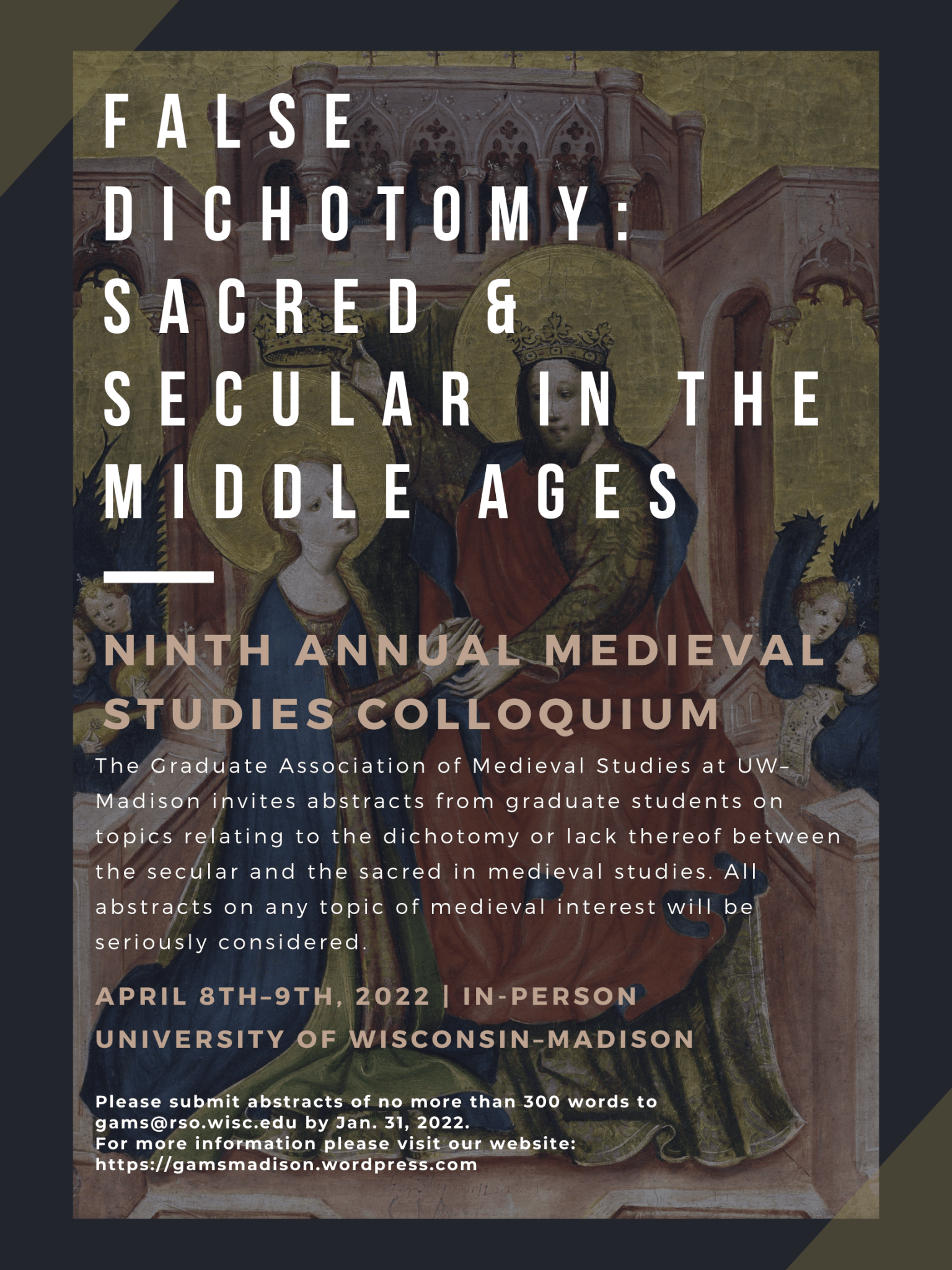
Ninth Annual Medieval Studies Colloquium: The call for papers for the Ninth Annual Medieval Studies Colloquium “False Dichotomy: Sacred & Secular in the Middle Ages” is now open. The colloquium will take place Friday, April 8th and Saturday, April 9th, 2022, in-person at the University of Wisconsin–Madison. Information about our keynote lectures and workshops will be posted soon.
The Graduate Associations of Medieval Studies (GAMS) at UW–Madison invites abstracts from graduate students on topics relating to the dichotomy or lack thereof between the secular and the sacred in medieval studies. All abstracts on any topic of medieval interest will be seriously considered.
Please submit abstracts of no more than 300 words to gams@rso.wisc.edu by January 31st, 2022.
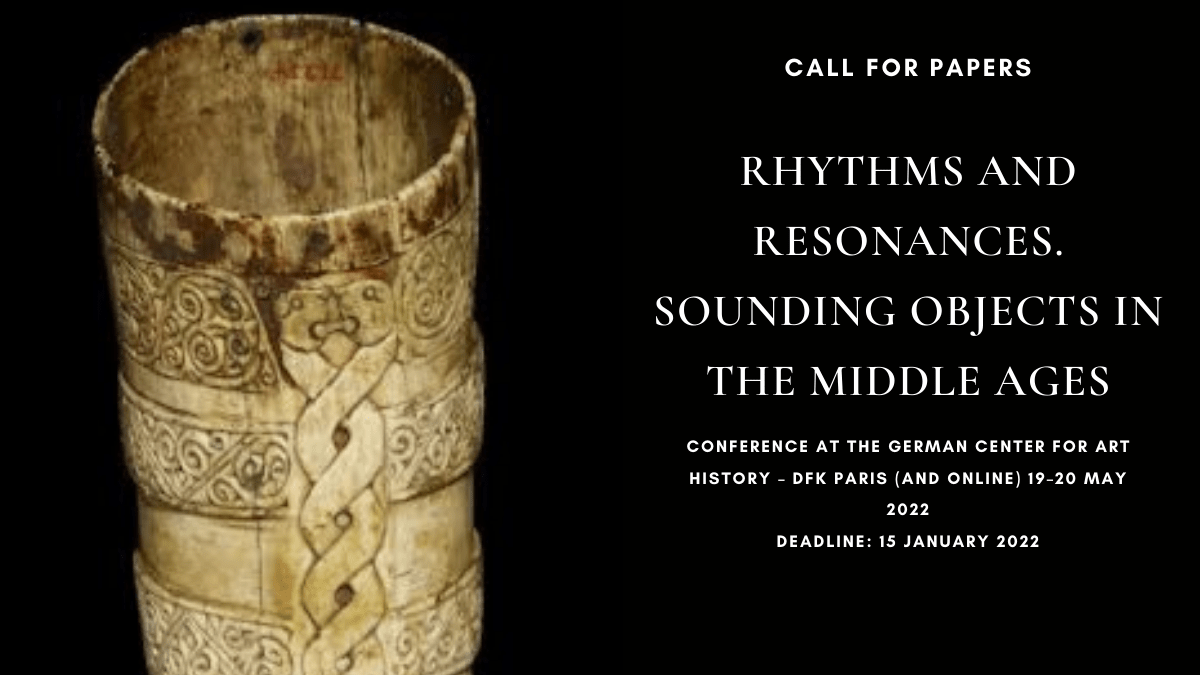
Call for Papers Conference at the German Center for Art History – DFK Paris (and online) May 19–20, 2022
Organization: Philippe Cordez (Centre allemand d’histoire de l’art – DFK Paris) Rebecca Müller (Ruprecht-Karls-Universität Heidelberg) Joanna Olchawa (Goethe-Universität Frankfurt am Main)
According to ancient legend, one day Pythagoras was walking past a forge and heard four hammers pounding irons on an anvil. The sound of the instruments of varying weights and the resulting divergent rhythms and intervals are said to have led him to a theory of harmony and, in turn, to the foundation of music theory. The story circulated widely in the Middle Ages in writings on music theory, as well as in songs and pictorial representations.
Medieval objects that either sound or symbolize sound find their place within historically and culturally inflected notions of the interconnectivity of earthly life and cosmic harmony. The medievalist Jean-Claude Schmitt (Les rythmes au Moyen Âge, Paris 2016) and the sociologist Hartmut Rosa (Resonance: A Sociology of Our Relationship to the World, Cambridge 2019) have recently shown, in different ways, how concepts of rhythm and resonance are applicable to comprehensive considerations of human society. In this sense, rhythmically moving and vibrating objects that, in their reception, generate physical and cognitive resonance can claim a vital role in and make a decisive contribution to shaping, experiencing, and negotiating social and world orders.
This interdisciplinary conference is dedicated to objects from the medieval period that produce music, repetitive sounds, or tones – from bells and organs, musical instruments, and sounding automata to the coins in one’s wallet. Also crucial is the question of how such sounds are “echoed” in ornament, images, and texts. In what terms might we describe and understand the relationship of object-generated sound to sight, touch, and other senses, as well as to voice and narration? In objects and architectures, how are sounds designed, staged, and received through movements and rituals? What intentions and meanings are conveyed in this way?
Submissions are welcome from history and art history, literary studies, musicology, cultural anthropology, and the fields of Sound History and Sensory Studies. Please send an abstract, not exceeding one page in length, to pcordez@dfk-paris.org, r.mueller@zegk.uni-heidelberg.de, and olchawa@kunst.uni-frankfurt.de by January 15, 2022.




 Medieval Art Research