Postponed online lecture: ‘Orality – Literacy – Digitality’, by Torsten Hiltmann, 13 January 2022, 5pm GMT

Due to unforeseen circumstances, this evening’s seminar with Professor Torsten Hiltmann has been postponed. The IHR European History 1150-1550 lecture series team hope to re-arrange the event for later this academic year.

Online lecture: ‘The Limits of Alterity in Ashkenazic Manuscripts’, Professor Elina Gertsman, 26 January 2022, 5pm (GMT)

The Research Forum at The Courtauld is delighted to host the online lecture ‘The Limits of Alterity in Ashkenazic Manuscripts’, presented by Professor Elina Gertsman, on 26 January 2022 between 5pm and 6.30pm GMT.

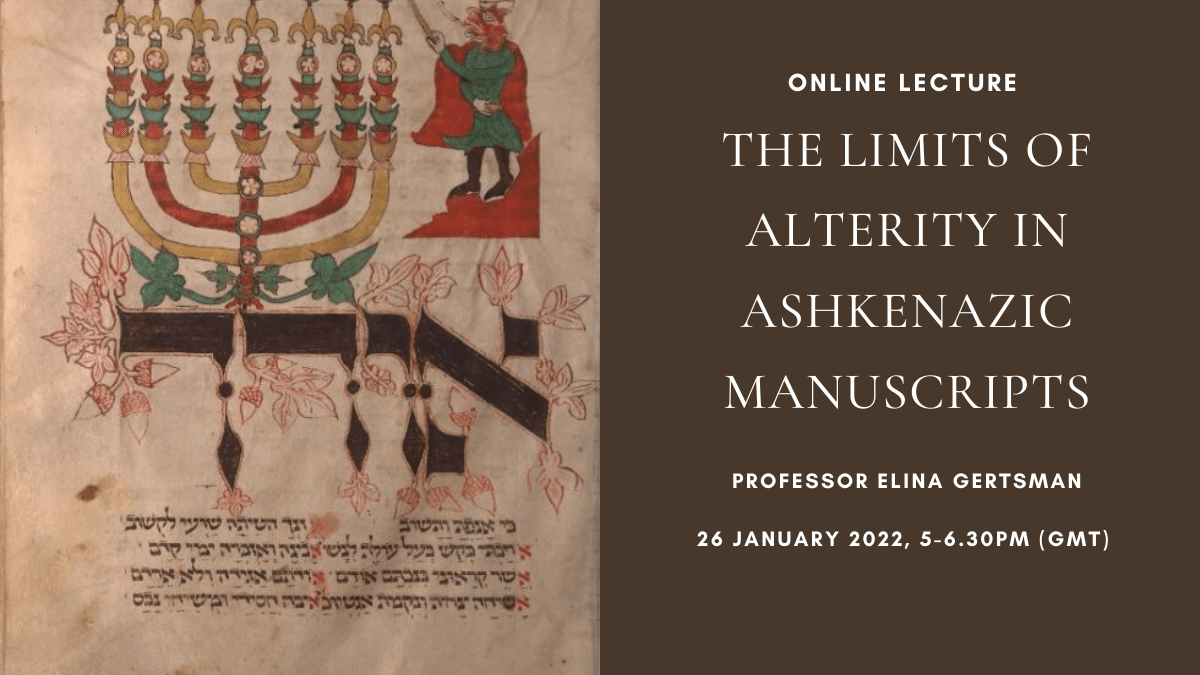
Professor Gertsman’s paper focuses on the woefully understudied Hammelburg Mahzor (Darmstadt, HLH Cod. Or. 13), a Jewish festival book completed in Lower Franconia in the middle of the fourteenth century. The book’s most remarkable feature is perhaps the inclusion of carefully curated zoocephalic, or theriomorphic, figures: humans with beastly and bestial heads. By virtue of their alterity, the zoocephali call attention to themselves with emphatic force. The purpose of this talk is to explore the semiotics and phenomenology of this alterity, and to suggest that its presence lies at the intersection of language, philosophy, poetry, and history.

In the Hammelburg Mahzor this visual idiom also signals distinction, albeit in a way that, conspicuously, collapses temporalities, tests the limits of alterity, and makes an argument about likeness and difference. By foregrounding linguistic elisions between words, images, and the celebrants, such an idiom establishes visceral connections with the community of the book’s users. Ultimately, theriomorphs stand as a fitting metaphor for medieval Jewish art as it has been viewed in mainstream scholarship.

Elina Gertsman is Professor of Medieval Art at Case Western Reserve University. In addition to numerous articles, she has authored The Dance of Death in the Middle Ages: Image, Text, Performance (2010); Worlds Within: Opening the Medieval Shrine Madonna (2015); The Middle Ages in 50 Objects (with Barbara H. Rosenwein); and The Absent Image: Lacunae in Medieval Books (2021). She has also edited a number of books, including Visualizing Medieval Performance: Perspectives, Histories, Contexts (2008); Crying in the Middle Ages: Tears of History (2011); Thresholds of Medieval Visual Culture Liminal Spaces (2012, with Jill Stevenson); Myth and Mystique: Cleveland’s Gothic Table Fountain (2016, with Stephen Fliegel); and Abstraction and Medieval Art: Beyond the Ornament (2021). Her work has been supported by the Guggenheim, Kress, and Mellon Foundations as well as by the American Council for Learned Societies.

The lecture is free, but reservation is required here.

The lecture has been organised by Dr Tom Nickson (The Courtauld).

Image: Zoocephalic Mattityahu The Hammelburg Mahzor, Hammelburg, 1347-1348. Darmstadt, HLH Cod. Or. 13, fol. 33r.

CFP: ‘Thresholds: Concepts of Rupture, Change and Adaptation’, UCD Humanities Institute PhD Conference, 25 March 2022, deadline: 15 February 2022

The UCD Humanities Institute PhD Conference will take place as a hybrid online and in-person conference at the UCD O’Brien Centre, Theatre E, Dublin, on 25 March 2022. The keynote speaker is Professor Caroline Bassett, University of Cambridge, Faculty of English, Director of Cambridge Digital Humanities.

The changes brought about by the COVID-19 pandemic have been so radical and extensive that the concept of ‘back to normal’ has evolved into that of a ‘new normal’ in recognition of the fact that there can be no return, only new forms of existence in a new world. This sense of a before and after, and the processes of rupture, change, adaptation, translation and transformation that it entails, are what we seek to critically and creatively engage with through the symbolic vehicle of the threshold. We understand thresholds as representing the movement from one space or state to another, whether this be sudden and cataclysmic or slow and gentle. The ‘threshold’ also allows for an exploration of ‘in-between’ or ‘in process’, i.e. that which is located on or within the threshold, rather than on either side of it. We may be forced to move through a threshold, adapting as best we can to the circumstances on the other side, or we might produce a threshold as part of a process of creativity and discovery. Translators, for example, work within a linguistic threshold, forging something new from a pre-existing piece of textual or verbal expression.

In the context of a world defined by change and flux, nevermore so than in the last eighteen months, the 2022 PhD Conference of the UCD Humanities Institute is seeking proposals from emerging scholars and artists (doctoral candidates or researchers who received their PhD within the last five years) who are engaged, either conceptually or practically, with thresholds of any kind.

We invite proposals for individual papers from the fields of literature, philosophy, history, classics, archaeology, art history and other humanities disciplines suitable for a 15-minute presentation, or 3-paper panel sessions addressing topics that include but not limited to:


● Thresholds of technological, social or political change
● Geographical, political, cultural or religious thresholds as places of division and encounter
● Instances of failed or thwarted attempts at adaptation
● Advantages, disadvantages, and complexities of change, translation, and transformation
● Thresholds between media and within the digital humanities
● Experience of ambivalent agency and liminal identity in migration, diaspora labour exportation, and refugee issues
● Social constraints and the overcoming of imposed limits against thresholds of race, gender, ability, age, or class identity
● Interrogating and problematising thresholds of gender and gender binaries
● Challenges and possibilities of linguistic and cultural translation
● The translation or adaptation of material for new audiences in art, literature, music, film, computer games, and other media
● Transformation and adaptation as a process of preservation
● Transformation between media and genre and the “going through” multiple thresholds; multiple levels or phases of change, adaptation and transformation
● Questions of the exaltation (or not) of the “original” versus the “copy”
● Hierarchies of adaptation. In what context do stories get “reborn”? Why are some stories retold more often than others?
● Gains and losses in the transformation from one medium to another
● Representations of ‘thresholds’ in social discourses in literature, art, film computer games, and other media

Please submit an abstract of 250 words and a bio-note of around 200 words to hiphdconference2022@gmail.com on or before Tuesday, 15 February 2022, 5:00 PM (Irish Standard Time). All proposals should include your name, email address and academic affiliation (if applicable). Please also include a main subject field plus secondary subject field in the application.

The conference will be held in English. The conference is convened by Resident Scholars of the UCD Humanities Institute. Exceptional papers may be recommended for publication in the blog (https://tnhphd.network/) or other venues.

This is a hybrid online and in person conference. We welcome applications from anywhere in the world. Successful applicants who are unable to travel to Dublin for the conference will be invited to present online. There will be a live stream of all presentations available for all registered attendees. We are also aware that due to the pandemic, it may become inadvisable to hold an in-person conference; in case of changes to government restrictions or UCD policy regarding in-person events, this conference will be moved online.

For further information contact HI Resident Scholars Louisa Carroll, Lauren Cassidy, Suchismita Dattagupta, Prolet Decheva, Clare Kelly, Annie Khabaza, and Maika Nguyen, at the above email address.

New Publication: ‘Medieval Art at the Intersection of Visuality and Material Culture. Studies in the ‘Semantics of Vision’’ edited by Raphaèle Preisinger

ISBN 978-2-503-58153-8

More Info: https://bit.ly/3qewnOF

By according equal importance to theoretical accounts of vision and cultural practices of seeing, the articles in this book contribute to the ongoing shift in the fields of art history and medieval history from considerations of vision to those of visuality.

Over the last two decades the historiography of medieval art has been defined by two seemingly contradictory trends: a focus on questions of visuality, and more recently an emphasis on materiality. The latter, which has encouraged multi-sensorial approaches to medieval art, has come to be perceived as a counterpoint to the study of visuality as defined in ocularcentric terms.

Bringing together specialists from different areas of art history, this book grapples with this dialectic and poses new avenues for reconciling these two opposing tendencies. The essays in this volume demonstrate the necessity of returning to questions of visuality, taking into account the insights gained from the ‘material turn’. They highlight conceptions of vision that attribute a haptic quality to the act of seeing and draw on bodily perception to shed new light on visuality in the Middle Ages.

Table of Contents

Acknowledgements, List of Illustrations

Colour Plates

Introduction: A Return to Medieval Visuality after the Material Turn — RAPHAÈLE PREISINGER

‘Visual Piety’ and Visual Theory: Was There a Paradigm Shift? — BERTHOLD HUB

Fortress of Form, Robber of Consciousness: Theorizing Visuality in Islam — WENDY M. K. SHAW

De spiritu et anima: The Cistercians, the Image, and Imagination — JENS RÜFFER

The Liveliness of the Methexic Image — BISSERA V. PENTCHEVA

Radiance and Image on the Breast: Seeing Medieval Jewellery — SILKE TAMMEN

Reliquaries and the Boundaries of Vision: Relics, Crystals, Mirrors and the ‘Vision Effect’ — CYNTHIA HAHN

Channelling the Gaze: Squints in Late Medieval Screens — TINA BAWDEN

Index

Online lecture: ‘Orality – Literacy – Digitality: Medieval Perspectives on the Digital Age’, by Torsten Hiltmann, IHR European History 1150-1550 lecture series, 13 January 2022, 5.30pm (GMT)

The first of the IHR European History 1150-1550 seminars 2022 will take place on 13 January 2022, between 5.30 and 7pm GMT.

Professor Torsten Hiltmann (FU Berlin) will deliver the paper ‘Orality – Literacy – Digitality: Medieval Perspectives on the Digital Age.’

This talk argues that, rather than the invention of the printing press, the processes of digitalisation in the present resemble the rise of the written word in the Middle Ages, which reshaped all aspects of society, from institutions and law to education and trade. Our knowledge of this medieval transition allows us to better understand our own, modern-day engagement with digital media. Intermediary steps such as recording and emulating the spoken word in the medium of text show how new media remained initially tied to customary ways, but would soon enable entirely new practices of use that alter culture and society irrevocably.

The seminar, which takes place on Zoom, is free. Please register online here.

Fellowships: Six RECEPTIO postdoctoral fellowships in codicology, 2022-2023 (deadline 1 February 2022)

RECEPTIO, the Research Centre for European Philological Tradition (Lugano/London), announces six fellowships for its training course for codicologists who are looking to work in auction houses and antiquarian bookshops.

RECEPTIO is the only research centre in Europe that combines codicological and philological research with the labour market, training codicologists to work for auction houses and antiquarian bookshops. Every semester we launch a competition for six scholarships to attend this unique course. The Institute’s diverse research areas and student body form an innovative, cosmopolitan and enriching academic environment, providing students with the skills and networks needed to pursue an exciting career.

There is no age limit, but applicants should have obtained their PhD no more than ten years from the date of the appointment. Researchers who have obtained their PhD more than ten years ago, but are active in the field of codicology or philology, are invited to apply on the basis of their Curriculum Vitae and will be tested for admission through a motivational interview. Candidates with a Master’s degree who have a strong interest in the object of study will be tested for admission through a motivational interview, too.

Admission decisions are based on the quality of the overall application file. The grant consists of €4,000 for each academic year and can be renewed on the basis of the results obtained.

For more information visit: https://www.receptio.eu/codicologia

Our selection committees give priority consideration to academic achievement and motivation. Academic achievement is documented using transcripts and recommendations. Motivation factors should be clarified in the cover letter/statement of purpose. The evaluation committees will take into consideration the difficulties encountered by many students around the world in the spring 2020 semester, due to the COVID-19 health crisis. The main language of the course is Italian, but a very good command of English is required to follow the seminars (seminars are also held in French and Spanish).

Deadline: 1 February 2022

Application via the website: https://www.receptio.eu/programmes

Exhibition: ‘Gold’, British Library, London, 20 May – 2 October 2022

The British Library has announced a new exhibition, Gold, which will run from 20 May to 2 October 2022.

Gold has long held the power to dazzle and ignite feelings of wonder. This new exhibition will take visitors on a journey to over 20 countries to discover how gold has been used to embellish and enhance the written word across cultures, faiths and through time.

Showcasing some of the most luxurious illuminated manuscripts, gold-tooled books, sacred texts and scrolls from the British Library’s collection, objects on display will include the Harley Golden Gospels, the Lotus Sutra and a treaty in Malayalam, beautifully inscribed on a long strip of gold. Through these stunning objects, Gold will examine the masterful techniques used to handle such a precious metal and tell the stories of those who owned these extraordinary books.

Tickets will go on sale in February 2022. 

The exhibition is supported by The Goldhammer Foundation and the American Trust for the British Library, with thanks to The Finnis Scott Foundation and the Owen Family Trust.

Photo: The Queen Mary Psalter, English, early 14th century, copyright British Library

CFP: ‘Ritual: Practice, Performance, Perception,’ Cerae Volume 9, deadline 30 April 2022

Rituals pervade human life. From small or mundane rituals like brushing our teeth or making one’s daily coffee, to grand ceremonies that mark important life stages, rituals are everywhere. This has prompted reflection on what rituals are, on what can be considered as ritual. Ceræ: An Australasian Journal of Medieval and Early Modern Studies invites essays that analyse rituals of all kinds: public and private, communal and solitary, secular and religious, rapidly changing and long-lasting. It also welcomes theoretically- or methodologically-focused contributions.

Authors may address, but are not limited to:

  • Royal rituals: coronations, births, or marriage consummations etc.
  • How rituals can be used as an element of identity and alterity
  • Subversive and subverted ritual: witchcraft trials, historical (mis)perceptions of Jewish rites etc.
  • Sacred landscapes and rituals focused on/in the natural world
  • Ritual as a medium for memory and memorialisation
  • Sacrifices, magic, religious rites and their intercultural reception
  • Medieval and early modern political rituals such as guild processions
  • Ritual represented in medievalism, including film, fantasy, literature, and art

We invite submissions encompassing all aspects of the late classical, medieval, and early modern world. There are no geographical restrictions. As an interdisciplinary journal, Ceræ encourages submissions from archaeology, art history, historical ecology, literature, linguistics, intellectual history, musicology, politics, social studies, and beyond.

Full length articles should be 5000-8000 words, excluding references. Ceræ also accepts short notices of up to 3000 words. Themed submissions must be submitted by 30 April 2022. For submission instructions, please visit our page on submission guidelines.

We also accept non-themed submissions throughout the year. Ceræ particularly encourages submissions from postgraduate and early career researchers, and offers a $200 (AUD) annual prize for the best postgraduate/ECR essay. Further information on our annual essay prize can be found here.

Featured image: The Trier Adventus Ivory, photo by Ann Münchow

Scholarship: British Archaeological Association 2022 Ochs Scholarship, deadline 1 February 2022

The Ochs Scholarships are awarded annually by the British Archaeological Association for research projects which fall within the Association’s fields of interest. These are defined as the study of archaeology, art and architecture from the Roman period until the nineteenth century, principally within Europe, though the core interests of the BAA are Roman to 16th century. We only entertain applications that cover the 17th to 20th centuries that are of an historiographical, conservationist or antiquarian nature. The scholarships are intended to provide post-graduate students striving to write up theses with late stage funding, and help independent researchers complete projects. Applicants should either be UK citizens, registered at a UK University, or undertaking work on material in the UK. Only one of these criteria is necessary, but there should be a connection with the UK.

Applications are thus invited from students who are completing theses for post-graduate degrees and who are facing financial hardship. It must be demonstrated that the award of an Ochs scholarship will enable a thesis to be completed satisfactorily within the period of the Scholarship. Applications where a substantial amount of fieldwork remains to be done are unlikely to succeed.

Applications for research projects conducted either privately or at post-doctoral level are not eligible. The Association is launching a separate fund to cover these. For further details please contact the Hon. Secretary as below.

In preparing the application, all information should be typed. Additional information may be attached on a separate sheet or in a covering letter. Scholarships are awarded annually in April on the recommendation of a Scholarship Committee. The committee reach a decision primarily on the basis of the application (plus any supporting documents), though committee members will take account of remarks made by the applicant’s referees.

Applications should give a detailed account of proposed expenditure, which may include a reasonable level of subsistence. Allowance may not be made for any imputed salary, nor do awards cover the costs of books or equipment such as computers. For post-graduate students allowable expenditure includes supervision and examination fees, as well as thesis-binding costs. While bearing in mind that scholarships up to the value of £5,000 are available, we ask applicants not to ask for more than the minimum they require, as this may enable the Scholarship Committee to make an additional award.

Applicants should supply the names and contact details of two referees, one of whom in the case of degree candidates should be the main supervisor and ask their referees to forward references (either by post or as email attachments) to the Hon. Secretary by 21 February. The scholarship is tenable for one year and may be taken up at any time between April and October 2022, so only work which is capable of submission by October 2023 will be considered by the Scholarship Committee. The award is payable in three instalments; half on acceptance of the Scholarship, one quarter at the half-way stage, and one quarter on submission (or publication if a non-degree research project). Arrangements will be made to pay the first instalment on a date agreeable to the successful candidate.

Members of the Scholarship Committee will not discuss applications with candidates once they have been submitted, nor offer feedback; it is the role of the applicant’s sponsors and supervisors to advise them on the tone and content of applications. However, the Hon. Secretary is happy to advise on procedure prior to the submission of an application. While all applications are regarded as confidential, the Association will publish the names of the successful applicants and the title of the work for which their Scholarship was awarded.

Application forms may be downloaded from the BAA website, or obtained by sending a stamped addressed envelope to John McNeill (Hon. Secretary, BAA), 18 Stanley Road, Oxford OX4 1QZ. Completed applications, together with any covering letter or enclosures, should be returned to John McNeill not later than 1 February, 2022, either by post – or as email attachments to jsmcneill@btinternet.com

Online lecture: ‘The Medieval Wall Paintings of Pickering Church’ by Dr Kate Giles, hosted by The Society for Church Archaeology, 6 January 2022, 7pm GMT

The Society for Church Archaeology is delighted to welcome Dr Kate Giles, who will deliver an online lecture ‘The medieval wall paintings of Pickering church (North Yorkshire): discovery, restoration and meaning’.

In this free online lecture, Dr Kate Giles (Centre for the Study of Christianity & Culture and the Department of Archaeology, University of York) will share her research on the remarkable series of wall paintings in Pickering church, N. Yorks. Long thought to be an example of Victorian over-restoration, Kate will make the case for a reappraisal of these paintings as a means not just of telling the story of hundreds, if not thousands of England’s medieval churches, but also as a potentially unique survival of a hidden scheme of meanings, which form the subject of her forthcoming monograph, to be published by Shaun Tyas in 2022.

The lecture will be hosted through Zoom and will take place on Thursday 6th January 2021 from 19:00 to 20:00 GMT.

Register for this event here.