Hybrid Joint Seminar: ‘Cities of the Living and the Dead: Sultanic and Royal Burial in Late Medieval Cairo and Paris Compared’, Caitlin John, and ‘Trade of Devotional Objects in Later Medieval London: Evidence from the City Customs Accounts, c. 1380-1530’, Eliot Benbow, Thursday 18 November 2021, 5:30PM – 7:30PM (GMT)

This year, most of our seminars will be held in a hybrid format, with an in-person audience and a zoom room online. The seminar will take place in UCL’s Cruciform LT2. Anyone who wishes to attend in person is welcome to, but you must register online. The online form will ask you to specify whether you will attend in person or online. Those attending online will receive the zoom link via email. If you have registered but lost the zoom link, feel free to email me for a reminder before the seminar. We ask all those attending in person to wear a face-covering, in line with UCL general policy.

Cities of the Living and the Dead: Sultanic and Royal Burial in Late Medieval Cairo and Paris Compared

This paper looks at the burial of kings and sultans in and around the late medieval cities of Paris and Cairo from a comparative perspective. The topographies of royal and sultanic burial and how these changed over time are explored. Sultans and kings’ burial locations were all intimately connected to the urban space, despite some being more geographically central than others. Both sultans and kings were buried in highly exclusive locations. Yet, more than just reflecting the social hierarchy of the city, royal and sultanic burial played an active role in reinforcing this. Dynasty and individual ambition were expressed in the burial spaces and architecture of both kings and sultans, although to differing extents, relating to the distinctions between these two forms of rule.  

And 

Trade of Devotional Objects in Later Medieval London: Evidence from the City Customs Accounts,  c. 1380-1530

The medieval customs accounts of the City of London form an important, and hitherto underutilized source for the study of material culture, trade, and daily life in later medieval England. Many of these accounts, detailing taxes paid on imports and exports to and from London, have been recently edited and published for the first time by Stuart Jenks and the Hanseatic History Association. They reveal interesting patterns concerning the trade, and of particular interest for this paper, the importing of devotional objects. Particularly frequent examples are cargoes which include paternosters or bedes, otherwise known as rosaries. These prayer beads were imported in large quantities and in a wide range of materials. The studying of these accounts further provide insights about the people importing these objects, how they might have been made and sold, as well as where they were coming from. This paper will seek to show the accounts provide important further evidence of the range of devotional goods available for purchase across a wide range of late medieval English society. Furthermore, it will argue that the accounts deserve further attention as sources for material culture, and particularly, less expensive, everyday goods, which are often considered to lack the vital documentary evidence to contextualize their regular archaeological survival.  

Please register online here.

Please note that there is a limited capacity on campus. If you have not selected an ‘in-person ticket’ please do not go to UCL, but join online. You are requested to wear masks at UCL.

Online/In Person Lecture: The Gothic Sculpted Portal: Technical Aspects, Dr. Iliana Kasarska, American University of Paris, 18 November 2021

For those of you who are based in Paris, you are welcome to come to a lecture by Dr. Iliana Kasarska on The Gothic Sculpted Portal: Technical Aspects. It will take place at the American University of Paris at 6 rue du Colonel Combes (75007) on Thurs. Nov. 18 at 6pm in room C-104. There is a maximum of 25 people in the room, Covid oblige. If you are planning on coming in person, please contact annadrussakoff@gmail.com. asap and come with a photo ID. Also indicate if you would like to join in for dinner afterwards.

If you’d like to hear the talk remotely, follow this link to the Microsoft Teams Meet-up.

Call for Papers: l’art à l’heure archéologique, Histoire de l’art issue no. 90, Deadline: 15 January 2022

The archaeological approach inspires today as much the art historians as the artists. The
patient reconstitution of the past that archaeologists make from fragmentary remains whose
context is meticulously analyzed opens new ways to the analysis of works but also to the
artistic creation. Beyond the mere “taste for ruins,” it is indeed the principles and methods of
archaeology that nourish the reflection on art. This issue of Histoire de l’art proposes to
explore different aspects of the dialogue between art and archaeology, in a resolutely broad
perspective. It also invites us to question the complex relationships, both on the academic
and scientific levels, between the two sister disciplines of art history and archaeology. This
call for papers is thus addressed to young researchers in art history, archaeology, history,
or anthropology interested in the avenues of research outlined below, regardless of their
preferred period.


Restitution
By taking an interest in the sometimes modest vestiges of a more or less distant past,
archaeologists draw attention to objects that a quick eye would judge to be hopeless, so
much so that their degradation makes them enigmatic. Their serialization and
archaeometric analyses allow the reconstruction of whole sections of the past and give an
unexpected value to collections or monuments that were once neglected. This type of
investigation has breathed new life into art history—the pioneering work of Jean Marcadé
comes to mind—and inspires artists to this day, as the exhibitions “The Way of the Shovel”
at the Museum of Contemporary Art in Chicago in 2013 and “Anarchéologie” at the Centre
Pompidou in Paris in 2017 have shown. The ability of archaeologists to render a vanished
world is also a powerful engine for the imagination, and artists have seized upon the
computerized visualization tools created for archaeology.
Contextualization
Archaeology is also a field discipline, attentive to the spatial inscription of the vestiges and
to their relationship to the environment. Collaboration with archaeologists pushes art
historians to leave the museums and to place the works in their architectural or natural
context, as Jane Fejfer did for example for the Roman portraits. This interest in the site, its
evolution and then its destruction has also given rise to numerous collaborations between
archaeologists and artists, such as the pioneering work of Anne and Patrick Poirier, the
collaborative process of “reappearing” the Northwest Palace of Nimrud by Michael
Rakowitz, or the sound technologies employed by Forensic Architecture or Umashankar
and the Earchaeologists.

Interpretation
A human science, archaeology is a critical discipline, which proposes an interpretation of
the past from new elements, drawn from oblivion by the excavation. If this capacity of
archaeology to write history has sometimes been instrumentalized, it often brings on the
contrary a denial to warped readings of the past. Works of art, archaeological objects in
their own right, contribute to this re-examination and allow us to refine our historical
knowledge, as John Ma’s work on honorary statuary shows. Artists have also seized upon
this capacity of the remains to carry a new analytical discourse, revealing political, social
and even environmental issues. The actions of removal (Yuji Agematsu), excavation
(Simon Callery), relocation (Danh Vo) and museification (Mark Dion, Ali Cherri, Rayyane
Tabet) are all ways for artists to question narratives and reveal the polysemy of the
discourse linked to an artifact.


The issue will be coordinated by Guillaume Biard (Aix-Marseille Université), Jean-Baptiste
Delorme (Centre National des Arts Plastiques), and Arianna Esposito (Université de
Bourgogne).


The journal is edited by Dominique de Font-Réaulx (Musée du Louvre).
Synopses (in French or English), including a presentation of the problematized subject
(1 page), a brief bibliography on the subject and a biography of the author (500 characters),
should be emailed as a single PDF file to revueredachistoiredelart@gmail.com by
January 15, 2022. The editorial board will review the submitted proposals. Selected
projects will be published in articles due May 1, 2022.

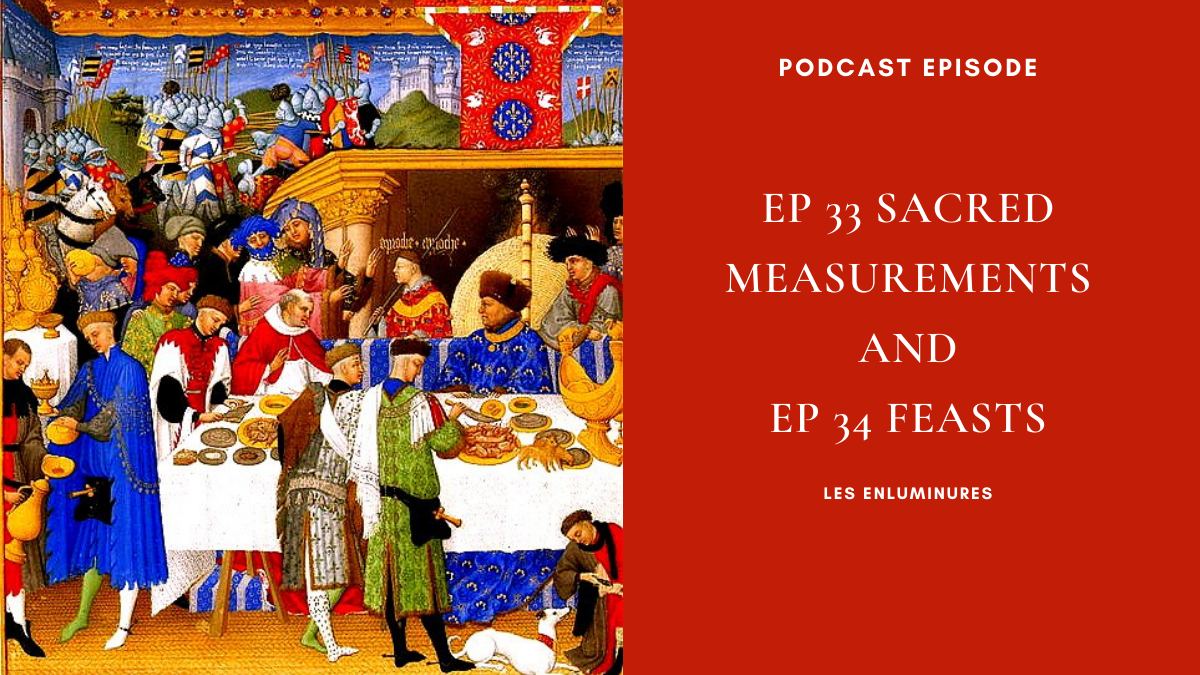
Podcast Episode: Les Enluminures, Time, Daylight, and a November Calendar

Les Enluminures have released the 32nd episode of their podcast, available online via this link.

Short winter days are now upon us. Usually we don’t consider the actual day to be shortened, however. There may be less daylight, but the measure of the day does not change throughout the year. Why is this? The transition between seasons often makes us more aware of time and the absurd ways we choose to apportion time during the day. Why do we structure our days around dates and increments instead of around feasts and labor? How were days and hours understood in the medieval period? Was time measured differently during the Middle Ages in comparison to contemporary, “equal” time standards? Find out today, and explore the illumination of a fabulous November calendar page from The Hours of Le Goux de La Berchère. 

Online Lecture: East of Byzantium: Eternal ‘Silk Road’? The Rise of Sogdiana during the 3rd–4th Centuries A.D., Sören Stark, Institute for the Study of the Ancient World, New York University, Monday 15 November, 12:00-1:30 pm (EST)

The last three decades ‘Silk Road’ studies have seen an unprecedented boom. As one of the consequences of this boom, Sogdiana and its traders were brought into the view of the broader academic and non-academic audience. Unfortunately (as is often the case with popular labels attached to research) the ‘Silk Road’ label has a tendency to take a somewhat timeless quality, thus turning Sogdiana into an eternal hub of transcontinental trade routes, supposedly flourishing since the dawn of history. But is this really the case? And if not, how can we explain the rise of Sogdiana as one of Eurasia’s economic power houses during Late Antiquity? In my lecture, I will attempt to approach this question with the help of both written sources as well as archaeological data. With regard to the latter, I will in particular draw from the results of archaeological fieldwork conducted since 2011 by the Uzbek-American Expedition in Bukhara in present-day Uzbekistan.

Sören Stark Associate Professor for Central Asian Archaeology at the Institute for the Study of the Ancient World at New York University. He received his PhD in 2005 from Martin-Luther-Universität Halle-Wittenberg. Professor Stark has close to two decades of experience in archaeological fieldwork in Western Central Asia. His current research interests are, among others, on Hellenistic and Late Antique/Early Medieval Sogdiana and the archaeology and history of nomadic groups close to oasis territories in Western Central Asia. His publications include a monograph on the archaeology of the 6th-8th century Türks in Inner and Central Asia, an exhibition catalogue on Early Iron Age kurgans from Kazakhstan, and numerous articles and book chapters on the history and archaeology of Sogdiana between the Hellenistic and the Islamic periods. He has been co-editor of the Journal of Inner Asian Art and Archaeology (at Brepols) and is currently co-editor of Brill’s Handbook of Oriental Studies, Section 8: Uralic & Central Asian Studies (HO8).

This lecture will take place live on Zoom, followed by a question and answer period. Please register to receive the Zoom link. An email with the relevant Zoom information will be sent 1–2 hours ahead of the lecture. Registration closes at 9:00 AM (EST) on November 15, 2021.

Click here to register.

EAST OF BYZANTIUM is a partnership between the Arthur H. Dadian and Ara Oztemel Chair of Armenian Art at Tufts University and the Mary Jaharis Center for Byzantine Art and Culture at Hellenic College Holy Cross in Brookline, MA. It explores the cultures of the eastern frontier of the Byzantine Empire in the late antique and medieval periods.

New Publication: Arte y liturgia en los monasterios de dominicas en Castilla. Desde los orígenes hasta la reforma observante (1218-1506) by Mercedes Pérez Vidal

Art and liturgy in the Dominican female monasteries in Castile. From the beginnings to the Observant reform (1218-1506)

In 1218, Saint Dominic founded in Madrid the second female monastery (after Prouilhe) of the Order of Preachers, and the first in the Iberian Peninsula. Coinciding with the 800th anniversary of the founder’s death in 1221, this long overdue monograph, the first dedicated to the study of Dominican female monasteries in the “Province of Spain”, is finally being published by Trea. Just as the Dominicans had, from the beginning, placed the divine office at the center of the nuns’ religious life, this book uses liturgy as a prism through which to study female monasteries. It has therefore been embedded in the “liturgical turn” which, far from being simply a trend, is shown here as absolutely necessary to go beyond the existing methodological horizons in the study of Dominican female foundations in Castile. This approach was adopted not only for a typological and functional analysis of the physical monastic spaces (mainly in chapter IV), images and artefacts (chapter III), but also for an in-depth study of the social, legislative and institutional history of these foundations (chapter I), and of their cultural, devotional and liturgical contexts (chapters II-III). As a result, this perspective touches on several disciplines: art history, musicology and studies on liturgy, gender studies, literary studies, institutional history of religious orders, cultural history, anthropology, etc.

Despite great efforts to encourage centralization and uniformity in the Order of Preachers from the mid-13th century onwards, this goal remained a utopian dream. Idiosyncrasies in matters of legislation, jurisdiction, enclosure, liturgy, and, of course, architecture, endured largely as a result of the local religious contexts. As the Master General Humbert of Romans (1254-1263) pointed out, the Dominicans had buildings and churches of various types and layouts. In female monasteries diversity was defined by the enclosure, where observance varied from place to place, as well as by the importance of lay patronage and how the nuns’ collective identity was shaped. All these factors had material consequences in the buildings, determining different articulations and functions of the liturgical space, as for instance, the wide range of locations of the nuns’ choirs. A selection of the most significant plans and illustrations at the end of this volume aims to provide a better understanding of the theoretical discourse.

This book is an important contribution to what is still a largely unexplored area of research on sacred topography and spatial functionality in female monasteries in the Iberian Peninsula. It caters to an increasing interest in female and religious networks, as well as the evolution of women’s role in various artistic and cultural processes. Lastly, the comparative approach guiding this work goes beyond the 21 monasteries analyzed, placing Castilian Dominican nuns within the broader contexts of both the Order of Preachers, and European female monasticism.

Art et liturgie dans les monastères de dominicaines en Castille. Des origines à la réforme observante (1218-1506)

En 1218, Saint-Dominique a fondé à Madrid le deuxième monastère féminin, après Prouilhe, lié à l’Ordre des Prêcheurs, et le premier de la péninsule ibérique. Coïncidant avec le 800e anniversaire de la mort du fondateur, survenue en 1221, cette attendue monographie, la première consacrée à l’étude des monastères féminins dans la «province d’Espagne» de l’ordre dominicain, est enfin publiée par Trea. De la même manière que les dominicains placèrent l’office divin au centre de la vie religieuse des moniales, ce livre prend la liturgie comme prisme à travers lequel sont étudiés les monastères féminins. L’ouvrage s’inscrit donc dans le liturgical turn qui, loin d’être une tendance, se présente ici comme une approche absolument nécessaire pour dépasser les horizons méthodologiques existants dans l’étude des monastères de moniales dominicaines en Castille. Cette méthode a été adoptée non seulement pour réaliser une analyse typologique et fonctionnelle des espaces monastiques (chapitre IV) et des images et des artefacts (chapitre III), mais aussi pour étudier l’histoire sociale, législative et institutionnelle de ces fondations (chapitre I) et de leurs contextes culturel, dévotionnel et liturgique (chapitres II-III). Ainsi, plusieurs disciplines s’entrecroisent au fil des pages : histoire de l’art, musicologie et études sur la liturgie, études de genre, études littéraires, histoire institutionnelle des ordres religieux, histoire culturelle, anthropologie.

La centralisation et l’uniformité auquel aspirait l’ordre dominicain depuis le milieu du XIIIe siècle constituaient un objectif ambitieux et, malgré les grands efforts déployés, l’uniformitas allait rester une utopie. Les particularités locales perdurèrent dans de nombreux domaines tels que la législation, la juridiction, la clôture, la liturgie et, bien sûr, l’architecture, largement déterminées par les contextes religieux locaux. Par conséquent, comme l’admit le maître général Humbert de Romans (1254-1263), leurs maisons avaient des bâtiments et des églises de divers types et dispositions. Dans les monastères de moniales la diversité fut définie par la clôture, dont l’observance variait d’un endroit à l’autre, par l’importance du patronage exercé sur les monastères et de la formation de l’identité collective des moniales.

Tous ces facteurs eurent des conséquences matérielles sur les bâtiments, déterminant différentes articulations de l’espace liturgique, comme par exemple la variété des solutions dans l’emplacement du chœur des moniales. L’inclusion d’une sélection des plans et illustrations les plus significatifs à la fin du volume vise à faciliter la compréhension du discours théorique.

Ce livre vient donc contribuer aux études encore rares sur la topographie sacrée et la fonctionnalité spatiale dans les monastères féminins de la péninsule ibérique et répond à l’intérêt croissant pour les réseaux féminins et religieux et pour la réévaluation du rôle des femmes dans divers processus artistiques et culturels. Pour conclure, l’approche comparative guidant ce travail est allée au-delà des 21 monastères analysés, plaçant les moniales dominicaines castillanes dans les contextes plus larges de l’Ordre des Prêcheurs et du monachisme féminin européen.

Click here for further details, or to purchase.

Workshop: Shades of Purple. Purple Ornament in Medieval Manuscripts, University of Zurich, 25-26 November 2021

This two-day workshop, organized by the research group Textures of Sacred Scripture – https://textures-of-scripture.ch at the University of Zurich will explore a range of questions about the materials and semantics of medieval purple manuscripts.

Recent advances in the material analysis of purple colorants have spurred new interest in the aesthetics of purple ornament in medieval manuscripts. This most prestigious embellishment associated with imperial splendor underwent stunning transformations between the 6th and the 12th century. Purple dyes (mostly produced from lichens) were not only used to color the entire parchment surfaces of sacred books, but purple colorants were also used selectively to highlight specific texts, pages and miniatures corresponding to the content, topology, imagery, and script of individual manuscripts. Various techniques and methods were employed to create multi-sensory purple textures, combining shades of purple from red to dark blue and evoking different purple-colored materials such as silks and porphyry.

Registration is required by 22.11.2021: thomas.rainer@uzh.ch
A COVID-19-certificate is mandatory for participants attending in person.
A Zoom link will be provided for participants unable to attend in person.

Program: https://texturestest.files.wordpress.com/2021/09/shades_of_purple.pdf

Day 1 | 25 Nov. 2021 | 09:00-16:50 (CET)

09:00 – 09:30
Introduction
David Ganz (UZH) & Thomas Rainer (UZH)

09:30 – 10:20
Bridging the Gap: The Identification and Technology of Purple Parchment on the Example of the Vienna Genesis (Austrian National Library, Cod.Theol. Gr. 31)
Christa Hofmann (ÖNB) & Maurizio Aceto (Università degli Studi del Piemonte Orientale, Alessandria)

Coffee Break

10:50 – 11:40
La pourpre dans les manuscrits d’apparat du haut Moyen Âge : de la caractérisation physico-chimique des matériaux à leur interprétation symbolique et sémantique
Charlotte Denoël (BnF) & Patricia Roger-Puyo (IRAMAT-CEB, Orléans)

11:40 – 12:30
The Brightest Colour of all in Medieval Illuminations
Maria João Melo (NOVA, New University of Lisbon) & Paula Nabais (NOVA, New University of Lisbon)

Lunch Break

14:00 – 14:50
Der Comes Parisinus und der Hof König Pippins von Italien
Fabrizio Crivello (Università degli Studi di Torino)

14:50 – 15:40
Shades of Purple in the Vienna Coronation Gospels and the Dagulf Psalter
Thomas Rainer (UZH)

Coffee Break

16:00 – 16:50
Aurea purpureis pinguntur scedis: The Apocalyptic Significance of the Godescalc-Evangelistary at Saint-Sernin of Toulouse
Catherine Fernandez (Princeton University)

Day 2 | 26 Nov. 2021 | 09:00-12:40 (CET)

09:00 – 09:50
Rhetoric and the Purple Stripe in the Terentius Vaticanus
Beatrice Radden Keefe (UZH)

09:50 – 10:40
The Astor Lectionary (New York Public Library)
Joshua O’Driscoll (The Morgan Library and Museum, New York)

Coffee Break

11:00 – 11:50
Die purpurnen Flüsse – Topologie von Porphyr-Purpur und Purpur-Topoi im Evangeliar Kaiser Heinrichs II. und verwandten Handschriften
Stefan Trinks (Humboldt Universität, Berlin)

11:50 – 12:40
Purple Aesthetics in Middle Byzantine Manuscripts
Joseph Kopta (Temple University, Philadelphia)

Organized by Textures of Sacred Scripture
Funded by the Swiss National Science Foundation
With support of University of Zurich

More information can be found here.

Online Lecture: Jeffrey Hamburger: ‘Colour in Cusanus’, The Murray Seminars at Birkbeck, Wednesday 17 November 5:00-6:30pm (GMT)

This research paper considers how Nicholas of Cusa, the fifteenth-century polymath, sought to convey higher truths in diagrammatic form


For Nicholas of Cusa, the fifteenth-century polymath, diagrams comprised the perfect medium with which to represent the highest truths. No less important, they were the ideal vehicle for attaining such truths in the first place. In overlooking the role of colour in his diagrams, which were painted according to his own instructions, not printed in black and white, modern accounts misrepresent Cusa’s method. In ways comparable to contemporary panel painting, Cusa employs colour to reproduce the diffusion of light through space and the interpenetration of light and dark, phenomena central to his theology. In functioning as operative instruments that structure thought, the diagrams visualize his epistemology as well as his ontology, inviting the viewer to experience the process of seeking truth that they set out to exemplify. Although deeply rooted in medieval traditions of diagrammatic representation, Cusa’s diagrammatic method proves to be more innovative than previously imagined.

A specialist in the art of the Middle Ages, Jeffrey Hamburger, the Kuno Francke Professor of German Art & Culture at Harvard University, has recently turned his attention to medieval diagrams. In addition to his work on the diagrams of Nicholas of Cusa, his recent and forthcoming publications on the topic include Diagramming Devotion: Berthold of Nuremberg’s Transformation of Hrabanus Maurus’s Poems in Praise of the Cross and The Diagram as Paradigm: Cross-Cultural Perspectives, co-edited with David Roxburgh and Linda Safran. On a separate topic, his book, The Birth of the Author: Pictorial Prefaces in Glossed Books of the Twelfth Century, just appeared last month. In the autumn of 2022, the pandemic permitting, he will deliver the Panizzi Lectures at the British Library on the topic of “Drawing Conclusions: Diagrams in Medieval Art and Thought.”

Click here to register.

Online Lecture: The Sound of the Lectionary: Chant, Architecture, and Salvation in Byzantium, Roland Betancourt, November 30, 2021, 2:00–3:30 pm (EST)

Looking at the interplay between chant, architecture, and manuscript illumination, this talk considers the ways in which notions of salvation were sonically articulated in the Divine Liturgy during the Middle Byzantine period. Tracing the Gospel lectionary from text to illustration to recitation, this lecture looks at how Byzantine artists produced a unified experience that took into consideration not only the text of the Gospel, but also how it would appear to the reader and his audience within the context of the Divine Liturgy. This work looks across text, art, and music to better understand how medieval artists fluidly worked across these categories. The material presented in this talk comes from Betancourt’s recent book Performing the Gospels in Byzantium: Sight, Sound, and Space in the Divine Liturgy (Cambridge University Press, 2021) that richly addresses these matters in further depth.

Part of the Boston Byzantine Music Festival Lecture Series exploring the musical heritage of the Byzantine Empire. The Boston Byzantine Music Festival is a program of the Mary Jaharis Center for Byzantine Art and Culture. 

This lecture will take place live on Zoom, followed by a question and answer period. Please register to receive the Zoom link. An email with the relevant Zoom information will be sent 1–2 hours ahead of the lecture.

Registration closes at 11:00 AM (EST) on November 30, 2021.

Click here to register.

Call for contribution : Workshops New Translations and indirect Reception of Ancient Greece (Texts and Images, 1300-1560) (ERC Advanced Grant AGRELITA Project)

ERC Advanced Grant AGRELITA Project
The Reception of Ancient Greece in pre-modern French Literature and Illustrations of Manuscripts and Printed Books (1320-1550): How invented memories shaped the identity of European communities
Direction : Catherine Gaullier-Bougassas

The AGRELITA project ERC n° 101018777 was launched on October 1st 2021. It is a 5-year project (2021-2026) financed on an ERC Advanced Grant 2020 through the European Union’s Research and Innovation Programme Horizon 2020.

Workshops
New Translations and indirect Reception of Ancient Greece
(Texts and Images, 1300-1560)

Thursday, September 15th and Friday, September 16th 2022
Thursday, January 19th and Friday, January 20th 2023

The AGRELITA Project studies the reception of ancient Greece, exploring a corpus of French-language literary works produced from 1320 to the 1550s, as well as the images of their manuscripts and printed books. The development of direct translations from Greek to French begins only from the 1550s. From the beginning of the 14th Century until the middle of the 16th Century, French-language authors and artists who illustrate manuscripts and printed books of their works, with some exceptions, have no direct knowledge of Greek works. The knowledge about ancient Greece that they transmit and reinvent in their texts and in their illustrations is mediated by various filters. Their reception is indirect, based on previous textual and iconographic works, whose representations of ancient Greece are in fact the result of one or more receptions.
The workshops of September 2022 and January 2023 will be devoted to the analysis, through this corpus, of new translations and adaptations into French language from Latin works which convey the knowledge about ancient Greece, in several different forms. These Latin works adapted by 1300-1550s French authors are partly ancient and medieval works which are not translations, and partly translations or adaptations of Greek works, sometimes with several linguistic transfers from Greek. They take very diverse forms : from ancient texts (Ovid, Virgil, Boethius, Augustine, Darès, etc.) to Latin humanist translations of Greek works produced in Italy and in the Netherlands in the 15th and 16th Centuries, including original medieval Latin works (id est no translations, Vincent de Beauvais, Third Vatican Mythograph, Petrarch, Boccaccio, the author of Rudimentum novitiorum…), Latin translations from French (Guido delle Colonne) and Arabic-Latin and Arabic-Spanish-Latin translations (Aristotle, Dits moraux des philosophes…).
French-language authors thus inherit various previous receptions, which they appropriate and transform, so that they carry on the inventing process of representations of ancient Greece. As the manuscripts and printed books of these new translations often comprise a lot of illustrations, the artists present simultaneously visual translations, which are also based on various sources and previous receptions and show new images of ancient Greece. The question of the reception of ancient Greece will therefore be explored from another perspective than the one adopted until now and which consisted in studying the direct transmission of Greek works.
In the corpus of 1300-1550s French new translations / adaptations which relate to ancient Greece, its history, its heroes, its authors and their works, although they are not direct translations of Greek works, the multiple origins and the syncretism of the knowledge available to authors and artists will be explored, as well as the methods of their appropriation and transformation. We will analyze how this transmission of knowledge that already conduct various interpretations is above all matter of circulation and of creation of representations, and how the elaboration of images of ancient Greece contributes to inventing a cultural memory submitted to a large secular audience both through text and images.

The corpus of studies (texts and images in manuscripts and printed books) will be constituted as follows:
-the translations / adaptations into French of ancient Latin works and the images of ancient Greece that they convey, in particular the translations of the works of Ovid, of the Consolation of Philosophy by Boethius, of the City of God by Augustine, of De excidio Troiae historia by Darès the Phrygian…
-the retranslations into French of medieval Latin works that are translations from French, such as the ones of the Historia destructionis Troiae by Guido delle Colonne.
-the translations / adaptations into French of medieval Latin works that are not translations, and among the most widely distributed the ones written by Vincent de Beauvais (in the wake of Hélinand de Froidmont), Boccacio, Petrarch, but also many others texts; the images of ancient Greece that the mid-Latin works present and those that their adaptations in French transmit, accurate or not.
-the first indirect translations of Greek works, through Latin, Arabic-Latin or Arabic-Spanish-Latin translations (the French translations of the ethical and political works of Aristotle, the Dits moraux des philosophes…)
-from the 15th century, French translations of Greek works through Latin translations of humanists from Italy and the Netherlands. Particularly, the indirect translations of Xenophon, Plutarch, Thucydides, Diodorus of Sicily, Lucian, Homer, Euripides from the translations of Poggio Bracciolini, Leonardo Bruni, Lorenzo Valla, Guarino Veronese, Pier Candido Decembrio and Erasmus.
How do the humanist Latin translators of Greek works, and then the French translators of these Latin translations, present their translation initiatives? What images do they give (them and the illustrators of the manuscripts and printed books of their works) of Greek authors and works, and of ancient Greece in works that deal with its history and its characters? What changes are emerging in the reception of ancient Greece?
-the translations into other European vernaculars, during the 15th and 16th centuries, from Latin humanist translations of Greek works. Analyzing the new indirect translations, from Latin, in particular from Xenophon, Plutarch, Thucydides, Diodorus Sicile, Lucien, which are written in the other Romance languages and in the English and Germanic languages, would make it possible to understand the commonalities as well as the differences of translation and reinterpretation in several European cultural fields, the various inflections given to Greek works and images from ancient Greece, the different uses of these translations, the different types of manuscripts and printed books, in their materiality and in their illustrations.

The papers will be published by Brepols publishers, in the “Research on Antiquity Receptions” series :
http://www.brepols.net/Pages/BrowseBySeries.aspx?TreeSeries=RRA

Travel and accommodation costs will be covered according to the terms of the University of Lille. Contact: Catherine Gaullier-Bougassas

Please submit a short abstract (title and a few lines of presentation) to catherine.bougassas@univ-lille.fr by December 15, 2021.

For more information about the ERC Agrelita Project, please see our academic Blog : https://agrelita.hypotheses.org/