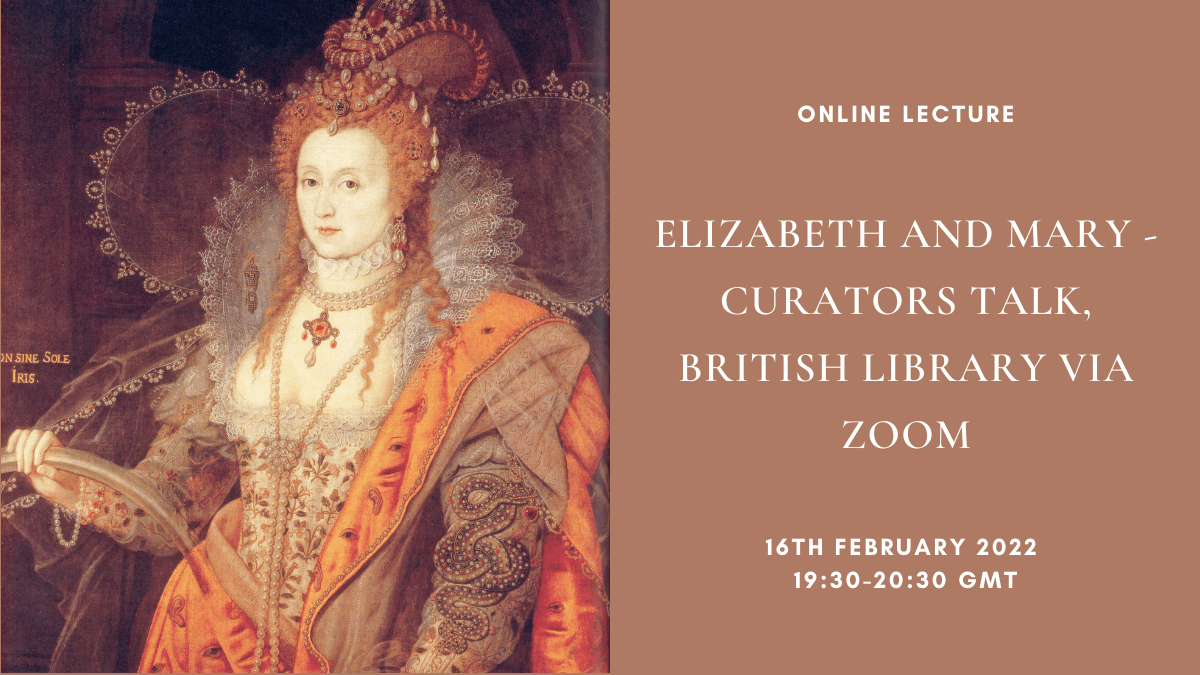
Online Lecture: Elizabeth and Mary – Curators Talk, British Library via Zoom, 16th February 2022, 19:30-20:30 GMT

This is an online event hosted on Zoom. Bookers are sent a link in advance giving access.

Take a look behind the scenes with the British Library curators of Elizabeth and Mary: Royal Cousins, Rival Queens, as they talk about the process of putting together this extraordinary exhibition.

Join Andrea Clarke and Karen Limper-Herz to find out how they selected some of the Library’s most exceptional 16th-century manuscripts and printed works to bring the dramatic story of the queens to life.

Andrea Clarke is Lead Curator of Medieval and Early Modern Manuscripts at the British Library. She co-curated the Library’s exhibition Henry VIII: Man and Monarch in 2009, and Leonardo da Vinci: A Mind in Motion in 2019, and is lead curator of Elizabeth & Mary: Royal Cousins, Rival Queens. She is the author of Love Letters: 2000 Years of Romance (2011) and Tudor Monarchs: Lives in Letters (2017).

Karen Limper-Herz is Lead Curator of Incunabula and Sixteenth Century Printed Books at the British Library. She is co-curator of Elizabeth & Mary: Royal Cousins, Rival Queens and also co-curated Georgians Revealed: Life, Style & the Making of Modern Britain in 2013. She is Hon. Secretary and Vice President of the Bibliographical Society of London.

Book online via this link.

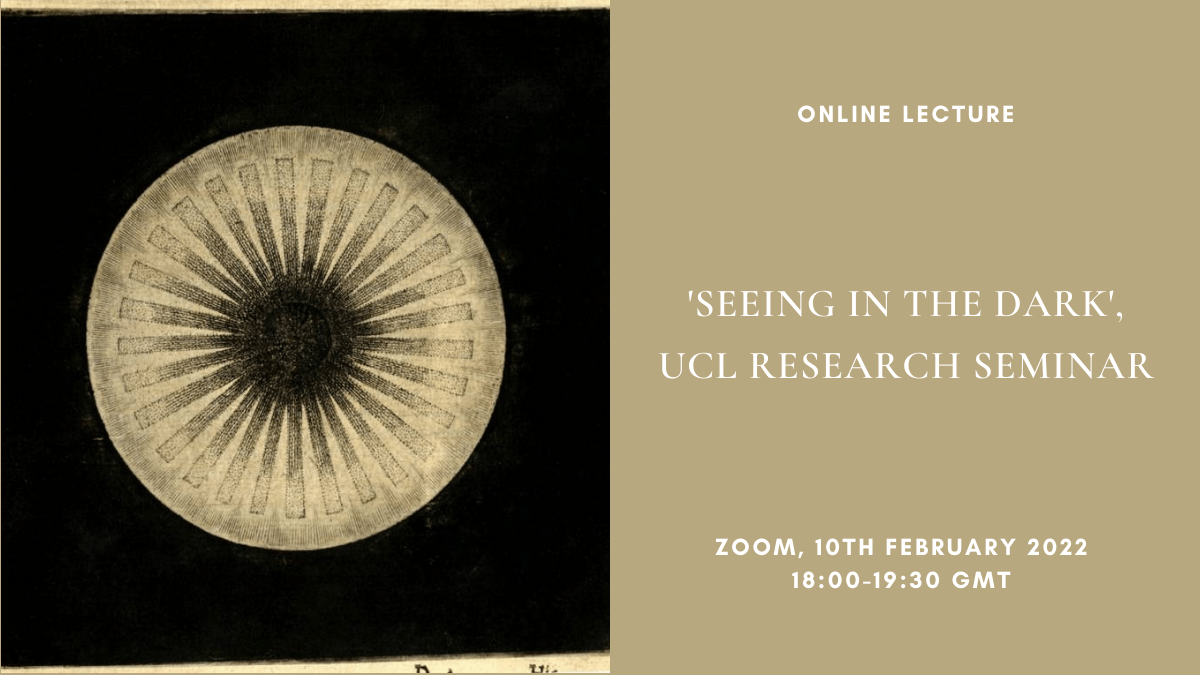
Online Lecture: ‘Seeing in the Dark’, UCL via Zoom, 10th February 2022, 18:00-19:30 GMT

In this exploratory paper I consider the long history of seeing in the dark, from cave painting to Zoom lectures. Focusing especially on what was once known as the ‘Dark Ages’, I seek to counter whiggish histories of enlightenment, and explore how art and architecture are and were commonly produced and experienced in darkness or half-light. How have new technologies helped to efface histories of darkness? How, despite this, does darkness still create powerful ‘occasions’ for viewing? And to what extent does artificial light diminish modern encounters and interpretations of artworks and spaces?

Image: Detail from Robert Fludd, Utriusque Cosmi Maioris Scilicet et Minoris Metaphysica, 1617 (Wellcome Collection)

Click here to book.

Organiser:

Helena Vowles-Shorrock – History of Art 

h.vowles-shorrock@ucl.ac.uk

Speaker:

Senior Lecturer in Medieval Art and Architecture at The Courtauld Institute of Art 

More about Tom Nickson

CFP: Gothic Ivories between Luxury and Crisis, University of Bern, 27th-28th October 2022, Deadline 3rd June 2022

Despite military and pandemic crises, ivory carvings as luxury goods experienced a boom in the 13th and especially 14th centuries. This apparent contradiction raises questions about the value and significance of these objects in elite society. A large number of preserved utilitarian items such as boxes, combs, and mirror cases feature profane depictions of courtship or other imagery from contemporary romances.


Analysis of these representations offers insight into the interests of courtly owners as well as into related social structures. In this way, profane ivory carvings reflect, albeit in an idealized manner, the lives, tastes, and literary knowledge of the elite. Such objects are the focus of this conference.
The frequent contrast staged between scenes of love and war on Gothic ivories reflected certain crises faced by society: did the images on these luxury objects help members of society to cope with violent crises, or were they not perceived as related to violence at all? Did they aid individuals in dealing with the personal dilemmas posed by courtly canons of virtue? Did they reflect quandaries that arose – as propagated in minnesong – from the suffering of love? What role did their materiality play? Can we determine to what extent economic realities also came to bear on the production, execution, or decline of profane ivory carvings?

The two-day conference will be divided into four sections, focusing on historical, social, personal, and economic crises respectively.
Interested parties are asked to submit an abstract of max. 300 words (German, English, or French; with an indication of which of the four sections is desired) and a short biography by June 3, 2022. Travel and accommodation costs will be covered.

Timetable:
Deadline for submission of abstracts and CV: June 3, 2022
Feedback on abstracts: June 15, 2022
Date of the conference: October 27–28, 2022
Submission of manuscripts: January 31, 2023

Contact:
Prof. Manuela Studer-Karlen (manuela.studer-karlen@unibe.ch)
University of Bern, Institute of Art History

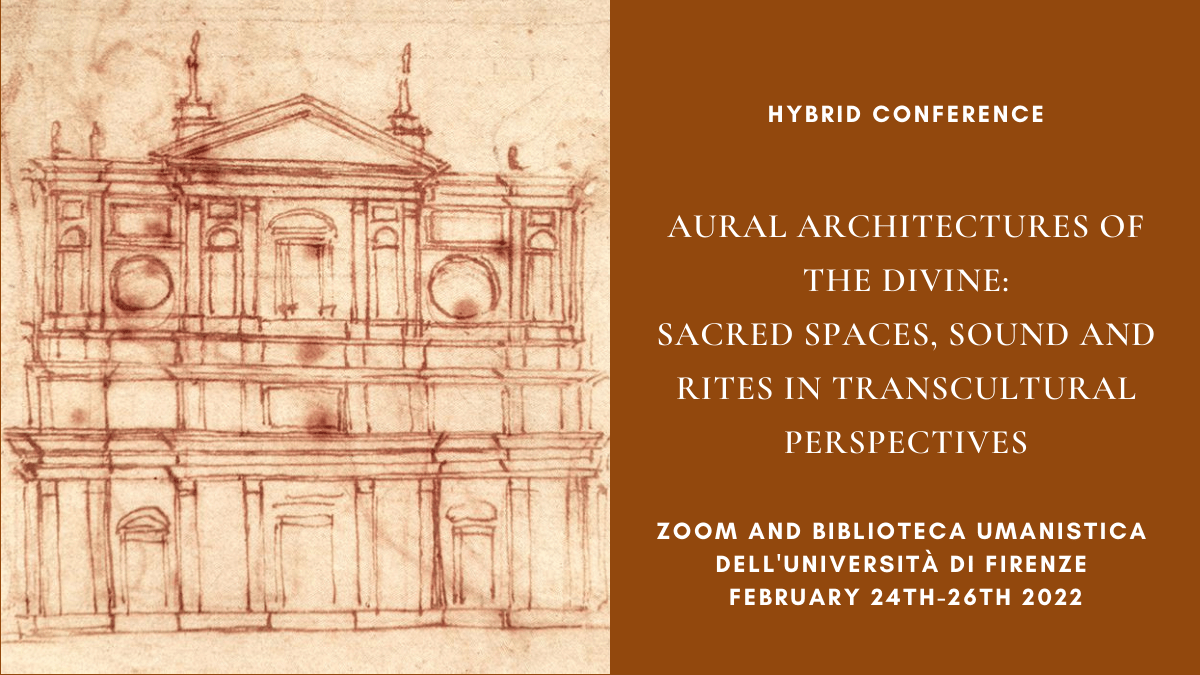
Conference: Aural Architectures of the Divine, Online and On-Site at University of Florence, February 24th-26th 2022

online / Florence, Feb 24–26, 2022
Registration deadline: Feb 23, 2022

International and Interdisciplinary Conference [Hybrid]

Florence, 24–26 February 2022 [on site and virtually]

Research Project “CANTORIA – Music and Sacred Architecture” (Johannes Gutenberg University Mainz) | Università degli Studi di Firenze, Dipartimento di Storia, Archeologia, Geografia, Arte e Spettacolo (SAGAS)

Conference Venues:
Biblioteca Umanistica dell’Università di Firenze
Sala Comparetti
Piazza Brunelleschi, 4
I-50121 Florence

Basilica di San Lorenzo
Piazza di San Lorenzo, 9
I-50123 Florence

Concept: Klaus Pietschmann and Tobias C. Weißmann (Johannes Gutenberg University Mainz)

Conference Committee: Mila De Santis and Antonella D’Ovidio (Università degli Studi di Firenze), Klaus Pietschmann and Tobias C. Weißmann (Johannes Gutenberg University Mainz)

An interdisciplinary conference to be held in Florence from 24 to 26 February 2022 and virtually via Zoom will focus on the complex interrelation of sacred space, sound and rites in transcultural perspectives from ancient to premodern times. The research project “CANTORIA – Music and Sacred Architecture” (University of Mainz) and the “Dipartimento di Storia, Archeologia, Geografia, Arte e Spettacolo” (University of Florence) invite all interested researchers to participate. The conference will be held in a hybrid format – in Florence on site and virtually.

Since ancient times, religious practices and the perception of the divine have been determined by the intersection of rite, sound and sacred space. Temples, churches and other sacred buildings not only define a holy place as a physical and symbolic expression of a specific faith, but establish the setting for performative and multisensorial religious ceremonies in which music and other sonic manifestations play an important role. The structure, decoration and furnishing of sacred buildings create specific acoustics which influence the soundscape of sacred spaces. Performative rites such as services, processions, sacred plays or other liturgical ceremonies use the potentials of these environments in specific ways. Vice versa, architecture reacts to ritual and musical developments by modifying venerable sanctuaries or in designing and constructing new buildings.
The interdisciplinary conference explores the complex interrelation of sacred space, sound and rites in transcultural perspectives from ancient to premodern times. The sacred space is understood as a historical product, which was determined by a religion’s theological, aesthetic and socio-cultural context and which – conversely – shaped the performative, sonic and aesthetic dimensions of the ritual activities.
The congress is organised by the research project “CANTORIA. Music and Sacred Architecture” (Johannes Gutenberg University Mainz) in cooperation with the “Dipartimento di Storia, Archeologia, Geografia, Arte e Spettacolo” (University of Florence). A lecture-concert in the basilica of San Lorenzo with polychoral music composed for this church and for the Florentine Cathedral in the 17th century will prove the interrelation of music, architecture and acoustics at an authentic space. A video recording of the lecture concert will be published on the “CANTORIA” project website.

Further information: 
The conference will be held in a hybrid format – in Florence and virtually. All participants on site must be vaccinated and tested. For the current Covid 19-regulations please, see the website: https://cantoria-mainz.de

Registration is required: 
anmeldung-musikwissenschaft@uni-mainz.de

Contact
Klaus Pietschmann: klaus.pietschmann@uni-mainz.de
Tobias C. Weißmann: tobias.weissmann@uni-mainz.de

Supported by
Fritz Thyssen Stiftung
Gutenberg Forschungskolleg

Programme:

Thursday, 24 February 2022

14.30: Mila De Santis | Antonella D’Ovidio (Florence): Welcome

14.45: Klaus Pietschmann | Tobias C. Weißmann (Mainz): Introduction

Keynote Lecture

15.00: Jonathan Berger (Stanford): Sound, Space and the Aesthetics of the Sublime

16.00: Coffee Break

I. Antiquity

17.00: Doris Prechel (Mainz) | Giulia Torri (Florence): Stations of the Temple Cult – Set to Music in the Hittite Culture in Central Anatolia 2nd Millenium BC

17.30: Diana Perego (Milan) | Michele Traversi Montani (Lecco): Spazio e suono nel santuario attico di Ikaria

18.00: Jutta Günther (Göttingen) | Florian Leitmeir (Würzburg): Mysterious Noises, Mysterious Space. The Soundscape of the Frieze of the Villa dei Misteri in Pompeii

18:30: Break

21.00: Lecture Concert in the Basilica di San Lorenzo

21.00: Umberto Cerini (Florence): Musiche policorali negli archivi musicali di San Lorenzo e Santa Maria del Fiore. Testimonianze di una pratica diffusa

21.15: Concert by Lilium Cantores & Cappella Musicale di San Lorenzo (Musical Director: Umberto Cerini)
Polychoral Church Music from 17th Century Florence: Ruggiero Giovannelli, Marco da Gagliano, Filippo Vitali and Nicolò Sapiti

Friday, 25 February 2022

II. Middle Ages

9.00: Renzo Chiovelli (Rome) | Enrica Petrucci (Camerino) | Vania Rocchi (Florence): Lo studio delle ‘Trombe d’Eustachio’ nella cripta del Santo Sepolcro di Acquapendente come contributo al paesaggio sonoro della Via Francigena

9.30: Stefan Morent (Tübingen): Sacred Sound – Sacred Space: In Search of Lost Sound. Virtual Acoustic-Visual Reconstruction of Sacred Spaces of the Middle Ages

10.00: Anna Adashinskaya (Moscow): Singing for the Dead in Medieval Serbia. From Lateral Chapels to Additional Monastic Buildings

10.30: Coffee Break

11.30: Galliano Ciliberti (Monopoli): Reims: Spazi sacri, suoni e riti nelle incoronazioni dei re di Francia. San Luigi IX (1226) e Carlo X (1825)

III. Early Modern Period I: Italy

12.00: Vasco Zara (Dijon): The Theory of Architecture. The Renaissance Principles and their Applications

12.30: Stephanie Azzarello (Cambridge): Angels Above, Monks Below. The Use of Images, Sound, and Ritual in Venetian Sacred Spaces

13.00: Lunch Break

15:00 Emanuela Vai (Oxford): Staging Sound, Shaping Space. The Confraternity of the Misericordia Maggiore in the Early Modern Venetian Terraferma

15.30: Maddalena Bonechi (Florence): Musiche negli spazi architettonici di Santa Felicita a Firenze nel primo Seicento

16.00: Umberto Cerini (Florence): Cantori, chierici, organi e strumenti. La dialettica della musica liturgica negli spazi di Santa Maria del Fiore a cavallo tra Sei e Settecento

16.30: Coffee Break

17.30 Elena Abbado (Vienna): Oratorio vs Oratorio. Considerazioni sull’evoluzione del rapporto tra spazio architettonico e genere musicale nella Firenze tra Sei e Settecento

IV. Early Modern Period II: Central and Eastern Europe

18.00: Eugeen Schreurs (Antwerp): Angelic Hymns of Praise. Rood Lofts in Brabant, Flanders and Liège

18.30: Camilla Cavicchi (Tours): The Inner Ear. Watching Painted Music in the Castle of Montreuil-Bellay

Saturday, 26 February 2022

IV. Early Modern Period II: Central and Eastern Europe (continued)

9.00: Jean-Christophe Valière (Poitiers): The Approach of the Archaeoacoustic. The Case of Montivilliers Abbatial Church

9.30: Jana Kratochvílová (Brno): The Relationship of Sacral Architecture and Musical Practise in Royal Cities in Czech Lands (1450–1700)

10.00: Nicholas Smolenski (Durham): Metaphorical Construction of St Paul’s Cathedral in John Blow’s I was glad

10.30: Coffee Break

V. Non-European Cultures

11.30: Patrick Becker-Naydenov (Vienna): From Eastern Plainchant to Qurʾān Recitation? Practical, Aesthetical, and Architectural Implications for Converting Churches into Mosques and Constructing Islamic Sacral Sites in 16th-Century Urban and Rural Ottoman Southeastern Europe

12.00: Janie Cole (Cape Town): Sacred Architecture, Jesuit Missionaries and Performance in the Christian Kingdom of Early Modern Ethiopia

12.30: Gayathri Iyer (New Delhi): She Came, She Sang, She Danced. Interactions Between South Indian Temple Architecture and the Body of the Hereditary Performer as the Foundation of the Hindu Aural Divine

13.00: Concluding Remarks and End of the Conference

Online lecture: ‘Saint-Lazare d’Autun, collégiale ducale et église de pèlerinage’, Éliane Vergnolle, 14 February 2022, 5pm (GMT) / 6pm (CET)

La célébrité du grand tympan du Jugement dernier et des magnifiques chapiteaux sculptés de Saint-Lazare d’Autun a quelque peu laissé dans l’ombre le monument lui- même. Il s’agit pourtant d’un fleuron de l’architecture romane en Bourgogne. Érigée dans l’enceinte de son château par le duc Hugues II, la collégiale consacrée en 1130 avait une double vocation : manifester le prestige de son fondateur et accueillir l’un des pèlerinages les plus importants de Bourgogne.

Si les jeux de pilastres cannelés et les ordres superposés de l’élévation intérieure s’inscrivent dans le courant antiquisant inau- guré au début du XIIe siècle à Cluny, leur traitement, notamment la riche polychromie révélée par la récente restauration, dénote un sens du décorum particulièrement affirmé. La translation des reliques de saint Lazare opérée en 1146 marqua une ultime étape du chantier avec, d’une part, la construction dans l’abside d’un imposant tombeau sculpté – détruit au XVIIIe siècle mais dont les vestiges sont conservés au musée Rolin – et, de l’autre, celle d’un somptueux porche d’entrée destiné à l’accueil des pèlerins.

Visio-conférence GRATUITE sur inscription obligatoire.

Inscription par courriel à l’adresse frederique@sfa-monuments.fr ou sur le portail HELLO ASSO (cliquez ICI)

Renseignements auprès de la Société française d’archéologie par téléphone au 0033 (0)1 42 73 08 07
ou ici.

Online Lecture: East of Byzantium Lecture – Syriac Villages in the Tur Abdin: A Microhistory of the Medieval Middle East, 15th February 2022 12:00-13:30pm (EST)

While scholarly work on the churches of the Tur Abdin dates back to the work of Gertrude Bell, and subsequently continued off and on through the twentieth century, the focus of most research has consistently been the churches in the region. However, churches are the heart of communities, whether villages or monasteries, and need to be considered as part of the whole. What has not been considered in detail is the importance of contextualizing churches in the villages and cities in the region, both in terms of the material remains and the literary sources. This paper is meant to start a discussion about the significance of colonialism in the study of this region, the importance of microhistory in understanding archaeological material, and the overall underdiscussed material present in the Tur Abdin.

Marica Cassis specializes in the Late Roman, Byzantine, and Syriac past in Anatolia, and did her PhD in Byzantine and Syriac studies at the University of Toronto in the Department of Near and Middle Eastern Civilizations. Since then she has worked at SUNY Cortland, Memorial University of Newfoundland, and is now the Head of Classics and Religion at the University of Calgary.

Her work currently focuses on two areas. First, she is the director of the SSHRC funded Byzantine excavations at Çadır Höyük, a multi-period site in Yozgat province Turkey. Work at the site is following the evolution of a small agricultural and defensive site in Anatolia from the Roman period through to the arrival of the Seljuk Turks. It is one of the few sites in Anatolia that is able to follow the continuous occupation of sites in the rural late Roman and Byzantine hinterland. She also works on the intersection of colonialism, orientalism, and gender theory with Byzantine and Syriac archaeology, considering new ways of reconsidering the material to provide a more nuanced view of the past.

This lecture will take place live on Zoom, followed by a question and answer period. Please register to receive the Zoom link. Please register to receive the Zoom link. REGISTER FOR THE LECTURE

EAST OF BYZANTIUM is a partnership between the Arthur H. Dadian and Ara Oztemel Chair of Armenian Art at Tufts University and the Mary Jaharis Center for Byzantine Art and Culture at Hellenic College Holy Cross in Brookline, MA. It explores the cultures of the eastern frontier of the Byzantine Empire in the late antique and medieval periods.

New Publication: A Companion to Medieval Ethiopia and Eritrea edited by Samantha Kelly

Choice Outstanding Academic Title 2020

Winner of the 2021 African Studies Review Prize for the Best Africa-focused Anthology or Edited Collection

A Companion to Medieval Ethiopia and Eritrea introduces readers to current research on major topics in the history and cultures of the Ethiopian-Eritrean region from the seventh century to the mid- sixteenth, with insights into foundational late-antique developments where appropriate. Multiconfessional in scope, it includes in its purview both the Christian kingdom and the Islamic and local-religious societies that have attracted increasing attention in recent decades, tracing their internal features, interrelations, and imbrication in broader networks stretching from Egypt and Yemen to Europe and India. Utilizing diverse source types and methodologies, its fteen essays ofer an up-to-date overview of the subject for students and nonspecialists, and are rich in material for researchers.

Contributors are Alessandro Bausi, Claire Bosc-Tiessé, Antonella Brita, Amélie Chekroun, Marie-Laure Derat, Deresse Ayenachew, François-Xavier Fauvelle, Emmanuel Fritsch, Alessandro Gori, Habtemichael Kidane, Margaux Herman, Bertrand Hirsch, Samantha Kelly, Gianfrancesco Lusini, Denis Nosnitsin, and Anaïs Wion. 

Samantha Kelly, Ph.D (1998, Northwestern University) is Professor of History at Rutgers University. She is a specialist of medieval Italian history and of Ethiopian-European relations to the mid-sixteenth century.

Readership: All interested in medieval Ethiopia, the medieval Mediterranean, global/comparative approaches to the Middle Ages, eastern Christianity (late antique and medieval), medieval Islamic history, Islam or Christianity in Africa, medieval Africa.

Reviews:

“Here we are well served by Samantha Kelly’s Companion to Medieval Ethiopia and Eritrea. Each chapter conveys a sense of discovery. As Kelly reminds us, we are dealing with a field marked by “the continual expansion of the available source base” due to the ongoing digitalization of Ethiopic manuscripts in Ethiopia itself and in libraries throughout the world. Yet perhaps the most exciting contribution of the Companion is a new view of Ethiopia itself. Christian Ethiopia has tended to be treated as an isolated mountain hideaway where time stood still; Edward Gibbon, at his most sonorous and most wrongheaded, wrote, “Encompassed on all sides by the enemies of their religion, the Aethiopians slept near a thousand years, forgetful of the world, by whom they were forgotten”. The reverse was true. Medieval Ethiopia (which includes much of modern Eritrea) was a frontier society, penetrated in all directions by routes that led from the Red Sea and the Indian Ocean deep into Equatorial Africa. This reenvisioning of medieval Ethiopia is, perhaps, the most challenging aspect of the Companion. In the words of one contributor of Kelly’s volume, “Let us hope that the image of an archaic, never evolving and isolated country is no longer acceptable”. “The Glories of Aksum”, by Peter Brown, in The New York Review of Books, October 2021

Winner of the 2021 African Studies Review Prize for the Best Africa-focused Anthology or Edited Collection. The awarding committee made the following statement, accessible here
“The ASR Prize for the Best Africa-Focused Anthology or Edited Collection recognizes editors and contributors to an anthology of original scholarship, cohesive in structure and interdisciplinary in nature, that advances African studies in new theoretical and/or methodological directions. The award recognizes the editor(s) and also the contributors as a whole. In making its selection, the prize committee pays particular attention to significance, originality, and quality of writing, and the anthology’s contribution to advancing debates in African studies. […] This stellar edited volume makes available recent scholarship on the history of Medieval Ethiopia and Eritrea. Comprehensive in its scope, the sixteen chapters by the international scholars Alessandro Bausi, Claire Bosc-Tiessé, Antonella Brita, Amélie Chekroun, Marie-Laure Derat, Deresse Ayenachew, François-Xavier Fauvelle, Emmanuel Fritsch, Alessandro Gori, Habtemichael Kidane, Margaux Herman, Bertrand Hirsch, Samantha Kelly, Gianfrancesco Lusini, Denis Nosnitsin, and Anaïs Wion bring to light various dimensions of the history and culture of this region. The chapters explore various dimensions of the history of the Ethiopian-Eritrean region from the seventh to the sixteenth century, including Christianity, Islam, and local religions, women, trade, literature, and visual culture. In addition to providing an insightful panorama of the religious and cultural contexts in the area, the diverse authors are very successful in articulating different textual and visual sources while employing several different methodological approaches. Innovative and based on extensive research, this is a unique edited volume that showcases the rich connections between the region of Ethiopia-Eritrea, the African continent, and the rest of the globe. This magisterial edited book is an important contribution to African Studies, which will be useful for scholars and students interested in the history of Africa, Ethiopia, and Eritrea.”

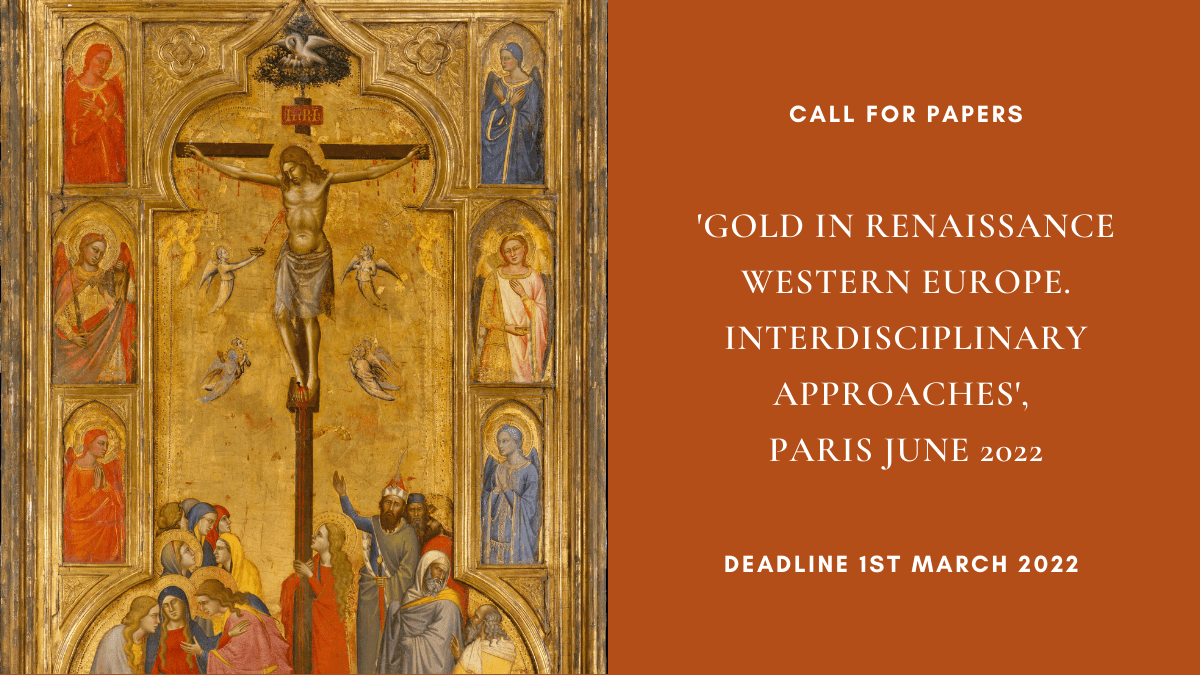
CFP: Gold in Renaissance Western Europe, Paris, June 2022, Deadline: 1st March 2022

Paris, Jun 9–10, 2022
Deadline: Mar 1, 2022

International Symposium:
“Gold in Renaissance Western Europe. Interdisciplinary Approaches”

In his influential book on painting and visual culture in fifteenth-century Italy (Painting and Experience in Fifteenth-Century Italy, 1972), Michael Baxandall described the abandonment of gold in painting practices as a sensitive phenomenon both in contracts between painters and patrons, and in the writings of some authoritative art theorists. He linked this attitude to a more general movement on a European scale, consisting of the decline of some practices of display, for example the fashion for clothes embellished with precious materials such as gold. He also suggested a correlation between with the shortage of gold in fifteenth-century Europe or the growing interest in the painter’s maestria at the expense of the preciousness of the materials. Although gold backgrounds gradually disappeared from Western European painting – mainly during the fifteenth century – and art theorists condemned the use of this material, gold was not completely abandoned in practice, as shown by certain artworks produced by painters as innovative as Rembrandt and Vermeer in the middle of the seventeenth century. Nevertheless, the question of the subsequent use of gold has not been a major focus of early modern art historians, who have instead sought to refine Baxandall’s vision by examining the disappearance of gold backgrounds in the fifteenth century in the two main artistic areas of the time : the Low Countries and the Italian Peninsula.

Fifty years after Baxandall’s work, this symposium aims to investigate, in an interdisciplinary way, the place of gold in Western European societies during the Renaissance. As a material, gold has played an important role in the cultural and economic history of Europe and the world, in the history of science, and also in the historiography of the ‘material turn’ in art, as shown by several transchronological syntheses published in recent years [Venable 2011; Zorach & Phillips 2016]. Museums have not been left out of this renewed interest in the various uses and meanings of gold: one need only think of the exhibition that the Mucem organised in 2018 [Bouiller 2018], or the numerous physico-chemical analyses carried out on ancient artworks in research laboratories in France (e.g. C2RMF) and abroad, particularly in London (at the National Gallery).
On the basis of these recent achievements, we will focus on a limited area (Western Europe), albeit one connected to the rest of the world, and a given time (especially the period from 1450 to 1520). 

The aim of the conference is therefore to explore: 
-The economic history of gold and what the heritage science can say about it. Which deposits of the metal were exploited at that time? What is the current state of knowledge of monetary history in Western Europe at the end of the fifteenth century ? How can we characterise the origin of the gold in a work of art? 
-The social history of gold. Can we speak of a symbolism linked to this material at that time? What are the myths associated with it (the alchemical quest, Eldorado, etc.)? What place does gold have in sumptuary legislation?      
-The taste for gold (e.g. in treasures, domestic interiors, sacred spaces, etc.) and the position of civic and ecclesiastical authorities with regard to this precious metal.
-Learned and practical knowledge : metallurgy, alchemical practices, humanist thinking.
-The craftsmen who worked with gold  (e.g. goldsmiths, gold beaters, gilders) and their regulations.
-Its artistic uses (goldsmithing, sculpture, illumination, engraving, tapestry, painting, etc.).     
-The techniques for using this material as they can be reconstituted today by the physical and chemical sciences, as well as the techniques for restoring the gilding of a few artworks from this period, including the Isenheim Altarpiece (around 1515), which is currently undergoing restoration in Colmar (Musée Unterlinden).

We are inviting papers in all relevant disciplines.

Abstract submission and deadlines
Please submit your abstract of 300 words with a short biography to Romain Thomas (rthomas@parisnanterre.fr), Valentina Hristova (valqhristova@yahoo.fr), Christine Andraud (christine.andraud@mnhn.fr), Anne-Solenn Le Hô (anne-solenn.leho@culture.gouv.fr) by 1 March 2022. Notification of acceptance will be given around 15 March 2022.

Organising Committee
– Prof. Christine ANDRAUD (Professor of Physics (Optics), CRC/CNRS/MNHN)
– Dr. Valentina HRISTOVA (Post-doctoral Fellow in Early Modern Art History, Fondation des Sciences  du Patrimoine and HAR, University Paris Nanterre)
– Dr. Anne-Solenn LE HO (Research Engineer in Physical Chemistry, C2RMF/CNRS)
– Dr. Romain THOMAS (Lecturer in Early Modern Art History, HAR, University Paris Nanterre)

Scientific Committee
-Prof. Erma HERMENS (Professor, Director of the Hamilton Kerr Institute and Deputy Director for Conservation and Heritage Research of the Fitzwilliam Museum, Cambridge University)
-Dr Julien LUGAND (Lecturer in Early Modern Art History, CRESEM, Université de Perpignan Via Domitia)
-Prof. Philippe SENECHAL (Professor in Early Modern Art History, Université de Picardie Jules Verne)
-Dr Laurent-Henri VIGNAUD (Lecturer in Early Modern History, LIR3S, Université de Bourgogne)
-Prof. Alison WRIGHT (Professor in Italian Art c. 1300-1550, University College London)
-Prof. Rebecca ZORACH (Mary Jane Crowe Professor in Art and Art History, Northwestern University)

Summary bibliography
Aix-en-Provence 1983 – L’Or au Moyen Age : monnaie, métal, objet, symbole (proceedings from the international conference in Aix-en-Provence, February 1982), Aix-en-Provence, 1983
Berzock 2019 – Caravans of gold, fragments in time. Art, culture, and exchange across medieval Saharan Africa, exh. catalogue ed. by Kathleen Bickford Berzock, Princeton, 2019
Bouiller et al. 2018 – Or , exh. catalogue ed. by Jean-Roch Bouiller, Philippe Jockey, Myriame Morel-Deledalle & Marcel Tavé (Marseille, Mucem, 24 april-10 september 2018), Vanves, 2018.
Duits 2008 – Rembrandt Duits, Gold brocade and Renaissance painting, London, 2008
Eveno et al. 2014 – Myriam Eveno et al., ”The Louvre Crucifix by Giotto – Unveiling the original decoration by 2D-XRF, X-ray radiography, Emissiography and SEM-EDX analysis”, Heritage Science 2014 2:17 [online]
Eveno-Ravaud 2021 – Myriam Eveno, Elisabeth Ravaud, ”Early occurrences of the use of smalt and shell gold in the Madonna of humility by Jacopo Bellini at the beginning of the fifteen century”, EPJ-P 136, 685 (2021) 
Kroustallis et al. 2016 – Stefanos Kroustallis et al., ”Gilding in Spanish panel painting from the fifteenth and early sixteenth centuries”, Journal of Medieval Iberian Studies, 2016.
Le Hô et al. 2021 – Anne-Solenn Le Hô et al., ”A l’origine des couleurs et éléments matériels d’œuvres peintes des XIVe-XVIe siècles – un aperçu des “brocarts appliqués” et d’autres décors d’imitation et d’enrichissement des vêtements”, CeROArt (2021)
Linden 2007 – Mystical metal of gold essays on alchemy and Renaissance culture, ed. by Stanton J. Linden,  NYC, 2007
MacLennan et al. 2019 – Douglas MacLennan et al., ”Visualizing and measuring gold leaf in fourteenth- and fifteenth-century Italian gold ground paintings”, Heritage Science, 2019, 7, 25 [online]
Minvielle Larousse et al. 2019 – Les métaux précieux en Méditerranée médiévale. Exploitations, transformations, circulations (proceedings from the international conference in Aix-en-Provence, 6-8 October 2016), ed. by Nicolas Minvielle Larousse, Marie-Christine Bailly-Maître, Giovanna Bianchi, Aix-en-Provence, 2019
Nuechterlein 2013 – Jeanne Nuechterlein, ”From Medieval to Modern : Gold and the Value of Representation in Early Netherlandish Painting” [online]
Schmitt  2018 – Lothar Schmitt, « Farbe, Gold und Teig : druckgraphische Experimente im 15. und 16. Jahrhundert », in Chiaroscuro als ästhetisches Prinzip, ed. by Claudia Lehmann, Norberto Gramaccini, Johannes Rößler & Thomas Dittelbach, Berlin, 2018, p. 241-262
Shelton  1987 – Lois Shelton, Gold in Altarpieces of the Early Italian Renaissance. A Theological and Art Historical Analysis of its Meaning and of the Reason of its Disappearance, Ann Arbor, 1987
Turner 2018 – Nancy K. Turner, ”Reflecting a heavingly light. Gold and other metals in medieval and Renaissance manuscript illumination”, in Manuscripts in the Making : Art and Science, ed. by Stella Panayotova & Paola Ricciardi, II, London, 2018, p. 81-96
Venable 2011 – Shannon L. Venable, Gold. A cultural encyclopedia, Santa Barbara, 2011
Wright 2015 – Alison Wright, ”Crivelli’s divine materials”, in Ornament and Illusion: Carlo Crivelli of Venice, ed. by Stephen J. Campbell, London, 2015, p. 57-77
Wright 2020 – Alison Wright, ”The politics of the gilded body in early Florentine statuary”,  The Sculpture Journal, 29, 2, 2020, p. 131-158
Zorach-Phillips 2016 – Rebecca Zorach & Michael W. Phillips, Gold. Nature and Culture, London, 2016

The AORUM project
This symposium is organised in the wake of the AORUM project (Analyse de l’OR et des ses Usages comme Matériau pictural / Analysis of Gold and its Uses as a Painting Material in Western Europe in the 16th and 17th centuries), directed by Romain Thomas (HAR, University Paris Nanterre), Christine Andraud (CRC/CNRS/MNHN), Anne-Solenn Le Hô (C2RMF) and Dan Vodislav (ETIS, CYU Cergy Paris Université). AORUM, which started on 1st October 2021, is an interdisciplinary project (art history, physical chemistry of painting techniques, optics), whose aim is to study gold as a painting material in artistic practices in Western Europe in the sixteenth and seventeeth centuries. Its objective is thus to explore a new historiographical field by gathering a corpus of artworks and analysing them from a triple perspective (historical, technical and optical). Indeed, contrary to the prescriptions suggested by fifteenth- and sixteenth-century painting theorists (e.g. Alberti and Vasari), gold continued to be used well beyond the Renaissance. This is evidenced by the paintings of such famous artists as Rembrandt and Vermeer. Many other examples exist, and yet, among the painter’s materials, gold is the great absentee from the literature on European painting of the early modern period. 
The objectives of the AORUM project are precisely to bring this largely ignored corpus out of the shadows: to exploit it according the fundamental questions of art history (iconography, social history, history of taste, etc.); to investigate, with an interdisciplinary approach (material history of art, technical art history – physical chemistry of heritage materials), the history of techniques for using gold; and to analyse the optical properties of gilding, the historical display of works of art, and the effects it generates through the interplay of luminous surfaces, again using an interdisciplinary approach involving art history and physics (optics). Finally, the aim is to manage all of the data in such a way as to contribute to the EquipEx+ ESPADON, thus enhancing its value for art historians, curators, restorers and the general public.
The institutional partners of the project are: the HAR research unit (University Paris Nanterre), the Centre de Recherche et de Restauration des Musées de France, the Centre de Recherche sur les Collections (CNRS, MNHN), the ETIS research unit (information sciences, CY Cergy Paris université). Other collaborators include curators (Louvre Museum, Unterlinden Museum of Colmar), restorers, a historian of science (University of Burgundy), physicists (University Lyon 1, University of Poitiers), and a specialist in digital humanities (École Nationale des Chartes). AORUM has already received financial support from the Fondation des Sciences du Patrimoine, the Université Paris Lumière, the Musée du Louvre, the HAR research unit (Université Paris Nanterre), and the IPERION-HS network (European Union).
Scholarship: Medieval and Renaissance Studies MA at UCL, Deadline 31st March 2022

The square half-mile around the UCL Centre for Medieval and Renaissance Studies must contain the highest concentration of manuscripts, books and seminars relating to the period 400 to 1600 anywhere in the Anglophone world. Situated halfway between the British Library and the School of Advanced Study, the Centre benefits from the richness of local resources and acts as a focal point for collaboration in the Bloomsbury area. It is one of the UK’s most prominent specialist centres for the study of the Medieval and Renaissance periods. 

Hosted by the History department but with teaching staff from across the university, we offer an MA degree in Medieval and Renaissance Studies. We also host a lively programme of seminars and events. This is an MA programme that offers excellent training in languages and palaeography, research-led courses, as well as supervision across a wide range of disciplines.


This year we have a particularly generous range of scholarships available. In addition to the programme-specific Chattaway scholarship, the UCL history department can distribute up to 6 Baxendale scholarships, which will cover the full home tuition fees for the year’s MA. All applicants to the MARS MA are eligible to be considered for these scholarships. Those who have been awarded a scholarship will be notified by the end of June.

The deadline for applications this year is 31st March 2022.

Find more details here.

Online Lecture: Art and Internal Anatomy – Michelangelo, Bronzino, and Mannerist Bodies, 8th February 2022, 5:00-6:30pm (CET)

Christian Kleinbub – Ohio State University
Building on the speaker’s research on Michelangelo’s investment in internal anatomical matters, this talk proposes that other artists of his time, especially Bronzino, paid particular attention to the meaning of the internal organs like the liver, heart, and brain, referencing those organs to explain the internal states of represented bodies. Although such references were only occasionally systematic, this talk contends that they contributed to something like an elite visual language of the body that depended on a long tradition in Tuscan poetry with special reference to Dante. Anatomy is featured throughout the practice and theorization of Italian art in the sixteenth century. Yet, almost without exception, the textual and pictorial evidence has been taken to suggest that artists were concerned only with superficial anatomy, those parts of the body visible on its outsides such as muscles, bones, and sinews. These findings emphasize that the Mannerist body cannot be easily dismissed as a matter only of arbitrary or ornamental form, and they cause us to rethink what “artificiality” means in discussing the art of the period.

The event is free to attend but registration is required. To register click here.
Info at: https://csmbr.fondazionecomel.org/events-and-activities/online/internal-anatomy/