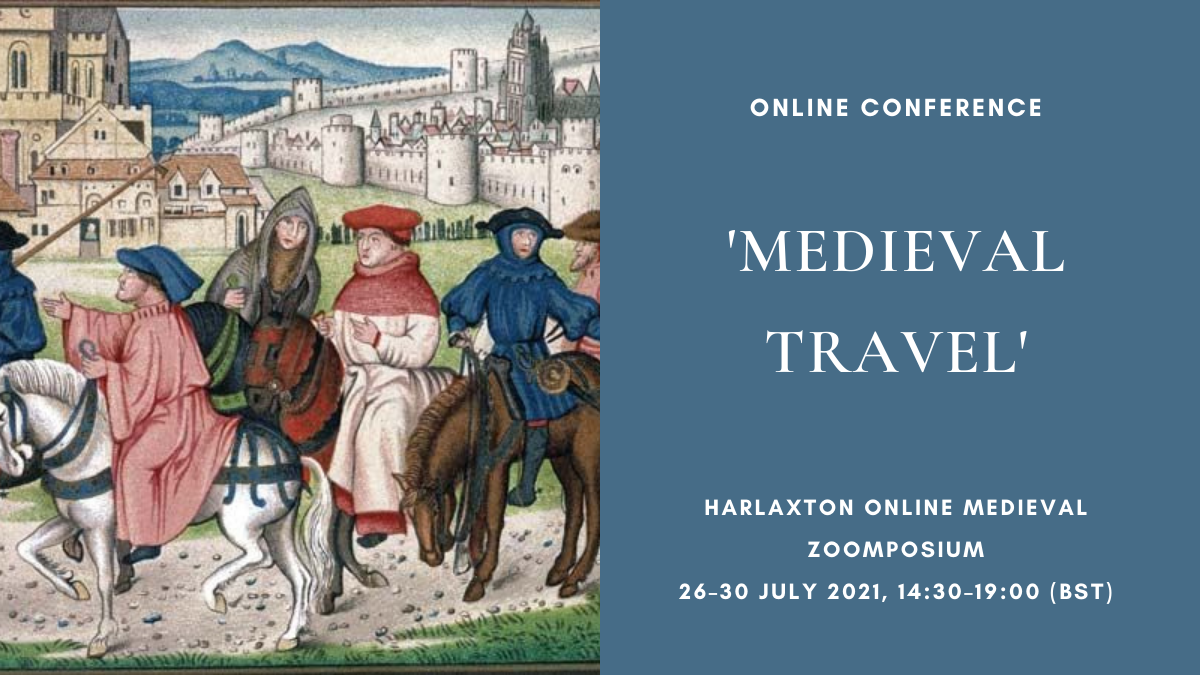
Online Conference: Medieval Travel: Harlaxton Online Medieval Zoomposium, 26–30 July 2021, 14:30–19:00 (BST)

This year’s Harlaxton Medieval Symposium on the theme of Medieval Travel will take place online via Zoom, Monday 26 July – Friday 30 July 2021.

Registration for all five days: £15 (students/unwaged £10)

Get your tickets here.

Find out more here.

Conference Programme

Monday, 26 July 2021:

2.30 – 4.00 PM            Session 1A      Travel Writing

Welcome:  Martha Carlin

  • Martha Driver:  Mandeville in the Twenty-First Century
  • Nicholas Orme: William Worcester: Traveller and Collector

5.00 – 6.30 PM            Session 1B       Images and Travel

  • Lynda Dennison: Travelling Artists and Travelling Books        
  • Nicholas Rogers: Visual Souvenirs of the Emperor Sigismund’s Visit to England in 1416

8.00 – 9.30 PM            Session 1C       Pamela Tudor-Craig Memorial Lecture

Julia Boffey: Richard Arnold’s Book

Tuesday, 27 July 2021:

2.30 – 4.00 PM            Session 2A      Maps

  • Alfred Hiatt: Maps and Travel
  • David Harrison: A Road Map of Medieval England

5.00 – 6.30 PM            Session 2B       Sources for Travel (panel)

  • Robert Swanson: Visitation and Church Court Records
  • Joel Rosenthal: Proofs of Age
  • Joanna Mattingly: Churchwardens’ Accounts
  • David Harrap: Travel Coffers
  • Anthony Gross: Three Travel Objects

8.00 – 9.30 PM            Session 2C       Student posters I

Wednesday, 28 July 2021:

2.30 – 4.00 PM            Session 3A      Inns

  • Martha Carlin: Inns, Horses, and Stabling
  • Laura Wright: Inn Clusters in London in the Fifteenth Century

5.00 – 6.30 PM            Session 3B       Entertainment and Travel

  • Simon Polson: Travelling Minstrels
  • Alexandra Johnston: Travelling Entertainers and Their Patrons: York, 1446-9

8.00 – 9.30 PM            Session 3C       Student posters II

Thursday, 29 July 2021:

2.30 – 4.00 PM            Session 4A      Travel and the Body

  • Carole Rawcliffe: ‘Do not stop at Famagusta’: Travel and Health in the Later Middle Ages
  • Kelcey Wilson-Lee: Travel and Childbirth

5.00 – 6.30 PM            Session 4B       Women Travellers

  • Anthony Bale: Margery Kempe and the Female Traveller in the Later Middle Ages
  • Bart Lambert and Josh Ravenhill: Travelled Women in the Capital: Opportunities for Immigrant Women in London during the Later Middle Ages

8.00 – 9.30 PM            Session 4C       Poster Judging & Book Launch           

  • Judging of student posters
  • Launch of Harlaxton Medieval Symposia volume(s)

Friday, 30 July 2021:

2:30 – 4:00 PM            Session 5A      Travel Wonders

  • Alan Thacker: Travels of St Wulfram
  • Shayne Legassie: Botanical Wonder and Medieval Travel

5:00 – 6:30 PM            Session 5B       Travel and the Exotic

  • Melanie Taylor: In Search of the Exotic: Visual Evidence of Knowledge and Trade in Simians, Birds, and Wingless Dragons
  • Kate Franklin: From Marvels to Motels: Imagined and Infrastructural Worlds of the Silk Road Travel

Final words: Caroline Barron

New Publication: ‘The Enclosed Garden and the Medieval Religious Imaginary’ by Liz Herbert McAvoy

During the Middle Ages, the arresting motif of the walled garden – especially in its manifestation as a sacred or love-inflected hortus conclusus – was a common literary device. Usually associated with the Virgin Mary or the Lady of popular romance, it appeared in myriad literary and iconographic forms, largely for its aesthetic, decorative and symbolic qualities.

This study focuses on the more complex metaphysical functions and meanings attached to it between 1100 and 1400 – and, in particular, those associated with the gardens of Eden and the Song of Songs. Drawing on contemporary theories of gender, gardens, landscape and space, it traces specifically the resurfacing and reworking of the idea and image of the enclosed garden within the writings of medieval holy women and other female-coded texts. In so doing, it presents the enclosed garden as generator of a powerfully gendered hermeneutic imprint within the medieval religious imaginary – indeed, as an alternative “language” used to articulate those highly complex female-coded approaches to God that came to dominate late-medieval religiosity.

The book also responds to the “eco-turn” in our own troubled times that attempts to return the non-human to the centre of public and private discourse. The texts under scrutiny therefore invite responses as both literary and “garden” spaces where form often reflects content, and where their authors are also diligent “gardeners”: the apocryphal Lives of Adam and Eve, for example; the horticulturally-inflected Hortus Deliciarum of Herrad of Hohenburg and the “green” philosophies of Hildegard of Bingen’s Scivias; the visionary writings of Gertrude the Great and Mechthild of Hackeborn collaborating within their Helfta nunnery; the Middle English poem, Pearl; and multiple reworkings of the deeply problematic and increasingly sexualized garden enclosing the biblical figure of Susanna.

407 Pages

23.4 x 15.6 cm; 6 b/w Illustrations

Series: Nature and Environment in the Middle Ages

Imprint: D.S.Brewer

Order and find out more here.

New Publication: ‘Romanesque Tomb Effigies: Death and Redemption in Medieval Europe, 1000–1200’ by Shirin Fozi

Framed by evocative inscriptions, tumultuous historical events, and the ambiguities of Christian death, Romanesque tomb effigies were the first large-scale figural monuments for the departed in European art. In this book, Shirin Fozi explores these provocative markers of life and death, establishing early tomb figures as a coherent genre that hinged upon histories of failure and frustrated ambition.

In sharp contrast to later recumbent funerary figures, none of the known European tomb effigies made before circa 1180 were commissioned by the people they represented, and all of the identifiable examples of these tombs were dedicated to individuals whose legacies were fraught rather than triumphant. Fozi draws on this evidence to argue that Romanesque effigies were created to address social rather than individual anxieties: they compensated for defeat by converting local losses into an expectation of eternal victory, comforting the embarrassed heirs of those whose histories were marked by misfortune and offering compensation for the disappointments of the world.

Featuring numerous examples and engaging the visual, historical, and theological contexts that inform them, this groundbreaking work adds a fresh dimension to the study of monumental sculpture and the idea of the individual in the northern European Middle Ages. It will appeal to scholars of art history and medieval studies.

“This deeply researched and insightful book fills a significant lacuna in the study of medieval sculpture, portraiture, and commemoration. It makes a vital contribution to the field’s ‘material turn,’ bringing together monuments in stone, metal, and stucco to reveal both their distinctive properties and their interconnections. At the same time, Fozi never lets us forget the real human beings these tombs honored or the communities that took pride in and comfort from these depictions.”

Jacqueline E. Jung, author of Eloquent Bodies: Movement, Expression, and the Human Figure in Gothic Sculpture

$89.95 | Hardcover Edition
ISBN: 978-0-271-08719-1

264 pages; 8″ × 10″; 16 color/80 b&w illustrations

Order and find out more here.

Online Event: The Guelph Treasure, Historic Significance & Legal Implications, International Center of Medieval Art, 28 June 2021, 12pm (EST)

A Special Online Event Presented by Friends of the International Center of Medieval Art

Please join the Friends of the ICMA for the second in a series of special online events on Monday, June 28 at 12:00 p.m. ET (9:00 a.m. PT; 5:00 p.m. BST; and 6:00 p.m. WET) with speakers Holger A. Klein, Lisa and Bernard Selz Professor of Medieval Art History, Columbia University, and Leila A. Amineddoleh, Founder, Amineddoleh & Associates LLC. Professor Klein will discuss the historic importance of the Guelph Treasure, a collection of liturgical objects now housed in Germany, Sweden, and U.S. museums. Ms. Amineddoleh will outline the legal cases related to the collection that have been argued in Europe and the U.S., including the U.S. Supreme Court. The moderator for the event will be George Spera, retired counsel at Shearman & Sterling, and former legal advisor to the ICMA.

Please feel free to notify colleagues and friends who may not be ICMA members about this event.

Sign up HERE. All are welcome!

For questions, please contact Doralynn Pines, Chair of the Friends of the ICMA, doralynn.pines@gmail.com.

Online Lecture: ‘Relocating the Holy Places: Jerusalem in Early Medieval Europe’, with Professor Julia Smith, 24 June 2021, 17:30 (BST)

Discover how small portable objects enabled biblical sites to be relocated in Early Medieval Europe. Historian Julia Smith of the University of Oxford will discuss the various uses mobile objects were put to, as well as the significance attributed to them.

Focusing mainly on Jerusalem, Historian Professor Julia Smith will examine the use of these objects within the Holy Land prior to the Arab conquest of 637 and in the Latin West in the centuries before the First Crusade.

Register here.

About the speaker

Professor Julia M. H. Smith took up the Chichele Professorship of Medieval History at Oxford in 2016, having previously held the Edwards Chair of Medieval History at the University of Glasgow. Her current project, Christianity in Fragments: Relics From Constantine to the First Crusade, examines the instrumental use of small material objects in late antique and early medieval Christian practice from a variety of per­spectives, and offers a new analysis of the origin and growth of relic cults.

Her recent publications include essays on relics as “portable Christianity,” on material Christianity in the early medieval household, and a reconsideration of saints’ cults and relics in early medieval Britain and Ireland. Julia has also published on politics, gender, hagiography, and saints’ cults in late antiquity and the early Middle Ages, ca. 300–1100, including The Cambridge History of Christianity III: Early Medieval Christianities, 600–1100 (with Thomas F X Noble, 2008); Europe after Rome: A New Cultural History 500–1000 (2005); Gender in the Early Medieval World: East and West 300–900 (with Leslie Brubaker, 2004); Early Medieval Rome and the Christian West (2000); and Province and Empire: Brittany and the Carolingians (1992).

* * * * * * * * * * * * * * * * * * * * * * * *

Please ensure you use the correct email address as this is where details of the online event will be sent. If you do not provide the correct address, you will not receive the acknowledgement email or ticket.

Online Lecture: ‘Vault Design at Ely Cathedral, Ely’ with Alex Buchanan and Nick Webb, 29 June 2021, 14–15pm (BST)

Some of the most remarkable features of medieval works of architecture, particularly greater churches and cathedrals, are the ribbed vaults spanning their interior spaces. For over nine hundred years, they have inspired worshippers and visitors alike, their eyes drawn heavenwards by these captivating constructions, prompting the question ‘How did they do that?’ No corresponding texts or drawings survive but digital methods now enable us to propose answers.

The Tracing the Past project at the University of Liverpool, funded by the Arts and Humanities Research Council, has spent the past seven years recording and analysing vaults in England. This lecture will introduce the project and share some of its key findings in relation to Ely Cathedral.

Register for a place here.

You might also be interested in the associated workshop. Further details are available here: https://vaultdesignatelycathedralworkshop.eventbrite.co.uk

Recommended for:

Young adults & adults – no prior knowledge necessary.

Language: English

Lecturers: Alex Buchanan and Nick Webb

Lecturers’ Profiles:

Alex Buchanan is an archivist and architectural historian specialising in medieval architecture; Nick Webb is an architect and architectural historian specialising in digital methods. Together they are the investigators on ‘Tracing the Past’, an Arts and Humanities Research Council funded project at the University of Liverpool exploring medieval vaults using digital methods (see www.tracingthepast.org.uk).

Joining the lecture:

The lecture will be delivered via Zoom. You will receive a Zoom workshop link and password to join the workshop after registration. The lecture will start promptly at the given time.

Exhibition: ‘Treasury Objects of the Middle Ages’, Sam Fogg, London, 24 June–30 July 2021

Treasury Objects of the Middle Ages (24th June – 30th July 2021) is the first selling exhibition of its type in more than a century. Devoted entirely to the subject of medieval goldsmiths’ work, it provides a unique survey of the varied types of precious, small-scale metalwork objects that were produced between the 12th and 16th centuries for use in cathedrals, churches, monasteries, and private chapels across Europe. Uniting the forty-five objects in this exhibition are the rich and glittering materials they were produced from – gold, silver, copper and its alloys (brass and bronze), many enriched with meticulous enamelling or studded with large cabochons of polished rock crystal.

Some of these objects would have enjoyed daily use as part of the celebration of Mass: gold and silver chalices for administering the Holy Communion, cast bronze censers for the burning of incense, gilded crosses for carrying in processions or venerating at the altar. But many are so sumptuous that they would have been carefully protected in treasuries for much of their lives and only brought out at particularly significant moments in the year, such as high feast days or even royal visits. Materials were lavished on the most spectacular and refined of them, like gilded reliquaries whose surfaces are enveloped in vivid coloured enamels and have tooled designs worked into the surrounding metal. Others are covered in delicate filigree, micro-architectural structures, or small-scale cast figures of the saints and angels.

Treasury objects were among the most potent bearers of meaning in the Middle Ages. Significance and symbolism were not only entwined with their craftsmanship and materiality, but more importantly also with their perceived sacredness. Many treasury objects protected holy relics, or the body and blood of Christ, but since most people never actually saw the relics or sacraments themselves, these objects came to embody and visualise the magical properties associated with what they contained, or with the miraculous moment of transubstantiation on the altar table. They were often modelled on descriptions of the heavenly Jerusalem, or keyed in to Biblical doctrine through representations of characters from the Old and New Testaments. Powerful, striking, sometimes even intended to shock, treasury objects existed to transport the medieval viewer from the material to the heavenly.

Treasury Objects of the Middle Ages celebrates the ingenuity of the Medieval metalworkers and the astonishing objects of devotion they crafted upwards of half a millennium ago.

Find out more here.

Exhibition opens from 24 June – 30 July 2021

Sam Fogg will also be open on the following weekends: 26 – 27 June & 3 – 4 July 2021

Online Conference: ‘Ora Pro Nobis: Marian Devotion in the Middle Ages and Renaissance’ in honour of Dr Cathy Oakes, The British Archaeological Association, 3 July 2021, 10-17:30 (BST)

An online day in honour of Dr Cathy Oakes

SATURDAY 3 JULY 2021

Cathy Oakes was Director of Studies in the History of Art at Oxford University’s Department of Continuing Education and a Fellow of Kellogg College, Oxford, co-founder of the Centre for Marian Studies, and a lecturer for the Learning Department of the V&A, The Arts Society (formerly NADFAS), Art Pursuits Abroad, ACE, and many other organisations, Dr Oakes inspired countless students by her knowledge of, and passion for, the visual culture of the Middle Ages. This study day is hosted by the British Archaeological Association, of which Cathy was a longstanding member. It will concentrate of various aspects of Marian devotion a subject close to Cathy’s heart and the focus of her book, Ora Pro Nobis: The Virgin as Intercessor in Medieval Art and Devotion (2008), from which this day takes its title.

To register please follow the link below:
https://us02web.zoom.us/webinar/register/WN_JFRhiN9oS7yV_6wE5s8zNg

DRAFT PROGRAMME

SESSION 1. Chair – Sally Dormer

10.00 Introduction

10.05-10.30 William Wykeham’s devotion to Mary – mostly in relation to the glass at New College – Anna Eavis

10.30-10.55 Cult and Image at Our Lady’s Well, Hempsted Gloucestershire) – Sarah Boss

10.55-11.05 Questions

BREAK

SESSION 2. Chair – John McNeill

11.30-11.55 Revisiting the Quinity – the Virgin Mary in Ælfwine’s Prayerbook (London, BL MS Titus D. xxvi and D. xxvii) – Teresa Lane

11.55-12.20 The Lady and the Lion in the Map Psalter (London, British Library, Add. MS 28681) – Sally Dormer

12.20-12.45 The mystery of the Mother of God and her companion in the Homilies of James Kokkinobaphos – Cecily Hennessy

12.45-13.00 Questions

LUNCH BREAK

SESSION 3. Chair – Sarah Boss

14.00-14.25 Metope North 32 on the Parthenon: False Virgins and Cultural Vandals – Steve Kershaw

14.25-14.50 The Reception of Sancta Maria Rotunda: Recent Interpretations and Open Questions – Richard Plant

14.50-15.15 Crowned in Glory: The Virgin Mary enthroned – Eileen Rubery

15.15-15.30 Questions

BREAK

SESSION 4. Chair – Richard Plant

16.00-16.25 The Virgin by the Chapter-House: The life and times of a carved relief at St-Aubin in Angers – John McNeill

16.25-16.50 Imagery and Meaning in Michelangelo’s Bruges Madonna – Paula Nuttall

16.50-17.15 The Virgin Mary in Fragments – Julian Luxford

17.15-17.30 Questions

In memoriam Cathy Oakes, 1956-2019

Online Lecture: ‘Becket: charismatic cathedral & sacred storytelling’ with Professors Paul Binski & Alixe Bovey, British Museum, 30 Jun 2021, 17.30–18.30 (BST)

Becket’s final days, murder, and posthumous career as a miracle-worker are among the best-documented episodes from the Middle Ages.

This conversation, between art historians Paul Binski and Alixe Bovey, will explore the way Becket’s universality as a martyr was embodied in the architecture of Canterbury Cathedral, evoking the heroic age of early Christian martyrdom. 

As the objects in the exhibition Thomas Becket: murder and the making of a saint reveal, Becket’s story was codified in word and image with extraordinary speed, in England and across Europe. What was the role of images and objects in promoting Becket’s cult, and how and why did Becket’s cult so rapidly come to define its age?

To attend this event

Book now(Opens in new window) to secure your place. We’re hosting the event on Zoom – a free video conferencing system that requires users to register in advance. If you do not already use Zoom, you can sign up using this registration link(Opens in new window).

If the event is fully booked, or you do not wish to use Zoom, you can also watch the event streamed live – as well as other events in the series – on the Museum’s live events YouTube channel(Opens in new window).

Register for your place here.

About the speakers

Paul Binski is Emeritus Professor of the History of Medieval Art at Cambridge University and a Fellow of Caius College. He writes widely on the visual arts in the Middle Ages, and his many books include Becket’s Crown: Art and Imagination in Gothic England, 11701300 (Yale University Press 2004).

Professor Alixe Bovey is a Canadian medieval art historian. She’s currently Dean and Deputy Director and the Head of Research at the Courtauld Institute of Art, London University. Bovey is also a member of the Fabric Advisory Committee of Canterbury Cathedral.

New Publication: ‘Images and Indulgences in Early Netherlandish Painting’ by Miyako Sugiyama

This book demonstrates the relationships between images and indulgences in fifteenth- and early sixteenth-century Netherlandish art. In the Roman Catholic Church, indulgences served as a way to reduce temporal punishment in purgatory for one’s sins. Indulgences could be obtained by reciting prayers and performing devotional practices. Penitents could earn this type of devotional indulgence with the aid of paintings and other artifacts that possessed theological, historical, and aesthetic values as well as performative and promissory ones. In this study, we explore not only the power of indulgenced images but also the power of their audiences, creating a way to communicate with the divine.

Miyako Sugiyama is an art historian specializing in early Netherlandish art. She received her Ph.D. in Art Science from Ghent University in 2017. She was the recipient of a Flemish government scholarship (2013–14), a Kress Foundation Travel Grant (2016), and a Japan Student Services scholarship (2015–17). She is currently a postdoctoral researcher at the Japan Society for the Promotion of Science, Tokyo. Her research focuses on the functions of images and the relationships between art and devotional practices in the Netherlands in the fifteenth and early sixteenth centuries.

Harvey Miller: Distinguished Contributions to the Study of the Arts in the Burgundian Netherlands (HMDC)

IV+193 p., 10 b/w ill. + 126 colour ill., 220 x 280 mm, 2021
ISBN: 978-1-912554-58-4
Languages: English
Retail price: EUR 50,00 excl. tax

Order and find out more here.