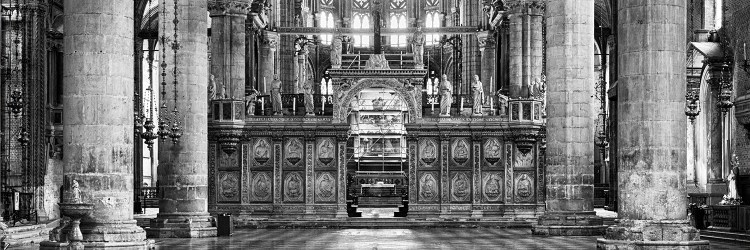
The church was a highly meaningful site for pre-Modern European society. As architectural sites accessible to all strata of society, church buildings provided contexts for interaction between social classes and genders, and settings for a wide variety of religious and non-religious activities. From an art-historical perspective, the vast majority of artworks produced in the medieval and Renaissance periods was intended for the many chapels, altars and screens in the church interior.
Yet, despite the obvious importance of these sites, the spatial dispositions of church interiors – and how they evolved over time – are still little-understood. Centuries of restorations and adaptations have radically transformed the appearance and usage of church interiors: screens have been removed; altars shifted position; new liturgical furnishings installed; fresco decoration whitewashed; and seating added or taken away.
Scholars studying the church interior seek to reconstruct the meaning, functions and visual appeal of these sacred spaces. The Society for the Study of the Church Interior seeks to promote this holistic and interdisciplinary approach to researching historic church buildings.
Who are we?
We are a group of scholars who are interested in the material culture, spatial dynamics and multifarious functions of the church interior in the Medieval, Renaissance and Baroque periods. We are mainly based in the US, Germany, Italy and the UK, but welcome members from around the world.
Primarily focused on pre-Modern Italy, we are interested in reconstructing aspects of individual churches, but also in broader issues associated with large-scale changes to architectural layouts generally associated with religious reform. In addition to purely art-historical inquiry, we investigate the religious, political or practical motivations behind transformation campaigns and the effects such changes had on the use of church buildings.
What do we do?
Studying the church interior presents complex challenges for the historian, given that documentary, archaeological and material sources can be fragmentary or even contradictory. Our research involves the analysis of several types of primary and secondary source material, which may include:
- Original archival documentation such as payments, contracts, testaments, etc
- Liturgical texts
- Official records of Visitations conducted by bishops and other clergy
- Historic ground plans
- Antiquarian guidebooks
- Modern restoration records
- Material evidence of surviving architecture
- Archaeological reports
- Provenance of objects such as altarpieces and liturgical furnishings
What are the activities of the Society?
The Society promotes broader engagement with the study of the church interior, disseminates research findings and fosters an academic community of like-minded scholars.
In the future, we hope to organize sessions and meetings at major conferences such as the Renaissance Society of America Annual Meeting.
We are also in the process of establishing an online, collaborative database to collect data on the church interior. Initially concentrating on Italy, where the impact of the Counter Reformation was particularly strong, the database will reveal the broad patterns and chronologies which are currently beyond the grasp of the individual researcher. Members of the Society who wish to contribute to the database will receive a login to access it: please email Joanne or Michael if you are interested.
Sign up for the mailing list here.
 Collecting Ancient and Medieval art attracts both academic and public curiosity because the objects (and structures) in question are not only often extremely rare, but also have fascinating histories. The ability to possess a piece of our past has allowed collectors throughout the centuries to create a continuity between that past and their present. This conference will explore the history of Ancient, Byzantine and Medieval collections, how they were originally formed, how objects survive and in what contexts, and how certain collections themselves live on. It will also address how the collections of the past may be reflected in the way that we approach collecting today, the theoretical and the historical framework of collections, how they are currently presented, as well as some of the controversies in the field. Equally, the problems and issues underlying the collecting of Ancient and Medieval art, and the knowledge required to authenticate them will be discussed. Speakers include: Maeve O’Donnell-Morales, Zoe Opacic, Emily Guerry, Amy Smith, Peter Toth, Amy Jeffs, Anna Kelley, Michael Carter, Naomi Speakman, and Claudio Corsi.
 Important Update
 This International conference will be devoted to Medieval Pantheons. The main aim is to promote a broad and innovative debate on the concept of “pantheon” throughout the Middle Ages, as well as their underlying intentions. It is also intended to address the specificity of themes that are intertwined with the construction, ornamentation and everyday uses of these spaces by the communities that host them.


 What is the study of the church interior?

 Medieval Art Research