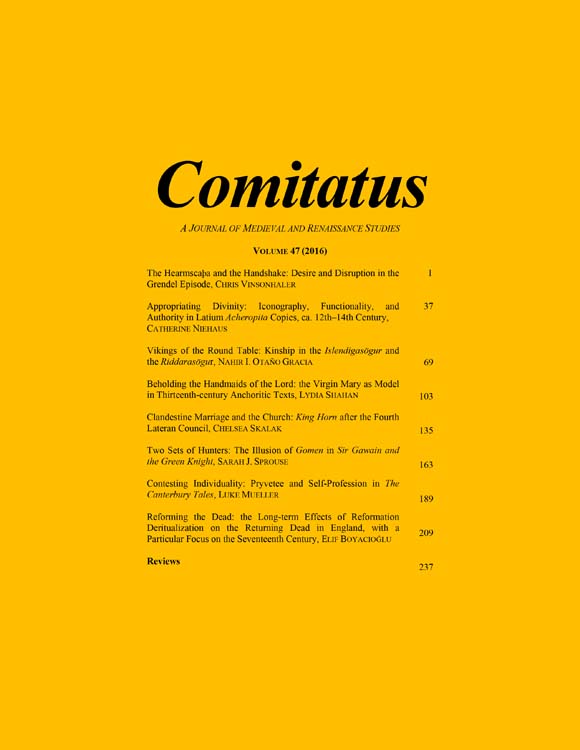
COMITATUS: A JOURNAL OF MEDIEVAL AND RENAISSANCE STUDIES,
published annually under the auspices of the UCLA Center for Medieval and Renaissance Studies, invites the submission of articles by graduate students and recent PhDs in any field of medieval and Renaissance studies.
Submissions should be sent as e-mail attachments in Word format.
SUBMISSION DEADLINE FOR VOLUME 48 (2017): 1 FEBRUARY 2017.
The Comitatus editorial board will make its final selections by early May 2017.
Please send submissions to Dr. Blair Sullivan, sullivan@humnet.ucla.edu.
Layers of Parchment, Layers of Time: Reconstructing Manuscripts: 800 – 1600 is an interdisciplinary conference that will explore various issues surrounding the complex subject of manuscripts whose parts have become dislodged and subsequently had diverging histories. Our goal is to foster dialogues—between different disciplines—on how to approach dismembered manuscripts from intellectual and practical perspectives.
We will compose panels thematically, grouping papers by geographical and temporal subject rather than by academic discipline. We encourage submissions from scholars, post-graduate students, and professionals in art history, palaeography/codicology, manuscript studies and conservation, digital humanities, history, museum studies, and beyond. Suggested topics include, but are by no means limited to:
The manuscript as an object made in layers over time
Digital reconstruction of manuscripts
New approaches to understanding reception
Methodologies for tracing lost/stolen fragments and leaves
Methodologies for reconstructing manuscripts
Economic, political, and legal consequences of reconstructing manuscripts
Reconstructed manuscripts in their original contexts
Modern methods of preservation for loose fragments/leaves
The art market as a means for fragment/leaf distribution
The role of collectors (public institutions and private individuals)
We intend to publish the proceedings from the conference in either a journal, or as a stand-alone anthology.
Papers will be scheduled for 20 minutes. Please email your abstracts, of no more that 300 words to Dr. Kathryn Rudy and Stephanie Azzarello at reconstructing.mss.cambridge@gmail.com by 1 February 2017. Along with your abstract please include your name, institution, paper title and brief biography. We strongly encourage you to consider your paper as a performance, rehearse it well, and to avoid reading directly from the page, if possible. Successful applicants with be notified by 10 February 2017. Layers of Parchment, Layers of Time: Reconstructing Manuscripts will take place at the University of Cambridge, Pembroke College, with a dinner to follow.
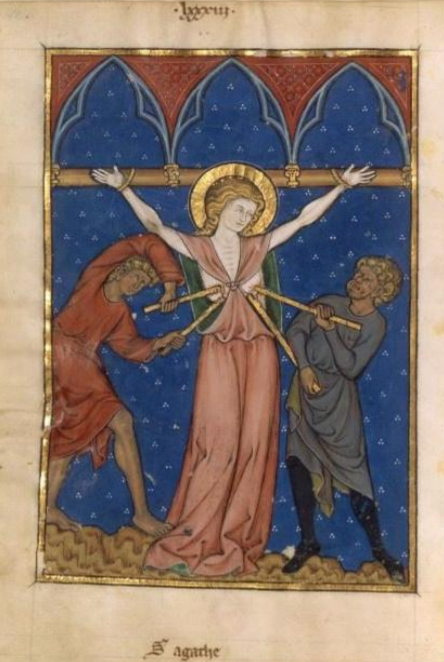
Holy women were represented on a variety of media, starting with manuscript illuminations, ending with frescoes, or textually-constructed and re-constructed in order to fit religious and/or political purposes, according to time and space(s). They imprinted their imagery on the social-cultural milieu of the Middle Ages as brides of Christ, virgin martyrs, or penitents, suggesting that medieval female sanctity is a multifaceted phenomenon. This volume intends to develop these concepts further in order to reconsider and redefine female holiness from a transdisciplinary perspective.
We welcome papers for the volume to be titled “Set Me as a Seal Upon Thy Heart.” Constructions of Female Sanctity in the Middle Ages.
Aiming to reflect recent research on the construction(s) of female holiness, we call for original manuscripts focusing on (but not limited to) the following topics:
Textual sources; text circulation and manipulation
Image-text relationship
Arts/visual culture and architecture
Thematic connections
Donors and audience
Cultural/religious constructions
Submission Guidelines:
Papers should be written following the template and guidelines found at http://www.trivent-publishing.eu and should have between minimum 7 and maximum 20 pages.
Dates and deadlines
Manuscript Submission March 20, 2017
Decision Notification May 8, 2017
Final Manuscript Submission June 12, 2017
Estimated Publication Date September 2017
* We kindly ask all prospective authors to send their intent of submitting a paper for this volume to publishing@trivent-publishing.eu by February 1st, 2017
The volume will be published open access. It will be listed in CEEOL, Directory of Open Access Scholarly Resources, SSOAR, DOI, and will be sent for evaluation in the Book Citation Index of Thomson Reuters.
For information and queries on the scientific content of the volume, please contact the editor of the volume, Andrea-Bianka Znorovszky, znorovszky_a@auca.kg
The book aims at challenging the current limits within the field of research related to English alabasters, in order to establish a new model of study. Over the last century many studies on English alabasters have been published, including exhibition catalogues, list of documents and archival sources, catalogues raisonnés of the most important collections. All these studies have marked key points in the scholarly approach to English alabaster carvings, but they have also imposed a stubbornly curt historiographical perspective. Indeed, these publications have mainly been focused on specific collections -e.g. Frances Cheetham’s Medieval English alabaster carvings in the Castle Museum of Nottingham (Nottingham, 1973)-, and have thus provided only a partial view on that artistic phenomenon. They ended up isolating English alabasters from their historical and cultural context. In addition, as Susan Ward has pointed out in her review to Frances Cheetham’s Alabaster Images of Medieval England (Speculum, 2006), these publications’ main focus was often traditional: their bulks describe the standard subject matters found in the alabasters (e.g. the Passion of Christ, the Life of the Virgin and the saints) and explain the literary sources of that subject matter in a sometime too basic way. The authors tend to isolate the pieces from their wider historical framework, lacking to consider the character of piety in late-medieval England, and failing to consider the sculptures from a comprehensive historiographical point of view.
The book aims at setting the study of English alabasters on a new footing, which results from the influence of previous scholarship but, at the same time, reacts against it and is finally capable to establish a different approach.
Possible themes and subjects could address, but are not limited to one of the following topics
Alabaster altarpieces: function and design
Alabasters in pre/post Reformation England
Centres of productions, Trade routes
Workshop practices (Collaborations and Co-creations; Process and Method; Marks and Inscriptions; Archival records)
Reception of alabasters abroad; Possible adaption to local practices/taste
Patronage
Paraliturgical Dramas
Distinctions between rural/urban churches
Alabaster tombs
Papers will be collected in a volume to be published by the end of next year (2018), entitled English Alabaster Sculptures in Context: Art, History and Historiography. Submission: Please send an abstract of your proposed contribution (ca. 300 words) and a short CV to the editor: zuleika.murat@unipd.it.
Christie’s Education is delighted to announce the first of our Antiquity to Renaissance Evening Lecture series. This lecture programme is arranged to support the study and understanding of arts from Antiquity to the Middle Ages and Renaissance. It is organised by the Art and Collecting: Antiquity to Renaissance department.
Dr Niamh Bhalla will present “Mapping Otherworldly Spaces in the Late Medieval World.” She was Visiting Lecturer at The Courtauld Institute of Art. Her research focuses on using contemporary theory to open up fresh insights into how classical, byzantine and medieval images were experienced. Dr Bhalla has also been the project coordinator for the Getty-supported research project, Crossing Frontiers: Christians and Muslims and their art in Eastern Anatolia and the Caucasus at the Courtauld Institute.
The lecture will be followed by a drinks reception.
Saturday 4 February 2017
10:00 am – 6:00 pm
Kenneth Clark Lecture, The Courtauld Institute of Art, Somerset House, Strand, London WC2R 0RN,
The traditional art-historical concern of attribution of works of art to specific masters has given way to more nuanced approaches to the artistic production of the Middle Ages that focus on collaborative working practices. Collaborations like that of Simone Martini and Lippo Memmi, the illuminators of the Winchester Bible, or the creators of Opus Anglicanum reveal a complex picture of artistic co-operation. Notions of the single commanding master have been replaced with collaborative artisan activity across disparate media, from the early-medieval cloister to the increasing specialisation of the late-medieval shop.
The Courtauld Institute’s 22nd Annual Medieval Postgraduate Colloquium invites speakers to consider new approaches to artistic collaborations of the Middle Ages, and how conceptions of collaboration have impacted on the study of these works.
The Medieval Postgraduate Colloquium offers the opportunity for research students at all levels from universities across the UK and abroad to present and promote their research.
Organised by Meg Bernstein (The Courtauld Institute of Art Kress Fellow 2015-7 / University of California, Los Angeles) and Imogen Tedbury (The Courtauld Institute of Art / National Gallery) with the generous support of The Sackler Research Forum.
Programme
09.30 – 10.00 Registration
10.00 – 10.10 Welcome
Session 1: Networks in collaboration. Chaired by Sophie Kelly (University of Kent)
10.10 – 10.30
Maeve O’Donnell-Morales, The Courtauld Institute of Art
It Took a Village: Collaborations at the Medieval Altar between Donors, Artists and Clerics
10.30 – 10.50
Aude Chevalier, Paris Nanterre Université
Collaborations in medieval copperware craftsmanship: the case study of French copper alloy censers (11th-17th centuries)
10.50 – 11.10
Maggie S. Crosland, The Courtauld Institute of Art
Commission as Collaboration: Untangling Agency in the Book of Hours of Philip the Bold
11.10 – 11.30
Discussion
11.30 – 12.00
TEA / COFFEE BREAK
Session 2: Artists in collaboration. Chaired by Lydia Hansell
12.00 – 12.20
Eowyn Kerr-Di Carlo, The Courtauld Institute of Art
Santa Maria degli Angeli or not? Considering Florentine artistic networks and the painter-illuminators of Fitzwilliam MS 30
12.20 – 12.40
Eleonora Cagol, Technische Universität Dresden
The workshop of Jörg Arzt and Jörg Feiss: winged altarpieces as evidence of artistic collaboration in South Tyrol at the end of the Middle Ages
12.40 – 13.00
Bryan C. Keene, The J. Paul Getty Museum / The Courtauld Institute of Art
Pacino / Pacinesque: Collaborative Choir Book Commissions in Early Trecento Florence
13.00 – 13.20
Discussion
13.20 – 14.30
LUNCH (speakers only)
Session 3: Collaborating across media. Chaired by Teresa Lane
14.30 – 14.50
Ella Beaucamp, Ludwig-Maximilians-University Munich
A joint venture from Venice: Medieval rock-crystal miniatures
14.50 – 15.10
Marie Quillent, University of Picardy Jules Verne
Artistic Collaboration in Medieval Funeral Sculpture in the North of France: the Tomb of Adrien de Hénencourt in the Cathedral of Amiens
15.10 – 15.30
Amanda Hilliam, National Gallery / Oxford Brookes University
Carlo Crivelli and the Goldsmith’s Art: shared aesthetics and technologies
15.30 – 15.50
Discussion
15.50 – 16.20
BREAK
Session 4: Collaborating across time. Chaired by Miguel Ayres DeCampos
16.20 – 16.40
Esther Dorado-Ladera, Independent Scholar
Reuse of Hispanic Muslim architecture during the Middle Ages: Christian interventions in the Aljaferia Palace
16.40 – 17.00
Oliver Mitchell, The Courtauld Institute of Art
Collaboration and conflict in Hugo de Folieto’s Liber de rotae religionis et simulationis
17.00 – 17.20
Costanza Beltrami, The Courtauld Institute of Art
Building and rebuilding the cloister of Segovia Cathedral (1436-1530): collaborations across space and time
17.20 – 17.50
Discussion
17.50 – 18.00
Closing remarks: Joanna Cannon (The Courtauld Institute of Art)
Conference: Reconsidering the Concept of Decline and the Arts of the Palaiologan Era
University of Birmingham
24-25 February 2017
This one day and a half conference combines a symposium and a workshop. The aim is to examine and contextualise the artistic and cultural production of the geopolitical centres that were controlled by or in contact with the late Byzantine Empire. This conference will explore the many intellectual implications that are encoded in the innovative artistic production of the Palaiologan Era often simplified by a rigid understanding of what is Byzantine and what is not.
24 Feb 2017 – 1st day 14.00-14.10 – Opening remarks: prof Leslie Brubaker, University of Birmingham 14.10-15.00 First Keynote lecture and discussion: Dr Cecily Hilsdale, McGill University, Title TBC 15.00-16.00 First panel – Chair Dr Ruth Macrides, University of Birmingham
Ivana Jevtic: Late Byzantine Painting Reconsidered: Art in Decline or Art in the Age of Decline?
Andrew Griebeler: The Greek Botanical Albums in Late Byzantine and Early Ottoman Constantinople
Maria Alessia Rossi: Political ruin or spiritual renewal? Early Palaiologan art in context 16.00-16.20 Discussion 16.30-16.50 Coffee break 17.00-17.50 Second Keynote lecture and discussion: prof Niels Gaul, University of Edinburgh: Palaiologan Byzantium(s): East Rome’s Final Two Centuries in Recent Research 18.00-19.00 Reception
25 Feb 2017 – 2nd day 9.00-9.50 Opening keynote lecture and discussion: Dr Angeliki Lymberopoulou, Open University, Palaiologan art from regional Crete: artistic decline or social progress? 10.00 -10.40 Second panel – Chair Dr Daniel Reynolds, University of Birmingham Anđela Gavrilović: The Stylistic Features of the Frescoes of the Church of the Mother of God Hodegetria in the Patriarchate of Peć (c. 1335-1337)
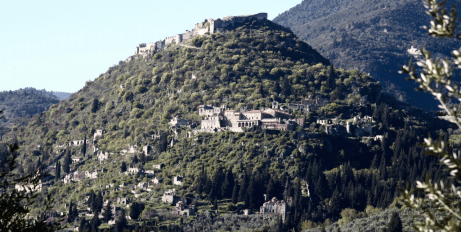
Ludovic Bender: Mistra and its countryside: The transformation of the late Byzantine religious landscape of Laconia 10.40-11.00 Discussion 11.00-11.20 Coffee break 11.30-12.30 Third Panel – Chair Dr Francesca Dell’Acqua, University of Birmingham Andrea Mattiello: Who’s that man? The perception of Byzantium in 15th century Italy
Tatiana Bardashova: Palaiologan Influence on the Visual Representation of the Grand Komnenoi in the Empire of Trebizond (1204-1461)
Lilyana Yordanova: The Issues of Visual Narrative, Literary Patronage and Display of Virtues of a Bulgarian Tsar in the Fourteenth century 12.30-12.50 Discussion 13.00-14.00 Lunch break
Workshop 14.10-14.50 Two 10-mins presentations by MA students and 20-mins discussion 14.50-15.30 Two 10-mins presentations by MA students and 20-mins discussion 15.40-16.00 Coffee break 16.10-16.50 Two 10-mins presentations by MA students and 20-mins discussion 16.50-17.00 Closing remarks: Andrea Mattiello/Maria Alessia Rossi
The programme, further information and details of how to book can be found at:
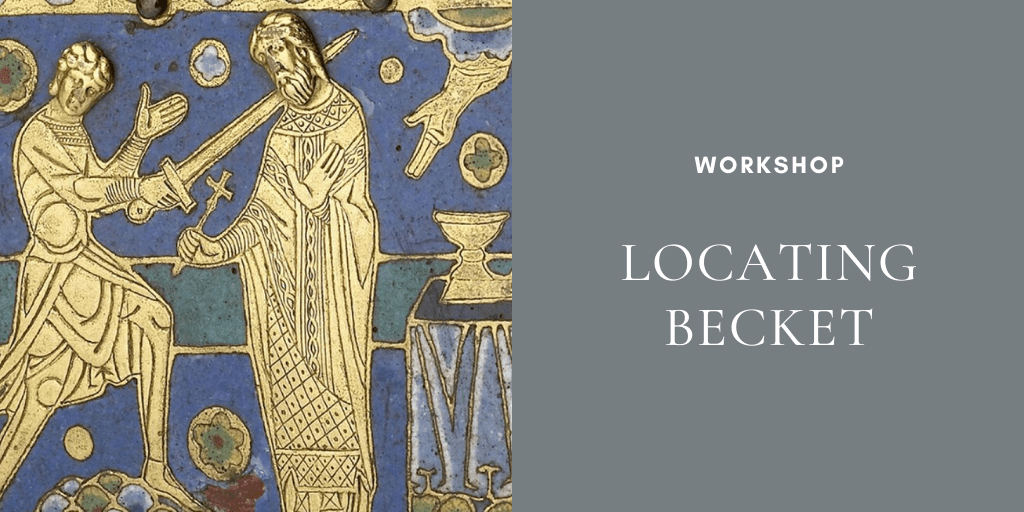
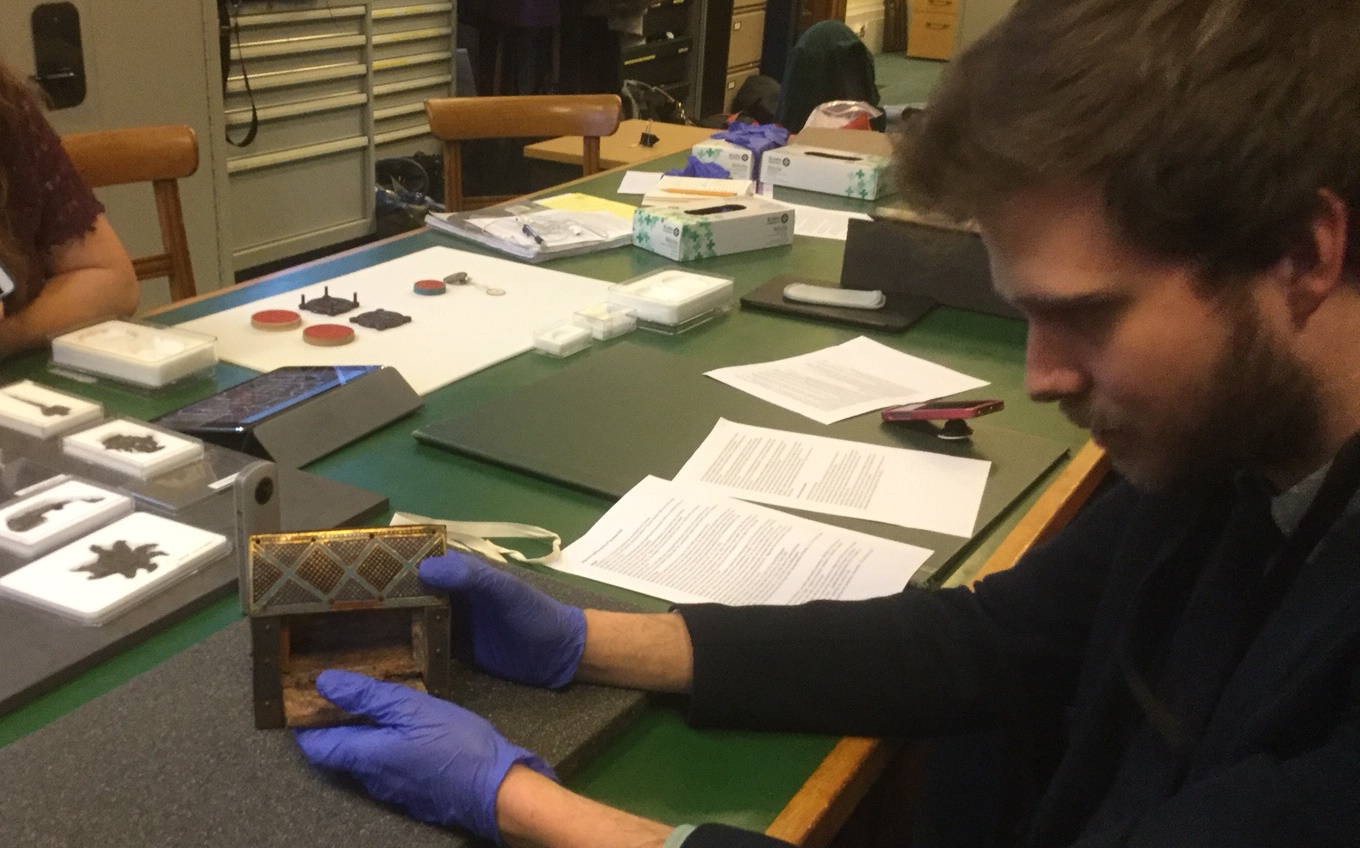
How can the life and cult of Thomas Becket be traced through material culture? This was the question at the heart of the ‘Locating Becket’ workshop, sponsored by CHASE, and held at the British Library, British Museum and Courtauld Institute of Art on Tuesday 6th December 2016. Curators and scholars gathered first at the British Library to examine a number of manuscripts connected to Becket’s life and cult, including Cotton Claudius B II, with the earliest representation of Becket’s martyrdom (below). This fairly stable iconography could be followed in later manuscripts, including the (very bloody) Huth Psalter (Add MS 38116 ), a 15th-century Book of Hours from Rouen (Harley 1251), and in two seals attached to Ch. 17353 and Harley Ch. 44 C 33.
Becket’s martyrdom, from Alan of Tewkesbury’s letters, British Library Cotton MS Claudius B II, late 12th century. Image in the public domain.
An early collection of Becket’s miracles was also examined (Egerton MS 2818), as well as the early fourteenth-century ‘memorandum book’ of Prior Henry Eastry (Cotton Galba E. iv), which includes an inventory of Prior Eastry’s interventions, an extensive inventory of the sacristy, and an inventory of the library. Finally, we looked at the early fifteenth-century customary of Becket’s shrine (Additional 59616), with extensive instructions for the celebration of his feast days, which is bound together with two copies of his lives which seem to have been kept at the shrine and read to pilgrims.
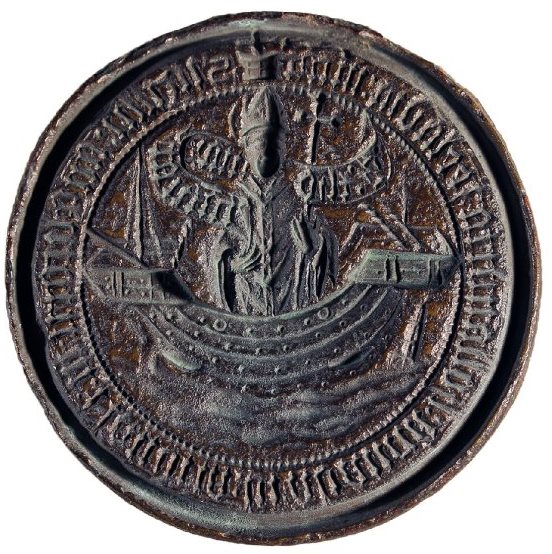
The afternoon was spent looking at the British Museum’s extraordinary collection of pilgrims’ badges, ampullae, reliquaries and other objects related to Becket, including the impression of the 15th-century seal of the Mercers Company (below), which shows Becket on a ship, returning from exile.
Impression of a Mercers’ company seal matrix, after 1462
Below is a full list of the objects consulted at the British Museum:
Badges 1836,0610.32, ca. 1320-1450, Becket bust, purchased from Cureton.
1855,0804.70, ca. 1250-1350, Becket contained within a T, found Thames 1845, previous owner Chaffers, then Cureton.
1855,0724.5, head of Becket between two raised swords contained within an octofoil frame, ca. 1320-1450. Purchased from William Edwards.
1856,0701.2036, ca. 1300-1350, bust of Becket between a nine point star, inscription SANCTVS.THOMAS, found 22nd August 1850, purchased Charles Roach Smith.
1856,0701.2031 and 2032, two badges in the form of Becket’s bust, ca. 1320-1450, purchased Charles Roach Smith.
1856,0701.2039, ca. 1350-1400, four embossed fleur-de-lis in the form of a quatrefoil around a central boss, inscription SANTE.THOMA.OR.P.M., purchased Charles Roach Smith, previous collection Edward Wigan.
1868,0904.39, badge in the form of a kind of ship known as a cog, ca.1350-1400, donated by Franks.
2001,0702.1, Becket’s bust reliquary, ca. 1320-1375, found Billingsgate.
OA.1817, decorative sword sheath (referring to the relic of the sword tip) with Fitz Urse coat of arms, ca. 1350-1450.
2001,0702.2, Becket riding a peacock, ca. 1250-1350, found Thames Exchange.
Ampullae
1891,0418.21, ampulla with circular openwork tracery. The obverse of the ampulla is embossed with the standing figure of St Thomas Becket in a bishop’s mitre and chasuble, with an equal-armed cross standing out from his breast. The reverse bears a representation of his martyrdom with Becket kneeling in the centre, inscription OPTIMUS EGRORVM.MEDICVS.FIT.THOMA.BONORVM, ‘May Thomas be the best doctor of the worthy sick’, ca. 1220-1420.
1896,0501.69, the front of the ampulla depicts the standing figure of St Thomas Becket in mitre and chasuble, making a gesture of benediction and holding a crosier. The reverse shows the scene of his martyrdom with one knight faced by a kneeling Becket. The frame is filled with openwork decoration of symmetrical sexfoil and fleur-de- lis motifs and a representation of the front- and back-view of a seated Becket, depicted in episcopal garb, enclosed within a roundel. Inscription, REGENAKDVS.FILIVS HVRS:THOMAS:MARTIRIVM:FECE:FR., ‘Reginald Fitz Urse brought to pass the Martyrdom of Thomas’, donated by Franks.
2001,0702.3, chasse shaped ampulla, ca. 1250-1350, found Billingsgate.
2001,0702.6, ship-shaped ampulla (referring to Becket’s return from exile) with a high relief representation of Becket, ?ca. 1170-1250, found Billingsgate.
Seals
1880,0624.1, impression of Mercer’s company seal matrix, showing a half-figure of St Thomas of Canterbury in a ship, inscriptions, ‘sigillu : anglicor in flandria : brabancia : hollandria: zeeladia : m’cat’ and ‘s. thomas catuar’, after 1462, found Harrow.
1913,1105.3, Langdon Priory seal matrices. On the obverse is a Virgin and Child seated in a canopied niche on a corbel. On the reverse is a scene of the Martyrdom of St Thomas in Canterbury Cathedral. 13th century. Inscriptions, ‘SIGILL’ . COMMVNE MONASTERII: ECCE: DE MARIE: DE: LANGEDON’ and ‘CAVSA: DOMVS: XPI: MORTEM: SIC: IRTVLIT ISTI’.
1981,1103.1, Seal-matrix: Warden of Greyfriars at Canterbury. Inscription, ‘SIG GARDIANI FRUM MINORU CANTUARIE’. Ca. 1330-1350.
Reliquaries and other objects
AF.2765, Reliquary pendant showing on the observes John the Baptist and possibly Thomas Becket on the reverse. Inscription, ‘A MON + dERREYNE’. Late 15th century, found Devizes.
1878,1101.3, Chasse depicting the martyrdom of Becket, ca. 1210, donated by Meyrick, previous collection Douce.
1852,0327.1, Henry of Blois plaques, made possibly in England, ca. 1150-1171. Inscriptions:
+ MVNERA GRATA DEO PREMISSVS VERNA FIGVRAT. ANGELVS AD CELVM RAPIAT POST DONA DATOREM;. NE TAMEN ACCELERET NE SVSCITET ANGLIA LVCTVS, CVI PXA VEL BELLVM MOTVSVE QVIESVE PER ILLUM (= ‘The aforementioned slave shapes gifts pleasing to God. May the angel take the giver to Heaven after his gifts, but not just yet, lest England groan for it, since on him it depends for peace or war, agitation or rest.’) + ARS AVRO GEMMISQ (UE) PRIOR, PRIOR OMNIBVS AVTOR. DONA DAT HENRICVS VIVVS IN ERE DEO, MENTE PAREM MVSIS (ET) MARCO VOCE PRIOREM. FAME VIRIS, MORES CONCILIANT SUPERIS. Also inscribed within the scene, HENRICUS EPISCOP (‘Art comes before gold and gems, the author before everything. Henry, alive in bronze, gives gifts to God. Henry, whose fame commends him to men, whose character commends him to the heavens, a man equal in mind to the Muses and in eloquence higher than Marcus [that is, Cicero].’)
1854,0411.2, enamelled casket depicting the murder of Becket, 13th century, purchased from William Forrest.
1890,0809.1, alabaster panel showing the murder of Thomas Becket,
Prints and Drawings
1973,0512.3.2, Ecclesiae Anglicanae Trophaea, Plate 2: the Trinity surrounded by angels in the upper section; two bishops in brocaded cloaks in the lower section, after Niccolò Circignani, etching.
1973,0512.3.25, Ecclesiae Anglicanae Trophaea, Plate 25: the martyrdom of St Thomas, archbishop of Canterbury, the saint kneeling before the altar, about to be martyred by a group of soldiers with swords; scene separated from the background by a balustrade with balusters; St Thomas named archbishop by Henry II at far left; saint kneeling before Pope Alexander III seated on a throne, accompanied by two male attendants at far right, etching.
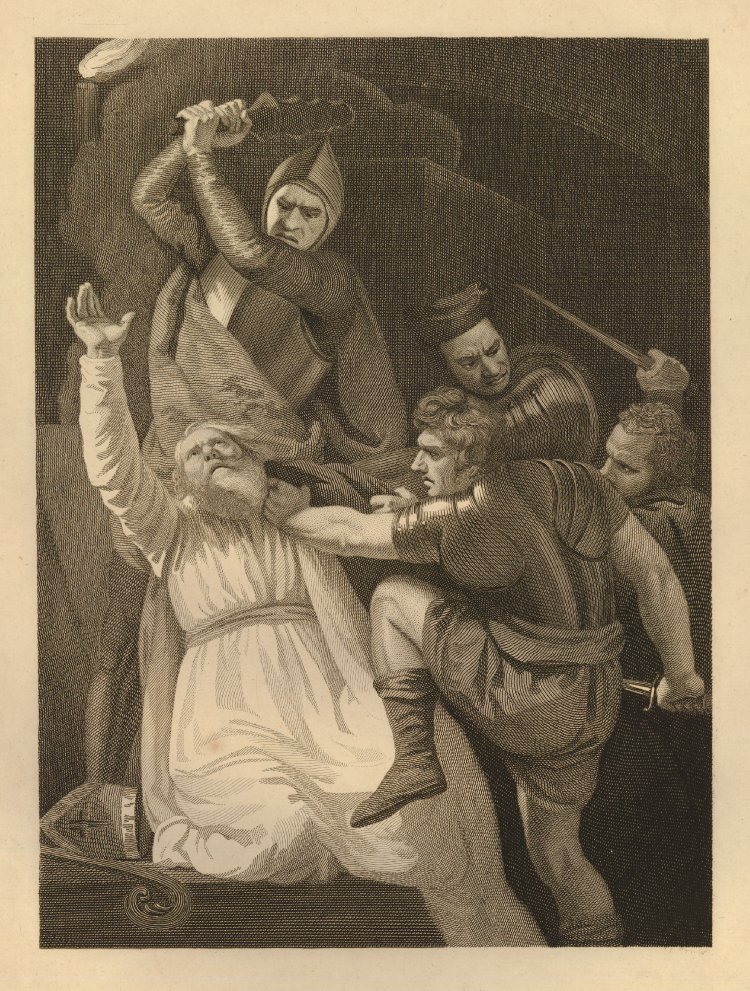
Illustration to Bowyer’s edition of Hume’s History of England, 1793
1853,1210.383, Illustration to Bowyer’s edition of Hume’s History of England; the assassination of Thomas Becket, wrestled to his knees by a gang of four knights, one raising a bludgeon above him, his mitre and staff fallen at left. 1793, etching and engraving.
1856,0607.15, Portrait of Thomas Becket, head and shoulders to left, with hands joined in prayer, wearing ecclesiastical robes, a sword wedged in his skull. 1647, etching.
Call for Papers: Conference: Bishops’ Identities, Careers and Networks Centre for Scandinavian Studies, University of Aberdeen 26 May and 27 May 2017
Bishops were powerful individuals who had considerable spiritual, economic and political power. To be a bishop was to be a leader who might crown kings or foment rebellion. So who became bishops? What were their family backgrounds, educational attainment, social networks? What was the impact of international Church events such as the Great Schism or the Council of Basle on the types of bishop appointed in individual dioceses?
The aim of this two-day conference, funded by an AHRC Early Career Research Grant, is to stimulate discussion on how individuals achieved a bishopric in Europe, including Scandinavia and the British Isles. An edited volume is the planned outcome for the conference.
Topics for the conference include, but are by no means limited to:
Family origins
Education
Pre-episcopal careers
Social networks
Spiritual networks
Political networks
the centralisation of the Papacy
international Church events
Diocesan patrons
Election of bishops
We invite proposals between 250-300 words for individual 20 minute papers relating to the conference theme. Please send abstracts to bishopscareersnetworks@gmail.com.
Please send abstracts by Friday 27th January 2017.
Please direct any queries to Sarah Thomas and Michael Frost at bishopscareersnetworks@gmail.com.
 COMITATUS: A JOURNAL OF MEDIEVAL AND RENAISSANCE STUDIES,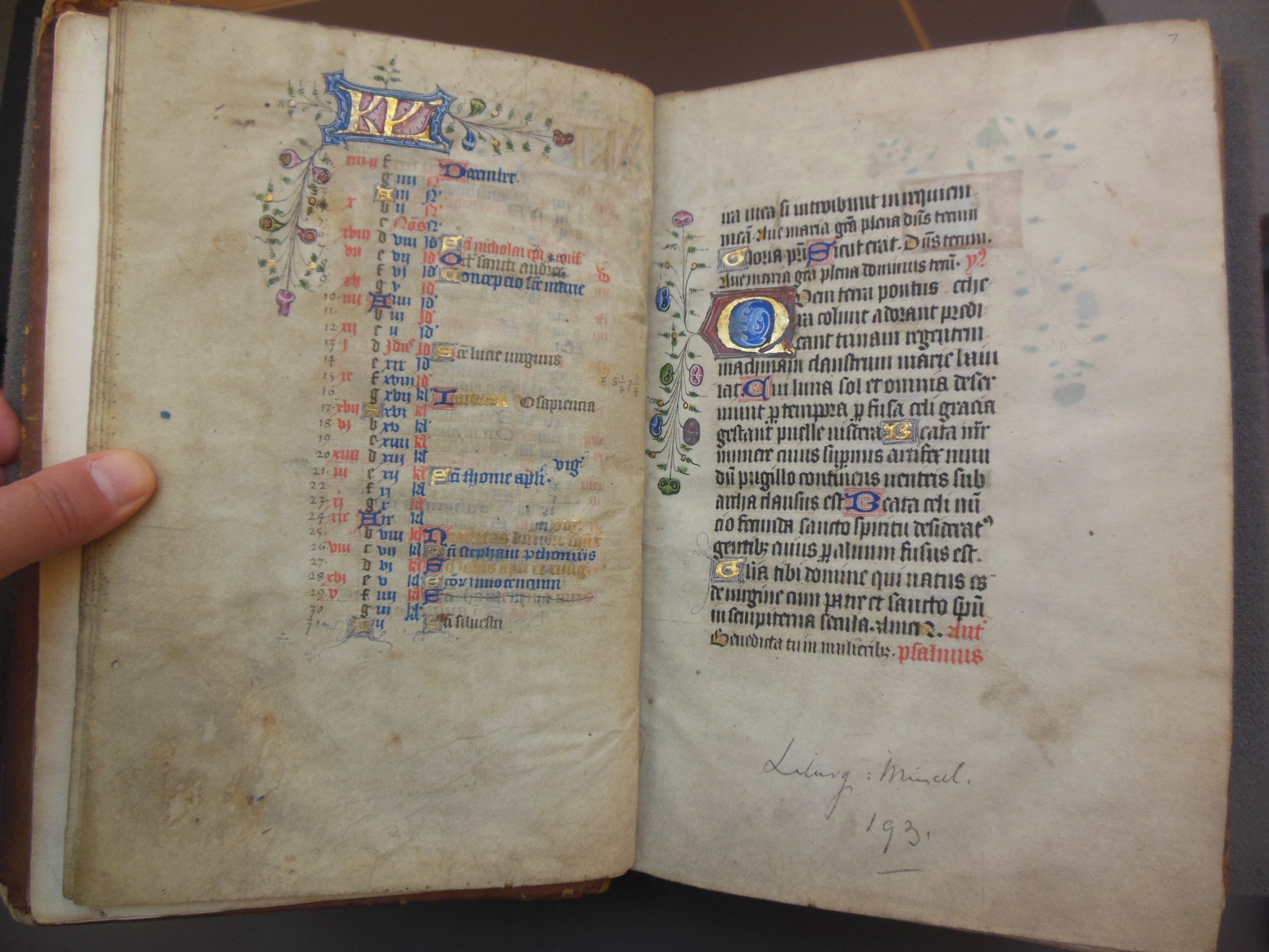

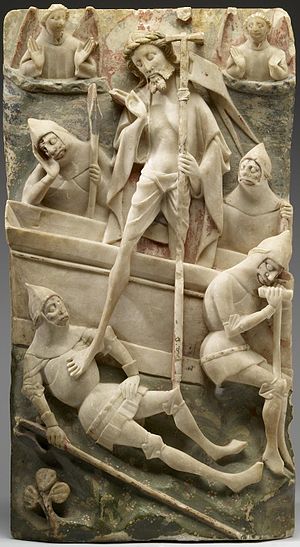 The book aims at challenging the current limits within the field of research related to English alabasters, in order to establish a new model of study. Over the last century many studies on English alabasters have been published, including exhibition catalogues, list of documents and archival sources, catalogues raisonnés of the most important collections. All these studies have marked key points in the scholarly approach to English alabaster carvings, but they have also imposed a stubbornly curt historiographical perspective. Indeed, these publications have mainly been focused on specific collections -e.g. Frances Cheetham’s Medieval English alabaster carvings in the Castle Museum of Nottingham (Nottingham, 1973)-, and have thus provided only a partial view on that artistic phenomenon. They ended up isolating English alabasters from their historical and cultural context. In addition, as Susan Ward has pointed out in her review to Frances Cheetham’s Alabaster Images of Medieval England (Speculum, 2006), these publications’ main focus was often traditional: their bulks describe the standard subject matters found in the alabasters (e.g. the Passion of Christ, the Life of the Virgin and the saints) and explain the literary sources of that subject matter in a sometime too basic way. The authors tend to isolate the pieces from their wider historical framework, lacking to consider the character of piety in late-medieval England, and failing to consider the sculptures from a comprehensive historiographical point of view.



 Call for Papers: Conference: Bishops’ Identities, Careers and Networks
 Medieval Art Research