IV. FORUM KUNST DES MITTELALTERS
BERLIN UND BRANDENBURG
360° – VERORTUNG, ENTGRENZUNG, GLOBALISIERUNG
20.–23. SEPTEMBER 2017
veranstaltet vom
Deutschen Verein für Kunstwissenschaft e.V.
mit der Humboldt-Universität zu Berlin, der Freien Universität Berlin
und dem Leibniz-Institut für Geschichte und Kultur des östlichen Europa
Das vierte Forum Kunst des Mittelalters widmet sich schwerpunktmäßig
Themenbereichen, die an den geographischen und methodischen Grenzen
klassischer Mittelalterforschung angesiedelt sind. Ausgangspunkt sind
die Veranstaltungsorte Berlin und Brandenburg an der Havel, wo
einerseits lokale mediävistische Themen zu verhandeln, andererseits
reiche Sammlungsbestände zu byzantinischer und vorderasiatischer Kunst
vorhanden sind. Entsprechend geht es um die Interaktion
zentraleuropäischer Kunst des Mittelalters mit künstlerischer
Produktion in anderen Regionen: von Osteuropa über den byzantinischen
Bereich, den Vorderen Orient, die Kaukasusregion und den Mittelmeerraum
bis hin zu den britischen Inseln und dem Ostseeraum einschließlich
Skandinaviens. Damit werden auch Forschungsbereiche wie die
Byzantinistik oder die Islamische Kunstgeschichte in den Fokus des
mediävistischen Bewusstseins gerückt, gerade vor dem Hintergrund der
massiven Gefährdungen künstlerischer und architektonischer Denkmäler im
Vorderen Orient. Thematisiert sind etwa Phänomene wie Migration,
Medientransformation und kulturelle Paradigmenwechsel. Indem wir nach
kulturell prägenden Regionen an den Grenzen „Europas“ und nach
transkulturellen Kontaktzonen fragen, werden auch Definitionen von
Mittelalter zur Debatte gestellt. – Als Pendant zu diesem Rundblick
präsentiert sich auch die Forschung zur Region Brandenburg/Berlin. Dazu
gehören ebenfalls Themen der museologischen und kunstwissenschaftlichen
Geschichte Berlins, wo die Erschließung von Zonen kulturellen
Austauschs eine lange Tradition hat.
MITTWOCH, 20. SEPTEMBER 2017
HUMBOLDT-UNIVERSITÄT ZU BERLIN (HU)
Henry Moore Institute, Leeds, March 16 – 17, 2018 Deadline: Sep 30, 2017
New Directions in the Study of Medieval Sculpture
Focusing on the materiality of medieval sculpture has proven crucial to
its study and has expanded our historical understanding of sculpture
itself. Whether monumental relief sculpture in stone, wooden sculptures
in the round, sculpted altarpieces, ivory plaques or enamelled
reliquaries, the possibilities for research on medieval sculpture now
extend far beyond the established canon.
Contemporary medieval sculpture studies have opened the field to
comparative and inclusive research that embraces the social,
performative, gendered and ritual uses of medieval sculpture. These
developments have inspired the organisers of the conference New
Directions in the Study of Medieval Sculpture to reflect on the field
and ask how do we investigate medieval sculpture today and what might
come ‘after’ materiality?
This two-day conference seeks to assess and critique the state of the
field on medieval sculpture and to investigate new directions,
approaches and technologies for research. A consideration of the state
of the field could be approached through, but is not limited to, the
following topics:
Processes and techniques of medieval sculpture The sensory experience of medieval sculpture The ephemeral and intangible aspects of medieval sculpture Medieval sculpture, photography and digital reproduction Archives, casts and reconstructing medieval sculpture Sculpture and medievalism Historiography of medieval sculpture studies Exhibition histories of medieval sculpture
This conference is hosted by the Henry Moore Institute, a centre for
the study of sculpture, and is convened by Dr Elisa Foster, 2016-18
Henry Moore Foundation Post-doctoral Fellow.
Accommodation and reasonable travel expenses within the UK will be
reimbursed.
This series is dedicated to the study of monstrosity and alterity in the medieval and early modern world, and to the investigation of cultural constructions of otherness, abnormality and difference from a wide range of perspectives. Submissions are welcome from scholars working within established disciplines, including—but not limited to—philosophy, critical theory, cultural history, history of science, history of art and architecture, literary studies, disability studies, and gender studies. Since much work in the field is necessarily pluridisciplinary in its methods and scope, the editors are particularly interested in proposals that cross disciplinary boundaries. The series publishes English-language, single-author volumes and collections of original essays. Topics might include hybridity and hermaphroditism; giants, dwarves, and wild-men; cannibalism and the New World; cultures of display and the carnivalesque; “monstrous” encounters in literature and travel; jurisprudence, law, and criminality; teratology and the “New Science”; the aesthetics of the grotesque; automata and self-moving machines; or witchcraft, demonology, and other occult themes.
Series Editors:
Kathleen Perry Long, Cornell University
Luke Morgan, Monash University
Advisory Board:
Elizabeth B. Bearden, University of Wisconsin Jeffrey Jerome Cohen, George Washington University Surekha Davies, Western Connecticut State University Richard H. Godden, Louisiana State University Maria Fabricius Hansen, University of Copenhagen Virginia A. Krause, Brown University Jennifer Spinks, University of Melbourne Debra Higgs Strickland, University of Glasgow Wes Williams, University of Oxford
The contested concept of “reproduction” stands at a critical nexus of
the conceptualisation of Early Modern artistic thought. The early
modern period has been characterised by the development of novel and
efficient reproduction technologies, as well as the emergence of global
empires, growing interconnectedness through trade, warfare and
conquest, and the rise of new markets and cultures of collecting. This
ethos of innovation and cultural exchange was, however, contextualised
against myriad contemporary ideologies still rooted in the values and
legends of narratives of the past. Reproduction stood at the centre of
this dichotomy. Set against the context of changing cultural tastes and
the increasingly overlapping public and private spheres,
‘reproductions’ were involved within changing viewing practices,
artistic pedagogy, acts of homage and collecting.
The idea of reproduction connotes a number of tensions: between
authenticity and counterfeit; consumption and production; innovation
and imitation; the establishment of archetype and the creation of
replica; the conceptual value of the original and the worth of the
reproduction as a novel work of art; the display of contextualised
knowledge and the de-contextualisation of the prototype. At the same
time, production is shaped historically through practices and
discourses, and has figured as a key site for analysis in the work of,
for example, Walter Benjamin, Richard Wolin, Richard Etlin, Ian Knizek
and Yvonne Sheratt. Participants are invited to explore reproduction
‘beyond Benjamin’, investigating both the technical and philosophical
implications of reproducing a work of art and seeking, where possible,
a local anchoring for the physical and conceptual processes involved.
We welcome proposals for papers that investigate the theme of
reproduction from the early modern period (c.1500-1800), including
painting, print making, sculpture, decorative arts, architecture,
graphic arts and the intersections between them. Papers can explore
artistic exchanges across geopolitical, cultural and disciplinary
divides and contributions from other disciplines, such as the history
of science and conservation, are welcome. Topics for discussion may
include, but are not limited to:
The conceptualisation and processes of reproduction and reproduction
technologies before and at the advent of ‘the mechanical’;
Reproduction in artistic traditions beyond ‘the West’;
The slippage between innovation and imitation;
Part-reproduction and the changing, manipulation and developments of
certain motifs;
Problematizing the aura of ‘authenticity’ and the ‘value’ of the
original, copies and collecting;
Fakes and the de-contextualisation of a work through its reproduction;
Reproduction within non-object based study e.g. architecture;
Theoretical alternatives and the vocabulary used to describe the
process and results of reproduction in contemporary texts.
Please send proposals of no more than 300 words along with a 150 word
biography by 6th July 2017 to kyle.leyden@courtauld.ac.uk and natasha.morris@courtauld.ac.uk
Organised by Kyle Leyden, Natasha Morris and Angela Benza (The
Courtauld Institute of Art)
Reference / Quellennachweis:
CFP: Recasting Reproduction (1500–1800) (London, 18 Nov 17). In:
H-ArtHist, Jun 6, 2017. <https://arthist.net/archive/15728>.
There could scarcely be a more appropriate setting for a study day on the theme of Thomas Becket than Canterbury Cathedral, the location of the archbishop’s martyrdom nearly 850 years ago on the 29th December 1170. In the Cathedral Library and Archives, just metres from the site of Becket’s murder in the North West Transept, experts from universities, museums and Canterbury heritage organisations gathered to discuss the saint’s life and cult.
The day began with a series of ‘quick fire’ presentations, each focusing on one theme or object related to Thomas Becket. The range of material gave an immediate sense of the scale and popularity of Becket’s cult in the Middle Ages and beyond. Some objects discussed have likely existed in the vicinity of Canterbury since they were produced, including a fragmentary sandstone ampulla mould discovered in the garden of 16 Watling Street (Dr Paul Bennett, Canterbury Archaeological Trust), a thirteenth-century cartulary made for Christ Church containing charters for the shrine of Thomas Becket (Professor Louise Wilkinson, Canterbury Christ Church University), the seal of Archbishop Simon Sudbury showing Becket’s martyrdom (Dr Sheila Sweetinburgh, University of Kent), and the spectacular miracle windows in the Trinity Chapel of the Cathedral itself (Professor Michael A. Michael, Christie’s Education).
Thomas Becket ampulla (or vessel), now in the British Museum, similar to the kind that would have been produced by the Watling Street mould discussed by Dr Paul Bennet. See more 3D models of pilgrim souvenirs here
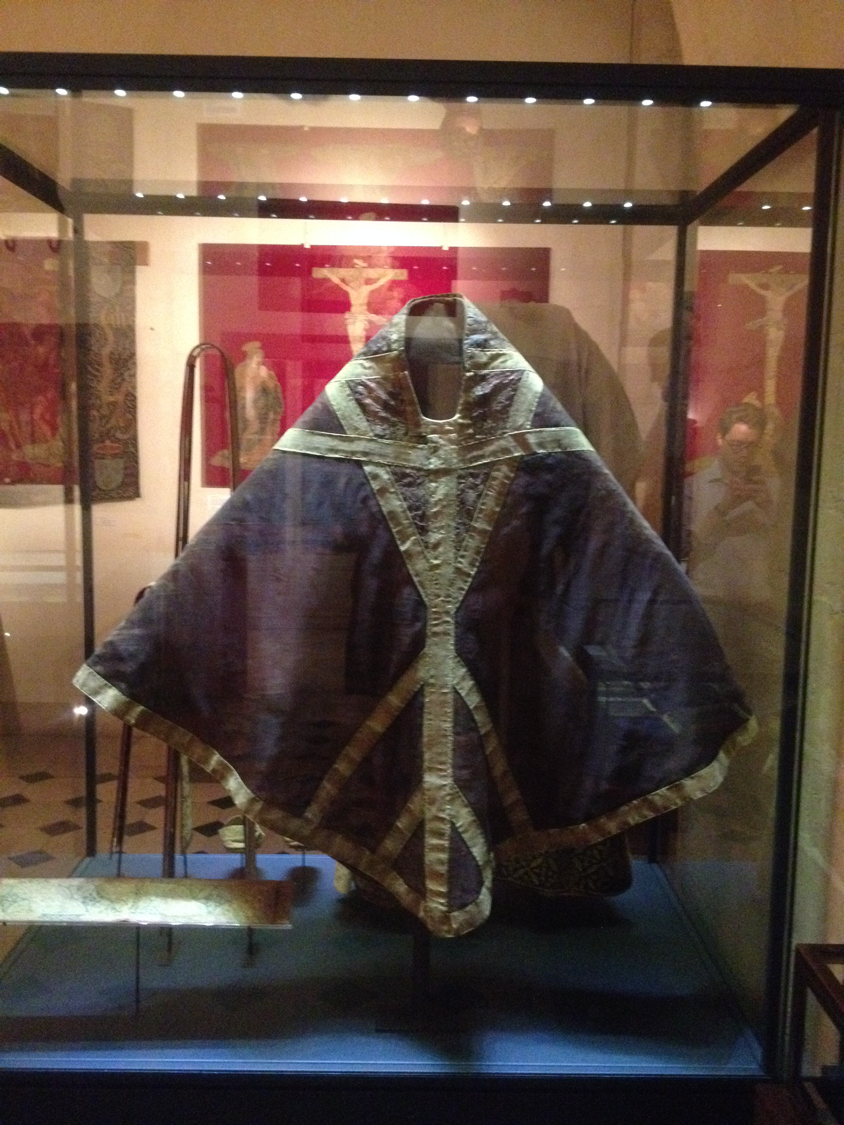
Chasuble in Sens Cathedral treasury thought to have been worn by Thomas Becket and venerated as a contact relic
Other delegates discussed geographically dispersed objects which originated or were believed to have originated in Canterbury. For instance, pilgrim souvenirs depicting Becket were bought by visitors to Canterbury and, it would seem, lost on the way home. These badges, with their intricate and compelling imagery, would have been worn on the bags, hats and garments of pilgrims as signs of their visit to Becket’s shrine and are now excavated from sites across Britain and Europe (Amy Jeffs and Dr Gabriel Byng, University of Cambridge and convenors of The Digital Pilgrim Project). Likewise, Dr Emily Guerry (University of Kent) discussed a series of vestments owned by Sens Cathedral that were reputedly worn by Becket and possibly used at Sens as contact relics.
A number of significant objects pertaining to Becket originated from further afield, both geographically and chronologically. Dr Tom Nickson (Courtauld Institute of Art), for example, presented on a c. 1200 altar frontal depicting Becket’s martyrdom found in the church of San Miguel in Almazán, which bears early witness to the popularity of Becket’s cult in Spain.
Altar frontal from the church of San Miguel in Almazán, showing Becket’s martyrdom
Becket’s later legacy was then examined. Lloyd De Beer (British Museum) assessed the sixteenth-century political and religious connotations of the saint’s martyrdom through the lens of Alberti’s The Martyr’s Picture (1581), displayed in the Venerable English College in Rome, and Naomi Speakman (British Museum) discussed Becket’s memory in post-Reformation England and his representation as an anti-martyr.
These evocative objects and themes provoked a lively concluding discussion that centred on the international nature of Becket’s cult and the extent to which the art associated with it imitated and/or innovated in order promote the saint and potency of his cult as a political tool.
Examining the Professions of Obedience in the Canterbury Cathedral Archives
This discussion was followed by an opportunity to see first-hand some of the extraordinary items associated with Becket. Cressida Williams, head of the Cathedral Archives and Library, had organised for an array of Becket-themed documents and objects from the Cathedral collections and various heritage organisations in Canterbury to be displayed together in the reading room of the Cathedral Archives. Among this impressive collection were two fragments of pink Tournai marble, discovered during excavations in the Cathedral grounds, which are thought to have come from the shrine of St Thomas himself. Also on display were a number of medieval seals from the Cathedral’s collections, including those of Archbishops Hubert Walter and Stephen Langton, which both depict Becket’s martyrdom. Dr Helen Gittos from the University of Kent discussed a particular treasure of the Cathedral Archive, the Professions of Obedience, a series of 170 documents now bound into a single volume that record the vows made by bishops during their consecration. These small vellum statements, which would have originally been sewn together in a continuous roll, contain the dates of bishops’ consecrations, and are thus immensely helpful in dating other contemporary documents based on a comparison of their palaeography. Becket’s entry is especially marked in the Professions by a statement in red noting his archiepiscopal status.
The later half of the afternoon saw the group move to the Cathedral stained glass studio, where Leonie Seliger, Head of the Stained Glass Conservation Department, led us in a discussion of the representation of Becket in the Cathedral glass. Notably, only three original thirteenth-century panels depicting Becket’s head survive, which Leonie encouraged us to find among her printed reproductions – a task that proved surprisingly difficult. We also had the opportunity to see some of medieval stained glass currently under restoration in the studio, and to hear from Leonie about the techniques that would have gone in to making these panels. A particular highlight was seeing how the colour of nine hundred year old stained glass was still bright and vivid when held up to the light.
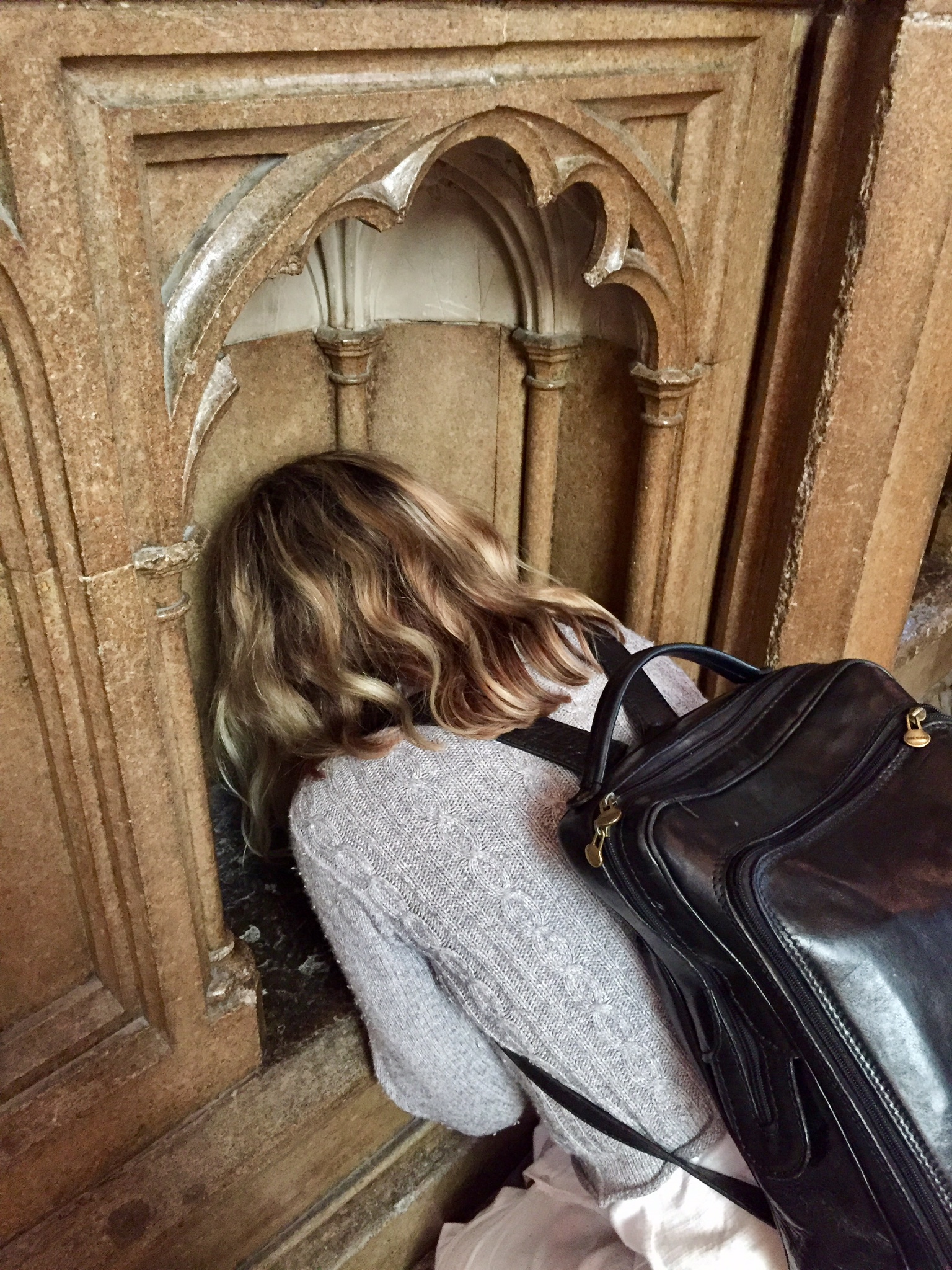
Kneeling at the resonant prayer niches in Archbishop Sudbury’s tomb, Canterbury Cathedral
A subsequent tour of the Cathedral offered a chance to see the miracle windows we had discussed in the glass studio in situ, along with the site of Becket’s shrine and several archiepiscopal and royal tombs. The tombs of Archbishops Sudbury and Mepham in the south aisle of the Choir afforded a particularly interactive experience; kneeling down at one of the vaulted prayer niches carved into the tombs’ exterior, penitents (or indeed academics) can experience an amplification not only of the music performed in the nearby Choir, but also their own whispered prayers and thoughts.
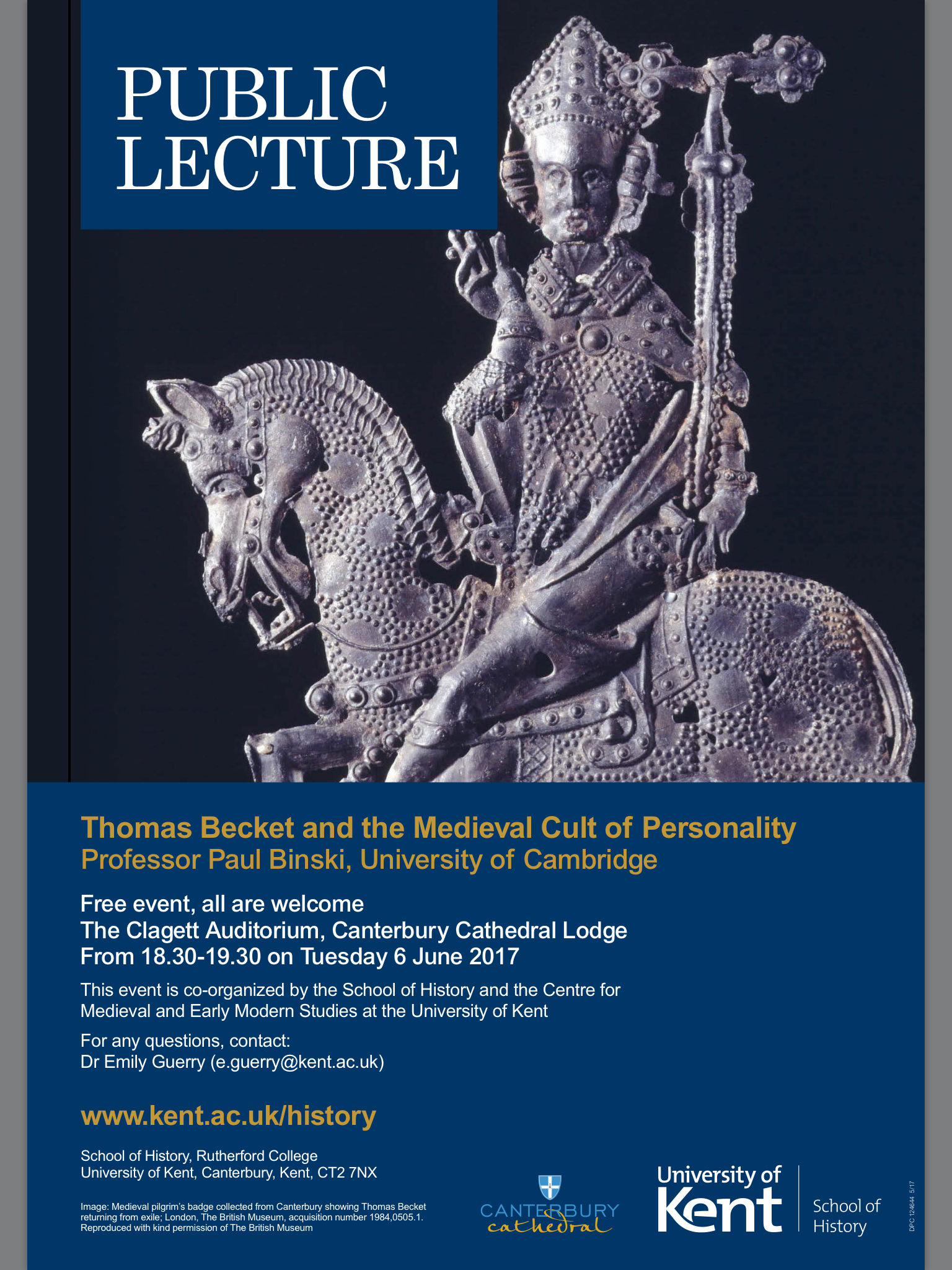
Professor Paul Binski (University of Cambridge) brought the study day to a close with a public lecture entitled ‘Thomas Becket and the Medieval Cult of Personality’. Drawing on many of the objects seen and discussed throughout the day, Professor Binski reflected on the idea of Becket’s ‘persona’ (as opposed to the modern notion of ‘personality’) and its importance in the formation and development of his cult. Much like a mask that can be put on or taken off, the medieval concept of an individual’s persona was related to their outer countenance, and formed by certain archetypal characteristics – both good and bad – often rooted in character types in biblical stories or saint’s lives. Becket’s persona and outer image, Professor Binski argued, was imitated in the art and architecture produced in response to his martyrdom, an aspect that was vital to the rapid dissemination and spread of the cult. Due in part to the accessibility of this image through objects made both for the elite and for the ordinary person, Becket’s persona transcended social as well as geographical boundaries, transforming his cult into a widespread, international phenomenon. Professor Binski’s concluding remarks on the appeal of the Becket’s cult in the Middle Ages had a particular resonance amidst of the full lecture theatre where the lasting legacy of Thomas Becket’s life and death was still very much felt.
Please, see the call for papers of the Templa Winter School, “Citizen Cathedrals in the Middle Ages. Image, institutions, networks” (Girona, December 18th-19th 2017), organized by members of our Research Team (V. Debiais, X. Granero, A. Moreno, G. Boto).
It is addressed mainly to young researchers whose studies are focused on medieval Cathedrals related to their cities, and vice versa.
As with the Templa Summer School 2015 and 2016, the Templa Team will cover the expenses of all researchers whose papers have been accepted.
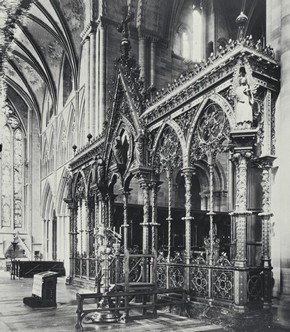
Issue 5 of British Art Studies features a One Object study of the Gothic Revival Hereford Screen. The 8 tonne metalwork structure was designed by Sir George Gilbert Scott and manufactured by the firm of Francis Skidmore in 1862. The collection of essays fosters discussion of the screen’s medieval models as well as its Victorian genesis.
The Hereford Screen in Hereford Cathedral, view from North Transept, 19th century. (Image from the V&A website)
As a new and exclusively digital journal, British Art Studies’ virtual platform is celebrated through abundant interplay of text, image and audio-visual material. It brings together seven scholars who present technical and theoretical perspectives on a single object by means of ‘traditional’ essays and short films. This brief blog-post aims to draw attention to the medieval content of the study, notwithstanding the overall interest and coherence of all the constituent articles.
Essays in the discussion that focus on medieval material are:
The Hereford Screen: A Prehistory, by medievalist Matthew Reeve, guides the reader through a history of the medieval predecessors of the Hereford screen and places its production in the context of the Cathedral space and the architect’s work at Lichfield and Salisbury.
Jacqueline Jung’s contribution, a video essay entitled, The Medieval Choir Screen in Sacred Space, considers the sight-lines and sculptural relationships created by the strategically designed perforations and interior figural programmes of medieval screens and their host churches, focusing on two examples from 13th-century Italy and 15th-century Germany.
The oddly fragile, contentious choir screen, in its many historical manifestations, receives a colourful and polyphonic tribute in this One Object study. As a medieval art blog, links to the most relevant essays are given above but are, for best results, to be enjoyed with their Gothic Revival companions.
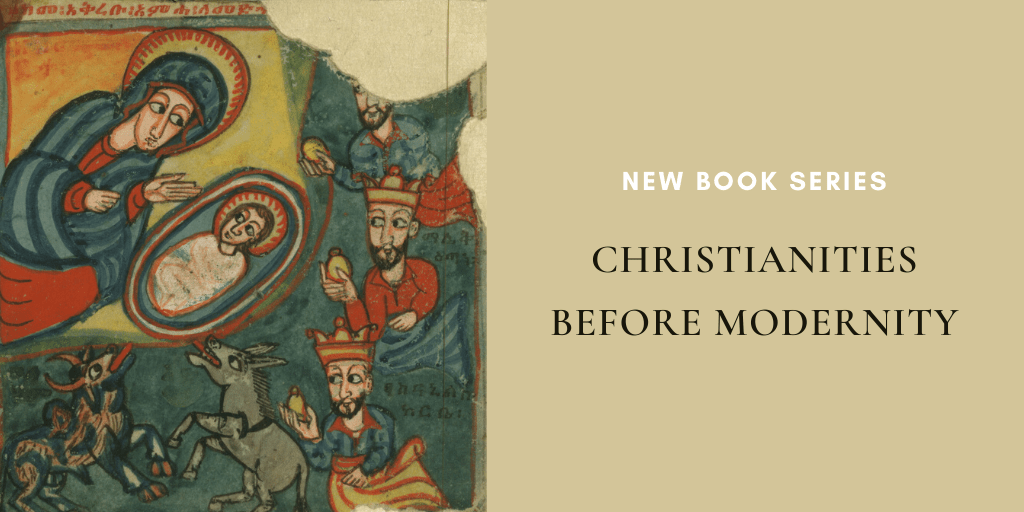
Challenging the perception of Christianity as a unified and European religion before the sixteenth century, this series interrogates the traditional chronological, geographical, social, and institutional boundaries of premodern Christianity. Books in this series seek to rebuild the lived experiences and religious worlds of understudied people as well as landmark disputes and iconic figures by recovering underappreciated vernacular sources, situating localized problems and mundane practices within broader social contexts, and addressing questions framed by contemporary theoretical and methodological conversations.
Christianities Before Modernity embraces an interdisciplinary and comparative approach, publishing on history, literature, music, theater, classics, folklore, art history, archaeology, religious studies, philosophy, gender studies, anthropology, sociology, and other areas.
Grounded in original sources and informed by ongoing disciplinary disputes, this series demonstrates how premodern Christians comprised diverse and conflicted communities embedded in a religiously diverse world.
Series Editors:
Rabia Gregory, University of Missouri
Kathleen E. Kennedy, Pennsylvania State Brandywine







 Medieval Art Research