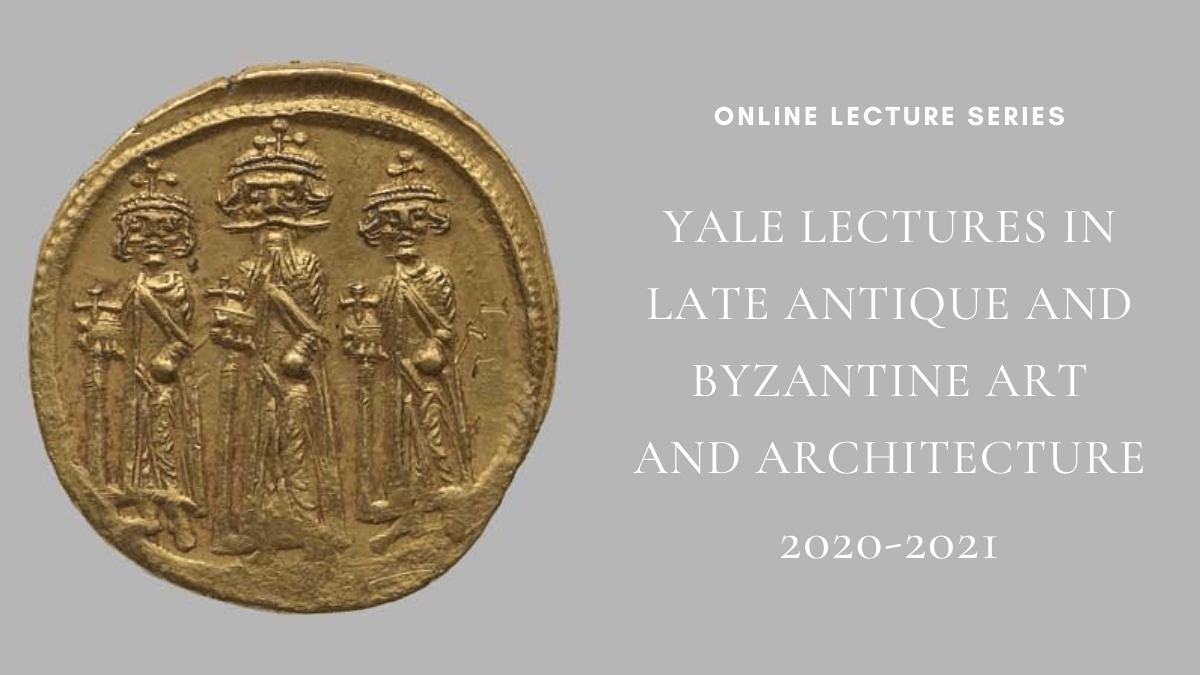
Online Lecture Series: Yale Lectures in Late Antique and Byzantine Art and Architecture, 2020-2021

This lecture series is organized by Robert S. Nelson, Robert Lehman Professor in the History of Art, and Vasileios Marinis, Associate Professor of Christian Art and Architecture at the ISM and YDS. Support is provided by the Department of Classics and the Department of the History of Art. 

Zoom lectures begin at 12 noon Eastern Time
[Registration and viewing link coming soon]

11 September 2020
Visual Epitome in Late Antique Art
Jaś Elsner, University of Oxford
Respondent: Maria Doerfler, Yale

9 October 2020
Visual Mastery of the Hippodrome?: Rethinking the Imperial Image in Byzantium
Paroma Chatterjee, University of Michigan
Respondent: Jacqueline Jung, Yale

13 November 2020
Everlasting Monument [արձան մշտնջենաւոր]: Ani Cathedral and its Contexts
Christina Maranci, Tufts University
Respondent: Vasileios Marinis, Yale

11 December 2020
What do Mosaics Want? Or, Wall Mosaics and the Space between Viewer and Viewed
Liz James, University of Sussex
Respondent: Robert S. Nelson, Yale

8 January 2021
The Nativity Church in Bethlehem in the Light of Recent Restorations
Michele Bacci, University of Fribourg
Respondent: Ariel Fine, Yale 

12 February 2021
From Domestic to Divine: The Mosaics of Late Antique Syria
Sean Leatherbury, University College, Dublin
Respondent: Örgü Dalgıç, Yale

12 March 2021
Africa in Late Antiquity: Faith, Politics, and Commerce between the Mediterranean and the Red Sea
Andrea Achi, The Metropolitan Museum of Art
Respondent: Felicity Harley, Yale

9 April 2021
Auro, argento, aere perennius: Byzantine Art in and through Coins 4th–15th Centuries  
Cécile Morrisson, CNRS and Académie des Inscriptions et Belles-Lettres
Respondent: Benjamin Dieter R. Hellings, Yale

More information can be found here.

CFP: Medieval War and Memory at International Medieval Congress (Leeds 2021), deadline 10 September 2020

Remembering war in the 21st century tends to focus on the loss and sacrifice regardless of the outcome. Memorials are built to remember the common soldier, events are held to honour the war dead, and the memories of veterans respected. While many are aware that this is how modern society chooses to remember war, when thinking about how medieval society remembered war the picture is not as clear. In the time of chivalry and the crusades, how did their way of remembering war differ from ours? This panel hopes to discuss questions such as: How was war remembered in the medieval period? Did remembering focus on the glory of the war leaders? How did medieval society record memories of war? How does modern society remember medieval war?

We encourage submissions on any aspect of medieval war and memory. Suggestions for topics include, but are not limited to:

  • Soldier’s memories of war
  • Warfare and memory in medieval texts
  • Memories of medieval military leaders
  • Memorialisation of medieval warfare, or the use of medieval military imagery in modern memorials
  • Heritage and the memory of medieval warfare
  • Memories of peace-making
  • Memory and the commemoration of warfare in medieval culture
  • Loss and memories of war

Please submit abstracts of no more than 300 words to katrina.ingram@stu.mmu.ac.uk or K.Hurlock@mmu.ac.uk by 10 September 2020. We are particularly keen to attract sibmissions form PGR researchers and ECRs.

Membership: Discounted Membership in the ICMA for First-Time International Members, deadline 31 August 2020

The ICMA is offering a promotion for first time international members –  50% off 2020 membership (code valid until 31 August 2020). To join, go to medievalart.org, create an account, select “individual” membership, then enter code ICMA2020.  Membership is valid until 31 December and includes all benefits.  

The offer is good only until 31 August 2020. New members will get both issues of Gesta for the year 2020- New members will be eligible for ICMA-Kress Research and Publication grants and ICMA-Kress Exhibition grants.

The deadline for both is August 31, 2020; info at: https://www.medievalart.org/kress-research-grant AND https://www.medievalart.org/exhibition-grant- 

In case of difficulties signing up and using the discount code, please contact Executive Director Ryan Frisinger at icma@medievalart.org.

CFP: Pre-Modern Women as Artists, Patrons and Collectors, Association for Art History Annual Conference (14-17 April 2021), deadline 19 October 2020

The study of women in pre-modern times is a well-established field that has generated important scholarship. But, as ongoing research shows, there is no shortage of new material yet to be analysed, or existing evidence that can be nuanced in the light of new methodological approaches. And whilst recent monographic exhibitions attest to the enduring appeal of ‘female artists’ in the ‘genius’ tradition (e.g. Anguissola, Gentileschi), new and ongoing work in the field points to different ways that women’s interaction with visual and material culture can be approached. The application of new digital and mapping technologies, meanwhile, is enabling scholars to propose alternative, non-linear narratives of pre-modern women’s lives.

We therefore invite proposals for papers exploring the role of women as artists, patrons and collectors in the medieval and early modern periods, broadly defined (c.400–1700). We encourage submissions that disrupt chronological and geographical conceptions of this period, or commonplace ideas surrounding ‘medieval’ or ‘early modern’ women. Papers considering non-Western subjects and materials, or which draw on new methodologies including digital ones, are also particularly welcome.

Papers may consider ruling and elite women, religious or secular ones, as well as laywomen. Possible topics include:

  • women as ‘makers’
  • women as patrons/collectors of paintings, sculptures, works on paper, or visual and material culture more broadly conceived
  • women and patronage of architecture or other large-scale ensembles
  • women and books (libraries, translators, writers)
  • women’s networks
  • gender and identity
  • inventories and women inheritors/benefactors
  • women in commerce (dealers, proprietors)
  • applying digital/mapping technologies to pre-modern sources
  • methodological and theoretical papers interrogating issues surrounding the study of pre-modern women.

More information can be found here.

Submission: Abstracts of around 500 words must be sent to e.a.lestrange@bham.ac.uk by 15 October 2020.

Session organisers:

  • Jamie Edwards, University of Exeter, j.l.edwards@exeter.ac.uk
  • Elizabeth L’Estrange, University of Birmingham, e.a.lestrange@bham.ac.uk
  • Edward Wouk, University of Manchester, edward.wouk@manchester.ac.uk

Online Lecture: Hagia Sophia: The History of the Building and the Building in History, Dumbarton Oaks Webinar, 1 September 1 2020, 11–12:30 (EDT)

Built between 532 and 537, Hagia Sophia (Holy Wisdom, Ayasofya) represents a brilliant moment in Byzantine architecture and art. It was the principal church of the Byzantine Empire in its capital, Constantinople (later Istanbul), and a mosque after the Ottoman Empire conquered the city in 1453. The decision of the Turkish government in 1934 to establish Ayasofya as a museum was intended to make it a repository of human history—all human history, not a single history confined to one religion or people. Recently, this decision was annulled, turning the building again into a mosque.

With the passage of time, Hagia Sophia has become deeply embedded in competing narratives of national, regional, religious, and cultural significance. Selective readings of cultural heritage, however, can effectively erase historical memory and sever links with the past. As a monument on the world stage, it should be allowed to maintain multiple meanings, to resonate with multiple narratives and histories for diverse audiences. This exceptional building belongs to world cultural heritage. 

Between 1931 and 1949, work was undertaken by the Byzantine Institute of America (founded by Thomas Whittemore in 1930) to reveal and preserve the mosaics of Hagia Sophia. Dumbarton Oaks, with its legacy of displaying, studying, and publishing all aspects of Byzantium, assumed the oversight of the Hagia Sophia project in 1953 and since then has been documenting every facet of this building and its artistic and historical record. Dumbarton Oaks houses an exceptionally important archive of data on the building in all its significant dimensions. We are in the process of making freely available online the extensive body of sources from, documentation of, and scholarship on Hagia Sophia collected and generated by the Byzantine Institute and Dumbarton Oaks.

This webinar brings together scholars who have actively promoted research on the Hagia Sophia and will cover historical facts, Dumbarton Oaks’ involvement, and the issues related to the recent reconversion of the monument. 

PROGRAM

Advance registration required. Register here.

Participants:

Ioli Kalavrezou (Harvard University), “Dumbarton Oaks, Hagia Sophia, and Its Historical Mosaics” 

Robert Nelson (Yale University), “Hagia Sophia: A Modern Monument?”

Bissera Pentcheva (Stanford University), “Hagia Sophia and the Liquidity of Light and Sound” 

Tugba Tanyeri-Erdemir (University of Pittsburgh), “Reconquest of Hagia Sophia: Official Discourse and Popular Narratives”

Moderator:

Elizabeth Bolman (Case Western Reserve University)

Fellowships: The Bibliographical Society of America

The Bibliographical Society of America (BSA) is accepting applications for multiple fellowship opportunities. The BSA funds a number of fellowships to promote inquiry and research in books and other textual artifacts in both traditional and emerging formats.

Projects may include establishing a text or studying the history of book or manuscript production, publication, distribution, collecting, or reading, and the history of bibliographical study itself. Fellowship awards may be used to fund travel to collections and other expenses associated with research, publication, or other scholarly outcomes related to the topic for which the award was made. Projects that are primarily enumerative (lists) will be considered for funding provided the proposal states a clear objective, describes the need for such work within its field, and specifies the extent to which textual objects will be described.

The BSA offers more than a dozen fellowships supporting a broad range of bibliographical pursuits. In addition to the broad array of Fellowship opportunities we have offered in the past, the Society is pleased to announce two new categories of fellowships supporting research by midwestern bibliographers and collections professionals (respectively) this year thanks to generous support from The Caxton Club of Chicago and the Peck-Stacpoole Foundation.

Find more information about Fellowships and application instructions here.

Exhibition: Hebrew Manuscripts: Journeys of the Written Word, British Library, 1 Sep 2020 – 11 Apr 2021

Journey beyond the Bible to discover the history, culture and traditions of Jewish people from all corners of the world through the ages.

Through rarely-seen treasures from as far back as the 10th century, this exhibition takes you from Europe and North Africa, through to the Middle East and China to explore the relationships between Jews and their neighbours in the communities that they lived in.

How much knowledge and culture was exchanged between these groups? Fascinating works displayed on music, science and philosophy by famous Jewish scholars suggest there was more than we might think.

Witness both the high points and the lows of these relationships. An Italian rabbi’s reply to Henry VIII, who sought advice on divorcing his first wife. A 13th-century Anglo-Jewish charter showing the passing of property between people of different faiths. And the signs of conflict as we encounter Christian censorship in Jewish texts.

Along the way, meet the sages versed in magic, Kabbalah and alchemy, and even learn a love potion or two, as we discover the power of the written word.

More information can be found here.

CFP: Mary on the Move: Marian Iconography in Late Medieval France, International Congress on Medieval Studies Kalamazoo 2021, deadline 15 September 2020

Session 1363

The proposed session concentrates of Marian iconography of the Late middle Ages, with particular emphasis on fourteenth to sixteenth century. It focuses on the movement of iconographies in/from/towards France by highlighting connections and influences pertaining to Italian, Spanish and/or geographical areas. Furthermore, it situates Marian visual depictions in the context of the development of Marian devotion (rise in her cult and liturgical feasts) and specific theological debates (Immaculate Conception).

The session is dedicated to the iconography of the Virgin Mary, generally speaking. This implies that any aspect of Marian iconography is accepted, into the session, starting with general or particular episodes of Mary’s life, development(s) of iconographic details or specific iconographies. The session aims at approaching such representations in a comparative manner either by focusing on the visual-textual relationship or by highlighting influences and movements of iconographies from one geographic area to the other. It focuses on material from various media be that miniatures, frescoes, altarpieces, etc.

Please submit an abstract 200-300 words for 15-20 minutes papers via the submission portal here by 15 September 2020.

Contact information: Andrea-Bianka Znorovszky, Ca’ Foscari University, Venice, Italy (andrea.znorovszky@unive.it)

Online Lectures: British Archaeological Association sponsored panels for the IMC 2020

As the IMC 2020 could not take place this year, the British Archaeological Association has recorded their sponsored panels which you can now watch online. All papers are chaired by Dr Harriet Mahood.

Havens for Burial: The Convents of Constantinople and their Female Founders, Dr Cecily Hennessy

This paper considers certain convents founded in Byzantine Constantinople and the design of their houses of worship, focusing on the places of burial the founders provided for themselves, their families and their communities of nuns. In Byzantium, many religious institutions were founded by members of the imperial family, both men and women. Of the six Byzantine convents for which we have the foundation rules, known as the typika, five were built by women in Constantinople, all connected with the imperial family. These documents include evidence for the buildings, their daily use, as well as the key regulations of worship. This paper examines them for what they tell us about the burials and their rituals and considers the networks and relations between the various women founders.

It also looks at what evidence we have for the design of the buildings by looking at both lost and surviving structures in Istanbul and at other visual records, considering how these designs are particularly appropriate for burials. One piece of evidence comes from an illumination in the illustrated typikon, Oxford, Lincoln College, MS Gr 35, depicting the foundress of the convent, Theodora Palaiologina Synadene, presenting a model of her church to the Mother of God. The convent, dedicated to the Mother of God of Bebaia Elpis (Good Hope), was founded in about 1300. The design of the building is discussed in the context of other related churches which existed in Constantinople.


The Surviving Early 16th-Century Chantry Chapels at St Stephen’s, Westminster, Dr Elizabeth Biggs

Within the iconic Houses of Parliament built by Charles Barry in the nineteenth century a sixteenth-century cloister and two rooms opening off its western walks, now known as the oratories, survive. While these rooms have been much altered over the centuries, it is clear that they are unusual pieces of sixteenth-century architecture whose original purposes are not clear. They have been called oratories, a chapter house, and simply chapels in various contexts over the centuries. The oratories invite comparisons with the chapter house of Old St Paul’s Cathedral in London, where the chapter house opened off of the cloisters there. Other possible comparisons are the chantry chapels built in the early sixteenth century at Windsor and Eton, or Abbot Islip’s chapel at Westminster Abbey.

This paper explores what is known of the oratories’ construction, their history within the Palace of Westminster, and the institutional context that provides clues as to their original uses. In doing so it identifies a lost chantry chapel belonging to a fifteenth-century bishop of St Davids, William Lyndwood.


‘Timor mortis conturbat me’ – Commemoration and the Macabre at Rosslyn Chapel , Dr Lizzie Swarbrick

Rosslyn Chapel is an idiosyncratic late medieval collegiate church in Midlothian, Scotland. The building is unusually ornate and has survived remarkably well. Both its exterior and interior are marked by an extraordinary level of surface ornament, which includes a variety of figural sculpture. Despite these surviving visual riches, and in contrast to the majority of comparable institutions, Rosslyn has no surviving tomb commemorating its founder, Sir William Sinclair.

In this paper, Lizzie examines this apparent omission by exploring the macabre images which make up a significant part of Rosslyn’s superabundant sculpture. She shows that representations of death and dying are concentrated in particular spaces within the church. In particular, she analyses images of the Ages of Man, the Dance of Death, and the Three Living and the Three Dead. Using their iconography and their placement within Rosslyn’s topography she reimagines the commemorative functions which the church once fulfilled, and reveals the probable site of the tomb of William Sinclair.


The Placement of Furnished Burials by Ecclesiastical Sites, Danica Ramsey-Brimberg

Viking settlement blurred boundaries in various ways. In areas already converted, such as Britain and Ireland, furnished burials in or near ecclesiastical sites in the ninth to eleventh centuries sat on the border, metaphorically and literally. They represented a style of burial similar, yet different from those interred nearby. However, it is their placement at the various ecclesiastical sites, the natural landscape and their related boundaries that adds further intrigue. Through understanding what their positioning is in the natural and man-made landscape, why they might have occurred or what they may have represented may be then more easily understood.


Lordly buildings amongst peasants: Displays of authority within manorial centres, Dr Duncan Berryman

This paper discusses how the buildings of the manorial farmstead, the curia, were designed and positioned to act as a display of the lord’s wealth and their authority over the tenants of the village. As well as the agricultural buildings, it will think about the relationship between the village, the church and the curia to indicate the relationships between the lord and the villagers. This work focuses on southern England and combines documentary research with landscape analysis (through maps) and archaeological excavation.


The Web-Foot Queen of Saint-Bénigne, in Dijon, Professor Kathleen Nolan

Monumental statue columns in the portals that followed Saint-Denis are thought to evoke the ancestry of Christ, their authority affirmed by the court attire they wear. But in Burgundy, the identities of column figures underwent a metamorphosis from their Parisian models. In the majestic monastic church of Saint-Bénigne, in Dijon, the identity of an Old Testament queen was marked by an appendage, a webbed foot, that seems to undermine the authority of the figure. How can we understand the message of this queen that blurred the boundary between species? Can the webfoot be a neutral attribute, or does it stigmatize the only female figure on the portal jambs?


Life in the Shadow: Power Relations in Medieval Wensleydale, Erik Matthews

This paper explores how the on-going archaeological fieldwork programme and documentary research at Hornby Castle in Wensleydale illustrates the often fraught relationship between elite landscapes of pleasure with the working agricultural landscape surrounding, together with the wider spiritual landscape. It looks in particular at the relationship of the adjacent Deserted Medieval Village to the buildings of the elite complex and its park and also the relationship between the site and the church in terms of investment by the owners in many forms.


CFP: Medieval Ars Memoriae in Italy: Theory, Technique, and Practices at International Congress on Medieval Studies Kalamazoo 2021, deadline 15 September 2020

Organized by: Elisabeth Trischler and Leon Jacobowitz Efron

Sponsor: Italians and ltalianists at Kalamazoo

From the pseudo-Ciceronian Ad Herennium to Pietro da Ravenna’s Phoenix, the vibrant intellectual climate of the Italian peninsula was the core of many important contributions to Europe’s mnemonic traditions, bridging not only Eastern and Western cultures but also adapting the classical tradition to its own epoch. This panel aims to explore the variety of memory techniques developed and practiced in Italy during the medieval period. Medieval memory has become a key topic of discussion amongst contemporary scholars from many disciplines, our panel will therefore accept papers from a variety of fields, including but not limited to: art, history, literature, philosophy, and theology.

Potential paper topics include but are not limited to:

  • the use of ars memoriae in Italian literature
  • the differences between theory and praxis
  • the influence or rejection of classical authors illustrations as pedagogical tools and/or their absence
  • Ars memoriae and the sermo modernus
  • the practice in relation to different audiences
  • real and imagined architectural spaces and ars memorae
  • the roles of affect and sensorial play
  • art and mnemonics: from manuscript decoration to cloister frescoes

We welcome proposals for 20-minute papers on (but not limited to) the above-mentioned topics. In order to submit an abstract please find the paper session here, by 15 September 2020.