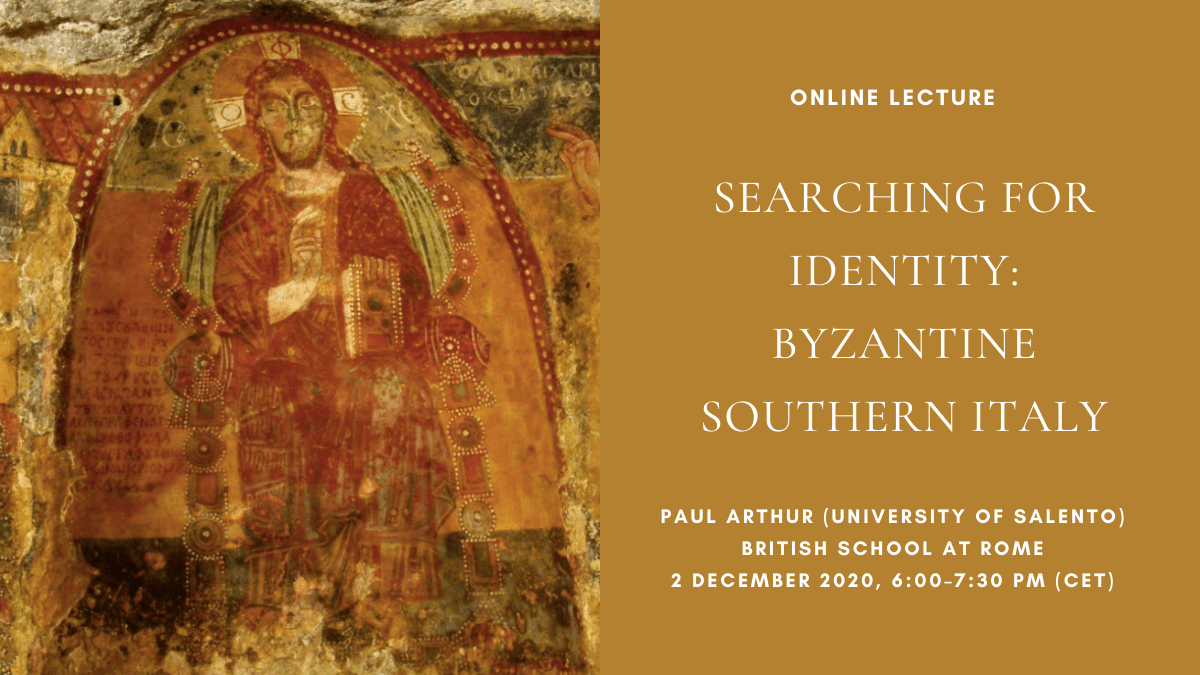
Online Lecture: ‘Searching for Identity: Byzantine Southern Italy’ with Paul Arthur, British School at Rome, 2 December 2020, 6:00–7:30 pm (CET)

This event will take place via Zoom and requires advance registration. Please click here to reserve your place.

There is abundant literature on the Byzantine reconquest of Italy in the 6th century and on the transition from late antiquity to the Middle Ages. Paradoxically, despite various historical contributions on the long period of Byzantine domination in the South, from the 6th to the 11th century, there is a lack of archaeological studies that propose an integrated overview. This is unfortunate, as the centuries were formative in the definition of southern Italy, helping to make it what it is today. This can be seen in many aspects of the country, including settlement patterns and communication, food and language, culture and traditions and, apparently, genetic makeup and mentality.

With these problems in mind, I applied for a major funding to the Italian Ministry of Education, which was awarded for the project entitled “Byzantine Heritage of Southern Italy: settlement, economy and resilience in changing territorial landscape contexts”.

The aim of the project is therefore to provide a panorama of the Byzantine heritage and its role in the formation of society across southern Italy, proposing to make different sources (archaeological, documentary, climatic and environmental, anthropological, genetic) interact in a systemic way through a database linked to a GIS platform. Even if we may speak of this large territory as a political significant entity in Byzantine times, it was constantly changing in size and boundaries, and in social composition through politics and mobility. Thus, it was also somewhat of a palimpsest. The examination of the ‘Byzantine Heritage of Southern Italy’ is thus an examination of differences and contrasts, in which we will explore and characterize unity in disunity.

The ultimate aim of the project is thus to rewrite part of the history of Italy from a new point of view, enhancing the vision of the South in its role as a geographical centre of the Mediterranean and key territory to the survival of the Byzantine Empire through a global analysis of interconnecting data.

Furthermore, the project intends to play an active role in the communication and dissemination of research results to the general public in line with modern trends of ‘public archaeology’. Therefore, the processing of information, in addition to normal scientific outlets, involves public presentation and the involvement of schools, in order for it to play an active role in disseminating knowledge so as to impact on local understanding and international tourism, thus reinforcing unity and identity.

Paul Arthur holds the Chair of Medieval Archaeology at University of Lecce (now Salento). 

Register here.

Online Lecture: ‘”The face of one making for Jerusalem”: The Angel Choir of Lincoln Cathedral & Joy’ with Katherine Turley, BAA Lecture, 2 December 2020, 5:00 PM (GMT)

The British Archaeological Association’s December Lecture will be by Katherine Turley (Birkbeck College) who will be presenting ‘”The face of one making for Jerusalem”: The Angel Choir of Lincoln Cathedral & Joy’.

The lecture will take place on Zoom on 2 December 2020 at 5pm (GMT).

Register here.

Medieval Views Virtual Arts Festival Crowdfund Campaign

In these trying times Medieval Studies needs more opportunities to come together to positively build and reinforce our community. Before the COVID-19 pandemic this was largely handled by universities, research groups and smaller location based gatherings. It wasn’t a perfect system as many were left out, their voices diminished or unable to contribute to any of the important conversations that results in modern research advances. More and more medieval focused graduate students enter a job market that holds no work or hope for them.

Medieval Views: A Virtual Arts Festival seeks to address that need while simultaneously being more inclusive to the public. Let us try a creative solution. Let us, as scholars and researchers, take it upon ourselves to hold a virtual gathering. In short let’s be inclusive, show some kindness and have an art party for all to enjoy if they so choose.

This Virtual Festival is designed to provide creative public engagement for all ages as the event provides a common positive memory with which to build and maintain relationships. There will be virtual events such as coloring, group art creation and an online historical fashion show. The Festival will also consist of virtual gallery displays of medieval themed art created and submitted by people of all ages. I would like to include the products of classroom projects as well, with permission from the creators.

Also on display will be the products of medievalists as artistic creators. Many have taught themselves skills of the medieval past and the digital present with great beauty as a result. Sharing that with one another forms another means of reinforcing our community and allowing it to grow. Since it so far has not been a need addressed let’s change that. There are few enough positive topics in the world. Together let’s create more.

Find out more information here.

How

In order to achieve the outlined description I want to create a dedicated website to host all of the art submissions and gallery displays, the links for videos, podcasts and talks for those who are okay with them being posted. If I’m able to arrange keynote speakers for the Festival period itself their contribution will also be hosted there. A full list of all Backers will be posted to this website. This would have member-only areas so that participants can be safer in this process.

To make this work a social media platform dedicated to the Festival itself will be set up. This will include Instagram, Facebook, Twitter, and Youtube. This will better support live question and answer sessions. A direct email for the festival will be set up for general inquiries and questions for the live question and answer sessions. This will help to involve the public from the beginning of the project.

If this Kickstarter campaign is successful I would like to give all of those who present a paper, including the keynotes, token compensation for their time. I’d also like to do the same for the winners of the popular vote for the art submissions themselves. Any volunteers would also be eligible for this. The best way to do that in this case is to give gift certificates to the recipients for use at a local indie art supply or bookstore to help these venues better survive the economic effects of COVID. If the campaign is more successful than this need I’d like to be able to offer small carer subsidies to help cover the cost of the time necessary for people to take part in Medieval Views as well.

New North of Byzantium Digital Project: Mapping Eastern Europe

North of Byzantium has launched a new open access digital project – Mapping Eastern Europe intended to promote study, research, and teaching about the history, art, and culture of Eastern Europe between the thirteenth and seventeenth centuries among students, teachers, scholars, and the wider public.

https://mappingeasterneurope.princeton.edu/

Mapping Eastern Europe gathers a multitude of specialists – early career and senior scholars who have either already published or are currently researching new topics – to supply original online content in English in the form of historical overview, art historical case studies, short notices about ongoing projects, and reviews of recent books and exhibitions. 

This platform aims to stimulate new research and outreach focused on the networked regions of the Balkan Peninsula, the Carpathian Mountains, and further north into early modern Russia, which developed at the crossroads of the Latin, Greek, Slavic, and Islamic traditions during the late Middle Ages and early modern periods. 

Mapping Eastern Europe is made possible through generous support from the “Rapid Response Magic Project of the Princeton University Humanities Council”.

If you have suggestions for future contributions you or other colleagues might be interested in submitting, please get in touch here: https://mappingeasterneurope.princeton.edu/help.html

Call for Papers: Saint Angelus, Carmelite: between history, hagiography & iconography on the Eighth Centenary of his martyrdom, deadline mid-December 2020

Licata (Sicily, Italy), 15th May 2021

The Eighth Centenary of the martyrdom of Saint Angelus (1220-2020) who is, together with Saint Albert of Trapani (†1307), one of the earliest saints of the Carmelite Order represents an important occasion to rediscover and revalue this figure. For this reason, the Postulator General and the General Archive of the Carmelite Order are organising an academic conference, for the purpose of reflecting on and deepening the study of Saint Angelus from historical, hagiographic and iconographic angles. 

Saint Angelus is counted as pater Ordinis of the Carmelite Order and his role was symbolically and iconographically central in the late medieval period, where he is represented in hagiographical and spiritual works. The conference will bring attention to a figure of great relevance who has not been the subject of focussed or systematic academic study.

Proposals for contributions are invited on topics including, but not limited to the following: 

• The history and reception of Saint Angelus in the Carmelite Order over the centuries. 

• Aspects of iconography and artistic history. 

• Liturgical aspects. 

• Hagiographical texts, literary traditions and references, including in non-Carmelite texts. 

• The late-medieval history of the Carmelite Order in Sicily, with particular reference to the historical context of Saint Angelus. 

• Connections between Saint Angelus, and Saints Francis and Dominic, founders of the other mendicant orders. 

Proposals of up to 300 words are invited, which should be sent, together with your biography and academic bibliography to archivio@ocarm.org before mid-December 2020. Presentations of up to 25 minutes may be given in Italian, English, Spanish or French, and will be subsequently collected in a volume published by Edizioni Carmelitane. 

Academic advisors: 

Fr. Mario Alfarano O.Carm. (General Archivist), 

Dr. Marco Papasidero

Online Lecture: Raphael 500: New Perspectives on Raphael, The Warburg Institute, 8 December, 17:30 – 19:00 (GMT)

Panel: Tom Henry (University of Kent), Claudia La Malfa (Loyola University, Chicago and University of Kent in Rome), Adam Lowe (Factum Arte), Arnold Nesselrath (Humboldt University, Berlin), Catherine Whistler (Ashmolean Museum, Oxford)

In the last few years, a plethora of international events, books, articles and exhibitions have focused on Raphael to shed new light on his processes of production, his operation of networks, his engagement with the environment, and much more. What are the most significant things we have learned from such intense looking at the work of this artist? Have Raphael studies also enlightened our understanding of his peers and their practices? Do we appreciate Raphael’s period in a new way? Please join us and our panel of distinguished Raphael specialists to explore the new perspectives on Raphael that arise from the long year marking his death and celebrating his life.

Raphael’s work in painting, drawing, architecture and design had a profound effect on the arts, influencing not only his own time but also ours. Raphael 500 celebrates the painter’s life and marks the year of his death with a programme that considers elements of his approaches to the invention and production of works of art and looks at the way the study of Raphael widens our understanding of other Italian Renaissance artists. 

Supported by the Italian Cultural Institute in London 

FREE VIA ZOOM. PLEASE BOOK IN ADVANCE – BOOK HERE.

More information can be found here.

Online Conference: Germanias & Other Renaissance Revolts: Art & Architecture, University of Valencia, 3-4 December 2020

On the occasion of the 500th anniversary of the Revolt of the Germanías (1519–1522), or ‘Brotherhoods’, this seminar focuses on the precedents, events and aftermath of this rebellion and some other European upheavals in art, architecture and visual culture, in order to evaluate the unique features of the Valencian revolt and its commonalities with other contemporary uprisings in Spain and the rest of Europe.

Indeed, this period appears to be a turning point in terms of major artistic changes requiring approaches that could assess the impact of war, of social and political upheaval and of religious unrest on art and architecture. Not only new objects, images and buildings from that period are considered, but also the reception of the past and the cultural memory of these events will be object of study.

What role did patrons, clients and artists play in visual culture, in architecture and in shaping the urban landscape? While infrastructure was being damaged, Moorish communities were being attacked, mosques converted into churches and palaces and churches plundered, what role did visual culture play in these conflicts? How were commemorative and exaltation programmes, ex-votos and the historical illustration and recreation of past events negotiated in the context of the birth of national consciousness and modern nation states?

International and Spanish experts from several disciplines will address these and related issues in a representative number of European conflicts during the Renaissance. Examining the effects of these difficult social circumstances on artistic destruction and (re)construction and comparing them from different perspectives will be one of the major aims of this international event.

See the conference programme here.

Registration

Attendance is free, but registration before 2 December 2020 is required.

Please send an email to germanias@uv.es with ‘webinar registration’ in the subject line, and in the email body, include your full name and academic institution (or indicate that you are an independent scholar).

Once you have provided these details, you will receive a link to attend the conference. After the webinar, participants can claim a certificate of attendance, if needed, as long as they have followed 70% of the sessions.

Online Conference: The church of Santa Maria dei Servi & the Venetian community of the Servants of Mary, 3-4 December 2020

When the Servites arrived in Venice in 1314 they were a small religious community. Thanks to the immediate support they received from both the local authorities and population, they settled in the neighborhood of Cannaregio, in the parish once of San Marziale, where they build their first wooden oratory in 1316. In 1330 they began the foundation of their mother church, Santa Maria dei Servi, a monumental Gothic construction which extended for three quarters of the Servite island and whose massive proportions are still perceivable in Jacopo de Barbari’s View of Venice (1500). Once completed around mid-sixteenth century, Santa Maria dei Servi could be compared for its architectural magnificence and its splendid furnishings to the main churches of the other Mendicant Orders, first and foremost the Dominican Santi Giovanni e Paolo and the Franciscan Santa Maria Gloriosa dei Frari.

What remains of the Servite Church today is a pale memory of its past grandeur. After the fall of the Republic of Venice and the subsequent Napoleonic suppressions, Santa Maria dei Servi was slowly torn down, its altars dismantled or sold in pieces, and all the paintings and sculptures either lost or disseminated in Venice or elsewhere. Fragments of the perimeter’s walls, two portals, and the outer shell of the Chapel of Lucchesi merged with the Institute Canal-Marovich. This conference has the primary scope to reconstruct the history of the church and its convent, which was the headquarter of the Servite Order in Venice. From their arrival in Venice until the eighteenth century, the Servite friars played a major role in the city’s political, social-economic, and cultural context. The prestigious commissions engaged by the friars for the decoration of their church (such as the numerous altars and the Doges’ tombs), the relationships established with a number of powerful patrician families, and the friars’ literary production serve to attest the predominance of their order in the lagoon.

The conference will take place online, using Zoom platform. To participate, you must register by filling the form available here by December 1st 2020.

Fill in the form indicating all the sessions of the conference you intend to attend. Participants will receive an email with instructions on how to access the telematic platform.

PROGRAM

3 December 2020, 9.30-13.00

SESSION 1: “I Servi e Venezia: il radicamento della comunità e la chiesa nel XIV secolo. Prima parte”

9.30-9.45: Welcome
9.45-10.00: Introduction, Eveline Baseggio Omiccioli, Tiziana Franco, Luca Molà
10.00: Raffaella Citeroni (Padova), “L’arrivo dei Servi di Maria nel Veneto e il loro insediamento a Venezia” 
10.30-11.00: Ludovica Galeazzo (Villa I Tatti, The Harvard University Center for Italian Renaissance Studies) “L’isola dei Servi: trasformazioni del tessuto urbano e sociale tra XIV e XIX secolo”
11.00-11.30: break
11.30-12.00: Davide Tramarin (Università degli Studi di Padova), “Santa Maria dei Servi. L’architettura della chiesa e del convento nel contesto della Venezia tardogotica”
12.00-12.30:Angela Squassina (Università Iuav di Venezia), Francesco Trovò (Soprintendenza ABAP per il Comune di Venezia e laguna), “La muratura della chiesa dei Servi nella storia della costruito materiale di Venezia. Conoscenza e valorizzazione”
12.30-13.00: discussion

3 December 2020, 15.00-18.00

SESSION 2: “I Servi e Venezia: il radicamento della comunità e la chiesa nel XIV secolo. Seconda parte”

15.00-15.30: Tiziana Franco (Università degli Studi di Verona), “Le tombe di epoca medievale”
15.30-16.00: Eveline Baseggio Omiccioli (Fashion Institute of Technology, NY), “The choir screen at Santa Maria dei Servi: its layout, decoration, and function”
16.00-16.30: break
16.30-17.00: Luca Molà (Warwick University), “Le manifatture nell’area di S. Fosca: il saponifico della famiglia Vendramin (XIV-XVI secolo)”
17.00-17.30: Valentina Baradel (Università degli Studi di Padova), “L’oratorio del Volto Santo: decorazione e culto”
17.30-18.00 discussion

4 December 2020, 9.30-13.00

SESSION 3: “La chiesa dei Servi. Arte, devozione e cultura dal XV al XVII secolo. Prima parte”

10.00-10.30: Valentina Sapienza (Università Ca’ Foscari, Venezia), “Una pala per la scuola dei Tintori ai Servi : Leonardo Corona e l’eredità dei grandi maestri veneziani del Cinquecento”
10.30-11.00: Damir Tulić (Università degli Studi di Rijeka/Fiume), “Le sculture e gli altari del Settecento nella chiesa di Santa Maria dei Servi”.
11.00-11.30: break
11.30-12.00: Manlio Leo Mezzacasa (Università degli Studi di Padova), “Un Tesoro perduto: le orificerie sacre della Chiesa dei Servi”
12.00-12.30: Alessia Giachery (Biblioteca Nazionale Marciana, Venezia), “Libri dispersi e libri ritrovati: sulle tracce dei Serviti di Venezia”
12.30-13.00 discussion

4 December 2020, 15.00-18.00

SESSION 4: “La chiesa dei Servi. Arte, devozione e cultura dal XV al XVII secolo. Seconda parte”

15.00-15.30: Liv Deborah Walberg (Bloomsburg University of Pennsylvania), “The Cult of the Madonna of Loreto in Early Modern Venice and the Cecchini Altar at Santa Maria dei Servi”
15.30-16.00:  Amy Namowitz Worthen (Des Moines Art Center), “Gasparino Borro at Santa Maria dei Servi”.
16.00-16.30: Eloise Davies (Peterhouse, University of Cambridge), “Sarpi, Micanzio and Bedell: an Anglo-Venetian encounter at the monastery of Santa Maria dei Servi, 1607–10”
16.30-17.00: break
17.00-17.30: Alessandra Schiavon (Archivio di Stato di Venezia), “Santa Maria dei Servi: la soppressione della comunità e la conseguente dispersione del suo patrimonio storico artistico”
17.30-18.00: Nora Gietz (Warwick University), “Il destino dei Servi in età napoleonica (1806-14) e oltre”
18.00-18.30: discussion

Online Conference: ‘The Afterlife of Medieval Sculpture’, 7th Annual Ards Conference, 3, 4 & 10 December 2020, 13:00 – 18:00 (CET)

The 7th ARDS annual colloquium, which celebrates new research in the field of renaissance and medieval sculpture will focus on the theme of the Afterlife of medieval sculpture. At the Ards conference in 2017 in Paris we already touched upon the theme of the Collecting of Medieval sculpture and at Ards 2018 in Utrecht, Michael Rief provided us with a very interesting keynote on the repurposing of (amongst others) some Mechelen Christ child statues. This year we want to explore the theme of the ‘nachleben’ (afterlife) of medieval sculpture in more depth. The idea of ‘nachleben’ is to be understood in a broader sense than the pure Warburgian interpretation. Not only the ‘nachleben’ of the image, but also that of the object is of interest for the study of sculpture.

How were medieval and late-gothic sculptures used, understood, copied, altered, re-used, recycled, repurposed and treated (or mistreated) in the centuries after the moment of their production? From the medieval period until the present, Gothic art has undergone shifts in taste and appreciation. Nowadays prices for medieval art are soaring at auctions but in the 17th and 18th centuries many churches and cloisters were refurbished in the style of the period and medieval art and furniture had to make room. And e.g. in the 1790’s many churches were stripped of their medieval furniture (if extant) and they were sometimes sold by the pound if not thrown away or burnt. Even in the fifteenth century, some sculptures made in the earlier Middle Ages were restored, remade, cleaned and polished, whereas others were neglected.

The conference committee consists of Dr. Jessica Barker (The Courtauld Institute of Art), Dr. Peter Carpreau (M Leuven/Ards), Dra. Marjan Debaene (M Leuven/Ards), Drs. Lloyd De Beer (The British Museum) and Dra. Michaela Zöschg (Victoria and Albert Museum).

We had a record number of proposals and were able to select a fascinating and diverse program in 4 large thematic sessions, with 25 speakers, over 3 conference days via Teams, due to COVID-19 restrictions.

See the programme here.

Register for the conference here.

Call for Papers: 10th Annual Háskóli Íslands Student Conference on the Medieval North, Deadline 5 December 2020

We invite submissions to our 10th annual Háskóli Íslands Student Conference on the Medieval North, which will take place at the University of Iceland April 15–17, 2021. Featured are keynote speakers Dr. Luke John Murphy and Dr. Beeke Stegmann.

This student-organized three-day event is intended as an interdisciplinary forum for postgraduate students (MA- and PhD-level) of Old Norse and medieval Scandinavia. The aim is to create an environment where postgraduate students can present their research projects to an international academic audience and to engage with fellow Early Career Researchers. The conference was established as an interdisciplinary forum for students of Old Norse and Medieval Scandinavia including but not limited to Archaeology, History, (Comparative) Literature, Old Nordic Religion, Linguistics, Editing and Digitization, Manuscript Studies, Gender Studies and Modern Reception Studies. Students who have presented papers at an academic conference before are especially encouraged to submit. 

In accordance with the HÍ Student Conference‘s previous instalments, the theme of this year is left broadly open for any independent research related to the medieval North. This year we will celebrate our 10th anniversary and are excited to expand our event for our audience at home and abroad. Ours is a vibrantly international conference attended by speakers from many different countries, and interested students from all over the world are encouraged to submit proposals.

Submission Guidelines

If you wish to present a paper or poster at the conference, please e-mail an abstract of 250-300 words, alongside a brief biography containing your name, institution, and program of study, to <histudentconference@gmail.com> by December 5, 2020. If you were an accepted presenter for last year’s COVID-cancelled conference and would like to present the same paper, simply resubmit the same abstract and it will automatically be accepted. The student conference committee reserves the right to make selections based on timely submissions and quality of abstracts. Make sure to read the – submission guidelines that can be found at the following URL: histudentconference.wordpress.com/abstract-submission-guidelines.

The languages of the conference are Icelandic and English. Individual paper presentations will be 20 minutes in length, followed by 10 minutes for discussion. Students may apply for either a paper or a poster; the conference committee may offer a poster presentation to some paper applicants. In light of the recent rise of global COVID-19 cases, we are now also accepting submissions for virtual presentations. Further information can be found on the conference blog at <histudentconference.wordpress.com>. Please direct any further inquiries to the student conference committee via e-mail (see above).