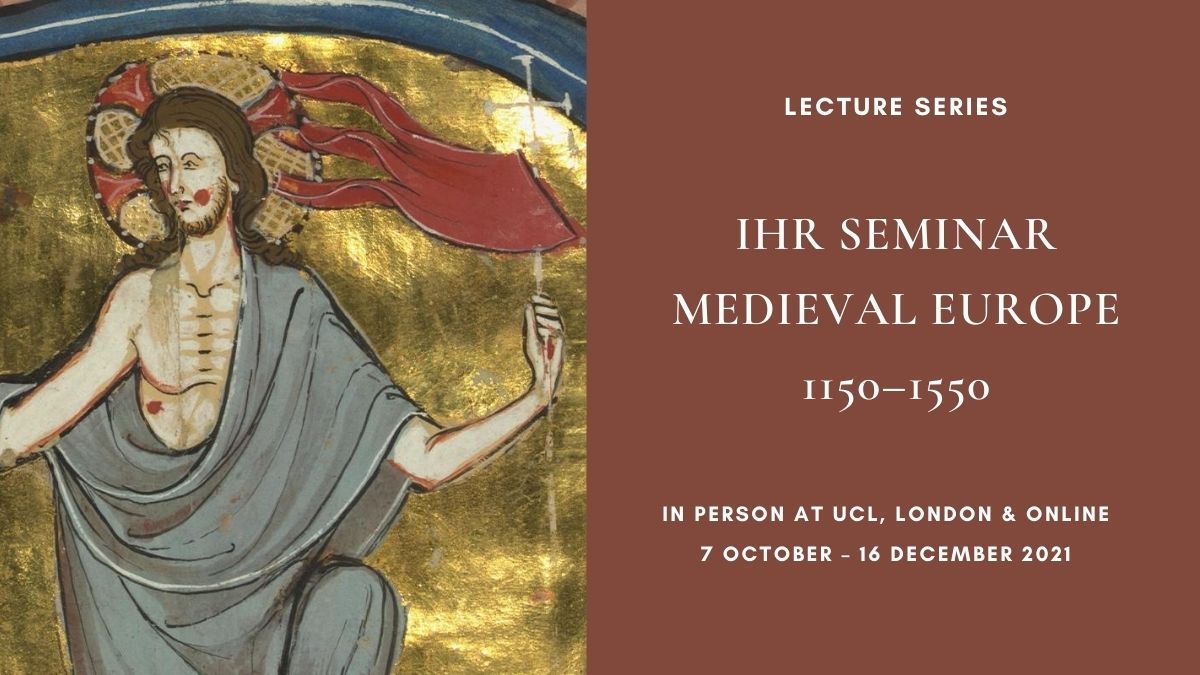
Autumn lecture series: IHR Seminar Medieval Europe 1150–1550

This year the IHR seminar series will take place in a hybrid form, with some in-person meetings with a live-stream via the usual Zoom room, and some Zoom-only seminars as well. All who wish to attend the seminar in person are very welcome.

The in-person seminars will take place at UCL in Cruciform LT2 (entry via Gower Street), and we still occupy our traditional Thursday evening slot, 5.30pm.

Whether you attend online or in person, it is necessary to register for the event via the IHR Seminars website (the events will go online very shortly).

If you have any questions or enquiries please address them to Andrew Jotischky (Andrew.Jotischky@rhul.ac.uk) or Emily Corran (emily.corran@ucl.ac.uk)

Find out more here.

7 October 2021

  • John Gillingham (LSE), Lindy Grant (Reading) John Sabapathy (UCL) Alice Taylor (KCL): ‘Remembering the work of Michael Clanchy, Susan Reynolds and Donald Matthew.’
  • Zoom and UCL, Cruciform LT2

21 October 2021

  • Philip Slavin (Sterling): ‘The Rise, Persistence and Decline of a Central European Plague Reservoir: c.1350–1500’
  • Zoom and UCL, Cruciform LT2

4 November 2021

  • Sophie Thérèse Ambler (Lancaster): ‘The Battle of Evesham (1265), the relics of Simon de Montfort, and the war of the Welsh march’
  • Zoom and UCL, Cruciform LT2

18 November 2021 – PhD Session

  • Caitlin John (UCL): ‘Cities of the Living and the Dead: Sultanic and Royal Burial in Late Medieval Cairo and Paris Compared.’
  • Eliot Benbow (QMUL): ‘Trade of Devotional Objects in Later Medieval London: Evidence from the City Customs Accounts, c. 1380–1530’
  • Zoom and UCL, Cruciform LT2

2 December 2021 (Online)

  • Christoph Maier (Zurich): ‘Jews, Popes and Crusaders in 1236: A Case Study’
  • Zoom

16 December 2021

  • Emily Guerry (Kent): ‘From four nails to three: Abbot Suger, the reinvention of Crucifixion iconography, and the cult of Passion relics at Saint-Denis’
  • Zoom and UCL, Cruciform LT2

Lecture Series: British Archaeological Association Programme of Meetings 2021-2022

The British Archaeological Association holds regular monthly lectures on the first Wednesday of each month between October and May in the rooms of the Society of Antiquaries of London, Burlington House, Piccadilly, London W1J 0BE.

Please note: However, it may be that precautions against the spread of Covid-19 make this impossible, in which case the lectures will be given online. Details on a lecture-by-lecture basis will be posted on the BAA website.

At the Society of Antiquaries of London: Tea is served from 4.30 p.m. and the Chair is taken at 5.00 p.m. 

The lectures are open to all and provide an opportunity for professionals, students and independent scholars to present research that falls within the BAA’s areas of interest. 

6 October 2021

‘From defacement to revivification: a digital-archaeological approach to illuminating the nave paintings of St Albans Cathedral’

Professor Michael Michael, Hon. Fellow, University of Glasgow

3 November 2021

‘Imagining Jerusalem in Late Medieval Scotland’

Dr Lizzie Swarbrick, Edinburgh University

1 December 2021

‘The Henry of Blois Enamels: A(nother) Reassessment’

Dr John Munns, Magdalene College, Cambridge

5 January 2022

‘Early Irish Sculpture and the Art of the High Crosses’

Professor Roger Stalley, Trinity College, Dublin

The lecture will be followed by the Association’s Twelfth-Night Party

2 February 2022

‘Antiquarian Societies and Scholarly Networks: Collectors, Curators and Conferences’

Dr Naomi Speakman, British Museum

2 March 2022

‘Writing Weaving at Sankt Klara, Nuremburg: A Consideration of Wolfenbüttel, Herzog August Bibliothek, Cod. Guelf. 57 Aug.8’

Dr Megan McNamee, Edinburgh University

6 April 2022

‘Building the Parish Church 1150-1300’

Dr Meg Bernstein, University of York

 4 May 2022

‘Gothic Networks: Juan Guas in Fifteenth-Century Spain’

Dr Costanza Beltrami, University of Oxford

The lecture will be followed by the President’s Reception

Online Study Day: The Digital Medieval Manuscript, University of St Andrews Online, 8 October 2021 15:00-19:00 PM BST

The Digital Medieval Manuscript, University of St Andrews Online via Microsoft Teams, October 8, 2021, 3:00-7:00 PM (BST)

This expert meeting will take place 8 October 2021, from 15:00-19:00 BST. It is hosted by Prof. Kathryn Rudy and Suzette van Haaren, School of Art History, University of St Andrews (Scotland). Panel discussions will centre on pre-recorded and pre-circulated talks. 

In a single click, a tap or swipe, the medieval manuscript appears on our screens: thousands of pixels light up and the ancient book lies open before us, in our office rather than in the reading room. The digital images emulate the book-like object in a two page-spread, or even animate it with graphics that turn its pages. We move through a digital facsimile that is reminiscent of its physical counterpart, and simultaneously is strange and new. What we see is familiar: age-stained parchment, neat script, colourful miniatures and gilded details. But we do not feel the subtle flexibility and soft skin of the parchment between our fingers as we turn the page — instead we feel the hard plastic of our mouse or trackpad, or the glass of our screens. The digital manuscript facsimile is not a medieval manuscript. Yet, the digital is fundamentally connected to parchment pages inscribed, decorated and bound in the Middle Ages.

The digital medieval manuscript has become exceedingly important for how medieval parchment codices are handled, studied and preserved. Libraries, museums and rare book collections are increasingly digitising their material, making objects more accessible to a larger public. Medieval manuscripts are being handled much more in digital environments than they are in reading rooms. Critically examining the effects of digitisation is fundamental to understand how medieval manuscripts move through the world today. The digital environment poses new affordances and constraints, bringing up many practical and ontological questions and ideas surrounding the medieval manuscript and its digital counterpart.

The organisers have invited experts in the field ranging from academics to digitisation specialists (and all overlaps imaginable) to talk about the digitsation of medieval manuscripts. The panel members have sent in videos. These will be available online from 1 October 2021 for everyone to watch.

During the expert meeting itself the panel members will engage in discussions surrounding their specific video topics. Audience members are encouraged to ask questions that contribute to the discussions.

Advance registration required.

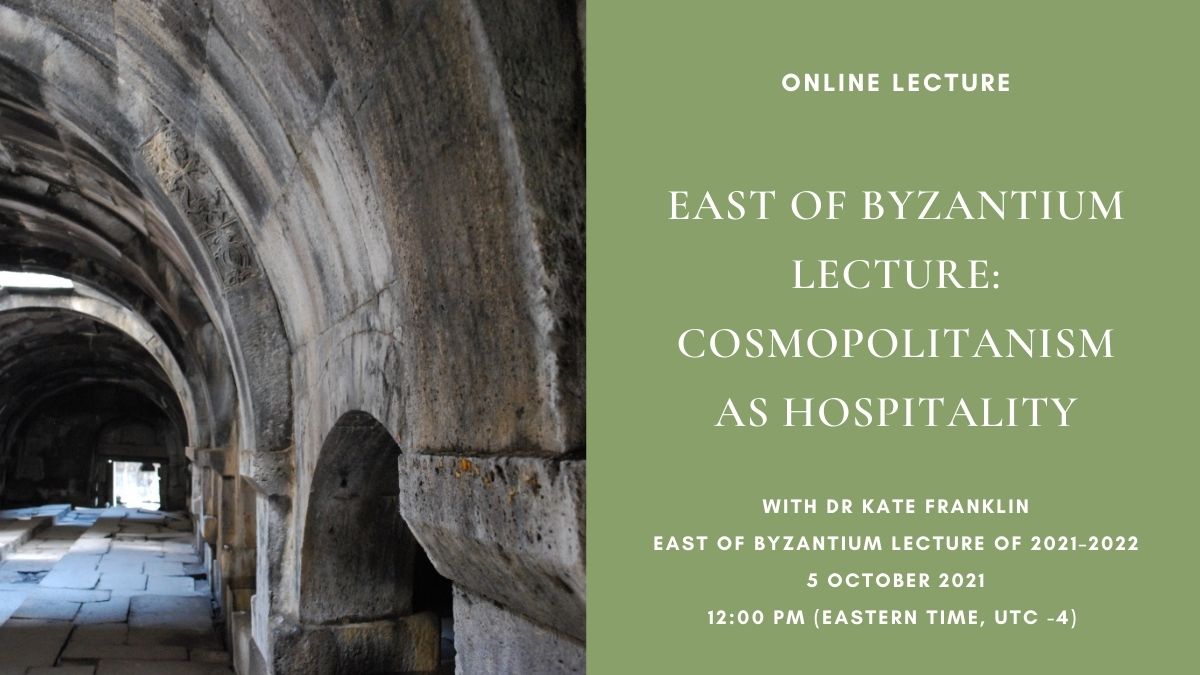
Online Lecture: ‘East of Byzantium Lecture: Cosmopolitanism as Hospitality’ with Dr Kate Franklin, East of Byzantium lecture of 2021–2022, 5 October 2021, 12:00 pm (ET)

How was a caravan inn a metaphor for the medieval self?
In this paper I will explore the materiality of charity in high medieval (13th-14th century) Armenia, and in particular the space-times made at the intersection of local politics and expansive worldviews, which worked to contain and produce the mobility and exchange now referred to as the medieval Silk Road. The paper will start from the perspective of the medieval caravan inn– or karavanatun in Armenia– and consider both the broader landscapes of piety and the everyday practices of hospitality which held together complexly interwoven cultures and identities in the medieval period. Bringing together archaeological as well as historical and epigraphic evidence, the paper will examine how nested metaphors of self, space, society, and cosmos linked religious tradition to trade worlds, as well as knitting together the edges of Christian and Muslim identities in the transformative period of the Mongol conquest.

Kate Franklin is an anthropological archaeologist and Lecturer in Medieval History at Birkbeck, University of London. Her work is focused most closely on Armenia in the Mongol period, and specifically engaged with techniques of world-making and Silk Road cosmopolitanism. Dr. Franklin’s dissertation (University of Chicago, 2014) centered on excavations at the Arai-Bazarjul caravanserai in the Kasakh Valley. Her current research explores the layered cultural landscapes of Orbelyan-era Vayots Dzor. Prior to her position at Birkbeck she has taught anthropology, archaeology and history at the University of Chicago as Dumanian Visiting Professor in Armenian Studies, and at the School of the Art Institute of Chicago. She has published on caravan infrastructure, medieval embodied politics, landscape, memory, and everyday life; her book Everyday Cosmopolitanisms: Living the Silk Road in Medieval Armenia will be published (in print and Open Access) in September 2021 from University of California Press.

This lecture will take place live on ZOOM, followed by a question and answer period. Please register to receive the Zoom link. An email with the relevant Zoom information will be sent 1–2 hours ahead of the lecture. Registration closes on October 5, 2021, at 9:00 AM. Time Zone Converter

REGISTER | POSTER

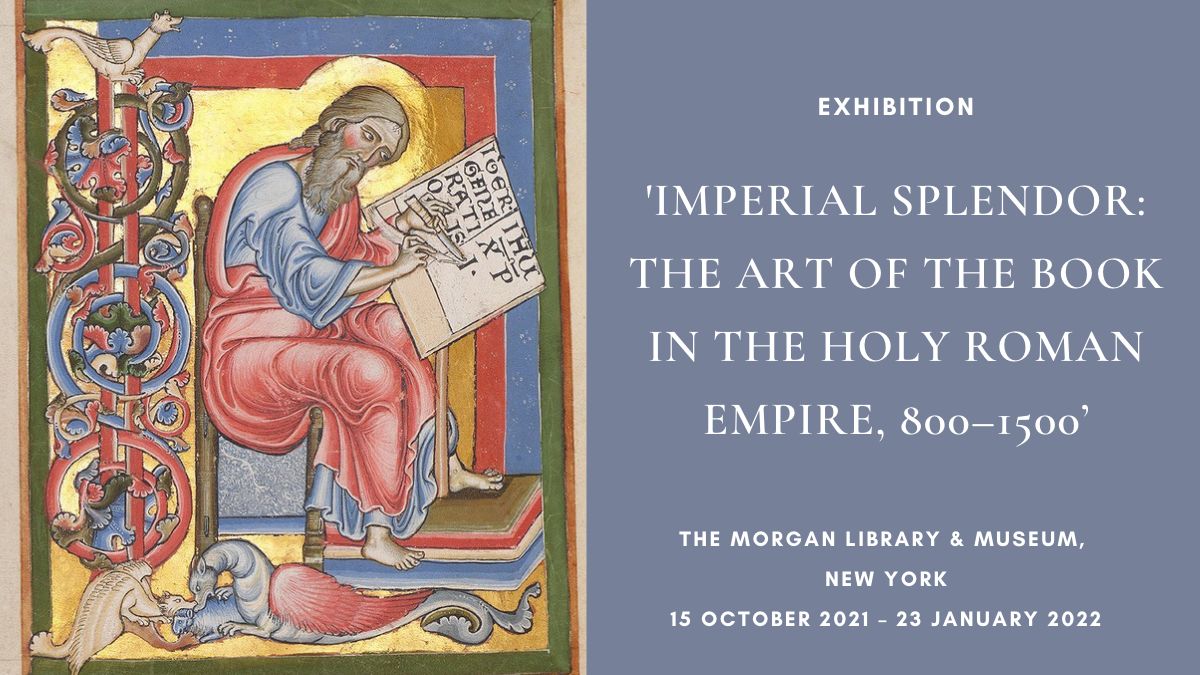
Exhibition: ‘Imperial Splendor: The Art of the Book in the Holy Roman Empire, 800–1500’, The Morgan Library & Museum, New York, 15 October 2021 – 23 January 2022

Imperial Splendor offers a sweeping overview of manuscript production in the Holy Roman Empire, one of the most impressive chapters in the history of medieval art. While little known and rarely seen by the general public, these illuminated manuscripts count among the most luxurious works of art from the Middle Ages. Designed to edify, to entertain, and above all to embody the sacred, these manuscripts and their spectacular illuminations retain the ability to dazzle and inspire modern audiences just as they did those of the Middle Ages. Bringing together some seventy manuscripts from collections across the country, the exhibition begins with the reforms initiated by Charlemagne, the first emperor following the fall of Rome. It ends with the flurry of artistic innovation coinciding with the invention of the printing press and the onset of humanism in the fifteenth century. As the first major presentation of this subject in the English-speaking world, Imperial Splendor introduces visitors to fundamental aspects of this history, including how artists developed a visual rhetoric of power, the role of the aristocratic elite in the production and patronage of manuscripts, and the impact of Albrecht Dürer and humanism on the arts of the book.

Find out more about the exhibition here.

New Publication: ‘The Birth of the Author: Pictorial Prefaces in Glossed Books of the Twelfth Century’ by Jeffrey F. Hamburger

Studies and Texts 225; Text Image Context: Studies in Medieval Manuscript Illumination 9 • xxvi, 302 pp. incl. 150 colour illus. • ISBN 978-0-88844-225-3 • Cloth • $100

This book argues that the images devised to accompany medieval commentaries, whether on the Bible or on classical texts, made claims to authority, even inspiration, that at times were even more forceful than those made by the texts themselves. Paradoxically, it was in the context of commentaries that modern concep­tions of independent authorship first were forged. 

Looking beyond author portraits and the genre known as the accessus ad auctores, usually seen as the sites of such claims, this study examines pic­torial programmes in copies of Horace’s poetic works, the Glossa ordinaria, the dominant biblical commentary of the first half of the twelfth century, anti-heretical polemics, and Rupert of Deutz’s commentary on the Song of Songs. The inventive images fashioned to accompany these works do not merely illustrate or exemplify pre-existing understandings of authorship; rather, they help to shape them at the very moment at which a particular historically situated set of ideas about authorship was itself coming into being.

Pictorial prefaces of the twelfth century represent commentaries of their own that work both in concert with the commentaries to which they are attached but also, at times, in ways that go beyond anything that the commentator himself authored or authorized. In this way, they participate in a broader trend in the High Middle Ages to cham­pion the ability of images to articulate and elabo­rate in the manner of rhetorical persuasion com­plex arguments regarding critical matters of faith.

Find out more here.

About the Author

Jeffrey F. Hamburger is the Kuno Francke Professor of German Art and Culture in the Department of the History of Art and Architecture at Harvard University. His most recent book is Diagramming Devotion: Berthold of Nuremberg’s Transformation of Hrabanus Maurus’s Poems in Praise of the Cross (2020). He is co-author, with Eva Schlotheuber, Margot Fassler, and Susan Marti, of Liturgical Life and Latin Learning at Paradies bei Soest, 1300–1425 (2017), and co-editor, with Robert Suckale and Gude Suckale-Redlefsen, of Painting the Page in the Age of Print: Central European Manuscript Illumination of the Fifteenth Century (2018), also published in Text Image Context.

“This is a brilliant study of illuminated manuscripts of authoritative writers which moves beyond specific author-portraits to explore a wider interpretive context, including representations of the writers of commentaries on auctores and indeed imagery which leaves the human form behind. Monastic illuminators constructed perspectives both narrative and allegorical, which did not merely exemplify or parallel, but did much to shape, ideas of authorship then becoming current in literature. Those artists were prominently present at ‘the birth of the author.’

Jeffrey Hamburger establishes the significance of their genre of the ‘pictorial preface’ and explores the ways in which it shaped readers’ perception of texts, and of those to whom their authorship was attributed, with sensitivity and brio. His methodology throughout is intellectually convincing and aesthetically appealing, and his command of the primary images and texts, along with secondary literature in several European languages, impeccable. Elegantly and enthusiastically written, The Birth of the Author is the very model of what interdisciplinary research should be. It demonstrates superbly well that images which functioned as avatars of authorship and authority could, in their own right, serve as vessels of truth and vehicles of complex, self-conscious argumentation.”

Alastair J. Minnis, Yale University

Ordering

Customers in North America please order through University of Toronto Press Distribution External Link . Please contact UTP Distribution directly by email, phone, or mail (PIMS books are not available through the UTP online catalogue). PIMS books are also available on Amazon External Link .

Customers outside North America please order through Brepols Publishers External Link . PIMS books are available through the Brepols online catalogue External Link .

Online Course: ‘Manuscripts in Arabic Script: Introduction to Codicology’, Aga Khan University, 15–16 November 2021

This online course aims to introduce key concepts in the field of Arabic manuscripts and codicology. It is designed to attract participants who want to learn basic knowledge about Arabic manuscripts. The first day will provide an overview of the field of codicology and its role in the manuscript field in general and in identifying key features of manuscripts in particular. The second session will be dedicated to writing supports, the structure of quires, ruling and page layout, bookbinding, ornamentation, tools and materials used in bookmaking, and the palaeography of book hands. Some practical examples will be given based on the lecturers’ long experiences. The second day will focus on the importance of manuscripts in research. While the first session will cover the paratextual features in the Arabic manuscripts, the second session will demonstrate the different approaches in editing manuscripts.

This introductory course is intended for students, researchers, and librarians who wish to increase their knowledge in the manuscript field.

Learning Outcomes:
Basic understanding of the field of Arabic manuscript studies.
Identify the role of manuscripts in knowledge production in different areas of studies in Muslim cultures.

Download course structure: https://fal.cn/3ilBC

Course Convenors:

Dr Walid Ghali is the Head of the Aga Khan Library, London, Associate Professor of Islamic and Arabic studies at the Aga Khan University’s Institute for the Study of Muslim Civilisations and a Chartered Librarian of the Chartered Institute of Library and Information Professionals (CILIP). Dr Ghali received his PhD in Islamic Manuscript Studies from the Faculty of Arts, Cairo University (2012). Dr Ghali’s current research projects focus on Islamic manuscript traditions, particularly in Arabic script and book history. He has published on Arabic literature, Sufi traditions and Islamic manuscripts cultures.

Dr Anne Regourd is researcher at the Centre National de la Recherche Scientifique/French National Centre for Scientific Research (CNRS) in Paris, France. She has published extensively in the fields of History and Philology dealing with Codicology, Paper Studies, and Papyrology. She is the editor of book, The Trade in Papers Marked with Non-Latin Characters, Leiden, E.J. Brill, 2018, and heads the free access online journal, Nouvelles Chroniques du Manuscrit au Yémen.

Dr Eléonore Cellard is a specialist in Qurʾānic manuscripts. She started her research activities in 2008 under the supervision of Professor François Déroche. In 2015, she submitted her dissertation entitled The Written Transmission of the Qur’an: Study of a Corpus of Manuscripts from the 2nd Century AH/ 8th Century CE (INALCO/EPHE). She has collaborated on several international projects about Qurʾānic manuscripts, and recently carried out a research project on one of the Qurʾān copies attributed to the caliph ʿUthman ibn Affan’. She has also authored several monographs and articles on Qurʾānic manuscripts.

Date and Time:
15–16 November 2021, 11:00–15:00 (London Time).

Registration:
Register now and join us online: https://fal.cn/3ilBx

Organiser:
Aga Khan University’s Institute for the Study of Muslim Civilisations (AKU-ISMC), London.

*The course will be delivered via Zoom and further details will be provided later upon registration.

Find out more here.

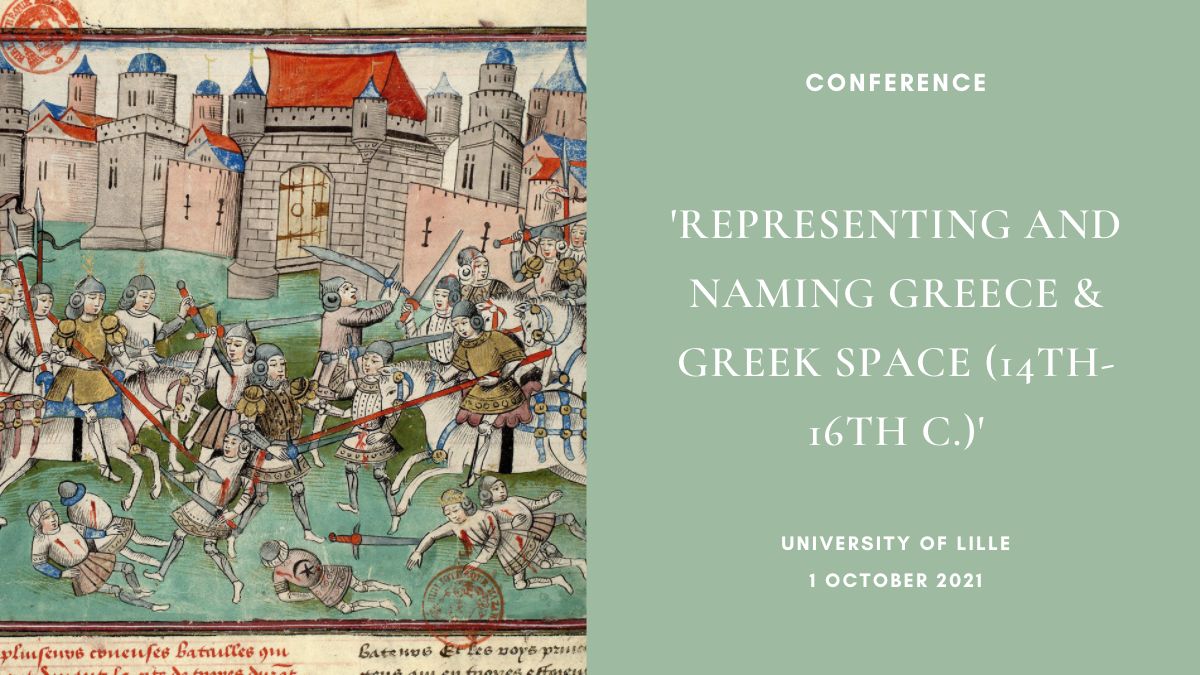
Conference: ‘Representing and naming Greece & Greek space (14th-16th c.)’, University of Lille, 1 October 2021

This conference will focus on the representations of Greek space, ancient and “modern”, in textual and iconographic works from the 14th to the 16th century. It will take place at the University of Lille on October 1, 2021 and is organized by Catherine Gaullier-Bougassas.

Find out more here.

Conference Programme

9h30 – Accueil

9h45 – 10h15 :
Marilynn Desmond (Binghamton University): ‘Trojan Typography and Fourteenthcentury Cartographies of the Morea in the Matter of Troy’


10h30 – 11h00: Pascale Mounier (Université Grenoble Alpes): ‘La Grèce de Thésée d’après la Teseida de Boccace et ses adaptations françaises’


11h15 – 11h30 : pause


11h30 – 12h00: Georges Tolias (EPHE ; Fondation Nationale pour la Recherche Scientifique,
Athènes): ‘Penser et représenter la Grèce au XVe siècle’

12h15 – 14h15 : repas

14h15- 14h45: Emmanuelle Vagnon-Chureau (CNRSLAMOP): ‘Cristoforo Buondelmonti et ses sources
dans sa représentation de la Grèce »

15h00- 15h30: Nathalie Bouloux (Université de Tours): ‘Sebastiano Compagni, géographe
humaniste vénitien (et «ptoléméen») de la fin du XVe siècle début du XVIe s. et sa description de la Grèce’


15h45- 16h15: Edith Mazeaud-Karagiannis ((Université de Strasbourg): ‘Les évocations du Péloponnèse dans l’œuvre des voyageurs français de la seconde moitié du XVIe (Belon, Nicolay, Thevet)’


16h30 – 17h00: Discussion

CFP: ‘Crafting Medieval Spain: the Torrijos ceilings in context’, For Art History 2022 Annual Conference, Deadline 1 November 2021

This session will explore the legacy of Islamic art in Europe through its medieval ceilings, many of which are dispersed as architectural fragments in contemporary museums. It will focus on the case study of the Torrijos ceilings, four monumental wooden ceilings that were commissioned in the 1490s by a couple close to the Catholic Monarchs, for their palace in Torrijos near Toledo (Spain). The ceilings were separated in 1904 when the Torrijos palace was dismantled, and they are now dispersed across collections in Europe and the USA. Despite their significance to histories of both Islamic and European art, these important objects remain under-explored. As objects made using techniques and motifs associated with Islamic craftsmanship, the Torrijos ceilings are not considered European enough to sit within western art history; on the other hand, their commission for a Christian-owned palace using a style adapted to Gothic taste means that neither are they considered within Islamic art history.

Drawing from a new interdisciplinary BA/Leverhulme funded research project with these ceilings at its heart, this panel invites papers that more fully contextualise the ceilings and their role in understanding the complex history of Islamic art in Europe. We seek to discuss the circumstances of the ceilings’ original making and decorative choices; the relationship of their carpentry techniques to earlier traditions, especially in the wider Islamic world; their fragmentation and acquisition, in the wider context of the dispersal of Spain’s cultural heritage in the late 19th and 20th centuries; their modes of display, and the potential for these ceilings to foster a new understanding of Spain’s medieval craftsmanship among contemporary museum-going publics.

Website: https://www.vam.ac.uk/research/projects/crafting-medieval-spain-the-torrijos-ceiling-in-the-global-museum
Instagram: @craftingmedievalspain

  • Mariam Rosser-Owen, Curator Middle East, Victoria and Albert Museum, m.rosserowen@vam.ac.uk, @mrosserowen
  • Anna McSweeney, Lecturer in History of Art and Architecture, Trinity College Dublin, mcsweean@tcd.ie

Find out more information here.

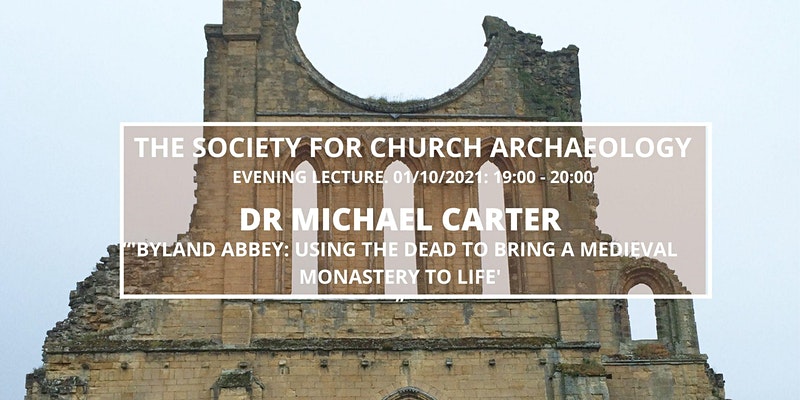
Online Lecture: ‘Byland Abbey: using the dead to bring a medieval monastery to life’, with Dr Michael Carter, Society for Church Archaeology, 1 October 2021, 19–20:00 (BST)

The Society for Church Archaeology is delighted to welcome Dr Michael Carter who will deliver an online lecture on the topic of ‘Byland Abbey: using the dead to bring a medieval monastery to life’. Dr Michael Carter got his PhD from the Courtauld Institute of Art for a thesis on Cistercian art and architecture in late medieval England, and is Senior Properties Historian at English Heritage. His interests are especially focused on monastic art and architecture.

The lecture will be hosted through Zoom and will take place on Friday 1st October 2021 from 19:00 to 20:00.

Please note: When you register for this talk you will receive an email (with reminders leading up to the event) with a link to a unique Online Event Page. This is where you will be able to access the talk at the scheduled time and date as listed.

Get your ticket here.