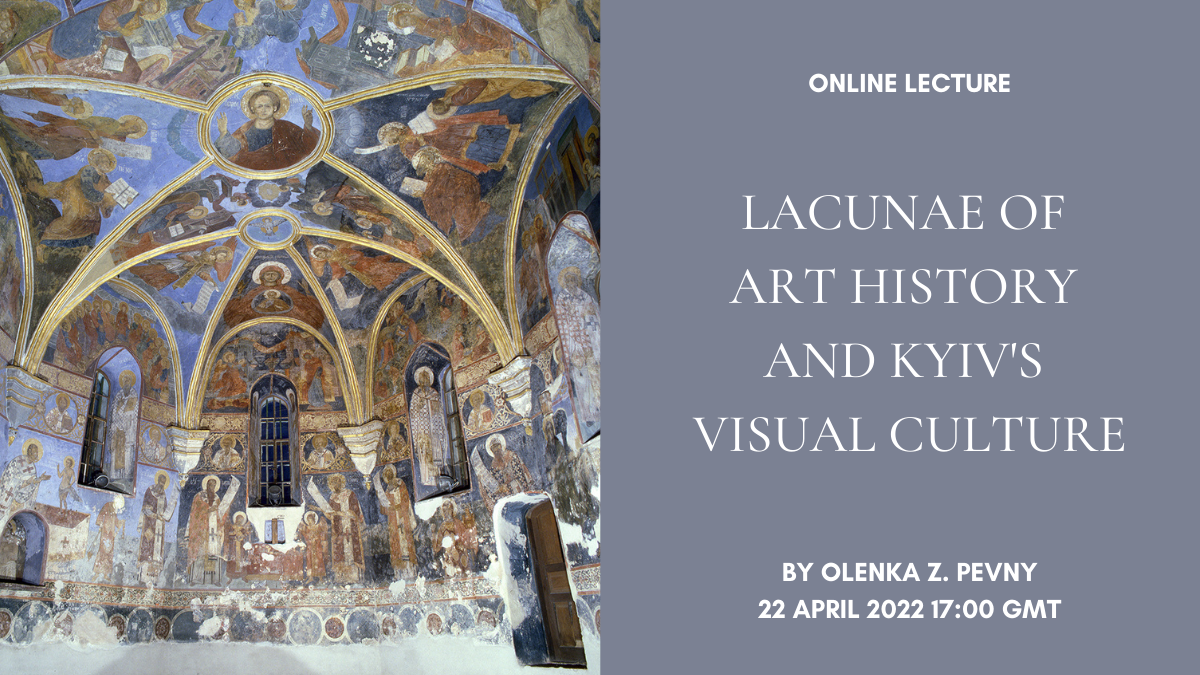
Online Lecture: ‘Lacunae of Art History and Kyiv’s Visual Culture’, by Olenka Z. Pevny, 22nd April 2022, 17:00 GMT

REGISTER

Dr. Olenka Z. Pevny is Associate Professor of Slavic and Ukrainian Studies at the University of Cambridge. She is a cultural historian of medieval Rus’ and early modern Ukraine. Her primary research focuses on the place of visual culture in the shaping of premodern and modern identities. Dr. Pevny is the author of numerous articles on Byzantine, Rus’, and Ukrainian baroque culture. She also writes on nineteenth century and Soviet cultural restoration practices.

This lecture is part of a series of events co-organized by Dumbarton Oaks in collaboration with North of Byzantium and Connected Central European Worlds, 1500–1700. Ukraine’s history, art, and culture are endangered by the ongoing war. This lecture and conversation series by experts in the fields of history, art history, archaeology, heritage, sociology, as well as museums and conservation, among others, presents the region’s rich historical and cultural complexity through its objects, sites, and monuments. A focus on the medieval and early modern periods featuring Greek, Latin, and Slavic contacts brings to the fore critical evidence to counter modern misrepresentations of Ukraine’s history and cultural heritage. 

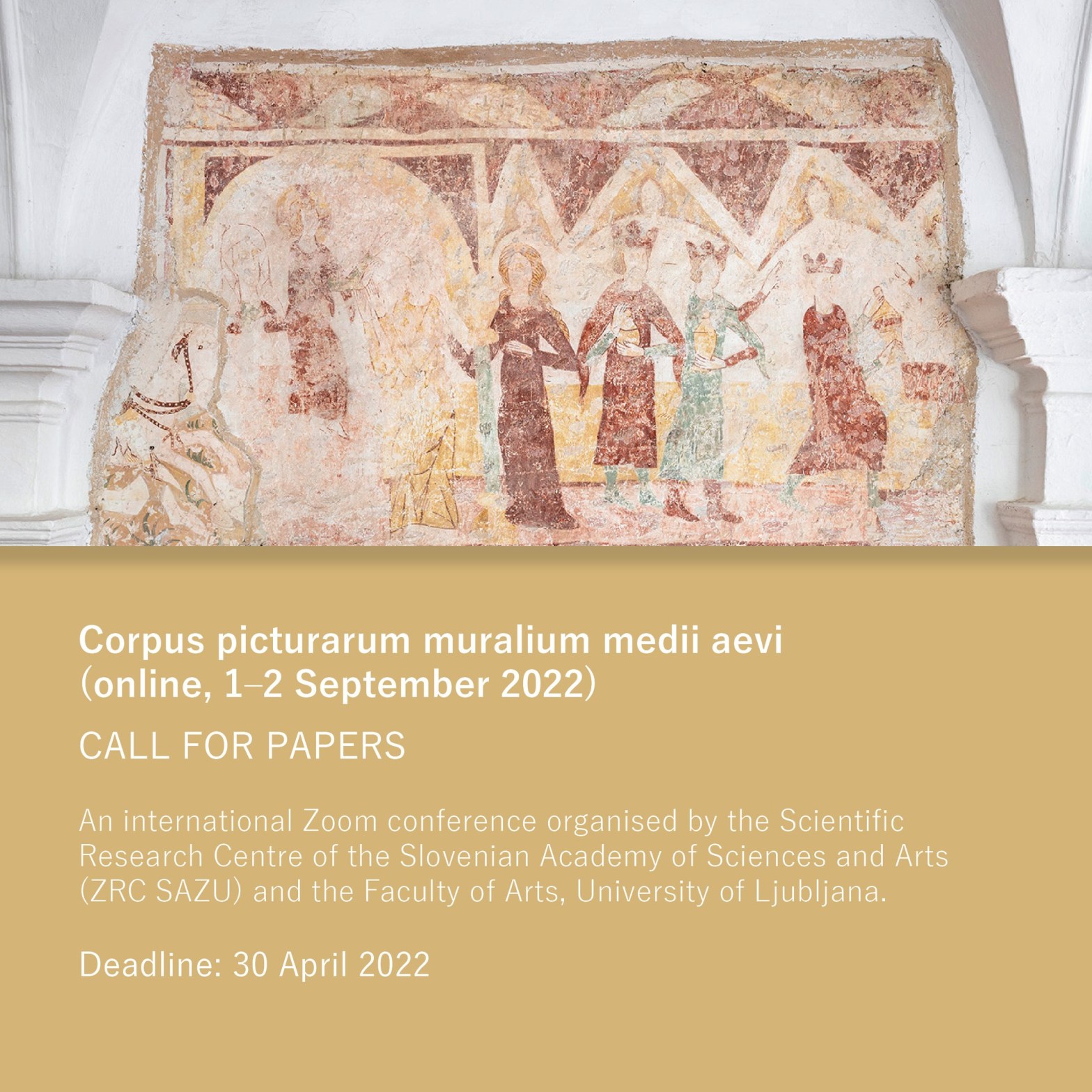
Call for Papers: ‘Corpus pictuarum muralium medii aevi’, 1st – 2nd September 2022 (Deadline 30th April)

Since 1 September 2020, the Scientific Research Centre of the Slovenian Academy of Sciences and Arts (ZRC SAZU) has led the research project titled Transformations – from Material to Virtual. Digital Corpus of Mural Painting – New Dimensions of Medieval Art Research in Slovenia. The project partner is the Faculty of Arts of the University of Ljubljana. The project’s main goal is to set up an online scientific corpus of medieval mural painting in Slovenia with the universal title Corpus picturarum muralium medii aevi. Within this project, we are developing a corpus of mural paintings in Slovenia until circa 1380, which will be expanded with further projects to include paintings until around 1500. Another project objective is to organise an international conference on medieval mural painting at the transition between the Romanesque and Gothic style, the creation of medieval art heritage corpora, and various aspects of medieval art analysis with an international discussion about the establishment of the joint international database Corpus picturarum muralium medii aevi.

The transition between the first two universal European art periods – the Romanesque and the Gothic – has been a major research topic for a long time. Nevertheless, this transition still represents an enormous methodological challenge, even in the field of mural painting. Outside its homeland of France, the Gothic style asserted itself very gradually and through various paths, spreading throughout the rest of Europe and even beyond. The characteristics of this expansion can be gleaned precisely from the mural paintings dating back to this period – particularly in the case of buildings that would later be heavily reconstructed and whose movable furnishings (table paintings, altars, manuscripts, reliquaries, etc.) have been long lost. Especially the examples from Central Europe, featuring phenomena such as the zig-zag style and the often robust Romanesque tradition up to the 14th century, indicate that the process of the Gothic style reception was exceedingly complex. The medieval late Romanesque and (early) Gothic mural painting thus calls for a constant questioning of the established hypotheses and a broadening of the methodological and increasingly also technological approaches – both in the fields of interpretation and discovery as well as conservation, restoration, and documentation. The advances in the field of digital humanities, in particular the creation of digital databases that facilitate the overview of such dispersed subjects, also play an increasingly important role in medieval mural painting research.

Therefore, the upcoming conference aims to open a discussion on the new approaches to the study of medieval mural painting and seek answers to questions such as: how do the discoveries of new paintings or the development of new approaches expand on the ideas about the iconographic and stylistic profile of mural painting between the Romanesque and the Gothic periods? To what extent do new technologies or their increased availability influence research? What has been the experience in creating and linking (digital) corpora of medieval art heritage? What is the significance of discovering, exhibiting, and reinterpreting medieval mural paintings in the broader political context of the 20th century in particular?

The proposed topics may include but are not necessarily limited to the following:
– new medieval mural painting research discoveries;
– spatial or visual references of medieval mural paintings to other art genres;
– new discoveries about the roles of artists, commissioners, and reception;
– comparative analyses with other periods and regions (the influences of Byzantine, Islamic, and other art);
– new technical methods for research, discovery, restoration, documentation, etc.;
– issues related to collecting, editing, and presenting research in the digital media;
– digital corpora of medieval wall paintings;
– new overviews and outlooks on the history of medieval mural painting research;
– reception of mural painting between the Romanesque and Gothic styles in the subsequent periods;
– broader socio-political analysis of mural paintings in the context of the 20th-century medieval art research.

Proposals for contributions in the English language and approximately 20 minutes long, consisting of a title and an abstract not exceeding 250 words, should be sent together with a short CV of no more than a single page to cfp.uifs@zrc-sazu.si, by 30 April 2022. The selection is expected to be completed by 30 June 2022.

Organisers:
Assistant Professor Dr Mija Oter Gorenčič, ZRC SAZU, France Stele Institute of Art History, Ljubljana, and Faculty of Arts, University of Maribor
Assistant Professor Dr Gašper Cerkovnik, Faculty of Arts, University of Ljubljana

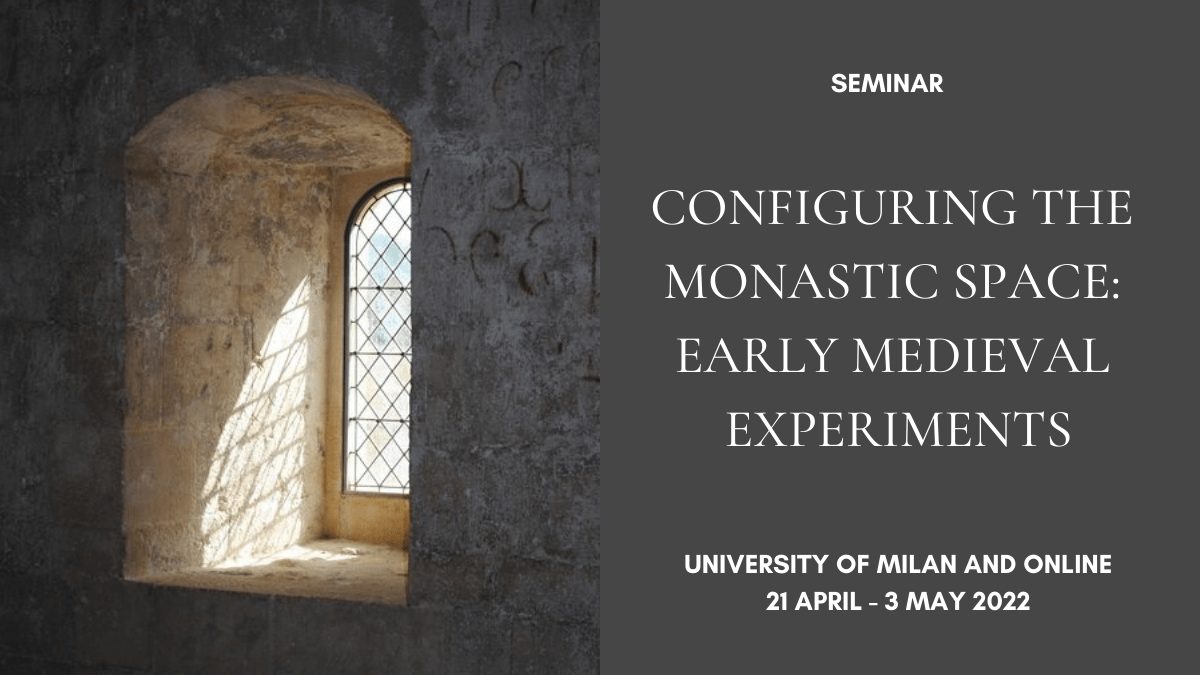
Seminar: ‘Configuring the Monastic Space: Early Medieval Experiments’, University of Milan and Online, 21st April – 3rd May 2022

The planimetric and functional standardization of monastic architectural settings is an achievement of the Romanesque period. During the early Middle Ages, monastic settlements were shaped through the progressive aggregation of spaces; pre-existencing structures and different levels of resources or skills often affected constructions. This approach led to a diversity of forms, sizes, site plans, and functions, though the latter also reflected differing liturgical customs. The workshop will explore this architectural experimentation, seeking to identify, and to contextualize, similarities, differences, and trends.

AGENDA:


Seminars will be held both at the University of Milan and in streaming (link available here: unimi.academia.edu/FabioScirea )

21.04.2022 – 10.30-12.00: Federico Marazzi (Università degli Studi Suor Orsola Benincasa), Indipendenza e interdipendenza: l’insediamento monastico tra desiderio di separatezza e necessità di connessione con il mondo.

26.04.2022 – 12.30-14.00: Stella Ferrari (Università degli Studi di Milano), Esperimenti urbani: insediamenti e spazi nei monasteri femminili.

28.04.2022 – 10.30-12.00: Fabio Scirea (Università degli Studi di Milano), Gli spazi monastici dell’insediamento di Torba, presso Castelseprio

03.05.2022 – 12.30-14.00, aula K 31: Eleonora Destefanis (Università del Piemonte orientale), Monasteri altomedievali del Piemonte: strutture materiali e organizzazione degli spazi.

Call for Papers: ‘Monumental Medievalism, Public Monuments, and the (Mis)Use of the Medieval Past’, 5th-6th October 2022 (Deadline 1st July 2022)

In the summer of 2020, one of several dozen protests organised throughout the world in response to the murder of George Floyd in Minneapolis (USA) culminated in the statue of the slave trader Edward Colston being dumped into the water of Bristol Harbour (England). The ripples were felt across the globe. In the ensuing days, weeks and months, scores of other monuments depicting historical figures were variously defaced, toppled, removed from view, or placed under new scrutiny. Many of these had played prominent roles in the slave trade and/or in European colonialism. Some of these monuments were of medieval figures, while others were evocative—to varying degrees of credibility—of the (faux-)chivalric codes and rose-tinted regalia of the medieval past. Of course, to medievalists, the convergence of civic and civil statuary with protest and activism was nothing new. In fact—from the damnatio memoriae of later Roman Emperors to Saints Florus and Laurus smashing statues in Kosovo; Byzantine Eikonomachía; Aniconism in medieval Islam; the Huichang Persecution of Buddhist images; the Ghaznavid plundering of Mathura and Somnath; the Khmer intolerance of Jayavarman monuments in Angkor; the Strigólnik stripping of Pskov and Novgorod; and the First and Second Suppression Acts of the 1530s—many of its roots actually lie in the medieval world. What use then, or advantage, might the study of the Middle Ages hold in evaluating these modern political struggles? This workshop will address precisely this question.

The workshop has three aims. Firstly, it will explore examples of statues, monuments and related forms of public sculpture which speak to the ongoing making and unmaking of medieval figures, images and histories: what we term ‘Monumental Medievalism’. Secondly, in addition to considering the ‘when’, ‘how’ and ‘why’ of monuments’ original production, it will interrogate the varied and often contested meanings that monuments later acquired over time. Of special interest, moreover, will be papers that address not only the use but the misuse of the Middle Ages, in connection to questions of local identity, gender, sexuality, race, religion and/or marginalisation. Thirdly, it will take the measure of nostalgia for the Middle Ages in the twenty-first century, asking questions of appropriation, anachronism, authenticity, nationalism and reflecting upon the possibilities and pitfalls of conscripting medieval images to serve as contemporary cultural conduits.

The topics of papers may include, but are not limited to:

– The intersection of statuary invoking the Middle Ages with protest and awareness/activism in popular or political thought
– The global and/or post-colonial Middle Ages and monumental evocations of the medieval world in Africa, Asia, the Americas and Europe
– The creation, alteration or removal of statues of medieval figures in any context
– The use of medieval figures, tropes and traditions in memorials to frame post-medieval history
– The commemoration of medieval figures by, inter alia, national, civic and civil communities
– The role of monuments in debates over the legacy of divisive or contested medieval figures and histories

Scholars at all career stages, regardless of disciplinary background or affiliation status, are invited to submit a (max) 300-word abstract for their proposed paper, along with a short biography, by 1 July 2022. Scholars invited to present at the workshop will be contacted soon after. Papers should be 25-30 minutes long. Attendance will be free. This event is supported by Swansea University’s Research Centre for Medieval and Early Modern Studies (MEMO) and by the Paul Mellon Centre for Studies In British Art.

KEY DETAILS
Format: Online, via Zoom
Dates: 5-6 October 2022; sessions will run c. 1pm–6pm GMT
Organisers: Euan McCartney Robson and Simon John
Contact email: monumentalmedievalism@gmail.com

Call for Papers: ‘Encounters and Exchanges in a Global Past’, University of Oxford TGHS, 25th June 2022 (Deadline 1st May 2022)

The Oxford Transnational and Global History Seminar is inviting submissions for a postgraduate conference, Saturday 25 June, 2022. The conference will be held in person by the Oxford History Faculty.

We welcome submissions on the theme ‘Encounters and Exchanges in a Global Past.’ We will explore the ways in which encounters and exchanges were experienced in the near and distant past. Despite the recent proliferation of frameworks for understanding contact and the exchange of goods, ideas and biota that accompanied it, contact is rarely considered from a truly global perspective that spans millennia, continents and disciplines.

We welcome interdisciplinary submissions relating to exchanges across time and space. We are particularly interested in submissions on the infrastructure that underlay encounters and exchanges, such as technology and ideology; multi-scalar interaction; the role of translation in contact; the environmental history of encounters and exchanges.

Sessions will consist of 20-minute papers with time for questions and discussion. Interested postgraduates should send a 400-word abstract and brief biography to oxfordtghs@gmail.com. The deadline to submit is 1st May 2022.

Course: ‘The History of Science in the Medieval World’ Summer School, St Cyril and St Methodius University of Veliko Turnovo, 18th-22nd July 2022 (Deadline 29th April 2022)

The Summer School studies the wider medieval world of Afro-Eurasia and aims to shed light on Byzantium and the Slavonic world, and their intellectual heritage as agents in the development of medieval science, which, though significant, nevertheless remain largely unknown to the scholarly community. Even though current scholarship is focused on the so-called ‘Global Medieval’, the medieval Slavonic, Byzantine and Black Sea regions remain a blind spot for both the researchers and the general public outside of Central, Eastern and Southeastern Europe. Thus, the School aims at positioning Byzantium and the Slavonic world on the map of history of medieval science, thus offering the participants the rare opportunity to get acquainted with their respective heritage.

In its pilot edition, the Summer School will problematize the medieval manuscript and approach it as a space and as a territory. Building upon this conceptual premise, the School will also introduce students to the medieval epistemic fields (sciences) which study the natural world (the kosmos) as a space, namely geography, cosmography and astronomy. Students will acquire fundamental knowledge concerning the place and role of the sciences in the intellectual world of the Middle Ages. They will also develop an understanding of premodern science as a spectrum of disciplines wider than the late antique framework of the four mathematical sciences (arithmetic, music, geometry, and astronomy) and inclusive of all epistemic domains dedicated to the intellectual exploration of the natural world (the kosmos) and of humanity. The School relies on a discussion-based and experiential / experimental format. That is, the School includes workshops, which will guide the students into the use of medieval instruments and maps as preserved in the surviving manuscripts.

The common discussion language of the School will be English. If the participants know a medieval scholarly language (for this pilot edition: Latin, Greek and/or Old Church Slavonic, but in the future also Persian, Arabic, Chinese, Classical Armenian, and so forth), this would be an advantage, but it is not an essential requirement for participation.

We cannot offer any financial support to cover travel and accommodation expenses. There is no registration fee. In order to apply, please send a short bio and description of what motivates your application (maximum one page altogether). Please indicate in your application whether you would like to attend the Summer School in person or online. Please address your informal inquiries and your application materials to Dr Divna Manolova at dvmanolova@mpiwg-berlin.mpg.de. During the selection process, preference will be given to MA and PhD students, but researchers with interest in the Middle Ages and / or History of Science can also apply.

The School offers twelve places for in-person participants wishing to attend both the morning (lectures) and afternoon (workshops) sessions. There is no limit for the number of online participants, but their registration is restricted solely to the morning sessions.

Organized by University of Veliko Tarnovo “Sts. Cyril and Methodius” with Academic Theatre Ikaros, in cooperation with the International Summer Seminar in Bulgarian Language and Culture.

Course: “Fresco-Hunting” Photo Research Expedition to Medieval Balkan Churches, 21st May – 4th June 2022 (Deadline 21st April 2022)

The “Fresco-Hunting” Photo Research Expedition to Medieval Balkan Churches provides a unique opportunity for students and volunteers to take part in an expedition to document abandoned medieval churches/chapels and their frescos in western Bulgaria, and to visit many other Christian Orthodox churches, monasteries, museums and archaeological sites in Sofia and western Bulgaria. The expedition and the field school are coordinated by the Balkan Heritage Foundation (BHF).    

Participants receive training in survey management, digital photography, surveys of architecture and iconographic program, technical drawing, use of dumpy level, developing archives of digital images etc., introduction to Byzantine art,  architecture and religious iconography as well as photogrammetry, Reflectance Transformation Imaging (RTI) and other photographic techniques for documentation of cultural heritage.

The field school is designed for students and young specialists in heritage, archaeology and conservation as well as artists.

All candidates are expected to have some familiarity with the basic principles of photography and DSLR cameras.

Please submit an application by 21st April 2022.

Call for Session Proposals: Mary Jaharis Center Sponsored Panel, 48th Annual Byzantine Studies Conference, 3rd-6th November 2022 (Deadline 22 April 2022)

As part of its ongoing commitment to Byzantine studies, the Mary Jaharis Center for Byzantine Art and Culture seeks proposals for a Mary Jaharis Center sponsored session at the 48th Annual Byzantine Studies Conference to be held at the University of California, Los Angeles, November 3–6, 2022. We invite session proposals on any topic relevant to Byzantine studies.

Session proposals must be submitted through the Mary Jaharis Center website (https://maryjahariscenter.org/sponsored-sessions/48th-bsc). The deadline for submission is April 22, 2022.

If the proposed session is accepted, the Mary Jaharis Center will reimburse a maximum of 5 session participants (presenters and chair) up to $600 maximum for scholars based in North America and up to $1200 maximum for those coming from outside North America. Funding is through reimbursement only; advance funding cannot be provided. Eligible expenses include conference registration, transportation, and food and lodging. Receipts are required for reimbursement. For scholars participating remotely, the Mary Jaharis Center will reimbursement participants for conference registration.

For further details and submission instructions, please visit https://maryjahariscenter.org/sponsored-sessions/48th-bsc.

Please contact Brandie Ratliff (mjcbac@hchc.edu), Director, Mary Jaharis Center for Byzantine Art and Culture with any questions.

Petition to Save the Art History Programme at the National University of Arts, Bucharest

Please consider reading and signing this petition to help save the Art History MA programme “Visual and Curatorial Studies” at the National University of Arts, Bucharest, Romania. 

On March 23, 2022, the Senate of the National University of Arts in Bucharest voted to discontinue the MA programme “Visual and Curatorial Studies,” the only programme with this profile within the University, and the only MA programme of the Department of History and Theory of Art. This program is the oldest art history MA programme in Romania, with graduates numbering many distinguished figures that act today as important members of the cultural and scholarly communities.

To read more and to sign the petition, please click here.

Funding Opportunity: Medieval Academy of America Travel Grants (Deadline 1st May 2022)

The Medieval Academy provides a limited number of travel grants to help Academy members who hold PhDs but are not in full-time faculty positions, or are adjuncts without access to institutional funding, attend conferences to present their work. Exceptions to the PhD requirement may be made for unaffiliated or contingent scholars who are active in Medieval Studies.

Awards to support travel in North America are up to $500; for overseas travel the awards are up to $750.

1 May deadline is for meetings to be held between 1 September and 15 February.

Major national and international meetings will be given priority. Grants will be limited to one per applicant in a three-year period. Applicants must hold the Ph.D. degree and must be current members of the Medieval Academy.

Click here to apply.