Call for Papers: ‘The Medical Paratext’, University of Glasgow, 7th-8th September 2022 (Deadline 30th April 2022)

‘Paratext’ is a term coined by Gérard Genette in 1987 to refer to the material surrounding a printed text, including titles, prefaces, introductions, and footnotes. The notion of the paratext has recently been introduced to the study of medieval codices, with scholars working on medieval palaeography and codicology currently negotiating its various categorisations and the challenges thereof. An important category of medieval manuscripts that has often been neglected in that respect is that of medical codices. This conference aims to plug this gap by applying the concept of the paratext right to the very heart of the study of medieval medical manuscripts containing texts in a variety of languages, including Arabic, Persian, Greek, Hebrew, Latin, and other European vernacular. It thus seeks to make a significant advance in our understanding of how medieval medical manuscripts were used by their producers and consumers. We are interested in encouraging theoretical reflection on the following subjects/questions:

Different kinds and categories of paratextual elements (e.g. prefaces, foliation, decoration, illustrations, diagrams, annotations of any sort, colophons) and their significance;

  • Transformation of texts through paratexts. How can the use of specific paratextual elements enhance/influence the reading/understanding of a particular medical text/theory?
  • Paratextual elements as visual aids, especially, but not exclusively, in scholastic settings;
  • The features of scribal and editorial paratextuality in medical works;
  • Extensive paratexts (e.g. commentaries and scholia) and their function;
  • The mobility of paratexts (e.g. their infiltration into the main text) and the transmission of the resulting ‘hidden’ paratext;
  • Medical paratexts and their reception;
  • Paratext and memory in medieval medicine (e.g. through the lens of cognitive theory);
  • Paratext as a means of tracing the history of medical codices through time, geographical and social space;
  • Paratext as a means of constructing and disseminating medical knowledge. 

Our aim is to hold a face-to-face event. Each paper will be 30 minutes long followed by a session of questions and answers (around 10 minutes). We are looking for papers dealing with original and previously unpublished material; extended versions of the papers will form a peer-reviewed edited volume.

Scholars are invited to submit abstracts of ca. 250 words to sophia.xenofontos@glasgow.ac.uk and petros.bouras-vallianatos@ed.ac.uk by 30 April 2022.

Organised by Petros Bouras-Vallianatos (University of Edinburgh) and Sophia Xenophontos (University of Glasgow). Funded by the Wellcome Trust.

Workshop: Graduate Workshop on Diversity in the Medieval Middle East, 16th-20th May 2022 (Deadline 4th April 2022)

The medieval Middle East was the most ethnically, religiously, and linguistically diverse literate society in the premodern world. For intelligible institutional reasons, graduate study in our field often encourages specialization in one or another ethnic, religious, or linguistic group rather than examining medieval people’s mutuality and distinctions as lived experiences of social history. Recognition of various forms of diversity is increasingly important in many fields of history, but apart from several important works on the early Islamic period, such recognition is only starting to inform the study of the medieval Middle East after 750 CE. This workshop invites early graduate students (considering their options for research topics) to discuss the place of various forms of diversity in the region and consider topics which cross the communal and linguistic boundaries imposed on premodern history by most graduate education today. The goal is to expose graduate students to the region’s diversity early in their academic trajectory to allow them to acquire the skills necessary to pursue wide-ranging research.

The workshop will invite graduate students to present a proposed topic for future research, while introducing participants to often overlooked evidence and scholarly resources for exploring diversity in the medieval Middle East. The workshop will also introduce participants to the Historical Index of the Medieval Middle East, a new NEH-sponsored digital history project to enable searching across selected primary sources in a wide range of languages.

The workshop will take place May 16-20, 2022 via Zoom, and the number of graduate participants is limited, though there is no cost for participation. Faculty participants include Thomas A. Carlson (Oklahoma State University), Margaret Gaida (Caltech), Andrew Magnusson (University of Central Oklahoma), and Jessica Mutter (Central Connecticut State University). Masters or early PhD students interested in any part of the Middle East (from Cairo to Samarqand and the Black Sea to Yemen) between the seventh and fifteenth centuries CE are welcome to apply.

Call for Papers: ‘The Invention of Greek Origins in the Textual and Visual Cultures of Pre-Modern Europe (1100-1600)’, University of Lille, 15th-16th June 2023 (Deadline 1st June 2022)

The ERC AGRELITA invites papers on the topic of “The Invention of Greek origins in the textual and visual cultures of pre-modern Europe (1100-1600)” for its workshops to be held on 15th and 16th June 2023.

In 1176, Chrétien de Troyes expressed the idea of ​​a heritage whose cradle would be Greece, the origin of “chivalry” and “clergy”, in the famous Cligès prologue : “Ce nos ont nostre livre apris / qu’an Grece ot de chevalerie / le premier los et de clergie” (v. 28-30). The purpose of such a discourse is to rely on origins to create a continuity through the use of translatio imperii et studii, and thus to legitimize and celebrate contemporary power and knowledge in the light of a Greek past. But Chrétien de Troyes does not give any specific content to these Greek origins. Many authors of pre-modern Europe then set about representing them : they appropriated and/or invented Greek origins, since the latter may refer to inherited and often reinterpreted data or were fantasised.

Indeed, between 1100 and 1600, in humanities and arts, the Greek past was used to create different types of origins. The figure of Hercules illustrates this well : it was exploited throughout much of Western Europe, in images as well as in texts, for various political, national and dynastic, social and cultural purposes. As Claude-Gilbert Dubois points out in the introduction to his major work, Récits et mythes de fondation dans l’imaginaire culturel occidental  (Bordeaux, 2009), a referential network is woven around the triangle formed by the territory, the character and the community that resorts to a Greek origin. Studies on the origines gentium, notably the following ones : Alheydis Plassman, Origo gentis. Identitäts- und Legitimitätsstiftung in früh- und hochmittelalterlichen Herkunftserzählungen (Berlin, 2006) and Magali Coumert, Origines des peuples. Les récits du Haut Moyen Âge occidental (550-850) (Paris, 2007), focused on the links between the writing of origin stories and the creation of a sense of belonging to a community.

If Greek origins often contribute to a political justification, they may also pursue other purposes, in particular in stories and images of the invention or the establishment of a cultural, artistic, scientific or social fact, of a political, legal or intellectual institution. Some examples may be given : the origin of the liberal arts, of painting, of fables, of universities, of academies… Close links thus exist between origin(s) and heritage, and invite us to question the notion of origin(s) by distinguishing it from the more general notion of heritage, and by studying the meanings it covers for the authors and the artists of pre-modern Europe.

These workshops thus aim to explore the uses, functions and purposes of the discourses on Greek origins and the polysemy of this concept between 1100 and 1600, in European textual, visual and material cultures, hinging on the following questions : how the authors and artists considered the notion of origin(s)? What both unites and distinguishes it from heritage ? Why Greeks ? Which Greece(s) are thought of as origins ? Whose origins are these ? What modalities of representation and what processes of appropriation appear? For what purposes and for what audiences?

In order to identify these issues, submitted papers may deal with one or more of the following themes, which do not exhaust the range of possibilities :

-Identity formations and legitimization of forms of government and of institutions : myths of the origins of peoples, cities, communities, dynasties, political, legal, intellectual and professional bodies,

-Greek origins in artistic, scientific and technical inventions, the origins of Greek languages ​​and etymologies, the Greek origins of literary forms and genres,

Translatio imperii and translatio studii, their staging and their interactions,

-Visual representations of origins, their sponsors and their recipients : paintings, sculptures, tapestries, decorative arts, illustrations in manuscripts and printed books, ephemeral arts (tournaments, festivals, theatre, processions, royal and imperial entrances…), heraldry,

-The relationships and the oppositions between the process of creation or recreation and archaeological acts, based on material evidence, paper records, inventions, imitations, “fakes”.

Please submit a short abstract (title and ten lines of presentation, along with a brief CV) before June 1st, 2022 to Catherine Gaullier-Bougassas at the following address: catherine.bougassas@univ-lille.fr.

Travel and accommodation costs will be covered according to the terms of the University of Lille.

The papers will be published by Brepols publishers, in the “Research on Antiquity Receptions” series : http://www.brepols.net/Pages/BrowseBySeries.aspx?TreeSeries=RRA

Papers are due by September 30th, 2023.

Seminar: ‘Medievalists Beyond the Academy’, Medieval Academy of American Graduate Student Webinar, 30th March 2022 19:00 EST

Join the Medieval Academy of America Graduate Student Committee on March 30th, 2022 at 7 pm ET for a panel on employment for medievalists outside of what we traditionally envision as the “academy” (university-based research and teaching). Each of our panelists received a PhD in a premodern subject, and each have successfully leveraged their training into a career that utilizes and expands upon their background as medievalists. From grant writing and archival management to secondary education and academic publishing, our participants represent a wide range of experience levels and professional opportunities. In this conversation moderated by leading independent scholar Laura Morreale, panelists will share their pathways from their PhD to their current position, followed by a live Q and A with questions submitted by our audience.

Panelists include

  • Dr. Jennifer Speed, Research Development Strategist at Princeton University
  • Dr. Anna Siebach-Larson, Director, Rossell Hope Robbins Library and Koller-Collins Center for English Studies at the University of Rochester
  • Dr. Ross Karlan, World Languages Educator at Geffen Academy
  • Dr. Rachel Ruisard, Project Editor at Oxford University Press

Click here to register.

Conference: ‘Rythmes et Résonances: Les objets sonores au Moyen Âge’, DFK Paris and Online, 18th-20th May 2022

The conference ‘Rythmes et Resonances: Les objets sonores au Moyen Age’ will take place from 18th to 20th May 2022 at the Centre allemand d’histoire de l’art – DFK Paris, 45 rue des Petits Champs, 75001 Paris, and online (Links below).

The conveners of this conference are Philippe Cordez, Centre allemand d’histoire de l’art – DFK Paris; Rebecca Müller, Universität Heidelberg; and Joanna Olchawa, Goethe-Universität Frankfurt am Main.

Below is the full schedule of the conference in French:

Mercredi 18

14:00 Accueil et introduction
Philippe Cordez, Centre allemand d’histoire de l’art – DFK Paris
Joanna Olchawa, Goethe-Universität Frankfurt am Main
Rebecca Müller, Universität Heidelberg

Son et silence

Modération : Vincent Debiais, École des hautes études en sciences sociales, Paris

14:45 Valentina Baradel, Università degli Studi di Padova
When the ‘Bell Flies to Rome’. The Sounds of Darkness and the Liturgy of Tenebrae in the Middle Ages

15:30 Manfred Luchterhandt, Universität Göttingen
Das psalmodierte Bild: Die Ikonen Roms als sakrale Klangräume, ca. 900–1200

16:15 pause

16:45 William Diebold, Reed College, Portland
The Silence of Carolingian Art

18:00 Conférence du soir
Christian Freigang, Freie Universität Berlin
Images sonores : la cloche médiévale comme objet visuel

19:00 réception

Jeudi 19

Corps résonnants

Modération : Rebecca Müller, Universität Heidelberg

9:30 Heike Schlie, Paris Lodron-Universität Salzburg
Klangkörper: Objekt und Bild

10:15 Joanna Olchawa, Goethe-Universität Frankfurt am Main
Die Stimme im Objekt. Repräsentation, Inszenierung, Klang

11:00 pause

Son et corps

Modération : Rebecca Müller, Universität Heidelberg

11:30 Gayathri Iyer, Jawaharlal Nehru University, New Delhi
Rhythms of the God and Resonances of the King: A Study of Ankle Bells in the Medieval South Indian Classical Dance Tradition

12:15 Irina Dudar, Universität zu Köln
Klimpern und Rasseln. Der Klang spätmittelalterlicher Schützenketten

13:00 Déjeuner

Objets musicaux

Modération : Joanna Olchawa, Goethe-Universität Frankfurt am Main

15:00 Martine Clouzot, Université de Bourgogne, Dijon
Bulles, cloches, orgue et vielle à roue : voir et entendre les objets sonores du roi David au XIIIe siècle

15:45 Dennis Disselhoff, Universität Heidelberg
Das Herz Gottes als tönendes Musikinstrument – Gotteserfahrung im Klang als rhetorisches Konzept in der Mystik des Zisterzienserinnenklosters zu Helfta im 13. Jahrhundert

16:30 pause

Le bruit des armes

Modération : Joanna Olchawa, Goethe-Universität Frankfurt am Main

17:00 Raphael Stepken, Technische Universität Chemnitz
Minnesang, Gottesdonner, Höllenlärm. Die Sprachen der Kanone im Spätmittelalter

17:45 Richard Newhauser, Arizona State University, Tempe
“a wonder breme noyse”: The Sounds of Weapons in Middle English Romance

18:30 fin de la journée

Vendredi 20

Rythme et texte

Modération : Philippe Cordez, Centre allemand d’histoire de l’art – DFK Paris

9:30 Jean-Marie Fritz, Université de Bourgogne, Dijon
Meules et moulins dans la littérature médiévale : itération et circularité du son

10:15 Corinne Mühlemann, Københavns Universitet
The Rhythm of Shafts – Pattern Notations of Complex Weaves from the Medieval Islamic World

11:00 pause

Rythme et performance

Modération : Philippe Cordez, Centre allemand d’histoire de l’art – DFK Paris

11:30 Robert Vogt, Johns Hopkins University, Baltimore
Reassuring Rhythms, Spherical Harmony, and Cosmic Order. Towards a Reevaluation of Medieval Handwarmers

12:15 Andrew Albin, Fordham University, New York
Organology of a Rollean Soundbook: Resounding Cambridge University Library MS Dd.5.64, part 3

13:00 déjeuner

14:00 Corina Gannon, Goethe-Universität Frankfurt am Main
The Sound of Seven Planets and Seven Metals – The ‘Alchemical Handbell’ of Emperor Rudolf II

Discussion finale

14:45 Jean-Claude Schmitt, École des hautes études en sciences sociales, Paris
Conclusions

15:30 fin

Below are the online registration links for each day:

18 mai
https://dfk-paris-org.zoom.us/j/83087928655?pwd=bGdzWmVtT1Z1WjgwR2Q4N3hLenBCZz09
830 8792 8655
286573

19 mai
https://dfk-paris-org.zoom.us/j/88442517858?pwd=NFpnUEJ1c1E3WDZCdHEraG1tNGt3dz09
884 4251 7858
062158

20 mai
https://dfk-paris-org.zoom.us/j/85754340279?pwd=blR6dDJTRTdqL0EwZzJUSTd6ZjBoUT09
857 5434 0279
618965

PhD Studentship: Medieval Greek Linguistics, Ghent University (Deadline 23rd April 2022)

The Department of Linguistics at Ghent University (Belgium) is seeking well-qualified applicants for a fully-funded and full-time doctoral research fellowship attached to the European Research Council Consolidator Grant project MELA. The meaning of language. A digital grammar of the Greek taught at schools in Late Constantinople. Prof. Dr. Andrea Cuomo, with his interest in the history of Medieval Greek and the reception of classical literature in Byzantium, is the principal investigator.

MELA primarily aims to create the first digital grammar of the Greek taught at schools in late Byzantium on the basis of textbooks for the teaching of Greek and their manuscript copies composed by (or within the networks of pupils, scribes, etc. of) scholars ranging from Planoudes (†1305) to Gregoras (†c. 1360). Overall, textbooks considered by MELA may be divided into the following categories: (1) works defined by author and genre (e.g. Planoudes’ Dialogue on Grammar); (2) lemmata on grammar that flowed into dictionaries (e.g. Moschopoulos’ Collection of Attic Words), provided with stylistic examples from model authors; 2a Comments on model authors; (3) scholars’ notes on grammatical topics; 3a anonymous treatises, sketches, reworked excerpts of larger works.

The successful applicant will write a doctoral dissertation in the digital humanities/Greek linguistics on the philological accuracy of the Greek text of the sources that constitute MELA’s digital grammar. MELA is an open-access searchable textual corpus database, created on the basis of textbooks for the teaching of Greek.

The successful candidate will have

  • an MA degree in disciplines relevant to MELA: Greek philology/ Greek linguistics/ digital humanities;
  • outstanding knowledge of Ancient and/or Medieval Greek;
  • a demonstrable interest in Byzantine studies and training in the digital humanities;
  • a strong knowledge of the literary and cultural history of post-classical Greek as evidenced by their study trajectory (optional courses, subject of papers and dissertations, letters of recommendation, etc.);
  • excellent command of English and of at least one of the following languages: Dutch, German, French, Spanish, Italian, Greek, or Russian.

Apply online through the e-recruitment system before the application deadline (April 23, 2022). We do not accept late applications or applications that are not submitted through the online system.

Your application must include the following documents:

  • In the field ‘CV’: your CV and an overview of your study results (merged into one pdf file)
  • In the field ‘Cover letter’: your application letter in pdf format, in which you give an account of your scholarly background and interests.
  • In the field ‘Diploma’: a transcript of the required degree (if already in your possession). If you have a foreign diploma in a language other than our national languages (Dutch, French or German) or English, please add a translation in one of the mentioned languages.
  • In the field “other documents”:
    • two (2) reference letters;
    • an autobiographical statement highlighting why you are interested in this project, how it resonates with your own expertise, what relevant experience/knowledge you have; what added value you expect to bring to the project; what you expect from MELA and your doctorate;
    • your MA dissertation (and possibly other relevant writing samples such as papers or a BA dissertation).

Note that the maximum file size for each field is 10 MB.

As Ghent University maintains an equal opportunities and diversity policy, everyone is encouraged to apply for this position.


MORE INFORMATION

Shortlisted candidates will be notified by May 16, 2022.

Interviews will take place between the end of May and the beginning of June 2022.

For more information about this vacancy, please contact Prof. Andrea Cuomo at:

Universiteit Gent

Faculty of Arts and Philosophy

Department of Linguistics

Blandijnberg 2 9000 Gent

E-Mail: Andrea.Cuomo@ugent.be.

Important: do NOT send your application by email, but apply online

Call for Papers: ‘Beyond the Sabbath: Witchcraft and its Stereotypes in Early Modern Europe’, Medici Archive Project, 16th September 2022 (Deadline 1st July 2022)

The antisocial character of witches has always been perceived as a danger to the established order. While the conventional stereotypes associated with witches have now been questioned and—to some extent—recalibrated, a constant factor that persists is the degree to which the “fama di strega” has played a fundamental role in prosecutorial processes. The aim of this conference is to reassess the broad assumption that social and cultural categories associated with individuals accused of witchcraft in early modern Europe are subject to conflicting perspectives. A crucial point of departure is to address, in light of new archival documentation, the ongoing debate between common perceptions (and misconceptions) and extant historical evidence. The organizers—Domizia Weber, Daniele Santarelli and Luca Al Sabbagh—invite proposals for twenty-minute unpublished papers in English or Italian. Ideal papers will interpret in a new and critical way the phenomenon of witch hunts, with particular emphasis on issues related to infamy, scapegoating, ignominy, violence, sexual behavior, sabbaths, legal proceedings, beliefs, folklore, hallucinations, therapeutic magic, medicine, and gender discrimination. The conference will take place at Palazzo Alberti in Florence on 16 September 2022. To apply, please send an abstract (max 250 words) and a short bio (max 200 words) by 1 July 2022 to education@medici.org.

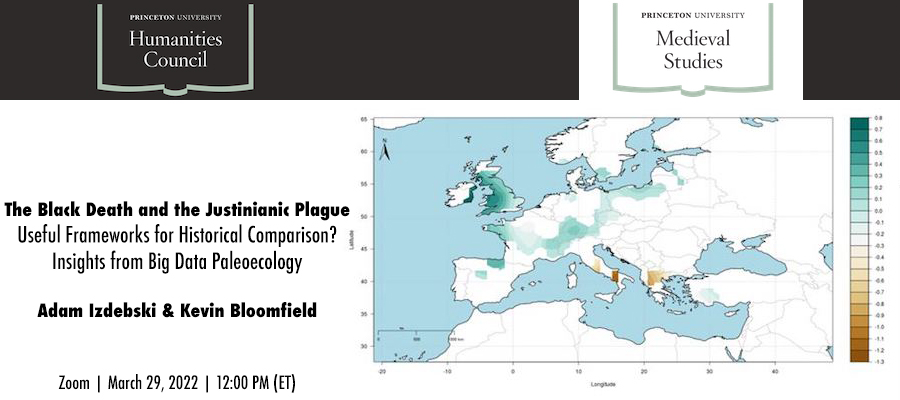
Lecture: ‘The Black Death and the Justinianic Plague – Useful Frameworks for Historical Comparison? Insights from Big Data Paleoecology’, with Dr. Adam Izdebski and Dr. Kevin Bloomfield, 29th March 2022, 12:00 EST

The Environmental History Lab of the Program in Medieval Studies at Princeton University invites you to join the seminar “The Black Death and the Justinianic Plague – Useful Frameworks for Historical Comparison? Insights from Big Data Paleoecology” with Dr. Adam Izdebski, Max Planck Institute for the Science of Human History, and Dr. Kevin Bloomfield, Cornell University.

The lecture will take place on Zoom on 29th March at 12:00 EST.

Advance registration required. 

Call for Proposals: IAS-Sponsored Sessions at CAA 2023 (Deadline 15th April 2022)

The Italian Art Society (IAS) invites proposals for one sponsored conference session (1.5 hours) at CAA, to be held in New York City 15–18 February 2023.

IAS members interested in organizing a panel on any topic of Italian art and architecture and their study should send a brief abstract (250 words max.), session title, a short list of potential or desired speakers (they need not be confirmed), the name of the chair(s) with email addresses and affiliation, and a one-page CV.

Please also include the five CAA Fields of Study that best represent your proposal, per CAA proposal instructions. The first five selected will be used by CAA to filter submissions during the review process and are later searchable in the conference schedule. See an example from CAA 2022 and a PDF list on the original post, at the link included.

We will consider both completed panels and those soliciting contributors, which will be completed during CAA’s annual “Call for Participation” in the summer.

In preparing your application, please consult IAS Submission Guidelines and CAA’s 2023 Submission Portal, to ensure you have gathered the correct materials for the panel format you are submitting for consideration by IAS at this time.

Deadline: Please submit all materials via the online submission form by 15 April 2022.

Please contact Janis Elliot, the IAS Program Committee Chair (programs@italianartsociety.org), with any questions.

Please also note the following rules for participation in the CAA conference:
If an individual’s proposal is accepted and they are not currently a member of CAA, they must join CAA within 90 days of acceptance. All session participants (chair, presenter, discussant) must be current Individual CAA members, and register for the conference.

Your session, presentation, or paper content may not have been published previously or presented at another scholarly conference.

Internship: The Medici Archive Project Summer Internships, 6th June – 15th July 2022 (Deadline 30th April 2022)

The Medici Archive Project offers internships for undergraduates and graduate students. This year they will run from the start of June to mid-July at MAP’s headquarters in Palazzo Alberti in Florence.
Interns learn the ropes of archival research by shadowing a MAP scholar and helping their mentor with active investigations. Typical responsibilities include digitizing and indexing volumes, transcribing documents, assisting with social media and organizational tasks, public relations correspondence, copy editing, and conducting secondary research online and in local libraries and archives.

How to apply
Please send the following (in PDF format):
– A CV that outlines your academic background and relevant coursework.
– A personal statement (for details, see the Application Procedure to the left).
– One recommendation letter written by someone from your academic institution who knows you well. Recommendation letters can either be sent by you with your application packet, or by the recommender directly to us, using the following email address: education@medici.org.

In their personal statements, prospective interns should:
1) outline their academic interests and motivations for undertaking the internship;
2) indicate current Fellows and Staff Members with whom they would especially hope to collaborate;
3) indicate their level of proficiency in languages other than English, especially Italian, Spanish, German, or Hebrew;
4) note any relevant previous experience (archival experience is not required).

Completed applications and recommendation letters should be submitted to education@medici.org.