Online Seminar: Psyche on a smartphone: shining new light on a Florentine Renaissance masterpiece, Dr Paola Ricciardi, ICON Conservation: Together at Home Webinar Series, 1 July 2020, 4pm

The Icon Book & Paper Group Committee are pleased to be able to bring you a series of live streamed talks while many people are required to stay at home during in these unprecedented times. We have been trying to think about what we can do to help support the community of conservators & conservation students, especially mindful of the fact that working or learning at home may mean re-imagining the ways you normally approach your role.

INSPIRE2020 (December 2019 – March 2020) was the first exhibition of work made by primary school children at The Fitzwilliam Museum in Cambridge. The exhibition resulted from a year-long project modelled on the National Gallery’s Take One Picture, which focused on the painting of Cupid and Psyche by Jacopo del Sellaio as a source of inspiration for creative cross-curricular enquiry on the part of teachers and pupils alike. Inspired by the children’s engagement with the artist’s materials and techniques, conservators and heritage scientists undertook their own technical research on the panel. Their work was integrated in the exhibition display and in a newly-developed AR app.
This talk will discuss the role played by Heritage Science in the INSPIRE project, as well as the range of opportunities that truly cross-disciplinary collaboration offers for meaningful, creative engagement of the Heritage Science community with teachers, schoolchildren and museum visitors.

Paola Ricciardi is Senior Research Scientist at the Fitzwilliam Museum in Cambridge. Her research focuses on the analysis of polychrome artworks with non-invasive methods. She is also interested in the transfer of knowledge between artists and craftsmen working in different media and the potential of object-based research for cross-disciplinary teaching of the school curriculum.

The online seminar takes place 1 July 2020 at 4pm.

You can register to join this webinar following this link. 

Seminars: The Business of Saints, talk by Dr Emma J. Wells, The Churches Conservation Trust seminar series, Thursday 2nd July at 1pm

Give me my scallop-shell of quiet, My staff of faith…My scrip of joy…And thus I’ll take my pilgrimage.

These lines used by John Bunyan in The Pilgrim’s Progress, reveal, quite clearly, the importance of pilgrimage and journeying to visit the relics of saints throughout history. Affecting all walks of life from the lowly peasant to gregarious monarch, these were not only arduous journeys but metaphors for the progress of life from birth to death and from earth to heaven. In this talk, we will discover how the saints came to be such an important aspect of the parish church—and thus how pilgrims and their peregrinations impacted the buildings’ development and evolution over time.

This talk is given by Dr Emma  J. Wells. Dr Emma is an Ecclesiastical and Architectural Historian specialising in the late medieval and reformation parish church/cathedral, the senses, pilgrimage, saints as well as built heritage more generally. She is the Programme Director of the PGDip in Parish Church Studies in partnership with the CCT at the University of York. Her book, Heaven On Earth: The Lives & Legacies of the World’s Greatest Cathedrals, is to be published by Head of Zeus in Autumn 2021.

Find out more here.

Seminar: We Have Always Been Medieval – Bruno Latour and the Premodern, UCL Institute of Advanced Studies, 30 June 2020 7-8:30pm

Miri Rubin (Queen Mary), Sarah Salih (King’s College) and Jan Miernowski, (University of Wisconsin). Chaired by Robert Mills (UCL)

Panel Discussion to Launch Romanic Review 111.1 (2020): Category Crossings: Bruno Latour and Medieval Modes of Existence. 

Guest Editors: Marilynn Desmond (Binghamton University), Noah Guynn (UC Davis)

Contributors: Anke Bernau, Emma Campbell, Marilynn Desmond, Mary Franklin-Brown, Jane Gilbert, Miranda Griffin, Noah Guynn, Catherine Keen, Luke Sunderland. Afterword by Graham Harman.

From We Have Never Been Modern to An Inquiry into Modes of Existence, Bruno Latour’s philosophical project has long been conceived as a critique of ‘Modernity’, starting with Enlightenment dualisms (nature/culture, words/things, sacred/secular) and extending to the Cyber Age’s promise of unmediated access to knowledge (what Latour calls ‘Double Click’). The contributors to this volume consider the relevance of this critique for the study of the medieval premodern and ask how Latour’s call for a renewal of metaphysics – and for a diplomatic encounter between the various modes of existence – might be used to defamiliarize ‘Modern’ intellectual habits. The essays assembled here examine a range of medieval artifacts and genres, including travelogues, historiography, diplomacy, romances, manuscripts, encyclopedias, bestiaries, theology, and theatre. 

Find out more information here and get your tickets here.

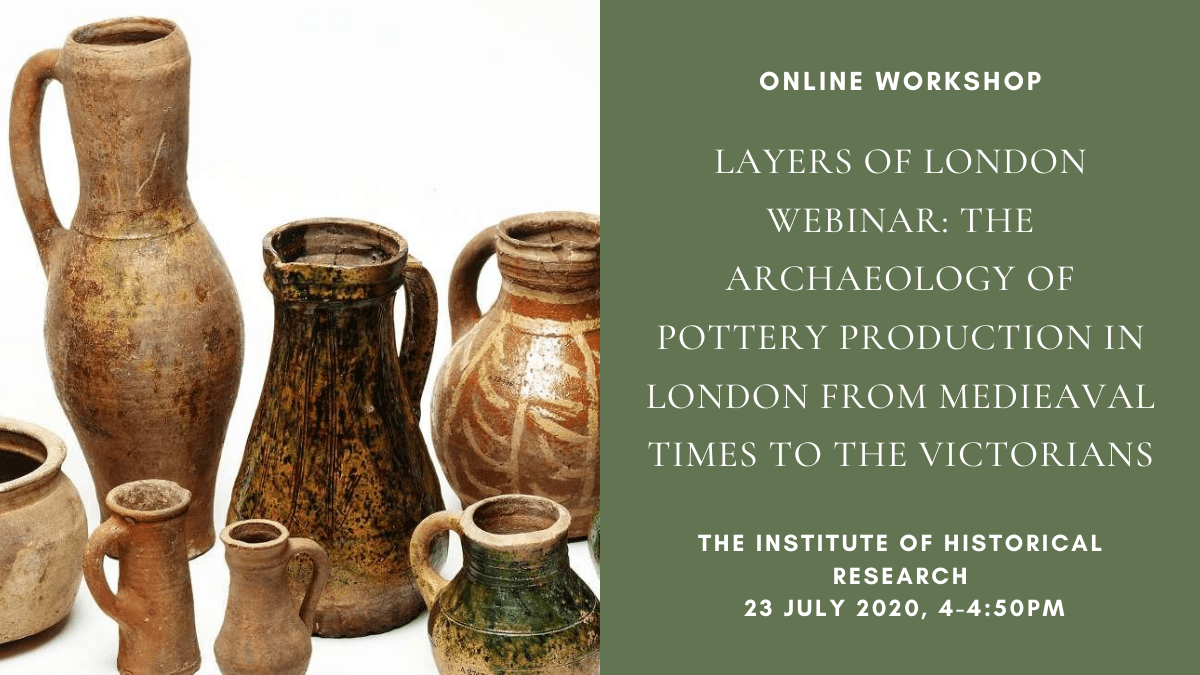
Online Workshop: Layers of London Webinar: The Archaeology of Pottery Production in London from Medieaval times to the Victorians, The Institute of Historical Research, 23 July 2020, 4-4:50pm

Jacqui Pearce, Senior Finds Specialist, MOLA

This talk looks at the rich archaeological evidence for the many different kinds of pottery that have been made in the London area from the 12th through to the 19th century, including medieval greywares, Surrey whitewares, London-made redwares, tin-glazed wares, stonewares, slipwares and porcelain and covering known centres extending from Woolwich and Deptford to Pinner, Fulham and Mortlake.    

23 July 2020, 4:00PM – 4:50PM

You will be emailed the link to join the webinar about an hour before it is due to start. 

Book your place here.

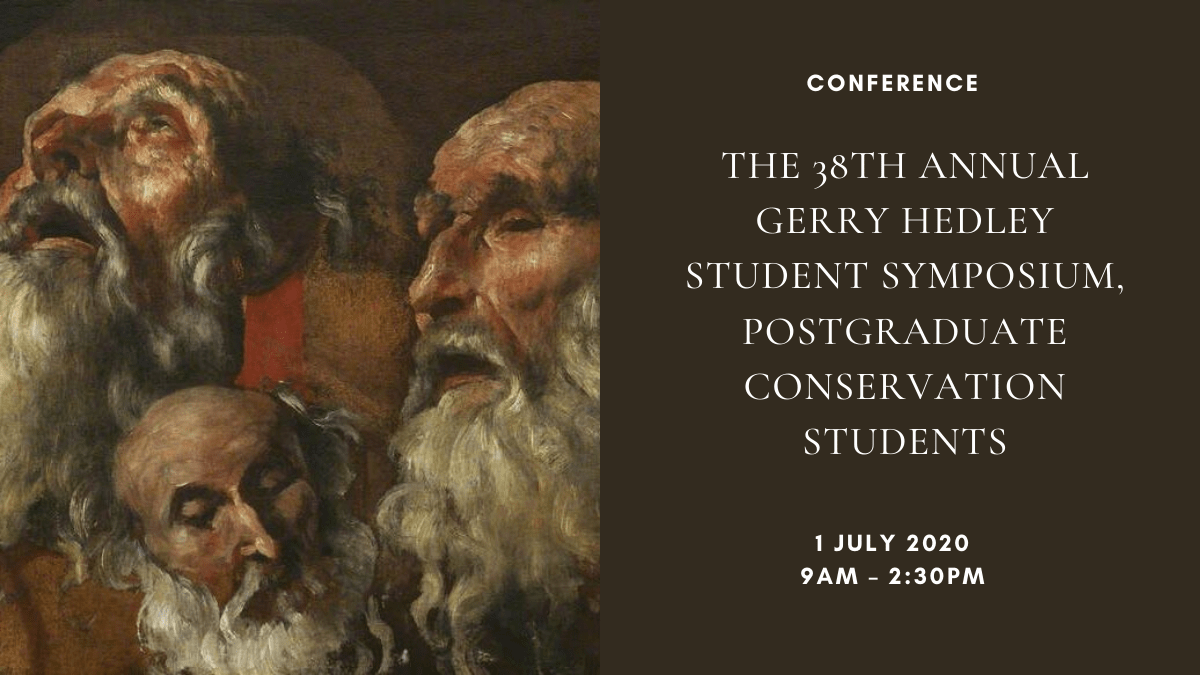
Conference: The 38th Annual Gerry Hedley Student Symposium, Postgraduate Conservation Students, Courtauld Institute of Art, 1 July 2020, 9am – 2:30pm

This is a live online event.

Book your place here / More information here.

Please register for further details. The platform and log-in details will be sent to attendees at least 48 hours prior to the event time.

The Gerry Hedley Symposium is an annual student-run conference. Post-graduate students and interns from all three of the UK’s conservation courses, The Hamilton Kerr Institute, Northumbria University and The Courtauld Institute of Art, have the opportunity to present their research ranging from conservation, technical analysis and art-historical research of paintings and artworks on paper. We are delighted this year to continue this tradition and offer students an opportunity to present their research to members of the conservation world and further afield via the new online format.

Welcome and Introduction by the organising students


Panel One

Alice Limb (Courtauld Institute of Art) Oil Sketching in Bologna, c.1600: Materiality, Technique and Conservation

Christelle Wakefield (Northumbria University) (No Title)

Luz Vanasco (Courtauld Institute of Art) (No Title)

Sophie Kean (Northumbria University) ‘Striving for Longevity’: Materials and Replica in Eighteenth-Century Britain. Focusing on a Case Study of The Fruit Girl, c.1784, attributed to James Northcote (RA)

Anna Vesaluoma (Courtauld Institute of Art) ‘Full of SOPrises’: Characterisation of synthetic organic pigments in cross sections from paintings from the first half of the 20th century


Break


Panel Two

Rachel Vella (Northumbria University) A Lost Painting: The Technical, Historical and Ethical Considerations in Uncovering a Maltese Seventeenth Century Painting

Alexandra Chipkin (Courtauld Institute of Art) A Palimpsetic Set of Panels: An investigation into the material, techniques, and historical context of the Fathers of the Church at Chastleton House

Kendall Francis (Courtauld Institute of Art) An Investigation into the materials and techniques of Willem Van de Velde the Younger (1633-1707), centring on the examination of The Royal Visit to the Fleet in the Thames Estuary 5 June 1672 at the National Maritime Museum, Greenwich


Lunch Break


Panel Three

Tara Laubach (Northumbria University) (Not Title)

Maria Carolina Peña Mariño (Hamilton Institute) Unnoticed: diverse uses of starch in paintings


Closing Remarks

New Publication: Reliquary Tabernacles in Fourteenth-Century Italy: Image, Relic and Material Culture, by Beth Williamson

Ground-breaking study of the enigmatic and unique tabernacles from fourteenth-century Italy, which for the first time combined relics and images.

Images and relics were central tools in the process of devotional practice in medieval Europe. The reliquary tabernacles that emerged in the 1340s, in the area of Central Italy surrounding the city of Siena, combined images and relics, presented visibly together, within painted and decorated wooden frames. In these tabernacles the various media and materials worked together to create a powerful and captivating ensemble, usable in several contexts, both in procession and static, as the centre of focussed, prayerful attention.


This book looks at Siena and Central Italy as environments of artistic invention, and at Sienese painters in particular as experts in experimentation whose ingenuity encouraged the development of this new form of devotional technology. It is the first full-length study to focus in depth on the materiality of these tabernacles, investigating the connotations and effects of the materials from which they were made. It examines especially the effect of bringing relics and images together, and considers how the impressions of variety and abundance created by the multiplication of materials give birth to meaning and encourage certain kinds of action or thought.

Beth Williamson is Professor of Medieval Culture at the University of Bristol.

Pre-order the book here.

Call for Papers: Privilege and Position, Sewanee Medieval Colloquium, deadline: 1 October 2020

The Forty-Sixth Annual Sewanee Medieval Colloquium, The University of the South, Sewanee, TN, April 9-10, 2021

The Sewanee Medieval Colloquium invites abstracts for papers engaging with privilege and position in global medieval cultures. Possibilities might include the histories of ecclesiastical or royal hierarchy, the production of artistic forms, analysis of international trade, the literature of class, status, or caste identity, the structures of visual or musical composition, ordering of public space, and popular medievalism, but we are open to many variations on the general theme.

We encourage papers from medievalists of any discipline and any geographic area. We accept abstracts from anyone either with a Ph.D. or in the process of gaining a doctorate.

Abstracts should be submitted through our website (http://medievalcolloquium.sewanee.edu/)  or via e-mail (medievalcolloquium@sewanee.edu) by October 1, 2020.

All papers are to be 20 minutes in length, and every panel will include feedback from a respondent. You may also apply to our seminar, featured on this page. 

For more information, contact:

Dr. Matthew W. Irvin, Director, Sewanee Medieval Colloquium
(medievalcolloquium@sewanee.edu)

Follow us on Twitter @SewaneeMedieval

More information can be found here.

Job: Lecturer in Pre-Modern Art, History of Art Department, The University of Edinburgh, deadline 23 July 2020

College of Arts, Humanities and Social Sciences

History of Art is seeking to appoint a Lecturer in pre-modern art with research and teaching expertise in art from any geographic area, c.500 CE to 1500 CE. The successful candidate will play a leading role in the delivery and development of our undergraduate and postgraduate programmes and will engage in the supervision of doctoral students. They will have an excellent research profile in the field, with the ability to produce exceptional research, further develop our collaboration with world-leading galleries and collections, and attract external funding. The appointee will also contribute to the administration of the subject area and the development of teaching and research across Edinburgh College of Art. We welcome candidates who will contribute to ECA’s strong commitment to equality, diversity, and inclusion.

History of Art at the University of Edinburgh is the second largest art history department in the UK and offers a rich curriculum spanning a diverse range of cultures including India, China, Japan, Islamic Spain, Italy, France, Germany, Ireland, the US, and the UK. The department provides teaching and research excellence that probes issues of power, gender, labour, race, class, religion, and art history’s institutional and disciplinary role in shaping the past and its responsibility to help improve the future. We especially encourage the applications of women and scholars of colour.

The University of Edinburgh is ranked in the top 20 of global institutions and located in the UNESCO capital city of Scotland, home to a vibrant arts scene rich in world-class museums, galleries, festivals, and striking architecture and surrounded by the stunning natural beauty of the Scottish landscape.

This is a full-time, open-ended post at 35 hours per week.

Closing date: 23rd July 2020 at 5pm (GMT).

For further particulars and to apply for this post please click on the ‘apply’ button below:

www.vacancies.ed.ac.uk/pls/corehrrecruit/erq_jobspec_version_4.jobspec?p_id=052438

Location: Edinburgh

Salary: £41,526 to £49,553 per annum (Grade 8)

Hours: Full Time

Contract Type: Permanent

Closes: 23rd July 2020

Job Ref: 052438

Seminar Series: Blogging Manuscripts, Oxford Medieval Studies, 6, 8, 9 July 2020

The University of Oxford Medieval Studies are hosting a fringe event on ‘Blogging with Manuscripts’ which will run on the Monday, Wednesday and Thursday of the Leeds IMC Congress (6th, 8th, 9th July 2020). Over the course of three days, you can join in with different seminars: Blogging Manuscripts with Polonsky German, Teaching the Digital Codex and Blogging Manuscripts for the General Public. Each seminar is online from 6.30-7pm.


Blogging Manuscripts with Polonsky German

Monday 6 July 2020, 6.30-7pm – Online – Registration Required

Speakers: Tuija Ainonen, Andrew Dunning, Henrike Lähnemann, Matthew Holford (Oxford) 

How can we best use the wealth of digitized medieval manuscripts to bring medieval studies to new audiences? The Bodleian Library launches the #PolonskyGerman blogging challenge with reflections on how universities and libraries can expand their public reach through teaching palaeography, the history of the book, and digital humanities. This is the first of three interactive sessions that will give participants the opportunity to collaborate on presenting everyday manuscripts to the public. 

Click here to register. If you would prefer to not use Eventbrite, please email torch@humanities.ox.ac.uk


Teaching the Digital Codex

Wednesday 8 July 2020, 6.30-7pm – Online – Registration Required

Speakers: Mary Boyle (Oxford),  Julia Walworth (University of Oxford), Leonor Zozaya-Montes (University of Las Palmas de Gran Canaria) 

How can we best use the wealth of digitized medieval manuscripts to bring medieval studies to new audiences? Since 2016, Teaching the Codex has brought together teachers to develop more engaging pedagogical approaches to palaeography and codicology, with both regular colloquia and a long-running blog. Mary Boyle shares the knowledge she gained in launching a successful manuscripts movement from scratch, with reflections from Leonor Zozaya-Montes on the process of writing for the project blog. Julia Walworth will present some of Merton’s digitised manuscripts as possible subjects for a blog post. The challenge here would be to use digitised items for a ‘teachable feature’; for examples look at previous ‘teachable features’ blogs.

Click here to register. If you would prefer to not use Eventbrite, please email torch@humanities.ox.ac.uk


Blogging Manuscripts for the General Public

Thursday 9 July 2020, 6.30-7pm – Online – Registration Required

Speakers: Alison Hudson (University of Central Florida), Alison Ray (Canterbury Cathedral Archive and Library) 

Alison Hudson and Alison Ray distil their wide-ranging expertise from the British Library’s Anglo-Saxon Kingdoms exhibition; the Medieval England and France, 700–1200 project; and and Canterbury Cathedral’s collaborative ‘Picture This’ website. Participants will challenge one another to engage audiences in 280 characters or less with selected images digitized online the British Library’s Medieval England and France, 700-1200 curated website. 

Click here to register. If you would prefer to not use Eventbrite, please email torch@humanities.ox.ac.uk

Essay Prize: Church Monuments Society Essay Prize, deadline 31 December 2020

The Council of the Church Monuments Society offers a biennial prize of £500 called the Church Monuments Essay Prize, to be awarded with a certificate for the best essay submitted in the relevant year. The aim of the competition is to stimulate people, particularly those who may be writing on church monuments for the first time, to submit material for the peer-reviewed international CMS journal Church Monuments. Therefore, the competition is open only to those who have not previously published an article in Church Monuments.

The subject of the essay must be an aspect of church monuments of any period in Britain or abroad. The length (including notes) shall not exceed 10,000 words and a maximum of 10 illustrations, preferably in colour. The prize will only be awarded if the essay is considered by the judges to be of sufficiently high standard to merit publication in Church Monuments.

The closing date for new entries is 31 December 2020.

For a copy of the rules and for the guidelines to contributors, see the link below. Do take time to look at the Society’s website https://churchmonumentssociety.org, or contact the Hon. Journal Editors for more details and/or advice on the suitability of a particular topic.

 Address for details and for submission of articles

(deadline 31 December 2020):

Jonathan Trigg

Ann Adams

Contact: https://churchmonumentssociety.org/contact-us

Find out more here.