Antiquity has long offered a repository of exemplary models to look at, stories of notable figures whose lives and deeds provided examples of good or bad moral behaviour, and therefore guidance as to what emulate or avoid. This is particularly true in the late medieval to the Renaissance and early modern period, when attention was first drawn to Famous Women – rather than to Illustrious Men alone – and a flourishing visual tradition established around them, stemming from Boccaccio’s ‘De mulieribus claris’ and Christine de Pizan’s ‘Livre de la Cité des Dames’. Figures as different as Penthesilea, Cleopatra, Lucretia, and Judith, among others, came to play particularly potent roles in European art from the mid-14th to the mid-17th century; their stories featured in a vast and varied corpus of paintings, manuscript and book illustrations, sculptures, tapestries, and a number of decorative objects in domestic interiors such as marriage chests and maiolica.
This panel seeks to explore the impact that these models from antiquity had on the developing notion of female identity between the late Middle Ages and the early modern period. It also aims to investigate more extensively the related iconographic tradition which, despite several recent scholarly publications and exhibitions, remains unevenly explored.
Proposals are invited to discuss examples of the visual reception of Famous Women in European art from c. 1350 to c. 1650, and to assess the kind of contribution these figures made to the formation of female identity in the period. While the panel focuses chiefly on figures from Greco-Roman myth and history, contributions on Famous Women from the Hebrew and Christian tradition (e.g., Biblical heroines and saints and martyrs) are also welcome. Paper topics might include but are not limited to: the visual tradition connected to collections of lives of women and educational treatises (e.g., Boccaccio, Christine de Pizan, Eustache Deschamps, Jacopo Filippo Foresti); case studies of medieval and Renaissance appropriations of Famous Women; the querelle des femmes; virtues and vices exemplified by representations of Famous Women.
Please submit proposals to Claudia Daniotti (Claudia.Daniotti@warwick.ac.uk) by 2 August 2020. They should include a paper title (max. 15 words), an abstract (max. 150 words), relevant keywords, a brief CV (max. one page, including your full name, affiliation, email address, and degree completion date, past or expected), and an indication of any audio/visual requirements you may have.
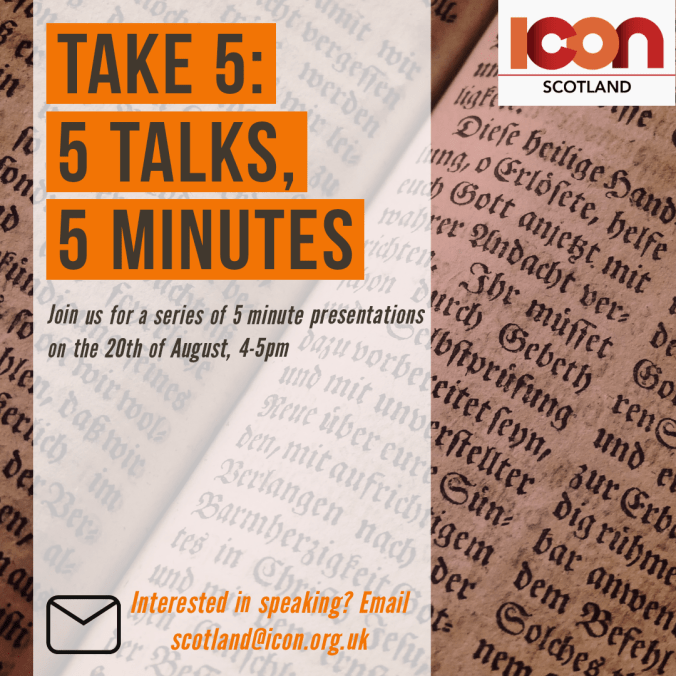
Call for Speakers: ICON Scotland Take 5: 5 speakers | 5 talks | 5 minutes (20 August 2020), deadline 31 July 2020
Following on from our successful ‘Knowledge Exchange’ webinar, Icon Scotland are pleased to invite contributions to our first ‘Take 5’ webinars. The one-hour online event will feature 5 x 5-minute presentations followed by a Q&A session.
We are inviting contributions from across the heritage conservation sector: whether it’s a case study you’d like to present, a project you are working on, or some research or training you have done during the lockdown. It’s fine to present a ‘work in progress’ and it can be a great way to get ideas and suggestions from colleagues.
We are asking for:
A 5-minute talk with an accompanying PowerPoint presentation to share visual content with the event attendees. The presentations will be conducted via Zoom and a moderator will be on hand to introduce the presentations and handle the question and answer portion of the event as an informal and friendly discussion.
If you would like to give a presentation at this event please send your name and the title of your talk to scotland@icon.org.uk by 31st of July.
The webinar is planned to take place on Thursday the 20th August via Zoom.
If you have any questions please do not hesitate to get in contact!
New Publication: Narrative Pasts: The Making of a Muslim Community in Gujarat, c. 1400-1650, by Jyoti Gulati Balachandran
Narrative Pasts retrieves the social history of a Muslim community in Gujarat, a region that has one of the earliest records of Muslim presence in the Indian subcontinent. By reconstructing the literary, social and historical world of Sufi preceptors, disciples, and descendants from the fifteenth to the seventeenth century, the book reveals the importance of learned Muslim men in imparting a distinct regional and historical identity to Gujarat. The prominence of Gujarat’s maritime location has often oriented the study of Gujarat towards the commercial world of the western Indian Ocean world. Narrative Pasts demonstrates that Gujarat was also an integral part of the historical and narrative processes that shaped medieval and early modern South Asia. Employing new and rarely used literary materials in Persian and Arabic, this book departs from the narrow state-centered visions of the Muslim past and integrates Gujarat’s sultanate and Mughal past to the larger socio-cultural histories of Islamic South Asia.
Dr. Jyoti Gulati Balachandran is Assistant Professor of History at Pennsylvania State University. A historian of medieval and early modern (c. 1200-1800) South Asia, Balachandran received her doctoral degree at the University of California, Los Angeles. She is interested in social and cultural histories of Muslim communities in Gujarat and the wider Indian Ocean world. Her research has appeared in the Indian Economic and Social History Review and she has contributed several articles to the third edition of the Encyclopaedia of Islam.
You can pre-order the book here.
New Publication: Iconophilia: Politics, Religion, Preaching, and the Use of Images in Rome, c.680 – 880, by Francesca Dell’Acqua
Between the late seventh and the mid-ninth centuries, a debate about sacred images – conventionally addressed as ‘Byzantine iconoclasm’ – engaged monks, emperors, and popes in the Mediterranean area and on the European continent. The importance of this debate cannot be overstated; it challenged the relation between image, text, and belief. A series of popes staunchly in favour of sacred images acted consistently during this period in displaying a remarkable iconophilia or ‘love for images’. Their multifaceted reaction involved not only council resolutions and diplomatic exchanges, but also public religious festivals, liturgy, preaching, and visual arts – the mass-media of the time. Embracing these tools, the popes especially promoted themes related to the Incarnation of God – which justified the production and veneration of sacred images – and extolled the role and the figure of the Virgin Mary.
Despite their profound influence over Byzantine and western cultures of later centuries, the political, theological, and artistic interactions between the East and the West during this period have not yet been investigated in studies combining textual and material evidence. By drawing evidence from texts and material culture – some of which have yet to be discussed against the background of the iconoclastic controversy – and by considering the role of oral exchange, Iconophilia assesses the impact of the debate on sacred images and of coeval theological controversies in Rome and central Italy.
By looking at intersecting textual, liturgical, and pictorial images which had at their core the Incarnate God and his human mother Mary, the book demonstrates that between c.680–880, by unremittingly maintaining the importance of the visual for nurturing beliefs and mediating personal and communal salvation, the popes ensured that the status of sacred images would remain unchallenged, at least until the Protestant Reformation in the sixteenth century.
Francesca Dell’Acqua is Associate Professor in History of Medieval Art at the Università di Salerno. She received her Ph.D. at the Scuola Normale Superiore di Pisa. She has since held research fellowships at the American Academy in Rome, the Dumbarton Oaks Center for Byzantine Studies, and the Centre for Byzantine, Ottoman and Modern Greek Studies, University of Birmingham, where she was Marie Skłodowska Curie Fellow of the European Commission.
On This Day: 800 year anniversary of the translation of the relics of Saint Thomas Becket to his new shrine in Canterbury Cathedral
Today is the feast of the Translation of St Thomas Becket, when his relics were translated to his new shrine into the Trinity Chapel at Canterbury Cathedral – on 7th July 1220. To celebrate Becket’s Translation, we’ve compiled a list of various resources, articles & events that are taking place.
Article: Modelling the Cult of Thomas Becket in Canterbury Cathedral by Dr John Jenkins
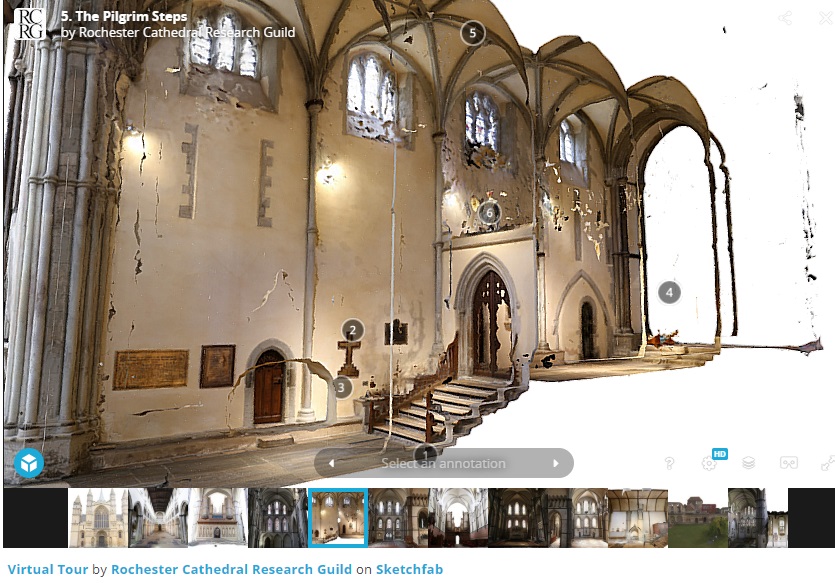
As part of an AHRC project, a team at the University of York created digital models of the major spaces of St Thomas Becket’s cult in Canterbury Cathedral in the early 15th century. Dr Jenkin’s article explains the reasoning behind the choices made in planning and constructing the models, and details much of the underpinning research. The models offer as much, if not more, an argument about the use and experience of space within the cathedral, as they do ‘accurate’ depictions of architecture and furnishings. Focusing particularly on the shrine in the Trinity Chapel, but also explicating the scenes in the Corona, Martyrdom and tomb chapels, this article explores the ways in which access and exclusion, in both physical and sensory terms, shaped the nature of the cult and pilgrimage experience in medieval Canterbury.
Published in the Journal of the British Archaeological Association, May 2020.
You can read the article here.
Blog post: The Miracles of St Thomas Becket by Professor Rachel Koopmans
In examining a piece of stained glass from the miracle windows at Canterbury Cathedral, which depicts St Thomas Becket emerging from his Shrine to heal a sick man, Professor Rachel Koopmans explains that the importance of the panel remains in ‘the power, effectiveness and energy of Becket’. Whilst this panel does not depict the shrine, the glaziers provided an image of the power of the cult of Becket for worshippers.
You can read about Becket’s shrine and the stained glass here.
Lecture: Tom Nickson, On Pilgrimage: Light and the Cult of St Thomas Becket
Listen to Dr Tom Nickson’s lecture ‘On Pilgrimage: Light and the Cult of St Thomas Becket’. Tom will be considering the role of light in Becket’s lives, miracles, and liturgy, as well as its place in his cult and its architectural setting.
This lecture forms part of Durham University’s On Pilgrimage programme
Find out more here & listen to the lecture here.
Website Resource: The Becket Story: The Life, Death and Influence of St Thomas Becket
The Becket Story is a wonderful resource that provides Recreations of medieval Canterbury and Canterbury Cathedral, Scholarship on Becket and medieval London by leading academics, a timeline of Becket’s life and death, and so much more.
This online resource has been created by the Centre for the Study of Christianity and Culture at the University of York, and generously funded by the Arts and Humanities Research Council and The Mercers Company.
Have a look at The Becket Story website here.
Blog post: Illuminated Manuscripts at the British Library
The British Library has written a blog post which provides an overview of the history of the Translation of St Thomas Becket’s relics to the new shrine in the Trinity Chapel. This post includes a look at some of the illuminated lives of St Thomas Becket, as well as English medieval calendars that include this translation date as a feast day.
To discover more about Thomas Becket, you can read the British Library’s earlier blogposts about Becket’s translation, Becket’s martyrdom and erasing references to Becket in manuscripts.
New Book Series & Call for Manuscripts: Mediterranean Studies in Late Antiquity and The Middle Ages Series, edited by Damien Kempf
This series is devoted to the study of the Mediterranean world in late antiquity and the medieval period. It welcomes original scholarly research pertaining to the fields of: history, art history, social history, cultural history, hagiography, religious studies, textual studies, archaeology, and gender studies.
We invite proposals for monographs, edited volumes, and conference proceedings. All suitable submissions will undergo a double-blind peer review process.
For more information, please contact Dr. Kempf at Damien.Kempf@liverpool.ac.uk.
Should you like to submit a book proposal, please complete the Book Proposal Form and send it by email to the series editor.
More on the series and its titles here: https://trivent-publishing.eu/38-mediterranean-studies
Books in the Series
Xavier Dectot and Anna Migdal (eds.), The Beauty of Ugliness and the Ugliness of Beauty: Materializing Monstruosity in the Middle Ages (forthcoming, 2020)
New Publication: Jewish Treasures from Oxford Libraries, Edited by Rebecca Abrams and César Merchán-Hamann
Representing four centuries of collecting and 1,000 years of Jewish history, this book brings together extraordinary Hebrew manuscripts and rare books from the Bodleian Library and Oxford colleges. Highlights of the collections include a fragment of Maimonides’ autograph draft of the Mishneh Torah; the earliest dated fragment of the Talmud, exquisitely illuminated manuscripts of the Hebrew Bible; stunning festival prayerbooks and one of the oldest surviving Jewish seals in England. Lavishly illustrated essays by experts in the field bring to life the outstanding works contained in the collections, as well as the personalities and diverse motivations of their original collectors, who include Archbishop William Laud, John Selden, Edward Pococke, Robert Huntington, Venetian Jesuit Matteo Canonici, Benjamin Kennicott and Rabbi David Oppenheim.
Saved for posterity by religious scholarship, intellectual rivalry and political ambition, these extraordinary collections also detail the consumption and circulation of knowledge across the centuries, forming a social and cultural history of objects moved across borders, from person to person. Together, they offer a fascinating journey through Jewish intellectual and social history from the tenth to the twentieth century
Rebecca Abrams is Royal Literary Fund Fellow at Brasenose College, Oxford and author of The Jewish Journey: 4000 years in 22 Objects.
César Merchán-Hamann is Hebrew and Judaica Curator in the Bodleian Library and Director of the Leopold Muller Memorial Library at the University of Oxford.
- 288 pp, 259 x 237 mm
- 136 colour illustrations
- 9781851245024 HB
- £35.00 May 2020
CFP: The Medieval Eschatology, Santiago de Compostela, deadline 1 April 2021
Santiago de Compostela, July 28-29th, 2021
Eschatology is one of the central components of medieval Christian culture. The end of the world, the Last Judgment, salvation, Messianism, the Antichrist, the Apocalypticism and millenarianism are inescapable elements in what we may generally describe as “Medieval eschatology”. In this universe, the coming of the Antichrist antedated the Last Judgment and the end of the world. This favoured the appearance of prophecies and contributed to the shaping of a present “on standby” on the basis of a future of salvation or damnation with the Last Judgment on the horizon. This medieval eschatological scenario can be found across events, authors, texts, social movements or cultural and artistic representations.
A far as events are concerned, the early medieval fears crystallized in the “fear of the year 1000”, the expectations of the end of the world during the 11th century, the “Investiture Controversy”, the catastrophes associated sometimes to the Antichrist of the last emperor, the Great Schism of 1378, not to mention many other events of different nature that we can identify in a variety of settings of the Medieval Western world and which have been interpreted in eschatological terms.
In other sense, eschatological mechanisms can also be found in medieval texts, authors and thinkers. This end-of-the-world traces can be identified in Beatus of Liébana and the Asturian Chronica Prophetica but also in De Liutprand, Raoul Glaber, Adémar de Chabannes or Helgaud. After the 12th century, the speculations on the future grew more developed. Particular mention deserve Gerhoh de Reichersberg, Hildegarda de Bingen and, most particularly, Joachim of Fiore, who in the 13th century, had a lot of influence in the Franciscan order in such authors as Pedro Olivi, Ubertino of Casale, Ramón Llull, Arnaldus de Vilanova or Jean de Roquetaillade. Later, they would be joined by such figures as Vicente Ferrer, Mamfred de Verceil or Bernardino de Siena, to cite but a few. There are even some authors and texts that include eschatological principles without this being their main purpose. Such is the case of some Chronicles, Histories, Annals and other text types (treaties, mirrors for princes, travel books, etc.).
As to social movements, from the 13th century, fundamentally, a number of heretic agitation and revolts where eschatological ideas emerge have been identified. These include, for instance, the apostolici, the Beguines and Beghards, or the Hussites, among others. Lastly, the representation of eschatological images in the Beati or in illuminated texts and the representation of the Last Judgments in architecture are just the artistic manifestation of the problem that is the subject of study of this Conference.
It is therefore the intention of the International Conference “The Medieval Eschatology” to provide a venue for reflecting on these as well as other eschatological issues that may be proposed. This can be done analytically or descriptively from both a practical and theoretical approach. Starting there, we can look at what their purpose was and at what meanings they have been given in different contexts and spaces. The Conference welcomes multidisciplinarity and encourages the participation of researchers from the fields of history, history of the art, literary studies, philosophy and political sciences. It is our aim to bring together different views in order to encourage a theoretical and practical reflection on eschatological concepts, their meaning and uses.
On the basis of the above, the following will be the main pillars on which this Conference will be built:
- The study of events (and/or their interpretations) with an eschatological component.
- Reflecting on authors who have eschatological thinking or where eschatology is present.
- Research into eschatological texts (Chronicles, Annals, apocalyptic treaties, sermons, commentaries, etc.), their dissemination and sources.
- The study of the social and mental involvement of eschatology in the medieval social movements and revolts.
- The study of medieval eschatological concepts such as time, space, salvation, fear, prophetism or Messianism, among others.
- In-depth theoretical or historiographical research into the variety of issues mentioned above.
- The interpretation of all things eschatological after the medieval times and in the near present (cinema, series, novel, comic and videogames).
- The analysis of medieval plagues and of medieval plagues and their connection to the present.
PAPERS
Proposals for papers should be sent to the Organizing Committee before 1 April 2021. Once the proposal has been received, the scientific committee will assess it and will communicate whether it has been accepted within a week. Contributors may then register and, if they so desire, book their lodging with the University Hospitality Service of the University of Santiago de Compostela.
The submission of papers will be via email to: israel.sanmartin@usc.es by attaching a document in Word format that must include:
- Title
- Author
- Abstract (no more than one sheet)
- Brief CV (no more than ten lines)
Papers may be submitted in Galician, Spanish, Catalan, Portuguese, French, English and Italian.
REGISTRATION FEES
- Speakers: €40
- Attendants (with certificate): €10
- Attendants (no certificate): free
PUBLISHING
The papers will be published in a book. All its chapters will be subjected to blind peer review.
DATES AND DEADLINES
- Deadline for submission of proposals: 1 April 2021
- Deadline for registration: 1 June 2021
- Date of the conference: 28 & 29 July 2021
VENUE
The Conference will be held at the School of Geography & History on 28th – 29th July 2021.
ACCOMMODATION
The Organising Committee has arranged with the University Hospitality Service the reservation of rooms. The price will be €33 for an individual room and €53 for a shared room. Information on how to book and pay for your room will be provided at a later date.
Deadline for submission of proposals is open to April 1, 2021. More info at: https://escatologiamedievalciem.webnode.es/call-for-papers-english/
New Publication: East Anglian Church Porches and their Medieval Context, by Helen E. Lunnon
A major interdisciplnary study of medieval church porches, bringing out their importance and significance.
The church porches of medieval England are among the most beautiful and glorious aspects of ecclesiastical architecture; but in comparison with its stained glass, for example, they have been relatively little studied. This book, the first detailed study of them for over a century, gives new insights into this often over-looked element. Focussing on the rich corpus of late-medieval East Anglian porches, it begins with two chapters placing them in a broad cultural outline and their context; it then moves on to consider their commissioning and design, their architecture and ornamentation, their use and their meaning. This book will appeal to all those interested in church fabric and function.
Dr Helen Lunnon, an Honorary Researcher in the School of Art, Media and American Studies at the University of East Anglia, is Head of Learning at Norwich Castle Museum and Art Gallery.
An e-book version of this title is available (9781787448513) to libraries through a number of trusted suppliers. See here for a full list of our partners.
Call for Papers: The Afterlife of Medieval Sculpture, 7th ARDS annual colloquium, London (2-3 December 2020), deadline 30 July 2020
Ards 7th annual colloquium on Current Research in medieval and renaissance sculpture
in collaboration with the Courtauld Institute of Art, the V&A Museum and the British Museum
The 7th ARDS annual colloquium, which celebrates new research in the field of renaissance and medieval sculpture will focus on the theme of the Afterlife of medieval sculpture. At the Ards conference in 2017 in Paris we already touched upon the theme of the Collecting of Medieval sculpture and at Ards 2018 in Utrecht, Michael Rief provided us with a very interesting keynote on the repurposing of (amongst others) some Mechelen Christ child statues. This year we want to explore the theme of the ‘nachleben’ (afterlife) of medieval sculpture in more depth. The idea of ‘nachleben’ is to be understood in a broader sense than the pure Warburgian interpretation. Not only the ‘nachleben’ of the image, but also that of the object is of interest for the study of sculpture.
How were medieval and late-gothic sculptures used, understood, copied, altered, re-used, recycled, repurposed and treated (or mistreated) in the centuries after the moment of their production? From the medieval period until the present, Gothic art has undergone shifts in taste and appreciation. Nowadays prices for medieval art are soaring at auctions but in the 17th and 18th centuries many churches and cloisters were refurbished in the style of the period and medieval art and furniture had to make room. And e.g. in the 1790’s many churches were stripped of their medieval furniture (if extant) and they were sometimes sold by the pound if not thrown away or burnt. Even in the fifteenth century, some sculptures made in the earlier Middle Ages were restored, remade, cleaned and polished, whereas others were neglected. The conference committee invites all researchers to submit papers focusing on the use, the copying, altering, faking or studying of medieval art but also in papers that talk about the material history of medieval sculpture, restoration policies in certain periods or regions, neogothic projects or even 19th and 20th century sculptors who were inspired by the medieval period.
Would you like to submit a paper for this conference? Your proposal can be:
- Of an art-historical, historical as well as a historiographical, technical or scientific in nature. Multidisciplinarity is encouraged.
- Case studies as well as papers providing a broader view and/or of a more reflective nature are welcomed.
Priority will be given to speakers presenting new research findings and contributions relevant to the specific conference theme. Submissions that are not selected for presentation in plenum, can still be taken into consideration for a (digital) poster presentation.
There are no fees, nor reimbursement of transport and/or lodging costs for the selected paper speakers. The organisation will publish acta colloquia in postprint after the conference.
*Disclaimer: Should there arise problems or new restrictions regarding travel to London due to a possible new wave of COVID-19, the conference will be held online via webinar presentations (and if so unfortunately without the in situ visits). Therefore the final program will only be compiled and communicated in the autumn of 2020.
How to submit your proposal:
- Write in English. Presentations must be given in English (with a ppt presentation) • Include a short CV.
- Max. 500 words for abstracts (excl. authors name(s) and contact details).
E-mail to Marjan Debaene via info(a)ards.be
Call for papers Deadline: 30.07.20
Successful applicants will receive a notification by 31.08.20
Questions or more information? Please contact Marjan Debaene via info@ards.be
The conference committee consists of:
- Jessica Barker (The Courtauld Institute of Art)
- Peter Carpreau (M Leuven/Ards)
- Marjan Debaene (M Leuven/Ards)
- Lloyd De Beer (The British Museum)
- Michaela Zöschg (Victoria and Albert Museum)