Conference recording: Secret Spaces: Medieval Sacristies, Vestries, Treasure Rooms and their Contents, Society of Antiquaries of London, 25 February 2019

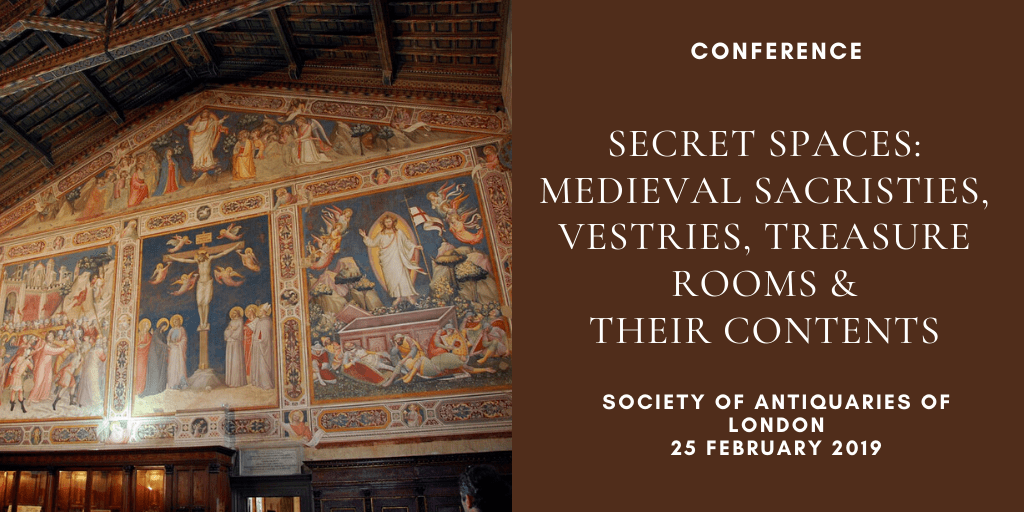
On the 25th February 2019, the Society of Antiquaries of London hosted a one-day conference on Secret Spaces: Medieval Sacristies, Vestries, Treasure Rooms and their Contents. The aim of this conference is to introduce the subject of ecclesiastical treasure houses to both the academic world and the wider public. You can now watch the entire conference from your very own sofa – scroll down for all the recordings.

Treasure houses take the form of small buildings attached as annexes to the cathedrals and churches which they served. Their function as store houses of the priceless ecclesiastical treasure belonging to the church meant that they were accessible to only a few privileged individuals but many are resplendent pieces of architecture in their own right. Recently Yves Gallet, in discussing an ambitious vault within the thirteenth-century treasure house of Saint-Urbain, Troyes, noted that ‘it is curious that they should have placed such a spectacular and up-to-date ornament in a place where it was never going to be seen’. Notable treasure houses in Britain are attached to the cathedrals of Canterbury, Lincoln, Wells, and Bristol, to name but a few. However, medieval ecclesiastical treasure houses existed everywhere in the medieval West and this will be reflected in the conference, which will bring together scholars from different countries. Ecclesiastical treasure houses also stored money, the presence of which necessitated the activities of depositing, guarding and counting. The ecclesiastical treasure house thus occupied a fault line between two opposing ideologies in medieval Christian thinking, the first condemning the accumulation of worldly treasure and the second promoting its use for God’s service.

Medieval treasure houses conserved, displayed and inventorised precious objects in a way that resembles these processes in our museums today. During the last twenty years academic interest in medieval ecclesiastical treasure has grown and has changed direction. Interest in the objects, which previously focussed on style and craftsmanship, has developed, encompassing the issues of how they were used and what they meant to medieval Christians.

A conference devoted to the medieval museums that housed these precious materials is long over-due and is particularly urgent at the moment. Ironically, the interest in the objects that they conserved has resulted recently in such treasures being removed to new museums, leaving their former places of protection in need of protection themselves. This conference brought these buildings to light but will also be concerned with the sumptuous arts in relation to medieval practices of collection, conservation and display.

Welcome by Prof. Eric Fernie CBE HON VPSA former President of the Society of Antiquaries of London

Dr Lesley Milner, Medieval treasure houses: an overview

Professor Eduardo Carrero Santamaria, From the Holy Chamber of Oviedo to the Gothic Cathedral Treasure House. An Iberian Survey

Dr Jeremy Ashbee, Buildings of the English royal treasury in the 13th and 14th centuries

Dr Zoe Opacic, Places of Greater Safety: Imperial treasuries of the Holy Roman Empire

Dr Alexandra Gajewski, Behind Locked Doors: the ecclesiastical treasures in the Papal Palace in Avignon

Dr John Renner, A treasure-chest for paupers: the sacristy of the Franciscan church of Santa Croce, Florence, and its fourteenth-century decoration

Dr Michael Carter, Monastic Treasures at the Suppression: Destruction, Dispersal and the Circumstances of Survival


Resource: Writing about Art with Art Critic Tabish Khan, Association for Art History

How do you write about art? On Wednesday 24 June we launched a new series of short online talks about writing about art. We started the series finding out how to write about art and exhibitions with art critic, Tabish Khan. Tabish has been visual arts editor at Londonist since 2013 and writes extensively about contemporary and historic art exhibitions for a variety of online publications. Join us for a short, informal conversation with Tabish about his work, his approach, and advice and tips for writing about art. This was a live event that was recorded.

Our ‘Writing About Art’ online events are free and open to all. They are useful for anyone interested in doing more writing about art, and looking to make art accessible through writing. They may be of particular interest to students and professionals engaged in writing about art, art history or visual culture who want to get an insider perspective and some top tips. E-tickets are available via eventbrite. The talks last approx 20 mins with time for questions at the end.

Online Seminar: Medieval French Online Seminar, 22 July 2020 at 5pm BST

We hope you can join us for the next meeting on 22 July 2020 at 5pm BST. We will have two papers: 

  • Bex Courtier (Cambridge): “Towards a Migrant Consciousness: Reading Saladin and Chamoiseau’s Frères migrants
  • Charlotte Spencer (Durham): “The Face in the Fountain: Reading, Reflection, and Representation on French Fourteenth-century Ivory Mirror Cases”

To request a Zoom link, contact luke.sunderland@durham.ac.uk

The following meeting, on 5 August, will feature Jonny Morton (Tulane) on “Love and Understanding in the Bestiaire d’Amour“. 

Luke Sunderland and Miranda Griffin (organizers) 

New Publication: Venetian and Ottoman Heritage in the Aegean: The Bailo House in Chalcis, Greece, edited by Nikos Kontogiannis & Stefania Skartsis

Witness the remarkable history of the East Mediterranean through the evidence of a still standing Venetian palace, built in a Byzantine city, transformed into an Ottoman mansion and a neoclassical house.

This book tells the astonishing story of a secular building and its inhabitants over six centuries and four successive civilizations. The Bailo House was constructed as a public loggia in the 14th century by Venetian officials in their Aegean colony of Negroponte on the Byzantine island of Euripos. Italian designs were followed and copied in the style of the lagoon’s palaces, digging the foundations through the earlier Byzantine layers. It later housed an Ottoman official, along perhaps with his apothecary. Thereafter, it was severely damaged before passing into the hands of a local Ottoman dignitary, who completely transformed it into a typical Middle Eastern mansion. In the late 19th century it was reshaped once more with a neoclassical façade to conform to the European models promoted by the Modern Greek state.

Extensive study, excavations and restorations over a ten-year period revealed remarkable evidence for one of the few remaining examples of secular architecture in the Eastern Mediterranean, as well as abundant and rare information about urban planning, material culture, economic and cultural exchanges, art and aesthetics, etc. It is the tale of a harbor town that was always cosmopolitan, a port of call along the Silk Road, the winter base of the Ottoman fleet, a European enclave in the East.

Nikos Kontogiannis and Stefania Skartsis studied Archaeology at the University of Athens, before pursuing graduate studies at the University of Birmingham. Having worked in various areas of Greece, they fruitfully collaborated in the Ephorate of Byzantine Antiquities for Euboea and Boeotia. Stefania is currently Head of Department at the Hellenic Ministry of Culture; Nikos is Assistant Professor of Byzantine Studies, at Koc University, Istanbul.

Table of Contents

Preface

Part 1. Introduction

A. The Restoration Chronicle — Eugenia Gerousi-Bendermacher

B. Chalcis: A Historical Overview — Nikos D. Kontogiannis

Part 2. Archaeological Investigation and Finds

A. Excavation Report: Architectural Data and Use of the Spaces — Stefania S. Skartsis and Panagiota Taxiarchi

B. Catalogue of Finds — Stefania S. Skartsis and Panagiota Taxiarchi

C. Venetian Mortars and Ottoman Drinking Jugs: Pharmacy and Sociability in the Bailo House — Valentina Pugliano, with Catalogue by Stefania S. Skartsis

Part 3. Architectural Study

Plans A1 – D3 

A. Architectural History of the Bailo House —  Nikos D. Kontogiannis, Yorgos Kourmadas, and Panagiota Taxiarchi

B. Architectural Sculpture and Spolia —  Stefania S. Skartsis

C. The Use of Timber in the Construction of the Bailo House —  Yorgos Kourmadas and Eleftheria Tsakanika

D. Dendrochronological Dating of the Bailo House with a Supplementary Comment on the Church of Ayia Paraskevi — Tomasz Wazny, Peter Kuniholm, and Charlotte Pearson

Part 4. The Relation of the Bailo House to the City and the World

A. The Bailo House as Part of the Urban Fabric of Chalcis —  Nikos D. Kontogiannis and Evrydiki Katsali

B. The Place of the Bailo House in the History of Architecture — Nikos D. Kontogiannis

Part 5. The Restoration Project and the Impact on the Modern City

A. Restoration of the Bailo House: An Overview — Yorgos Kourmadas

B. Reintegrating the Monument in the Modern City — Pari Kalamara

Concluding Remarks — Nikos D. Kontogiannis and Stefania S. Skartsis

Bibliography

Index

Order the book here.

CFP: Modernity and Lateness in Medieval Architecture, International Congress on Medieval Studies (13-15 May 2021), deadline 15 September 2020

Session organized by Alice I. Sullivan (University of Michigan) and Kyle G. Sweeney (Winthrop University)

This panel challenges Eurocentric progress models of stylistic change that presuppose a nascent, fully- realized, and late style in architecture. The panel aims to (re)situate the eclectic visual vocabularies of secular and religious buildings from the thirteenth to the seventeenth centuries that are indebted to medieval building practices and designs within the larger and more established narratives of art and architectural history. Individual papers might address historiographic, methodological, or theoretical concerns related to the study of medieval architecture and its forms, focusing on the legibility and currency of medieval stylistic conventions across cultures over time; the relationships between monumental architecture and other forms of artistic expression; the role of ornament as bearer of cultural meaning and identity; the coexistence of Gothic and antique features; and issues of hybridity and eclecticism in architecture.

Please submit all proposals through the ICMS portal (wmich.edu/medievalcongress/submissions / https://wmich.edu/medievalcongress/call) by September 15, 2020. Session ID = 1232

Fellowship: I Tatti/DHI Rom Joint Fellowship for African Studies (2021-2022), deadline 16 November 2020

I Tatti – The Harvard University Center for Italian Renaissance Studies and the German Historical Institute in Rome (Deutsches Historisches Institut in Rom) offer a joint residential fellowship for the 2021-2022 academic year. The fellowship offers post-doctoral scholars working on African studies (or topics that closely consider Africa) a ten-month position to conduct historical research in Italy supported by two institutes with dynamic academic communities. Fellows will spend five months (September 1, 2021 – January 30, 2022) in Rome at the DHI and five months (February 1 – June 30, 2022) in Florence at I Tatti.

The fellowship is designed for scholars in fields related to the study of African history c. 1250-1750, including art history, the history of expressive cultures, musicology, economic history, intellectual, political, and religious history, as well as literature and languages. Preference will be given to advanced research projects that address the relationship between the African continent and the Mediterranean world during the early modern period, broadly understood historically to include the period from the 14th through the 17th centuries.

We welcome applications from scholars of all nationalities. Special consideration will be given to scholars from the African continent.

Applications must be written in English and must be submitted electronically by midnight (Cambridge, MA time) on November 16, 2020.

For more information on this fellowship, please visit: http://itatti.harvard.edu/i-tatti-dhi-rom-joint-fellowship-african-studies

To apply, click here.

CFP: Weather Saints (International Medieval Congress 2021), deadline 10 September 2020

Call for Papers for Session Proposal at the International Medieval Congress (IMC 2021), July 5 – 8, 2021, University of Leeds. Thematic focus: Climates

This session seeks to explore the interaction between human beings and the meteorological manifestations of the weather. It focuses on the intervention of saints who either function as divine intercessors or whose meteorological powers control and influence the weather in order to reassure and reestablish the prosperity/security/protection of a given community.

Suggested topics, on any geographic area, may include, but are not limited to:

  • use and reuse of Biblical patterns in the constructions of saintly lives: miracles, control, and influence over the weather;
  • miraculous interventions of saints: growths of crops, fruits, and vegetation; engaging with the weather; miraculous protection;
  • invocations (of a given saint) against/for: bad weather, cold weather, harvests, crops, disasters, drought, fire, floods, freezing, good weather, hail, rain, storms, tempests, water;
  • feasts/celebrations/relics/shrines/cures of weather saints;
  • intercession(s) and divine control over the weather by sending: rain, snow, hail, frost, wind, sunshine;
  • manifestations of meteorological powers: calming the sea, calming the wind;
  • disasters: crop disruption, periods of drought, floods;
  • punishment for transgressions: storms, floods, thunder, and fire;
  • intersection of weather and geography or agriculture and the protection of saints;

Submissions from a variety of disciplines are accepted including but not limited to: history, art history, visual culture, social history, cultural history, hagiography, religious studies, textual studies in a transdisciplinary perspective.

Please submit a 250-word proposal for a 15-20 minute paper. Proposals should have an abstract format and be accompanied by a short CV, of no more than 800 words, including e-mail, current affiliation, and position.  Please submit all relevant documents, as PDF or Word.doc, by 10 September, 2020, to the e-mail address: andrea.znorovszky@unive.it

Contact information:

Andrea-Bianka Znorovszky, Ca’ Foscari University, Venice, Italy (andrea.znorovszky@unive.it)

New Resource: Census of Italian Renaissance Woodcuts

Please note the existence of a new resource, which has just gone live: The online Census of Italian Renaissance Woodcuts. The Census team have traced, studied and catalogued all single-leaf woodcuts and woodblocks made in Italy from the earliest known use of this medium to about 1550.

The project is part of the research activities of the Institute of Art History of the Fondazione Giorgio Cini. It can be consulted from the Fondazione’s website or http://italianrenaissancewoodcuts.com/.

The works belong to museums and public collections, libraries, archives, art dealers and private collectors, in Italy and worldwide. The Census will continue to be enriched with new information.

Essay Prize: XXI Medievalism Prize, Sociedad Española Estudios Medievales, deadline 31 December 2020

The XXI Medievalism Prize welcomes applications according to the following bases:

  1. Participants may not be older than 30 years and must be members of the Spanish Society for Medieval Studies in active service, that is, up to date with their annual quota.
  2. The work presented will deal with topics related to any manifestation of the Middle Ages, with special value being given to those contributions that are more interpretive than monographic research.
  3. The length of the presented work will not be, in any case, superior to the 25 folios (DIN A-4) to double space in Times 12 font size or similar for each one of them (the footnotes may go to single space and in size 10 of the aforementioned typography), and four copies must be presented, presented as follows: in the originals, no identifying element of the author should appear, enclosing the name and surname, complete postal address, telephone number in a sealed envelope and email address. The submission of the work will be through an email to info@medievalistas.es, in PDF format or files compatible with M-WORD, without identification of authorship.
  4. The prize will consist of 600 euros (300 in case the jury deems it to be shared).
  5. The prize may be declared void in the event that none of the originals presented reach a minimum quality requirement. The jury’s decision will be final.
  6. The jury will be made up of the vice-presidents, the secretary and two members of the board of directors elected for that purpose by it. The commission will be obliged to safeguard the anonymity of the originals submitted to the award, and the selection task will be carried out with the highest scientific quality rigor.
  7. The works must be sent, before  December 31, 2020 , to the secretary of the Society:

Prof. Germán Navarro Espinach

More information: info@medievalistas.es

More information here.

Original Spanish Version

Queda convocado el XXI premio Medievalismo con arreglo a las siguientes bases:

  1. Los participantes no podrán tener edad superior a 30 años y deberán ser socios de la Sociedad Española de Estudios Medievales en activo, es decir, al corriente de su cuota anual.
  2. El trabajo presentado versará sobre temática relativa a cualquier manifestación del Medievo, valorándose de manera especial aquellas aportaciones que tengan más carácter de ensayo interpretativo que de investigación monográfica.
  3. La extensión del trabajo presentado no será, en ningún caso, superior a los 25 folios (DIN A-4) a doble espacio en tamaño de letra Times 12 o similar por cada una de ellas (las notas al pie podrán ir a espacio sencillo y en tamaño 10 de la citada tipografía), y habrán de presentarse cuatro ejemplares presentados de la siguiente forma: en los originales no deberá aparecer ningún elemento identificativo del autor, adjuntando éste en sobre cerrado su nombre y apellidos, dirección postal completa, número de teléfono y dirección electrónica. El envío del trabajo será a través de un correo electrónico a info@medievalistas.es, en formato PDF o ficheros compatibles con M-WORD, sin identificación de autoría.
  4. El premio consistirá en 600 euros (300 en caso de que el jurado estime otorgarlo de modo compartido).
  5. Podrá declararse el premio desierto en el caso de que ninguno de los originales presentados alcance un mínimo de calidad exigible. El fallo del jurado será inapelable.
  6. El jurado estará compuesto por los vicepresidentes, el secretario y dos vocales de la junta directiva elegidos a tal efecto por la misma. Será obligación de la comisión la salvaguarda del anonimato de los originales presentados al premio, realizándose la tarea de selección con el mayor rigor de calidad científica.
  7. Los trabajos deberán ser remitidos, antes del próximo 31 de diciembre de 2020, al secretario de la Sociedad:

Prof. Germán Navarro Espinach

Más información:
info@medievalistas.es

New Journal Issue: Speculum: A Journal of Medieval Studies, July 2020

Speculum: A Journal of Medieval Studies, Volume 95, Number 3 | July 2020

The latest issue of Speculum is now available on the University of Chicago Press Journals website

Articles:

Bishop Guðmundr’s Roman Redemption: Imagining and Suspending Papal Government in Medieval Iceland, Joel Anderson

The Social Constituency of the Jacquerie Revolt of 1358
, Justine Firnhaber-Baker

Petrarch’s Queer History
, Anna Wilson

Copying and Reading The Prick of Conscience in Late Medieval England
, Michael Johnston

Book Reviews:

This issue of Speculum features more than 80 book reviews, including:

Kay Davenport, The Bar Books: Manuscripts Illuminated for Renaud de Bar, Bishop of Metz (1303–1316) Reviewed by Anna Russakof

William J. Courtenay, Rituals for the Dead: Religion and Community in the Medieval University of Paris. Reviewed by Sean L. Field

Elisa A. Foster, Julia Perratore, and Steven Rozenski, eds., Devotional Interaction in Medieval England and Its Afterlives. Reviewed by Beth Williamson

Laura Slater, Art and Political Thought in Medieval England, c. 1150–1350. Reviewed by Sonja Drimmer

Miriamne Ara Krummel and Tison Pugh, eds., Jews in Medieval England: Teaching Representations of the Other. Reviewed by Samantha Katz Seal

View the new journal edition here.